
Generative AI influencers, consumer trust, and purchasing intent
Introduction to the Algorithmic Endorser
The global marketing ecosystem is undergoing a profound structural and psychological transformation, transitioning from human-centric promotional paradigms to algorithm-driven influence. The proliferation of generative artificial intelligence (AI) has catalyzed the meteoric rise of virtual influencers (VIs) - computer-generated, AI-powered personas explicitly designed to simulate human physical aesthetics, cognitive behaviors, and social interaction within digital spaces 123. The broader global influencer marketing sector, valued at over $15 billion in 2023, escalated to $24 billion by 2024, and is currently projected to reach an unprecedented $37.8 billion by the year 2030 45. Within this rapidly expanding economy, the virtual influencer sub-sector alone was valued at $6.06 billion in 2024 and is forecast to achieve a staggering $261.28 billion by 2035, driven by a compound annual growth rate (CAGR) of 40.8% 6.
This paradigm shift is fundamentally driven by what industry analysts term the "Content Crisis" - a growing divergence between the insatiable audience demand for hyper-personalized, omnipresent digital content and the logistical, financial, and physiological limitations of human-only workflows 7. Generative AI influencers resolve this bottleneck by offering unparalleled operational advantages to brands and marketing agencies. These synthetic entities provide absolute narrative control, immunity to personal scandals, infinite scalability, and the total elimination of geographical, temporal, and physical constraints 4510. Furthermore, they operate continuously across omnichannel environments, driving a 30% to 50% reduction in campaign management costs by neutralizing the expenses traditionally associated with human talent, such as travel, physical production, and contractual renegotiations 25.
However, the substitution of human authenticity with algorithmic perfection introduces highly complex psychological tensions that disrupt traditional consumer behavior models. Consumer trust - historically anchored in lived human experience, relatable physiological flaws, and genuine emotional resonance - must now be negotiated with non-human, synthetic agents 26. This report provides an exhaustive, multidisciplinary analysis of the contemporary literature spanning marketing, media psychology, and human-computer interaction (HCI) from 2023 onward. It dissects the psychological mechanisms governing consumer engagement with generative AI influencers, interrogates the cognitive dissonance produced by the uncanny valley, evaluates the polarizing effects of AI transparency and disclosure, and conducts a granular cross-cultural comparison between Western consumer responses and those in dominant Asian markets. Finally, it provides a rigorous empirical comparison distinguishing the efficacy of hyper-realistic avatars, stylized digital personas, and traditional human influencers.
The Psychological Mechanics of Synthetic Influence
To comprehend how virtual influencers alter purchasing intent, brand perception, and consumer loyalty, it is necessary to examine the foundational psychological frameworks that govern human-machine interaction. Contemporary literature relies heavily on Mind Perception Theory, Parasocial Interaction (PSI) Theory, Upward Social Comparison Theory, and the emerging Virtual Influencer Trust and Engagement Model (VITEM) to decode these complex cognitive dynamics.
Mind Perception Theory and the Match-Up Hypothesis
Mind Perception Theory posits that individuals attribute mental capacities to entities based on two distinct, orthogonal dimensions: agency and experience 78. Agency refers to the perceived capacity for intentional action, logic, planning, and rational thought. Experience refers to the perceived capacity to feel physiological and emotional sensations, such as pain, pleasure, fear, and joy 79. The literature reveals a consistent asymmetry in how consumers process the "minds" of AI influencers. Because these entities are driven by advanced computing, consumers readily grant them high levels of cognitive agency; however, because they lack biological bodies, consumers perceive them as suffering from a pronounced deficit in authentic experience 710.
This cognitive bifurcation directly impacts the "Match-Up Hypothesis," a cornerstone of marketing psychology which dictates that advertising effectiveness hinges on the perceptual congruence between the endorser's identity and the core attributes of the product 811. Data indicates that this match-up dynamic operates as a strict crossover interaction when comparing human and AI influencers.
| Influencer Type | Dominant Mind Perception | Optimal Product Category | Psychological Driver of Fit | Consequence of Mismatch |
|---|---|---|---|---|
| Generative AI Influencer | High Agency / Low Experience | Utilitarian (e.g., tech hardware, software, household appliances, financial tools) | Consumers trust algorithms for logic, precision, functional reliability, and objective data processing. | Cognitive dissonance; perception of the AI as manipulative or "faking" human sensory appreciation. |
| Human Influencer | High Experience / High Agency | Hedonic (e.g., luxury fashion, gourmet food, perfume, experiential travel) | Consumers require validation of sensory pleasure, aesthetic joy, and lived physical sensation to establish trust. | Suboptimal use of the human's emotional capacity; potential perception of the human as a mere corporate mouthpiece. |
Table 1: The application of Mind Perception Theory to the Match-Up Hypothesis in influencer marketing.
As outlined in the comparative analysis, AI influencers exhibit a vastly superior fit for utilitarian products 5811. In contexts requiring functional evaluation, the AI's lack of emotion is entirely irrelevant, and its algorithmic precision enhances source credibility. Conversely, human influencers retain a decisive, near-insurmountable advantage in endorsing hedonic products. Hedonic consumption relies intrinsically on emotional resonance, sensory gratification, and aesthetic pleasure 811. Because virtual influencers lack lived physical experiences, their endorsements of hedonic goods - such as claiming a perfume smells beautiful or a vacation feels relaxing - trigger immediate consumer skepticism and cognitive dissonance, significantly diminishing purchase intent and heightening reputational risks for the brand 21012.
The Evolution of Parasocial Relationships (PSRs)
Parasocial Interaction Theory, originally developed in the mid-20th century to explain the one-sided, emotionally intimate bonds audiences form with television personalities, has been radically adapted to the HCI and generative AI era 21314. Modern psychological research demonstrates that consumers are highly capable of forming deep, friendship-like bonds with entirely synthetic entities, provided specific interaction criteria are met 715.
However, the architecture of a parasocial relationship with a virtual influencer differs structurally from human-to-human parasocial bonds. The development of a PSR with a generative AI relies far more heavily on mental humanlikeness than on mere physical resemblance 915. Mental humanlikeness is achieved through algorithmic self-disclosure. Drawing upon Social Penetration Theory, researchers have found that when an AI influencer shares simulated vulnerabilities, internal thoughts, opinions, and "behind-the-scenes" narratives, it simulates the layers of human intimacy 915. Even when audiences are fully aware the entity is artificial, this reciprocal sharing of "inner life" triggers the human brain's deeply ingrained interpersonal rules, fostering a sense of closeness that mirrors biological friendship 1521.
Furthermore, interactions with virtual influencers are heavily governed by the Uses and Gratifications (U&G) framework 1617. Consumers do not follow AI personas under the illusion that they are human; rather, they engage to satisfy specific cognitive and affective needs, primarily novelty, entertainment, aesthetic appreciation, and intellectual curiosity regarding the technology itself 161718. When these specific needs are gratified, it triggers a psychological process known as "self-expansion," wherein the consumer integrates the digital identity and narrative associated with the virtual influencer into their own self-concept. This self-expansion serves as the primary psychological bridge, elevating brand identification and directly stimulating purchase intention 1617.
Upward Social Comparison and Consumer Well-Being
While parasocial bonds can drive engagement, interacting with algorithmically perfected entities also introduces severe psychological hazards. Drawing upon Upward Social Comparison Theory, recent literature highlights the dual-edged nature of synthetic anthropomorphism 19. As generative AI influencers become more sophisticated, they continually project algorithmic perfection: flawless skin, physically impossible bodily proportions, infinite wealth, and curated digital lifestyles devoid of genuine human struggle 3.
This perfection frequently induces competence frustration, negative body image, and intense envy, particularly among younger female demographics 31219. When an AI influencer attempts to simulate human vulnerability - for example, by posting about "mental health struggles" or "bad hair days" - the discourse is overwhelmingly rejected by consumers as manipulative, corporate gaslighting 320. Textual analysis of user comments reveals that while human influencers can build trust through genuine imperfection, attempts by flawless synthetic models to mimic human struggle actively reduce consumer well-being and completely shatter the illusion of authenticity 32021.
The VITEM Framework
To synthesize these complex, often contradictory mechanisms, researchers have recently proposed the Virtual Influencer Trust and Engagement Model (VITEM) 14. VITEM posits that consumer trust acts as the central, indispensable mediating variable that links the technical characteristics of a virtual influencer (its visual realism, interactivity, and perceived authenticity) with definitive marketing outcomes (engagement rates, purchase intention, and long-term brand loyalty) 14. The model suggests that without the establishment of cognitive and affective trust, the technological novelty of the AI influencer generates only superficial attention, failing to progress the consumer down the commercial conversion funnel.
Morphological Design: Hyper-Realistic vs. Stylized Avatars
The foundational structural design of a virtual influencer dictates its psychological impact on the consumer, its susceptibility to the uncanny valley, and its ultimate commercial utility. The HCI and marketing literature categorizes these digital entities along a reality-virtuality continuum. Mouritzen et al. (2024) propose a rigorous 2x2 taxonomy that classifies virtual influencers based on the intersection of two specific variables: Form Realism (the degree of physical, visual resemblance to human biology) and Behavioral Realism (the complexity, naturalness, and interactivity of their social behaviors) 2223.
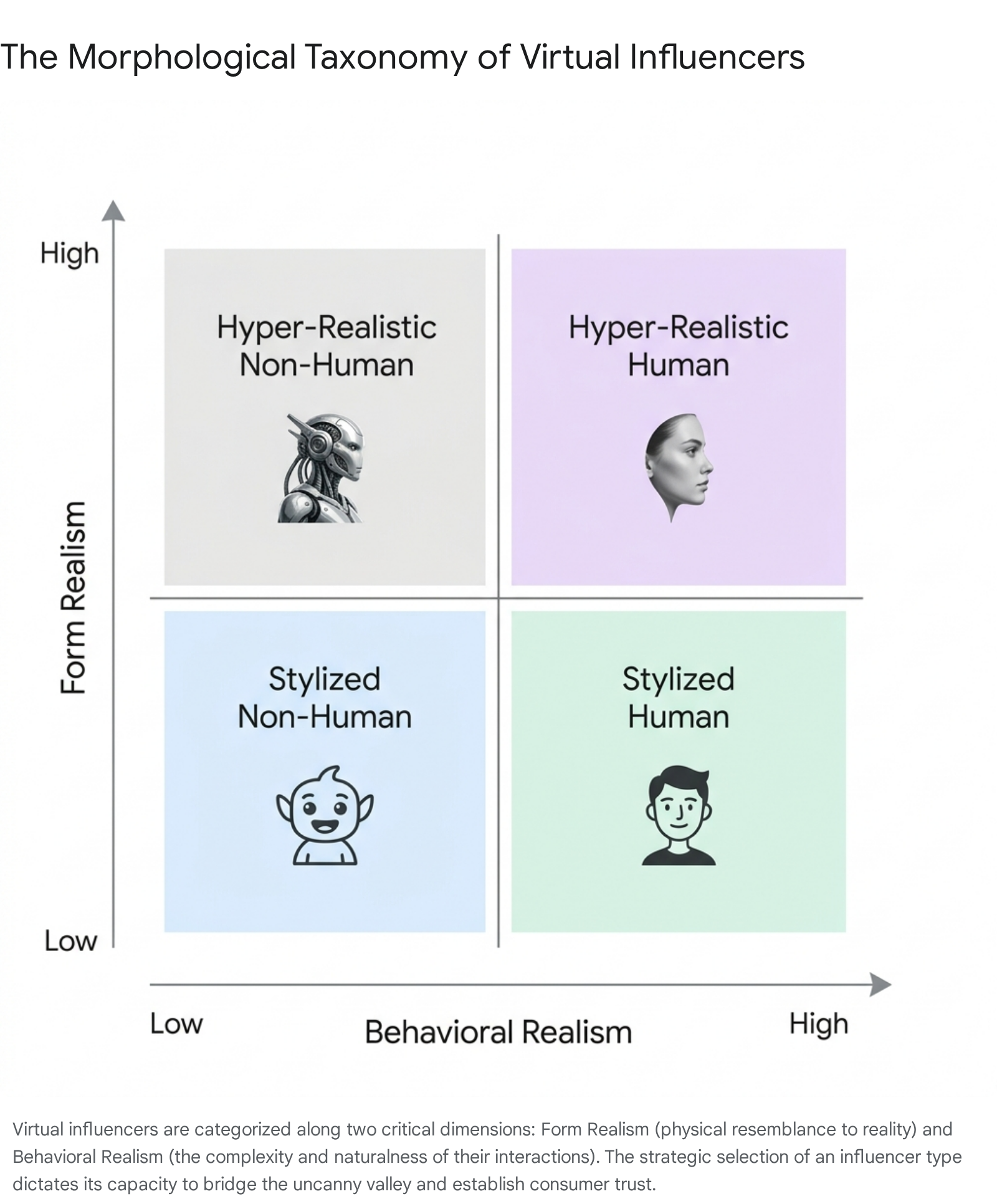
This taxonomy yields two dominant morphologies that dictate current industry applications: hyper-realistic humanized avatars and stylized (or anime-like) avatars.
Hyper-Realistic AI Influencers
Hyper-realistic influencers (e.g., Lil Miquela, Rozy, Imma) are constructed using advanced generative adversarial networks (GANs), deep learning models, and meticulous 3D rendering to be visually indistinguishable from living human beings 1524.
Strengths and Commercial Applications: Hyper-realism is highly effective in contexts requiring aspirational aesthetics, deep lifestyle integration, and visual product validation, such as high-fashion and luxury marketing 525. Because they mirror the human form perfectly, they attract massive initial followings driven by technological curiosity and boundary-pushing artistry 415. Commercially, they have proven immensely lucrative when deployed correctly; for example, a 2024 campaign by Calvin Klein featuring hyper-realistic AI avatars produced a 22% higher engagement rate than their human-only influencer content, while Gucci reported e-commerce conversion lifts of up to 20% by using avatars to improve "decision confidence" in virtual try-ons 32.
Vulnerabilities and The Uncanny Valley: Despite these commercial triumphs, the proximity to human reality makes hyper-realistic entities highly susceptible to the uncanny valley. This phenomenon occurs when a synthetic entity appears highly human-like but exhibits subtle, almost imperceptible imperfections in anatomical proportion, lighting, emotional timing, or micro-expressions, triggering profound psychological discomfort, eeriness, and physical repulsion in the human observer 772026.
The literature dictates that the uncanny valley is primarily triggered when there is a severe mismatch between form realism and behavioral realism. If an avatar looks perfectly human but moves rigidly or communicates with a flat, robotic affect, the cognitive dissonance peaks 2735. To bridge this valley, developers must program specific "social cues" - injecting warmth, conversational fluidity, and highly expressive, context-aware emotional reactions. When these behavioral cues match the visual realism, the eeriness is neutralized, leading to high acceptance 728.
Stylized and Anime-Like Avatars
Stylized avatars (e.g., Noonoouri, Any Malu, VTubers) deliberately eschew photorealism in favor of cartoonish, animated, or distinctly fictional aesthetics, intentionally signaling their synthetic origins 1524.
Strengths and Commercial Applications: Stylized influencers largely bypass the uncanny valley entirely. Because they make no pretense of being actual biological humans, consumers process them through a fundamentally different psychological schema. Instead of judging them against human standards, audiences treat them as digital art, entertainment characters, or corporate mascots 2429. This distinct categorization allows for high novelty effects and shields them from the intense authenticity scrutiny applied to hyper-realistic models 30. Stylized avatars are perceived as highly authentic within the context of their own fictional universes, allowing brands to leverage them effectively for storytelling, creative expression, and promoting symbolic, gaming, or fast-moving consumer goods to Gen-Z audiences 524.
Vulnerabilities: While they foster intense community engagement and cult followings in entertainment-oriented sectors, stylized avatars struggle to build the deep, relatable interpersonal trust required for high-stakes, real-world recommendations. In sectors like healthcare, complex financial services, or experiential travel - where genuine physical human experience is a prerequisite for credibility - the overt artificiality of stylized avatars actively undermines their persuasive power 531.
Human-Computer Interaction (HCI) and Generative Workflows
The field of Human-Computer Interaction (HCI) provides critical insights into how both creators and consumers process generative AI tools. Recent scholarship, notably studies presented at the CHI 2025 conference, highlights the tension between technological empowerment and the degradation of authentic communication.
Generative AI platforms are increasingly utilized not just to create autonomous influencers, but to augment the promotional capabilities of everyday users and microentrepreneurs. Text-to-image and text-to-video models (such as Veo 2, PDFtoBrainrot, and SciSpace) allow users to rapidly synthesize complex information into highly engaging, short-form video content 3241. Empirical experiments demonstrate that while these AI-infused exploration tools massively boost creative output and technical polish, they frequently strip the resulting content of the emotional connection and subtle authenticity markers found in human-created advertisements 32.
To navigate this, HCI researchers rely on the HAII-TIME framework (Human-AI Interaction - Theory of Interactive Media Effects) 33. This framework explores how "prompt coaching" and user agency during the generation process affect the final output's trustworthiness. When users - and by extension, the brands they represent - rely too heavily on automated, zero-shot generation without fine-grained, human-guided curation, the resulting content often suffers from hallucinations, logical fallacies, and a sterile aesthetic that audiences quickly identify and reject 4133. HCI findings emphasize that for AI-generated marketing to succeed, it must remain fundamentally human-centered, functioning as a collaborative augmentation of human intent rather than a fully autonomous replacement 3435.
The Transparency Paradox: The Impact of AI Disclosure
As generative AI becomes more sophisticated and visually indistinguishable from reality, global regulatory bodies (such as the EU AI Act and Federal Trade Commission guidelines) increasingly mandate clear, explicit disclosures when digital content is synthetically generated 343637. The psychological fallout of this mandated transparency is a subject of intense academic debate, characterized in the literature as the "transparency paradox."
Activation of Persuasion Knowledge
The Persuasion Knowledge Model (PKM) suggests that when consumers recognize a persuasion attempt, they immediately adopt defensive cognitive postures, scrutinizing the source's motives 1436. Empirical evidence heavily indicates that explicit disclosure (e.g., a label stating "This influencer is AI-generated") acts as a profound cognitive disruptor. Upon encountering an AI disclosure label, a consumer's perception of the influencer's authenticity, credibility, and brand trust suffers a rapid and statistically significant decline 213.
Disclosure forces the consumer to confront the artificiality of the interaction, abruptly stripping away the carefully constructed illusion of a parasocial relationship and exposing the cold, corporate engineering behind the persona 13. In experimental settings, even when an anime-like or hyper-realistic influencer initially generates high levels of trust, the sudden introduction of a sponsorship and AI-generation disclosure entirely negates that advantage, reducing purchase intent to levels below that of human baselines 303637.
The Threshold Model and Moderating Variables
However, the negative impact of disclosure is not uniform; recent scholarship suggests a "threshold model" of AI involvement 38. Below a certain level of perceived AI contribution (e.g., AI used for basic image touching or script outlining), the disclosure penalty is negligible. However, once the AI involvement crosses a critical threshold into full persona generation, consumer reactions shift sharply into skepticism and algorithm aversion 3839.
This penalty is heavily moderated by the audience's digital literacy and their adherence to the "machine heuristic" 21340. Consumers possessing high digital literacy - those who understand the technical mechanics of generative algorithms - exhibit significantly weaker negative reactions to disclosure 21350. Because they understand how the content is produced, they appreciate the technological artistry and are more accepting of the avatar's limitations. Furthermore, individuals possessing a strong machine heuristic - the ingrained belief that computational machines are inherently more objective, mathematically precise, and less prone to bias than flawed humans - may actually perceive disclosed AI influencers as more trustworthy than human influencers, particularly when evaluating data-driven, utilitarian products 4041.
Context also dictates the severity of the disclosure penalty. In prosocial advertising campaigns (e.g., charitable giving, environmental sustainability), high perceived mental humanlikeness can buffer the negative shock of an AI disclaimer, maintaining donation intentions if the avatar's narrative aligns closely with the societal cause 3942. Conversely, in purely commercial sectors, over-disclosure or the presentation of excessive technical transparency can overwhelm the consumer with cognitive load, severely damaging the emotional resonance of the campaign and actively eroding trust 42.
The Temporal Dimension: Novelty Effects vs. Long-Term Trust
A critical vulnerability identified in current generative AI marketing strategies is the industry's overreliance on short-term engagement metrics, which dangerously conflate genuine consumer trust with fleeting technological curiosity.
The Novelty Effect
Virtual influencers benefit from a pronounced, highly measurable "novelty effect" upon their debut 42930. The aesthetic spectacle of a photorealistic digital human, or the highly stylized, visually flawless animation of a virtual character, acts as a potent stimulus that disrupts standard social media scrolling patterns and commands immediate visual attention 414. Consequently, AI influencers frequently demonstrate initial engagement rates vastly superior to their human counterparts, often commanding interaction rates 2.8 to 3 times higher on average 45.
However, deep psychological research indicates that this heightened engagement is heavily skewed toward superficial interactions - likes, views, and pure aesthetic appreciation - rather than profound brand commitment or emotional resonance 4354. If the digital interaction relies solely on visual novelty without underlying narrative substance, the engagement curve inevitably decays as the audience habituates to the technology and the spectacle normalizes 444.
Engineering Longitudinal Trust
Transitioning from novelty-driven attention to durable, longitudinal trust requires the meticulous algorithmic simulation of psychological depth over time. Longitudinal studies of human-computer interaction reveal that sustained trust in AI entities requires continuous, contextually appropriate self-disclosure, deep reciprocity, and narrative consistency 91421.
Human influencers build trust organically over years through shared life events, public mistakes, and evolving worldviews. Virtual influencers must be programmed to simulate this longitudinal progression. AI avatars that leverage advanced natural language processing to maintain personalized, ongoing dialogues with followers - remembering past interactions, providing emotional validation, and displaying consistent, evolving character arcs - can successfully transition from digital marketing spectacles to perceived digital companions 32154. In these optimal longitudinal scenarios, the audience cognitively suspends their disbelief, accepting the virtual influencer's narrative reality in the exact same manner one accepts the reality of a character in a beloved serialized television drama 35.
This evolution poses an existential question for the creator economy. Recent sweeping industry surveys indicate a rapidly approaching crossroads: while 76% of consumers now state they trust AI influencers for product recommendations, 62% of human creators fear that these synthetic entities represent an overwhelming, unfair competitive threat to their livelihoods 56. As a compromise, the industry is seeing the rise of "digital twins" - AI-generated replicas of real human creators - which expand a creator's capacity while attempting to retain the underlying human authenticity, though 57% of consumers remain skeptical of this hybrid approach 56.
Cross-Cultural Dynamics: The West vs. Asian Markets
The integration, acceptance, and psychological processing of generative AI influencers are highly localized phenomena, driven by deep-seated cultural paradigms, indigenous philosophies regarding non-human entities, and localized digital infrastructures. The empirical literature highlights a stark, structural divergence between Western markets (primarily the USA and Europe) and dominant Asian markets (specifically Japan, South Korea, and China).
Asia-Pacific: The Epicenter of Synthetic Integration
Asian markets unequivocally lead the global proliferation and commercial monetization of virtual influencers, boasting projected regional Compound Annual Growth Rates (CAGR) exceeding 42.7% through 2030 4. The psychological acceptance of synthetic entities in these regions is facilitated by distinct cultural philosophies and economic imperatives.
- Japan: Japan's rapid, frictionless adoption of AI personas is deeply rooted in Shinto animism, an indigenous belief system that naturally attributes a spiritual essence (kami) to inanimate objects, natural phenomena, and crafted artifacts 57. This philosophical foundation significantly lowers the psychological barrier to interacting with non-biological entities, preemptively mitigating the uncanny valley effect 57. Furthermore, a profound cultural emphasis on wa (social harmony) frames automated agents not as threatening replacements for human labor, but as benign companions, assistants, and collaborators 57. This is evidenced by recent Pew Research indicating that 85% of Japanese respondents are comfortable with robot caregivers, compared to just 28% in the United States 57. Consequently, stylized virtual YouTubers (VTubers) like Kizuna AI and hyper-realistic models like Imma command massive, highly loyal audiences and deep brand trust 445. Interestingly, customer experience (CX) studies reveal that while Japanese consumers readily embrace AI customer service, cultural norms dictate they avoid direct complaints due to systemic friction, whereas American consumers complain loudly but cynically assume the AI will not resolve the issue 5960.
- South Korea: Virtual influencers are seamlessly and strategically integrated into the highly structured K-pop, beauty, and entertainment industries as core components of the "Hallyu 4.0" (Korean Wave) governmental export strategy 4. Avatars like Rozy are treated as legitimate pop-cultural phenomena. This integration benefits from the region's intense fan-idol engagement dynamics, where audiences are already deeply accustomed to engaging with highly curated, highly stylized, and heavily produced human personas, making the leap to purely digital personas conceptually minor 44546.
- China: The Chinese market is characterized by massive scale and high utilitarian integration. Virtual influencers are heavily deployed in AI live-commerce environments (e.g., Taobao, Douyin) to drive extraordinary sales volumes, operating 24/7 with flawless, inexhaustible product knowledge 4647. Over 60% of Chinese "netizens" actively follow virtual idols 4. Notably, consumption behaviors differ sharply by geography; followers in Tier 1 cities prioritize brand image, digital innovation, and narrative storytelling, while followers in Tier 2 and Tier 3 cities rely on virtual influencers primarily for functional cost-effectiveness and practical product demonstrations 46.
The West: Skepticism, Utility, and Identity
In stark contrast, Western markets exhibit a highly cautious, utilitarian, and inherently skeptical approach to generative AI influencers 5760.
- Skepticism and Autonomy: Western consumer psychology is heavily rooted in post-Enlightenment humanism, emphasizing strict individualism, personal autonomy, and an unrelenting demand for unfiltered, biological authenticity 457. The highly engineered, corporate-controlled nature of virtual influencers directly conflicts with the Western social media demand for raw, "behind-the-scenes" relatability 3. Furthermore, systemic cultural fears regarding AI-driven job displacement and the proliferation of malicious deepfakes create a high baseline of distrust toward all synthetic media 5657.
- Diversity and Conceptual Art: When generative AI influencers do succeed in the West, they often pivot away from simulating standard human life and lean heavily into conceptual art or sociopolitical representation. Avatars like Shudu (promoted as the world's first digital supermodel) are actively utilized to spark meta-conversations about racial diversity in the fashion industry, positioning the avatar overtly as a digital art project and cultural commentary rather than a deceptive human replacement 4.
- Utilitarian Neutrality: Despite emotional skepticism, Western consumers are increasingly accepting of AI when it operates strictly as a neutral, unbiased intermediary. Because a generative AI has no personal financial stake in a product, no underlying biological biases, and no need for a salary, it is increasingly perceived as a more objective recommender for highly technical, data-driven, or functional goods, bypassing the financial conflict-of-interest skepticism that heavily plagues paid human influencers 41.
Comparative Metrics: Human vs. Hyper-Realistic AI vs. Stylized AI
To operationalize these diverse psychological theories, it is necessary to examine the empirical performance metrics differentiating human influencers from their synthetic counterparts. The following table synthesizes aggregated data from multiple 2024 - 2025 large-scale industry analyses, omnichannel campaign audits, and empirical marketing studies 452248.
| Performance Metric | Traditional Human Influencer | Hyper-Realistic AI Influencer | Stylized / Anime AI Influencer |
|---|---|---|---|
| Primary Psychological Driver | Lived Experience, Authenticity, Empathic Resonance | Curiosity, Aspirational Aesthetics, Technological Novelty | Entertainment, Narrative Storytelling, Escapism |
| Trust Index (Scale 1-5) | 4.2 (High; driven by organic connection) | 3.1 - 3.4 (Moderate to Low; highly penalized by AI disclosure labels) | 3.5 - 3.8 (Moderate; evaluated safely within the bounds of fiction) |
| Average Engagement Rate | 3.1% - 6.32% | 8.7% (Highly skewed by initial visual novelty and "scroll-stopping" spectacle) | 5.5% - 7.0% (Sustained longitudinally via narrative/gaming communities) |
| Average Conversion Rate | 2.87% (Significantly higher for hedonic/emotional product categories) | 2.31% (Higher for tech/utilitarian product categories) | Variable (Highly dependent on specific niche product alignment) |
| Cost Per Impression (CPI) | Higher ($10.34 average baseline) | Lower ($7.14 average baseline) | Lowest (Often highly automated via 2D/3D skeletal rigs and text-to-speech) |
| Uncanny Valley Risk | N/A | Severe (Requires perfect behavioral and conversational realism to mitigate) | Low (Bypassed entirely via clear, overt fictional framing) |
| Optimal Product Match | Hedonic, Lifestyle, Experiential Wellness, Beauty | Utilitarian, High-Fashion, Tech hardware, Automotive | Gaming, Metaverse assets, Gen-Z apparel, Fast Moving Consumer Goods |
| Message Consistency | 83.9% (Subject to human error, fatigue, or brand divergence) | 91.2%+ (Absolute algorithmic and corporate control) | 91.2%+ (Absolute algorithmic and corporate control) |
Analysis of the Funnel Dynamics
The quantitative data definitively underscores the theoretical conclusions drawn from the psychological literature. AI influencers - particularly hyper-realistic variants - absolutely dominate in top-of-funnel operational metrics. They excel in cost-efficiency (CPI) and message consistency, making them highly attractive for scalable, low-risk, global corporate communications 548. Their massive advantage in baseline engagement rate (averaging 8.7% compared to human baselines of roughly 3.1%) confirms the undeniable power of the novelty effect and their ability to disrupt crowded algorithmic feeds with striking visual spectacles 5.
However, the critical divergence occurs at the bottom of the marketing funnel. Despite generating lower initial engagement, human influencers command significantly higher structural trust scores (4.2 vs. 3.4) and superior final conversion rates (2.87% vs. 2.31%) 48. This metric hierarchy proves a fundamental reality of contemporary digital commerce: while generative AI currently excels at capturing attention and generating aesthetic awe (Top-of-Funnel), organic human authenticity remains the most potent, irreplaceable catalyst for actual purchasing behavior (Bottom-of-Funnel), particularly in Western markets and emotionally driven hedonic product categories 51048.
Strategic Synthesis and Future Trajectories
The integration of generative AI into the global influencer economy represents a permanent, structural paradigm shift, fundamentally altering how brands construct narratives and how consumers allocate their psychological trust. Based on an exhaustive review of the current marketing, psychology, and HCI literature, several overarching analytical conclusions emerge that will dictate the future of digital persuasion:
- The Limits of Hyper-Realism: The industry's pursuit of absolute visual realism is a deeply flawed objective if it is not matched with equivalent behavioral and emotional realism. Hyper-realistic avatars without deep, responsive emotional programming trigger the uncanny valley, invite intense forensic scrutiny of their artificiality, and foster deep consumer resentment by promoting unattainable, flawless standards that erode consumer well-being 31927. Conversely, stylized avatars, which openly embrace their artificiality, often yield more sustainable, frictionless engagement by operating safely under the accepted psychological parameters of fiction and entertainment 24.
- The Necessity of Utilitarian Alignment: Deploying virtual influencers successfully is an exercise in respecting the Match-Up Hypothesis. Brands must restrict AI endorsements to utilitarian, technical, or highly aesthetic categories where the AI's high perceived cognitive agency is a strategic asset. Utilizing emotionless algorithms to endorse hedonic, sensory-driven products actively undermines the core tenets of consumer persuasion and generates commercial pushback 5811.
- Reframing the Transparency Paradox: As global regulations inevitably force the standardized disclosure of AI generation, brands must adapt to the reality of the transparency paradox. AI disclosure should not be an afterthought that abruptly shatters the parasocial illusion; rather, the artificial, synthetic nature of the influencer must be woven into its core narrative identity from inception. By openly celebrating the technological artistry and leveraging the "machine heuristic," brands can transform an AI disclaimer from a commercial liability into a powerful marker of digital innovation and objective neutrality 134042.
- The Hybrid Ecosystem Imperative: The most sophisticated, high-yielding future campaigns will not seek to entirely replace human influencers, but will operate within a carefully calibrated hybrid ecosystem. Generative AI avatars will be deployed for top-of-funnel engagement, localized omnichannel scale, and 24/7 personalized customer interaction, while human influencers will be strategically retained for bottom-of-funnel validation, emotional resonance, and the cultivation of deep, unassailable brand trust 104154.
Ultimately, generative AI influencers are not mere technological novelties or passing marketing trends; they are profound, highly engineered psychological instruments. As multimodal algorithms become increasingly capable of simulating empathy, retaining long-term memory, and executing hyper-personalized interactions, the cognitive boundary between artificial parasocial engagement and genuine digital companionship will irreversibly blur. The entities that succeed in this new era will be those that understand a fundamental truth: while artificial intelligence can generate an infinite, scalable stream of content, authentic consumer trust remains a fragile, deeply human phenomenon that must be earned, not computed.