
Do Nano or Macro Influencers Have Better ROI in 2026
In 2026, the data is unequivocal: smaller audiences generate significantly higher returns, with nano- and micro-influencers delivering conversion rates more than double those of macro-influencers and celebrities. Brands routinely earn between $5.78 and $6.93 for every dollar spent on influencer marketing, but campaigns utilizing distributed networks of small, highly engaged creators push that return to over $11.00. The era of paying for massive, superficial reach is over; performance-driven marketers now prioritize niche trust, authentic engagement, and measurable lower-funnel conversions.
The Maturation of the Creator Economy in 2026
The creator economy has transitioned from a supplementary brand awareness tactic into a foundational pillar of modern digital commerce. In 2026, the global influencer marketing industry reached approximately $32.55 billion to $35.1 billion, having more than tripled since 2020 123. The trajectory shows no signs of deceleration, with conservative forecasts placing the market at roughly $48 billion to $52.1 billion by 2030 14.
This massive influx of capital - which now exceeds the entire global outdoor advertising market - is driven by a fundamental shift in how corporations measure and attribute success 1. Marketers no longer approach influencers as an experimental alternative to traditional media buys, where reach and impressions were the primary goals. Instead, influencer marketing is judged by the exact same strict performance metrics as paid search or programmatic display advertising: Customer Acquisition Cost (CAC), Average Order Value (AOV), and direct Return on Investment (ROI) 5.
The financial footprint of this channel reflects incredible durability. Today, 87.49% of marketers plan to increase their influencer marketing budgets, with nearly 72% expecting to increase their spend by 50% or more over the next year 46. The overwhelming reason for this step-change investment is superior comparative efficiency. The baseline average ROI for influencer marketing sits comfortably between $5.78 and $6.93 per dollar spent, dwarfing the returns of standard digital banner ads by more than eleven to thirteen times 123. Furthermore, performance-based campaigns operating on a Cost-Per-Acquisition (CPA) model have achieved an astonishing 22.6x ROI multiple over traditional digital ads by eliminating wasted impressions 3.
However, the headline ROI averages mask a massive structural shift happening beneath the surface. The brands driving the highest returns have systematically abandoned the traditional playbook of hiring a handful of mega-influencers. Instead, they are scaling infrastructure to manage distributed networks of smaller, highly trusted creators.
Defining the Creator Tiers in 2026
To understand the shifting ROI dynamics, we must define the standard creator tiers. While the industry is increasingly moving away from using follower counts as a proxy for value, these thresholds remain the standard taxonomy for budgeting and strategic planning.
Follower Thresholds and Strategic Use Cases
In 2026, the landscape is generally divided into four primary tiers, each serving a distinct function in the marketing funnel:
- Nano-Influencers (1,000 - 10,000 followers): These are everyday consumers, local experts, and hyper-niche enthusiasts. They command the highest trust metrics and are responsible for driving immediate conversions. Nano-influencers now make up a staggering 75.9% of Instagram's total creator base and 87.68% of TikTok's influencer base 47.
- Micro-Influencers (10,000 - 100,000 followers): Semi-professional content creators who have established genuine authority within a specific vertical (e.g., tech hardware reviewers, specialized fitness coaches, or B2B software consultants). They represent the "Goldilocks zone" for most marketers, balancing reasonable reach with strong community engagement 89.
- Macro-Influencers (100,000 - 1 Million followers): Professional creators, prominent internet personalities, and minor celebrities. While they offer massive reach and visibility, their content is often perceived as highly commercialized. They are primarily utilized for top-of-funnel brand awareness and large-scale product launches 810.
- Mega-Influencers and Celebrities (1 Million+ followers): Mainstream celebrities, athletes, and viral stars. They command premium pricing but act primarily as high-visibility billboards rather than community-driven conversion engines. Their engagement rates are universally the lowest across all platforms 811.
Pricing and Performance Baselines
The pricing structures for these tiers scale exponentially, even though the core performance metrics - engagement and conversion rates - scale inversely.
| Creator Tier | Typical Follower Range | Estimated Cost Per Post (USD) | Avg. Engagement Rate (Cross-Platform) | Primary Funnel Objective |
|---|---|---|---|---|
| Nano | 1,000 - 10,000 | $50 - $500 | 4.0% - 10.3% | Direct Conversion, UGC Creation |
| Micro | 10,000 - 100,000 | $500 - $5,000 | 2.5% - 6.0% | Consideration, Targeted Sales |
| Macro | 100,000 - 1 Million | $5,000 - $25,000 | 1.5% - 3.0% | Broad Awareness, Brand Trust |
| Mega | 1 Million+ | $50,000 - $1M+ | 0.5% - 2.0% | Cultural Relevance, PR Impact |
(Benchmark data aggregated from 2026 pricing and engagement studies across Meta and ByteDance platforms 891113. Note: TikTok pricing is generally 20-30% lower per post than Instagram 811.)
The Core Debate: Why Smaller Audiences Drive Higher ROI
The debate over whether to hire one mega-influencer or fifty nano-influencers is effectively settled for brands focused on direct conversion and Customer Acquisition Cost (CAC). For the vast majority of campaigns, bigger is definitively not better.
Social Capital and the Psychology of Trust
Academic research into social capital theory explains this phenomenon clearly. Consumers perceive nano- and micro-influencers as relatable peers rather than distant, aspirational figures 12. When a creator with 4,000 followers recommends a skincare product or a new software tool, their audience treats the endorsement like advice from a knowledgeable friend. Because these creators frequently interact with their audience through direct messages, Q&A sessions, and comment threads, they build a deep reservoir of psychological trust 1012.
Conversely, when a mega-influencer with five million followers promotes a product, the parasocial relationship is fundamentally different. Modern audiences are deeply media-literate; they know the creator is being heavily compensated. This triggers a psychological defense mechanism against traditional advertising, diluting the impact of the endorsement.
This dynamic translates directly into measurable conversion metrics. Nano-influencers convert approximately 7% of their engagements into actual sales, whereas macro-influencers convert only around 3% 715. A recommendation from a trusted micro-creator carries inherent pre-qualification, meaning the consumer who clicks the link has already been primed by someone they respect, fundamentally shifting their purchase intent 16.
Cost-Per-Engagement (CPE) Economics
Beyond conversion rates, the raw math of content acquisition heavily favors smaller creators. Micro-influencers deliver a cost-per-engagement (CPE) of approximately $0.20, while macro-influencers charge roughly $0.33 per interaction 101617. At the extreme ends of the spectrum, nano-influencers can offer a CPE as low as $0.12, whereas mega-influencers sit around $0.58 11.
This means brands are paying up to 65% more per meaningful interaction when they route their budgets through macro-influencers rather than micro-influencers 1617. For companies running tight performance marketing operations, this discrepancy in unit economics makes macro-influencer campaigns mathematically unviable for strict direct-response goals.
The Multiplier Effect of Distributed Campaigns
The ultimate validation of the micro- and nano-strategy comes when analyzing aggregate campaign performance. By spreading a large budget across dozens or hundreds of small creators rather than consolidating it into a single celebrity post, brands drastically mitigate their risk and amplify their returns.
A 2026 performance benchmarking study by HypeAuditor and Meta analyzed 4.8 million active Instagram accounts to test this exact scenario. The study revealed that when a brand distributed an identical budget across 100 nano-influencers instead of purchasing one macro-influencer placement, the distributed campaign generated 3.7 times higher total engagement volume 3. Furthermore, the network of nano-influencers delivered 2.8 times more unique reach and achieved a 61% lower cost-per-conversion 3.
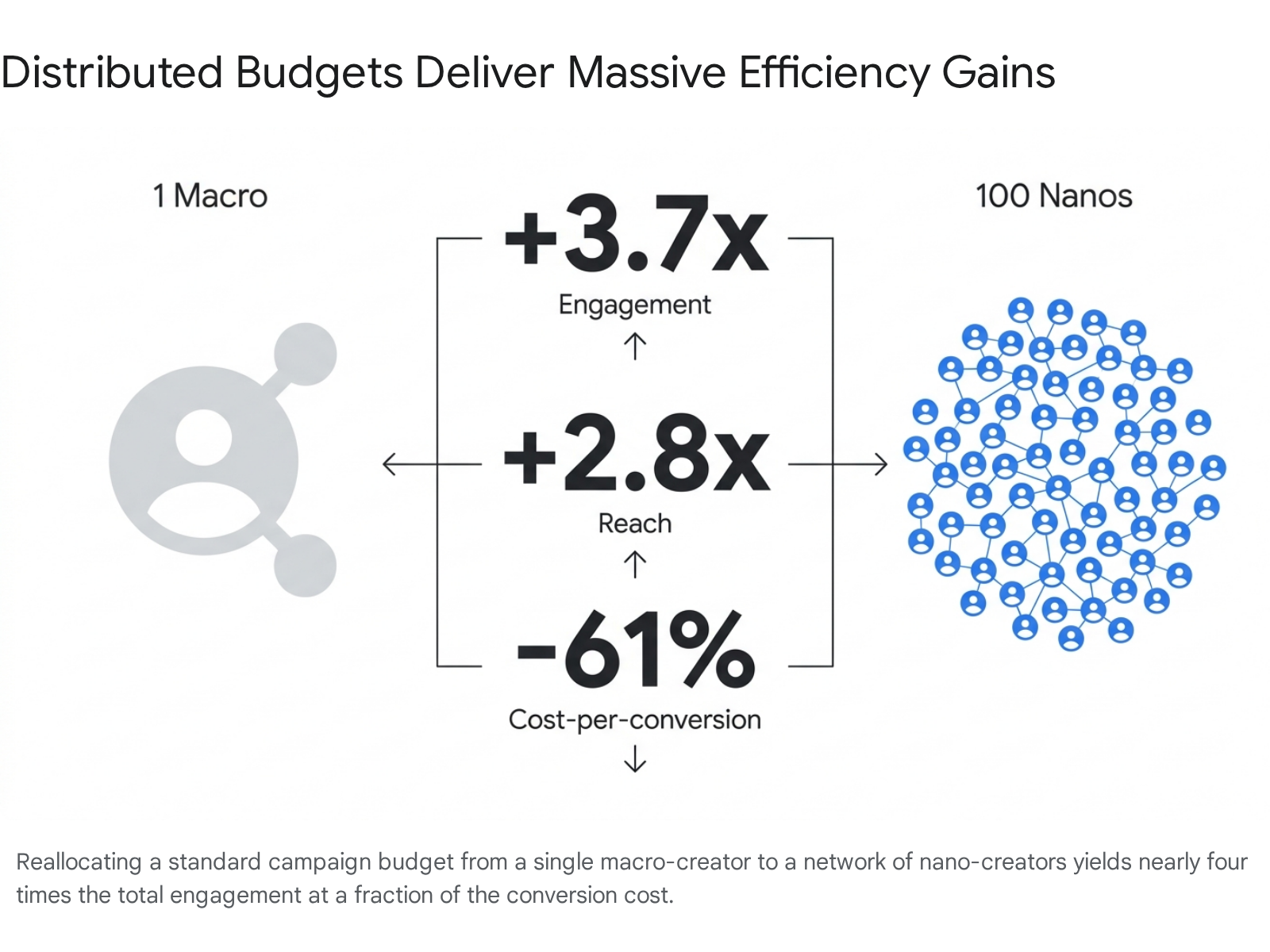
This data proves that a distributed nano-strategy is currently the most capital-efficient campaign architecture available to performance-driven marketers 3. It transforms influencer marketing from a localized media buy into a decentralized word-of-mouth engine.
Platform-Specific Benchmarks and Strategies
The choice of social platform heavily dictates the potential ROI of an influencer campaign. In 2026, social media algorithms have largely evolved past simple chronologies; they are sophisticated recommendation engines that prioritize content quality, user retention, and organic shareability over a creator's historical follower count.
TikTok: The Unrivaled Conversion Engine
Heading into 2026, TikTok is the clear focal point for influencer investment. In a survey of over 600 marketing leaders, 31% identified TikTok as their primary platform for budget expansion - more than double the selection incidence of any other single network 46.
TikTok's dominance is driven by its unparalleled engagement metrics. In 2025, TikTok's average engagement rate across all creators reached roughly 3.70%, up 49% year-over-year 4. When drilling down into the nano-tier, the numbers become even more dramatic. Nano-influencers on TikTok average an incredible 10.3% engagement rate 247. Because TikTok's user base is heavily skewed toward nano-creators (who make up 87.68% of the platform's influencer population), the network naturally facilitates the highly efficient, distributed campaigns that brands desire 47.
Furthermore, TikTok has successfully integrated social commerce directly into the viewing experience. With features like TikTok Shop, users can purchase items directly from a short-form video without leaving the app. This reduces friction in the customer journey and turns entertaining content directly into trackable sales.
Instagram: The Legacy Commerce Backbone
Instagram remains a vital platform, capturing approximately 67% of the total influencer marketing spend share 11. It serves as the legacy commerce backbone of the creator economy, benefiting from older, higher-spending demographics and mature shopping features.
However, Instagram is facing a severe crisis of engagement. In 2025, Instagram's mean engagement rate plummeted to roughly 0.48% - approximately one-seventh of TikTok's average 4. Macro-influencers on the platform struggle to surpass 1.6% to 2.15% engagement 411.
Despite these macro-level declines, Instagram remains highly effective when brands utilize nano-influencers and specific video formats. Nano-creators on Instagram still achieve strong 4.4% to 6.23% engagement rates, generating nearly eight times the interaction of celebrity accounts on the same platform 3411.
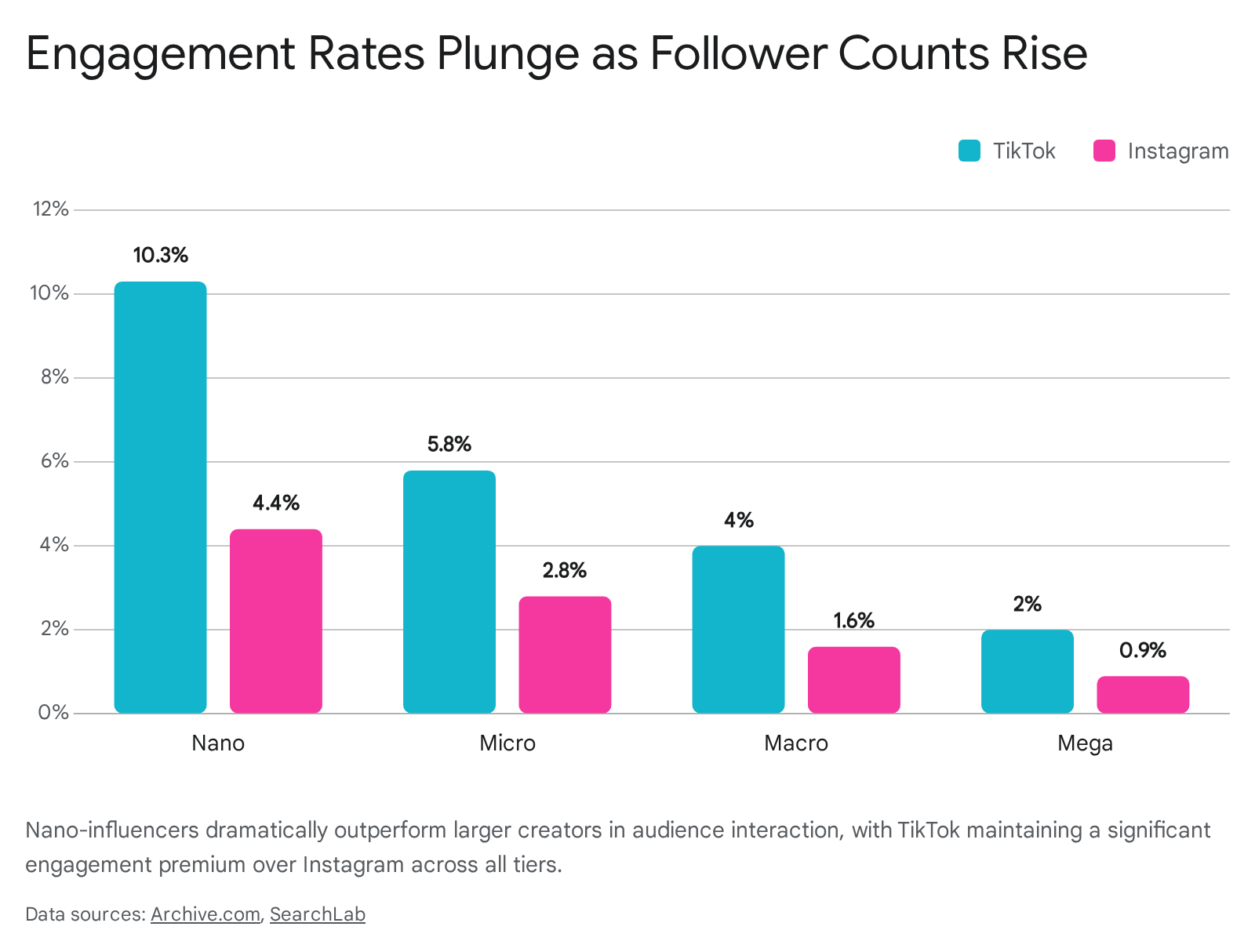
Additionally, Instagram Reels generates twice the engagement of standard static posts, making short-form video the mandatory format for Instagram ROI in 2026 11.
YouTube: Deep Engagement for Considered Purchases
While TikTok and Instagram battle for impulse purchases and viral trends, YouTube retains unmatched strategic relevance for considered-purchase categories. Products requiring deep technical explanation, such as consumer electronics, B2B software, personal finance tools, and high-end beauty, perform exceptionally well in long-form video formats.
On YouTube, micro-influencers achieve engagement rates of approximately 5.2% to 5.43%, effectively doubling the 2.8% average generated by macro-creators (those with over 500,000 subscribers) 717. The true value of YouTube influencer marketing lies in its evergreen nature. A detailed tutorial or product review can drive high-intent search traffic for months or even years after publication, creating a long-tail ROI curve that short-form platforms cannot replicate 17.
LinkedIn and the Rise of B2B Influence
Historically viewed as a digital resume platform, LinkedIn has transformed into a robust arena for B2B influencer marketing. In 2026, B2B brands allocated $4.1 billion to influencer programs, representing a massive 47% year-over-year growth and making it the fastest-rising subcategory in the industry 1.
In the B2B space, thought leadership is paramount. Business software is rarely purchased on a whim; buyers rely on specialized consultants and industry veterans to validate complex technical solutions. LinkedIn-first campaigns that leverage expert micro-influencers (typically holding 10,000 to 50,000 followers) generate 3.2 times more qualified leads than standard paid social advertising 118. In this vertical, audience precision and content depth are exponentially more valuable than global reach.
Industry-Specific ROI and Engagement Data
Influencer performance is not uniform across all product categories. The visual nature of the product, the average price point, and the typical buying cycle all influence how audiences interact with creator content.
Beauty, Fashion, and Aesthetics
The beauty and cosmetics industry consistently records the highest average influencer marketing metrics of any vertical. In 2026, beauty brands see average engagement rates between 4.2% and 5.5% on Instagram, and a staggering 6% to 10% on TikTok 913.
Beauty thrives on visual proof: makeup tutorials, before-and-after transformations, and authentic product reviews are highly engaging formats 9. Nano-influencers in the beauty space often achieve 5% to 8% engagement on Instagram, allowing brands to secure a highly efficient 5:1 to 8:1 ROI 913. Furthermore, performance-based beauty campaigns utilizing a Cost-Per-Acquisition model achieve an astonishing 18.2x ROI multiple compared to traditional digital ads 3.
Fast-Moving Consumer Goods (FMCG)
Fast-Moving Consumer Goods (FMCG) - including packaged foods, beverages, and household cleaning supplies - represent a massive segment of the influencer economy. Because these products have relatively low ticket prices, high purchase frequency, and tight profit margins, small efficiency gains in Cost-Per-Mille (CPM) or conversion rates compound heavily over large sales volumes 14.
In the FMCG sector, food and beverage content leads with average engagement rates of 3.2% to 4.8% on Instagram and 6.2% to 8.1% on TikTok 1314. Nano-creators in the FMCG space achieve an average of 4.8% engagement, while mega-creators drop to just 1.3% 14. Brands in this space rely heavily on micro and nano creators to build everyday habits and integrate products seamlessly into relatable lifestyle content.
Software and B2B Technology
The software and B2B technology sector operates on a fundamentally different dynamic. Sales cycles are long, and products require significant education. Consequently, engagement rates are naturally lower - averaging between 1.2% and 2.1% on platforms like LinkedIn 13.
However, a lower engagement rate does not equate to lower ROI. Because the Customer Lifetime Value (CLTV) of a B2B software contract is exceptionally high, a small handful of highly qualified conversions can render a campaign incredibly profitable. B2B brands typically see a 3x to 5x ROI from influencer marketing, relying heavily on niche micro-influencers to provide in-depth tutorials and technical validation 15.
| Industry Vertical | Avg. Nano Engagement Rate | Avg. Micro Engagement Rate | Typical ROI Expectation |
|---|---|---|---|
| Beauty & Cosmetics | 5.0% - 8.0% | 3.5% - 5.5% | 5:1 to 8:1 |
| Fitness & Wellness | 4.0% - 6.5% | 3.8% - 5.1% | 2.5:1 to 4.5:1 |
| Food & Beverage (FMCG) | 4.8% | 3.4% | Volume/CPA Driven |
| B2B SaaS / Tech | N/A (Highly Niche) | 1.2% - 2.1% | 3:1 to 5:1 |
(Aggregated vertical benchmarks for 2026, primarily tracking Instagram and cross-platform integrations 9131415.)
Advanced Measurement and Attribution in 2026
The influx of capital into the creator economy has brought intense scrutiny from corporate finance departments. Marketers can no longer rely on vanity metrics; they must prove direct commercial impact. However, tracking that impact has become increasingly complex.
Navigating the Privacy-First Web
The deprecation of third-party cookies - a process initiated by Apple's iOS 14.5 update and solidified by subsequent industry-wide privacy regulations (like GDPR and CCPA) - has severely fractured traditional tracking methods 221624. In 2026, cookie-based tracking is essentially obsolete, leaving brands that rely on it effectively blind to their campaign performance 16.
To survive in this privacy-first landscape, brands have shifted entirely to first-party data strategies. This involves capturing customer information directly (via gated content, loyalty programs, and direct purchases) and utilizing server-side tracking 1624. Brands that successfully transitioned to robust first-party data infrastructure reported a 34% improvement in attribution accuracy, allowing them to confidently scale their influencer budgets 16.
Multi-Touch Attribution and Custom Tracking
The modern customer journey is rarely linear. A consumer might discover a product via a TikTok nano-influencer, research it on a YouTube review channel two weeks later, and finally purchase it after clicking a retargeted Google Ad. If a brand uses a primitive "last-click" attribution model, Google Ads gets 100% of the credit, and the influencer marketing ROI appears artificially terrible 221624.
To solve this, 78% of sophisticated marketing teams now utilize multi-touch attribution models 2216. These models intelligently distribute credit across all the touchpoints that contributed to the sale. To feed data into these models, brands employ a combination of specific tactics: 1. Unique Promo Codes: Assigning dedicated discount codes (e.g., "CREATOR20") remains the most foolproof way to track direct influencer sales, especially on platforms like Instagram and TikTok where linking out can be cumbersome 2216. 2. UTM Parameters: Every link shared by an influencer is tagged with detailed tracking data, allowing brands to monitor exactly which post generated website traffic and subsequent conversions 2216. 3. Post-Purchase Surveys (Zero-Party Data): Simply asking customers "How did you hear about us?" at the checkout page often captures the unmeasured "dark social" influence that software tools miss 24.
Artificial Intelligence in Creator Matching
Perhaps the most significant technological leap in 2026 is the application of Artificial Intelligence (AI) to campaign management. Currently, 92% of brands are using or are open to using AI for influencer marketing, with 62% specifically utilizing it for influencer selection 211.
Predictive AI models ingest massive datasets - including historical campaign performance, creator sentiment analysis, audience demographic overlap, and engagement authenticity - to forecast which influencers will drive the most conversions 517. This eliminates the guesswork of relying on follower counts or simple category alignment.
The financial impact of AI integration is staggering. Campaigns that utilize AI-matched creator selection deliver an average ROI of $9.14 per dollar spent - a massive 31.9% premium over the standard industry average 3. AI ensures that budgets are routed precisely to the micro- and nano-creators whose specific audiences harbor the highest latent purchase intent.
Emerging Operational Trends: From One-Offs to Infrastructure
As influencer marketing matures into a $35 billion industry, the operational models used to execute campaigns are shifting from ad-hoc relationships to scalable, systemic infrastructure 5.
Serialized Influence and Long-Term Ambassadors
Audiences are increasingly exhausted by the infinite scroll and the transactional nature of one-off sponsored posts 18. In response, brands are pivoting toward "Serialized Influence" - establishing long-term, multi-month ambassador programs with creators 18.
By securing creators for 6 to 12 months, the brand becomes a native, recurring character in the creator's content, building compounding trust over time 2719. The ROI data heavily supports this approach. In 2026, campaigns featuring long-term brand ambassador relationships of six months or more generated an $11.28 return per dollar spent - the highest performing campaign structure measured across all variables 3. Relationship duration is now recognized as a more powerful ROI amplifier than content format or platform choice.
Gifted Collaborations vs. Paid Placements
For brands with limited cash budgets, product seeding and gifted collaborations remain highly viable, particularly when targeting nano-influencers. Astonishingly, research shows that for nano-creators, product-only collaborations actually generate 12.9% higher engagement and 215% more views than paid monetary partnerships 7.
Because 93% of nano-creators are willing to work in exchange for products, brands can build massive, highly engaged affiliate networks with essentially zero cash outlay beyond inventory costs 7. This strategy is particularly dominant in the Direct-to-Consumer (DTC) beauty and fashion sectors 15.
The Virtual Influencer Phenomenon
A fascinating, if somewhat controversial, sub-trend in 2026 is the rise of AI-generated virtual influencers. These digital avatars have captured a 4.2% market share of total influencer spending, representing roughly $1.37 billion in brand deals 1.
Despite lacking human authenticity, virtual influencers are remarkably effective at driving interaction, boasting an average engagement rate of 5.67% - nearly three times higher than their human counterparts with equivalent follower sizes 1. Brands are attracted to virtual influencers because they eliminate human error, pose zero PR controversy risk, and drastically reduce content production costs. However, they are generally deployed for top-of-funnel awareness and visual aesthetic campaigns rather than deep-trust conversion initiatives 1.
Global Nuances: Regional Shifts in Influencer ROI
While the mathematical advantage of nano- and micro-influencers is a global phenomenon, cultural and economic realities drastically alter how influencer marketing is executed across different regions.
Latin America (LATAM) and the "De-Influencing" Movement
Latin America is currently experiencing a severe cultural backlash against highly curated, hyper-consumerist influencer content. This movement, widely referred to as "de-influencing," has caused a steep decline in audience trust. Between 2022 and 2024, consumer trust in sponsored influencer posts plummeted from 58.1% to just 37.7% 29.
Consequently, LATAM consumers have pivoted heavily toward raw, unpolished User-Generated Content (UGC). An overwhelming 77% of consumers in the region explicitly state they prefer product reviews from regular, everyday users over professional influencers 29. For brands targeting the Latin American market in 2026, the strategy must abandon macro-influencers entirely. Success requires investing in massive product seeding campaigns with nano-influencers and encouraging authentic, unscripted reviews that prioritize relatability over production value 29.
Southeast Asia (SEA) and Key Opinion Sellers (KOS)
Southeast Asia is arguably the most advanced region globally for influencer-driven commerce. In 2026, influencer marketing in SEA drives an astonishing $38 billion to $46 billion in annual e-commerce sales, capturing 20% to 24% of the entire regional e-commerce market 30.
However, the archetype of the successful creator has mutated. Brands in SEA are moving away from traditional influencers (who focus on brand building and lifestyle) and are investing heavily in "Key Opinion Sellers" (KOS) 3132. A KOS is a performance-first creator entirely optimized for immediate sales conversion.
This dynamic is starkly visible in Thailand, where 9 out of the top 10 highest-earning TikTok creators are classified as Key Opinion Sellers 3132. These creators host high-energy livestream shopping events and produce highly actionable, shoppable short-form videos. They frequently operate on affiliate commission models rather than flat fees, allowing brands to scale their marketing spend directly in line with generated revenue 2730.
India's Drive Toward Market Formalization
The Indian creator economy is undergoing rapid institutionalization. Driven by increasing smartphone penetration in regional areas and deep brand integration, India's influencer marketing sector is projected to hit ₹4,500 to ₹5,000 crore (approximately $540M to $600M USD) by 2027, sustaining a 22% compound annual growth rate 20.
Historically an informal market of handshake agreements, the Indian creator ecosystem is now formalizing to meet the demands of corporate procurement. Currently, over 15.2% of Indian creators have registered as formal business entities or obtained GST registration to secure legitimate, long-term brand partnerships 2034.
Furthermore, the data shows that regional, localized communities are the true growth engine in India. Nano-creators (1K-10K followers) now account for 61.1% of the total creator base, providing brands with hyper-targeted access to diverse linguistic and cultural subsets across the subcontinent 20.
Bottom line
In 2026, the influencer marketing ecosystem heavily penalizes brands that prioritize follower volume over audience trust. The benchmark data conclusively proves that nano- and micro-influencers provide vastly superior engagement rates, conversion efficiencies, and overall ROI compared to macro-creators and celebrities. While measuring impact in a cookieless digital landscape remains an operational hurdle, brands that leverage AI matching, multi-touch attribution, and long-term ambassador structures are routinely achieving returns exceeding $11.00 for every dollar invested. Moving forward, success requires treating creators not as isolated media placements, but as a scalable, performance-driven commerce infrastructure.