
Psychology and economics of luxury consumption and Veblen goods
Historical Foundations of Conspicuous Consumption
The human drive to acquire and display luxury goods represents a complex intersection of psychology, economics, and evolutionary biology. The theoretical foundation for understanding this behavior was established by Norwegian-American sociologist and economist Thorstein Veblen in his 1899 treatise, The Theory of the Leisure Class 12. Writing during the Gilded Age - a period defined by rapid industrialization and profound wealth inequality - Veblen analyzed the socio-economic transformations that enabled a new class of industrialists to accumulate vast surpluses 23. Veblen introduced the concept of "conspicuous consumption," which he defined as the acquisition and display of expensive goods and services not for their functional or utilitarian value, but explicitly to signal wealth, power, and social standing to observers 14.
Veblen's analysis utilized the anthropological frameworks of his era, tracing human socio-economic development from a cooperative, peaceable phase into a predatory and competitive era marked by intense social stratification 25. In this stratified society, productive or manual labor became associated with the lower classes and was deemed degrading, while exemption from industrial labor became a hallmark of the elite 35. The leisure class maintained its status through conspicuous leisure (the non-productive consumption of time) and conspicuous consumption (the non-productive consumption of goods) 34. Both mechanisms share the fundamental characteristic of deliberate waste; it is the visible wastefulness of time or resources that proves the individual possesses an economic surplus 15.
Furthermore, Veblen documented the phenomenon of "vicarious consumption" and "vicarious leisure," wherein the patriarchal head of a household demonstrated his wealth through the consumption patterns of his dependents 25. Servants, for example, were employed not merely to perform mechanical tasks, but to master "good form" and conspicuously know their place, demonstrating the master's pecuniary ability to maintain an unproductive retinue 3. Similarly, Veblen argued that the elaborate dress and enforced leisure of upper-class women served as a reflection of their husband's or father's financial dominance 25. Even the clerical system and religious institutions were analyzed as engaging in conspicuous consumption to reflect the majesty of a worshipped deity, operating under the same socio-economic mechanics as the secular leisure class 2.
Evolutionary Psychology and Costly Signaling Theory
Biological Origins of Honest Signaling
While Veblen situated conspicuous consumption within sociological structures, contemporary evolutionary psychology traces the behavior to deeply rooted biological imperatives. The primary framework used to explain this is costly signaling theory, a concept that originated in evolutionary biology with Amotz Zahavi's 1975 "handicap principle" 6. Zahavi posited that elaborate animal displays - such as the peacock's heavy, highly visible tail - function as evolutionary handicaps 6. These traits are detrimental to survival, yet they evolve because they serve as honest indicators of the organism's underlying genetic quality 67. Because only highly fit individuals can bear the metabolic and survival costs of the handicap, the signal cannot be successfully faked by lower-quality individuals, ensuring signal reliability under conditions of asymmetric information 68. This principle was later formalized mathematically by Alan Grafen in 1990, demonstrating how costs stabilize honest signaling in game-theoretic models even when the interests of signalers and receivers conflict 6.
Human Behavioral Ecology and Mating Strategies
Applied to human behavioral ecology, costly signaling theory explains phenomena that otherwise appear economically irrational. In ancestral hunter-gatherer societies, behaviors such as large-game hunting functioned as costly signals rather than mere subsistence strategies; the risk and energy expenditure signaled bravery, skill, and generosity, elevating the hunter's social standing and mating success 68. Today, the conspicuous consumption of luxury goods serves an identical evolutionary function 68. Wealth displays operate as costly, resource-intensive signals of an individual's financial stability, resource-holding potential, and provisioning ability 67.
Experimental research strongly supports the link between luxury consumption and evolutionary mating strategies. Studies demonstrate that when human males are primed with romantic motives, their willingness to engage in conspicuous consumption increases significantly, shifting expenditure away from necessities and toward designer goods 69. Women's shopping behaviors also shift during the ovulatory cycle, aligning with evolutionary goals related to mate attraction and intrasexual competition 79. Females utilize conspicuous consumption to signal their own mate quality to rivals, deter mate poaching, and demonstrate the commitment and investment capacity of their partner 7.
Phenotypic Mimicry in Consumer Goods
Evolutionary psychologists have also explored how specific features of luxury goods act as mechanisms for "phenotypic mimicry." Research indicates that the prominent display of male luxury goods - such as the size of a luxury brand logo or the vibrancy of a vehicle's coloration - mimics the function of male secondary sexual characteristics 10. Consumers who display highly conspicuous, visually dominant luxury items are perceived by observers as adopting faster life history strategies, characterized by high mating effort and lower long-term paternal investment 10.
In these studies, men owning items with prominent sensory characteristics are judged to use authority, intimidation, and social dominance to advance their status 10. Conversely, individuals favoring less showy, high-quality items are perceived as demonstrating useful abilities and fostering cooperative alliances 10. This indicates that conspicuous consumption is not monolithic; it is carefully calibrated by the signaler to attract specific types of cooperative partners or mates, and to intimidate potential rivals for resources 710.
Cognitive and Sociological Drivers
The Tension-Based Psychological Model
At the individual cognitive level, the psychology of luxury consumption is governed by a complex set of tensions between internal self-concept and external societal forces 111213. Consumers are driven to the luxury market by distinct psychological gratifications, including hedonic pleasure, the desire for escapism, social bonding, and self-enhancement 13. Symbolic consumption theory provides a lens to understand this: consumers pursue luxury far beyond the material attributes of the product to construct their identity, express cultural values, and secure social belonging 13.
However, the pursuit of status through consumption frequently yields unintended psychological consequences. Recent empirical research has identified an "impostor syndrome from luxury consumption" 14. While purchasing high-end goods holds the promise of elevated stature, many consumers report feeling inauthentic and less confident when wearing or using luxury products compared to non-luxury alternatives 14. This occurs because consumers often internalize societal views that highly exclusive luxury is an undue and undeserved privilege 14. This psychological cost is generally only mitigated when the consumer possesses an inherently high sense of psychological entitlement, or when the purchase is tied to a specific celebratory occasion that allows the consumer to feel they have "earned" the indulgence 14.
Conspicuous Ethics and Post-Materialist Values
The parameters of what constitutes a luxury status symbol are also shifting as societies undergo intergenerational value changes. In advanced, post-materialist economies, survival and economic necessity are largely secured, leading to an environment where consumption increasingly reflects ethical, environmental, and social concerns 15. This has given rise to the phenomenon of "conspicuous ethics," an evolution of Veblen's original theory 15.
In this framework, ethical products - such as sustainably sourced apparel, organic foods, or fair-trade goods - function as modern status symbols 15. Consumers derive esteem from publicly displaying moral considerations in their consumption choices 15. A study analyzing organic wine consumers in Italy demonstrated that consumers use the high price of organic wine as a quality cue, establishing a Veblen effect in the food and beverage market 16. Lowering the price of the organic product resulted in a decreased perception of quality and moral value, reinforcing the concept that the price premium itself signals the ethical virtue of the buyer 16.
The Economics of Veblen Goods
Departures from the Law of Demand
In classical microeconomics, the standard "Law of Demand" establishes an inverse relationship between the price of a good and the quantity demanded 1718. When the price of a normal good falls, the quantity demanded expands due to two primary forces: the substitution effect (consumers switch away from relatively more expensive competing products) and the income effect (the price drop effectively increases the consumer's real purchasing power) 1719.
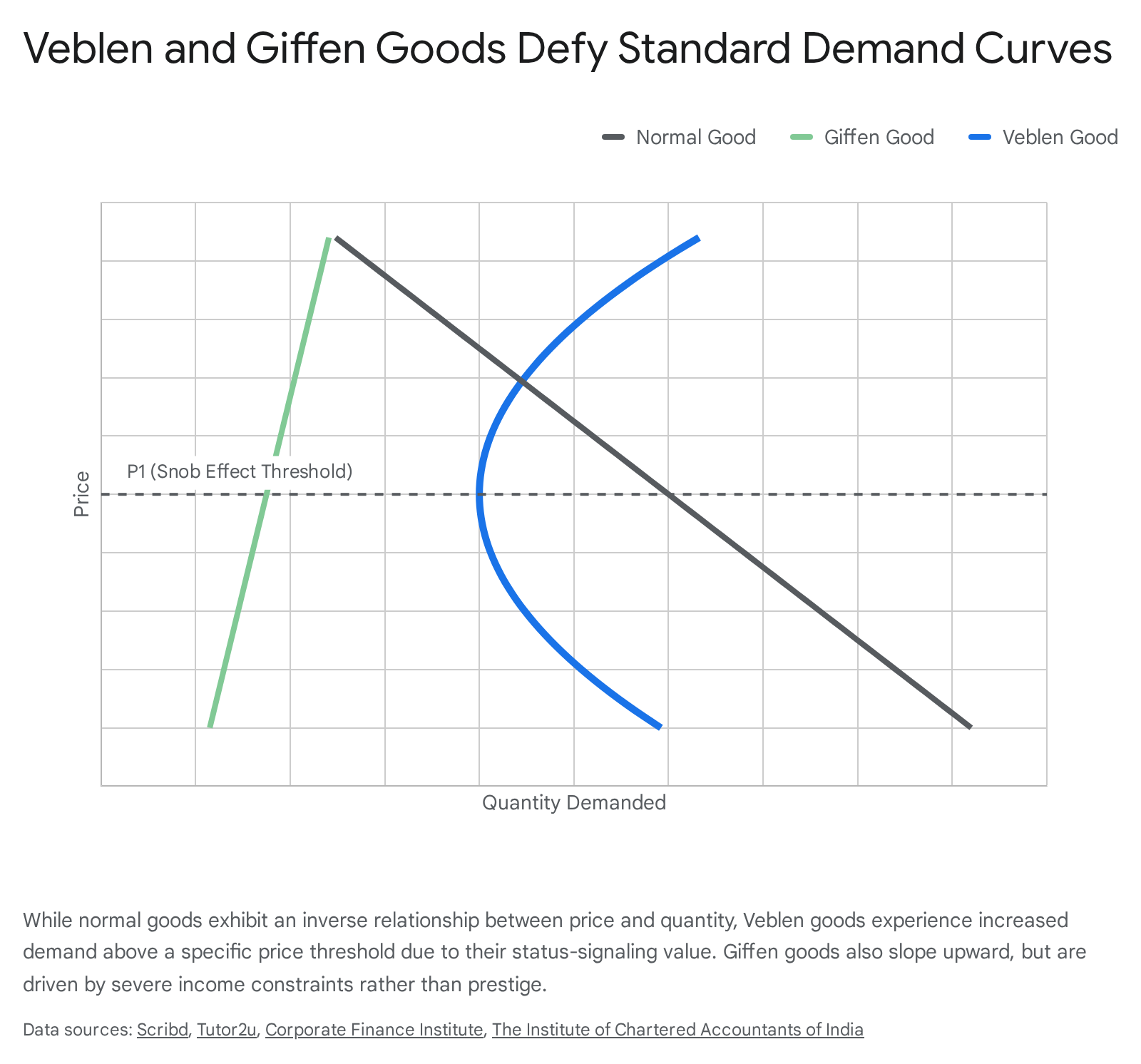
However, empirical observation and economic theory highlight significant exceptions to this law, most notably Giffen goods and Veblen goods, both of which exhibit upward-sloping demand curves under specific conditions 171819.
While both Giffen and Veblen goods defy standard demand logic, their drivers are diametrically opposed. To isolate the unique behavior of Veblen goods, it is essential to categorize how different goods respond to income and price shifts.
| Good Classification | Relationship to Income | Price/Demand Relationship (Curve Slope) | Economic & Psychological Drivers | Common Examples |
|---|---|---|---|---|
| Normal Goods | Demand rises as income rises. | Inverse (Downward sloping). | Positive income and substitution effects. Consumers seek functional utility. | Electronics, standard clothing, housing, vacations 212220. |
| Inferior Goods | Demand drops as income rises. | Inverse (Downward sloping). | Negative income effect. Consumers abandon these for better alternatives as wealth grows. | Public transit, canned foods, second-hand clothing 212024. |
| Giffen Goods | Demand drops as income rises. | Direct (Upward sloping). | Highly inferior goods with virtually no close substitutes. The negative income effect overpowers the substitution effect. Driven by extreme economic constraint. | Rice, wheat, potatoes in historically impoverished populations 192120. |
| Veblen Goods | Demand rises as income rises. | Direct (Upward sloping). | Driven by the snob effect, conspicuous consumption, and status signaling. Price acts as the primary indicator of prestige. | Luxury sports cars, high-end mechanical watches, designer handbags 192125. |
A Giffen good relies on extreme poverty and a lack of market alternatives. If the price of a basic staple like wheat rises, an impoverished consumer cannot afford higher-quality calories like meat; they are forced to spend their remaining budget buying even more wheat to meet basic caloric needs 2120.
Conversely, Veblen goods serve no absolute functional necessity. They operate as positional goods - items valued exclusively by how they are distributed among the population and who is excluded from owning them 1720. Veblen goods possess an income elasticity of demand exceeding 1.0; a 10% price increase frequently results in a quantity demand increase of more than 10% among the target demographic 25. The high price inherently rations affordability, transforming the cost itself into the product's most desirable feature 1725.
Mathematical Models and Threshold Dynamics
To integrate Veblen's sociological theories into formal economic modeling, researchers have mapped the specific mechanisms of interpersonal demand. Harvey Leibenstein (1950) was a pioneer in this area, categorizing interpersonal externalities into the "bandwagon effect" (demand increases because others consume the good) and the "snob effect" (demand decreases because others consume the good) 2122.
For a true Veblen good, the demand curve is often depicted as piecewise or backward-bending. At lower price levels, the product operates as a normal good, with demand falling as prices rise 1819. However, once the price crosses a critical threshold - often denoted as $P_1$ - the snob effect is activated 1823. Above $P_1$, the good becomes financially inaccessible to the general population, acquiring sudden status value. From this inflection point, the demand curve hooks and slopes upward, as higher prices successfully verify the exclusivity of the product 1823.
Bagwell and Bernheim (1996) advanced this by demonstrating how Veblen effects arise endogenously in competitive markets without relying on actual differences in product quality 242531. In a standard competitive market with identical production technologies, goods are priced at marginal cost 24. Bagwell and Bernheim established that when consumers possess private information about their assets and wish to signal their wealth, standard "single-crossing properties" in utility functions fail 2426. Consequently, sellers can market functionally identical products under two distinct strategies: a "budget" brand sold at marginal cost, and a "luxury" brand sold at a massive premium 242531. Wealthy consumers intentionally overpay for the luxury brand specifically because the premium represents a sunk cost that lower-income consumers cannot absorb (pecuniary emulation) 2531. Therefore, Veblen effects are not reliant on superior craftsmanship; luxury brands generate positive profits by monetizing the human desire for invidious distinction 2527.
Furthermore, sociological threshold models, such as those developed by Granovetter (1986), indicate that markets for status goods are highly volatile. When consumer demand relies on the consumption patterns of others (whether seeking conformity via bandwagons or differentiation via snob effects), stable price-quantity equilibria are difficult to maintain 22. Granovetter demonstrated that for many plausible parameter values, market equilibria for status goods are asymptotically unstable, and slight parameter shifts can push the system into chaotic dynamics that mimic random noise 22. This mathematical instability explains the rapid, unpredictable rise and fall of certain luxury trends.
Cultural Variations in Luxury Demand
Individualism versus Collectivism
The underlying psychological triggers for luxury consumption do not manifest uniformly across global populations; they are fundamentally structured by cultural values. A central framework for analyzing these differences is Hofstede's dimension of Individualism versus Collectivism.
In highly individualistic cultures, such as the United States and Western Europe, self-esteem is derived from bounded, unique, and independent characteristics 2829. Western luxury consumers typically utilize conspicuous goods to signal personal achievement, individual superiority, and distinctiveness 2830. Because the motivation is strictly individualistic, status consumption in the West is frequently critiqued or viewed negatively as materialistic showing-off 30.
Conversely, in collectivist cultures typical of East Asian markets (including China, South Korea, and Japan), self-concept is deeply intertwined with group relatedness and societal harmony 2829. This presents a historical paradox: many Asian societies are shaped by traditional religious and philosophical systems, such as Buddhism and Confucianism, which strongly advocate for modest, frugal living and warn against materialistic excess 30. Despite this, the Asia-Pacific region represents the largest market for personal luxury goods globally 30.
Recent demographic studies resolve this paradox by revealing that Asian consumers are not becoming more individualistic or Westernized; rather, collectivism itself actively amplifies luxury consumption 30. In these societies, acquiring high-status items is viewed as a mechanism to bring honor to valued in-groups (such as family or corporate affiliations), fulfill social expectations, and signify harmonious integration into elite circles 3031. The positive pressure to engage in status consumption derived from collectivism is so dominant that it entirely overrides the countervailing negative pressures of traditional religious thriftiness 30.
The Mechanics of Face (Mianzi)
The collectivist pursuit of luxury in East Asia is intimately bound to the cultural construct of "face" (saving face, or mianzi). Face reflects a person's social self-esteem and the ongoing desire to be respected during interpersonal interactions 2829. In China, consumers are acutely face-conscious, operating under a constant mandate to gain and maintain face while aggressively avoiding the loss of it 2932.
Consequently, East Asian consumers demonstrate a pronounced preference for publicly visible luxury goods - such as watches, handbags, and prominent outerwear - over private or experiential luxuries (such as home goods or discreet services) that are more common in Western markets 2829. Because public behavior must align with stringent societal expectations, the pressure to maintain face forces individuals to engage in luxury consumption even when their absolute income levels are low, a phenomenon rarely observed to the same degree in individualistic societies 2930.
The threat of losing face also heavily influences interaction with the counterfeit market. While counterfeit goods could theoretically act as affordable status signals to maintain prestige, Chinese consumers driven by face-saving motives demonstrate highly negative attitudes toward counterfeit luxury 32. The sociological risk is asymmetrical: the potential gain from faking a status signal is vastly outweighed by the catastrophic loss of face that would occur if the individual were publicly exposed or accused of purchasing a fake 32. Thus, the cultural requirement for face directly supports the demand for authentic, high-priced Veblen goods 32.
Structural Shifts in Status Signaling
The Taxonomy of Luxury Consumers
As global wealth distribution evolves and luxury goods become more democratized, the strategies utilized to broadcast status have bifurcated. Consumer researchers Han, Nunes, and Drèze (2010) provided a critical taxonomy of luxury buyers, segmenting them into four groups based on two axes: their absolute financial standing and their psychological need for social prestige. These four archetypes - Patricians, Parvenus, Poseurs, and Proletarians - dictate whether a consumer seeks out "loud" or "quiet" luxury 3334.
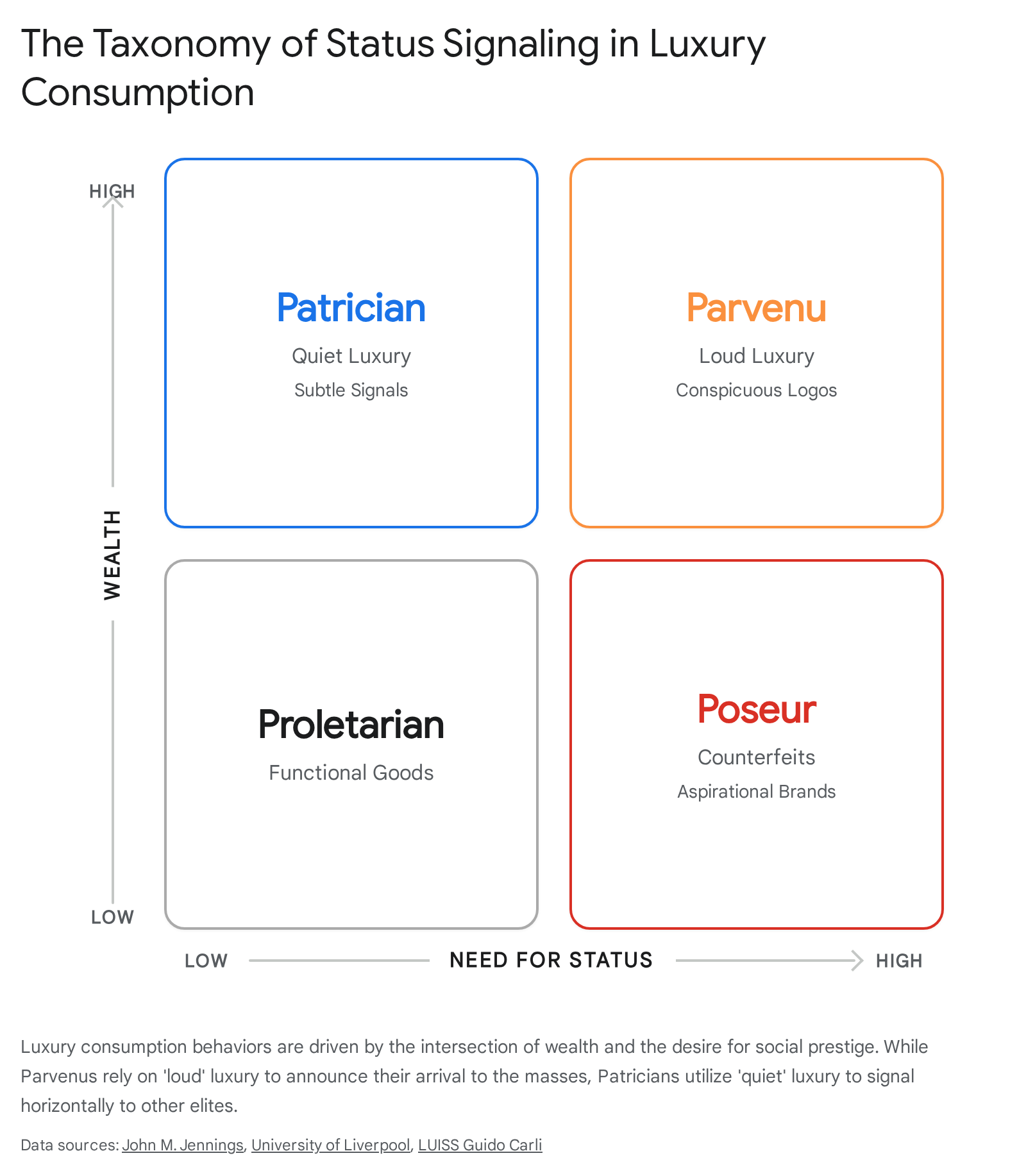
Parvenus possess significant wealth alongside a high need for status, often representing newly acquired wealth ("new money") 333435. They rely heavily on "loud luxury," characterized by conspicuous logos, highly recognizable monograms, and ostentatious design aesthetics 3336. Loud branding strategies aim to maximize observer recognition, allowing Parvenus to separate themselves from lower socioeconomic classes and loudly broadcast their upward mobility to the general public 333435. Poseurs similarly possess a high need for status but lack the requisite financial means; they attempt to mimic Parvenus by purchasing highly visible, entry-level luxury items, heavily discounted goods, or counterfeits 3435.
The Great Inversion and Quiet Luxury
Conversely, Patricians represent individuals with vast wealth but a low psychological need to broadcast it to the masses (often associated with "old money" or the established elite) 333435. Patricians have catalyzed the "quiet luxury" or "stealth wealth" movement, deliberately shunning conspicuous branding 363738. Quiet luxury relies on minimalist aesthetics, exceptional material quality, unparalleled craftsmanship, and timeless design 363739. The aesthetic frequently utilizes low color saturation and muted palettes, which empirical studies have shown are strongly associated by consumers with profound brand heritage, continuity, and elevated institutional status 40.
This transition toward inconspicuous consumption represents what luxury analysts term "the great inversion" 37. Over the past decade, loud luxury became highly democratized; outlet malls, digital payment plans, and affordable entry-level lines allowed a massive influx of aspirational consumers to wear prominent designer logos 37. Consequently, prominent logos suffered from semantic dilution and ceased to function as reliable exclusionary signals of elite wealth 3741. In response, Patricians inverted the code: visibility became a liability, while invisibility became a sign of true power 37. Quiet luxury goods act strictly as horizontal signals; an unbranded $3,000 cashmere sweater is unidentifiable to a casual observer or a Poseur, but is instantly recognizable to peers within the exact same elite strata 333537.
The shift toward quiet luxury is also deeply tied to generational value shifts and macroeconomic conditions. Following the post-pandemic luxury boom of 2021-2022, the global luxury goods sector faced an estimated contraction of 2% to 5% by 2024 and 2025, pulling back to roughly €1.48 trillion in total sales 4842. This contraction was heavily influenced by economic anxiety, inflation, and a downturn in Chinese consumer confidence 4843. During periods of economic uncertainty, affluent consumers pivot away from ostentatious displays (Veblen's "daydream luxury") toward more resilient, responsible, and understated consumption to avoid public backlash and reflect economic sustainability 4844.
Furthermore, Millennials and Gen Z are actively accelerating the quiet luxury ethos as a reaction against fast fashion, disposable culture, and the "planned obsolescence" prevalent in the tech and apparel industries 384352. For younger affluent cohorts, environmental sustainability, ethical sourcing, and product durability constitute new forms of status 373845. Reflecting this value shift, the market for second-hand luxury goods grew by 140% between 2017 and 2024, far outpacing the 42% growth rate of new luxury goods 43. For these demographics, status is derived from intentional living and curated authenticity rather than the external validation of a logo 3852.
Algorithmic Amplification of Conspicuous Consumption
Social Media Feedback Loops
While quiet luxury dominates the uppermost echelons of old money, the mass manifestation of the Veblen effect has been radically accelerated by digital ecosystems and algorithmic governance. Social media platforms such as Instagram, TikTok, and X operate on profit-oriented business models engineered to maximize user attention and dwell time 4647. To achieve this, recommendation algorithms heavily track early engagement metrics - including likes, comments, shares, and watch times - to trigger algorithmic feedback loops that exponentially amplify highly stimulating posts 4849.
Because algorithms prioritize content that elicits strong emotional reactions (such as envy, excitement, or awe), displays of extreme wealth and conspicuous consumption are naturally favored by the system 4650. As posts featuring luxury lifestyles gain early traction, the algorithm pushes them into recommendation feeds and explore pages, exposing them to vast audiences outside the creator's immediate network 4850. This dynamic creates filter bubbles and echo chambers, where users are repeatedly exposed to similar displays of affluence, making highly conspicuous luxury consumption appear vastly more common and normalized than it actually is within the general population 46.
Influencer Following Norms and Materialism
The architectural design of these platforms directly "hijacks" fundamental human social interactions, converting the psychological drive for status into quantifiable engagement metrics 5152. By consistently exposing users to the highly curated lifestyles of Social Media Influencers (SMIs), algorithms establish hyper-inflated "influencer following norms" 5354. Users begin to perceive the acquisition of luxury as a mandatory baseline for social participation 54.
Empirical research grounded in self-determination theory reveals the precise mechanisms of this influence. Exposure to algorithmically amplified SMIs triggers intense social comparison and Fear Of Missing Out (FOMO) among followers 53. Furthermore, this exposure actively amplifies the psychological "desire to mimic" and heavily stimulates materialistic tendencies 53. This chain reaction - from algorithmic exposure, to FOMO, to the desire for mimicry - translates directly into increased purchase intent for conspicuous luxury products, regardless of the user's actual financial utility 535455. The continuous digital consumption of luxury aesthetics locks users into a behavioral loop where purchasing decisions are dictated not by need, but by the pressure to maintain digital visibility and status 5255.
Digital Veblen Goods and the Tokenized Economy
Non-Fungible Tokens (NFTs) as Status Signals
The intersection of conspicuous consumption and digital platforms culminated in the creation of an entirely new asset class subject to the Veblen effect: Non-Fungible Tokens (NFTs). Theorists classify NFTs as "Digital Veblen Goods" - purely positional assets that exist primarily to signify social status and club membership in online environments 5657. Unlike traditional investments, the majority of profile-picture NFTs provide no cash flows or functional utility; their value is derived entirely from digital scarcity and the social signaling power they confer upon the owner 5666.
In digital environments, NFTs serve as the precise equivalent of displaying a Picasso painting in a living room or driving a Ferrari in public 56. The Veblen mechanics were solidified when major social platforms, such as Twitter, introduced blockchain verification features allowing users to authenticate their ownership of rare NFTs, transforming them into globally visible badges of wealth and technological savvy 56.
Market Maturation and Attrition
Because the value of Digital Veblen Goods relies entirely on social coordination and perception, their demand is inherently fragile 56. Following a speculative frenzy where the NFT market reached a staggering $414 billion market capitalization in May 2022, the sector experienced a profound correction 67. By mid-2024, the total market capitalization had stabilized between $18 billion and $35 billion 67.
Research tracking the life-cycle of these digital assets reveals a brutally oversaturated market. A comprehensive 2024 study analyzing nearly 30,000 newly launched NFT collections demonstrated that 98% of projects were effectively "dead," exhibiting zero trading volume shortly after minting 68. A mere 0.2% of new NFT drops proved profitable for investors, and the vast majority lost over 50% of their value within days, indicating a near-total collapse in the blind speculative demand that characterized earlier years 68.
Despite this high attrition rate, the core concept of the Digital Veblen Good is evolving rather than disappearing. The surviving ecosystem is transitioning away from pure aesthetic hype toward tangible utility and interoperability 6667. Future iterations of digital status signaling are heavily focused on tokenizing Real World Assets (RWAs) - using blockchain to verify ownership of physical luxury goods like real estate, fine wine, or precious metals - and establishing cross-platform digital identities across various metaverse environments 6669. As the digital asset industry matures, the desire for provable digital scarcity remains, confirming that the psychological drive for Veblen goods seamlessly translates into virtual ecosystems 6667.
Conclusion
The psychology and economics of luxury consumption expose the limitations of traditional economic models that assume purely rational, utility-maximizing behavior. Veblen goods defy standard demand curves because their utility is intrinsically and paradoxically linked to their high cost and exclusionary nature. Whether analyzed through the lens of evolutionary biology as a costly, honest signal of genetic and financial fitness, or through cognitive psychology as a complex tension between self-concept and the desire for external validation, luxury consumption serves as a deeply ingrained human communication tool.
As global markets expand, these status signals are continuously redefined by cultural and generational contexts. In collectivist East Asian cultures, conspicuous consumption reinforces social integration and protects crucial public face, whereas in Western contexts, it highlights individual success. Furthermore, modern consumption has fractured into two divergent strategies: the loud, logocentric luxury utilized by the newly affluent to assert social mobility, and the quiet, sustainable minimalism employed by established elites to signal horizontally to peers. This deeply human phenomenon has now been co-opted and accelerated by digital infrastructure, with algorithmic feedback loops amplifying material envy, and blockchain technology extending the Veblen effect from physical handbags into the realm of digital tokens. Ultimately, as long as human social hierarchies persist, the demand for exclusive markers of status will continue to disrupt classical economic paradigms.