Psychology of billionaire wealth accumulation
Introduction to the Behavioral Paradox of Extreme Wealth
At the apex of the global economic system exists a cohort of individuals whose accumulation of capital dramatically defies classical economic models of rational utility. By early 2026, the collective wealth of the world's billionaires reached an unprecedented $18.3 trillion, representing an 81% increase since the beginning of the decade 12. In 2025 alone, global billionaire wealth grew three times faster than the average annual rate recorded over the preceding five years, generating enough newly accumulated capital to theoretically eradicate extreme global poverty dozens of times over 344. The sheer scale of this accumulation presents a profound behavioral and psychological paradox.
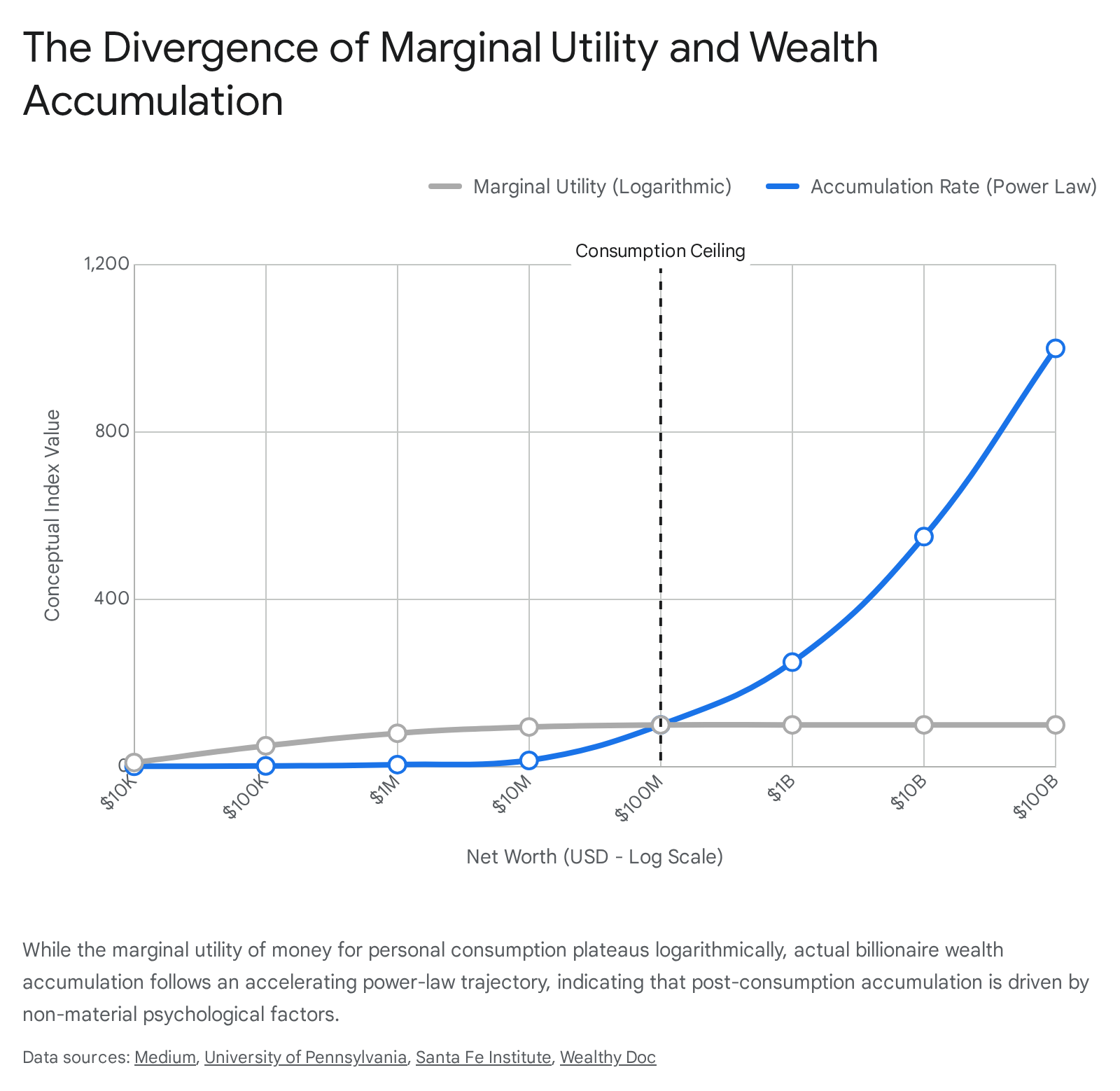
In foundational economic theory, the pursuit of wealth is primarily understood as a rational mechanism to secure resources for consumption, security, and leisure. However, when an individual's net worth crosses into the tens or hundreds of billions, the capacity for personal material consumption is entirely exhausted. For the ultra-wealthy, the marginal utility of each additional dollar approaches zero 5. Yet, the psychological drive to accumulate persists, often accelerating rather than decelerating. The continuous hoarding of wealth beyond any conceivable physical or material need cannot be adequately explained by standard consumption-driven models.
Resolving this paradox requires a multidisciplinary framework that encompasses evolutionary psychology, neurobiology, behavioral economics, and sociological identity formation. The drive for endless accumulation is deeply rooted in evolutionary mismatches involving supernormal stimuli, the neurobiological mechanisms of process addiction, the psychological demands of status signaling, and the institutionalization of dynastic legacy.
Diminishing Marginal Utility and Power Law Dynamics
To understand the psychological drivers of extreme wealth hoarding, it is necessary to first analyze the failure of traditional utility theories to map onto the behavior of the ultra-rich. The Law of Diminishing Marginal Utility dictates that as an individual consumes more of a specific good, the satisfaction or subjective utility derived from each additional unit steadily declines 56.
For the average earner, the transition from poverty to a middle-class income yields a massive increase in subjective well-being, as basic survival needs such as housing, food, and security are met. Subsequent millions provide access to luxuries, exclusivity, and supreme comfort 5. However, once a baseline of extreme affluence is reached - characterized by private aviation, multiple estates, and total material security - the incremental benefit to daily life provided by the next billion dollars is practically negligible 5. The individual hits the absolute ceiling of what capital can purchase in terms of repeatable personal pleasure.
If wealth were strictly a medium of exchange for goods and services, the motivation for accumulation would logically cease or drastically slow once this consumption ceiling was reached. The empirical data on billionaire wealth accumulation, however, demonstrates the exact opposite: wealth at the very top accumulates at a rate proportional to the level of wealth already held, a mathematical phenomenon known as proportional growth or the Yule process 7.
| Economic Theory | Application to Average Earners | Application to Ultra-High-Net-Worth Individuals |
|---|---|---|
| Marginal Utility | High correlation between income increases and life satisfaction. Additional capital directly improves living conditions 68. | Utility completely flatlines. Additional capital provides zero incremental change to physical comfort or material access 5. |
| Logarithmic Utility | Rarely applicable, as average earners operate within additive dynamics (saving from wages) 910. | Highly applicable. Wealth operates on multiplicative dynamics, scaling exponentially as an abstract metric rather than purchasing power 911. |
| Power Law Distribution | Not applicable. Wealth growth is constrained by labor output and standard market consumption 12. | Defines the accumulation trajectory. Growth rate is proportional to existing size, leading to extreme tail-end concentration 712. |
Because the marginal utility of material consumption plateaus, the psychological focus of the ultra-wealthy shifts entirely. Wealth transitions from being a currency of material consumption to an abstract metric of historical achievement and systemic power 5. For individuals possessing tens of billions of dollars, deploying capital toward world-changing mega-projects, space exploration, or media consolidation provides a novel form of psychological satisfaction that simple material purchasing cannot yield 5. In this phase, money operates via a logarithmic utility function, where its value is derived from its mathematical role in multiplicative dynamics and scaling influence 910. The accumulation itself becomes an abstract game where the incremental units are no longer dollars, but degrees of global influence and historical legacy.
Evolutionary Psychology and Biological Mismatches
The psychological inability to recognize "enough" is deeply encoded in the evolutionary history of the human species. Evolutionary psychology posits that human cognitive and affective systems were shaped during the Pleistocene epoch, in what is known as the Environment of Evolutionary Adaptedness (EEA) 131415.
For the vast majority of human history, our ancestors lived in subsistence-level hunter-gatherer societies where resource scarcity was the primary, persistent threat to survival. In this environment, the drive to acquire and hoard caloric and material resources was highly adaptive 1415. The human brain evolved to relentlessly pursue resources because, in the natural world, it was physically impossible to acquire an amount of food or status that would become lethal or entirely redundant. There was no evolutionary pressure to develop a cognitive "off-switch" for resource acquisition 13.
Today, the modern economic environment features high-leverage financial capitalism, creating an intense evolutionary mismatch. The primitive instinct to hoard against winter or famine is now applied to abstract financial instruments, digital equities, and compounding interest, allowing for limitless accumulation that far outpaces any biological necessity 1315.
Wealth as a Supernormal Stimulus
In the field of ethology, a supernormal stimulus is defined as an artificial imitation of a natural stimulus that evokes a stronger, more intense instinctive response than the natural object for which the response originally evolved 131617. Coined by Nobel laureate Niko Tinbergen, the concept explains why certain birds will abandon their own pale eggs to sit on giant, artificially bright neon eggs placed by researchers, or why human beings are biologically drawn to hyper-palatable, highly processed foods over natural sustenance 1314.
In the context of the modern global economy, billionaire wealth acts as the ultimate supernormal stimulus. Human beings evolved to seek social status, relative dominance, and moderate material surplus to attract mates and ensure the survival of their offspring 1516. Modern wealth takes these natural cues - security, dominance, and resource control - and amplifies them to an unprecedented, abstract scale 1617.
The human psychological architecture is captivated by this infinite scalability. It responds to billion-dollar net worths with the exact same primal hoarding instincts originally designed for a surplus of winter grain. Because abstract wealth is numerical and boundless, the pursuit of it can indefinitely exploit the brain's reward circuitry without ever reaching a natural biological point of satiation 1314. Consequently, the individual remains perpetually motivated to acquire the next billion, driven by an ancient survival instinct misapplied to modern financial abstraction.
Process Addiction and Neurobiology
When a supernormal stimulus continually triggers the brain's reward centers, it risks severely deregulating the motivational system 13. Clinical and psychological researchers have increasingly begun to conceptualize relentless wealth accumulation not merely as extreme professional ambition, but as a formal process addiction or behavioral addiction 1819.
Process addictions are characterized by compulsive behaviors driven not by exogenous chemical substances, but by actions that produce endogenous neurochemical rewards - primarily dopamine and endogenous opiates 1820. For the ultra-wealthy, the act of earning, closing massive market acquisitions, or witnessing a net worth figure tick upward triggers a profound emotional high 18.
Over decades of high-level financial operation, the neural pathways become deeply conditioned. The individual develops a psychological tolerance to standard financial victories. Just as a substance addict requires larger doses to achieve the same baseline physiological response, a billionaire requires increasingly massive financial returns or larger corporate acquisitions to feel a sense of achievement or basic satisfaction 1821. The emotional high from wealth accumulation evolves into the central focus of the individual's life, overriding other fundamental human needs.
Anhedonia and the Psychopathology of Money
The relentless pursuit of this dopaminergic reward often results in severe psychological side effects, notably anhedonia - the clinical inability to experience pleasure in normally enjoyable acts 21. A recent psychological study focusing on Ultra-High-Net-Worth Individuals (UHNWIs) utilizing the Snaith-Hamilton Pleasure Scale (SHAPS) revealed alarming mental health trends within the ultra-rich demographic. The research demonstrated that 43.3% of the surveyed UHNWI population reported pronounced symptoms of anhedonia, manifesting as emotional blunting, reduced motivation, and a pervasive sense of meaninglessness 21.
This phenomenon is primarily the result of dopaminergic desensitization from repeated exposure to extreme luxury and high-stakes financial stimuli 21. Because their baseline for pleasure requires such extreme, highly leveraged stimulation, ordinary human experiences - such as simple leisure, unstructured social interactions, or standard hobbies - lose their psychological resonance.
| Clinical Addiction Marker | Manifestation in Wealth Hoarding |
|---|---|
| Escalating Tolerance | The strict requirement for increasingly larger financial acquisitions or market wins to achieve the same subjective feeling of success or security 1821. |
| Anhedonia & Emotional Blunting | Loss of interest in non-financial life aspects; inability to derive pleasure from standard human experiences due to extreme luxury normalization 21. |
| Compulsive Engagement | The inability to stop accumulating capital even when physical health, family relationships, or social well-being are heavily compromised 1822. |
| Paranoia and Isolation | Extreme distrust of others' motives, leading to physical and emotional separation from the general public 1923. |
Furthermore, extreme wealth correlates with heightened levels of clinical paranoia and social isolation. Psychological assessments comparing wealthy individuals to average-income controls using the Paranoia Checklist have demonstrated that those with extreme wealth exhibit significantly greater paranoia, particularly regarding the intentions of others 19. Wealthy individuals struggle with profound trust issues, constantly questioning whether social relationships are authentic or covertly motivated by financial extraction 23.
This paranoia drives further physical and emotional isolation, as billionaires retreat into highly fortified, exclusive echo chambers, relying almost entirely on paid intermediaries - such as wealth managers and security personnel - and fellow billionaires for socialization 2324. The resulting isolation strips away the buffering effects of genuine community, leaving the individual increasingly reliant on further wealth accumulation as their sole metric of self-worth and security.
Sociological Drivers and Status Signaling
Beyond individual neurobiology, the psychology of wealth hoarding is heavily mediated by sociology and comparative peer dynamics. Humans are inherently social creatures who benchmark their success and security relative to their immediate peers rather than an absolute historical standard 25. As economic inequality widens globally, research indicates that the desire for wealth and status intensifies across all social classes, but among the ultra-wealthy, it is driven heavily by acute social comparison 26.
The Inner Scorecard versus the Outer Scorecard
Renowned investor Warren Buffett popularized a psychological framework differentiating between the "Inner Scorecard" and the "Outer Scorecard." The Inner Scorecard relies on internal criteria, personal ethics, and self-defined standards to judge one's self-worth, whereas the Outer Scorecard predicates self-worth entirely upon the judgments, rankings, and perceptions of others 27.
While some highly successful investors maintain a dominant Inner Scorecard - allowing them to remain rational during market hysteria and avoid lifestyle inflation 27 - a vast segment of the ultra-wealthy are driven by a hyper-competitive Outer Scorecard. In the billionaire echelon, absolute wealth is materially meaningless; relative wealth is everything. When an individual possesses $5 billion, the fact that they can purchase anything on earth is overshadowed by the psychological sting of a peer possessing $10 billion. Mechanisms such as the Forbes 400 list and real-time billionaire trackers act as gamified leaderboards, transforming wealth accumulation from an economic necessity into an ego-driven competition of fortunes 72830.
The Prestige Tax and Invisible Wealth
Historically, the wealthy utilized "conspicuous consumption" - the highly visible purchase of luxury goods, sprawling mansions, and yachts - as a definitive basis for social esteem, a concept originally outlined by sociologist Thorstein Veblen in 1899 19. However, as the global upper-middle class gradually gained access to entry-level luxury goods and branded merchandise, the psychological mechanisms of status signaling among the absolute elite evolved.
Recent research into the modern "prestige economy" indicates that traditional ostentatious luxury is losing its cultural cachet among the ultra-wealthy. Overt displays of luxury logos and hyper-consumerism are increasingly viewed as signaling insecurity 29. Instead, modern billionaires now engage in what is termed the "prestige tax" 30 and signal their status through "invisible wealth" and exclusive access 29.
The ultimate flex for the modern billionaire is no longer a supercar - which can be purchased by a mere multi-millionaire - but rather total systemic autonomy, the ability to operate entirely outside societal rules, and the acquisition of unique, unreplicable assets. This includes controlling a major social media platform, owning a professional sports franchise, or launching a private space exploration program 2930. This psychological shift dramatically escalates the financial cost of status. Competing in the arena of systemic influence, technological disruption, and historical legacy requires hundreds of billions of dollars, thus continuously feeding the psychological imperative to accumulate capital endlessly.
Cross-Cultural Variations in Wealth Psychology
It is also critical to recognize that the psychological drivers of wealth accumulation are not perfectly uniform globally; they are shaped by distinct regional and cultural histories. Research into high-net-worth psychology reveals differing attitudes toward wealth preservation and status between Western economies and rising Asian markets 3132.
In the United States, wealth psychology is heavily influenced by the "American Dream" narrative, emphasizing individual entrepreneurship, personal legacy, and often resulting in highly individualistic accumulation strategies 31. Conversely, in regions like China and India, wealth accumulation is often viewed through the lens of rapid generational mobility and dynastic security. Chinese ultra-high-net-worth individuals, for instance, are significantly more likely to invest in offshore property and international assets as a mechanism for familial security compared to their American counterparts 31. Furthermore, human capital accumulation strategies vary, with China historically prioritizing broad-based engineering and vocational skills supporting manufacturing growth, while India's legacy of administrative focus fueled its service sector, leading to differing patterns of wealth concentration and inequality in those respective economies 32. These cultural nuances dictate how accumulated wealth is deployed, yet the underlying drive to secure resources exponentially remains a constant.
Institutionalization of Wealth Preservation
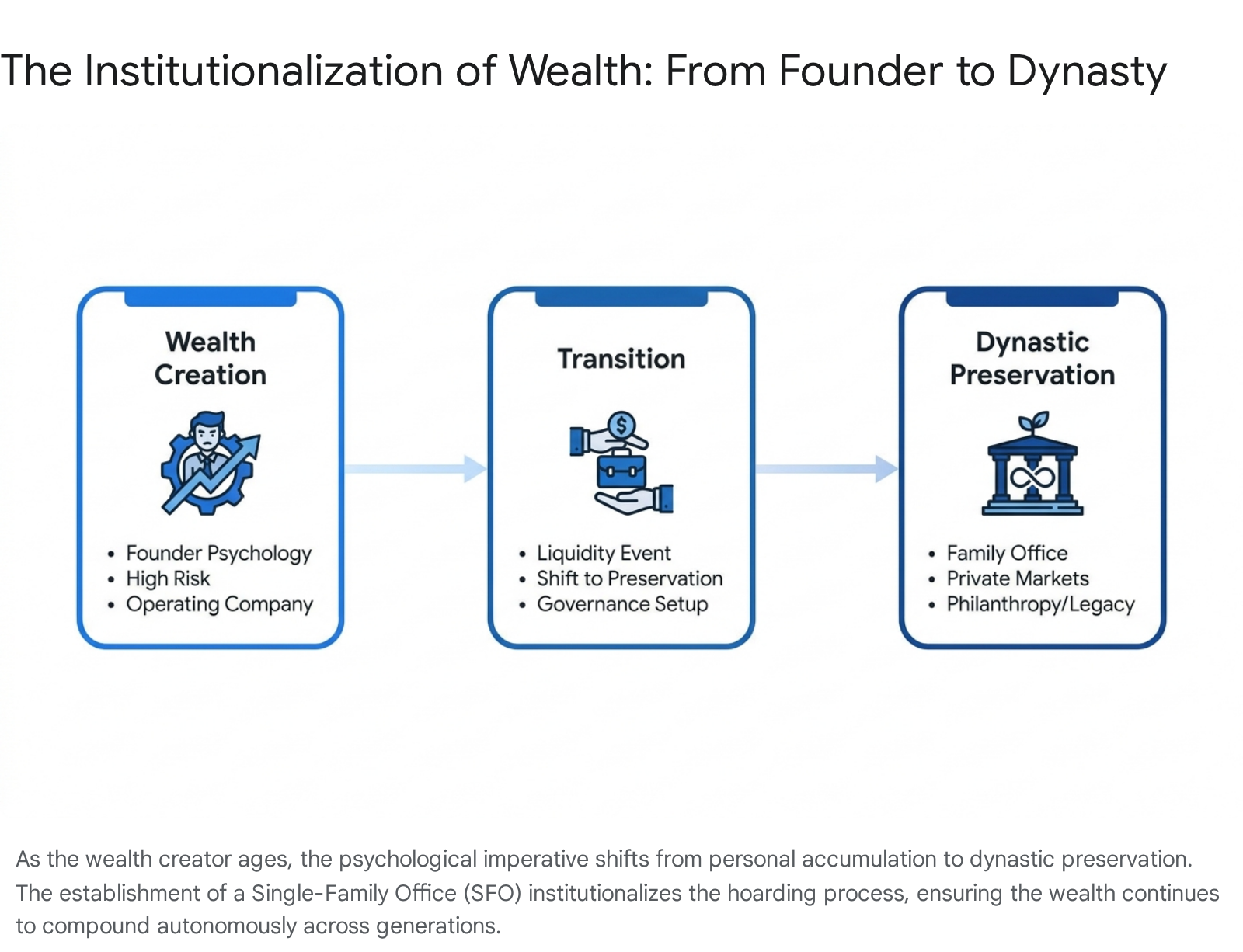
As an ultra-high-net-worth individual ages, the psychological drive for aggressive personal accumulation often morphs into a profound desire for dynastic permanence. The hoarding of wealth transitions from an individual behavioral trait to a hardened, bureaucratic institutional structure. This transition is most visibly manifested in the explosive global rise of the "Family Office."
Family offices - private wealth management advisory firms that serve ultra-high-net-worth investors - were once the exclusive domain of historic Western dynasties, such as the Rockefellers or European aristocracy 33. Today, they have become a structural necessity for the newly minted billionaires of the 21st century.
The growth of these institutions has been particularly staggering in Asia and the Middle East. By the end of 2024, Singapore saw its number of single-family offices (SFOs) surge to over 2,000, representing a five-fold increase since 2020 and a massive migration of new wealth seeking institutional permanence 3336. Similarly, the United Arab Emirates (UAE) has emerged as a global hub for family offices, drawing thousands of millionaires and billionaires seeking zero-tax jurisdictions and highly favorable regulatory environments to preserve their wealth 3637.
From Wealth Creation to Capital Immortality
The primary psychology underpinning the family office is the pursuit of capital immortality. The founder recognizes their own biological mortality and seeks to ensure the wealth survives them indefinitely. As a result, operations demand highly professional governance, sophisticated digital infrastructure, and institutional-grade investment capabilities to handle cross-border complexity and succession planning 34.
In these institutional structures, capital is heavily rotated into private markets, private credit, and venture capital. These are illiquid assets that lock up wealth for long durations, shielding it from short-term public market volatility, regulatory scrutiny, and rapid liquidation 373435. This marks a definitive shift in investor psychology from "How much can I make?" to "How do I ensure this wealth is never lost?" The family office is legally and structurally designed to bypass the traditional dissipation of dynastic wealth, effectively locking vast sums of capital out of the broader public economy to serve a single bloodline in perpetuity.
Philanthropy and Legacy Rationalization
A frequent counter-argument to the concept of pathological wealth hoarding is the high-profile philanthropy practiced by many billionaires, most notably structured through initiatives like "The Giving Pledge." Founded in 2010 by Bill Gates, Melinda French Gates, and Warren Buffett, the Pledge asks the world's billionaires to publicly commit to giving away at least half of their wealth either during their lifetime or upon their death 363738.
The Psychology of Elite Philanthropy
While the general public often perceives such mega-philanthropy as purely altruistic, deep psychological and sociological analyses of the Giving Pledge reveal a much more complex motivation tied to ego, legacy-building, and systemic social control. When researchers analyze the commitment letters written by Giving Pledge signatories, they find a strong rhetorical emphasis on funding systemic global interventions - primarily in health, education, and technology - which effectively allow the billionaire to exert massive, unaccountable influence over public policy and scientific direction 3639.
Philanthropy at this echelon acts as an extension of the billionaire's power and psychological need for control. It allows them to apply their personal, business-oriented "solutionism" to global socio-economic problems, satisfying a deep psychological need to be perceived as a savior or a historical figure of profound, lasting importance 39. Furthermore, giving away money via private family foundations rather than public institutions allows the ultra-wealthy to convert financial capital into immense social and political capital, avoiding the democratic redistribution of resources via taxation.
The Reality of the Giving Pledge
The empirical data regarding the Giving Pledge suggests that the ingrained psychology of accumulation often overrides the stated intent of charitable distribution. A comprehensive 2025 analysis of the Giving Pledge at its 15-year mark revealed stark realities regarding billionaire giving behaviors 373840:
| Giving Pledge Metric (15-Year Mark, 2025 Data) | Statistical Reality | Implication for Wealth Psychology |
|---|---|---|
| Wealth Growth of Original Signers | The 32 original U.S. signers from 2010 who remain billionaires have collectively grown 283% wealthier since taking the pledge 40. | The mechanisms of compounding wealth drastically outpace voluntary charitable disbursement, rendering the pledge mathematically ineffective at reducing inequality 3840. |
| Control of Distributed Funds | Of the estimated $206 billion given to charity by the original cohort, roughly 80% ($164 billion) was transferred to private foundations or donor-advised funds (DAFs) 3740. | Billionaires retain tight control over the allocation and timing of the funds, prioritizing dynastic influence over immediate charitable impact 3740. |
| Pledge Fulfillment at Death | Of the 22 U.S. Pledgers who have died by 2025, only 8 successfully fulfilled their pledge of giving away 50% or more of their wealth 3740. | Even upon death, the psychological imperative to preserve capital and transfer wealth to heirs frequently supersedes philanthropic commitments 37. |
These statistics highlight that even when billionaires consciously decide they "have enough" and intend to disburse their wealth, the systemic mechanisms of their assets - and their underlying psychological need to maintain total control over capital - result in continued, accelerated hoarding.
Systemic Drivers and Oligarchic Insulation
Finally, the psychology of wealth hoarding does not exist in a vacuum; it is actively cultivated, validated, and accelerated by the mathematical and political realities of the global economic system. Individual psychology is profoundly shaped by the environment in which it operates, and the current financial architecture provides a frictionless environment for limitless accumulation.
Multiplicative Dynamics and the Power Law
The distribution of wealth in modern capitalist systems is not linear; it follows a Pareto or "power law" distribution 712. As economist Thomas Piketty's inequality model formally demonstrates, when the return on capital persistently exceeds the overall rate of economic growth, wealth naturally and aggressively concentrates at the very top 7.
Because the ultra-wealthy derive the vast majority of their income not from salaried wages, but from capital gains, private equity returns, and corporate dividends 41, their wealth operates entirely on multiplicative dynamics 9. According to the Udny Yule model of proportional growth, the growth rate of wealth is proportional to the sheer size of the wealth already held 7. Therefore, a billionaire does not necessarily need to psychologically try to hoard wealth on a daily basis; once a fortune reaches a critical mass, the financial architecture of compounding interest, market power, and asset appreciation does the hoarding autonomously.
Political Capture and the Protection of Wealth
To protect this runaway accumulation, billionaires utilize their immense resources to actively reshape the political and regulatory landscape. By early 2026, Oxfam research highlighted that the ultra-wealthy use their fortunes to systematically buy political influence, control media narratives, and shape justice systems to defend their assets 14. The data indicates that billionaires are over 4,000 times more likely to hold political office than ordinary citizens, granting them direct access to the levers of state power 142.
This dynamic creates a highly insulated feedback loop: extreme wealth allows individuals to capture regulatory and tax policy, which in turn facilitates further, unimpeded wealth accumulation 47. By investing vast sums in the legitimation of elite power - through the ownership of major media networks, influence over algorithmic AI platforms, and massive political campaign contributions - the ultra-wealthy secure a macro-environment where their hoarding is legally protected, socially rationalized, and extremely lightly taxed 244. The internal psychology of the billionaire is thus validated by an external societal structure that continuously rewards and protects their behavior, cementing the foundation of what researchers and inequality advocates increasingly term a new global oligarchy 24344.
Conclusion
The psychology of billionaire wealth hoarding represents a complex, deeply entrenched intersection of primitive human neurobiology, sociological status signaling, and modern financial architecture. It is a phenomenon where the biological survival mechanisms developed in ancestral environments of severe scarcity have been hijacked by the limitless, abstract metrics of global finance.
Billionaires continue to accumulate capital long after they have enough because, at the highest echelons of net worth, money ceases to be a functional tool for personal consumption. Instead, it transforms into an infinitely scalable supernormal stimulus. This stimulus locks individuals into a dopaminergic loop of behavioral addiction, driving them to pursue ever-greater numbers to stave off anhedonia and signal their superiority in an exclusive, high-stakes prestige economy.
When individual mortality inevitably approaches, this psychological drive is codified into the legal structure of the Family Office and private foundations, ensuring that the wealth - and the systemic power it commands - remains hoarded and insulated across generations. Ultimately, wealth hoarding is not simply a matter of individual greed or moral failing; it is a profound evolutionary mismatch, constantly reinforced by mathematical power laws and fiercely protected by political capture, resulting in the most extreme concentration of resources in human history.