Psychological Drivers of Customer Loyalty
1. Introduction: Deconstructing the Loyalty Paradigm
For decades, the concept of customer loyalty has been enveloped in a romanticized paradigm, fundamentally conflating transactional repeat purchasing with genuine affective commitment. The prevailing orthodoxy within marketing management has assumed that consumers naturally form deep, emotional bonds with commercial entities, leading to the pursuit of "brand love" as the ultimate corporate objective 12. However, modern empirical marketing science and behavioral economics present a starkly different reality. Customer loyalty is rarely an intense psychological attachment; more frequently, it is a byproduct of behavioral inertia, cognitive load minimization, and structural market availability 13.
The stakes for understanding these psychological mechanisms are exceedingly high. Although improving customer retention by a mere 5% can yield profit increases ranging from 25% to 95%, the strategies deployed to achieve this retention often rely on flawed attitudinal assumptions 45. As the commercial landscape transitions into the hyper-accelerated digital ecosystems of the 2020s, where attention compression forces consumer decisions into micro-moments, traditional longitudinal nurture sequences are collapsing 4. Simultaneously, cross-cultural research reveals that the psychological drivers of retention and advocacy are not universal, varying dramatically between individualistic and collectivistic societies 75.
This report delivers an exhaustive analysis of the psychology of customer loyalty. By systematically dismantling attitudinal misconceptions, contrasting prominent theoretical frameworks, and exploring the behavioral economics of friction and inertia, the analysis provides a rigorous, data-driven architecture of modern consumer retention. Furthermore, it maps the complex psychological transition required to elevate a passively retained customer into an active brand evangelist utilizing structural equation modeling and probabilistic data structures.
2. Theoretical Frameworks of Loyalty: A Comparative Analysis
To comprehend customer loyalty, one must navigate the deep epistemological divide between frameworks that prioritize a consumer's psychological disposition, those that prioritize a single metric of advocacy, and empirical frameworks that prioritize observed, aggregate purchasing patterns.
2.1 The Attitudinal Illusion: Dick and Basu's Framework
A foundational pillar of traditional loyalty theory is the two-dimensional framework proposed by Dick and Basu (1994), which posits that true loyalty exists only at the intersection of high relative attitude and high repeat patronage 6. Under this model, consumers are categorized into four distinct typologies. The first is "True Loyalty," indicating high repeat patronage coupled with a strong positive relative attitude. The second is "Spurious Loyalty," describing high repeat patronage driven by situational constraints or inertia, but lacking affective attachment. The third, "Latent Loyalty," occurs when a consumer possesses a high relative attitude but exhibits low repeat patronage, often due to environmental constraints such as high pricing or poor physical distribution. Finally, "No Loyalty" describes consumers with both low relative attitude and low repeat patronage 67.
The Dick and Basu framework holds intuitive appeal for marketing practitioners because it distinguishes between a customer who buys out of emotional preference and one who buys out of laziness or a lack of alternatives 89. Attitudinal researchers argue that distinguishing between these motivations is critical for assessing the vulnerability of a customer base to competitive incursions 10.
However, rigorous empirical testing severely limits the predictive validity of this composite definition. Longitudinal studies utilizing continuous reporter household panels demonstrate that attitudinal loyalty is only weakly related to future purchase loyalty and customer vulnerability 1011. Rather than predicting future behavior, stated attitudes are primarily a reflection of past and current behavior. As consumers buy a brand more frequently, their cognitive familiarity increases, leading to higher scores on brand attitude surveys - an empirical phenomenon where usage drives attitude, rather than attitude driving usage 315. Consequently, attempting to categorize buyers into rigid typologies like "spurious loyals" introduces unnecessary methodological noise, as attitudes exhibit extreme instability over time compared to the relative stability of aggregate purchasing behavior 1011.
2.2 The Net Promoter Score (NPS) Assumption
The Net Promoter Score (NPS) has dominated corporate boardrooms as the primary proxy for customer loyalty. NPS relies on a single question regarding the likelihood of recommending a brand, subtracting the percentage of "detractors" from "promoters" to generate a solitary metric 16. The fundamental assumption of NPS is that active advocacy is the primary engine of organic growth, and that satisfaction translates linearly into commercial loyalty.
Despite its operational simplicity and widespread adoption, NPS suffers from profound limitations when scrutinized through the lens of marketing science. The framework assumes that heavy buyers (the most likely promoters) are the source of brand growth, entirely neglecting category buying patterns. Empirical data consistently shows that a brand's customer base shares immense overlap with competitors, and that a single attitudinal metric fails to account for the actual purchasing repertoires of consumers 3. NPS functions adequately as a general barometer of recent customer service interactions, but it operates poorly as a predictive model for long-term category churn or market share expansion, as it ignores the massive volume of sales generated by light, indifferent buyers 312.
2.3 The Ehrenberg-Bass Perspective and the Law of Double Jeopardy
In stark contrast to the attitudinal and NPS paradigms stands the empirical generalization championed by Byron Sharp and the Ehrenberg-Bass Institute, built upon the Dirichlet model of buyer behavior. The central thesis here is that loyalty is fundamentally a predictable function of brand size, governed by the Law of Double Jeopardy 1213.
The Double Jeopardy law dictates that brands with smaller market shares suffer a dual penalty: they have far fewer buyers (lower penetration), and those few buyers are slightly less loyal (lower purchase frequency) 31514. This law has been consistently replicated across thousands of datasets encompassing fast-moving consumer goods, durable goods, business-to-business services, and digital subscriptions 3712. Under the Dirichlet model, a stationary, unpartitioned market operates predictably. Consumers possess varying probabilities of purchasing different brands, forming a repertoire of acceptable choices 2015. Because all brands share their customer base with competitors in proportion to those competitors' market shares - a phenomenon known as the Duplication of Purchase Law - the concept of exclusive, deeply committed "brand lovers" is a statistical anomaly 315.
The implications of Double Jeopardy systematically dismantle the traditional focus on deep psychological segmentation and complex loyalty programs. First, it highlights that growth relies on penetration over retention. It is mathematically impossible to radically alter customer defection rates without a massive concomitant shift in overall market share 3. Thus, growth strategies must prioritize mental availability (being easily thought of in a buying situation) and physical availability (being easy to find and purchase), targeting the entire market of light and non-buyers rather than attempting to squeeze higher purchase frequencies out of a small base of heavy buyers 21213.
Second, it shatters the myth of brand love. Empirical data demonstrates that buyer profiles across competing brands within a category are virtually identical 23. Consumers do not typically select brands because the brand's "archetype" perfectly matches their own identity; they buy because the brand is cognitively accessible and physically present at the moment of need 2. Finally, the law of Retention Double Jeopardy proves that larger brands automatically enjoy lower defection rates strictly by virtue of their scale and network dominance, not necessarily due to superior relationship marketing 31514.
| Analytical Framework | Core Theoretical Assumption | Proposed Mechanism of Retention | Primary Strategic Imperative | Empirical Validity & Limitations |
|---|---|---|---|---|
| Net Promoter Score (NPS) | Customer advocacy directly predicts corporate growth. | High satisfaction drives recommendations. | Maximize promoters, minimize detractors. | Operational simplicity; but exhibits weak predictive power for long-term category churn. |
| Dick & Basu (Attitudinal) | Loyalty requires both behavioral action and deep affection. | Cognitive and emotional commitment prevents switching. | Convert "Spurious" loyals to "True" loyals via relationship building. | Low empirical validity; attitudes are highly unstable and generally reflect past usage rather than predict future action. |
| Byron Sharp (Double Jeopardy) | Loyalty is a mathematical function of overall market share. | Mental and physical availability minimize cognitive friction. | Maximize penetration; target all category buyers uniformly. | Exceptionally high validity; replicated across thousands of global categories, though ignores rare behavioral anomalies. |
3. The Behavioral Economics of Retention: Inertia, Friction, and Cognitive Load
If consumers are not bound to brands by profound emotional affection, the fundamental question remains: what keeps them returning? Behavioral economics provides the structural explanation, demonstrating that human decision-making is optimized for cognitive efficiency. Consequently, behavioral inertia and psychological friction serve as the primary engines of transactional retention 116.
3.1 Status Quo Bias and the Endowment Effect
Consumer retention relies heavily on the Status Quo Bias, defined as the inherent psychological preference for maintaining a current state of affairs due to the asymmetrical weighting of potential losses over equivalent gains 1724. When a consumer subscribes to a service, joins a digital loyalty program, or selects a default utility provider, deviating from that established option requires cognitive effort and carries the perceived risk of a suboptimal outcome 17.
This bias is powerfully amplified by the Endowment Effect, an anomaly where individuals ascribe a higher subjective value to an item or status simply because they possess it 172518. In the context of loyalty ecosystems, the Endowment Effect translates into the behavioral concept of "psychological ownership" 19. In classic behavioral economics experiments by Kahneman, Knetsch, and Thaler, subjects demanded an average of $7.12 to relinquish a standard coffee mug they had just been given, while buyers were only willing to offer $2.87 to acquire the exact same mug. This demonstrated an inflation of perceived value by roughly 2.5 times due solely to the psychological state of ownership 1819.
For loyalty professionals designing digital ecosystems, psychological ownership is the ultimate retention mechanism. When a consumer earns tier status, accumulates points, or customizes a user dashboard, the relinquishment of the brand relationship equates to a loss of self-concept and accrued cognitive capital 19. Loss resistance is activated; the customer is not loyal because they harbor deep affection for the brand's products, but because leaving triggers profound loss aversion 2519. Notably, empirical studies reveal that the Endowment Effect is most pronounced when consumers invest their own resources - such as personal financial expenditure rather than corporate accounts - to achieve status, cementing a deeper cognitive fusion with the target brand 19.
3.2 Behavioral Inertia and Cognitive Costs
Behavioral inertia operates as an invisible but extraordinarily powerful barrier to switching, often masquerading as "brand loyalty" in corporate CRM datasets. A massive randomized field experiment conducted in the Danish retail electricity market, analyzing administrative smart-meter data for 200,000 households, highlighted the staggering magnitude of this inertia 20. Despite potential average savings ranging from $140 to $360, targeted information interventions and the reduction of search costs increased switching by a mere 0.8 to 1.3 percentage points 20. The data revealed a vast gap between the intention to switch and the action of switching, driven primarily by procrastination, distrust, and meta-cognitive costs 2021.
Similarly, large-scale studies on digital subscription contracts for a major European newspaper reveal that "auto-renewal" defaults drastically inflate retention rates not through product satisfaction, but through sheer inattention 2223. Auto-renewal contract takers possess a 53% to 75% probability of failing to take a desired cancellation action within a given month, continuing to pay for services they rarely read or utilize 23. The research notes that highly sophisticated consumers, aware of their own future inertia, will actively preempt it by avoiding auto-renewal contracts altogether, leading to lower initial subscriber take-up but preserving long-term autonomy 2223.
This phenomenon underscores the profound impact of task switching costs and cognitive lock-in 21. The human brain continuously attempts to minimize the expenditure of mental energy. Once a purchasing habit loop is established - comprising a contextual cue, a routine, and a reward - neuro-imaging (fMRI) suggests that the neurological activity in the decision-making centers of the brain actually decreases during the repeated transaction 12425. Standard loyalty theory frequently misses this vital component: creating customer "stickiness" is significantly less about persuasive argumentation or emotional bonding, and significantly more about engineering behavioral automaticity 124.
3.3 The Paradox of Psychological Friction
In behavioral economics, friction refers to any cognitive, physical, or procedural obstacle that increases the effort or time required to execute a decision or complete a task 2635. Digital transformation initiatives have relentlessly pursued the "frictionless customer experience," operating under the assumption that any barrier reduces satisfaction and increases defection risk 3527. Indeed, corporate studies indicate that 94% of customers experiencing low-effort interactions demonstrate high repurchase intent, whereas minor hurdles - such as point expiration rules, complex redemption processes, or slow website load times - generate severe frustration and rapid program abandonment 35.
However, there is a profound psychological cost to the entirely frictionless environment. By engineering out all human interaction, procedural resistance, and cognitive strain, brands inadvertently strip away the mechanisms that foster genuine community, empathy, and emotional resilience 27. The "Social Friction" paradox suggests that minor, shared inconveniences or casual face-to-face interactions (even brief, seemingly inefficient exchanges with retail staff or customer service agents) are strong predictors of psychological belonging and long-term trust 27. In the pursuit of pure transactional efficiency and automated checkouts, digital platforms risk creating an environment of profound psychological detachment, where the consumer remains loyal only until a marginally faster algorithm or lower price appears 2728.
4. Algorithmic Loyalty: Navigating the Digital Ecosystem
The architecture of loyalty is undergoing a structural transformation driven by artificial intelligence and advanced data analytics. By the mid-2020s, the traditional conceptualization of the marketing funnel - with its slow, deliberate stages of awareness, consideration, and purchase - has been largely rendered obsolete by hyper-contextual algorithmic environments 438.
4.1 Attention Compression and Micro-Moments
The fundamental constraint of the modern digital ecosystem is "attention compression." Data from 2026 indicates that the average human attention span has deteriorated to 8.25 seconds, representing a 33% decline over the previous decade 4. On mobile interfaces, consumers spend roughly 1.7 seconds evaluating content before swiping away, meaning that retention decisions are executed in micro-moments rather than through deliberate, cyclical evaluation 4.
Consequently, static retention tactics - such as prolonged email nurture sequences, complex storytelling, or delayed point-accumulation schemes - break down in this environment 24. Behavioral intent completely eclipses demographic targeting; what a customer is doing in the immediate, real-time context is a vastly superior predictor of retention than their historical psychographic profile 4. To survive, AI systems must shift retention efforts upstream, intervening dynamically before the consumer's fragile attention evaporates 4.
4.2 The Algorithmic Personalization/Depersonalization Loop
Artificial intelligence reshapes loyalty by exploiting cognitive biases and curating choice architecture through predictive analytics and sophisticated recommender systems 3940. When successfully deployed, algorithmic marketing creates "experiential brand loyalty." As users interact with a digital platform - whether a streaming service, an e-commerce storefront, or a social media application - the algorithm learns, iterates, and reflects their precise preferences. The psychological sensation of being "seen and understood" by the algorithm activates positive emotional loops, deepening relational bonds and dramatically reducing churn intent 2829. Studies confirm that data-driven, highly personalized experiences can increase customer retention by up to 15% by minimizing search costs and maximizing immediate relevance 29.
However, this reliance on AI introduces the systemic risk of "algorithmic depersonalization" 29. Over-reliance on platform algorithms (such as TikTok feeds or Amazon recommendation engines) can severely erode the direct relationship between the brand and the consumer. According to industry reports, more than 35% of consumer purchases on Amazon and 75% of content consumed on Netflix are driven entirely by AI recommendations 42. If the platform alters its recommendation logic or restricts brand visibility, the carefully cultivated brand equity can vanish instantly, demonstrating that algorithmic visibility is highly fragile and not synonymous with durable brand loyalty 4230. Furthermore, aggressive algorithmic nudging and hyper-personalization often trigger consumer reactance, as individuals feel their autonomy is compromised or their privacy invaded, highlighting the absolute necessity for ethical transparency in digital choice architecture 394044.
4.3 Social Proof and the Gamification of Referral Dynamics
In the digital ecosystem, social proof acts as a primary catalyst for breaking behavioral inertia. The integration of social referral programs, where individuals recommend products within their networks for mutual rewards, operates by leveraging human social compliance and the principle of reciprocity 431. Recent studies on a telecommunications operator in China involving over 160,000 users analyzed the psychological friction involved in sending referrals.
The data revealed that senders often experience guilt when benefiting financially from their social networks 31. Interestingly, introducing uncertainty into the sender's referral reward (e.g., a probabilistic chance of a high payout rather than a guaranteed flat fee) significantly mitigated this guilt perception. By transforming the referral into a game of chance, the psychological friction was reduced, boosting overall referral volume and attracting higher-quality, highly engaged users to the platform 31. This demonstrates how precise algorithmic structuring of rewards can bypass cognitive barriers that traditional marketing strategies fail to overcome.
5. Cross-Cultural Loyalty Dynamics: Individualism vs. Collectivism
The psychological drivers of customer loyalty are not universal; they are deeply embedded within specific cultural frameworks. Operating primarily on Western-centric assumptions leads to systemic failures in global marketing strategy, as the core metrics of satisfaction, trust, and interpersonal connection manifest entirely differently depending on a society's orientation toward individualism or collectivism 732.
5.1 Individualistic Loyalty: Autonomy and Transactional Utility
In individualistic cultures (predominantly Western societies such as the United States and Western Europe), the self is viewed as autonomous, independent, and consistent across varying situations 747. Consumers in these environments prioritize personal freedom, self-expression, individual achievement, and personal autonomy 7.
Behaviorally, individualistic customers exhibit significantly lower thresholds for brand switching. They calculate commercial relationships based on mutual benefit and individual gains; if a competitor presents superior features, better pricing, or elevated product quality, the individualistic consumer will readily defect 3247. Loyalty programs in these markets must focus intensely on personal rewards, customization, and frictionless utility. For example, a comparative study revealed that individualistic consumers are highly motivated by direct economic rewards when induced to generate electronic word-of-mouth (eWOM) or write online reviews 5.
Furthermore, psychological states such as loneliness trigger a unique response in individualists. Lacking strong, interdependent community ties, lonely individualistic consumers attempt to restore a sense of social connection indirectly by amplifying their emotional attachment to corporate brands - seeking out "brand love" to fill a psychological void 3334.
5.2 Collectivistic Loyalty: Social Cohesion and Network Trust
Conversely, collectivistic cultures (prevalent across vast regions of Asia, Africa, and Latin America) define the self interdependently, viewing individuals as fundamentally embedded within extended families and broad social networks 747. In these societies, the collective good, social harmony, and communal values supersede personal desires and individual autonomy 74735.
In collectivistic settings, consumer decision-making is often consensus-driven, relying heavily on the perception of the societal group and familial ties 7. Consequently, collectivistic consumers display significantly higher baseline brand loyalty, provided the brand continuously aligns with community norms and upholds social ideals 32. Trust is constructed not just through efficient transactions, but through personalized interactions that respect hierarchical relationships and cultural expectations (e.g., deference to elders or an emphasis on profound hospitality in Japanese or South Korean service environments) 7. A quantitative survey utilizing Geert Hofstede's framework in Malaysia (surveying 103 participants, split evenly between Asian and Western cultural backgrounds) demonstrated that collectivism plays a dominant role in determining overall service satisfaction levels in retail environments involving multinational brands 3536.
When designing retention mechanics for collectivistic cultures, economic bribes are less effective than social validation. Collectivistic consumers respond substantially better to social rewards rather than economic incentives when participating in referral programs or generating eWOM 5. Furthermore, the experience of loneliness in collectivistic consumers does not lead to an increase in brand love. Instead of attempting to forge parasocial relationships with commercial entities, they turn inward to their existing, close-knit interpersonal networks to restore their psychological equilibrium 3334.
6. The Service Recovery Paradox: Catalyzing the Transition
The transition from a passive, retention-based state (driven by inertia and switching costs) to an active state of brand evangelism rarely occurs through standard, frictionless transactional satisfaction. Often, it requires an emotional disruption. One of the most potent catalysts for this rare transition is the Service Recovery Paradox (SRP).
The SRP is a well-documented phenomenon where a customer's post-failure satisfaction significantly exceeds their pre-failure satisfaction, provided the firm executes a superlative, unexpected service recovery 165237. Rooted in expectation disconfirmation theory and the resolution of cognitive dissonance, the SRP relies on the sudden removal of acute psychological friction 3754. When a service failure occurs, it shatters the customer's expected baseline, generating immediate mental discomfort and emotional volatility 5238.
If the brand intervenes rapidly and effectively, demonstrating high distributive justice (fair, tangible compensation for the failure) and procedural justice (efficient, transparent problem resolution processes), the cognitive dissonance is resolved overwhelmingly in the brand's favor 37. Interestingly, studies utilizing structural equation modeling to analyze 638 survey responses found that interactional justice (the mere politeness of the staff) had a negligible impact compared to actual procedural and distributive justice in these critical moments 37.
The sudden display of competence, fairness, and empathy triggers a powerful reciprocity effect 4. The customer, transitioning rapidly from a state of vulnerability and frustration to one of intense relief, frequently experiences an emotional spike that converts them from a mere repeat purchaser into an active brand ambassador 1652. While the SRP is challenging and costly to execute consistently at scale, it highlights a crucial psychological reality: flawless, expected execution merely maintains behavioral inertia, whereas effectively resolved flaws create the emotional intensity required for true advocacy 38.
7. The Architecture of Brand Evangelism
Brand evangelism represents the absolute apex of customer behavior. An evangelist transcends passive retention; they exhibit proactive citizenship behavior by actively defending the brand against detractors, aggressively persuading non-users within their social networks, and providing free, highly credible social proof 195639. Evangelism extends traditional word-of-mouth marketing into the realm of voluntary, passionate advocacy, rooted heavily in psychological ownership and social identity theory 3940.
7.1 Psychological Transition Mechanics
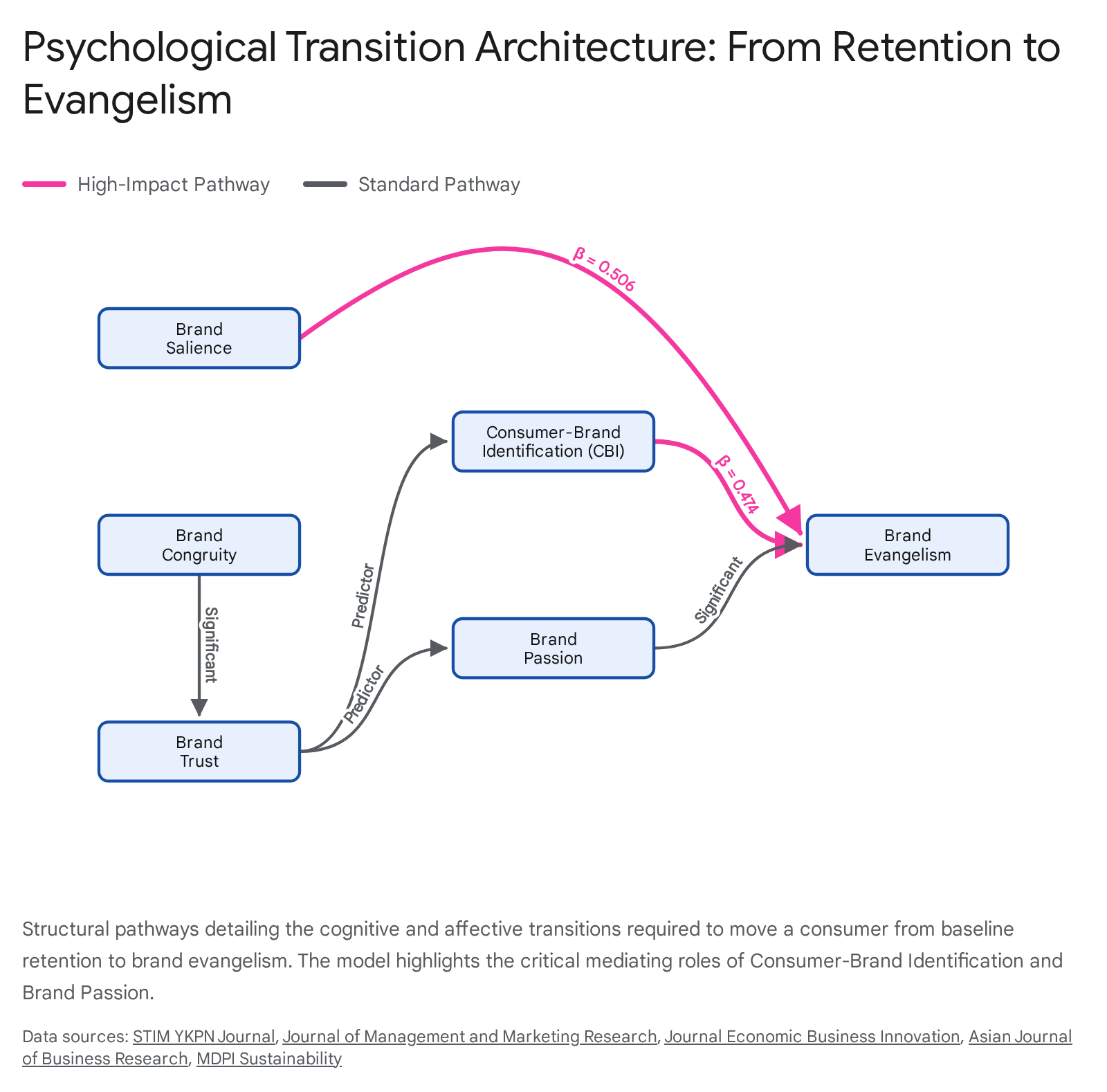
The transformation from a retained buyer to an active evangelist requires specific, sequential psychological triggers. Marketing scientists have mapped this transition extensively using Structural Equation Modeling (SEM) and Partial Least Squares (PLS-SEM) in academic literature to isolate the precise cognitive and affective variables involved 41.
First, the foundation requires the brand to be highly salient (cognitively available) and to exhibit brand congruity - a deep, authentic alignment between the consumer's self-image and the brand's projected image 414261. Empirical data indicates that brand congruity is the primary catalyst that initiates the deeper affective sequence 41.
Second, the consumer must experience Brand Trust and Brand Passion. Trust operates as a necessary, but entirely insufficient, condition for evangelism. Trust solidifies the consumer's belief in the brand's integrity, effectively minimizing perceived risk and supporting continuous repurchase behavior 4142. However, trust alone merely sustains passive retention. To trigger vocal advocacy, trust must be mediated by Brand Passion - an intense, emotional arousal and enthusiasm directed toward the brand 43.
Finally, Consumer-Brand Identification (CBI) acts as the critical cognitive mechanism that unlocks evangelism. Rooted deeply in self-verification and social identity theories, CBI occurs when a consumer internalizes the brand as a core, defining component of their own social identity 4044. SEM path analysis consistently demonstrates that CBI exerts a massive positive effect on brand evangelism ($\beta = 0.474$), effectively translating baseline satisfaction into proactive, oppositional advocacy 61. Without strong CBI, even highly satisfied, trusting customers will remain silent and will not evangelize 61.
7.2 Modeling Relationship Dynamics via Hidden Markov Models
From an advanced data science perspective, managing this transition across massive customer bases requires sophisticated probabilistic tools. Because a consumer's internal psychological state (e.g., 'Inactive', 'Retained via Inertia', 'Active Evangelist') is inherently unobservable in raw, cross-sectional transactional data, leading marketing analysts utilize Hidden Markov Models (HMM) to accurately map these relationship dynamics 4566.
An HMM assumes the existence of finite, latent relationship states governed by a Markov process. In this structure, the transitions between states are not random, but are driven by time-varying covariates such as targeted marketing encounters, service failures, promotional pricing, or specific algorithmic interventions 4566. By deeply analyzing observable, sequential behaviors - such as purchase incidence, the monetary amount of the transaction, channel choice, and social sharing behavior - the HMM algorithm probabilistically classifies the customer's current hidden state 66.
Through rigorous HMM analysis, firms can empirically prove that specific marketing interventions serve completely different psychological purposes depending on the customer's latent state. For instance, research demonstrates that offline, high-touch experiences (like a physical retail visit or a direct consultation) are highly effective at migrating customers from an inactive state to an active state, successfully breaking the powerful bonds of behavioral inertia . Conversely, low-friction, highly optimized digital channels do very little to wake an inactive customer; instead, they are the optimal mechanism for maintaining an already active state through continuous cognitive load reduction and ease of use .
8. Conclusion
The modern psychology of customer loyalty demands a rigorous reconciliation of seemingly opposing forces. On a macro-behavioral level, the Ehrenberg-Bass Institute's Double Jeopardy law remains incontrovertible: true brand growth and baseline commercial retention are overwhelmingly governed by market penetration, mental availability, and the minimization of cognitive friction, rather than by deep, widespread affective commitment. Consumers, especially those navigating the hyper-accelerated algorithmic digital ecosystems of the modern era, naturally default to behavioral inertia to conserve precious cognitive resources, sticking with default options and familiar repertoires simply because switching is mentally taxing.
However, recognizing the sheer mathematical dominance of behavioral inertia does not negate the existence, nor the profound commercial value, of the active brand evangelist. While statistically rare within the broader customer base, the evangelist represents a distinct, highly actualized psychological state. This state is achieved not through frictionless transactions, but through structural identity alignment, the resolution of psychological friction (often via service recovery), and the establishment of psychological ownership. To cultivate this upper echelon of loyalty, marketers must move beyond rudimentary transactional point systems and design sophisticated interventions that resonate with specific cultural dimensions - leveraging social cohesion and communal validation in collectivistic societies, while honoring autonomy and transactional utility in individualistic ones. Ultimately, the future of customer retention lies in managing the precise, delicate balance between seamless, algorithmic utility designed to capture the inert majority, and profound, identity-affirming engagement required to mobilize the highly valuable, vocal minority.