
Psychology of deceptive advertising and consumer vulnerability
Human cognition represents a highly evolved system capable of complex abstraction, rapid pattern recognition, and sophisticated reasoning. However, the exact evolutionary mechanisms that enable rapid comprehension in chaotic environments also generate systematic distortions in judgment. In the context of modern commerce, deceptive advertising capitalizes on these structural limitations - frequently termed cognitive blind spots - to manipulate consumer perception and direct economic behavior. Unlike traditional persuasion, which theoretically relies on the substantive merits and verifiable facts of an argument, deceptive advertising operates by exploiting the psychological heuristics that govern human decision-making under conditions of uncertainty, time pressure, or information asymmetry.
Understanding consumer vulnerability requires examining the intersection of behavioral economics, cognitive psychology, and digital interface design. As marketing communications evolve from static mass-media broadcasts to hyper-personalized algorithmic targeting, the psychological mechanisms of deception have become increasingly covert and highly engineered. This analysis explores the cognitive frameworks that leave individuals susceptible to misleading claims, the modern typologies of digital manipulation, cross-cultural variances in consumer vulnerability, and the ongoing friction between established psychological reality and the legal standards governing consumer protection.
Foundational Mechanisms of Persuasion
The susceptibility of consumers to deceptive advertising is heavily predicated on how the human brain processes incoming information. Cognitive psychology provides several robust models to explain why individuals frequently accept factually untrue, highly exaggerated, or contextually misleading claims without subjecting them to critical, rational scrutiny.
Dual-Process Cognition and the Elaboration Likelihood Model
The Elaboration Likelihood Model (ELM), developed by Richard E. Petty and John T. Cacioppo in the 1980s, remains a foundational dual-process theory for understanding attitude formation and persuasion 12. The ELM posits that persuasion occurs along a continuum of cognitive elaboration, functioning primarily through two distinct mental pathways: the central route and the peripheral route 11.
Central route processing involves high cognitive elaboration. When consumers utilize this pathway, they meticulously evaluate the logical arguments, factual evidence, and underlying substantive merits of a marketing message 12. Attitudes formed via the central route are generally highly resistant to counter-persuasion, demonstrate greater temporal persistence, and are durable predictors of long-term economic behavior 1. However, central processing is metabolically and cognitively expensive; it requires both the motivation to process the information (often driven by high personal relevance) and the cognitive ability to do so, which requires sufficient time, baseline knowledge, and freedom from environmental distraction 121.
Conversely, the peripheral route requires exceedingly low elaboration. When individuals lack the motivation or cognitive capacity to scrutinize a message deeply, they rely on peripheral cues - superficial elements such as the physical attractiveness of the spokesperson, the apparent expertise of the source, or the sheer quantity of arguments presented - to form an attitude 12. Deceptive advertising systematically targets and isolates the peripheral route. By artificially inflating the cognitive load - through rapid visual pacing, complex fine print, high-pressure countdown timers, or information overload - marketers can effectively strip consumers of the ability to process claims centrally. This forces reliance on heuristic shortcuts that bypass logical scrutiny, rendering the consumer susceptible to manipulation 212.
Availability Heuristics and Cognitive Ease
A primary driver of peripheral processing is the human brain's relentless pursuit of cognitive ease. The human mind naturally favors information that is easily retrieved from memory, a phenomenon inextricably linked to the availability heuristic 36. Marketers exploit this biological tendency through sheer repetition. Repeated exposure to a specific claim, visual motif, or brand asset increases its familiarity, and the human brain frequently struggles to distinguish simple familiarity from objective truth 3.
Psychological research demonstrates that an entire statement does not even need to be repeated for this effect to take hold; the repetition of a single phrase within a broader claim is often sufficient to make the entire proposition feel familiar and, by extension, credible. For example, consistent exposure to a neutral phrase such as "the body temperature of a chicken" makes an individual significantly more likely to accept an arbitrary, fabricated numeric claim regarding that specific temperature simply because the premise feels cognitively fluent 3. In the absence of a verifiable source or related contextual knowledge, consumers naturally default to the feeling of cognitive ease. Authoritarian institutions and mass marketers have historically relied on this mechanism, recognizing that frequently mentioned topics populate the conscious mind while alternative considerations slip away from awareness 3.
Metacognitive Deficits and the Bias Blind Spot
The effectiveness of deceptive advertising is further compounded by widespread metacognitive deficits among the general public. Consumers generally operate under the profound illusion that they are rational actors who are largely immune to manipulation. This phenomenon, known as the bias blind spot, refers to the systematic tendency for individuals to recognize cognitive biases in others while remaining entirely oblivious to those same biases in their own decision-making processes 64.
Empirical studies reveal that the bias blind spot affects nearly everyone, generalizing across social, cognitive, and behavioral domains. In one comprehensive psychological study conducted at Carnegie Mellon University, only a single individual out of 661 participants assessed themselves as being more biased than the average person 4. This pervasive overconfidence acts as a formidable barrier to critical reflection. The research indicated that intelligence, general cognitive ability, and self-esteem are independent characteristics entirely unrelated to the bias blind spot 4. Consumers possessing a high bias blind spot are statistically the most likely to ignore expert advice and the least likely to learn from de-biasing interventions or consumer education training, making them particularly vulnerable to sophisticated marketing manipulations 45.
Furthermore, the Dunning-Kruger effect illustrates that individuals lacking competence in a specific domain - such as assessing the efficacy of complex financial products, understanding pharmaceutical contraindications, or evaluating the actual carbon footprint of an eco-labeled garment - also lack the metacognitive capacity to recognize their own ignorance. The less an individual knows about a product category, the less capable they are of accurately judging their own vulnerability to deception within that category 6.
Exploitation of Cognitive Heuristics in Market Environments
Marketing strategies deliberately exploit evolutionary heuristics to optimize conversion rates and maximize profit. While cognitive biases function biologically as protective mechanisms to conserve brain resources in complex environments, they produce highly predictable errors in judgment when manipulated by carefully crafted commercial choice architectures 9.
Anchoring, Framing, and Loss Aversion
Pricing and promotional strategies rely heavily on anchoring, a cognitive bias where individuals depend excessively on the initial piece of information encountered to guide all subsequent judgments and estimations 10. In retail environments, displaying an artificially inflated "original" price directly next to a "sale" price establishes a high psychological anchor. The consumer evaluates the transaction not on the absolute utility or intrinsic market value of the item, but relative to the anchor, perceiving a substantial, albeit fabricated, financial gain 1012. This mechanism limits the consumer's search for better alternatives and obfuscates the true market value of the product, consistently leading to irrational purchasing decisions 6.
Framing effects and loss aversion further distort economic rationality. Behavioral economics indicates that the psychological pain of losing an asset is significantly more intense than the pleasure derived from acquiring an equivalent gain 14. Advertisements framed around scarcity or the active avoidance of a penalty - such as losing free shipping, missing a limited-time discount, or forfeiting accumulated reward points - trigger highly risk-averse behavior. Consumers frequently spend more absolute capital to avoid a perceived minor loss, prioritizing immediate emotional relief over long-term economic optimization 126. A classic manifestation occurs when a shopper adds unnecessary items to a digital cart simply to avoid a nominal shipping fee, erroneously viewing the avoidance of the fee as a victory despite the higher total expenditure 12.
Authority Bias and the Halo Effect
When confronted with uncertainty or complex product specifications, consumers routinely look to external signals to validate their choices. Authority bias dictates that individuals attribute greater accuracy and credibility to the opinions of perceived experts or authority figures, regardless of the actual content of the message 7. Brands operationalize this by utilizing white-coat endorsements, scientific jargon, and official-looking trust badges, triggering compliance mechanisms that are deeply instilled through childhood socialization 716. Consumers subconsciously utilize these symbols of authority to shorten the decision process and reduce perceived risk 7.
Concurrently, the halo effect creates a spillover of unearned trust based on an overall positive impression. If a consumer likes a specific individual or brand, they automatically attribute other positive qualities to them that they may not possess 98. This is the psychological foundation of celebrity endorsements; the attractiveness, success, or charisma of the endorser creates a halo that transfers perceived competence and reliability onto the advertised product, bypassing any logical evaluation of the product's actual merits 99.
Social Proof and the Bandwagon Effect
The human species is inherently social, and the desire to conform to group behavior is a powerful evolutionary survival mechanism. Social proof capitalizes on this herd instinct, wherein consumers assume that collective actions represent the correct, safe, and optimal path 91011. E-commerce platforms leverage this by displaying "bestseller" tags, high-volume review counts, and artificial notifications of recent purchases by other users (e.g., "15 people are looking at this item right now").
The reliance on social proof is so profound that market research indicates approximately 45% of consumers refuse to purchase products that lack user reviews, viewing consensus as an absolute surrogate for quality verification 911. Deceptive advertisers exploit this vulnerability through fabricated testimonials, purchased follower counts, and engineered word-of-mouth campaigns. The illusion of popularity effectively neutralizes individual skepticism, driving impulse purchases through a manufactured fear of missing out (FOMO) 99.
| Cognitive Bias | Primary Psychological Mechanism | Common Deceptive Marketing Execution |
|---|---|---|
| Anchoring Bias | Over-reliance on the first piece of numerical information offered as a reference point. | Striking through a highly inflated "original" price to make the standard retail price appear as a steep discount 10. |
| Loss Aversion | The psychological pain of losing is stronger than the pleasure of gaining an equivalent amount. | Countdown timers, "limited stock" warnings, and artificial cart-expiration notices creating manufactured urgency 1214. |
| Social Proof | Assuming the actions of the masses reflect correct and safe behavior under uncertainty. | Fabricated testimonials, inflated follower counts, and notifications stating "X people bought this in the last hour" 911. |
| Authority Bias | Attributing higher credibility to figures perceived as experts or officials. | Actors in lab coats endorsing cosmetics, or the use of complex, pseudo-scientific terminology to obscure poor product efficacy 716. |
| Sunk Cost Fallacy | Continuing an endeavor due to previously invested resources rather than future value. | Introducing hidden fees (drip pricing) only at the final stage of checkout, knowing the consumer will not abandon the effort 12. |
| Halo Effect | Allowing a positive impression in one area to positively influence opinions in other areas. | Celebrity endorsements transferring the perceived attractiveness or success of the individual onto an unrelated product 9. |
Digital Choice Architecture and Dark Patterns
The rapid digitization of commerce has fundamentally altered the scale, speed, and precision of deceptive advertising. The user interface itself has become the primary mechanism of persuasion, giving rise to new taxonomies of behavioral manipulation embedded directly into the software consumers interact with daily.
The Mechanics of Interface Manipulation
Dark patterns, also referred to as deceptive patterns, represent user interface designs meticulously crafted to coerce, steer, or manipulate consumers into making choices that serve a commercial entity's goals, often at the direct expense of the user's finances, time, or data privacy 132314. These practices are not accidental design flaws; they are engineered applications of behavioral psychology intended to subvert user autonomy. Research categorizes these manipulative patterns primarily into two distinct tactical families: tactics that exploit information asymmetry and tactics that repress free choice 12.
Tactics exploiting information asymmetry prey on a consumer's lack of comprehensive data through active misleading or passive omission. For example, "sneaking" or "drip pricing" involves hiding mandatory fees, taxes, or auto-renewal conditions until the consumer is deeply invested in the final stages of a transaction, effectively exploiting the sunk cost fallacy 121314. Similarly, "visual interference" utilizes color psychology and spatial layout to fade out non-lucrative options (such as declining tracking cookies) while aggressively highlighting lucrative ones, exploiting the user's propensity to follow paths of least cognitive resistance 1215.
Tactics focused on free choice repression impose psychological pressures or physical digital barriers to hinder a user's desired actions. The "roach motel" pattern makes subscribing to a service virtually frictionless but requires consumers to navigate labyrinthine, multi-step processes, phone calls, or confusing menus to cancel 122316. "Confirmshaming" employs hostile or emotionally manipulative phrasing (e.g., "No thanks, I prefer to pay full price" or "No, I don't care about my security") to trigger guilt, social anxiety, and compliance, pushing the user toward the commercially desired outcome 12.
Global Prevalence of Deceptive Design
The integration of these deceptive practices is not localized to fringe enterprises; it has become an industry standard. A 2024 global internet sweep conducted by the International Consumer Protection and Enforcement Network (ICPEN) and the Global Privacy Enforcement Network (GPEN) reviewed 642 subscription-based platforms across multiple countries and languages 1317. The findings revealed that an overwhelming 75.7% of the analyzed applications and websites employed at least one dark pattern, with nearly 67% utilizing multiple manipulative tactics concurrently 1317.
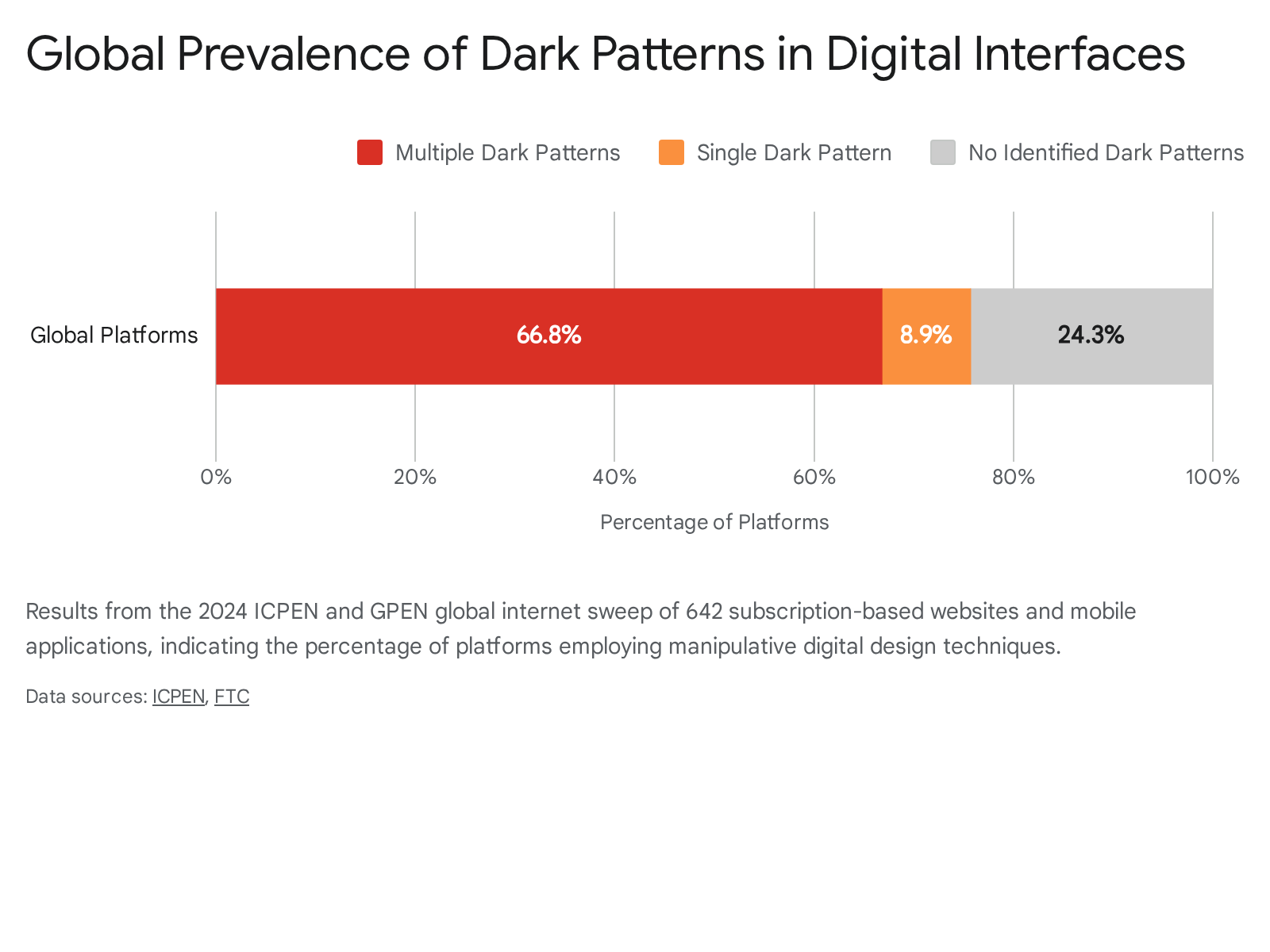
Regional data corroborates this systemic issue. A 2022 study by the European Commission estimated that 97% of the most-visited e-commerce websites in Europe employed at least one dark pattern, paving the way for sweeping regulatory reforms 1819. In India, the Advertising Standards Council of India (ASCI) reported in 2024 that 52 out of the 53 top Indian mobile applications utilized dark patterns, predominantly drip pricing and privacy deception, severely undermining user autonomy 2021.
Economic Consequences of Interface Deception
The economic toll of this ubiquitous manipulation is staggering. Consumers frequently suffer direct financial losses due to hidden subscriptions, stealth fees, and biased impulse purchases orchestrated by deceptive architectures. The French consumer watchdog, the DGCCRF, estimates that these specific digital manipulation tactics result in approximately €8 billion in losses across Europe annually 19.
Beyond direct financial extraction, dark patterns facilitate massive, unconsented data harvesting. Interfaces designed to obfuscate privacy settings or mandate data sharing as a prerequisite for service access coerce consumers into trading highly sensitive personal information, which is subsequently monetized by data brokers 1322. The Organization for Economic Cooperation and Development (OECD) notes that the harm extends to psychological distress, eroded market trust, and the disproportionate exploitation of vulnerable groups, such as minors or less educated individuals, who lack the digital literacy to navigate hostile interfaces 14.
Algorithmic Seduction and Micro-Targeting
The integration of artificial intelligence, machine learning, and predictive analytics into marketing platforms has birthed a highly insidious phenomenon described in recent psychological literature as algorithmic seduction 2324. Rather than broadcasting a uniform deceptive message to a mass audience, digital systems now continuously aggregate vast behavioral datasets to identify, track, and exploit individual consumer vulnerabilities in real-time 2325.
Predictive Analytics and Dynamic Profiling
Algorithmic marketing operates by creating datafied profiles of consumers, mapping their preferences, emotional states, and cognitive weaknesses 25. This creates an environment of extreme, unparalleled information asymmetry. Algorithms identify highly transient psychological states - such as late-night fatigue, emotional distress following a life event, or sudden financial insecurity - and dynamically deploy personalized stimuli designed specifically to bypass that individual's rational resistance 2326.
The psychological harm of this practice is profound because the consumer operates under a total illusion of consent and autonomy. The algorithmic nudging is so tightly integrated into the user experience, often masquerading as personalized convenience or curated content, that the consumer genuinely believes the artificially generated choices represent their organic desires 2325. This represents a shift from traditional persuasion, which relies on arguable claims, to the commodification of psychological vulnerability, where the digital environment itself is orchestrated to steer behavior below the threshold of conscious awareness 23.
The Illusion of Consent and Inefficacy of Warnings
Traditional consumer protection paradigms, which rely heavily on transparency, disclosure, and informed consent, prove largely ineffective against algorithmic micro-targeting. Regulatory efforts often focus on warning users that their data is being used to target them, assuming that transparency will empower the consumer to engage their central processing route and resist manipulation.
However, recent psychological studies evaluating the efficacy of "warning popups" (which alert users that they are being subjected to personality-tailored political or commercial micro-targeting) found that the presence of the warning had almost no meaningful impact on the persuasiveness of the advertisement 27. Across multiple experiments utilizing within-subject designs, personality-targeted ads maintained a significant persuasive advantage over non-targeted ads, and this advantage persisted entirely unabated despite explicit warnings 27. These findings suggest that the cognitive resonance achieved through deep personalization circumvents conscious defensive mechanisms, rendering standard transparency regulations fundamentally inadequate.
Parasocial Exploitation in Influencer Marketing
Influencer marketing introduces a highly effective vector for deceptive advertising by weaponizing the fundamental human need for social connection and community. Consumers, particularly digital natives in Generation Z, frequently form parasocial relationships with digital content creators. These are one-sided psychological bonds where the viewer perceives the influencer as a close, authentic, and relatable peer, rather than a corporate broadcaster 382829.
Synthetic Intimacy and Trust Transference
This perceived intimacy effectively short-circuits the consumer's standard persuasion knowledge model. Because the influencer is viewed as a relatable friend, their product endorsements are processed with significantly lower critical skepticism than traditional advertisements 282930. Research indicates that influencer authenticity and source credibility are powerful mediators of purchase intention; when an influencer is deemed authentic, trust is transferred directly to the endorsed product 2931.
"Parasocial exploitation" occurs when this forged intimacy is harvested for commercial gain without the consumer fully recognizing the transactional nature of the content 43. Deceptive practices in this space are rampant and deeply psychological. They include failing to adequately or conspicuously disclose financial compensation, promoting scientifically unfounded health or financial products to a trusting audience, or artificially inflating the efficacy of cosmetic items using undisclosed digital filters 3032. Because the recommendation comes from a trusted parasocial node, the consumer's critical faculties are bypassed, leading to manipulated purchasing behaviors driven by synthetic peer pressure 28.
The Emergence of De-Influencing
However, the efficacy of this mechanism is currently experiencing notable cultural friction. Data indicates a rising wave of skepticism among younger demographics. A 2024 report highlighted that nearly 50% of Generation Z consumers are unlikely to purchase products purely based on influencer recommendations, frequently describing paid partnerships as insincere, annoying, or inherently deceptive 33. Furthermore, an overwhelming 62% of Gen Z consumers now state they trust anonymous peer reviews significantly more than compensated influencer endorsements 34.
This erosion of trust has birthed the "de-influencing" trend, a digital counter-movement prioritizing anti-consumption, transparency, and authenticity. De-influencers actively critique overhyped products and urge audiences to avoid unnecessary purchases 34. Studies reveal this content enhances perceived authenticity and can lead to a 13% to 18% reduction in impulse buying among Gen Z consumers 34. Paradoxically, however, this trend itself is rapidly being co-opted by marketers as a novel, subversive tactic, wherein influencers disparage one product only to pivot and recommend a competitor's product, illustrating the relentless adaptability of deceptive marketing architectures 4334.
Environmental Deception and Greenwashing
As global anxiety regarding climate change and ecological degradation accelerates, consumer demand for sustainable products has surged. In response, deceptive environmental marketing - commonly known as greenwashing - has proliferated across the fashion, food, and energy sectors. Greenwashing exploits a combination of the affect heuristic, confirmation bias, and the general public's profound lack of scientific environmental literacy 23536.
The Affect Heuristic and Carbon Incompetence
When consumers are exposed to eco-centric imagery (such as green foliage, pristine oceans, or earthy color palettes) and vague, unregulated buzzwords like "natural," "earth-friendly," or "sustainable," they rely heavily on the affect heuristic 235. This cognitive bias leads individuals to prioritize their immediate, positive emotional response over objective, empirical data when making a decision 235. This emotional shortcut is heavily reinforced by confirmation bias; consumers who actively desire to act responsibly are eager to accept claims that align with their self-concept as ethical actors, making them highly susceptible to superficial indicators 236.
Furthermore, consumers generally exhibit what researchers term "carbon incompetence." The average individual lacks the technical expertise necessary to evaluate complex global supply chains, verify life-cycle emission data, or understand the nuances of agricultural runoff 36. Across multiple studies, consumers' estimates of emission intensity for various products were found to be essentially random, driven by irrelevant cues such as brand familiarity rather than actual environmental impact 36.
Symbolic Action and Narrow Framing
This profound informational gap allows firms to engage in sophisticated deception through narrow framing and hyperbolic discounting 836. Companies routinely highlight a minor, symbolically eco-friendly attribute of a product (such as a partially recyclable cardboard sleeve) while entirely obscuring the massive ecological damage caused by the product's core manufacturing process or supply chain 835.
The psychological damage of greenwashing extends beyond individual misallocation of funds. It generates widespread consumer confusion that artificially inflates the perceived value of illegitimate products, allowing bad actors to command premium pricing. Eventually, as these deceptive practices are exposed, it breeds a pervasive market cynicism that penalizes genuinely sustainable enterprises, leaving the public feeling disillusioned, deceived, and paralyzed in their environmental efforts 235.
Cross-Cultural Variances in Consumer Vulnerability
The psychological mechanisms of deception, while rooted in universal human neurobiology, are not entirely uniform in their application; their efficacy is heavily modulated by distinct cultural dimensions. Marketers operating globally must adapt their deceptive frameworks to exploit the specific socio-cultural conditioning, values, and communicative norms of their target populations 3738.
Individualism Versus Collectivism
The dichotomy between individualistic and collectivistic cultures drastically alters how cognitive biases manifest and which persuasive appeals are most effective.
Individualistic cultures, prevalent in North America and Western Europe, prioritize personal autonomy, distinctiveness, individual achievement, and self-expression 3739. Consumers in these regions are highly susceptible to framing that emphasizes exclusivity, personal success, and absolute freedom of choice. Deceptive marketing in the West frequently appeals to the ego, utilizing messaging that suggests a product will elevate the individual above the collective baseline or fulfill a unique personal desire 37.
Collectivistic cultures, dominant in East Asia and parts of the Global South, prioritize group harmony, social balance, filial piety, and community needs over individual desires 3740. The vulnerability to social proof is significantly magnified in collectivistic cultures due to an ingrained sense of social responsibility and the intense psychological desire to align with normative group behaviors 11. Consequently, deceptive advertising in these regions rarely focuses on individual rebellion; instead, it frequently relies on fabricated consensus, portraying a product as essential for family cohesion, societal acceptance, or communal prosperity 37.
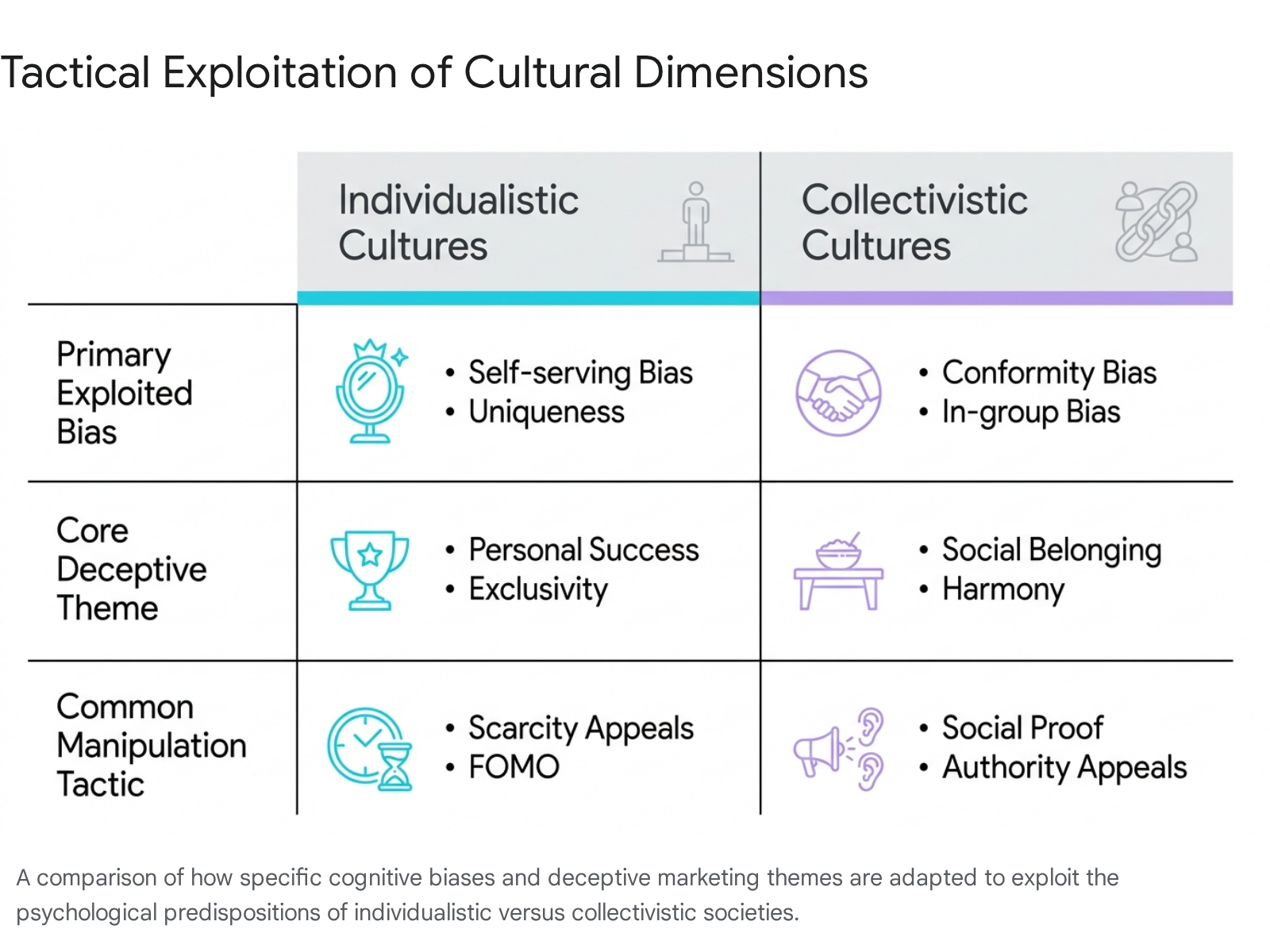
Power Distance and Authority Acceptance
The cultural dimension of "Power Distance" - defined as the extent to which less powerful members of a society accept and expect hierarchical inequality - also heavily dictates specific vulnerabilities 40.
In high power distance cultures, authority bias is intensely potent 40. Deceptive claims endorsed by figures portraying corporate, governmental, medical, or elder authority are rarely questioned by the average consumer, as challenging hierarchy is culturally discouraged. Marketers exploit this by heavily featuring authoritative figures to validate dubious claims. Conversely, in low power distance cultures (which value egalitarianism), overt, heavy-handed appeals to authority may trigger psychological reactance and suspicion. In these markets, deceptive advertisers must often adopt more subversive, peer-to-peer manipulation tactics, such as astroturfing, fake grassroots reviews, or subtle influencer marketing, to bypass the cultural skepticism of institutional power 74053.
Furthermore, cross-cultural differences in social desirability effects - the tendency for individuals to act in ways viewed favorably by their immediate society - alter how consumers report and react to privacy invasions. Differing cultural baselines regarding what constitutes private versus communal information require global platforms to tailor their dark patterns; a forced-consent interface that is tolerated in one region may trigger mass abandonment in another 5341.
Legal Frameworks and the Reasonable Consumer Standard
Despite the overwhelming consensus of empirical evidence demonstrating the systematic irrationality of human cognition under commercial pressure, consumer protection law has historically rested on a deeply flawed psychological premise: the "reasonable consumer" standard.
Psychological Critiques of Traditional Legal Doctrines
Rooted in classical economic theory and neoformalist legal philosophy, the "reasonable consumer" standard assumes that individuals are highly rational, utility-maximizing actors 4243. Under this doctrine, the law presumes that a consumer meticulously reads all disclosures, carefully weighs long-term economic consequences, perfectly calculates risk, and consistently acts to maximize their own best interests 4243. This legal fiction heavily favors commercial enterprises. It allows courts to routinely dismiss false advertising claims by ruling that a "reasonable" person would naturally recognize obvious marketing puffery, would not be swayed by emotional appeals, or would have diligently read the exculpatory fine print buried in a terms of service agreement 4244.
However, interdisciplinary research robustly challenges the validity of this standard. Behavioral economics proves conclusively that consumers are subject to bounded rationality, severe cognitive limits, and unavoidable heuristic biases 42. Furthermore, empirical studies on "fine-print fraud" reveal a troubling psychological phenomenon regarding consent. When consumers are subjected to blatant, deceptive verbal or visual promises but subsequently sign standard form contracts containing contradictory fine print (which they practically never read), they experience profound psychological demoralization 45. Believing that the dense contract is legally inviolable, they abandon their right to complain, seek redress, or warn others. This illustrates how the mere presence of legal boilerplate psychologically immunizes deceptive firms from accountability, as the consumer internalizes the blame for their own deception 45.
Evolution Toward the Vulnerable Consumer
Recognizing the severe friction between antiquated legal doctrines and modern cognitive reality, international regulatory bodies are slowly shifting their paradigms to account for systemic digital vulnerability 26.
In the European Union, the Unfair Commercial Practices Directive (UCPD) is undergoing intense reevaluation via the proposed Digital Fairness Act 464748. Legal scholars, consumer advocates, and the European Commission increasingly acknowledge that the traditional "average consumer" benchmark is entirely obsolete in the context of hyper-personalized digital markets 4649. Algorithms do not target a hypothetical "average" individual; they identify and exploit the temporary, highly specific situational vulnerabilities of individual users 264749. Consequently, the EU is moving toward redefining consumer vulnerability. It is shifting away from viewing vulnerability merely as a static, categorical trait (e.g., age, physical disability, or mental capacity), and moving toward understanding it as a dynamic, contextual state that can be artificially induced in any consumer through the application of asymmetric, predatory choice architectures 4748.
Global Regulatory Enforcement Trends
This theoretical shift is manifesting in concrete, aggressive enforcement actions globally.
In the United States, the Federal Trade Commission (FTC) has significantly expanded its enforcement mandate under Section 5 of the FTC Act (which prohibits unfair or deceptive acts) to directly target digital dark patterns and algorithmic manipulation 2350. Recent historic enforcement actions signal a dramatic regulatory pivot. For example, the FTC levied a record $245 million penalty against Epic Games for utilizing confusing and inconsistent button configurations specifically designed to trick players into making unwanted in-game purchases 2350. Furthermore, the FTC's high-profile litigation against Amazon regarding the intentionally labyrinthine cancellation architecture of its Prime subscription service underscores a new legal reality: the FTC now asserts that designing interfaces that intentionally exploit cognitive heuristics to subvert user intent constitutes unlawful deception, regardless of whether technical disclosures exist deep within the interface 231664.
| Regulatory Body / Region | Key Legislative or Enforcement Action | Primary Focus Regarding Deceptive Advertising |
|---|---|---|
| Federal Trade Commission (USA) | Enforcement of Section 5 of FTC Act; 2023/2024 Dark Pattern actions. | Prosecuting "roach motel" cancellation flows, forced consent, and deceptive button configurations (e.g., Epic Games, Amazon) 2350. |
| European Union | Digital Fairness Act (updating UCPD and Consumer Rights Directive). | Shifting from "average consumer" to situational "vulnerable consumer" metrics; targeting addictive design and AI manipulation 464748. |
| State Administration for Market Regulation (China) | 2024 E-Commerce Act amendments; 2025 Anti-Unfair Competition Law. | Explicit bans on "gradual disclosure of costs", fake reviews, and unauthorized data scraping for competitive intelligence 155152. |
| Advertising Standards Council of India (India) | 2024 Greenwashing Guidelines; Influencer awareness campaigns. | Mandating substantiation for eco-claims; educating consumers on identifying drip pricing and basket sneaking in apps 2053. |
Similar momentum is reshaping markets in Asia. China has implemented sweeping, stringent revisions to its Anti-Unfair Competition Law (AUCL) and E-Commerce Act, set to take full effect by 2025. These regulations explicitly prohibit the gradual disclosure of costs, false hierarchies in interface design, and the use of algorithms or paid "water armies" to fabricate reviews 155152. This effectively criminalizes the psychological manipulation of digital commerce, moving beyond mere content regulation to dictate interface ethics. Concurrently, India's Advertising Standards Council of India (ASCI) has launched expansive initiatives targeting greenwashing and explicitly outlawing dark patterns like drip pricing, deploying influencers themselves to educate the public on how to spot deceptive interfaces 202153.
Conclusion
The psychology of deceptive advertising reveals that consumer vulnerability is rarely a function of low baseline intelligence or mere carelessness; rather, it is an inevitable byproduct of human neurobiology operating within highly engineered, adversarial commercial environments. Marketers systematically weaponize dual-process cognition, utilizing high-stress choice architectures, information overload, and manufactured urgency to force reliance on predictable mental heuristics.
From the affective exploitation inherent in greenwashing and the parasocial manipulation of influencer marketing, to the opaque, real-time nudging of algorithmic micro-targeting, deception is increasingly structurally embedded into the digital ecosystem. As the volume, velocity, and personalization of commercial information continue to outpace human cognitive capacity, maintaining consumer autonomy will require moving far beyond the antiquated legal remedies of mere transparency and disclosure. Regulatory frameworks and corporate ethical design principles must rapidly evolve to recognize systemic digital vulnerability, strictly prohibiting practices that intentionally extract commercial value from the universal, biological blind spots of the human mind.