
Asymmetric dominance and the decoy effect in pricing
Theoretical Foundations of Context-Dependent Choice
The decoy effect, formally known within behavioral economics and decision theory as the asymmetric dominance effect or the attraction effect, represents a fundamental anomaly in classical rational choice paradigms. First systematically documented by psychologists Joel Huber, John Payne, and Christopher Puto in 1982, the phenomenon occurs when the introduction of a third, strategically inferior option - the decoy - alters consumer preferences between two original options 121.
Classical microeconomic theory and normative decision-making models, including Luce's choice model, rely heavily on the axiom of the Independence of Irrelevant Alternatives (IIA) and the overarching principle of regularity 123. The IIA axiom dictates that the relative preference between two existing items should remain strictly stable regardless of the introduction or absence of a third, non-preferred item. Regularity posits that the absolute probability of choosing an option from a given set cannot increase when that set is enlarged. In formal mathematical terms, if set A is a subset of set B ($A \subset B$), the probability of choosing alternative $X$ from set $B$ cannot exceed the probability of choosing $X$ from set $A$ ($P(X; A) \ge P(X; B)$) 1.
The decoy effect explicitly violates both of these foundational axioms. By introducing an alternative that is asymmetrically dominated - meaning it is entirely inferior to one option (the target) but only partially inferior to the other (the competitor) - decision-makers reliably shift their preference toward the target 674. In the presence of the decoy, the target's market share strictly increases, demonstrating that human valuation is not derived from absolute utility calculations, but is deeply and predictably context-dependent.
In a standard two-attribute decision space mapping price against quality, asymmetric dominance can be visualized geometrically. The target and competitor options typically occupy points along a theoretical indifference curve, where neither option strictly dominates the other. The decoy is plotted such that it falls into the strictly inferior, dominated quadrant relative to the target - meaning it is both higher in price and lower in quality, or equivalent in one attribute and worse in the other. However, the decoy remains only partially inferior or incomparable to the competitor. This spatial relationship creates a zone of asymmetric dominance that exerts a psychological pull, drawing the consumer's selection toward the target option 256.
Seminal Demonstrations and Choice Architecture
The earliest empirical demonstrations of asymmetric dominance sought to prove that consumer preference could be manipulated across various product categories without altering the core products themselves. Huber, Payne, and Puto's 1982 experiments involved presenting university students with binary choices across diverse scenarios, including beer, cars, restaurants, lottery tickets, and television sets 7. In every scenario except lottery tickets, introducing a decoy successfully and significantly increased the probability of the target option being chosen.
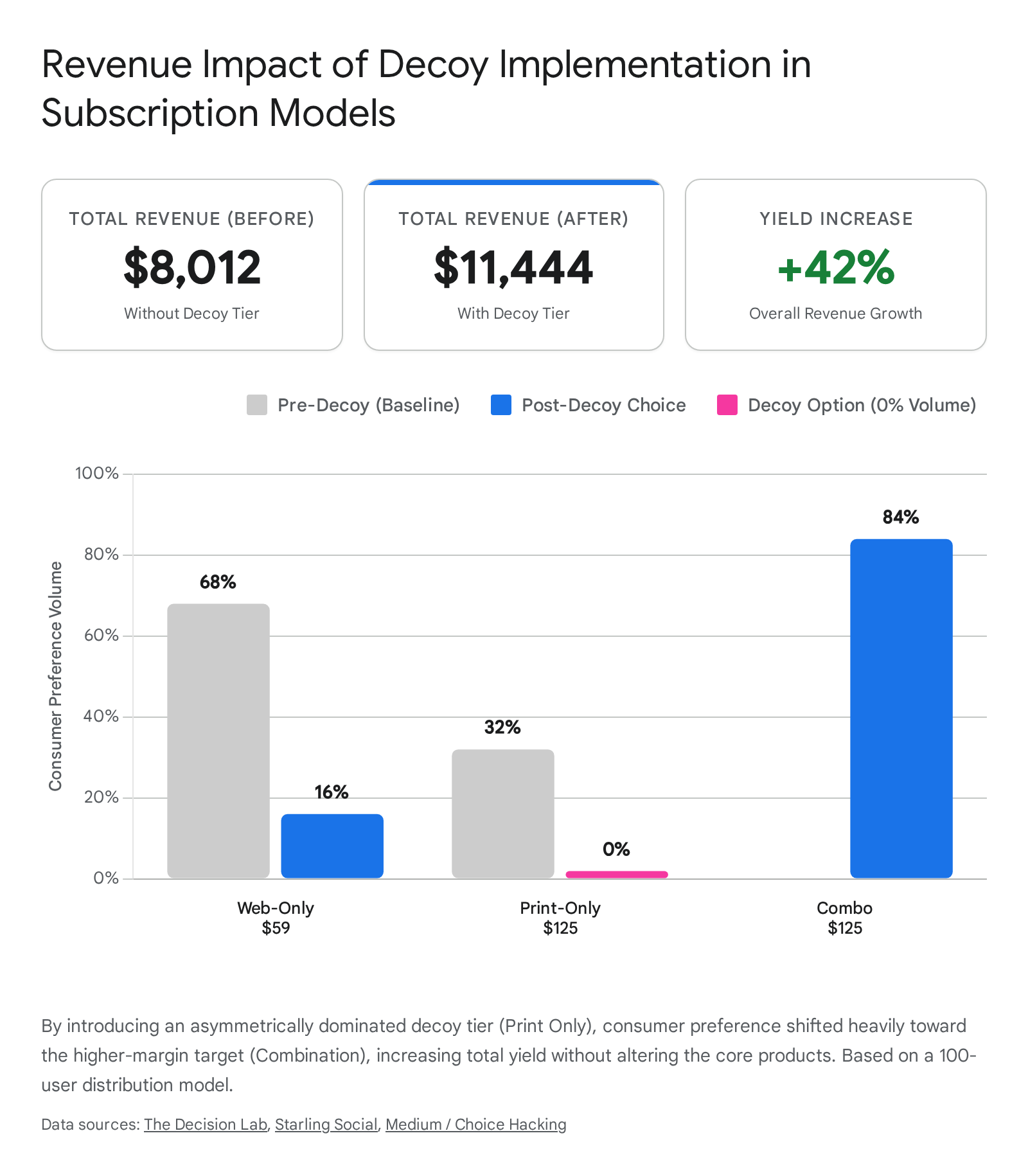
However, the most frequently cited manifestation of the decoy effect in contemporary behavioral economics comes from an experiment conducted by behavioral economist Dan Ariely, utilizing real-world subscription pricing from The Economist magazine 4128. Participants were presented with a carefully engineered tiered pricing architecture featuring three options: a web-only subscription for $59, a print-only subscription for $125, and a combined web-and-print subscription for $125.
In this architecture, the print-only subscription operates purely as the asymmetrically dominated decoy. It is equal in price to the combination package but demonstrably inferior in value, as it lacks the digital access included in the combo tier. When presented with only the web and combination options in a binary choice format, 68% of participants chose the cheaper, web-only tier 128. However, when the print-only decoy was introduced into the choice set, preference reversed entirely: 84% of participants shifted their choice to the $125 combined subscription, despite the fact that zero participants selected the decoy itself 48.
This structural addition increased modeled revenue by over 42%, serving as definitive proof that the decoy does not exist to be purchased; it exists strictly to reframe the psychological evaluation of the target, altering the consumer's perception of maximum utility 8.
The phenomenon illustrates that consumers frequently rely on localized, comparative advantages to define value when absolute value is ambiguous.
Cognitive Mechanisms and Psychological Drivers
The efficacy of the decoy effect relies on the fundamental neurological reality that human beings do not possess an internal, absolute value meter. Instead, human cognitive architecture necessitates relative comparison to determine utility and fairness 7149. Several distinct cognitive mechanisms converge to produce the asymmetric dominance effect.
Relative Valuation and Choice Simplification
When consumers face multi-attribute choices where variables are inversely correlated - such as the inherent tension between high quality and low price - cognitive load increases substantially 2716. In these scenarios, decision-makers experience preference uncertainty and decision fatigue. The introduction of a decoy provides a highly effective cognitive shortcut. Because the target clearly and unambiguously dominates the decoy, the consumer can make an easy, localized comparison 49.
This ease of comparison bleeds into the overall evaluation of the target, artificially amplifying its perceived superiority over the competitor. The decoy minimizes choice anxiety by establishing an unmistakable, objective hierarchy within a subset of the choices, allowing the consumer to bypass the complex trade-off calculation required to compare the target directly against the competitor 21417. The consumer abandons absolute utility maximization in favor of comparative ease.
Loss Aversion and the Reference Point
Loss aversion, a core pillar of Prospect Theory, posits that individuals experience the psychological pain of a loss more acutely than the pleasure of an equivalent gain 274. In the context of asymmetric dominance, the decoy fundamentally shifts the psychological reference point of the transaction. Rather than evaluating the target and competitor in isolation, the consumer evaluates both options relative to the newly introduced decoy 74.
When the target is compared to the decoy, it represents a pure gain for the consumer, offering better features at an equivalent or better price. Conversely, when the competitor is compared to the decoy, it presents a mixed outcome: it may be cheaper, but it is significantly worse in quality or features. Driven by loss aversion, the consumer's focus narrows to avoiding the disadvantages highlighted by the decoy, thereby pushing them toward the target option to minimize perceived value loss 410.
Choice Justification
Behavioral research consistently demonstrates that decision-makers prioritize options that are easily justifiable, both to their own internal logic and to external observers 7417. The asymmetric dominance effect provides a highly salient rationale for a purchase. The decision-maker can articulate, "I chose option A because it is clearly a superior deal compared to option C." The decoy supplies the narrative required for the consumer to feel they have made a shrewd, rational, and financially sound decision, entirely masking the underlying manipulation of the choice architecture 47. Research indicates that the decoy effect is actually strengthened when participants are informed in advance that they will have to justify their selection to researchers, underscoring the dominance of justification heuristics in complex choices 4.
Mathematical Models of Context-Dependent Choice
To formally quantify context-dependent choice and explain preference reversals across various domains, behavioral economists have developed several mathematical frameworks that diverge from standard fixed-utility models 311. These models attempt to map exactly how the mere presence of an irrelevant alternative alters the underlying utility vectors of the primary options.
The Relative Advantage Model
Developed by Amos Tversky and Itamar Simonson in 1993, the relative advantage model integrates the principles of loss aversion directly into multi-attribute choice matrices 10121314. The model posits that utility is not an absolute scalar value but a comparative one, separating the utility equation into a context-free component and a context-dependent component 15. Valuation is derived by calculating the specific gains and losses of an option relative to all other items present in the choice set.
Using a simplified linear representation of loss aversion, the relative value ($V_i$) of an alternative is calculated as the sum of its comparative advantages minus the asymmetrically weighted sum of its comparative disadvantages: $$V_i = \text{Gains}_i - \lambda(\text{Losses}_i)$$ Where $\lambda$ represents the loss aversion coefficient (typically $\lambda > 1$, and frequently formalized as a factor of 2 in standard models) 14. Because the decoy is completely dominated by the target, the target registers virtually zero losses relative to the decoy. Conversely, the competitor registers specific, measurable losses when compared to the decoy along certain attribute dimensions. The asymmetric weighting of these losses depresses the total calculated utility of the competitor while elevating the comparative utility of the target 1014.
Contrast-Weighting Theory
An alternative formal explanation is the contrast-weighting theory. This model posits that the utility weights assigned to any given attribute - such as price sensitivity or feature importance - are not static. Instead, they are dynamically adjusted based on the similarity of levels along the competing attributes within the immediate context 1617.
If a decoy extends the perceived range of an attribute (for example, making the target's high price seem less extreme by introducing an even more expensive decoy), it alters the subjective weight of that dimension for the consumer. Small contrasts along one dimension result in a greater psychological weight being assigned to the opposing dimension. This contrast-weighting systematically skews preference toward the target by making the target's relative weaknesses seem numerically insignificant compared to the newly established baseline 16.
Dynamic Preference Accumulation (Decision Field Theory)
Dynamic models, such as Decision Field Theory and other sequential sampling models, approach choice not as a static, instantaneous calculation but as an accumulation process occurring over time 1016. Preferences accumulate gradually as the decision-maker shifts attention between pairs of alternatives. Because the comparison between the target and the decoy yields a rapid, unambiguous advantage, preference for the target accumulates faster, eventually crossing the internal decision threshold.
These dynamic models yield a counter-intuitive prediction: limiting deliberation time (imposing time pressure) can actually decrease the magnitude of the decoy effect 1618. Because the attraction effect relies on a sequence of pairwise comparisons across attributes, restricting time prevents the decision-maker from fully processing the relative comparisons that drive the bias, causing them to revert to baseline preferences.
Summary of Theoretical Models
To understand the varied approaches to quantifying the attraction effect, researchers rely on a taxonomy of mathematical models, summarized below.
| Model Framework | Primary Mechanism | Explanation of Asymmetric Dominance |
|---|---|---|
| Fixed Utility (Classical) | Absolute Valuation | Cannot explain the effect; assumes utility is strictly context-independent, adhering to the IIA axiom. |
| Relative Advantage Model | Loss Aversion | Decoys shift reference points; targets incur zero comparative losses against the decoy, amplifying utility due to the $\lambda$ coefficient. |
| Contrast-Weighting | Range & Frequency Shifts | Decoys artificially extend the attribute space, dynamically changing the subjective weights consumers assign to price versus quality. |
| Dynamic Accumulation | Sequential Sampling | Clear dominance allows target preference to accumulate faster over deliberation time; effect size correlates with available processing time. |
Typology of Contextual Decoys
While the standard asymmetrically dominated option is the most widely recognized implementation, behavioral pricing utilizes a broader spectrum of contextual decoys that exploit different cognitive boundaries and heuristics.
The Compromise Effect
Though distinct from asymmetric dominance, the compromise effect operates on parallel psychological tracks and is frequently utilized in tandem with decoy pricing. The compromise effect introduces a new extreme option - either very low or very high in price and quality - to make a previously extreme option appear as a safe, intermediate choice 1920.
Unlike a pure decoy, the extreme option in a compromise architecture is not objectively dominated; it remains a viable alternative for edge-case consumers who value absolute premium quality or absolute minimum price. The goal of the compromise effect is to exploit the human tendency to avoid extremes, a phenomenon known as extremeness aversion. By framing the target as the balanced median, businesses successfully funnel the majority of consumers into the mid-tier target without relying on strict dominance 7192021.
Phantom Decoys
Phantom decoys are a unique class of alternatives that are introduced into the choice set to influence perception but are inherently unavailable for purchase at the time of decision-making (e.g., labeled as "Out of Stock," "Waitlisted," or dynamically restricted based on geography) 510. The phantom decoy effect relies heavily on the relative advantage model, operating purely through reference-dependence 10.
Behavioral economists classify phantoms based on their precise spatial relationship to the target option in the attribute space: * Phantom Frequency (PF): The phantom beats the target on the target's worst dimension, but equals it on its best dimension. * Phantom Range (PR): The phantom beats the target on the target's best dimension, but equals it on its worst dimension. * Phantom Range-Frequency (PRF): The phantom beats the target on both dimensions, meaning the unavailable option symmetrically dominates the target 22.
Empirical research indicates that the timing of the consumer's knowledge regarding the phantom's unavailability dictates its ultimate effect. An unknown phantom - where the consumer attempts to select the superior option and is only subsequently informed that it is unavailable - can trigger psychological reactance. This frustration sometimes pushes consumers away from the target as an act of rejection. Conversely, known phantoms - options clearly displayed as unavailable from the beginning of the choice process - serve as powerful, frustration-free psychological anchors that reliably boost the target's perceived relative value without triggering reactance 1022.
Boundary Conditions and Replication Challenges (2024 - 2026)
Despite its foundational status in consumer psychology and marketing literature, the decoy effect has faced intense academic scrutiny. Between 2014 and 2026, researchers have increasingly challenged the robustness of the effect outside of highly stylized, numerical laboratory settings, identifying strict boundary conditions required for the effect to consistently manifest 216312324.
The Replication Crisis in Perceptual Tasks
Early signs of replication failure were documented by researchers such as Frederick et al. (2014) and Yang and Lynn (2014). These meta-analyses and replication attempts found that the decoy effect frequently failed to appear when options were presented as naturalistic stimuli - such as actual images of products, qualitative descriptions, or sensory experiences like tasting food or watching movie trailers - rather than abstract numeric tables 242526.
Recent empirical studies conducted in 2025 and 2026 have rigorously tested the decoy effect in purely perceptual domains, such as requiring participants to choose between rectangles of varying heights and widths to maximize area. These studies demonstrate a near-total collapse of the decoy effect 3136. When participants engage in quick, low-deliberation perceptual tasks, the presence of a visual decoy does not reliably bias choice toward a target. In some cases, spatial proximity to the decoy can even trigger a repulsion effect (sometimes termed negative attraction), where the negative valence or physical similarity of the decoy "contaminates" the target, actually reducing the target's market share 22426.
Item-Wise Dominance and Spatial Alignment
To reconcile these replication failures with decades of established literature, recent research has fundamentally redefined the boundary conditions of the attraction effect. Null results frequently stem from a failure of the experimental design to establish genuine item-wise dominance asymmetry 2.
It is insufficient for a decoy to simply be inferior on specific, isolated attributes (such as being slightly smaller). The decision-maker must effortlessly perceive the entire item as structurally dominated. Furthermore, if attributes are highly commensurable - meaning they are easily translated into a common underlying currency, such as calculating the total area of a shape from its height and width - the decision-maker processes the items holistically rather than making ordinal, attribute-by-attribute comparisons. This holistic processing effectively erases the decoy's psychological leverage 2.
Additionally, spatial alignment serves as a critical boundary condition in visual and digital settings. Horizontal or linear arrangements of options channel user attention effectively, facilitating the target-decoy comparisons necessary for the effect to occur. Triangular, oblique, or scattered arrangements dilute attentional salience, increase cognitive load, and cause the effect to vanish entirely 223. Adding excessive complexity - such as attempting to introduce multiple decoys simultaneously - also causes cognitive overload, resulting in choice paralysis that returns choice distributions back to baseline 16.
Cross-Cultural Variances in Asymmetric Dominance
The overwhelming majority of foundational research surrounding the decoy effect has been conducted on populations originating from Western, Educated, Industrialized, Rich, and Democratic (WEIRD) societies, with a heavy emphasis on North American university students 272829. However, contemporary cross-cultural psychology highlights that cognitive styles, decision-making heuristics, and susceptibility to contextual nudges vary significantly across global populations.
Analytic versus Holistic Processing
A primary divergence in cross-cultural cognition lies in the spectrum between analytic and holistic processing. Western populations traditionally engage in context-independent, analytic processing. This cognitive style focuses heavily on salient objects separated from their backgrounds, evaluating items based on intrinsic properties. In contrast, populations from Confucian East Asian cultures, as well as many Latin American and African societies, frequently utilize holistic, context-dependent processing, attending much more deeply to the relationships between objects and their surrounding environments 2930.
Because the decoy effect is fundamentally a context-dependent phenomenon, susceptibility to it develops differently across cultures. Developmental psychology studies suggest that the asymmetrically dominated decoy effect is not an inherent, hard-wired human trait, but rather an acquired cognitive heuristic. The onset of susceptibility to the decoy effect appears earlier in Asian populations due to the cultural emphasis on relational evaluation, whereas Western populations may experience a delayed developmental onset regarding this specific bias 3031.
Limitations of the Global Base
The historical reliance on WEIRD populations poses a severe structural validity threat when multinational corporations attempt to deploy global pricing architectures. Studies investigating the applicability of Western behavioral nudges in non-WEIRD populations note that cultural dimensions - such as Geert Hofstede's metrics of uncertainty avoidance, indulgence, and individualism - heavily moderate how consumers interact with tiered pricing and decoys 273132.
While the basic neuroeconomic mechanism of loss aversion is generally recognized as a human universal, the specific choice architecture and framing required to trigger a decoy effect may require substantial cultural adaptation to function optimally in emerging markets. Direct application of Western pricing matrices in South American or African markets frequently yields divergent conversion outcomes, highlighting the need for localized behavioral optimization 27.
Implementation in Commercial Pricing Strategies
Despite academic debates over exact boundary conditions and cultural generalizability, the commercial deployment of asymmetric dominance remains ubiquitous. The effect is heavily utilized by pricing strategists in structuring product portfolios and subscription tiers to maximize Average Revenue Per User (ARPU) 43444546.
B2C and E-Commerce Applications
In business-to-consumer (B2C) retail markets, decoy pricing relies heavily on physical or digital product bundling, tiered sizing configurations, and fast-moving consumer goods 149. A classic implementation exists in fast-food and cinema concessions. When confronted with a $5.00 small popcorn and a $6.50 large popcorn, a significant segment of consumers selects the small to minimize expenditure. By introducing a $6.00 medium popcorn (the decoy), the $0.50 marginal cost to upgrade to the large re-frames the target as a high-value proposition. The medium serves solely to make the large appear to be a superior financial decision, exploiting the consumer's relative comparison bias 4933.
A rigorous meta-analysis examining over 3.6 million UK grocery store wine transactions provided empirical proof of the decoy effect operating "in the wild." The study demonstrated that in complex consumer environments where choices are vast and varied, the presence of dominated options reliably increased the selection of target items. While the aggregate effect size was modest - representing roughly a 1% overall shift in preference across millions of interactions - this fractional shift translates into immense gross profit scaling for the retailer 34. Similar architectures are visible in consumer electronics, such as Apple's storage-tier pricing, where mid-tier devices are priced to heavily incentivize the purchase of premium models 43.
B2B and SaaS Pricing Architectures (2024 - 2026)
In Business-to-Business (B2B) and Software-as-a-Service (SaaS) environments, pricing is inherently more structured, relying almost exclusively on tiered subscription models rather than singular product sales 4535. The decoy effect is frequently deployed in these spaces to drive the adoption of mid-tier or premium "Professional" plans over basic entry-level "Starter" models 463651.
In a standard SaaS three-tier model, the target plan is typically the middle tier. A decoy tier may be positioned just below the target in price but severely limited in essential B2B functionality (e.g., lacking API access or single sign-on), creating high contrast that pushes procurement teams upward. Alternatively, a highly expensive "Enterprise" tier can be introduced that acts simultaneously as an anchor (making the target seem highly affordable) and a decoy (if its feature set is not proportionally better than the target to justify the massive price leap) 193652.
Case studies from 2025 demonstrate the profound financial impact of optimizing B2B pricing packages using behavioral frameworks. For instance, Proper, a European property management SaaS, utilized behavioral pricing strategies - combining decoys with willingness-to-pay testing - to execute an 80% average price increase and a 146% unit fee increase for SMBs. This architectural redesign ultimately yielded a 300% increase in Annual Recurring Revenue (ARR) with minimal customer churn, proving the efficacy of psychological packaging in enterprise software 52.
However, SaaS vendors must execute decoys with precision. In enterprise scenarios characterized by complex, high-friction purchasing processes and sophisticated procurement teams, obvious or insulting decoys can trigger pattern recognition. If buyers realize the choice architecture is overtly manipulative, it erodes trust and damages the integrity of the vendor's entire pricing strategy 36.
Comparative Table of Pricing Architectures
| Pricing Strategy | Primary Cognitive Mechanism | Optimal Market Domain | Known Limitations & Risks |
|---|---|---|---|
| Decoy Effect (Asymmetric Dominance) | Relative valuation; loss aversion | Subscription models, hardware configurations, fast-food sizing | Fails if the decoy is not strictly dominated, or if the choice set is too complex (cognitive overload). |
| Compromise Effect | Extremeness aversion; risk mitigation | Professional services, tiered SaaS, B2B procurement | Requires consumers to have uncertain preferences; ineffective if buyers have strict feature requirements. |
| Price Anchoring | Heuristic reliance on initial information | B2B negotiations, real estate, software tiering | Requires a plausible anchor. Arbitrary anchors lose efficacy as consumers access comparative market data. |
| Phantom Decoys | Reference dependence; scarcity framing | E-commerce inventory, limited-time digital goods | "Unknown" phantoms can trigger severe psychological reactance and brand distrust. |
The Decoy Effect as a Digital Dark Pattern
As the digital economy matures, the line between strategic behavioral pricing and deceptive consumer manipulation has become highly contested. The decoy effect is increasingly categorized by UI/UX researchers, consumer advocacy groups, and global regulators as a "dark pattern" - a manipulative user interface design technique intended to trick, coerce, or unconsciously steer users into actions that benefit the platform at the direct expense of the consumer's optimal utility 37543839.
User Interface Manipulation and Consumer Welfare
Dark patterns exploit fundamental cognitive vulnerabilities, entirely bypassing conscious deliberation. In modern e-commerce, the decoy effect is rarely deployed in isolation. It is frequently paired with other deceptive designs to compound the psychological pressure on the buyer. These include false urgency (e.g., artificial countdown timers), fake social proof ("15 people are looking at this item"), roach motels (subscriptions that are easy to enter but deliberately difficult to cancel), and drip pricing (revealing hidden fees only at the final stage of checkout) 383957.
A comprehensive 2022 European Commission report revealed the staggering scale of this issue, finding that 97% of popular mobile apps contained at least one deceptive design element. Parallel research out of Princeton University identified complex dark patterns actively deployed on over 11% of major shopping websites 3839. When e-commerce platforms intentionally introduce decoys alongside these tactics, they engineer choice architecture to seamlessly funnel users toward higher-margin items. This often results in profound "buyer's remorse," as consumers subsequently realize they purchased excess capacity, premium features, or larger sizes they did not fundamentally need, driven entirely by regret aversion and relative framing at the point of sale 4.
While these deceptive patterns reliably yield short-term conversion spikes and immediate revenue bumps, they incur severe long-term costs. Research indicates that 56% of consumers report permanently losing trust in a brand after realizing they have been subjected to manipulative design practices. This erosion of trust directly damages brand equity, suppresses customer lifetime value, and dramatically increases customer churn 38.
Regulatory Responses to Deceptive Architecture
By 2024 and 2025, the unchecked proliferation of digital manipulation prompted significant, coordinated regulatory backlash across multiple jurisdictions. Government bodies worldwide have recognized the potential for systemic consumer financial harm. The International Consumer Protection and Enforcement Network (ICPEN), operating in coordination with the U.S. Federal Trade Commission (FTC), executed global reviews of dark patterns, explicitly categorizing extreme choice architecture manipulation - including aggressive asymmetric dominance and forced continuity - as unfair commercial practices 5440.
Regulatory bodies are actively transitioning from issuing guidelines to mandating transparent, neutral choice architectures through legal enforcement. These regulations attempt to strip platforms of the ability to use behavioral nudges that actively obfuscate objective value or intentionally confuse the consumer regarding the true cost of digital goods 3738.
Artificial Intelligence and Algorithmic Tacit Collusion
The integration of artificial intelligence into e-commerce and B2B pricing optimization marks the most significant evolution in behavioral economics in recent decades. The period spanning 2024 to 2026 has witnessed a structural shift away from human-navigated marketplaces toward environments fundamentally mediated by AI agents and Large Language Models (LLMs) 59.
LLM Susceptibility to Decoys
As individual consumers and corporate procurement departments increasingly delegate shopping, comparison, and purchasing tasks to AI intermediaries (such as ChatGPT's integrated shopping features, Amazon's Rufus, or proprietary B2B procurement bots), a critical theoretical question arises: Do algorithmic agents exhibit the same cognitive biases as humans?
Research confirmed in 2025 and 2026 indicates that instruction-tuned LLMs do, in fact, exhibit the asymmetric dominance bias 59. Because these generative models are trained extensively on human-generated text, decision-making rationales, and historical purchasing data, they inherit human heuristics and contextual biases. In empirical market simulations, introducing a decoy into the dataset processed by an LLM shopping agent reliably added calculated utility to the target product. This resulted in autonomous choice shifts consistent with the 20% to 30% preference variations historically observed in human subjects 59.
Vertical Tacit Collusion in AI-Mediated Markets
The inherent susceptibility of AI agents to behavioral nudges has generated a novel and highly complex market failure termed vertical tacit collusion. In modern digital marketplaces, the platform controls the choice architecture, the ranking algorithms, and the visual display of comparison options. Conversely, the individual sellers control product inputs, feature descriptions, and algorithmic bidding strategies for prominence.
Using advanced reinforcement learning frameworks (such as Q-learning algorithms), digital platforms quickly and autonomously discover that presenting options in a decoy configuration mathematically maximizes platform revenue. Simultaneously, independent seller algorithms learn through trial and error to price their goods and bid in ways that optimize their placement within these highly effective decoy structures 59.
Crucially, neither the platform nor the seller explicitly communicates, colludes, or specifically codes an intent to manipulate the consumer. Instead, the distinct algorithms independently discover that exploiting the AI agent's inherited cognitive biases is the most efficient, frictionless route to profit maximization 59. This vertical alignment requires no illegal communication or horizontal price-fixing agreements; the incentives are naturally aligned around a shared, exploitable vulnerability in the AI delegate 59.
To combat the rise of algorithmic manipulation, 2024 and 2025 witnessed a massive legislative push in the United States, with over 50 state-level bills introduced targeting algorithmic price-fixing. Furthermore, federal agencies like the FTC have begun utilizing administrative subpoena power to investigate vendors of dynamic pricing software, signaling an end to the era of unchecked digital behavioral manipulation 16. As Agentic AI begins to autonomously govern dynamic B2B pricing - potentially shifting future models away from static subscription tiers toward continuous usage and agent-based outcomes - the role of static pricing decoys may diminish 41. However, as long as human psychology, and its algorithmic reflections, remains deeply sensitive to relative value, asymmetric dominance will remain a core mechanism of economic persuasion.