
Senior Year Month-by-Month College Application Timeline
The senior year college application timeline begins with summer list-building and essay drafting, accelerates in the fall with early applications and complex financial aid filings, and concludes with regular decisions in the winter. Staying on track requires organizing deadlines in a centralized system, securing letters of recommendation early, and fiercely protecting academic momentum to avoid burnout. Students must ultimately compare their financial aid award letters in the spring and commit to a single institution by National College Decision Day on May 1.

How Should You Prepare the Summer Before Senior Year?
While the broader college preparation process spans all four years of high school, the strategic work that dictates final outcomes is heavily concentrated in the window between the end of junior year and the fall of senior year 12. The summer months represent the most valuable stretch of uninterrupted time a prospective applicant will have before academic pressures mount. Utilizing this period effectively transforms a chaotic autumn into a manageable series of administrative submissions.
The foremost priority during the summer is finalizing the college list. Candidates typically begin with a broad conceptual list of 20 to 25 colleges, which must be systematically narrowed down to a balanced, final list of roughly eight to twelve institutions 34. Admissions professionals universally recommend categorizing these final choices into three distinct tiers based on historical acceptance data and the applicant's academic profile. A well-rounded list typically consists of two to three "reach" schools where the applicant's metrics fall below the historical average or where overall acceptance rates are exceedingly low, four to six "target" or "match" schools where the student's metrics align perfectly with the median admitted student, and two to three "safety" schools where admission is highly probable 13. Whenever feasible, summer should be utilized for conducting in-person campus visits or detailed virtual tours, allowing the applicant to gauge campus culture and specific program offerings before classes resume 4.
Simultaneously, the summer months must be dedicated to drafting the primary admissions essays. The Common Application (or Common App), a centralized platform accepted by over a thousand colleges, typically opens for the new application cycle on August 1 21. Rather than waiting for the portal to officially launch, applicants should begin brainstorming and drafting their main personal statement throughout June and July. Completing the primary 650-word essay before the academic year begins allows the applicant to dedicate their fall strictly to drafting the numerous school-specific supplemental essays required by highly selective institutions 3. Taking the time to outline a comprehensive extracurricular activities list and update a formal high school resume is also a highly productive summer task that streamlines data entry later in the process 36.
Finally, the summer serves as the ultimate window for standardized test preparation. While an increasing number of institutions have adopted test-optional policies - such as Princeton University extending its test-optional policy for fall 2026 and 2027 entry - many selective programs still require or strongly encourage the submission of SAT or ACT scores 28. Applicants who are unsatisfied with their junior year scores should use the summer to engage in targeted test prep platforms, aiming to take their final ACT or SAT during the August, September, or October test administrations 24.
What Are the Best College Application Organization Tools?
Managing applications for eight to twelve distinct universities requires tracking a dizzying array of usernames, disparate portal logins, varied deadlines, and unique institutional requirements. Relying on memory or disorganized notes reliably results in missed deadlines and compromised applications. To mitigate this risk, educational consultants strongly advise implementing a centralized organizational architecture before the school year begins 6910.
Many high schools provide students with access to robust college admissions software, while others leave students to create their own digital tracking environments. Regardless of the chosen medium, the system must clearly track application phases, financial aid deadlines, essay requirements, and document submission statuses 910.
| Organizational Platform | Primary Functionality | Key Advantages | Typical User Base |
|---|---|---|---|
| Custom Spreadsheets (Excel/Google Sheets) | Personalized tracking of all deadlines, essay prompts, and requirements. | Highly customizable; allows students to track overlapping essay topics to reuse writing material efficiently 610. | Independent students seeking granular control over their application workflow. |
| Naviance | School-integrated student success planning and transcript management. | Seamless integration with high school guidance offices for requesting and tracking official transcripts and recommendation letters 9. | Students attending public or private high schools that contract with the software. |
| Scoir | Counselor-student collaboration and document management. | Facilitates direct communication between students and counselors; streamlines the submission of school reports and transcripts 911. | High schools moving away from legacy platforms toward modern interface solutions. |
| Cialfo | Comprehensive application tracking and college matching. | Capable of handling both domestic and international application requirements seamlessly in one unified interface 9. | Institutions with diverse, global student populations applying across multiple countries. |
| College Board BigFuture | College research, scholarship matching, and timeline planning. | Directly linked to SAT scores and the CSS Profile ecosystem; excellent for early-stage college discovery and list building 93. | Early high school students (sophomores and juniors) beginning their college search. |
A well-constructed digital tracking system prevents the common pitfall of discovering a hidden supplemental essay requirement hours before a submission deadline. Furthermore, creating a dedicated, professional-sounding email address exclusively for college correspondence ensures that critical communications from admissions offices or financial aid departments are not lost in personal inboxes 13.
What Are the Different College Admission Plans?
Before September concludes, applicants must finalize their overarching submission strategy. Colleges offer several distinct pathways for admission, and choosing the optimal timeline directly impacts both admission probabilities and downstream financial flexibility. The various admission types carry vastly different legal and strategic implications 141516.
| Application Plan | Binding Commitment? | Typical Application Deadline | Typical Decision Notification | Strategic Implications |
|---|---|---|---|---|
| Early Decision (ED I & II) | Yes | ED I: Nov 1 - Nov 15 ED II: Jan 1 |
Mid-December (ED I) Mid-February (ED II) |
The student may only apply to one school ED. If admitted, they are legally bound to attend and must withdraw all other applications. This provides a statistical advantage for the student and protects the college's yield rate 141517. |
| Early Action (EA) | No | Nov 1 - Nov 15 | December - January | Allows students to apply early and receive a decision early without a binding commitment. Students maintain the freedom to compare offers and have until May 1 to decide 1415. |
| Restrictive / Single-Choice Early Action (REA) | No | Nov 1 | Mid-December | Non-binding, but strictly restricts the student from applying early to other private universities. Signals immense interest to the institution without the legal requirement to attend 1516. |
| Regular Decision (RD) | No | Jan 1 - Jan 15 | March - April | The standard application pool. Applying RD offers the student the most time to perfect their essays and demonstrate strong senior year academic grades 114. |
| Rolling Admission | No | Ongoing (until class is full) | 4 - 8 weeks post-submission | Applications are evaluated as they arrive. Spots and financial aid deplete over time, making it highly advantageous to apply as early as September 141516. |
A pervasive and dangerous myth surrounding Early Decision (ED) is that breaking the binding agreement carries no consequences. Because the agreement is signed by the student, a parent, and the high school counselor, breaking the contract to attend a different institution is considered deeply unethical. In such scenarios, the high school counselor is often compelled to notify other colleges, which frequently results in those institutions rescinding their own offers of admission 419. Consequently, students should only apply Early Decision if the institution is their undisputed first choice and they are highly confident their family can absorb the net financial cost. If comparing financial aid packages is a necessity, Early Action or Regular Decision are the only prudent pathways 1516.
Furthermore, some institutions offer an Early Decision II (ED II) round, which mirrors the binding nature of ED I but features a later deadline, typically aligning with Regular Decision dates in January. ED II is strategically utilized by students who were rejected by their ED I school in December and wish to pivot their binding commitment to a second-choice institution to secure a slight admissions advantage 141720.
September: Managing Recommendations and Finalizing Strategy
With the application strategy mapped out, September marks the official transition from preparation to active application execution. The primary administrative goal during this month is securing the educators and professionals who will advocate on the student's behalf.
Almost every selective college requires a holistic evaluation package that includes at least one comprehensive evaluation from the high school counselor and one to two letters of recommendation from core academic teachers, typically in disciplines such as English, mathematics, science, or history 25. The quality of these recommendations can act as a crucial tie-breaker between applicants presenting identical academic metrics 2223.
A frequent stumbling block in the application timeline is failing to request these letters with sufficient lead time. The optimal practice is to request recommendations at the end of the junior year, allowing teachers the entirety of the summer to outline their letters 2223. If this window is missed, applicants must formally approach their chosen teachers immediately upon returning to school in September 2324. Teachers are frequently overwhelmed with recommendation requests during the fall and may institute hard caps on the number of letters they are willing to author; at a minimum, they require four to six weeks to craft a thoughtful, specific endorsement 246.
When initiating the request, etiquette dictates doing so in person rather than via an abrupt email. This professional courtesy allows the teacher to decline gracefully if they feel they cannot write a strongly supportive letter 523. Once a teacher agrees, the student must provide them with a comprehensive "brag sheet." This document serves as a specialized resume, detailing the student's college list, intended major, overarching career goals, and specific memories, projects, or breakthroughs achieved within that particular teacher's classroom 56. Providing this contextual scaffolding enables the recommender to move beyond generic praise and highlight specific evidence of the student's intellectual curiosity and character 236.
Following the request, the applicant must navigate the application portal - typically the Common Application - to sign the Family Educational Rights and Privacy Act (FERPA) waiver. Waiving the right to view the recommendation letters assures college admissions committees that the endorsements are candid and uncoerced 7. From there, the student must diligently track the submission status of all required documents, gently reminding recommenders as early deadlines approach 237.
October: Navigating the Financial Aid Ecosystem
October is arguably the most critical month for securing the capital required to finance higher education. Because significant portions of state and institutional financial aid are distributed on a first-come, first-served basis, early applicants have access to the largest pools of available funding 8910. To access these funds, families must navigate a complex ecosystem of distinct financial forms.
The FAFSA Simplification Act and Recent Delays
The Free Application for Federal Student Aid (FAFSA) is the universal gateway to federal assistance, determining eligibility for Pell Grants, federal work-study programs, and subsidized federal student loans 1131. In a standard historical cycle, the FAFSA opens to the public on October 1 18.
However, the federal financial aid landscape has recently experienced unprecedented turbulence. The FAFSA Simplification Act mandated a massive redesign of the application to reduce the number of questions and update the underlying formulas used to calculate aid - specifically replacing the Expected Family Contribution (EFC) metric with the new Student Aid Index (SAI) 321234. The rollout for the 2024-2025 academic year was disastrously marred by software glitches, calculation errors failing to account for inflation, and severe delays that pushed the form's release to late December 2023 341314. This failure created cascading delays, preventing colleges from receiving Institutional Student Information Records (ISIRs) until March, which in turn stalled financial aid award packages and disrupted enrollment timelines nationwide 141516.
To prevent a repeat of this crisis for the 2025-2026 and 2026-2027 cycles, the Department of Education instituted phased beta testing models. Rather than launching the form to the entire country simultaneously, the Department partnered with community-based organizations and specific high schools to test the system with escalating cohorts of students throughout the fall - beginning with hundreds of students in Beta 1 and scaling to tens of thousands by Beta 4 - to identify and resolve critical bugs before wide release 17184119. The ultimate federal deadline to file the FAFSA for a given academic year is June 30 of that same academic year 820; however, relying on the federal deadline guarantees that a student will miss out on limited, first-come-first-served state and institutional funds 931.
The CSS Profile and IDOC Requirements
While the FAFSA is sufficient for federal and state aid, approximately 250 to 400 mostly private, highly selective institutions require an entirely separate application: the CSS Profile (College Scholarship Service Profile) 113144.
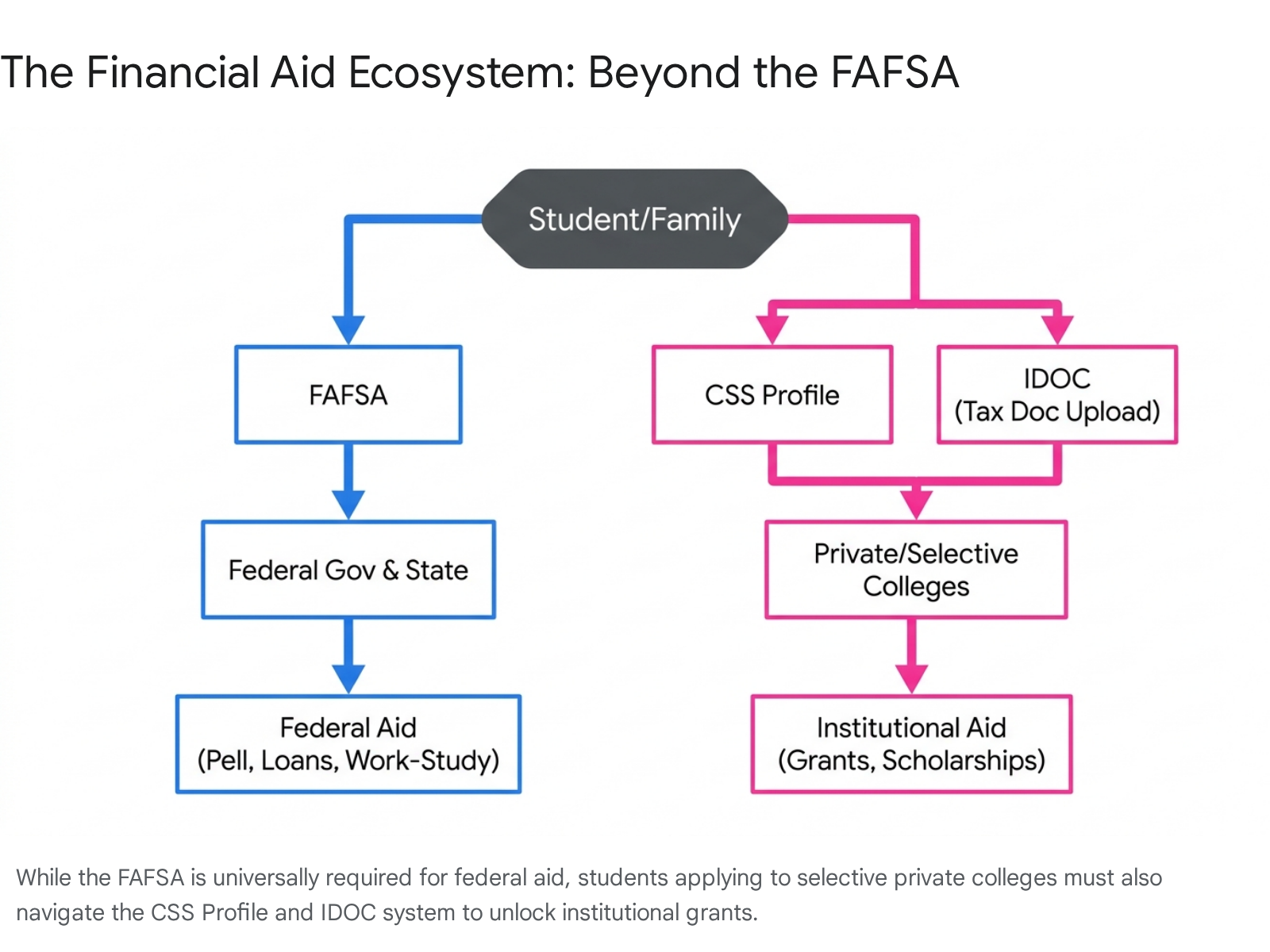
Administered by the College Board, the CSS Profile also officially opens on October 1 and is explicitly designed to unlock non-federal, institutional grants originating from the universities' own endowments 34421.
The CSS Profile is significantly more exhaustive than the FAFSA. While the FAFSA relies on straightforward tax data retrieved via the IRS Data Retrieval Tool, the CSS Profile probes deeply into assets the federal government ignores. Institutions utilizing the CSS Profile will routinely require declarations of primary home equity, the valuation of small family-owned businesses or farms, and estimated future medical or private K-12 tuition expenses 3144. Crucially, in cases of divorce or separation, the FAFSA primarily looks at the custodial parent's income; the CSS Profile, conversely, often demands the financial information of the non-custodial parent, requiring them to fill out an entirely separate portion of the application unless a formal waiver is approved by the specific college 113144.
Furthermore, unlike the FAFSA, the CSS Profile is not free. Families are charged a $25 base fee for the application and first school report, plus $16 for each additional institution 4647. The College Board does automatically grant fee waivers, but only to domestic undergraduate students whose families report an adjusted gross income of up to $100,000 or who qualified for an SAT fee waiver 113.
Finally, selective institutions frequently utilize a third mechanism called the Institutional Documentation Service (IDOC). IDOC is a secure College Board portal where families are required to upload digital copies of their actual federal tax returns, W-2s, and business tax schedules 114648. The IDOC system allows university financial aid officers to cross-reference and verify the self-reported data submitted on the CSS Profile 4849. Families must meticulously track the distinct deadlines for the FAFSA, the CSS Profile, and IDOC uploads, as missing a single institutional deadline can disqualify a student from receiving tens of thousands of dollars in need-based grants 322223.
| Financial Aid Component | Administering Body | Primary Purpose | Cost | Key Distinctions |
|---|---|---|---|---|
| FAFSA | U.S. Department of Education | Determines eligibility for federal Pell Grants, student loans, and work-study. | Free | Requires basic tax data; utilizes the Student Aid Index (SAI); generally ignores home equity and non-custodial parent income 313244. |
| CSS Profile | College Board | Determines eligibility for institutional grants and endowment scholarships at selective private colleges. | $25 initial + $16 per additional school (waivers available) | Highly invasive; evaluates home equity, business valuations, and mandates non-custodial parent financial data 314446. |
| IDOC | College Board | Secure document upload portal for verifying financial data. | Free (included with CSS Profile if required) | Requires physical or digital uploads of actual W-2s and full tax returns to cross-reference against self-reported profile data 114849. |
November and December: Submitting Early Applications
November acts as the execution phase for the bulk of the intense application labor. Early Decision (ED) and Early Action (EA) deadlines overwhelmingly fall tightly between November 1 and November 15 121520.
During this high-pressure window, the applicant's role shifts from drafting to quality control. The student must ensure that all moving parts have converged simultaneously in the college's portal: the application itself, the supplemental essays, the official transcripts uploaded by the counselor, the recommendation letters, and the FAFSA/CSS Profile data 28. If a college is not test-optional, or if the student chooses to submit scores to strengthen their profile, they must verify that the College Board (SAT) or ACT has transmitted official score reports, a process that can take weeks 124.
By mid-December, the institutions process these early applications and release their initial wave of decisions. This leads to one of three outcomes: 1. Acceptance: If the student is accepted under a binding Early Decision agreement, the college application season effectively ends. The student must immediately log into all other applicant portals and formally withdraw their pending Regular Decision or Early Action applications 315. 2. Deferral: An applicant who is neither accepted nor outright rejected in the early round is deferred. Their application is moved into the Regular Decision pool to be re-evaluated against the broader applicant base in the spring. A deferred student should submit a "Letter of Continued Interest" updating the college on new academic achievements, but they must immediately pivot to finalizing their backup options 31517. 3. Rejection: An outright denial is final for that academic year; a student rejected in the ED or EA round is strictly prohibited from reapplying to that same institution during the Regular Decision cycle 1719.
For students who are deferred, rejected, or who chose not to apply early, December is the month to aggressively polish the supplemental essays for the impending Regular Decision deadlines. Completing this writing prior to the winter holidays prevents the applicant from sacrificing their rest period to a severe time crunch 2313.
January and February: Regular Decision and Mid-Year Reports
The vast majority of highly competitive universities mandate that Regular Decision applications be submitted between January 1 and January 15 1320. Once these final applications are transmitted, the focus shifts entirely back to the student's current high school performance.
A widespread and highly destructive myth among high school seniors is that once the primary applications are submitted in the fall, senior year grades cease to matter 4. In reality, the admissions process requires a continuous stream of academic data. In late January or early February, high school guidance counselors are required to submit a "Mid-Year Report" to all the colleges where the student has active applications. This report contains the student's official first-semester grades from their senior year 1424.
Admissions committees scrutinize these mid-year reports heavily. If a college observes a severe drop in academic performance, or if a student drops rigorous Advanced Placement (AP) classes in favor of unchallenging electives after applying, the admissions office will flag the application. In cases of severe "senioritis," universities possess the absolute authority to rescind offers of admission, and they regularly execute this right even for students who were confidently admitted during the Early Decision round 4. Sustained academic rigor is a non-negotiable requirement throughout the spring semester.
March and April: How to Evaluate Financial Aid Award Letters
Between mid-March and early April, Regular Decision results are released en masse 116. Accompanying the acceptance letters - or arriving shortly thereafter via a digital portal - are the Financial Aid Award Letters. This phase signifies a major transition: the process morphs from an evaluation of the student's academic merit into a rigorous test of the family's financial literacy.
Financial aid award letters lack a standardized federal format, making them notoriously difficult for families to interpret and compare side-by-side 115354. Some institutions deploy formatting tactics that obscure the true cost of attendance, occasionally blending self-help loans and free grant money into a single overarching "award" total to make the school appear artificially affordable 5325.
To make an educated enrollment decision, families must deconstruct each letter to calculate the true Net Price (the actual out-of-pocket cash cost). This requires isolating specific variables across every offer 535657.
| Financial Award Component | Definition and Financial Impact | How to Evaluate It |
|---|---|---|
| Cost of Attendance (COA) | The estimated total cost for one year. Includes direct costs (tuition, fees, on-campus housing, meal plans) and indirect costs (books, travel home, personal expenses) 535626. | Always request the full COA if a college only lists direct tuition. Standardize travel expenses across letters to ensure an apples-to-apples comparison 5356. |
| Gift Aid (Grants & Scholarships) | Pure discounts off the sticker price. This is free money provided by the state, the federal government (Pell Grants), or the institution itself. It never has to be repaid 535657. | Subtract this number directly from the COA. Check the fine print to ensure institutional grants are renewable for all four years and are not "front-loaded" just for freshman year 5626. |
| Self-Help Aid (Subsidized Loans) | Federal loans offered to students with demonstrated need. The government pays the interest while the student is enrolled at least half-time 5726. | Do not subtract this from the COA when calculating Net Price. This is debt that must be repaid. Subsidized loans are preferable due to the interest pause 255627. |
| Self-Help Aid (Unsubsidized Loans) | Federal loans available regardless of financial need. Interest begins accruing the moment the loan is disbursed 5727. | Do not subtract from COA. Track the long-term cost of borrowing using a loan simulator 2760. |
| Federal Work-Study | Funds earned via a part-time campus job throughout the semester 1160. | Do not subtract from the immediate tuition bill. This money is paid in paychecks to the student for living expenses 1160. |
To find the true Net Price for any given institution, families must take the total Cost of Attendance (COA) and subtract only the Gift Aid. Any remaining balance is the amount the family must cover through existing savings, out-of-pocket cash flow, or by taking on student or Parent PLUS loans 532556.
If a financial aid offer renders a top-choice school entirely unaffordable - particularly if the family has experienced a recent, undocumented financial hardship such as a job loss or severe medical emergency - April is the time to file a formal financial aid appeal. Financial aid officers have the discretionary authority to adjust the underlying data in the FAFSA to output a more favorable aid package if justified by documented special circumstances 5628.
May: What Happens on National College Decision Day?
The culmination of the year-long process arrives in May. Traditionally, May 1 is recognized universally as National College Decision Day (often referred to as the National Candidates Reply Date) 121562. By midnight on this date, an applicant must select a single college, formally accept their offer of admission in the portal, and submit a non-refundable enrollment deposit to lock in their seat in the incoming freshman class 46263.
However, the rigidity of the May 1 deadline has softened considerably in recent years due to the systemic failures of the FAFSA rollout. When massive delays prevented colleges from receiving FAFSA data until mid-March, financial aid packages could not be generated in time for families to make informed choices by May 1. In response to the crisis, hundreds of institutions, acting on guidance from higher education consortiums, unilaterally extended their commitment deadlines to May 15 or June 1 13152966. Applicants must therefore meticulously check the specific portal for each accepted university, as deposit deadlines currently vary significantly across the landscape 2863.
A critical ethical consideration during this period is the practice of "double depositing." In an attempt to buy more time to negotiate financial aid or weigh their options, some students will submit enrollment deposits to two different colleges simultaneously. This practice violates the terms of admission at almost all institutions; universities share data, and if a student is caught double depositing, both colleges possess the right to immediately revoke the admission offers, leaving the student without a collegiate home 6263.
There is only one accepted exception to this rule: waitlists. If a student is placed on the waitlist for their absolute top-choice school, they must still submit a deposit to a backup school where they were accepted before the May deadline to guarantee they have a place to attend in the fall 63. If the top-choice school eventually pulls the student off the waitlist in June or July, the student is allowed to accept the new offer and withdraw from the backup school, though they will inherently forfeit the non-refundable deposit paid to the first institution 2863.
How Can High School Seniors Avoid Application Burnout?
The confluence of maintaining rigorous advanced coursework, finalizing standardized testing, holding extracurricular leadership positions, and executing high-stakes college applications makes the senior year an ideal breeding ground for severe academic and emotional burnout 3031. Burnout is distinct from standard "senioritis." While senioritis is characterized by apathy and a desire to relax, burnout manifests as clinical exhaustion, a complete disengagement from formerly loved hobbies, a noticeable drop in academic performance, and overwhelming, paralyzing anxiety regarding the future 3069.
To protect mental and physical health during this marathon, mental health professionals and admissions experts recommend several proactive strategies:
- Time-Block the Application Process: Staring at an open document for hours creates immense stress without yielding results. Students should dedicate specific, finite blocks of time to application work - such as one focused hour on a Monday night - and then close the laptop 306932. Breaking massive tasks into granular steps ("Draft the first paragraph of the Yale supplement") makes the workload surmountable 3031.
- Practice the Art of Saying "No": A primary driver of burnout is over-commitment. As senior year unfolds, students often feel pressure to join new clubs or take on more shifts to pad their resumes. Admissions officers value sustained, multi-year commitment to a few core interests over superficial, last-minute involvement in a dozen activities. Students must learn to decline new obligations to protect their application time and their sanity 3031.
- Protect Sleep and Physical Health: High-level executive functioning and introspective writing are biologically impossible when a student is severely sleep-deprived. Prioritizing basic nutrition, physical movement, and a strict minimum of six to eight hours of sleep per night is non-negotiable 303171.
- Maintain Perspective on Rejection: The application ecosystem is highly gamified, leading to intense social comparison among peers. Students must internalize that rejection from a highly selective institution is frequently a reflection of institutional priorities and sheer mathematics - too many highly qualified applicants for too few beds - rather than a judgment of the student's personal worth or future potential 197172.
Bottom line
The senior year college application process is a complex, heavily front-loaded marathon that tests a student's organizational stamina as much as their academic prowess. Success requires researching schools and drafting essays during the summer, securing recommendations early, and rapidly navigating the notoriously turbulent FAFSA and CSS Profile financial aid systems the moment they open. While external factors like federal processing delays may unexpectedly shift traditional commitment deadlines, an applicant who centralizes their tasks, understands the strategic difference between admission plans, and rigorously protects their mental health will successfully secure strong options for higher education.