
Your Junior Year College Prep Checklist
Junior year is the most critical phase of the college admissions process, requiring students to lock in standardized testing, solidify deep extracurricular commitments, and strategically build a balanced list of target schools. Families must concurrently establish a financial strategy using net price calculators to avoid senior-year sticker shock and align their budgets with actual costs. By breaking these tasks into a strategic, month-by-month timeline, students can maximize their admissions outcomes and minimize the anxiety that often accompanies application season.
The Critical Role of Junior Year in College Admissions
The college application process requires sustained effort over several months, and admissions officers widely consider junior year to be the most pivotal academic period on a student's transcript 12. Because applications are submitted in the fall of senior year, the eleventh grade represents the last full year of grades a college will review before making an admissions decision. It serves as the ultimate proof of a student's ability to handle rigorous, college-level coursework.
The current landscape of college admissions adds an extra layer of complexity for high school juniors. The higher education sector is currently facing a "demographic cliff," a term used to describe a sharp decline in domestic birth rates following the 2008 recession. The number of college-aged students in the United States is expected to drop by nearly 400,000 between 2025 and 2029 3. However, this demographic dip has not made it easier to get into highly selective institutions. Because of the ease of the Common Application and widespread anxiety, individual students are applying to more schools than ever before, averaging over six applications per student 4. This creates a "K-shaped" admissions landscape where highly sought-after universities see record-breaking application volumes and plummeting acceptance rates, while less selective regional colleges struggle to meet their enrollment targets 34.
Furthermore, colleges are increasingly relying on early action deferrals and waitlists that stretch deep into the summer to manage unpredictable student enrollment behaviors 12. There has also been a massive surge in applications to large, public universities in the South, such as the University of Texas at Austin, Clemson, and the University of North Carolina at Chapel Hill, making these formerly accessible institutions highly competitive 42. Navigating this chaotic environment requires families to abandon outdated assumptions and execute a highly strategic, month-by-month preparation plan.
Fall Preparation: Establishing Rigor and Baseline Metrics
The start of junior year is about setting a solid academic foundation and gathering baseline data on standardized testing. Students should schedule a meeting with their high school guidance counselor early in the fall to conduct a thorough audit of their course rigor 238. Admissions officers evaluate transcripts contextually, meaning they look at the difficulty of a student's schedule relative to what the specific high school offers 2. Taking Advanced Placement (AP), International Baccalaureate (IB), or dual-enrollment college courses is essential for signaling academic readiness 28.
During the fall, students should also register for and take the Preliminary SAT/National Merit Scholarship Qualifying Test (PSAT/NMSQT). Typically offered in October, the PSAT is critical not only as a diagnostic practice run for the official SAT but because high scores qualify students for the National Merit Scholarship Program 239. Taking this test also puts students on the radar of college recruiters, initiating the flow of informational brochures and emails that can aid in early college research 3. Concurrently, students must begin formal preparation for the SAT or ACT, establishing a study schedule with the goal of taking their first official exam in the late fall or early winter 389.
Winter Strategy: Solidifying Testing and Senior Year Plans
As the second semester begins, focus shifts to executing the testing strategy and planning ahead for senior year. Students must work with their counselors in January and February to set their senior schedule, ensuring they enroll in the most challenging courses available for the twelfth grade 23. Colleges want to see an upward trajectory in core subjects that align with a student's intended major, proving that the student is not coasting toward graduation 2.
The winter months are also the optimal time to take the first official SAT or ACT 8. Early testing allows students to identify weak areas and leaves ample time for prep courses and retakes in the spring and summer. Additionally, deadlines for competitive summer pre-college programs, internships, and research opportunities often fall between December and February 23. Students should identify summer programs that fit their academic narrative, keeping in mind that programs requiring significant financial investment should be evaluated carefully for their actual impact on admissions outcomes 2.
Spring Execution: Research, Recommendations, and Refinement
Spring is research-heavy, representing the transition from building a personal profile to finding the colleges that match it. Students should build a preliminary college list by researching institutions online, attending local college fairs, and speaking with college representatives who visit their high school 39. When possible, families should schedule campus visits - ideally over spring break - to get a feel for the differing environments of large, medium, and small campuses 3.
Crucially, the spring is when juniors must request letters of recommendation from their teachers 31011. Asking in April or May allows teachers to agree before the overwhelming senior-year rush and gives them the entire summer to write thoughtful, detailed letters 101112. Spring is also heavily weighted toward final exams and AP or IB testing, making it an incredibly stressful period for high school students. Strategic test scheduling for any SAT or ACT retakes is required during these months to avoid severe academic burnout 8.
Summer Launch: Finalizing Lists and Starting Applications
The summer before senior year should be treated as the quiet launch of the college application itself. Students must narrow down their preliminary list of prospective schools to a finalized, balanced mix of safety, match, and reach institutions 41415.
Because the Common Application typically rolls over and opens for the new cycle in early August, students should spend June and July brainstorming and drafting their main personal statement 3. Writing the essay without the competing pressures of high school coursework generally yields a much stronger, more introspective piece of writing. Finally, the summer is the time to organize robust tracking systems, creating master spreadsheets to monitor deadlines, portal logins, and the varied supplemental essay requirements for each specific college 16518.
Navigating Standardized Testing in 2026
One of the most profound shifts for the high school graduating classes of 2026 and 2027 is the rapid reversal of pandemic-era test-optional policies. While thousands of colleges remain test-optional, the era of widespread flexibility at the nation's most elite institutions has definitively ended. Highly selective universities have largely reinstated SAT and ACT requirements, citing internal data proving that standardized tests are significantly more predictive of college success than high school grades alone 19.
Grade inflation has become rampant in American high schools, making it exceedingly difficult for admissions officers to differentiate true academic standouts using transcripts 19. In response, a massive wave of colleges has returned to mandatory testing to establish a baseline of academic competency. For the 2026 - 2027 admissions cycle, the Ivy League is almost entirely test-required, with Harvard, Yale, Dartmouth, Brown, Cornell, and the University of Pennsylvania all reinstating their mandates 19202122. Princeton will remain test-optional for the 2026-2027 cycle before requiring scores starting in 2027-2028, leaving Columbia as the sole Ivy League institution with a permanent test-optional policy 21.
Beyond the Ivy League, STEM powerhouses like the Massachusetts Institute of Technology (MIT), Caltech, and Georgia Tech have returned to mandatory testing, arguing that quantitative math scores are the best predictor of whether a student can survive their rigorous curriculums 212223. Other highly selective universities, including Stanford, Johns Hopkins, Georgetown, the University of Texas at Austin, and the public university systems in Florida and Tennessee, have also announced returns to test-required policies 192122.
Decoding Modern Testing Policies
As students build their college lists, they must carefully decode the testing policy of each individual institution, as terminology varies widely across the higher education landscape.
| Policy Type | Operational Definition | Strategic Approach for Applicants |
|---|---|---|
| Test-Required | The application is considered incomplete without an SAT or ACT score. Some institutions operate under a "Test-Flexible" model (e.g., Yale), meaning they require testing but allow students to submit AP or IB scores in lieu of the SAT or ACT 192024. | Standardized testing is mandatory. Students must prepare thoroughly and plan for two to three testing attempts before the end of their junior year to maximize their highest superscore 8. |
| Test-Optional | Students choose whether or not to submit their scores. If submitted, the scores are weighed in the evaluation process. If withheld, the student is judged entirely on other factors like GPA, essays, and extracurriculars 252627. | Submit scores if they fall at or above the 50th percentile of the college's historical admitted student profile. Withholding a score at a highly competitive test-optional school can negatively impact admissions odds 192428. |
| Test-Blind (Test-Free) | The college will not look at or consider SAT or ACT scores under any circumstances, even if the student submits perfect scores. The University of California system is the most prominent example 242527. | Students should focus their energy entirely on maintaining a high GPA, taking rigorous courses, writing exceptional essays, and building a strong extracurricular portfolio 23. |
A critical dynamic to understand regarding test-optional policies is that "optional" does not mean "irrelevant." Admissions data from recent cycles reveals a stark advantage for students who submit strong scores. For example, when Yale operated under a test-optional policy, students without test scores had a 2% chance of admission, while students who submitted scores had a 6% chance - effectively tripling their odds 24. A similar trend was observed at the University of Southern California, where submitting a strong score nearly doubled a student's chances of acceptance 19. Unless a school is explicitly test-blind, students who have access to testing should assume that a high score will act as a significant advantage 1922.
Scheduling the SAT and ACT
Most college admissions counselors recommend taking the chosen test two to three times, aiming to wrap up all testing by June of the junior year 8296. Taking tests on back-to-back dates in the spring allows students to build momentum and benefit from superscoring - a practice where colleges combine the highest section scores across multiple test dates to create a new, higher composite score.
The College Board and ACT establish anticipated national test dates well in advance. For juniors planning for the 2025-2026 academic year, the SAT is anticipated to be offered in August, October, November, and December of 2025, followed by March, May, and June of 2026 29317. The ACT follows a slightly different cadence, with anticipated dates in September, October, and December of 2025, followed by February, April, June, and July of 2026 6317. Students should cross-reference these dates with their high school's AP exam schedule and extracurricular commitments to avoid taking the SAT or ACT during their most exhausting academic weeks.
Extracurriculars: Why Quality and Sustained Commitment Beat Quantity
A pervasive misconception among high school students is that a lengthy resume featuring ten different club memberships and superficial volunteer hours will impress an admissions committee 333435. In reality, this approach frequently backfires. Colleges are not looking for a "well-rounded" student who dabbles in a bit of everything; rather, they are looking to build a well-rounded class made up of highly specialized, passionate individuals 333637.
Admissions officers increasingly prioritize sustained engagement and depth over breadth 33. They want to see what students genuinely care about and how they translate that passion into tangible action over time. Engaging deeply in two or three core activities over a period of three to four years demonstrates persistence, robust time management, and leadership potential - traits that correlate directly with college retention and future career success 3338.
When evaluating a student's extracurricular profile, admissions readers are actively looking for evidence of progression and leadership. This means moving from a general club member in freshman year to a committee chair or editor-in-chief by junior year 36. Furthermore, they look for impact and tangible results. Organizing a local community event, raising funds for a specific cause, or solving a real-world problem carries significantly more weight than simply attending weekly meetings 3637. Finally, top-tier universities look for intellectual vitality, which involves taking initiative beyond the standard high school curriculum. Pursuing independent research, building a coding repository, or writing for external publications demonstrates a self-directed love of learning 35.
Students who spread themselves too thin risk severe burnout and often fail to develop a clear, compelling narrative for their college application 36. It is also vital to note that non-traditional activities are highly valued by admissions offices. Working a part-time job to support a family, caring for younger siblings, or running a small online business demonstrates profound responsibility, maturity, and real-world competence 378.
Building a Balanced College List: The Portfolio Approach
Given the increasing unpredictability of college admissions - where application volume is surging and acceptance rates at selective schools are plunging - students cannot afford to apply exclusively to highly rejective institutions 440. A strategic college list must be carefully balanced to guarantee a successful outcome.
Admissions experts and educational consultants often compare building a successful college list to constructing a diversified financial investment portfolio 40910. Just as an intelligent investor mitigates market risk by holding a balanced mix of volatile growth stocks, stable bonds, and highly secure cash equivalents, a student must spread their applications across a spectrum of admission probabilities 14943.
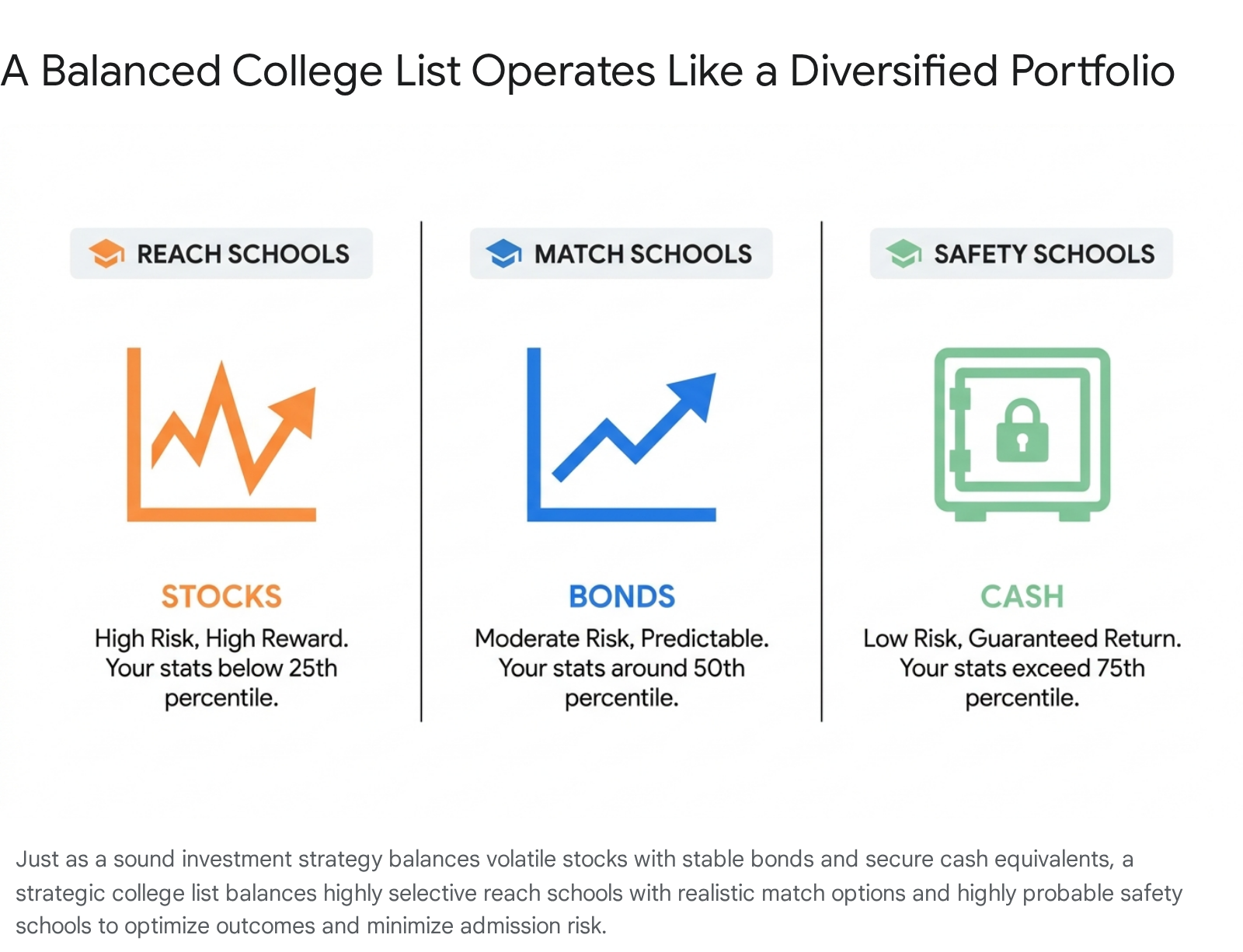
Applying only to reach schools is akin to putting a life savings entirely into speculative equities - it exposes the student to the very real risk of receiving zero acceptances in the spring 14. Conversely, applying only to safety schools limits a student's potential for academic challenge and prestige 14. To categorize schools accurately, students must compare their own GPA and standardized test scores against the average admitted student profile of a college. This data is typically found in the school's Common Data Set or via platforms like the College Board's BigFuture 2811.
| College Category | Academic Alignment & Definition | Acceptance Probability | Recommended List Allocation |
|---|---|---|---|
| Reach | The student's academic credentials fall below the 25th percentile of admitted students, OR the school is highly selective with an overall acceptance rate below 20% (meaning it is a reach for all applicants, regardless of perfect stats) 4141528. | Low (< 20%) | 2 to 4 schools 14 |
| Match (Target) | The student's academic profile aligns closely with the typical admitted student, usually falling comfortably between the 25th and 75th percentiles of the most recently admitted class 141528. | Solid (40% - 70%) | 4 to 6 schools 14 |
| Safety | The student's academic credentials significantly exceed the typical admitted student profile (placing them well above the 75th percentile), and the institution historically accepts more than 50% of its total applicants 41428. | Very High (> 75%) | 2 to 3 schools 415 |
Students should aim for a total list of roughly 8 to 12 well-researched applications 415. It is vital that students genuinely like their safety schools, ensuring that they will be happy to attend if the highly competitive reach schools do not pan out.
Financial Planning: The Crucial Role of Net Price Calculators
A fatal and highly common mistake families make during the junior year is allowing a student to apply to, and fall deeply in love with, a college without first understanding its true cost. Relying on a college's published "sticker price" is fundamentally misleading because a vast majority of students do not pay the full retail cost due to institutional grants, merit scholarships, and need-based financial aid 4612.
Before the Free Application for Federal Student Aid (FAFSA) opens in the student's senior year to determine the Student Aid Index (SAI), families must engage in transparent discussions about the household budget and what they can realistically afford to contribute toward higher education 13.
The Mechanics of the Net Price Calculator (NPC)
By federal law, specifically the Higher Education Act of 1965 as amended in 2011, any post-secondary institution receiving Title IV federal student aid funding must host a Net Price Calculator on its website 4914. This digital tool allows families to enter their specific financial information - including parental income, household assets, and tax data - alongside the student's academic profile, such as GPA and standardized test scores 1415.
The calculator processes this data to generate a highly tailored estimate of what the family will actually pay out-of-pocket for a specific school in the upcoming academic year 1415. It subtracts estimated grants and scholarships from the total cost of attendance (which includes tuition, room and board, and books) to reveal the true net price 1415.
Junior year is the exact right time to utilize NPCs extensively. Doing so before the college list is finalized prevents students from wasting time and application fees on schools that will ultimately prove unaffordable 134914. The results can be surprising. A private university with an intimidating $60,000 sticker price might offer a robust institutional financial aid package that drops the net price to $20,000, making it significantly cheaper than an in-state public university 49. Conversely, families with high assets or self-employed income may discover they will be expected to pay the full sticker price everywhere, prompting a strategic pivot toward schools known for offering generous non-need-based merit scholarships 4915.
Crucially, every college list must include at least one "financial safety" - a school where the student is virtually guaranteed admission and the family can definitively afford the net price without taking on crippling, high-interest student debt 15.
Scholarship Search Strategies
In addition to securing institutional aid, junior year is the optimal time to begin registering on vetted, reputable scholarship search engines. Platforms such as the College Board's BigFuture (which tracks over $1.5 billion in awards), Fastweb, Scholarships.com, and Sallie Mae offer massive databases that can be filtered by a student's specific demographics, major, and geographic location 16541718. Students should begin compiling a tracking list of deadlines for local, regional, and national scholarships. Because these private scholarships often require essays similar to those used on formal college applications, starting the search early allows students to recycle and refine their writing across multiple submissions.
Securing Outstanding Letters of Recommendation
Highly selective colleges generally require one or two letters of recommendation from core academic teachers - such as those instructing math, science, English, or history - alongside one comprehensive letter from the high school guidance counselor 1157. These documents provide vital context to a student's transcript, allowing teachers to speak directly to the student's intellectual curiosity, resilience through struggle, and positive classroom presence 1157.
The Spring Timeline and Etiquette
The ideal, industry-standard time to ask a teacher for a letter of recommendation is the spring of the junior year, typically in late April or May 101112. This timeline is critical because popular, highly effective teachers often hit their personal capacity for recommendations quickly. Asking early secures a spot on their roster and provides them with the entire summer to write a thoughtful, unhurried letter before the chaos of the fall semester begins 1112.
Students should approach teachers with whom they have built a strong, interactive relationship and in whose classes they have actively participated. Counterintuitively, the best recommendation does not always come from the class where the student easily earned a perfect grade; a teacher who witnessed a student overcome a difficult concept through tutoring and relentless effort can often write a far more compelling narrative about the student's work ethic and character 1158.
Crafting the Brag Sheet
To assist the recommender in writing a specific and highly effective letter, students should always provide a document known as a "Brag Sheet" 58596061. A brag sheet operates as an informal resume and questionnaire that summarizes the student's academic and extracurricular life, offering specific anecdotes and reminders of their performance in that specific teacher's class 586061.
A comprehensive brag sheet should include the student's basic contact info, current GPA, standardized test scores, and intended major or career goals 5861. It must outline significant extracurricular activities, leadership roles, and work experience to provide a holistic view of the student's life outside the classroom 58. Most importantly, the brag sheet should include specific memories, assignments, or projects from that teacher's class. Writing a prompt like, "I loved writing my research paper on the Cold War because it challenged my assumptions about diplomacy," helps the teacher avoid generic praise and cite concrete examples of intellectual growth 5761.
When submitting college applications, students will be asked under the Family Educational Rights and Privacy Act (FERPA) if they wish to waive their right to view their recommendation letters. Students should universally agree to waive this right. Colleges take recommendation letters much more seriously when they know the teacher wrote them confidentially, guaranteeing a candid and trustworthy assessment 59.
Organizational Strategies for Application Success
Applying to college requires managing a sheer deluge of fragmented information: distinct application deadlines, varied supplemental essay prompts, shifting standardized testing policies, and financial aid codes. Relying on memory or disjointed sticky notes guarantees missed opportunities. The most successful applicants build a centralized, digital tracking system - usually a master spreadsheet - in the summer before their senior year 1651162.
A robust college application tracker allows students to view their entire workload at a glance. It should include the following essential headers for every school under consideration:
- College Name & Location: Basic identifiers to keep similar-sounding institutions distinct 6263.
- Admissions Type & Deadline: Clearly delineate whether the student is applying Early Decision (Binding), Early Action (Non-binding), or Regular Decision, alongside the exact calendar date the application is due 6364.
- Application Platform: Note whether the school uses the centralized Common App, the Coalition App, or requires the use of an institution-specific portal, such as the University of California application system 6364.
- Testing Policy & Requirements: Detail whether the school is test-optional or test-required, and note whether they allow self-reported scores on the application or require official reports to be paid for and sent directly from the College Board or ACT 63.
- Net Price Estimate: Record the specific out-of-pocket dollar figure generated by that school's Net Price Calculator to keep financial realities front and center 1164.
- Required Materials: List the specific number of recommendation letters needed, copy and paste the exact supplemental essay prompts, and note any alumni interview requirements 6263.
- Financial Aid Deadlines: Track the strict due dates for the FAFSA and the CSS Profile, as missing these can result in a total loss of institutional grant money 1163.
- Status Tracking: Utilize a drop-down menu to mark applications as Not Started, In Progress, Submitted, and eventually Accepted, Waitlisted, or Denied 626365.
Maintaining this level of meticulous organization reduces anxiety, prevents catastrophic missed deadlines, and allows students to identify overlapping supplemental essay prompts that can be efficiently repurposed across multiple applications 566.
Debunking Common Admissions Myths
As families prepare for the upcoming cycle, they must separate actionable, data-driven trends from pervasive, anxiety-inducing myths that circulate through high school hallways and online forums.
A primary myth is that colleges inherently prefer the SAT over the ACT, or vice versa. The reality is that all U.S. colleges and universities universally accept both tests with absolutely no preference for one over the other 67. Admissions officers use concordance tables to compare scores equally. Students should take practice tests for both formats early in their junior year and commit exclusively to preparing for the test that better suits their natural pacing and academic strengths 67.
Another dangerous misconception is that taking easy classes to protect a flawless 4.0 GPA is the safest admission strategy 34. Admissions officers analyze transcripts contextually, looking specifically for intellectual courage. A slightly lower GPA achieved while taking highly rigorous AP or IB classes is almost universally preferred over a perfect GPA achieved by deliberately avoiding academic challenges 834. Colleges want to admit students who have proven they can handle a demanding workload.
Finally, families often mistakenly believe that "test-optional" means the college truly does not care about standardized test scores. The reality is far more nuanced. Unless a school is explicitly designated as "test-blind," admissions officers absolutely care about high scores. Data consistently shows that at highly selective test-optional schools, students who manage to submit strong scores are admitted at significantly higher rates than those who choose to withhold them 192419. The presence of a high score provides a comforting external validation of a student's inflated high school grades, removing doubt for the admissions reader.
Bottom line
The junior year is essentially a masterclass in time management, requiring students to balance intense academic coursework with forward-looking strategic planning. By solidifying standardized testing early, deepening a few core extracurricular passions rather than padding a resume, and utilizing net price calculators to ensure financial feasibility, students set themselves up for a calm and successful application season. Ultimately, building a highly balanced college list - operating much like a diversified investment portfolio - remains the single best defense against the sheer unpredictability of modern college admissions.