
How Summer Programs and Internships Help College Apps
Highly selective, tuition-free academic programs - alongside ordinary summer jobs, independent research, or community volunteering - can significantly strengthen a college application by providing verified proof of a student's merit and character. In contrast, expensive, open-enrollment summer programs hosted on elite college campuses offer almost zero competitive advantage in the admissions process. Ultimately, admissions officers look for intellectual curiosity, real-world responsibility, and sustained commitment, rather than a family's ability to pay for a prestigious campus experience.
The Frenzy of Summer Planning and Admissions Anxiety
Every spring, high school students and their parents navigate a gauntlet of glossy brochures and targeted emails promising transformative summer experiences at some of the nation's most elite university campuses. For many families, summer planning is accompanied by a mix of high optimism and profound anxiety 1. With the cost of higher education climbing and admission rates at highly selective universities plummeting into the single digits, families are desperately searching for any competitive edge to help their child stand out 2.
This intense pressure creates a widespread misconception that a jam-packed, highly scheduled, and explicitly "unique" summer is a mandatory prerequisite for admission to a dream school 3. Students often feel compelled to accumulate high-profile activities to bolster their resumes, leading them to trudge through endless pre-college applications while teachers are burdened with writing extra letters of recommendation 3.
The reality of holistic college admissions is much more nuanced. Admissions officers are acutely aware of the vast summer program landscape. They know exactly how to differentiate between a student who bought their way onto a prestigious campus and a student who earned their spot through verified academic merit. Furthermore, admissions committees appreciate unstructured, real-world experiences just as much - if not more - than rigidly scheduled academic camps 3. Understanding how colleges evaluate these critical ten weeks of summer sunshine is essential for making strategic, impactful, and financially sound decisions.
The Illusion of the "Pay-to-Play" Pre-College Experience
The most pervasive myth in the college admissions landscape is the belief that attending a paid summer program hosted at a prestigious university will inherently increase a student's chances of being admitted to that specific university as an undergraduate 4. Programs with names like "Harvard Summer," "Yale Summer Session," or "Columbia Summer Immersion" trade heavily on their elite campus branding. They often involve living in a university dorm for several weeks, taking non-credit "college-level" courses, and experiencing a simulated taste of campus life 5.
These pre-college experiences come with notoriously steep price tags, frequently costing between $3,000 and $10,000, not including travel expenses or lost summer wages 45. Despite the high costs, they are heavily marketed as vital ways to explore academic interests, experience college independence, and boost undergraduate applications.
How Admissions Officers Actually View Them
With very few exceptions, attending these expensive, open-enrollment programs confers no meaningful advantage in the highly competitive admissions process 11. Admissions officers refer to these as "pay-to-play" programs 528910. Because these programs admit the vast majority of students who can afford to pay the tuition, they are viewed strictly as enrichment opportunities rather than rigorous indicators of academic ability 1.
Furthermore, these programs are rarely integrated into the university's actual academic or research ecosystem. During the summer months, regular undergraduates leave campus, and tenured faculty members prioritize their own academic research 3. As a result, summer courses are typically taught by adjunct professors, graduate students, or third-party educational companies hired to run the logistics 53.
The Institutional Revenue Incentive
From the university's perspective, these programs serve a distinct administrative and financial purpose: filling empty dormitories and generating vital tax-exempt revenue. Experts often note that these programs are motivated more by "empty beds" than "empty heads" 43.
According to a 2024 National Association for College Admission Counseling (NACAC) survey, fewer than 9% of admissions officers consider participation in paid pre-college programs as having "considerable importance" in their final decisions 1. Ultimately, successfully completing a pay-to-play program signals to a college that a family has substantial financial resources, rather than proving the student possesses the intellectual readiness to excel at an elite institution 13. In some cases, a highly conventional, expensive summer course may even generate a negative signal, suggesting a lack of imagination or independence on the applicant's part 3.
Are Paid Programs Ever Worth the Investment?
This does not mean that paid summer programs are entirely devoid of value. They can offer a safe, structured environment for a high school student to experience living away from home, gain personal independence, and dive deeper into a subject they are genuinely passionate about 5. If a student excels in the coursework and produces a significant, measurable deliverable - such as a published paper in a reputable scientific journal - it can indirectly strengthen their application 52.
Additionally, some programs straddle the line between pay-to-play and selective mentorship. Programs like the Boston University Research in Science & Engineering (BU RISE) charge tuition but remain highly selective because they rely on a limited pool of host-institution professors 2. However, families must critically assess the return on investment. If the sole motivation for writing a five-figure check is to secure a backdoor entry into an Ivy League school, the investment will almost certainly fail 412.
| Feature | Pay-to-Play Pre-College Programs | Tier 1 Merit-Based Programs |
|---|---|---|
| Primary Goal | Revenue generation and campus utilization | Academic acceleration and talent identification |
| Cost to Student | High ($3,000 - $10,000+) | Free, heavily subsidized, or provides a stipend |
| Selectivity | Open enrollment or very high acceptance rate | Highly competitive (<10% acceptance rate) |
| Instructors | Adjuncts, grad students, or 3rd-party vendors | Leading researchers, tenured faculty, industry experts |
| Admissions Impact | Minimal (Signals financial resources) | Massive (Signals verified academic excellence) |
The Tier 1 Accelerators: Highly Selective Merit Programs
While open-enrollment programs carry little weight, there is a distinct subset of summer experiences that operate as profound academic accelerators. Often referred to in college consulting circles as "Tier 1" programs, these opportunities are highly selective, entirely merit-based, and academically demanding 1.
Because they evaluate high school students as researchers and learners rather than as paying customers, Tier 1 programs admit only a tiny fraction of applicants. They require strong academic prerequisites, standardized test scores, and comprehensive essays, immersing the accepted students in high-level research, seminar discussions, or complex problem-solving 1.
The Vetting Power of Extreme Selectivity
Admissions officers at top universities place a massive premium on Tier 1 programs because they act as a reliable, independent vetting mechanism. If a student is admitted to a program with a 3% to 5% acceptance rate, it objectively proves their ability to beat out tremendous competition on a national or global scale 4.
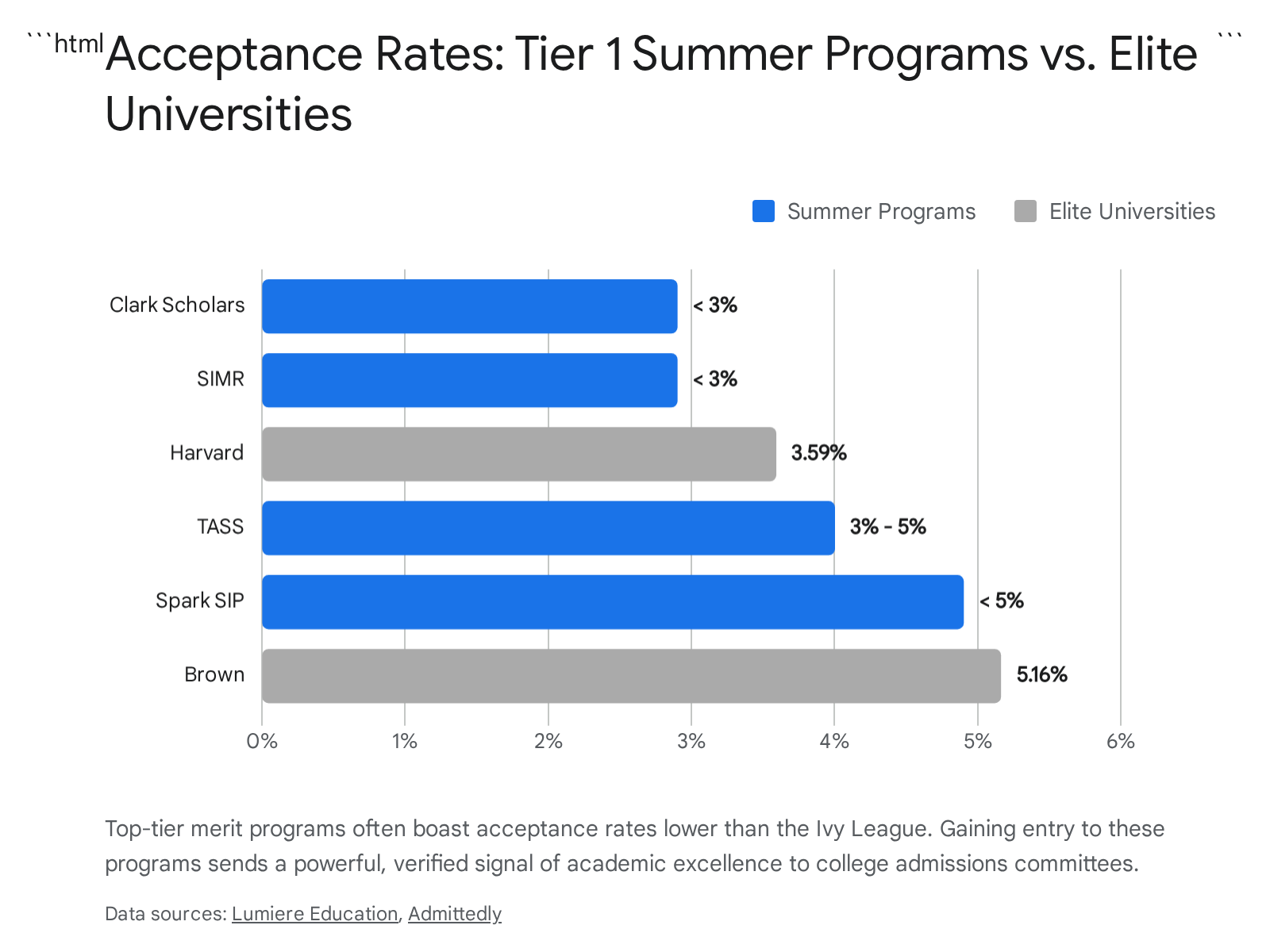
For example, the Research Science Institute (RSI), hosted at MIT and sponsored by the Center for Excellence in Education, accepts only about 100 students globally and is entirely cost-free. This makes it one of the most prestigious STEM programs in the world 11131415161718. Similarly, the Anson L. Clark Scholars Program at Texas Tech University accepts a mere 12 students annually, providing them with hands-on research experience alongside a $750 stipend 29131617181920.
When admissions officers at Yale, Princeton, or Stanford see programs like RSI, the Stanford University Mathematics Camp (SUMaC), the Summer Science Program (SSP), or the Telluride Association Summer Seminars (TASS) on an application, they instantly recognize the rigor required just to get in 11151617181920. These elite programs heavily factor into the upper echelons of extracurricular evaluation, ensuring maximum impact on admissions odds 1321.
Mentorship and Tangible Deliverables
Beyond selectivity, Tier 1 programs yield highly tangible deliverables that bolster an application. Students in these programs often co-author published papers, present their findings at research symposiums, or build functional prototypes. Furthermore, they grant ambitious high schoolers direct access to leading researchers and tenured faculty.
A letter of recommendation from an MIT researcher or a Stanford neurobiologist contextualizing a 17-year-old's brilliance carries significantly more weight than a generic certificate of completion from a paid summer camp 522234. By building real-world academic networks, students also clarify their long-term career goals, which translates into highly focused and compelling college entrance essays.
| Prestigious Summer Program | Discipline | Key Benefits & Selectivity |
|---|---|---|
| Research Science Institute (RSI) | STEM | Cost-free, MIT-hosted, ~5% acceptance rate, extensive research cycle. |
| Anson L. Clark Scholars | Multidisciplinary | 12 students admitted, $750 stipend, hands-on faculty mentorship. |
| Telluride Association (TASS) | Humanities | Cost-free, focuses on critical Black studies and anti-oppression. |
| Summer Science Program (SSP) | STEM | 39-day immersive research in astrophysics or biochemistry, need-blind. |
| MITES Summer | Engineering / Science | Six-week residential program for underserved juniors, cost-free. |
The Overlooked Power of the Ordinary Summer
While Tier 1 academic programs provide a massive advantage, they are not the only way to impress a college admissions committee. In fact, admissions officers hold profound respect for "ordinary" summer experiences that demonstrate grit, responsibility, and initiative 35.
There is a growing sentiment among admissions professionals that teenagers have lost the art of the traditional summer job. Decades ago, students naturally gravitated toward local jobs because they wanted or needed to earn money 3. Today, many affluent families eschew part-time work in favor of curated internships or academic camps, fearing a retail job will not look "good" on an application.
Why a Minimum-Wage Job Can Beat a $10,000 Camp
This modern approach is a critical miscalculation. Working as a barista, a lifeguard, a camp counselor, or a grocery store clerk demonstrates reliability, time management, and the ability to interact with the general public 515. Earning a paycheck teaches financial responsibility, and navigating workplace conflicts builds a type of emotional intelligence that cannot be learned in a pre-college lecture hall.
In an applicant pool saturated with identical resumes detailing expensive enrichment camps, a student who spent the summer managing a busy ice cream shop often stands out as grounded, resilient, and mature 35. As admissions experts often note, colleges do not care precisely what you do with your summer; they care what you do with what you did over the summer 25.
Family Responsibilities and Independent Learning
Equally important to the admissions process are family responsibilities. Many students spend their summers providing childcare for younger siblings, translating for non-English speaking parents, or caring for sick relatives. The Common Application explicitly lists family responsibilities as a designated extracurricular activity. Admissions officers heavily value this, viewing it as a profound indicator of character, maturity, and selflessness 5.
Furthermore, colleges love to see self-directed independent projects 5. Building a computer from scratch, teaching oneself a new programming language, restoring an old car, writing a novel, or deeply engaging in a personal hobby shows pure, unadulterated intellectual vitality 35. When a student pursues a rigorous interest without the promise of a certificate, a grade, or a resume line, it tells the college that they are intrinsically motivated - a trait highly correlated with success in higher education.
Navigating the Post-SCOTUS Admissions Landscape
The calculus of college admissions experienced a seismic shift in June 2023 when the United States Supreme Court (SCOTUS) struck down race-conscious affirmative action in Students for Fair Admissions v. Harvard and Students for Fair Admissions v. UNC 567298319341011371213.
The ruling effectively banned colleges from using race as a standalone factor in admissions. However, Chief Justice John Roberts noted in the majority opinion that universities may still consider how a student's race affected their life, provided that it is tied to "courage and determination," "qualities of character," or a specific lived experience 13.
The Shift to Socioeconomic Context
In the wake of this historic decision, universities have aggressively pivoted toward race-neutral methods of maintaining campus diversity. Admissions offices are now placing an unprecedented emphasis on socioeconomic indicators, first-generation college status, Pell Grant eligibility, and geographic context 3440. They want to understand the environment a student grew up in to accurately measure their academic achievements against the resources they had available.
This post-SCOTUS landscape makes the narrative surrounding a student's summer activities more critical than ever. Private college counselors now advise students to use their summer experiences - and the essays written about them - to highlight social mobility, personal resilience, community impact, and linguistic or cultural assets 34.
Summer Programs as Vital Diversity Pipelines
For universities, free and highly selective summer programs have become essential tools for discovering and recruiting talented students from under-resourced backgrounds 567813. Because these institutions can no longer shape their freshman class using demographic checkboxes, they must build stronger student pipelines earlier in the high school journey 713.
Programs like the Minority Introduction to Engineering and Science (MITES) at MIT, or the Telluride Association Summer Seminars (TASS) - which specifically study how power and privilege shape social structures - are deeply valued 1131516171820. Medical schools and healthcare pipelines have similarly leaned into programs like the Summer Health Professions Education Program (SHPEP), an initiative aimed at college freshmen and sophomores from economically or educationally disadvantaged backgrounds 58. By participating in these merit-based equity programs, students signal their readiness for rigorous academics while providing colleges with the diverse perspectives they actively seek to recruit 578.
The Digital SAT and the Return of Standardized Testing
During the COVID-19 pandemic, higher education triggered a massive wave of test-optional policies, drastically reducing the importance of the SAT and ACT. However, starting in the 2024 - 2025 admissions cycle, the pendulum has decisively swung back. Elite institutions such as MIT, Yale, Dartmouth, and Brown have formally reinstated their standardized testing requirements 4142.
Simultaneously, the College Board executed a total overhaul of the SAT. The paper-and-pencil test was officially retired in the United States in March 2024 in favor of a fully digital format taken on a laptop or tablet via the Bluebook app 4142141545461617491851195320.
Adaptive Testing and Format Changes
The digital SAT is significantly shorter, lasting roughly two hours and fourteen minutes instead of the classic three hours. It features shorter reading passages with single questions, allows a built-in Desmos calculator on all math sections, and most importantly, relies on multistage adaptive formatting 414214454616174918195320. In an adaptive test, a student's performance on the first module directly determines the difficulty of the questions in the second module 4114454618195320.
| Feature | Paper SAT (Pre-2024) | Digital SAT (Post-2024) |
|---|---|---|
| Duration | 3 hours | 2 hours 14 minutes |
| Format | Linear (everyone gets the same test) | Multistage Adaptive |
| Reading Passages | Long passages with multiple questions | Short paragraphs with 1 question each |
| Calculators | Restricted to specific math sections | Allowed on the entire math section |
| Scoring Turnaround | Weeks | Days |
Rebalancing the Holistic Admissions Portfolio
The return to mandated testing and the introduction of the digital SAT have a direct impact on how summer programs are weighed. With test scores back in the mix, the academic threshold to enter top-tier universities is once again rigidly quantifiable. A high SAT score (typically 1500+ for the most selective schools) confirms college readiness and acts as an objective baseline 4114.
However, because tens of thousands of applicants possess perfect or near-perfect GPAs and high test scores, these metrics alone are insufficient for admission. The admissions process remains deeply holistic 41141516174918. Once a student clears the academic bar, the admissions committee looks to extracurriculars, essays, and summer activities to act as the ultimate tie-breakers.
If two applicants have identical 1550 SAT scores and 4.0 GPAs, but one spent their summer taking a generic $8,000 pre-college course while the other spent the summer assisting a local researcher, volunteering as a medical translator, or successfully running a small landscaping business, the latter applicant is far more likely to be admitted. The summer narrative is what breathes life, character, and distinction into the cold, hard data of a transcript.
Strategies for Choosing the Right Summer Experience
When evaluating which path to take, students and families should focus heavily on alignment, tangible outcomes, and personal growth rather than perceived prestige. A strong summer plan prioritizes skill development over branding. Gaining proficiency in Python, learning lab safety protocols, or mastering customer service will serve a student far better than a certificate bearing a university logo 22234.
The best summer opportunities also allow students to work closely with adults who can advocate for them. A detailed, glowing letter of recommendation from a summer employer, a local charity director, or a principal investigator carries tremendous weight in holistic review 5222234. Furthermore, a student does not need to commit to one single track. A highly effective summer often embraces a "combo" approach, blending a part-time paying job with a few hours a week of independent study or local volunteering 3. Ultimately, a summer activity is only as strong as a student's ability to reflect upon it. When writing the Common Application essays or college-specific supplements, students must articulate why they chose their summer path, what challenges they faced, and how the experience shifted their worldview 141823.
Bottom line
The pursuit of the perfect summer program is often driven by parental anxiety and a profound misunderstanding of how selective college admissions work. Expensive, pay-to-play programs hosted on elite campuses provide almost no competitive advantage; they simply signal that a family can afford the tuition. Conversely, highly selective, merit-based programs (like RSI or MITES) are incredibly valuable, but so are ordinary jobs, community volunteering, and self-directed projects. In a post-SCOTUS, standardized-testing-mandated world, colleges use summer activities not as a checklist of wealth, but as a crucial lens to gauge a student's true character, resilience, and intellectual vitality.