
When to Start Preparing for College
While financial planning for higher education should ideally begin in early childhood, a student's academic and extracurricular preparation officially commences in the ninth grade. Middle school years are best spent building a foundation of curiosity and basic time management rather than engaging in high-stakes resume building. The most intensive application tasks - such as standardized testing, essay writing, and financial aid filings - are deliberately concentrated in the junior and senior years of high school.
The Middle School Myth and the Origins of Academic Burnout
A common source of anxiety for modern families is the widespread belief that the race for college admissions begins in middle school. Driven by an increasingly competitive educational landscape, parents and students often worry that a poor grade in seventh-grade math or a lack of prestigious extracurriculars at age twelve will permanently derail future college prospects 1. This phenomenon has led to a surge in middle schoolers experiencing advanced academic anxiety, often manifesting as a fear of the unknown regarding collegiate expectations and tuition costs years before they are relevant 1.
In reality, collegiate admissions officers do not review middle school transcripts, attendance records, or behavioral files 2. The singular exception to this rule occurs when a middle school student takes a verified high-school-level course, such as Algebra I or an introductory world language, which subsequently appears on their official high school transcript as a foundational credit 2. Furthermore, rumors that admissions committees audit middle school social media accounts or internet browsing histories are entirely unfounded; committees do not have the bandwidth or the inclination to investigate the digital footprint of a twelve-year-old applicant 23.
Instead of treating middle school as the starting line for a college resume, education experts and the U.S. Department of Education recommend using these early years to develop fundamental life skills 1. The primary focus should be on reading widely across different genres, building strong independent study habits, and exploring organic interests without the looming pressure of "resume building" 12. When students engage in sports, arts, or volunteering during these years, the objective should be personal discovery rather than attempting to manufacture an impressive profile for future admissions officers 2.
Starting the college pressure cooker too early is actively detrimental to adolescent development. Psychologists note that pushing middle schoolers to adopt a "grind culture" mentality often leads to severe academic burnout before they even reach high school 13. Burnout in this context is clinically characterized by a sequential triad of symptoms: emotional exhaustion driven by excessive demands, a cynical or depersonalized attitude toward learning, and a reduced sense of academic efficacy 459. Students who exhaust their mental reserves early are at a significantly higher risk of developing chronic anxiety, sleep disturbances, maladaptive coping strategies, and depressive symptoms by the time they reach the critical upper-level high school years 45106.
Financial Preparation: 529 Plans and the FAFSA Overhaul
Preparing for post-secondary education is as much a financial endeavor as it is an academic one. The timeline for financial preparation operates on an entirely different scale than the academic timeline, often beginning years before the student is even aware of the concept of college.
Maximizing 529 College Savings Plans
A 529 plan is a specialized, tax-advantaged savings account designed specifically to encourage saving for future educational expenses. Contributions to these accounts grow tax-deferred, and subsequent withdrawals are entirely tax-free provided they are used for qualified higher education expenses, which include tuition, mandatory fees, room and board, and necessary technology 78. While families inherently receive the maximum benefit of tax-free compound interest by opening and funding these accounts when a child is an infant, financial planners emphasize that starting a 529 plan when a student is in middle or high school still offers highly valuable financial benefits 79.
Even with a truncated timeline of four to five years before enrollment, utilizing a 529 plan allows families to capitalize on state income tax deductions, which many states offer to residents who contribute to in-state plans 7. Furthermore, a common hesitation among parents - the fear of over-funding a 529 plan if the child ultimately decides not to attend a traditional four-year university or secures a full scholarship - has been recently alleviated by federal legislation. Under the provisions of the SECURE 2.0 Act, families are now permitted to roll over up to $35,000 of unused 529 plan funds directly into a Roth IRA for the account's beneficiary, provided the 529 account has been open and maintained for a minimum of fifteen years 8. This legislative change provides a vital safety net, ensuring that diligent educational savings can be repurposed for long-term retirement security if the educational funds are no longer required.
Navigating the Free Application for Federal Student Aid (FAFSA)
The Free Application for Federal Student Aid (FAFSA) serves as the universal gateway to federal Pell Grants, work-study funds, and low-interest federal student loans. Beyond federal aid, the FAFSA is also the primary diagnostic tool utilized by state governments and individual colleges to distribute their own institutional need-based financial aid packages 10.
The financial aid landscape underwent a massive legislative overhaul with the implementation of the FAFSA Simplification Act, which fully took effect in the 2024-2025 academic cycle 11121314. This overhaul introduced profound changes to how a family's ability to pay is calculated. Most notably, the traditional Expected Family Contribution (EFC) metric was entirely replaced by the Student Aid Index (SAI) 111314. Unlike the EFC, the SAI can drop to a negative number (as low as -1500), which allows financial aid administrators to more accurately identify and assist students with the most profound financial need 11.
The Simplification Act also altered several critical calculation parameters. For instance, the calculation no longer divides the expected family contribution by the number of siblings concurrently enrolled in college, a change that may significantly reduce the amount of need-based aid offered to middle-class families with multiple college-bound children 1113. Additionally, the net worth of family-owned farms and small businesses - which were previously exempt from the calculation in many cases - must now be reported as assets 1113. On the procedural side, the application now mandates that all contributors provide direct consent for the Department of Education to import federal tax information straight from the IRS via the Direct Data Exchange, significantly reducing the number of manual questions applicants must answer 121415. For students with divorced or separated parents, the filing requirement has shifted; the FAFSA must now be completed by the parent who provided the most financial support during the last calendar year, regardless of which parent the student lived with most frequently 13.
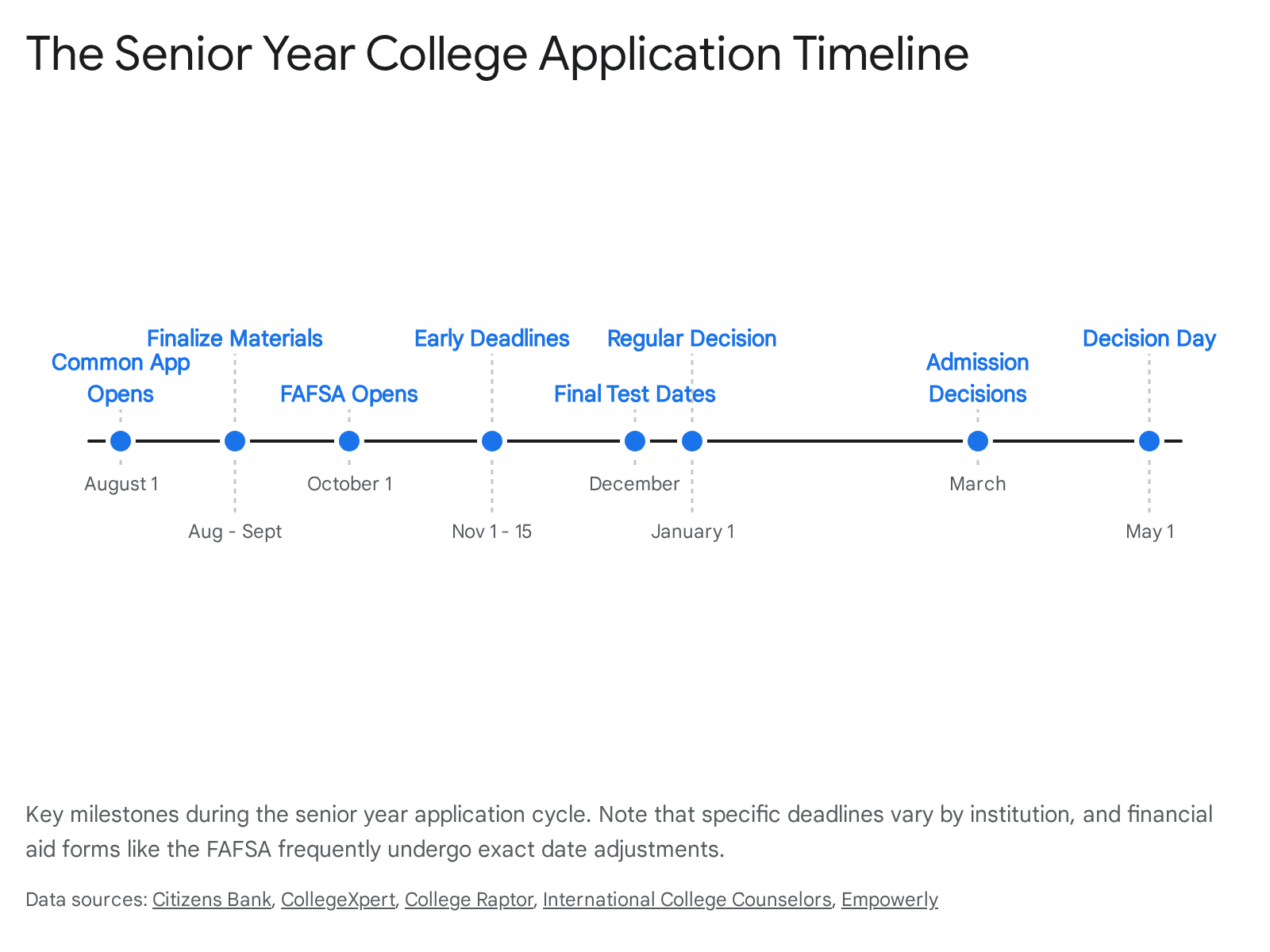
Historically, the FAFSA opened annually on October 1 of the student's senior year 1215. Following a highly publicized and rocky implementation period that caused severe delays and technical glitches in previous application cycles, the U.S. Department of Education accelerated the timeline for the class of 2026. The 2026-2027 FAFSA was officially launched early on September 24, 2025, marking the earliest successful launch in the program's history 1016. Because a significant portion of state and institutional financial aid is distributed strictly on a first-come, first-served basis, financial advisors urge families to file the FAFSA as early in the fall of the student's senior year as possible, well ahead of the official federal deadline of June 30 1023.
A Comprehensive High School Preparation Timeline
The high school years are when the narrative of college preparation translates into actionable metrics. However, rather than attempting to tackle every requirement simultaneously, students must strategically pace their workload to maintain academic performance while preserving their mental health.
Freshman and Sophomore Years: Exploration and Foundation
The ninth and tenth grades are strictly about establishing a solid upward academic trajectory and exploring meaningful extracurricular involvement. When evaluating applicants, admissions committees look for students who demonstrate sustained, multi-year commitment to a select few activities rather than a shallow, uninvested presence in a dozen different clubs 17. Students should use these early high school years to identify organizations, sports, or volunteer opportunities that genuinely align with their passions and commit to growing within those spaces 117.
During sophomore year, students should consider taking the PSAT. At this stage, the PSAT serves purely as a low-stakes diagnostic practice run; the results do not impact college admissions and are not sent to universities 18. This is also the ideal timeframe to initiate preliminary conversations with high school guidance counselors. These discussions should focus on balancing current coursework, identifying potential career interests, and designing a rigorous but manageable academic schedule for the upcoming junior year, ensuring the student is positioned to take appropriate honors or Advanced Placement (AP) classes without becoming overwhelmed 1819.
Junior Year: The Academic Crucible
The junior year of high school is universally recognized as the most critical and demanding period in the college preparation timeline. This is the year when students typically enroll in their most challenging curriculum and sit for the standardized tests that will eventually anchor their applications 2021.
The groundwork for college applications transitions from passive exploration to active research during the spring semester of junior year. Students should officially take their first SAT or ACT in the winter or early spring, allowing ample time to review their scores, identify areas for improvement, and retake the exam in the late spring or early fall if necessary 2021. Simultaneously, students should begin curating a balanced target list of colleges. This list should be strategically categorized into "safety" schools (where the student's metrics are well above the historical average), "match" or "target" schools (where the student aligns squarely with the middle fifty percent of admitted students), and "reach" schools (highly selective institutions where admission is highly competitive regardless of a student's profile) 2022.
Before the junior school year concludes in May or June, students must proactively secure their letters of recommendation. They should approach two teachers - ideally from core academic subjects who taught them during their junior year - and provide them with a detailed "brag sheet" outlining their academic goals, extracurricular achievements, and specific memories from the class to help the educators craft personalized, compelling letters 202130.
The Summer Before Senior Year: Conquering the Common App
The summer bridging junior and senior year is the phase where proactive students quietly win the application season. The Common Application, a centralized platform utilized by over one thousand colleges and universities globally, officially opens for the new academic cycle on August 1 313233. However, because the platform features a highly convenient account rollover function, students can technically create their accounts during the spring of their junior year to familiarize themselves with the interface and begin inputting basic demographic and educational data 3334.
The primary objective of this summer is to draft, refine, and finalize the main 650-word personal statement. Attempting to conceptualize and write this deeply introspective essay while simultaneously juggling the heavy academic coursework of the fall semester frequently leads to rushed, generic, and lower-quality submissions 203035. Students should also use this quiet period to carefully curate their Common App Activities section. This section strictly limits applicants to listing a maximum of ten activities, with only 150 characters allotted to describe the duties, leadership roles, and accomplishments of each 3133. Crafting high-impact descriptions within such a tight character constraint requires significant editing and strategic word choice, a task that consistently takes students much longer than they initially anticipate 33.
Senior Year: Execution, Deadlines, and Decisions
By the time the senior year begins in September, the student's operational mode must shift entirely from preparation to execution. The fall semester is heavily dictated by a cascade of strict submission deadlines.
Students opting to apply through Early Action (EA) or Early Decision (ED) pathways will face deadlines that typically fall between October 15 and November 15 2036. It is vital to understand the distinction between these two options: Early Decision is a legally binding agreement, meaning the student is absolutely obligated to attend the institution and withdraw all other applications if accepted, whereas Early Action is a non-binding mechanism that simply allows the student to receive an admissions decision sooner 36.
For students utilizing the Regular Decision (RD) pathway, applications are generally due around January 1 or shortly thereafter 1836. Following the submission of these applications, the late winter and early spring months transition into a waiting period. Colleges typically release their Regular Decision admissions outcomes and corresponding financial aid packages in March and April 1836. The entire high school application cycle culminates on May 1, universally recognized as National College Decision Day, which serves as the final deadline for students to submit their non-refundable enrollment deposits and officially commit to their chosen institution 1836.
The Evolving Role of Standardized Testing
The role and weight of standardized testing have proven to be the most volatile and heavily debated aspects of college admissions in recent history. During the onset of the COVID-19 pandemic in 2020, thousands of collegiate institutions were forced to adopt emergency "test-optional" or "test-blind" policies due to the widespread, unavoidable closures of SAT and ACT testing centers 2338. However, as the educational system moved further away from the pandemic, the testing landscape fractured significantly, leaving students to navigate a highly complex and contradictory environment.
By the 2024-2025 academic cycles, a distinct divergence emerged. Several of the nation's most highly selective and prestigious universities - including the Massachusetts Institute of Technology (MIT), Dartmouth College, Georgetown University, Yale University, Brown University, and the University of Texas at Austin - publicly reversed their pandemic-era policies and officially reinstated mandatory standardized testing requirements 233839. The rationale behind this reversal was deeply rooted in institutional data and predictive analytics. Internal longitudinal studies conducted by these universities revealed that standardized test scores, particularly when evaluated within the specific socioeconomic context of an applicant's high school, remain one of the most reliable predictors of academic success and retention at the collegiate level 2339. Furthermore, admissions deans at these institutions argued that reinstating testing requirements actually serves to promote diversity; standard objective metrics allow exceptionally talented students from under-resourced, rural, or lesser-known high schools to stand out to admissions committees, serving as a necessary counterweight to the rampant grade inflation currently plaguing the American high school system 233940. Studies indicate that in recent years, nearly 89% of all high school students received an A or B in all subjects, making it increasingly difficult for highly selective universities to differentiate academic excellence based solely on high school transcripts 40.
Conversely, the vast majority of U.S. colleges - representing over 80% of four-year universities - have opted to maintain their test-optional or test-blind policies as their new permanent operational standard 3839. These institutions argue that test-optional policies successfully increase the total volume of applications and help attract a broader, more diverse applicant pool 39.
However, prospective students must interpret "test-optional" phrasing with a high degree of strategic caution. Extensive admissions data indicates that even at institutions proudly advertising test-optional policies, students who choose to submit strong standardized test scores frequently enjoy a statistically significant acceptance advantage over their peers who withhold their scores 1740. For example, prior admissions cycle data from highly competitive programs revealed stark disparities: the University of Pittsburgh's nursing program admitted 77% of students who submitted test scores compared to only 23% of those who applied test-optional, while the University of Illinois Urbana-Champaign (UIUC) demonstrated an 81% acceptance rate for engineering students with test scores versus a 59% rate for those without 40. At the University of Miami, despite a stated test-optional policy, over 57% of the enrolled freshman class had ultimately submitted SAT or ACT scores, suggesting a clear institutional preference for higher-scoring applicants 40.
Given this fractured landscape, the most strategic approach for high school students is to plan to rigorously prepare for and take the SAT or ACT during their junior year 1721. Once they receive their official scores, they can individually evaluate each college on their target list. If their score falls at or above the 50th percentile of a specific college's historically admitted class, submitting the score will likely bolster their application. If the score falls significantly below that threshold, the student can leverage the test-optional policy and withhold the score, relying entirely on their GPA, essays, and extracurricular profile.
Alternative Post-Secondary Pathways
The single-minded pursuit of a traditional four-year university degree remains culturally dominant in the United States, but it is unequivocally not the only valid pathway to a successful and lucrative career. Depending on a student's specific academic timeline, financial constraints, and ultimate professional goals, community colleges and specialized trade schools offer highly viable, economically efficient alternatives 412443.
| Post-Secondary Option | Typical Duration | Average Cost Profile | Admissions Timeline & Requirements |
|---|---|---|---|
| 4-Year University | 4 to 5 years | Highest (Tuition, mandatory fees, room & board) | Strict deadlines typically falling between November and January of Senior Year. Requires transcripts, extensive essays, letters of recommendation, and often standardized test scores. 2036 |
| Community College | 2 years (Yielding an Associate degree or transferable credits) | Low (Often under $5,000 per year for local, in-state students) 41 | Rolling admissions, frequently accepting applications right up until the first week of classes. Open-door policies generally require only a standard high school diploma or a GED. 254546 |
| Trade / Vocational School | 6 to 24 months | Moderate (Averages approximately $33,000 total for the entire program) 4126 | Flexible or rolling deadlines. Requires a high school diploma or GED. Admissions focus entirely on readiness for specific, hands-on skill development (e.g., HVAC, nursing, welding, cosmetology). 482728 |
Trade and vocational schools are currently experiencing a significant surge in popularity and cultural acceptance, largely driven by nationwide shortages in skilled technical labor 4328. These specialized programs intentionally strip away the broad general education requirements found at traditional universities, immersing students directly into practical, hands-on training for specific, high-demand careers such as welding, electrical work, dental assisting, or HVAC maintenance 412427. This focused approach allows students to complete their education and enter the full-time workforce in a fraction of the time required for a bachelor's degree, allowing them to begin earning an income years earlier and with significantly less accumulated student debt 412629.
Similarly, community colleges provide an incredibly cost-effective mechanism for students to fulfill general education prerequisites before eventually transferring to a four-year university 412430. Earning an associate degree at a community college first is an excellent strategic choice for students who are entirely undecided on a major, allowing them to explore various academic disciplines at a low cost before committing to the higher tuition rates of a traditional university 2430.
Specialized Preparation Strategies
Certain subsets of students face unique challenges or possess specific resources that alter the standard college preparation timeline. Tailoring the approach to fit these distinct circumstances is critical for navigating the admissions process successfully.
Supporting First-Generation College Students
First-generation students - generally defined as students whose parents or legal guardians did not complete a four-year college degree - face profound systemic hurdles in the admissions process. While these students currently account for roughly one-third of all enrolled undergraduates in the United States, they successfully complete their bachelor's degrees at rates that are significantly lower than their peers who have college-educated parents 313233. Without the benefit of informal, generational family knowledge regarding the complex mechanics of application timelines, standardized testing registration, and financial aid verification, first-generation students can easily miss critical deadlines or fail to maximize their financial aid eligibility 3334.
To counteract these systemic disadvantages, first-generation students must actively begin building a robust external support network starting as early as their freshman or sophomore year. This proactive approach includes: * Identifying Mentors Early: Seeking out high school guidance counselors, teachers, or community leaders who have successfully navigated higher education. These mentors can provide crucial assistance in curating a balanced college list, reviewing essay drafts, and decoding the complexities of the FAFSA 3132. * Enrolling in Educational Opportunity Programs (EOPs): Many colleges and universities offer EOPs specifically designed to provide targeted academic counseling, peer mentorship, and specialized financial guidance tailored to the unique challenges faced by students from underrepresented or low-income backgrounds 35. * Utilizing Campus Resources Immediately: Once they arrive on a college campus, research shows that first-generation students benefit heavily from utilizing academic tutoring centers early in their first semester and joining first-generation networking cohorts. These actions directly combat feelings of imposter syndrome and foster the strong sense of belonging necessary for academic retention 3334.
The Role of Independent Educational Consultants
For families with the financial means, hiring an independent educational consultant has become a popular method to manage the stress of college admissions. Many of these elite consulting firms aggressively market "early start" packages, encouraging parents to retain their services when a student is in the eighth or ninth grade 5836. These early-start programs focus on curating a highly optimized four-year trajectory, advising students on which high school courses to take, which extracurricular leadership roles to pursue, and how to develop a unique "capstone" project to differentiate themselves in the applicant pool 5836.
While securing professional guidance can undoubtedly streamline the organizational aspects of the application process, families must weigh the high costs against the actual necessity of the service. Educational consultants are generally most beneficial for specific demographics: highly recruited student-athletes who must navigate complex NCAA eligibility timelines, students targeting the most hyper-selective Ivy League institutions where the margin for error is nonexistent, or families struggling to understand complex financial aid and institutional pricing structures 58. For the vast majority of students targeting excellent but standard-selectivity state universities or private colleges, engaging a consultant early in high school is largely unnecessary and risks transforming a child's authentic high school experience into a heavily manufactured, high-stress endeavor.
Safeguarding Mental Health During Admissions
Perhaps the most universally critical, yet frequently overlooked, aspect of college preparation is actively managing and safeguarding the student's psychological and emotional health. The modern admissions landscape has inadvertently created a demographic characterized by sociologists as the "panicking class" - a group of affluent or highly motivated families who hyper-fixate on a tiny fraction of elite, highly rejective universities, operating under the false and damaging assumption that institutional prestige is the sole metric of future happiness and career success 37.
This unrelenting pressure inherently fuels a toxic "grind culture" among American teenagers 3. Recent surveys indicate that an alarming 81% of teens feel pervasive negative pressure regarding their future, with over a quarter reporting that they are actively struggling with clinical burnout - a condition previously associated primarily with adults in high-stress professional environments 3.
The academic literature highlights that chronic stress during the college preparation phase leads to severe psychological consequences. Research utilizing structural equation modeling demonstrates a direct, sequential pathway: an imbalance between excessive academic demands and insufficient personal coping resources leads directly to emotional exhaustion; this exhaustion triggers profound loneliness, which in turn breeds a fear of social alienation and significantly lowers the student's overall life satisfaction 53839. A comprehensive study of highly motivated high school students showed that over half experienced active academic burnout during the school year 9. The symptoms are pervasive and destructive, manifesting as chronic insomnia, problem avoidance, social withdrawal, severe test anxiety, and even an increased risk of substance use as a maladaptive coping mechanism 49394041. Furthermore, the congruence of high academic pressure and a lack of psychological balance has been empirically linked to a sharp increase in depressive symptoms in adolescents, particularly among high school seniors bearing the dual burdens of maintaining high grades and preparing for high-stakes entrance exams 4042.
To combat this epidemic of burnout, educational consultants, child psychologists, and university researchers unanimously urge parents to help their teenagers build resilience by intentionally broadening their definition of success 10674344. Families must consciously shift their focus away from prestigious rankings and instead prioritize finding an educational "fit" - an institution that aligns with the student's specific academic interests, social preferences, and financial reality 3767. On a practical level, students require deliberately unstructured free time, adequate sleep hygiene, time spent outdoors, and constant reassurance from the adults in their lives that their inherent worth is not dictated by a collegiate acceptance letter 1310.
Bottom line
Effective college preparation is a multi-year marathon that officially begins in the ninth grade, requiring a delicate balance of academic rigor, authentic extracurricular exploration, and strategic financial planning. While families are wise to initiate 529 savings plans early and stay informed on shifting FAFSA deadlines, pushing middle schoolers into intense resume-building often backfires, resulting in severe psychological burnout and academic disengagement. Ultimately, safeguarding a student's emotional well-being and focusing on finding a post-secondary pathway - whether a four-year university, community college, or trade school - that aligns with their personal aptitude is far more critical than chasing elite institutional prestige.