
How to Cope With Climate Anxiety Without Ignoring the Science
Climate anxiety is a rational, empathetic response to the reality of environmental degradation, not a mental disorder that needs to be cured. The most effective way to cope is by shifting from isolating, individual guilt to collective, meaning-focused action. By balancing active environmental engagement with intentional rest and community support, individuals can sustain their advocacy without succumbing to burnout or despair.
What Is Climate Anxiety?
In recent years, the escalating frequency of extreme weather events - from unprecedented wildfires to catastrophic flooding - has thrust the reality of a warming planet into daily life. This constant exposure has given rise to a profound psychological phenomenon: climate anxiety.
The American Psychological Association (APA) formally describes eco-anxiety as a "chronic fear of environmental doom" 123. However, researchers and clinical psychologists are quick to clarify that worry about climate change is fundamentally a healthy and rational response to an objective, scientifically documented threat 434. Unlike generalized anxiety disorders, which often involve exaggerated responses to unlikely threats, climate anxiety is tethered to reality 5. It signifies empathy, awareness, and a deep connection to the living world 6.
Worry acts as a necessary motivator for action. Problems arise, however, when this distress becomes overwhelming and debilitating, leading to a state of psychological paralysis 3.
Defining the Terminology
While "climate anxiety" is the most recognized term, the umbrella of climate distress encompasses several nuanced emotional states that people experience as the environment changes around them.
Eco-anxiety generally refers to anticipatory fear about future environmental disasters and the long-term survival of human and ecological systems 35. Ecological grief, or eco-grief, is distinct from anxiety; it involves profound sadness over observed environmental losses, such as melting glaciers, shrinking snowpacks, or the extinction of beloved species 3597.
Another emerging concept is solastalgia. Coined by environmental philosopher Glenn Albrecht, solastalgia describes a form of homesickness experienced while still at home, caused by the visible degradation of one's immediate, familiar environment 3311. Finally, eco-guilt and eco-moralism describe the shame individuals feel regarding their own carbon footprint, often leading to a paralyzing perfectionism where everyday actions - like flying, driving, or using plastic - feel like profound moral failures 35.
Worry Versus Clinical Anxiety
It is important to distinguish between climate worry and clinical impairment. According to longitudinal survey data spanning more than two decades, a significant majority of adults express "worry" or "concern" about global warming 3. Concern is a broad, somewhat passive state, whereas worry is an active emotion that often drives problem-solving 3.
Climate anxiety crosses into clinical territory when it severely impacts daily functioning. This can manifest as intrusive thoughts, an inability to concentrate at work or school, or the deterioration of social relationships 38. While climate anxiety is not currently classified as a distinct mental disorder in diagnostic manuals, mental health professionals increasingly recognize it as a significant public health issue requiring targeted therapeutic interventions 467.
The Physical and Relational Toll
Eco-anxiety is not confined to the mind; it manifests heavily in the body and in social dynamics. The psychological burden of planetary crisis fundamentally alters how people move through the world and interact with one another.
How the Body Keeps the Climate Score
From a neurobiological perspective, constant exposure to catastrophic climate news keeps the nervous system in a state of chronic vigilance 59. Rather than a brief fight-or-flight response, individuals experience prolonged physiological stress. This can lead to somatic symptoms including sleeplessness, chronic fatigue, muscle tension, a racing heart rate, and shortness of breath 135914.
For some, this borders on collective trauma 5. The body carries the weight of a crisis too large to resolve alone, and the sheer volume of distressing information can overwhelm the brain's capacity to process it, leading to a cycle of despair and emotional numbness 5.
The Strain on Interpersonal Relationships
Climate distress introduces a subtle but pervasive strain on interpersonal relationships, a phenomenon sometimes termed "eco-alienation" 5. This occurs when individuals feel consumed by the urgency of the climate crisis while their peers, family members, or broader society appear indifferent 515.
These relational fractures take many forms. Value mismatches between partners can create friction, particularly when one partner is deeply eco-engaged and the other is avoidant 5. Many young adults experience profound parenting dread, grappling with the moral and practical implications of raising children under intense climate uncertainty 5910. The loneliness of feeling like you care "too much" in a world that seemingly does not care enough can severely compound the primary anxiety caused by the changing environment 15.
The Hidden Costs of Occupational Burnout
In professional spheres, climate distress is increasingly recognized as an occupational hazard. For climate scientists, environmental policymakers, first responders, and emergency managers, seasonal shifts no longer represent leisure; they act as ignition points for severe burnout 19.
These professionals often grapple with secondary trauma - witnessing suffering and environmental destruction they cannot prevent 59. A phenomenon known as "hope fatigue" sets in, describing the sheer exhaustion of maintaining optimism against overwhelming scientific data 5. Furthermore, the expectation to remain strictly objective in scientific and governmental settings disenfranchises their grief, forcing practitioners to bury or filter the emotional toll of their daily work to protect their perceived impartiality 9.
Who Is Most Affected by Climate Distress?
While climate anxiety is a global phenomenon affecting people across all demographics, its distribution is highly uneven. The burden falls disproportionately on those positioned to inherit the crisis and those already living on its frontlines.
The Generational Divide and Youth Mental Health
Young people are experiencing unprecedented levels of climate-related distress. A sweeping 2021 study published in The Lancet Planetary Health, which surveyed thousands of youths aged 16 to 25 across ten countries, found that 84% were at least moderately worried about climate change, with 59% reporting they were "very" or "extremely" worried 6711. Nearly 40% indicated that these feelings negatively affected their daily lives 6.
For younger generations, climate anxiety is deeply intertwined with feelings of betrayal by older generations and institutional leaders who hold the power to enact systemic change but consistently fail to do so 1219. This anxiety is not merely about shifting weather patterns; it is an existential dread regarding the loss of a stable future, safe water, and predictable seasons 5.
Research also indicates that climate anxiety can impact the cognitive development of children. Extreme weather events and the chronic stress of climate awareness can disrupt normal development, increasing the risk of attention-deficit/hyperactivity disorder, educational challenges, and psychiatric disorders later in life 6.
Frontline Communities and the Global South
For populations in the Global South, Small Island Developing States (SIDS), and Indigenous communities, climate anxiety is rarely an abstract fear of the future; it is a present-tense traumatic reality 202122. In these regions, climate change translates directly to the loss of ancestral lands, the disruption of traditional livelihoods, and forced migration 202213.
For example, the Kalash community in the Hindu Kush mountains of Pakistan faces immediate existential threats from melting glaciers, while the Mbororo tribesmen in Cameroon face climate-induced disasters that aggravate existing systemic discrimination 13. In Bangladesh, coastal dwellers like the Munda community are increasingly thrust into urban slums due to rising sea levels 13.
In these contexts, environmental degradation leads to the rapid erosion of traditional governance, cultural practices, and religious beliefs. This disruption often precipitates severe mental health struggles, compounding physical vulnerabilities with profound cultural bereavement and psychological trauma 12213.
The Psychology of Coping: Dual-Pathway Models
Understanding how humans successfully navigate this massive existential threat requires looking at established psychological frameworks. Research within environmental psychology frequently points to a "dual-pathway" or "dual-process" model of coping, which categorizes human reactions to climate distress into specific strategic pathways 12142515161718.
How an individual unconsciously or consciously selects among these coping strategies determines whether their climate anxiety paralyzes them or pushes them toward sustainable, healthy action. Social scientists generally classify these coping mechanisms into three distinct categories: emotion-focused, problem-focused, and meaning-focused coping 12142515.
| Coping Strategy | Core Mechanism | Behavioral Outcome | Psychological Impact |
|---|---|---|---|
| Emotion-Focused Coping | Distancing oneself from the distress. Strategies include avoidance, denial, wishful thinking, and de-emphasizing the threat 12142515. | Low Engagement. Decreases pro-environmental behavior and collective action 3031. | Maladaptive. Provides temporary relief but fails to resolve underlying dread. Often leads to eco-paralysis 2515. |
| Problem-Focused Coping | Addressing the stressor directly by seeking information, reducing personal carbon footprints, and engaging in activism 12142515. | High Engagement. Strongly associated with taking actionable steps to mitigate climate change 2531. | High Risk of Burnout. Because the problem is global, this can increase distress, anger, and exhaustion if used alone 2517. |
| Meaning-Focused Coping | Reappraising the situation to find purpose. Involves cultivating constructive hope, trusting in collective efforts, and finding spiritual or personal significance 6121530. | Sustained Engagement. Motivates long-term, resilient pro-environmental behavior 153031. | Highly Adaptive. Buffers against depression and burnout. Transforms paralyzing fear into a sense of agency and solidarity 615. |
The Limits of Problem-Solving
It is highly intuitive to think that the best way to handle anxiety about a problem is to simply fix the problem. However, climate change defies standard psychological problem-solving because of its immense scale and systemic complexity.
When individuals rely solely on problem-focused coping - such as obsessively tracking their household recycling, refusing to fly, or aggressively campaigning - they inevitably collide with the reality that their individual actions barely register against global industrial emissions 5253233. This realization can cause problem-focused coping to backfire. Instead of providing relief, it replaces anxiety with deep despair, a heightened sense of powerlessness, and severe burnout, as the complexity and seriousness of the uncontrollable stressor become fully apparent 2517.
The Necessity of Meaning and Collective Efficacy
To sustain environmental action without destroying mental health, psychologists emphasize the absolute necessity of meaning-focused coping. This strategy acts as a psychological buffer. It does not ignore the severity of the crisis; rather, it consciously shifts the narrative toward constructive hope and shared purpose 615.
A core component of meaning-focused coping is moving away from the heavy burden of individual responsibility and leaning into "collective efficacy" - the belief that a group, acting together, can create meaningful change 1819. Studies consistently demonstrate that individuals who engage in collective climate action experience significantly lower levels of depression and anxiety compared to those who ruminate on the crisis in isolation 31518.
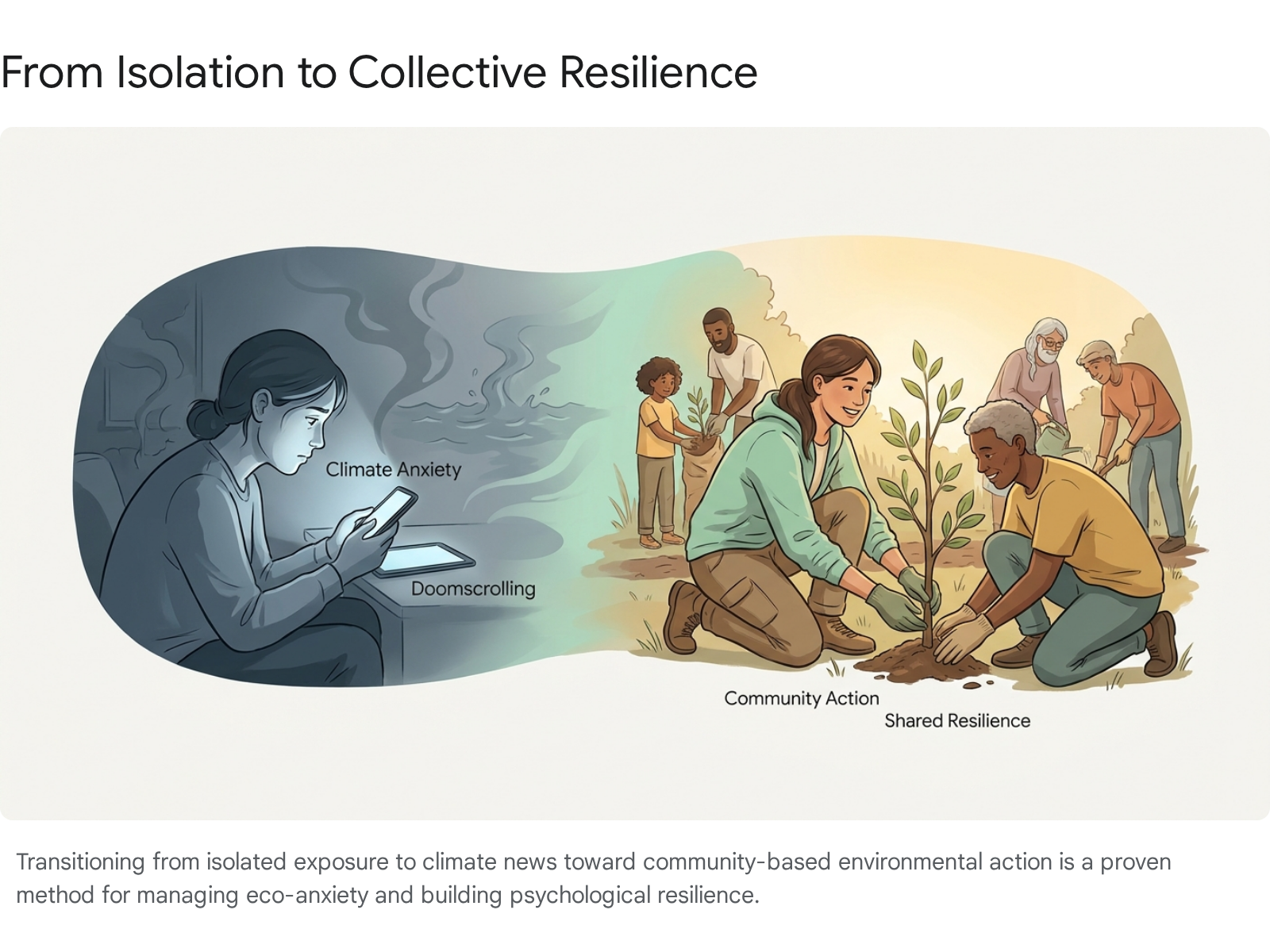
Collective action allows individuals to connect with like-minded communities, providing the social support necessary to drive change while safeguarding mental health 18.
The Role of Positive Psychology and Psychological Capital
Clinical responses to climate anxiety are evolving. Rather than treating it solely through the lens of pathology, mental health professionals are increasingly applying frameworks from positive psychology to help individuals build "Psychological Capital" (PsyCap) 1920.
Building Resilience Through PsyCap
Psychological Capital focuses on cultivating four key traits: self-efficacy, optimism, resilience, and hope 1920. In the context of climate change, optimism does not mean toxic positivity or downplaying the gravity of ecological collapse. Instead, it involves cognitive reframing - shifting one's viewpoint from inevitable doom to a manageable challenge 19.
PsyCap interventions, such as goal-setting activities and resilience training, empower individuals to transform their climate fear into constructive, solution-focused behaviors 19. By recognizing that humans possess the capacity to adapt and innovate, individuals can regain a sense of control over their immediate environment, which directly combats the helplessness characteristic of severe eco-anxiety 3219.
Acceptance and Commitment Therapy (ACT)
Therapeutic modalities such as Acceptance and Commitment Therapy (ACT) are also proving highly effective for those suffering from climate distress 36. ACT helps individuals explore their personal values and commit to actionable steps aligned with those values, while simultaneously accepting the uncomfortable emotional realities of the crisis 36. This approach recognizes that trying to eliminate negative emotions regarding climate change is both impossible and counterproductive; instead, therapy focuses on living a meaningful, engaged life alongside those difficult feelings.
Five Pathways of Mindfulness for Sustained Action
Recent frameworks in environmental psychology have proposed mindfulness not just as a relaxation technique, but as a critical, evidence-based alternative to fear-based climate messaging 3721. Traditional climate communication often relies heavily on fear to stimulate immediate action. However, framing climate change purely as an existential threat frequently triggers eco-paralysis, emotional burnout, and long-term disengagement 3337.
Mindfulness offers a structural pathway to sustained pro-environmental behavior through five distinct mechanisms:
- Emotional Regulation: Cultivating the emotional resilience necessary to face distressing ecological news without immediately resorting to avoidance or denial 3721.
- Cognitive Flexibility: Developing the ability to adapt thinking, shift perspectives, and break out of automatic, high-carbon habitual behaviors 3721.
- Connectedness to Nature: Fostering a deep, psychological bond with the biosphere. When individuals feel a sense of kinship with nature, their environmental engagement is driven by care and love rather than sheer terror 2139.
- Intrinsic Motivation: Aligning daily behaviors with deeply held ecological values. This closes the "attitude-behavior gap," ensuring that pro-environmental actions are self-sustaining rather than reliant on external pressure or guilt 21.
- Collective Action: Transforming internal, personal awareness into social engagement, facilitating broader community resilience and societal shifts 3721.
Reframing the Narrative Through Indigenous Knowledge
Mainstream Western approaches to climate anxiety often treat it as a novel psychological dilemma brought about by recent data. However, Indigenous communities and populations in the Global South have long navigated environmental displacement, systemic extraction, and ecological grief. Their traditional coping mechanisms and knowledge systems offer profound frameworks for resilience that focus on deep relationality rather than hyper-individualism.
Reports from the United Nations highlight a stark reality: while Indigenous Peoples constitute only 6% of the global population, they safeguard an estimated 80% of the world's remaining biodiversity 22. Despite this, they receive less than 1% of international climate funding 22. Recognizing and supporting their methodologies is not just a matter of equity; it is a strategic imperative for global adaptation 13.
Ancestral Stewardship and Ecological Law
Indigenous resilience strategies are deeply rooted in community action and ancestral wisdom. For example, in Ayacucho, Peru, Quechua communities are reviving ancient "water sowing and harvesting" practices to adapt to severe droughts and shrinking glaciers 22. Because these actions are tied to cultural heritage rather than sheer panic, they promote resilience rather than anxiety.
In Somalia, environmental governance is maintained through complex oral traditions. Cultural taboos against harming specific flora, such as the gurmo go'an prohibitions on cutting certain trees, integrate environmental protection seamlessly into daily cultural life 22. By embedding ecological law within generational wisdom - passed down through proverbs and stories - environmental stewardship becomes a shared community identity rather than a separate, anxiety-inducing political chore 22.
The Interrelationship Model and Kinship
Western climate anxiety is heavily driven by a sense of isolated, individual responsibility. Indigenous frameworks, by contrast, often operate on an "interrelationship model" 39. This model posits that an individual's "psychological family" extends far beyond human relatives to include non-human entities - plants, animals, local ecosystems, and future generations 3923.
Within this eco-relational worldview, protecting the earth is not an overwhelming burden to "save the world" hoisted upon an individual. Instead, it is a natural, healthy expression of reciprocal care and kinship 3923. By adopting an eco-relational perspective, individuals facing climate anxiety can transition away from the high-pressure savior complex. Action becomes an expression of ongoing responsibility to the local ecosystem rather than a frantic, isolated attempt to halt a global apocalypse 3923.
Practical Strategies to Build Personal Resilience
Translating psychological models and global perspectives into everyday life involves intentional shifts in how people consume information, interact with their communities, and view their own roles in the crisis.
Curating Information and the "Positivity Sandwich"
The digital age ensures that catastrophic headlines and terrifying visuals of floods and fires are delivered hourly. Human brains are simply not wired to process planetary-scale collapse continuously 5. Overconsumption of fear-inducing news leads directly to secondary trauma and desensitization 5924.
Mental health professionals recommend implementing strict boundaries on media consumption. One highly effective strategy is the "positivity sandwich" 25. This involves starting a reading session with a piece of constructive or solutions-oriented news, moving on to process a heavier, difficult reality check, and concluding with a second feel-good story about positive community action 25. Seeking out trusted, science-based sources that focus heavily on climate solutions rather than exclusively on climate disasters helps individuals stay informed without succumbing to doomscrolling 1124.
Finding Community and Climate Cafés
Because mainstream culture often reduces environmental responsibility to hyper-individual consumer choices - such as buying zero-waste products or agonizing over plastic packaging - many people fall into the trap of eco-moralism 5. Measuring one's worth strictly by carbon-perfect lifestyle choices breeds chronic guilt, which ultimately erodes personal agency and causes burnout 5.
The proven antidote to this eco-alienation is communal solidarity. Joining a local stewardship group, participating in invasive species removal, or organizing for systemic policy changes reminds individuals that they are part of a larger ecosystem of activists 5142425.
A growing movement to support this is the establishment of "Climate Cafés" 1126. These are informal, facilitated community gatherings where people can openly share their climate grief, fears, and frustrations in a supportive environment, free from debate or the pressure to immediately "fix" the problem 1126. Finding spaces to vocalize distress safely is proving highly effective at breaking the silence and isolation that fuels severe anxiety 26.
Toggling, Rest, and Permitting Joy
Mainstream advice often reduces coping to superficial self-care, but sustainable resilience requires deeper psychological boundaries. Taking a deliberate break from climate work is not the same as climate denial; it is necessary psychological maintenance 27.
Psychologists recommend a practice called "toggling" 627. This is the cultivated ability to hold space for the grim realities of the climate crisis while deliberately stepping away to experience spontaneous play, joy, and rest 2728. Taking full days off to relax - sometimes referred to as taking "doona days" - or engaging in hobbies completely unrelated to environmentalism prevents the central nervous system from locking into chronic stress 27. Permitting joy is essential; it replenishes the emotional reserves needed to return to advocacy work with renewed energy and perspective 2728.
Supporting Vulnerable Populations
Addressing climate anxiety requires tailored approaches for those most vulnerable, particularly children and youth, who require specific guidance to navigate their unique developmental stages in a warming world.
Guidance for Parents and Educators
Parents and educators play a critical role in shaping how young people perceive and react to climate threats. Frameworks developed by psychological associations emphasize the importance of open, age-appropriate conversations 647. Rather than shielding children entirely from the reality of climate change - which can breed distrust and confusion - adults are encouraged to focus on solutions and active participation 47.
Useful tools are emerging to aid these conversations. For instance, the "Climate Emotions Wheel" helps individuals of all ages identify and validate complex feelings, recognizing that anger, sadness, and frustration are normal responses 6. In classroom settings, educators utilize environmental timeline tools that allow students to document their personal interactions with the natural world. This practice grounds students, often stirring rich conversations and transforming generalized fear into localized, actionable engagement 25. Parents can further support their children by modeling sustainable behaviors - such as participating in local cleanups or gardening - which demonstrates agency and reduces the perception of helplessness 25.
Building Systemic Community Resilience
Ultimately, clinical interventions and personal coping strategies cannot exist in isolation from systemic change. Individual therapy is insufficient if the underlying environmental and structural threats remain unaddressed 2.
Mental health support must be integrated directly into climate adaptation planning 2930. Advocacy for policies like the Community Mental Wellness and Resilience Act highlights a growing recognition that disaster response must extend beyond physical infrastructure to include long-term psychological recovery 26. Expanding mental health resources, particularly in highly vulnerable regions and SIDS, is a necessary step to transition societies from a state of reactive fear to proactive, community-based resilience 29.
Bottom line
Climate anxiety is a highly valid, empathetic response to the undeniable reality of environmental degradation, not a mental disorder to be suppressed or pathologized. Coping effectively without ignoring the science requires moving past isolating, problem-focused perfectionism and embracing meaning-focused strategies such as community engagement, collective action, and an intentional reconnection with nature. While the emotional toll of the crisis is heavy, integrating the reality of scientific data with strong social support networks allows individuals to transform their grief into resilient, sustainable advocacy.