
Power distance and authority bias in celebrity and expert endorsements
Introduction to Endorsement Evaluation
The strategic deployment of human faces and voices to persuade consumer audiences represents one of the foundational practices in modern marketing communications. However, the efficacy of advertising endorsements is neither universal nor strictly intuitive. It is heavily mediated by an intricate framework of cultural conditioning, cognitive biases, and shifting demographic attitudes toward institutional authority. Two distinct archetypes dominate this landscape: the celebrity, who leverages widespread recognition, physical attractiveness, and parasocial attachment, and the expert, who commands authority through specialized knowledge and credentialed competence 12.
Evaluating the differential success of these endorser types requires an extensive examination of power distance beliefs, a cultural dimension that measures the extent to which less powerful members of a society expect and accept that power is distributed unequally 234. When power distance beliefs are integrated with cognitive models of persuasion - specifically the halo effect and epistemic trust - it becomes evident that advertising efficacy relies on highly specific alignments between the endorser's perceived status, the cultural expectations of the audience, and the intrinsic attributes of the product 256.
Furthermore, the contemporary digital ecosystem has introduced unprecedented volatility into these traditional endorsement models. The proliferation of social media algorithms, the rise of the micro-influencer, and the emergence of severe generational skepticism have disrupted historical pathways of persuasion 78910. Younger demographics, particularly Generation Z, exhibit fundamentally different patterns of trust compared to older cohorts, demanding rigorous independent validation over passive celebrity acceptance 111314. This analysis explores how power distance and authority bias manipulate the effectiveness of celebrity versus expert endorsements, detailing the cognitive, cultural, and technological forces that dictate contemporary consumer purchase intentions.
Cultural Mechanics of Power Distance Beliefs
Power distance operates as a foundational psychological filter through which consumers interpret authority, prestige, and credibility. Originally codified by Geert Hofstede as a macro-level national characteristic within cross-cultural anthropology, recent consumer behavior research recognizes power distance beliefs as an individual-level psychological orientation that can be culturally ingrained or situationally primed 412. The degree to which consumers internalize these beliefs strictly dictates their susceptibility to different forms of advertising persuasion and their preference for specific types of authority figures.
High Power Distance Environments
In cultures characterized by high power distance - such as many markets across Asia, the Middle East, and Latin America - social hierarchies are widely accepted as a natural and necessary ordering of society 5131415. Individuals embedded within these demographics inherently respect authority figures and aspire to associate with elite status markers. Consequently, celebrity endorsements are disproportionately effective in high power distance contexts 245.
Celebrities function as aspirational symbols of power, wealth, and societal success. For audiences with high power distance beliefs, purchasing a brand endorsed by a prominent celebrity represents a form of status consumption, operating as a mechanism to absorb a fraction of the endorser's elite societal positioning 41419. Empirical studies indicate that these audiences tend to overlook objective evaluations of a celebrity's specific product expertise, deferring instead to the endorser's generalized authority and overarching prestige 25. Advertisements featuring celebrity endorsers in these regions yield consistently higher brand attitudes and purchase intentions compared to those featuring non-celebrities or relatable, "everyday" individuals 515.
For example, quantitative survey research conducted in Saudi Arabia demonstrates that celebrity attractiveness and perceived prestige play pivotal roles in shaping purchasing behaviors, as consumers are highly responsive to the status signals broadcast by prominent figures 1617. Similarly, an experimental study examining consumer reactions to restaurant endorsements revealed that individuals with high power distance beliefs exhibited significantly more positive attitudes and stronger purchase intentions toward restaurants owned by entertainer celebrities, valuing the associated prestige over culinary competence 15. In the context of ecotourism marketing, individuals with high power distance beliefs respond more favorably to conspicuous travel content on social media that signals social status, transferring their deference for hierarchical positioning onto the consumption of luxury ecological experiences 4.
Low Power Distance Environments
Conversely, in low power distance cultures - such as the United States, the United Kingdom, and Scandinavian nations - egalitarianism is prioritized as a core social value. Consumers in these regions view themselves as relatively equal to authority figures and are inherently skeptical of unearned or purely status-driven hierarchies 51213. In these markets, the persuasive power of a celebrity merely for the sake of their fame is significantly diminished 25.
Low power distance consumers demand functional relevance and demonstrable expertise. They are far more likely to be persuaded by a credentialed expert who possesses verifiable technical knowledge or a relatable peer whose lifestyle closely mirrors their own 51315. When exposed to celebrity advertising, these individuals are prone to cognitive resistance, critically evaluating whether the celebrity possesses genuine knowledge of the product or is merely participating in a paid financial transaction. As a result, the differential advantage of using a celebrity over a non-celebrity spokesperson frequently disappears in low power distance demographics unless the celebrity possesses an undeniable, logical connection to the product category 25. The aforementioned restaurant endorsement study confirmed this dichotomy, finding that consumers with low power distance beliefs showed a substantially more positive attitude and stronger intent to purchase toward restaurants owned by working celebrity chefs rather than entertainers, favoring verifiable expertise over generalized fame 15.
To synthesize the divergence in endorsement efficacy across these cultural contexts, the following table summarizes the primary mechanisms of persuasion based on power distance orientations:
| Endorsement Variable | High Power Distance Beliefs | Low Power Distance Beliefs |
|---|---|---|
| Primary Persuasion Mechanism | Aspirational status signaling, deference to hierarchy, status consumption 45. | Functional relevance, egalitarian assessment, skepticism of unearned status 513. |
| Preferred Endorser Profile | High-status celebrity, luxury influencers, prominent authority figures 213. | Credentialed experts, relatable peers, micro-influencers, specialized technicians 29. |
| Impact of Celebrity Fame | Amplifies perceived expertise; general authority is accepted without domain knowledge 25. | Diminished; fame alone does not confer trust without domain-specific congruence 2. |
| Consumer Motivation | Upward social mobility, prestige acquisition, conformity to idealized images 419. | Practical utility, authentic connection, independent verification, logical assessment 1315. |
| Advertising Message Frame | Eager gestures, promotional frames emphasizing achievement and prestige 18. | Vigilant gestures, preventive frames emphasizing security and objective quality 18. |
Cognitive Processing in Advertising Persuasion
Beyond macro-cultural dimensions, the efficacy of advertising endorsements is governed by micro-level cognitive processes. The divergence between expert and celebrity appeal is rooted deeply in the distinction between epistemic trust and the psychological phenomenon known as the halo effect.
Epistemic Trust and Expert Authority
Epistemic trust refers to an individual's willingness to rely on the knowledge, testimony, or claims of an informant as a reliable source of truth 6192021. It is a highly functional, domain-specific form of trust. An audience grants epistemic trust when they assess that an endorser possesses practical intelligence, verifiable competence, and ethical benevolence 626. Expert endorsements rely entirely on this mechanism. When a dermatologist endorses a skincare formulation, or a financial analyst endorses an investment platform, the persuasion is driven by the consumer's rational calculation that the endorser's specific academic or professional training qualifies them to make an accurate claim 12.
However, epistemic trust is fragile and highly context-dependent. Research indicates that when audiences perceive a mismatch between an expert's displayed confidence and their actual evidential support, epistemic trust erodes rapidly 2627. Furthermore, epistemic trust is strictly confined to the expert's domain; an epidemiologist holds immense epistemic authority regarding virology and public health but possesses zero inherent authority regarding automotive engineering or monetary policy 628.
Developmental psychology reveals that the capacity for epistemic trust begins forming in early childhood, evolving from a reliance on superficial cues to a demand for accuracy and skill-based justifications. Studies examining children's trust in information sources show that younger children initially exhibit a strong preference for well-groomed individuals over ungroomed individuals, utilizing physical appearance as a heuristic for reliability 22. However, by middle childhood, children shift toward epistemic justifications, prioritizing informants with demonstrated competence over those with mere aesthetic appeal, indicating that the prioritization of expertise is an advanced cognitive developmental milestone 2223.
The Halo Effect in Celebrity Advertising
While expert endorsers rely on domain-specific epistemic trust, celebrities leverage powerful cognitive biases - chiefly, the halo effect. The halo effect is a cognitive shortcut whereby positive evaluations of a person on one prominent dimension (such as physical attractiveness, athletic prowess, or cinematic fame) unconsciously bleed over into unrelated traits, such as moral integrity, generalized intelligence, or product expertise 620242526.
In advertising and marketing communications, the halo effect explains why consumers routinely accept the recommendations of actors, musicians, or athletes regarding complex products entirely outside their professional purview, such as software, automobiles, or nutritional supplements 628. The sheer visibility and generalized societal success of the celebrity create an illusion of universal wisdom. Because the human brain favors heuristic processing to conserve cognitive energy under conditions of uncertainty, consumers often substitute the difficult task of evaluating a product's complex technical merits with the significantly easier task of evaluating their affective, emotional response to the celebrity 242526.
The concept of the halo effect is closely related to the generalization effect in attractiveness evaluations, where traits associated with a physically attractive or highly familiar individual are generalized to other, unrelated entities 26. Advertisers capitalize on this by pairing visually appealing celebrities with products, relying on the consumer's cognitive bias to transfer the positive affect associated with the celebrity directly onto the brand image, thereby increasing the willingness to accept product recommendations without rigorous empirical scrutiny 2627.
Stimulating Analytical Thinking to Mitigate Biases
The power of the halo effect can be artificially mitigated when consumers are prompted to engage in deep analytical thinking. Experimental psychology demonstrates that when individuals are forced into a state of deliberate, rational cognition prior to a judgmental task, the halo effect generated by traits like physical or vocal attractiveness is significantly reduced, rendering generalized celebrity endorsements less persuasive 2024.
In controlled studies where participants' analytical thinking was activated using Raven's Standard Progressive Matrices or structured writing tasks, subjects became far less biased by irrelevant central traits (such as a speaker's attractiveness) when evaluating the substantive quality of the speaker's information 2024. These findings suggest that celebrity endorsements are most effective when target consumers are in a state of low cognitive involvement or passive media consumption. If an advertisement or purchasing environment requires high cognitive load or analytical assessment, the halo effect dissipates, and the consumer reverts to requiring the epistemic trust provided by a credentialed expert 624.
Generational Divergence in Endorsement Trust
The authority bias that powers both the halo effect and epistemic trust is undergoing a severe realignment across demographic lines. Extensive survey data collected through 2024, 2025, and 2026 reveals that generational cohorts assess credibility through fundamentally different rubrics, with a stark division emerging between Generation Z and older cohorts 7112829.
Generation Z and Independent Validation
Generation Z exhibits deep-seated skepticism toward traditional advertising, branded communication, and paid influencer endorsements. Having been socialized entirely within digital environments characterized by algorithmic manipulation, sponsored content, and the rapid spread of disinformation, this demographic has developed a highly calibrated defense mechanism against the halo effect 71014.
The 2026 Gen Z Brand Credibility Study, conducted by Walr and the communications agency We Are Talker, identified a structural divide in how younger consumers evaluate brands, a phenomenon termed the "Independent Validation Gap" 11131437. The nationally representative study of 2,000 Gen Z consumers demonstrated that independent sources of information drastically outperform brand-controlled messaging across every measured trust metric 1114. Specifically, 72% of Gen Z consumers cite independent customer reviews as the most trusted source for evaluating a brand, followed closely by independent research and surveys (68%) and expert opinions (68%) 1113.
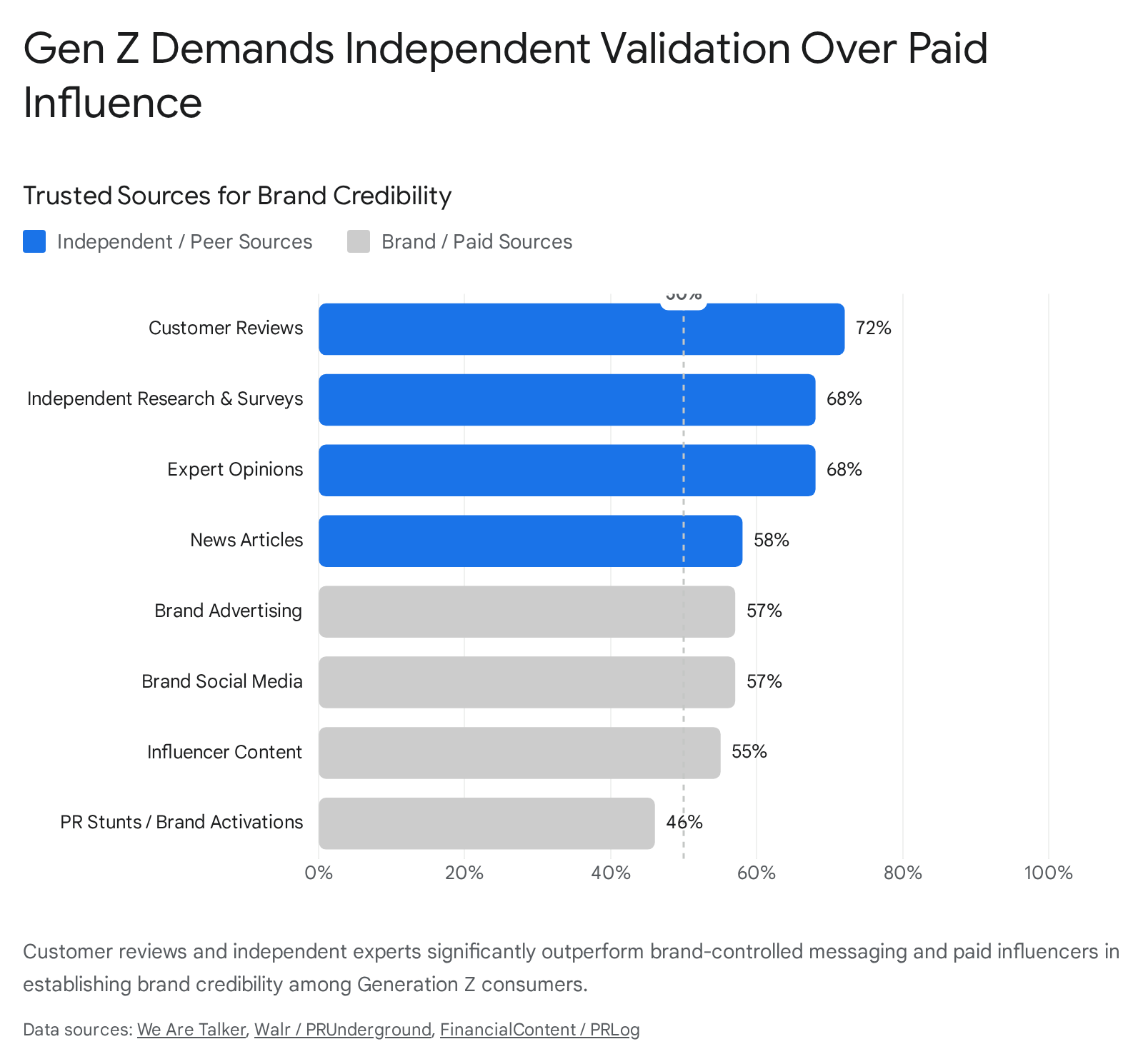
By stark contrast, only 55% trust influencer content, and just 46% trust PR stunts or branded activations 111314.
This 26-point differential between peer reviews and influencer content indicates that for younger audiences, the structural independence of the source carries as much weight as the content itself 1114. Influencers and celebrities, once perceived as authentic or aspirational figures, are increasingly viewed through the lens of commercial intent, thereby stripping them of their epistemic trustworthiness 1430. Consequently, brands targeting Generation Z are forced to pivot away from broad celebrity halo effects toward strategies that emphasize verifiable expertise and aggregated, uncompensated peer validation 1114.
Older Demographics and Institutional Skepticism
In contrast to the highly specific digital skepticism of younger cohorts, older demographics exhibit a distinct pattern of trust characterized by a broader rejection of modern digital marketing structures. Baby Boomers largely reject influencer marketing entirely, with 69% disagreeing that they trust influencers more than traditional advice, and only a minimal fraction indicating any trust in social media personalities 72829. While younger cohorts have shifted trust from institutions to peer networks, older generations maintain a higher baseline loyalty to established corporate brands and traditional broadcast media formats 7.
However, at a macro-population level, global trust in traditional authority is heavily fractured. The 2024 and 2025 Edelman Trust Barometer reports, which survey over 32,000 respondents across 28 countries, note a global dispersion of authority, marked by deep grievances and a continuous decline in trust for government leaders and traditional journalists 31323334. Yet, credentialed experts maintain a distinct advantage amid this institutional collapse. According to the 2024 global report, 74% of the population trusts scientists to tell the truth about new innovations and technologies, ranking them as the most trusted category of authority figures 31353645.
Fascinatingly, this 74% figure for scientists is tied identically with trust in "someone like me" (lay peers) 3137. This statistical parity between elite academic experts and ordinary peers underscores a dual-track authority bias in modern consumer psychology. Consumers simultaneously demand the rigorous, empirical backing of an objective scientist and the relatable, lived-experience validation of a peer, leaving the traditional celebrity - who offers neither objective technical expertise nor relatable peer status - at a distinct disadvantage in scenarios requiring high epistemic trust 31453738.
The following table visualizes the hierarchy of global trust regarding communication on innovation, highlighting the parity between experts and peers, and the deficit faced by traditional institutional leaders:
| Category of Spokesperson / Authority | Global Trust Percentage (Truth regarding Innovations) | Source Reference |
|---|---|---|
| Scientists | 74% | 31 |
| Someone Like Me (Peers) | 74% | 31 |
| Company Technical Experts | 66% | 31 |
| NGO Representatives | 54% | 31 |
| CEOs | 51% | 31 |
| Journalists | 47% | 31 |
| Government Leaders | 45% | 31 |
The Match-Up Hypothesis and Product Congruence
Regardless of cultural power distance variables or the demographic age of the target audience, the functional relationship between the endorser and the product remains a critical moderator of advertising success. This phenomenon is formally defined in advertising literature as the "match-up hypothesis," which posits that an endorsement is only effective if the perceived attributes, lifestyle, and persona of the spokesperson align seamlessly with the attributes of the product 81839495040.
High-Involvement Goods and Technical Expertise
For high-involvement goods - products that carry significant financial, medical, or technological risks to the consumer - expert endorsements vastly outperform celebrity endorsements across almost all cultural contexts 1239. When purchasing complex financial instruments, advanced electronics, or healthcare therapeutics, consumers engage in central-route cognitive processing, prioritizing logical evaluation, safety, and utility over emotional affect 39.
In these specific scenarios, a celebrity lacking specific domain knowledge is perceived as incongruent, immediately breaking the halo effect and triggering intense consumer skepticism 9184142. For example, in the highly competitive skincare and personal care industries, micro-influencers and dermatologists who dedicate their platforms specifically to cosmetics are perceived as vastly more credible than mainstream film actors, as their focused expertise directly answers the consumer's need for epistemic trust 939. A study comparing the endorsement of halal fashion products similarly demonstrated that consumer purchase intentions are deeply reliant on the perceived authenticity and congruency of the endorser; if an expert is deemed insufficiently familiar with the specific cultural or religious requirements of the product, their influence is negated entirely 42.
Conversely, for low-involvement or purely symbolic goods - such as luxury fashion, perfumes, or soft drinks - celebrities remain highly effective because the consumer's primary motivation is image enhancement and social signaling rather than technical utility or risk mitigation 5041.
Regulatory Interventions in High Power Distance Markets
The dangers of violating the match-up hypothesis and prioritizing fame over expertise have become so severe that state regulatory bodies have intervened, particularly in high power distance nations where the susceptibility to celebrity influence is structurally strongest. The regulatory environment in China provides the most profound contemporary case study of this phenomenon.
Historically, the high power distance culture of China resulted in a saturated market of celebrity endorsements 43. Celebrities commanded immense epistemic power, acting as trusted authorities on everything from consumer electronics to pediatric nutrition and healthcare 1943. This over-reliance on the celebrity halo effect culminated in massive public health tragedies, most notably the 2007 Sanlu melamine milk powder scandal, where an infant formula heavily endorsed by a trusted actress was found to contain lethal chemical contaminants 43. Repeated subsequent incidents of prominent entertainers endorsing fraudulent medical treatments, deceptive tutoring services, or volatile financial scams severely eroded public trust and harmed millions of consumers who relied on the celebrity's perceived benevolence 4344.
In response to widespread public outrage and significant financial damages, Chinese state authorities instituted stringent regulations in late 2022 to tightly govern the endorsement economy 454647. Recognizing the danger of the halo effect bypassing critical consumer evaluation, the State Administration for Market Regulation (SAMR) formally banned celebrities from endorsing specific high-risk categories, explicitly including medical care, pharmaceuticals, medical devices, off-campus education, and health foods 454647.
Crucially, the new regulations legally mandated a functional match-up: celebrities are now strictly prohibited from endorsing products they have not personally used, and their close relatives must use products if the advertisement is targeted at children 4647. Furthermore, celebrities face severe financial penalties and multi-year industry bans if they represent fraudulent brands, as seen in the high-profile case of actress Jing Tian, who was heavily fined and banned for illegal endorsement of unverified healthcare products 47. This sweeping governmental intervention illustrates the ultimate limits of power distance; even in cultures heavily primed to accept hierarchical authority and prestige, the catastrophic failure of epistemic trust forces a regulatory return to verified expertise and strict product congruence 4347.
Social Media Algorithms and Hierarchical Flattening
The traditional binary dichotomy between the distant, glamorous celebrity and the credentialed, institutional expert has been heavily destabilized by the architecture of modern social media. The digital environment fundamentally alters the perception of power distance, creating a sense of psychological proximity and continuous intimacy between the audience and the endorser.
Algorithmic Curation and Filter Bubbles
Social media platforms such as TikTok, Instagram, and X operate on machine learning algorithms designed to maximize user retention and engagement through hyper-personalized curation 4849615051. These predictive mathematical feeds actively flatten traditional hierarchies of information. By placing content from Hollywood celebrities, recognized scientific experts, political figures, and amateur content creators into the exact same endlessly scrolling, homogenized format, the platform architecture strips away traditional aesthetic markers of institutional prestige 5052.
This algorithmic flattening artificially lowers perceived power distance. Celebrities share intimate, unpolished glimpses of their daily lives, attempting to foster parasocial relationships that make them appear as relatable peers rather than elite, untouchable idols 103951. Simultaneously, credentialed experts are forced to adapt to the aesthetic constraints of the algorithm, utilizing short-form video formats, trending audio, and engaging emotional hooks to compete for user attention 50.
As audiences interact with this content, the algorithm recursively reinforces their behavioral preferences. Theoretical models of curation algorithms demonstrate that this optimization for engagement reduces the horizontal distance of matched content, rapidly accelerating the creation of "filter bubbles" or echo chambers 5354. In these isolated networks, users are disproportionately exposed to influencers who validate their pre-existing beliefs and cultural identities, regardless of those influencers' objective expertise 61555657. Consequently, the metric of algorithmic visibility frequently supersedes the metric of epistemic truth, allowing charismatic but uncredentialed influencers to wield the authority of experts.
The Rise of Micro-Influencers
The most significant byproduct of this algorithmic ecosystem is the emergence and dominance of the micro-influencer 9. Micro-influencers occupy a unique psychological space that effectively bridges the gap between the traditional celebrity and the academic expert. Because they possess smaller, highly engaged audiences centered around a specific topic, they benefit from the epistemic trust usually reserved for genuine peers or specialized technicians; they are viewed by their audience as authentic, relatable, and deeply knowledgeable within their specific niche 92841.
Simultaneously, micro-influencers enjoy a localized halo effect generated by their carefully curated social media aesthetics and their follower counts 950. Mixed-methods research evaluating consumer engagement metrics consistently demonstrates that micro-influencers yield higher engagement rates, foster stronger feelings of consumer trust, and drive higher purchase intentions for niche products than traditional, top-tier celebrities 9. They effectively bypass the skepticism that Generation Z holds toward mass-market celebrities by presenting themselves as independent, expert peers, perfectly aligning with the modern consumer's demand for verified, relational authority without the overt commercialism associated with global fame 914.
Advanced Endorsement Strategies
When brand marketers attempt to utilize authority figures in the modern era, they are increasingly abandoning the reliance on a single face. Recent marketing research highlights the economic and psychological impact of multi-celebrity endorsement strategies - featuring multiple famous individuals either concurrently in a single campaign or sequentially across a brand portfolio 1458.
Multi-Celebrity Endorsement Formats
From a theoretical standpoint, the effectiveness of multiple endorsers is explained by Social Impact Theory, which posits that the persuasiveness of a message increases as a mathematical function of the strength, immediacy, and number of independent sources delivering it 58. When a consumer encounters an advertising campaign featuring multiple recognized celebrities appearing together, it acts as a highly potent market signal of the brand's financial health, corporate effort, and market dominance 58. The sheer perceived cost of securing multiple top-tier figures signals to the consumer that the firm has immense capital resources and supreme confidence in its product's quality.
This consumer perception of high advertising expense and extraordinary corporate effort directly translates into more favorable brand attitudes, elevated purchase intentions, and a mathematically higher willingness to pay (WTP) among the target audience 58. However, this strategy is highly contingent upon the baseline credibility of the assembled figures. Structural equation modeling of multi-celebrity campaigns reveals that if even one celebrity in a multi-endorser lineup is perceived by the audience to have low credibility, trustworthiness, or expertise, the collective effectiveness of the entire campaign drops drastically, completely negating the financial signaling effect 58.
Furthermore, in high power distance cultures, endorsement strategy operates slightly differently at the corporate level. Research investigating brand portfolio management indicates that as a firm's portfolio of endorsed brands increases, its overall corporate market valuation tends to rise, provided the celebrities utilized are highly reputable and viewed as seasoned, experienced figures rather than fleeting viral sensations 14.
Conclusion
The intersection of power distance beliefs, cognitive authority biases, and algorithmic media delivery creates a highly complex, dynamic matrix for advertising persuasion. The historical marketing assertion that "celebrities sell" is fundamentally reductive; the reality is that endorsement efficacy is highly conditional, requiring exact alignments of cultural expectation, product congruence, and source credibility.
In high power distance demographics, the halo effect of celebrity status remains an immensely powerful tool for driving purchase intention, as consumers readily defer to elite hierarchies and utilize brands as tools for upward social signaling 4514. However, as demonstrated by the stringent regulatory backlash in markets like China, the unchecked application of celebrity influence to high-risk, high-involvement products inevitably leads to catastrophic breaches of public trust, forcing state interventions to mandate verified expertise 4347.
Conversely, in low power distance environments - and increasingly across all global youth demographics - unearned celebrity influence is met with intense skepticism. Generation Z's strict demand for the "Independent Validation Gap" requires modern brands to abandon superficial prestige in favor of epistemic trust, prioritizing aggregated peer reviews, credentialed experts, and highly specialized micro-influencers 91114.
Ultimately, modern advertising must navigate an era of algorithmic flattening, where consumers simultaneously demand the empirical rigor of an objective scientist and the relatable authenticity of an everyday peer 103150. Brands that succeed in this volatile environment will be those that align the specific cultural expectations of their audience with the precise, demonstrable expertise of their endorsers, utilizing the halo effect not as a replacement for substantive knowledge, but as an amplifier for genuine authority.