
Elaboration Likelihood Model and Advertising Persuasion
The Elaboration Likelihood Model (ELM) remains one of the most robust, extensively tested, and widely applied frameworks in the fields of social psychology, consumer behavior, and advertising strategy. Formulated by Richard E. Petty and John T. Cacioppo in the late 1970s and formalized throughout the 1980s, the model provides a dual-process theory to explain how persuasive messages are processed, how attitudes are formed, and why certain attitude changes endure over time while others prove highly transient 123. The core analytical utility of the ELM lies in its ability to predict how the interaction between message argument strength and peripheral cues dictates persuasive outcomes, entirely dependent on the target audience's level of cognitive elaboration 45.
Theoretical Foundations of the Framework
The development of the ELM emerged as a necessary resolution to decades of conflicting empirical data in the field of persuasion research. The scientific study of attitudes and persuasion became a central focus of social psychology in the early twentieth century, heavily featured in the foundational work of psychologists such as Gordon Allport and Edward Alsworth Ross 1. Allport famously described attitudes as the most indispensable concept in contemporary social psychology 1. During World War II, Carl Hovland and the Yale Communication Research Program systematically explored attitude change, attempting to isolate the specific variables of the source, the message, and the audience that reliably induced persuasion 6.
However, by the 1970s, the accumulated literature on persuasion presented a fractured and highly inconsistent landscape 789. Some empirical studies concluded that source expertise was the dominant driver of attitude change, while others found that source characteristics were entirely eclipsed by the logical strength of the message's arguments 57. Furthermore, researchers documented that attitude changes were sometimes highly stable and predictive of future behavior, yet in other contexts, they dissipated almost immediately 5810. Petty and Cacioppo introduced the ELM to synthesize these disparate findings into a unified, overarching theory, proposing that persuasion is not a monolithic cognitive event but rather a dynamic process dictated by an "elaboration continuum" 2101112.
Core Postulates of the Model
The theoretical architecture of the ELM is built upon seven fundamental postulates that govern human information processing in persuasive contexts 158. The foundational assumption (Postulate 1) is that individuals possess an inherent motivation to hold correct attitudes, driving them to assess the validity of the messages they encounter 18. However, because cognitive resources are strictly limited, people cannot deeply evaluate every persuasive claim they face daily 25. Consequently, the amount and nature of issue-relevant elaboration a person is willing or able to engage in varies substantially across different situations and individuals (Postulate 2) 811.
Postulates 6 and 7 articulate the dual-process mechanics that define the model. Postulate 6 asserts a strict trade-off: as the motivation or ability to process arguments decreases, peripheral cues become relatively more important determinants of persuasion. Conversely, as argument scrutiny increases, peripheral cues become relatively less important 1. Finally, Postulate 7 addresses the consequences of these processes, stating that attitude changes resulting from the deep processing of issue-relevant arguments exhibit greater temporal persistence, greater prediction of behavior, and greater resistance to counter-persuasion than attitude changes driven by peripheral cues 18.
Cognitive Processing Routes in Persuasion
The ELM posits that individuals process persuasive stimuli, such as marketing communications and advertising, through one of two primary pathways depending on their position on the elaboration continuum: the central route and the peripheral route 1513.
Mechanism of the Central Route
The central route to persuasion is activated when elaboration likelihood is exceptionally high. Under these optimal conditions, the recipient of an advertising message ceases to be a passive observer and instead acts as an active, critical evaluator 51415. Persuasion via the central route relies profoundly on the objective strength, empirical logic, and true merit of the arguments presented within the advocacy 2416.
A consumer utilizing the central processing route will meticulously dissect the claims made in an advertisement, integrate this new information with their pre-existing knowledge structures, and generate cognitive responses 2513. These cognitive responses act as the ultimate mediators of persuasion. If the arguments are strong, the consumer generates favorable thoughts, leading to a positive attitude change 216. If the arguments are weak or logically flawed, the consumer generates unfavorable thoughts or active counter-arguments, which not only prevents persuasion but can trigger a "boomerang effect" - a negative attitude shift away from the advocated position 1216. Because central processing requires a massive expenditure of cognitive capacity, it is reserved strictly for contexts where the consumer has both the intense motivation and the unhindered ability to scrutinize the message 4511.
Mechanism of the Peripheral Route
When elaboration likelihood is low - either because the topic lacks any personal relevance, the audience is experiencing cognitive fatigue, or the message relies on overly complex technical jargon - individuals default to the peripheral route 451317. In this cognitive pathway, individuals act as "cognitive misers," avoiding the effortful and fatiguing scrutiny of argument strength 513. Instead, they rely heavily on heuristics - simple mental shortcuts - to form evaluative judgments regarding the advertisement 51213.
Peripheral cues are non-content, contextual elements embedded within the persuasion environment that trigger rapid, associative attitude changes 245. In the realm of advertising, these cues are ubiquitous. They include source characteristics such as the physical attractiveness, perceived expertise, or likability of a celebrity endorser 41318. They also encompass structural heuristics, such as the sheer quantity of arguments presented; under low elaboration, consumers often equate message length with message strength, assuming that a lengthy argument must inherently be valid without actually analyzing its contents 4512. Additional peripheral drivers include aesthetic visual design, emotionally resonant background music, and salient markers of social proof 51920. In a low-involvement scenario, a consumer is unlikely to evaluate the specific thermodynamic efficiency of a new home appliance but may instead be persuaded solely because a trusted public figure endorsed it, generating a positive affective reaction that transfers to the brand 421.
The Elaboration Continuum and Concurrent Processing
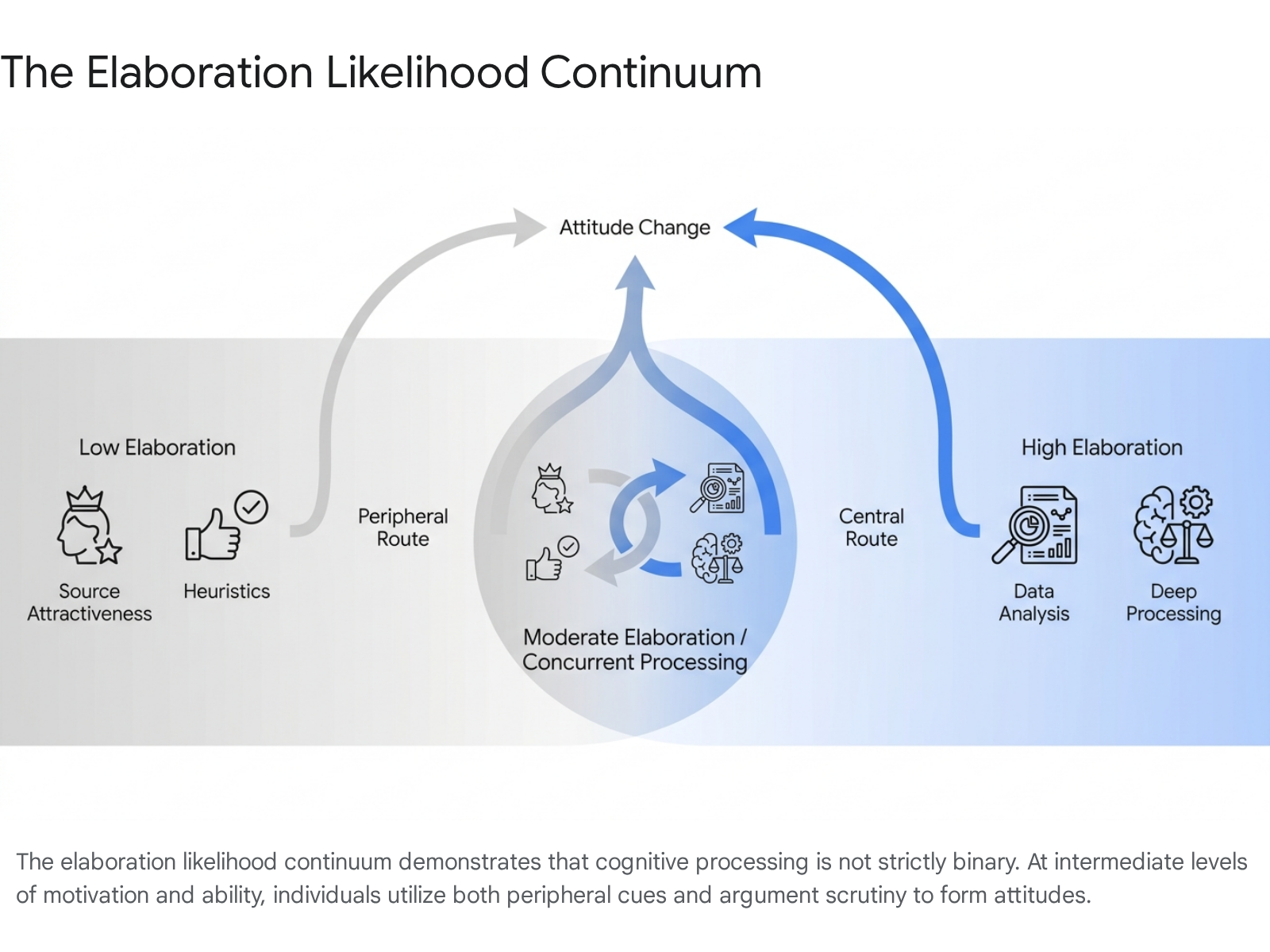
One of the most frequent misinterpretations of the ELM in early academic literature was the assumption that the central and peripheral routes functioned as strictly binary, mutually exclusive categories 101113. Early critics, such as Stiff (1986), argued that the model forced a false dichotomy, artificially requiring individuals to choose a single processing strategy while ignoring the possibility that a consumer might evaluate both the logical arguments and the source's attractiveness simultaneously 101121.
In response, Petty, Cacioppo, and subsequent ELM scholars clarified the probabilistic nature of the framework. The central and peripheral routes do not represent isolated silos but rather the absolute opposing endpoints of a seamless elaboration continuum 71013. At the extreme high end of the continuum, central argument processing entirely dominates attitude formation; at the extreme low end, peripheral cues dictate the outcome 21113. However, at intermediate levels of elaboration, concurrent processing is not only possible but highly expected 101321. In moderate-involvement scenarios, a combination of both central argument evaluation and peripheral cue reliance simultaneously influences the consumer's final judgment 1013.
Furthermore, the ELM is governed by the multiple roles postulate, which stipulates that a single environmental variable can serve entirely different functions depending on where the consumer sits on the elaboration continuum 1812. For example, the physical attractiveness of a model in an advertisement for a high-performance computer functions strictly as a peripheral cue, lacking any logical relevance to the product's efficacy 1219. However, the exact same physical attractiveness featured in an advertisement for a cosmetic skincare product can function as a central, highly relevant argument regarding the tangible benefits of the product 1219. The model asserts that variables are not inherently "central" or "peripheral"; their role is defined entirely by the processing context 112.
Determinants of Elaboration Likelihood
To accurately predict whether an audience will engage in central or peripheral processing, marketers must assess the two foundational determinants of elaboration likelihood: motivation and ability 11122. If either of these determinants is insufficient, central processing fails, and the consumer reverts to the peripheral route 322.
Motivation and Personal Relevance
Motivation represents the internal cognitive drive to engage in effortful evaluation of an advertisement 3511. The most powerful external catalyst for motivation is personal relevance or outcome involvement 51623. When a message has direct, significant implications for a consumer's finances, health, or core personal values, their motivation to process the arguments central to the issue skyrockets 3524.
This dynamic was definitively demonstrated in the seminal 1981 study by Petty, Cacioppo, and Goldman. The researchers manipulated personal relevance by telling university students that a new policy requiring comprehensive exams for graduation would be implemented either next year (high personal relevance) or in ten years (low personal relevance) 525. They simultaneously manipulated source expertise (a Princeton professor versus a high school student) and argument quality (strong statistical data versus weak personal opinions) 525. The findings perfectly validated the ELM: highly involved students were persuaded entirely by the strong arguments and ignored the source's expertise, whereas low-involvement students ignored the weak arguments entirely and were persuaded solely by the high-expertise source 525.
Beyond situational relevance, motivation is heavily influenced by intrinsic personality traits, most notably the Need for Cognition (NFC) 12326. Individuals high in NFC intrinsically enjoy complex puzzle-solving and deep analytical thought; they possess a chronically high elaboration likelihood across diverse topics and habitually utilize the central route 2326. Conversely, individuals low in NFC find extensive cognitive effort aversive and consistently rely on peripheral heuristics such as celebrity endorsements or social consensus to navigate decision-making 2326. Additionally, the psychological drive to resolve cognitive dissonance - the discomfort experienced when holding contradictory beliefs - acts as a powerful motivational trigger forcing individuals into central-route evaluation to restore internal psychological consistency 2426.
Cognitive Ability and Opportunity
Even if a consumer possesses immense motivation to evaluate an advertisement, central processing cannot occur without sufficient cognitive ability and opportunity 1513. Ability refers to the recipient's requisite prior knowledge, intellectual capacity, and mental resources needed to comprehend and evaluate the substantive arguments 3513. For example, a consumer highly motivated to purchase a secure cryptographic software solution cannot process the technical arguments if they lack fundamental knowledge of encryption protocols; they are subsequently forced to rely on peripheral cues such as brand reputation or user reviews 3513.
Opportunity, closely related to ability, refers to the situational constraints placed upon the recipient's processing environment 1. Distractions, such as loud background noise, rapid visual editing, or secondary tasks, consume limited working memory capacity 51727. Time pressure similarly truncates the opportunity for deep elaboration 27. Furthermore, individuals experiencing cognitive fatigue or ego depletion - a state of diminished self-regulatory resources resulting from prior mental exertion - lack the necessary mental energy to engage the central route, rendering them highly susceptible to peripheral persuasion tactics 17.
Persuasion Outcomes and Attitude Durability
The qualitative differences in how information is processed via the central versus peripheral routes lead to vastly divergent psychological outcomes regarding the durability, stability, and behavioral impact of newly formed attitudes 3413. The ELM provides a predictive framework for determining which advertising campaigns will generate fleeting sales spikes versus long-term brand loyalty 128.
Temporal Persistence and Behavioral Prediction
Attitudes formed via the central route - rooted in high-effort cognitive elaboration - demonstrate profound temporal persistence 1513. Because the consumer has actively evaluated the arguments, generated favorable cognitive responses, and systematically integrated the new data into their existing cognitive schemas, the resulting attitude is deeply anchored 22126. These attitudes exhibit immense internal consistency and are therefore highly resistant to spontaneous decay over time 132126.
Consequently, attitudes forged through central processing are exceptionally predictive of actual consumer behavior 1413. If a consumer utilizes the central route to evaluate the crash-test ratings and fuel economy of an automobile, the resulting highly confident, favorable attitude reliably predicts their physical action of purchasing the vehicle 52126. The depth of processing fosters attitude certainty, transforming the belief into a chronic behavioral guide 26.
In stark contrast, attitude changes resulting from peripheral processing are generally ephemeral and weak 345. Because the attitude is anchored strictly to an external contextual cue rather than substantive, internal belief integration, the persuasion effect decays rapidly once the cue is removed from the consumer's immediate environment or memory 529. A consumer persuaded to buy a specific beverage purely due to a peripheral cue - such as an upbeat music track or a celebrity endorsement - forms an attitude that lacks structural integrity 35. They are likely to abandon the brand without hesitation when a competing brand presents a more salient emotional appeal or when the original celebrity endorser falls out of public favor 521. Peripheral route persuasion generates immediate, short-term compliance but is an unreliable engine for long-term behavioral prediction 4528.
Resistance to Counter-Persuasion
A critical differentiator between the two ELM routes is the resulting attitude's resistance to future attacks, competitive advertising, or counter-persuasion 113. High-elaboration processing inherently equips the individual with a robust network of supporting arguments and rehearsed cognitive responses 13. Should a competing brand attempt to dissuade them with contradictory claims, the centrally-persuaded consumer possesses the accessible cognitive resources and the internal motivation to actively counter-argue the opposing message, effectively defending their established attitude 1316.
This mechanism is the foundation of psychological inoculation theory, which posits that exposing individuals to weakened forms of counter-arguments acts as an "immunization" process 24. By forcing the consumer to engage in central-route processing to refute the weak attack, they build defensive cognitive schemas that grant immense resistance against future, stronger misinformation campaigns 24. However, this defensive posture requires sustained cognitive energy; research demonstrates that when individuals suffer from high cognitive fatigue or ego depletion, their central processing defenses collapse, leaving them suddenly vulnerable to peripheral counter-persuasion 17.
Theoretical Critiques and Alternative Models
Despite its monumental influence on communication theory and consumer psychology, the ELM has faced rigorous academic scrutiny over the past four decades. Critics have challenged various aspects of its methodology, its predictive nature, and specifically, its assertion of a qualitative distinction between central and peripheral processes 7101126.
The Unimodel of Persuasion
The most comprehensive and thoroughgoing critique of the ELM is articulated in the Unimodel of Persuasion, proposed by Arie Kruglanski and Erik Thompson in 1999 82126. The unimodel aggressively challenges the ELM's core philosophical tenet that attitude change is governed by two qualitatively different cognitive routes 7826. Instead, the unimodel posits that there is only a single, uniform epistemic process of persuasion that operates purely on syllogistic reasoning 82526.
According to the unimodel, all discrete pieces of information in a persuasive context - whether they are dense statistical data sets regarding product performance or the physical attractiveness of the spokesperson - merely serve as functionally equivalent "evidence" 82526. The recipient utilizes this evidence in an "if-then" syllogistic premise to reach a conclusion 825.
Kruglanski and Thompson argued that the dual-route distinction observed in decades of ELM research was actually an artifact of flawed experimental design 51226. In classic ELM studies, central arguments were consistently presented as long, complex text, whereas peripheral cues (like source expertise) were presented as brief, simple statements 51225. The unimodel theorists conducted experiments demonstrating that if a peripheral cue - such as a speaker's academic credentials - was presented as a highly complex, lengthy, and difficult-to-read resume, it required the exact same high cognitive capacity to process as a "central argument" 525. Therefore, the unimodel concludes that the extent of processing is determined entirely by the length and complexity of the information, rendering the qualitative distinction between "cues" and "arguments" an artificial construct 58.
The Heuristic-Systematic Model (HSM)
Parallel to the ELM, Shelly Chaiken developed the Heuristic-Systematic Model (HSM) in the 1980s 672125. While often grouped with the ELM as a "dual-process model," the HSM operates on slightly different psychological principles. It distinguishes between "systematic processing" (analogous to the central route) and "heuristic processing" (analogous to the peripheral route) 625.
However, the HSM places heavy emphasis on the "sufficiency principle," which argues that humans balance the desire for cognitive economy against the desire for accurate judgments 621. Individuals will process heuristically to conserve mental energy until their confidence in their attitude drops below their "desired sufficiency threshold," at which point they will activate systematic processing to close the confidence gap 21. Unlike the ELM, which initially framed peripheral and central processing as a zero-sum trade-off at the ends of a continuum, the HSM explicitly modeled how heuristics could bias systematic processing in situations of high ambiguity 6721.
Responses to Critiques and Empirical Validations
Proponents of the ELM, including Petty and colleagues, have mounted robust, data-driven defenses against the unimodel critique, emphasizing that the qualitative distinction between routes remains theoretically vital and empirically valid 72526. ELM advocates concede that while both cues and arguments can be broadly defined as "evidence" in a syllogism, the qualitative nature of how that information is integrated into neural schemas dictates profoundly different psychological and behavioral outcomes 72526.
Petty argued that while the unimodel correctly identifies that people process evidence along a quantitative continuum of effort, it ignores the qualitative distinction in how different types of information affect attitude strength metrics (durability, resistance) 726. The ELM successfully predicts that heuristics (cues) completely dominate decision-making under time pressure and high cognitive load, whereas substantive logic (arguments) overwhelmingly dominates under high personal involvement - a dynamic the unimodel struggles to parsimoniously explain 7812. Extensive meta-analytic reviews over the past two decades maintain that the dual-process architecture of the ELM offers superior predictive validity regarding attitude persistence and resistance to counter-persuasion when compared to single-process alternatives 71221.
| Theoretical Model | Core Premise | Treatment of Persuasive Variables | Processing Pathways | Determinants of Attitude Strength |
|---|---|---|---|---|
| Elaboration Likelihood Model (ELM) | Persuasion depends heavily on motivation and cognitive ability. | Explicit distinction between argument strength (central) and peripheral cues. | Dual (Central and Peripheral). | High elaboration via central route yields persistent, resistant attitudes. |
| Heuristic-Systematic Model (HSM) | Persuasion balances cognitive economy with accuracy goals. | Explicit distinction between systemic arguments and heuristic rules/cues. | Dual (Systematic and Heuristic). | Systematic processing activates to meet desired sufficiency thresholds. |
| Unimodel of Persuasion | Persuasion is a singular epistemic process of syllogistic reasoning. | All variables (cues and arguments) are functionally equivalent "evidence." | Single (Uniform reasoning process). | Attitude strength depends solely on the complexity and volume of evidence processed. |
Advertising Strategy and Consumer Involvement
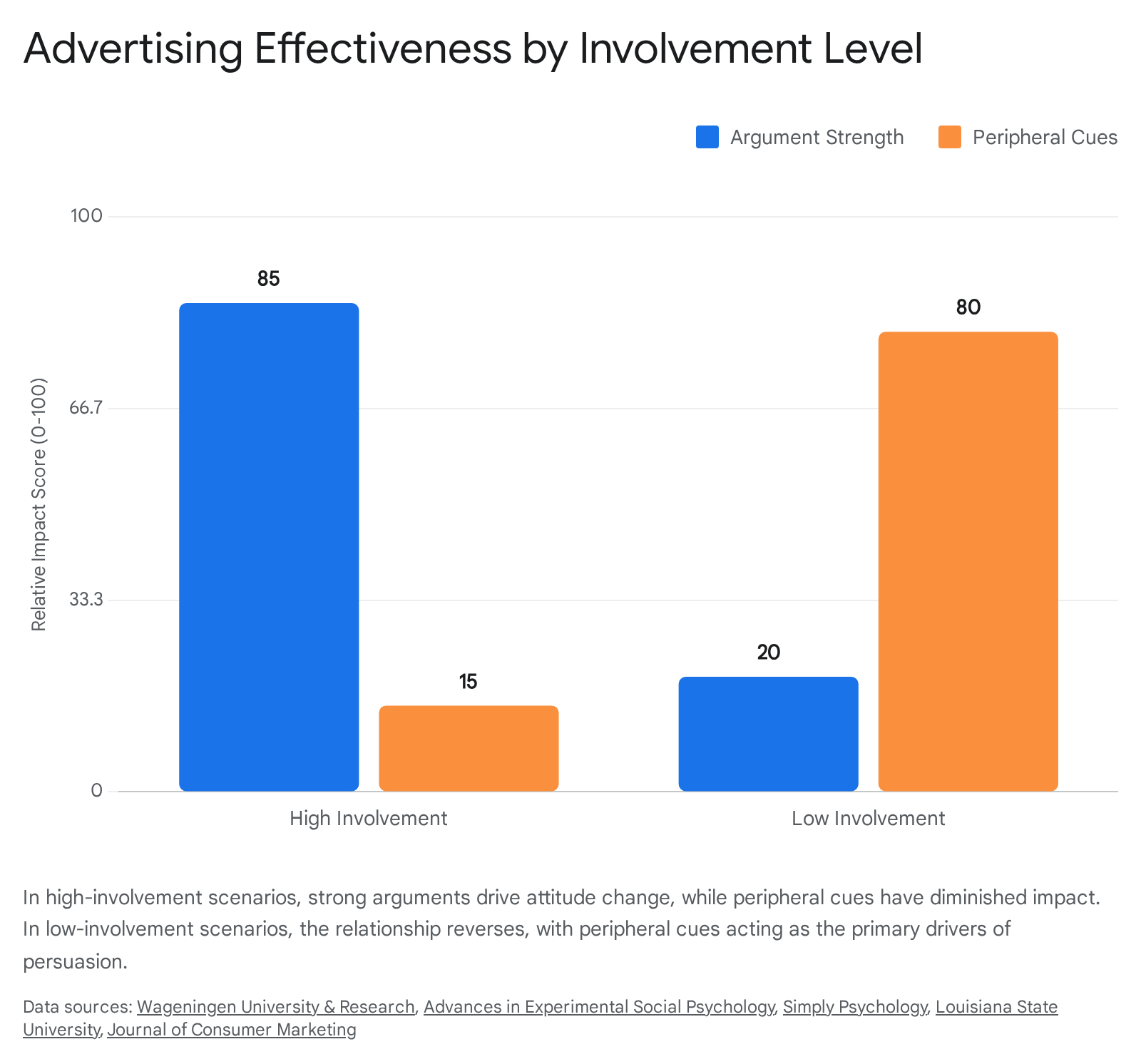
In applied marketing and commercial communication, the ELM operates as an indispensable blueprint for aligning message strategy with baseline consumer involvement 52228. The most successful advertising campaigns are characterized by a precise, data-driven calibration of argument strength and peripheral cues tailored directly to the target demographic's natural elaboration likelihood 528.
Persuasion in High-Involvement Product Environments
High-involvement products are characterized by significant financial risk, complex technical features, extended lifespans, or deep ties to consumer identity and ego 303132. Products in this category - such as automobiles, real estate, enterprise B2B software, luxury fashion, and major healthcare decisions - naturally activate high levels of personal relevance, pushing the consumer toward the central route 5303132.
For high-involvement categories, argument strength is unequivocally paramount 532. Advertising strategies in these contexts must provide logical, informative, and highly verifiable data 53032. For instance, B2B marketing campaigns rarely rely on celebrity endorsements; instead, they utilize detailed case studies, technical whitepapers, rigorous comparative charts, and return-on-investment (ROI) calculations as their central persuasive arguments 53032.
If an advertisement for a high-involvement product relies entirely on superficial peripheral cues - such as attractive models or flashy music - while ignoring substantive arguments, the highly motivated consumer will perceive the message as manipulative, evasive, or intellectually insufficient 5313233. This misalignment creates severe persuasion resistance, ad irritation, and ultimately, negative brand attitudes 3233. Research confirms that for products requiring high cognitive engagement, logical persuasion through the central route drives long-term brand equity and conversion rates far superior to peripheral tactics 53033.
Persuasion in Low-Involvement Product Environments
Conversely, low-involvement products - such as fast-moving consumer goods (FMCG), fast food, basic apparel, and household sundries - are purchased frequently, carry negligible financial risk, and rarely stimulate extensive cognitive processing 51830. In these low-stakes scenarios, consumers are generally unmotivated to engage in deep product evaluation, meaning the peripheral route completely dictates advertising success 5183034.
For low-involvement products, marketers must eschew dense informational data and instead emphasize "transformational" and emotional creative appeals 1830. Successful campaigns utilize catchy jingles, striking visual aesthetics, humor, and highly recognizable celebrity endorsements to bypass the need for cognitive engagement entirely 183035. The objective is to create rapid, positive affect and brand familiarity that triggers automatic, habitual purchasing behavior at the point of sale 183034.
Attempting to persuade a low-involvement consumer with a dense, data-heavy argument is usually counterproductive 518. Because the audience lacks the motivation to process complex informational appeals regarding a low-stakes item, presenting them with a wall of technical data leads to immediate cognitive disengagement, ad fatigue, and total message abandonment 52931.
Digital Media and Short-Form Video Environments
The explosion of digital media, specifically the dominance of algorithmic short-form video platforms such as TikTok, Instagram Reels, and YouTube Shorts, has fundamentally altered the structural application of the ELM in advertising 19203638. These platforms present a uniquely high-velocity psychological environment characterized by ultra-compressed processing times, a rapid turnover of visual cues, and continuous, opaque algorithmic curation 273637.
Cognitive Load Constraints in Short-Form Content
Short-form video environments artificially and severely constrain a consumer's cognitive ability to process information via the central route 152738. Drawing upon Cognitive Load Theory (CLT) and the Limited Capacity Model of Motivated Mediated Message Processing (LC4MP), researchers note that the rapid, chaotic pace of short-form video scrolling quickly overwhelms human working memory limits 2739. Under extreme time pressure and divided attention, the audience is forced into a state of heuristic processing, regardless of their baseline motivation 1527.
Consequently, peripheral cues dominate short-form video advertising 15203639. Substantive arguments are routinely ignored in favor of aesthetic visual quality, fast-paced editing cuts, viral audio tracks, and the physical attractiveness and charisma of the creator, which become the primary drivers of engagement, brand recall, and purchase intention 15203639. A massive 2024 analysis indicated that user-generated content (UGC) styles - which rely heavily on emotional resonance and perceived creator authenticity (operating as peripheral cues) - achieve vastly higher engagement rates (up to 142% higher) than polished, argument-heavy traditional advertisements on these platforms 2035.
To mitigate extraneous cognitive load and preserve any remaining processing resources for the core brand message, digital advertisers increasingly employ "one face, many roles" casting strategies 27. By utilizing a single creator to drive a multi-scene narrative within a short video, the ad simplifies identity tracking for the viewer. This approach dramatically enhances perceptual fluency, acting as a potent heuristic cue that facilitates positive truth judgments and ad liking without requiring deep cognitive elaboration 27.
Algorithmic Curation and Telepresence
The Stimulus-Organism-Response (SOR) model, when integrated with the ELM framework, reveals that algorithmic personalization generates a powerful psychological sense of "telepresence" and cognitive flow state for users scrolling through digital feeds 1536. Algorithms themselves have evolved into structural actors within the persuasion process 36.
When a highly personalized algorithm serves a video, users develop a form of "algorithmic trust." They implicitly assume that the content has been curated and vetted by the platform's invisible logic, which primes the user to accept the embedded advertising message or product recommendation without applying rigorous central-route scrutiny 153637. This creates an environment where impulsive buying urges are triggered rapidly, overriding rational evaluation mechanisms 15.
Social Proof as a Digital Peripheral Cue
In ambiguous digital spaces, technological mechanisms function as immensely powerful peripheral cues, heavily supplementing traditional advertising tactics 19364041. Social proof - quantified digitally through view counts, likes, comments, subscriber numbers, and shares - serves as an immediate, high-impact heuristic validating product quality and brand legitimacy 1940414245.
According to Social Proof Theory, individuals operating in highly uncertain, low-involvement digital environments rely on the observable actions of the majority to shortcut complex decision-making processes 404145. An advertisement displaying high engagement metrics triggers a herd behavior response; the consumer uses the peripheral cue of social validation to infer that the product is desirable, entirely bypassing the central route evaluation of the product's actual features 404145.
Artificial Intelligence and Virtual Influencers
The integration of artificial intelligence (AI) and synthetic media into influencer marketing strategy highlights the rapidly evolving complexity of persuasion pathways. Virtual influencers - computer-generated digital avatars endowed with hyper-realistic human personalities and pristine aesthetics - actively challenge the traditional binary classification of what constitutes a central argument versus a peripheral cue 324043.
Source Credibility in Synthetic Media
Extensive research on virtual influencers, such as the prominent digital avatar Imma, demonstrates that AI-driven marketing campaigns trigger a uniquely hybrid persuasion mechanism 43. In traditional ELM frameworks, source credibility dimensions (trustworthiness, physical attractiveness, and expertise) typically function entirely as peripheral cues 3143. However, because the virtual influencer's entire existence is a constructed digital artifact, consumers evaluating high-involvement products endorsed by an avatar engage in deep, central-route scrutiny of the avatar's technical accuracy, realism, and interaction quality 4043.
In recent 2025 studies examining the ELM in AI-driven recommendation settings, findings revealed that brand awareness, anthropomorphism, and social endorsement operate conventionally via the peripheral route to build affective trust with the avatar 40. Simultaneously, the perceived utility, visual rendering clarity, and informational quality of the avatar operate via the central route, establishing cognitive trust and rational persuasion 4043.
Hybrid Persuasion Pathways and Algorithm Transparency
The necessity for robust argument strength is massively amplified when AI generation is explicitly disclosed to the consumer base 32. For high-involvement product categories like luxury goods, disclosing the use of generative AI in ad creation initially provokes intense consumer skepticism 132.
Consumers with pre-existing negative biases toward AI apply high cognitive elaboration to critically scrutinize the advertisement, demanding superior argument quality, verifiable data, and logical evidence to overcome their intrinsic distrust of synthetic media 132. If the AI-generated message relies entirely on aesthetics, it fails completely; however, if it provides high-quality, transparent, and highly accurate information, it can successfully navigate the central route, neutralizing persuasion resistance and resulting in continued intention to use AI recommendations for future purchases 132.
Cross-Cultural Moderation of Persuasive Routes
While the ELM was predominantly developed and empirically validated within Western, individualistic contexts, contemporary global marketing research overwhelmingly demonstrates that macro-cultural orientations profoundly moderate how humans process argument strength and peripheral cues 44454647. Specifically, the societal spectrum of individualism versus collectivism alters baseline elaboration dynamics 454647.
Argument Scrutiny in Individualistic Cultures
In highly individualistic societies (e.g., the United States, Western Europe, Canada), cultural norms vehemently prioritize personal autonomy, self-reliance, internal disposition, and independent decision-making 45464748. Consumers embedded within these cultures are intrinsically motivated to evaluate how a product serves their own specific, personal objectives, utility, and distinct identity 454748.
Consequently, in individualistic markets, persuasive communications that lean heavily on central-route argument strength - highlighting personal benefits, empirical utility, and distinct competitive differentiation - prove phenomenally effective 4547. Individualistic consumers are also highly prone to the fundamental attribution error, viewing behavior as an extension of internal traits rather than situational forces, making them highly receptive to arguments targeting personal enhancement 47. Furthermore, individualistic consumers exhibit different psychological defense mechanisms regarding persuasion knowledge; studies comparing individualistic (Dutch) and collectivistic (Vietnamese) cohorts found that individualistic consumers displayed lower baseline inferences of manipulative intent (IMI) toward standard marketing tactics, provided the arguments presented logical personal utility 44.
Social Consensus in Collectivistic Cultures
Conversely, collectivistic cultures (e.g., East Asia, parts of Latin America, and Africa) prioritize group harmony, social cohesion, and strict adherence to normative community expectations over isolated personal desires 464748. In these contexts, consumer decision-making is frequently driven by consensus rather than isolated personal evaluation 414548.
As a result, peripheral cues related to social conformity and group validation carry significantly more weight. Social proof, peer recommendations, familial ties, and the sheer volume of consensus become dominant heuristic drivers of attitude change 4142454849. While an individualistic consumer might utilize the central route to meticulously analyze the technical specifications of a software tool, a collectivistic consumer is far more likely to rely on the peripheral cue of corporate widespread adoption or high-profile institutional endorsement to validate their purchase decision 414849.
Furthermore, obedience to authority figures operates quite differently across cultural boundaries. While authority cues function universally as a peripheral heuristic, compliance rates and the rapid deferral of critical argument scrutiny are markedly higher in high power-distance, collectivistic societies, where contradicting expert consensus disrupts social harmony 4950. Experimental replications of Asch's conformity studies and Milgram's obedience studies reveal that collectivist cultures demonstrate significantly higher rates of "cyber-conformity" and deference to normative pressure 4951. Understanding these deep-seated cultural nuances is absolutely essential for multinational marketing teams deploying the ELM, as a central-route argument that performs flawlessly in North America may be entirely ignored in Asia if it lacks the requisite peripheral markers of social proof, authority backing, and communal validity 45.
| Processing Variable | Individualistic Cultures (e.g., USA, UK, Canada) | Collectivistic Cultures (e.g., China, Vietnam) |
|---|---|---|
| Primary Persuasion Driver | Personal utility, feature differentiation, logical argument strength (Central Route dominance). | Social harmony, group consensus, shared community values (Peripheral Route dominance). |
| Response to Social Proof | Viewed as secondary validation; strong preference for independent assessment and tailored advice. | Primary heuristic for decision-making; highly responsive to peer reviews and collective action. |
| Reaction to Authority Cues | Subject to critical scrutiny; higher skepticism toward institutional mandates and absolute authority. | High deference to expert opinion and structural authority; authority functions as a formidable heuristic. |
| Attribution of Behavior | Fundamental Attribution Error is highly common; behavior is firmly attributed to internal disposition. | Nuanced, situational attribution; behavior is understood within social constraints and group dynamics. |
Methodological Considerations in Persuasion Research
The shift toward digital, AI-driven, and cross-cultural environments necessitates an evolution in how researchers study the ELM. Historically, classical persuasion experiments (such as those pioneered by Hovland or Petty) were conducted in highly controlled laboratory settings. While these settings provided immense precision in manipulating argument strength and source credibility, critics increasingly note that they often suffer from low ecological validity - meaning the highly sterile laboratory environment fails to accurately reflect the chaotic, distraction-filled reality of the modern digital consumer 5052.
Contemporary applied social psychology increasingly utilizes field experiments, social network analysis, and real-time digital analytics to assess conformity, social proof, and peripheral processing in genuine e-commerce and algorithmic environments 5052. Ensuring that ELM research captures the true cognitive load of a user rapid-scrolling through a short-form video feed, or the genuine cultural pressures faced by consumers in international markets, remains critical for maintaining the model's relevance in modern marketing strategy 5052.
Conclusion
The Elaboration Likelihood Model endures as an indispensable theoretical framework for decoding the complex, multifaceted mechanics of human persuasion and attitude change. By delineating the distinct cognitive pathways of the central and peripheral routes, the ELM effectively explains the delicate, probabilistic interplay between logical argument strength and non-content heuristic cues.
Modern commercial and technological advancements - from the compressed, high-velocity cognitive environments of algorithmic short-form video feeds to the nuanced deployment of generative AI and virtual influencers - continuously validate the model's core premise: as a consumer's intrinsic motivation and cognitive ability to scrutinize information diminish, peripheral heuristics inevitably take control of the decision-making process. Ultimately, the successful commercial application of the ELM requires a highly nuanced understanding of audience involvement, rigid technological and platform constraints, and profound cross-cultural dynamics. By synthesizing these elements, marketers and communicators can strategically craft messages that not only capture transient attention in a saturated media environment but achieve durable, resistant, and behavior-driving persuasion.