
Phonetic symbolism and consumer perception in product naming
Introduction to Phonetic Symbolism in Language
For over a century, the dominant paradigm in structural linguistics, pioneered by Ferdinand de Saussure, held that the relationship between a linguistic sign (the sound) and its meaning is fundamentally arbitrary 12. Under this classical framework, the sequence of phonemes that form a word possesses no inherent connection to the physical or abstract properties of the object it represents. However, empirical research in cognitive psychology, psycholinguistics, and ethology has consistently demonstrated a robust counter-phenomenon known as sound symbolism, or phonetic iconicity. Sound symbolism posits a non-arbitrary, systematic linkage between specific phonetic sounds and the semantic meanings they convey, suggesting that human cognition is hardwired to extract implicit data from acoustic signals 1234.
The early foundations of this field were established by researchers such as Edward Sapir and Wolfgang Köhler in the late 1920s. Sapir's (1929) experiments demonstrated that individuals instinctively matched the nonsense word Mal with a large table and Mil with a small table, indicating an automatic association between acoustic frequency and spatial volume 45. Similarly, Köhler's (1929) foundational crossmodal correspondence experiments - often referred to as the "bouba-kiki effect" - revealed that subjects universally map angular shapes to words containing sharp, high-frequency consonants and vowels (e.g., takete or kiki), while matching rounded shapes to words with low-frequency, resonant sounds (e.g., maluma or bouba) 678.
In modern consumer research, phonetic symbolism has emerged as a critical variable in brand strategy and marketing architecture. A brand name operates as the semantic anchor for a commercial entity's identity, serving as the first cognitive touchpoint for a consumer prior to any brand experience. Beyond explicit semantic cues or etymological roots, the physical acoustic properties of a brand name - dictated by the way air is pushed through the human vocal tract and processed by the auditory system - transmit implicit information regarding a product's size, speed, durability, and luxury 9. Because these cognitive associations occur automatically, effortlessly, and outside of conscious awareness, phonetic symbolism acts as an unmediated channel for communicating brand attributes prior to any formal marketing efforts 10.
Evolutionary and Biological Foundations
To understand why human brains map specific phonetic structures to abstract attributes, researchers frequently turn to evolutionary biology and acoustic ethology. The most prominent explanatory framework for the origin of sound symbolism is the Motivation-Structural (MS) rules and the corresponding "Frequency Code," primarily articulated by Eugene S. Morton in 1977 and later adapted to human speech by John Ohala 2111213.
The Motivation-Structural Rules and the Frequency Code
Morton analyzed the close-contact agonistic displays - defined as face-to-face competitive or hostile encounters - of numerous avian and mammalian species. His research identified a remarkable cross-species convergence in the physical structure of vocalizations based entirely on the animal's motivational state 1314. According to the Motivation-Structural rules, animals that are confident, aggressive, or hostile emit harsh, low-frequency (low-pitch), wide-bandwidth sounds 111516. Conversely, animals expressing fear, submission, or an intent to appease emit pure-toned, high-frequency (high-pitch), narrow-bandwidth vocalizations 111516.
This biological frequency code evolved due to the fundamental physics of sound production. The fundamental frequency (F0) and resonant frequencies (formants) of a vocalization are inversely proportional to the size of the vocalizer; larger animals generally possess larger vocal tracts and larynges, which naturally produce lower acoustic frequencies 212. Therefore, a low-frequency growl effectively signals large mass and physical dominance to a rival, while a high-frequency squeak mimics infancy to signal smallness and non-threat 212. Over evolutionary time, natural selection favored the recognition of these acoustic cues across species to assess threat levels without engaging in physical combat, which carries a high risk of injury or death 1213.
Detailed spectrographic analyses of specific species support this evolutionary hypothesis. For instance, empirical tests on the vocalizations of the white-nosed coati (Nasua narica) demonstrated that their "chirps" - emitted during nonaggressive, appeasing behaviors - were short-duration (68.6 - 212.0 ms), high-maximum frequency (16.2 - 17.9 kHz) tonal calls 16. Conversely, their "squawks" - emitted during hostile agonistic encounters - were longer-duration (177.9 - 546.5 ms), low-maximum frequency (8.4 - 13.2 kHz) calls characterized by wide bandwidths and multiple resonances 16. This structural dichotomy minimizes ambiguity in animal signaling, a concept tracing back to Darwin's principle of antithesis 1516.
Extrapolation to Human Paralinguistics
John Ohala extended the Frequency Code to human speech and intonation patterns, proposing that humans exploit this deeply ingrained biological circuitry in both paralinguistic displays and phonetic vocabulary 211. In human language, cross-linguistic studies show that high-frequency acoustic properties are disproportionately utilized in words denoting smallness, proximity, or lightness. Conversely, low-frequency acoustics are predominantly used for words denoting largeness, distance, and heaviness 211.
Furthermore, physiological manifestations of emotion, such as the human "smile," align intimately with this acoustic code. Retracting the lips into a smile physically shortens the vocal tract, which consequently raises the resonant frequencies of any vocalization produced in that state 212. This physiological action functions acoustically to signal a non-threatening, appeasing posture, reinforcing the evolutionary link between high frequencies and safety 2. The sexual dimorphism of the human larynx, which descends significantly in human males during puberty, further underscores the biological imperative of utilizing low-frequency acoustic signals to project size, dominance, and threat 12.
While the Frequency Code provides a compelling phylogenetic origin for sound symbolism, it is not without academic critique. Some researchers caution against sweeping universalist claims, pointing out that intonation markers often cited as evidence of the code exhibit significant language-specific variance 17. For example, while the Frequency Code posits that rising, high-pitch intonations universally signal uncertainty or questioning (a submissive posture), linguistic analyses of Hawaiian Creole English, Australian English, and Murshidabad Bengali demonstrate the opposite, utilizing falling pitch patterns for questions and rising patterns for declaratives 17. Additionally, the perception of dominance and politeness relies not solely on F0, but also on secondary voice qualities such as breathiness, creakiness, and pharyngealization 17. Nonetheless, the fundamental association between acoustic frequency and perceived size remains one of the most robustly replicated phenomena across cognitive psychology and marketing research 18.
Physiological and Articulatory Mechanics
The translation of the biological Frequency Code into consumer brand perception relies entirely on human vocal tract morphology. The acoustic profile of any brand name is strictly governed by the specific articulatory gestures - the precise movements of the tongue, jaw, lips, and velum - required to produce it 192021. Understanding articulatory phonetics is therefore a prerequisite for executing strategic brand nomenclature.
Acoustic Signatures of Vowel Production
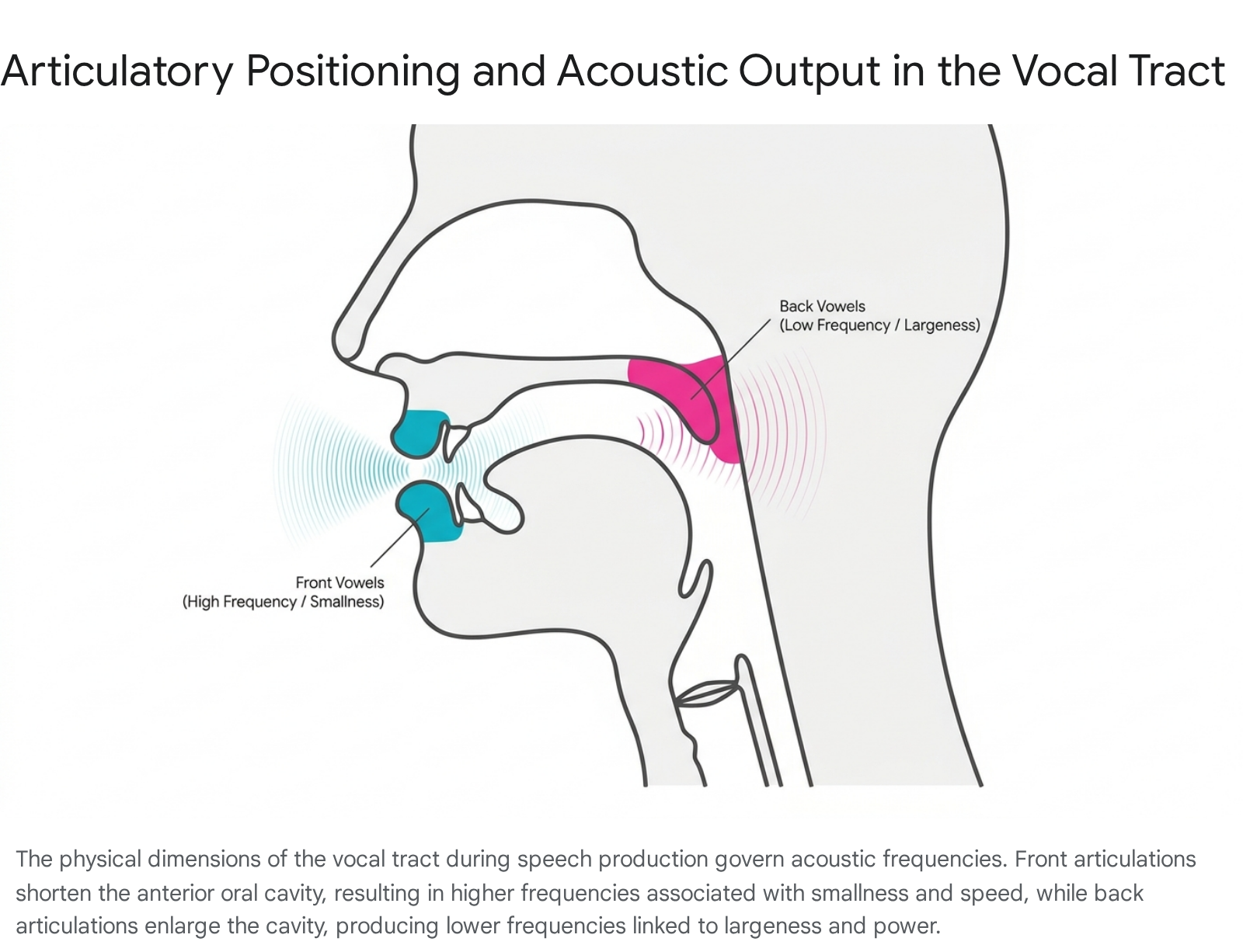
Vowels are produced with a relatively open vocal tract, devoid of total constriction, and are primarily differentiated by the position of the tongue body 2122. The tongue acts as the primary manipulator of space within the vocal tract, altering the dimensions of the pharyngeal and oral cavities to highlight specific resonant frequencies, known as formants 2223. Vowels are generally categorized along a spatial continuum from "front" to "back" depending on tongue placement.
Front vowels, such as the /i/ sound in machine or the /e/ sound in pet, require the tongue to be positioned forward and high in the mouth toward the hard palate 2124. This physical configuration significantly decreases the volume of the anterior oral cavity. In acoustic physics, a smaller resonating chamber produces higher frequencies; thus, front vowels are characterized by a high second formant (F2) frequency 1922. Because the human auditory system processes these high frequencies through the lens of the biological Frequency Code, consumers consistently perceive brand names containing front vowels as smaller, lighter, thinner, faster, sharper, and softer 471024.
Conversely, back vowels, such as the /u/ sound in moon or the /o/ sound in bold, are produced by pulling the tongue backward toward the velum and often rounding the lips 82124. This posterior articulation expands the volume of the oral cavity, which consequently lowers the acoustic frequencies of the formants 2225. As dictated by the evolutionary association between low frequency and large physical mass, brand names utilizing back vowels are perceived by consumers as larger, heavier, darker, slower, duller, and more masculine 472426.
Consonantal Constrictions and Airflow
Unlike vowels, consonants are produced by creating a partial or complete obstruction in the vocal tract 2021. The manner of this obstruction, combined with the presence or absence of vocal cord vibration, dictates the consonant's symbolic resonance within a brand name.
Table 1. Articulatory Mechanics and Brand Perception of Consonant Classes
| Consonant Class | Phonetic Examples | Articulatory Mechanism | Primary Acoustic & Brand Perception |
|---|---|---|---|
| Plosives (Stops) | /p/, /b/, /t/, /d/, /k/, /g/ | Complete closure of the vocal tract followed by a sudden release of air pressure. | Abrupt, percussive impact; conveys power, stability, and heaviness. Word-initial plosives enhance recall. |
| Fricatives | /f/, /v/, /s/, /z/ | Air forced through a narrow channel, creating continuous friction without complete closure. | Continuous, unstopped airflow suggests speed, smoothness, agility, lightness, and forward momentum. |
| Affricates | /ch/, /j/ | Begins as a plosive stop but releases as a fricative, causing excessive friction. | Highly distinctive and less common in standard vocabulary; conveys exclusivity, luxury, and premium status. |
| Nasals | /m/, /n/, /ng/ | Soft palate lowers, allowing air to escape exclusively through the nasal cavity. | Sonorous, resonant, and gentle; conveys comfort, reliability, and approachability. |
A critical secondary dimension of consonant articulation is voicing. Consonants are divided into voiced sounds (where the vocal cords vibrate, such as /b/, /z/, and /d/) and voiceless sounds (produced without vocal cord vibration, such as /p/, /s/, and /t/) 202127. The physiological act of voicing adds significant low-frequency acoustic energy to the speech signal 27. Consequently, voiced consonants weigh down a sound, making it feel heavier, thicker, and more substantial to the human ear 2728.
The Articulation Direction Effect
Beyond the isolated impact of individual phonemes, the sequential ordering of sounds within a brand name triggers somatosensory mapping. The "articulation direction effect" dictates that consumers subconsciously process the physical muscle sequence required to vocalize a word 7.
When a brand name moves from front consonant sounds to back consonant sounds (e.g., from a labial consonant like /b/ to a velar consonant like /k/), the articulatory movement physically moves inward toward the pharynx. This inward sequence mimics the physiological action of swallowing or ingesting food 7. Research demonstrates that consumers generally exhibit more positive affective attitudes toward names with front-to-back sequences. Conversely, names that sequence from back sounds to front sounds demand an outward muscular action that mimics spitting or food rejection, which can subconsciously project negative or avoidant reactions onto the brand 7.
Phonetic Fit and Brand Personality Frameworks
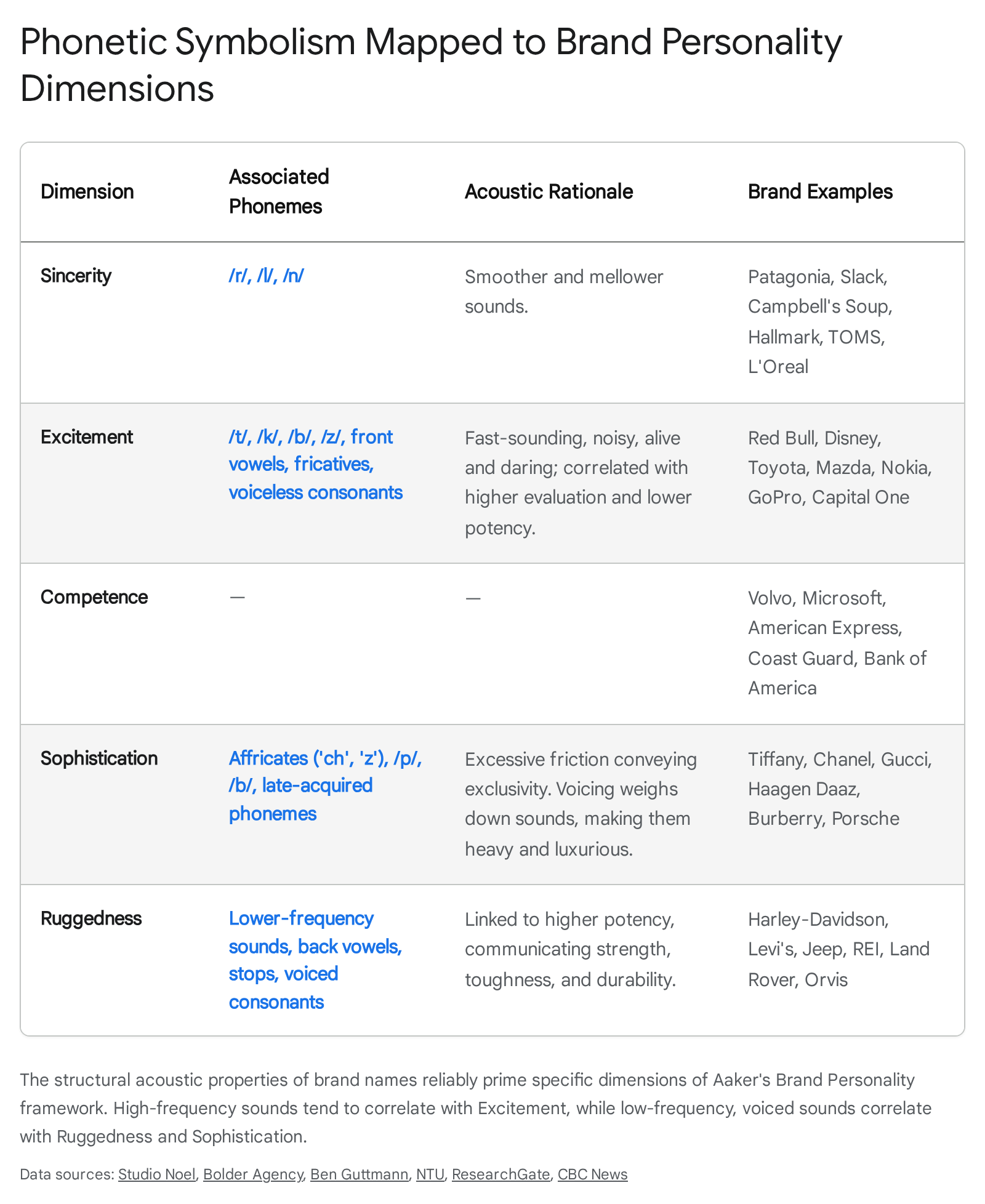
Understanding the acoustic physics of speech allows marketers to deliberately engineer brand names that align with desired corporate identities. The most widely adopted psychological framework for categorizing brand identity is Jennifer Aaker's (1997) Brand Personality Framework 2930313233. Aaker's model organizes consumer perceptions of brands into five core human-like dimensions: Sincerity, Excitement, Competence, Sophistication, and Ruggedness 2930313233.
Recent meta-analyses and empirical studies linking psycholinguistics to Aaker's dimensions reveal systemic mappings between linguistic components and brand personality traits, establishing that phonetics are a primary driver of dimensional classification 334.
Structuring Excitement and Competence
Brands striving for an Excitement positioning - characterized as spirited, daring, dynamic, and youthful (e.g., tech startups, energy drinks, athletic wear) - benefit significantly from high-frequency phonetic structures 293334. Names containing front vowels, voiceless consonants, and fricatives project the requisite speed, lightness, and activity associated with this dimension 34. Furthermore, non-standard spelling or letter structures, such as the letter 'x' or 'z', signal high-tech innovation and rapid business momentum 727.
The drive for Competence - characterized by reliability, intelligence, and success - frequently leverages the "K effect," a documented phenomenon where the letter K (and the hard /k/ plosive phoneme) is statistically overrepresented as the initial letter of top brand names 263035. Word-initial plosives convey stability, incisive action, and structural integrity, traits that reassure consumers of a product's efficacy and reliability 263036.
Structuring Ruggedness and Sincerity
In stark contrast to excitement, brands targeting a Ruggedness positioning - characterized as tough, outdoorsy, durable, and masculine (e.g., automotive trucks, outdoor apparel, heavy machinery) - rely heavily on low-frequency speech sounds 29323334. The utilization of back vowels (/u/, /o/) combined with heavy plosive stops (/t/, /d/, /g/) and voiced consonants creates a thick, heavy acoustic profile. The human brain interprets this dense acoustic energy as physical mass, resilience, and durability 34.
Sincerity, defined by traits such as honesty, cheerfulness, and being down-to-earth, relies on approachability 3032. Research indicates that high-ranking hospitality and family-oriented brands show a strong phonetic preference for sonorous, gentle sounds, specifically nasals and liquids (/m/, /l/, /r/, /n/) 9. These phonemes lack the abrupt aggression of plosives and the sharp friction of fricatives, instead providing a smooth, comforting acoustic contour that fosters trust 9.
Linguistic Markers of Sophistication and Luxury
The linguistic profile of Sophistication - associated with luxury, glamour, and high-end exclusivity - diverges significantly from standard, everyday vocabulary 2933.
Research by linguists analyzing top-tier luxury brands has identified specific "luxurious sounds." Affricates - consonants that begin as stops but release as fricatives, causing excessive friction (e.g., the 'ch' in Gucci, or the stylized 'z' sounds in Häagen-Dazs) - are heavily overrepresented in luxury brand nomenclature 45. While affricates are sometimes perceived as harsh or unpleasant in everyday language, their comparative rarity in common commercial naming conveys exclusivity, novelty, and distinction 5.
Additionally, voiced consonants are paramount in luxury naming. Voicing vibrates the vocal cords, introducing low-frequency resonance that acoustically weighs down the sound 27. In psycholinguistic analysis, heavy sounds are equated with premium weight, substance, and high material quality; names like Burberry, Porsche, and Rolex utilize this heavy acoustic profile to impart a subconscious sensation of luxury and heritage 27. The presence of "late-acquired phonemes" - sounds that children master later in developmental stages - also flips consumer perception of a hypothetical brand from basic to luxury, emphasizing the sophisticated phonetic complexity required to articulate the name 5.
Cross-Linguistic and Cultural Implementations
A persistent debate in phonetic symbolism research concerns the universality of sound-meaning mappings versus the influence of language-specific orthographies, syntax, and phonetic rules 1718. While the biological Frequency Code suggests a universal physiological baseline, the grammatical constraints and sensory experiences of a speaker's native language undeniably modulate perception. For global branding initiatives, it is imperative to understand how sound symbolism operates in non-alphabetic and tonal languages 3737.
Lexical Tone Symbolism in Mandarin Chinese
Mandarin Chinese provides an unparalleled environment for testing sound symbolism due to its minimal morphological complexity; the language consists primarily of monosyllabic morphemes where a single character represents a direct amalgamation of sound and meaning 1. Crucially, Chinese relies on lexical tones - variations in pitch contour over a syllable - to distinguish meaning 838.
In addition to replicating universal vowel effects (where the front vowel /i/ maps to small/angular and the back vowel /u/ maps to large/round), laboratory experiments with native Mandarin speakers reveal that lexical tones independently drive crossmodal correspondences 6183940. Controlling for acoustic duration and amplitude, researchers found that sound-shape and sound-size judgments follow a systematic tone trajectory: * Tone 1 (Flat/High) and Tone 2 (Rising): Consistently matched with larger spatial sizes and rounder visual shapes 183940. * Tone 3 (Falling-Rising) and Tone 4 (Falling): Progressively matched to smaller sizes, sharper edges, and more angular visual patterns 183940.
The pervasiveness of sound symbolism in Chinese is not a modern artifact. Diachronic analyses utilizing natural language processing (NLP) on historical rhyme books confirm the longevity of these phonetic associations. Researchers analyzed four distinct rhyme texts: the Guangyun (representing Middle Chinese from the Sui and early Tang dynasties), the Pingshui Yun (a cross-generational poetic system), the Zhongyuan Yinyun (early modern Chinese from the Yuan dynasty), and the Zhonghua Tongyun (based on contemporary Putonghua released in 2019) 1. Using distributional semantic embeddings derived from classical corpora like the Siku Quanshu and modern datasets like Baidu Baike, the NLP analysis demonstrated that characters grouped within the same phonological rhyme categories exhibit significantly higher semantic similarity than the overall vocabulary average 1. This proves that sound-meaning associations have remained a central, robust feature of Chinese linguistic evolution for over a millennium, functioning across initials, finals, and tones 1.
Ideophones and Mimetic Structures in Japanese
The Japanese language possesses one of the world's most extensive inventories of sound-symbolic vocabulary, broadly classified as ideophones or mimetic words 4143444243. Applying Peirce's classification of icon types, Japanese mimetic words can be categorized into three distinct grammatical and semantic functions 434344.
Table 2. Categories of Japanese Mimetic Words and Ideophones
| Category | Japanese Term | Peircean Icon Type | Linguistic Function & Examples |
|---|---|---|---|
| Animate & Inanimate Phonomimes | Giseigo & Giongo | Icons of abstract quality | Words imitating real sounds. Giseigo mimics human/animal voices (wanwan for a barking dog). Giongo mimics environmental sounds (zaazaa for heavy rain). |
| Animate & Inanimate Phenomimes | Gitaigo & Giyōgo | Icons of physical instantiation | Words expressing visual, tactile, or physical states that do not produce sound (kirakira for sparkling light, furafura for dizziness or unsteadiness). |
| Psychomimes | Gijōgo | Icons of abstract relation | Words expressing internal psychological or physiological emotions (dokidoki for a pounding heart indicating excitement or anxiety). |
Japanese product naming frequently exploits these mimetic structures. The inherent sound symbolism within Japanese orthography dictates brand perception heavily based on the presence of voiced obstruents (e.g., /b/, /d/, /g/, /z/) 28. In a comprehensive study of Japanese character names - specifically utilizing the Pokémon corpus - researchers established that the number of voiced obstruents in a name directly and positively correlates with the character's physical size, weight, evolution level, and perceived combat strength 28.
A minimal pair example perfectly illustrates this phonetic scaling: the mimetic word koro-koro signifies a light, small object rolling, while the addition of voicing in the initial consonants creates goro-goro, which radically transforms the perception to a heavy, massive rock rolling, or the rumbling of thunder 284445. Consequently, global brands entering the Japanese market must tightly audit their phonetic voicing to avoid inadvertently signaling undesirable traits such as excessive weight or aggression in delicate product categories 3746. Furthermore, the translation of these highly specific mimetic words into English marketing copy often results in semantic loss, as English lacks direct equivalents for non-auditory Gitaigo, forcing translators to rely on weaker adverbs or omissions 414243.
Strategic Naming Failures and the "Sounds-Right Trap"
The ultimate commercial utility of phonetic symbolism lies in establishing product-name congruence. A brand name operates at maximum psychological efficiency when its implicit phonetic meaning flawlessly aligns with the explicit semantic attributes of the product 104748. When consumers evaluate unknown brands, their preferences are strictly governed by phonetic fit; an ice cream named with back vowels (Frosh) is evaluated as significantly smoother and richer than an identical product named with front vowels (Frish) 1026.
Despite the empirical clarity of phonetic symbolism, naming failures remain a rampant issue in global commerce. Companies frequently prioritize cleverness, complex portmanteaus, creative misspellings (e.g., Flickr, Twtter), or obscure Latin/Greek roots over phonetic clarity 363749. Names that are structurally difficult to pronounce fail to trigger fluid phonetic symbolism, increasing cognitive friction, reducing brand recall, and exponentially inflating the advertising costs required to seed the name with target demographics 3649.
A primary driver of sub-optimal naming strategy is the "Sounds-Right Trap" 50. Brand managers often evaluate a proposed name by comparing its phonetic contour to highly successful existing brands, assuming that because a name like Google, Kodak, or Apple "sounds right," a similar phonetic structure will guarantee success for their distinct product 3650. This is a fundamental cognitive illusion. The certainty that a famous brand name "sounds right" is a retrospective certainty - a psychological byproduct of decades of accumulated brand equity, positive customer experience, and billions of dollars in marketing reinforcement 50. At their inception, these names relied on their inherent phonetic properties to gain traction, not on mimicry 950. Copying the phonetic structure of a successful brand without matching it to the specific dimensional attributes of the new product guarantees incongruence 3650.
Furthermore, failing to conduct phonetic and semantic audits across languages leads to catastrophic global product launches. Because phonetic sequences carry profound cultural and semantic baggage, phonemes that are neutral or positive in English may translate into taboo, derogatory, or nonsensical slang in other languages. Historical examples underscore this risk: Ford's launch of the Pinto failed in Brazil because the word is slang for small male genitalia, while Procter & Gamble faced hurdles marketing Puffs tissues in Germany, where the term is colloquial slang for a brothel 3751.
Artificial Intelligence in Algorithmic Naming
The intersection of phonetic linguistics and brand naming is currently undergoing a structural transformation driven by Artificial Intelligence (AI). Historically, brand naming relied on agency brainstorming sessions, human intuition, and manual linguistic validation. This traditional process is highly susceptible to human fatigue, cognitive bias, and the safe recycling of familiar linguistic patterns, leading to market saturation and unoriginality 3755.
Modern AI-driven naming platforms utilize Natural Language Processing (NLP) and advanced machine learning models to synthesize and optimize brand generation 375657. These algorithms are trained on vast datasets encompassing historical brand success metrics, phonetic symbolism rules, global semantic associations, and domain registries 555658.
Semantic and Phonetic Databases
When prompted to create a name, an AI platform simultaneously parses multiple variables. Phonetically, it evaluates how a word sounds, scoring the name on pronounceability, memorability, and the specific affective emotions triggered by its vowel and consonant structures 375558. Semantically, it runs global resonance tests to identify cultural connotations, predicting whether a phonetic sequence carries negative implications in foreign languages, thereby preventing localization failures 555658. Simultaneously, the AI conducts real-time legal validation, scanning global trademark databases and domain availability, reducing a validation process that traditionally took weeks into a real-time output 3756. By automating semantic clustering, AI systems identify distinct, brandable phonetic structures that human teams frequently overlook due to linguistic fatigue 555657.
Machine Discovery and Entity Resolution
The most profound shift in naming strategy, however, is not simply how names are generated, but how they are discovered by the consumer. For the past century, brand names were designed to capture human attention on a physical retail shelf, a billboard, or a digital screen 59. A name required phonetic strength primarily to evoke a feeling or promise an attribute to a human buyer 1059.
As modern commerce transitions toward AI-mediated discovery, this paradigm is fracturing. Increasingly, the initial path to purchase is governed by algorithms: voice assistants recommending products, AI shopping agents filtering thousands of SKUs based on parameters, or Large Language Models (LLMs) drafting initial vendor shortlists for enterprise procurement 59. In these digital environments, no human eyeballs appraise the brand name during the primary filtration stage; an AI algorithm does 59.
When an AI pattern-matches language to recommend a product, the brand name serves as the primary anchor entity 59. Names that are highly generic, confusable with common dictionary vocabulary, or phonetically and linguistically incoherent generate diffuse, low-confidence semantic associations within the LLM's neural network 59. Because AI recommendation systems are trained to surface brands with strong, consistent data reputations, these ambiguous entities are systematically deprioritized and dropped from machine shortlists 59. Conversely, a brand name that is phonetically strong, linguistically distinctive, and structurally unique allows the AI to organize associations efficiently and resolve the entity with high confidence 59.
Consequently, phonetic distinctiveness is no longer merely a psychological tool to influence human emotion; it has evolved into a critical technical requirement for entity disambiguation in machine learning ecosystems. A name engineered with precise phonetic symbolism aggregates semantic associations clearly over time, reinforcing the brand's competitive position in both human cognition and algorithmic processing 59.
Sonic Branding and Emotional Engagement
The principles of phonetic symbolism extend beyond the written orthography of a brand name into the realm of sonic branding. Sonic branding involves the strategic use of sound and music - such as audio logos, brand anthems, and product sounds - to enhance the way consumers experience a brand across multiple touchpoints 52.
Acoustic repetition plays a vital role in consumer evaluation. Studies on fictitious brand names demonstrate that consumers evaluate a brand most favorably when the phonetic structure of its name contains sound repetition (such as alliteration or rhyming) and, crucially, when the name is spoken aloud rather than read silently 4. The physical act of articulating the repeated phonetic structures enhances memorability and lodges the brand firmly within the consumer's phonological loop 4.
In the contemporary market, sonic branding is becoming an essential tool for overcoming "brand agnosticism." Recent consumer data indicates a growing segment of brand-agnostic consumers who show diminished loyalty to specific brands, motivated instead by immediate discounts, convenience, or product quality 52. Experimental studies reveal that sonic brands equipped with specific musical properties successfully evoke positive emotional responses 52. These positive emotions fully mediate the path between the sonic logo and consumer trust 52. Notably, for individuals who exhibit low emotional commitment to brands, the deployment of a well-engineered sonic logo significantly increases digital engagement and fosters higher levels of trust 52. Thus, the acoustic profile of a brand - whether spoken as a name or played as a sonic logo - serves as a primary relational foundation in an increasingly crowded and agnostic consumer landscape.
Conclusion
The psychology of product naming is not a subjective art, but a highly applied science deeply rooted in evolutionary biology, acoustic physics, and human physiological morphology. Through the mechanisms of phonetic symbolism, the precise structural arrangement of vowels and consonants transmits immediate, subconscious data regarding a brand's physical attributes, technical capability, and overarching personality.
Whether leveraging high-frequency fricatives to project the speed and excitement of a disruptive technology, or utilizing heavy affricates and voiced consonants to anchor the sophistication and durability of a luxury good, strict alignment between phonetic structure and brand positioning is paramount for commercial success. Cross-cultural research confirms that while specific grammatical manifestations - such as Mandarin lexical tones or Japanese mimetic ideophones - vary significantly by region, the human brain's propensity to extract semantic meaning from acoustic shapes remains a universal constant.
As the commercial landscape evolves, the role of the brand name is shifting from a mere psychological trigger designed for human consumers to a fundamental anchor for algorithmic entity resolution. In an era increasingly dominated by AI-mediated discovery and brand-agnostic consumers, companies that prioritize distinctive, data-driven phonetic fit will secure higher cognitive resonance in human audiences and sharper data resolution in machine networks, ensuring survival and growth in highly saturated global markets.