
Embodied simulation and sensory responses to visual advertising
Visual advertising relies fundamentally on the human brain's capacity to internally simulate experiences that are not physically present. Historically, cognitive science operated on the assumption that the brain processed information through amodal, symbolic representations, abstracted entirely away from physiological and sensory experience 12. However, the paradigm of grounded cognition - prominently advanced by theorists such as Lawrence Barsalou, Friedemann Pulvermüller, and George Lakoff - posits that cognition is inherently embodied 1234. Under this framework, cognitive processing operates through the reactivation of modality-specific brain states across visual, motor, and introspective neural networks 234.
Within consumer behavior, embodied mental simulation is defined as the automatic, often nonconscious reenactment of perceptual and motor experiences triggered by exposure to visual or verbal stimuli 456. When a consumer observes an advertisement for a food product or a physical good, the brain does not merely classify the object abstractly. Instead, it simulates the actions, tactile sensations, and gustatory responses associated with consuming or interacting with the product 67. This document exhaustively examines the neurobiological pathways, behavioral phenomena, cross-modal integrations, and cross-cultural variables that explain how embodied simulation translates static visual cues into complex, multi-sensory consumer responses.
Theoretical Foundations of Grounded Cognition
The concept of embodied simulation provides a unified theoretical framework for understanding how sensory stimuli influence abstract decision-making. The traditional disembodied view of cognition maintained that modality-specific perceptual and motor cortices were utilized solely for interacting with the immediate physical environment, playing no role in the processing of meaning or conceptual thought 4.
Modality-Specific Representation
The embodied simulation hypothesis, which emerged concurrently across psychology, neuroscience, and philosophy in 1999, directly challenged disembodied models 4. Grounded cognition asserts that representations in memory are modality-specific. When an individual recalls or views a representation of an object, the brain simulates the perceptual states that originally occurred during the physical interaction with that object 23. These simulations are rarely conscious mental imagery; rather, they are rapid, nonconscious computational mechanisms that integrate the brain, the body, and the immediate environmental context to predict outcomes and plan actions 238.
Contextual Modulation of Simulation
Simulations do not provide complete or perfectly accurate representations of reality. Instead, they are dynamic constructs representing abstractions, caricatures, and ideals based on specific learning episodes 2. Operating in a Bayesian manner, the simulation of an object - such as a beverage in an advertisement - reflects aspects of that beverage experienced frequently in the past, heavily modulated by the contextual relevance of the current environment 2. Consequently, the cognitive architecture of the brain acts as a situation-processing mechanism whose primary function is to capture and simulate situated conceptualizations, forming the foundation of advertising efficacy 2.
Neurobiological Mechanisms of Sensory Simulation
The efficacy of visual advertising is deeply rooted in the interconnected architecture of the brain's sensory and motor systems. Observing a product engages a complex network that extends far beyond the primary visual cortex, bridging sight, touch, and movement.
Cortical Pathways and Visual Processing
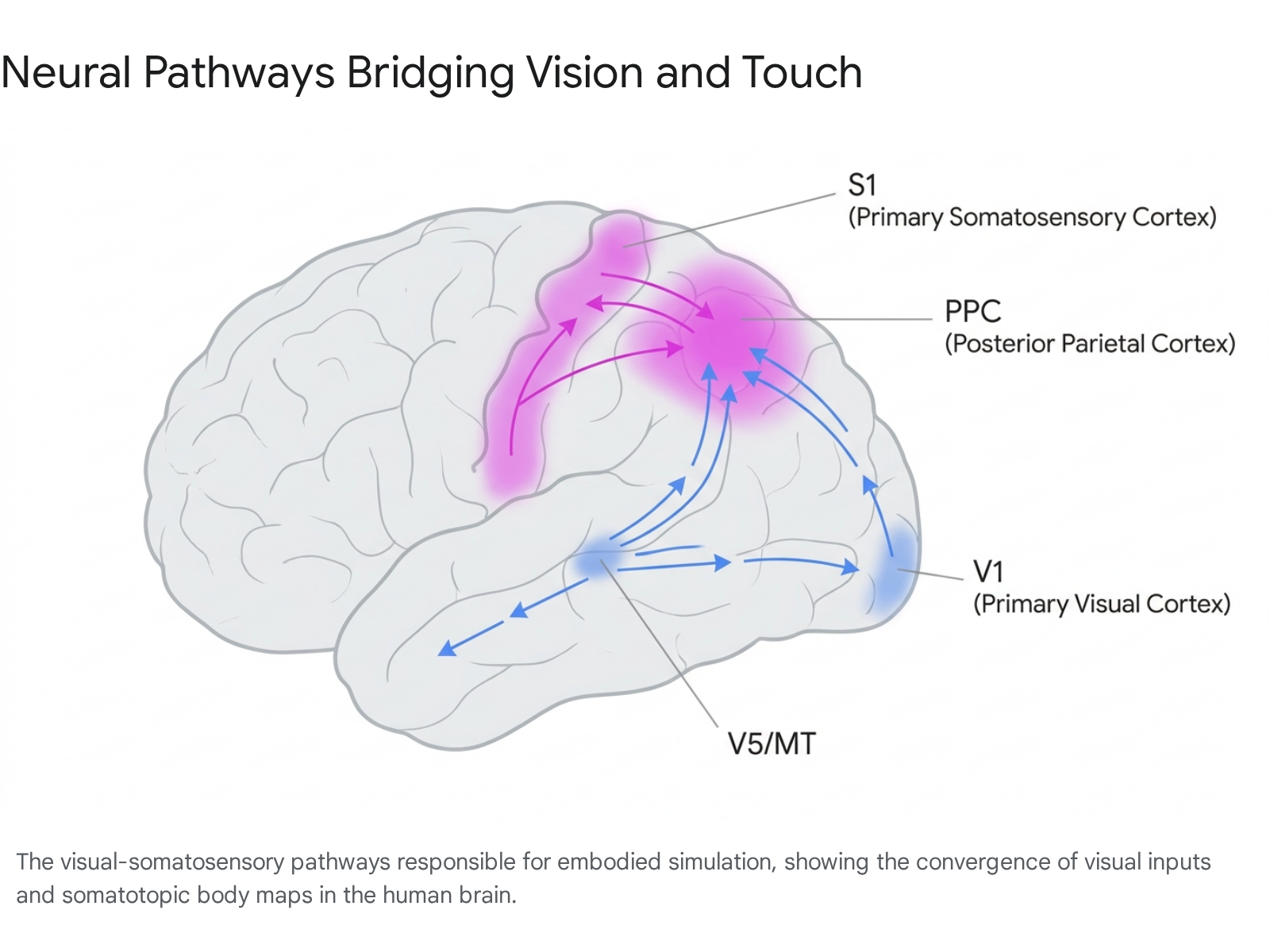
Visual processing begins in the primary visual cortex (V1) at the posterior of the brain 91011. The information is subsequently processed by extrastriate visual regions (V2, V3, V4, and V5/MT) before dividing into two distinct processing streams 911. The ventral stream, projecting to the inferior temporal cortex, is primarily responsible for perception and object recognition 911. The dorsal stream, which projects to the posterior parietal cortex (PPC), computes spatial perception and facilitates the online control of action 91011. The PPC serves as a critical nodal point where visual information is integrated with somatosensory and kinesthetic data, enabling the brain to map objects in body-centered coordinates rather than purely retinotopic (retina-centered) coordinates 910.
Visual-Somatosensory Integration and Vicarious Body Maps
Recent advancements in ultra-high-field neuroimaging have fundamentally altered the understanding of how vision and touch intersect during passive observation. A 2025 study published in Nature utilized 7-Tesla functional magnetic resonance imaging (fMRI) on 174 participants to investigate the integration of visual and somatosensory information 121314. Using a novel dual-source connective-field modeling framework, the researchers simultaneously estimated retinotopic tuning from V1 and somatotopic tuning from the primary somatosensory cortex (S1) 1213.
The findings revealed the existence of "vicarious body maps" bridging vision and touch 1213. The data demonstrated that visual brain regions possess an intrinsic somatotopic organization - a layout corresponding to the human body - even in the absence of external tactile stimuli 1213. During naturalistic video viewing, somatotopic connectivity expanded substantially into the dorsal and lateral visual cortices 1315.
Neural responses in these regions were best explained by genuine multimodal processing rather than purely visual encoding 13. In dorsal visual regions, body maps align with the visual field (e.g., neural populations tuned to sensations in the feet respond to the lower visual field), whereas in ventral regions, somatotopic maps align with semantic body-part categories 1415. This indicates that the neural architecture utilized to process physical touch is structurally embedded within the visual system. When a consumer views an advertisement, visual input translates directly into somatosensory formats, providing the neurological substrate for embodied perception and vicarious tactile sensation 121314.
Motor Simulation and the Mirror Neuron System
Alongside visual-somatosensory integration, the motor cortex actively participates in processing visual advertising. The Mirror Neuron System (MNS), originally identified in the premotor and parietal areas of macaques, consists of neurons that fire both when an action is executed and when that identical action is observed 161718. In consumer contexts, observing an actor consume a food product or manipulate an object triggers an isomorphic neural mapping in the observer's brain, functionally replicating the state of acting 1617.
Proponents of the embodied simulation model, such as Vittorio Gallese, argue that this neural resonance provides direct, non-inferential access to the meaning of actions, generating "intentional attunement" 1618. Transcranial magnetic stimulation (TMS) studies demonstrate that observing specific actions increases excitability precisely in the muscles required to execute that action 1819.
However, the application of mirror neurons as a comprehensive explanation for high-level cognition requires calibrated uncertainty. Critics assert that mirror mechanisms primarily support low-level action processing rather than sophisticated mental state attribution or conceptual mindreading 1720. Nevertheless, within the specific scope of embodied simulation in advertising - such as the visual observation of grasping a product - the activation of the observer's action observation network (AON) and somatotopically organized premotor areas remains an established mechanism for translating visual input into simulated motor engagement 181921.
Visual Depiction and Motor Affordances
One of the most direct applications of embodied simulation in visual marketing is the manipulation of visual object affordances. Rooted in ecological psychology, an affordance represents the perceived action possibilities that an object presents to an observer 2223. Vision and action are intimately linked; merely viewing a graspable object automatically activates specific manual motor plans, including abstract response codes selective for grasp type (e.g., precision vs. power grasp) and wrist orientation 2223.
The Visual Depiction Effect
The alignment of visual depictions with natural motor affordances profoundly impacts consumer behavior. Research defining the "visual depiction effect" demonstrates that orienting a product in an advertisement to facilitate a consumer's dominant hand significantly enhances behavioral intentions 672425.
For instance, Elder and Krishna (2012) conducted multiple experiments illustrating that displaying a coffee mug with the handle facing the right side - matching the dominant hand of the majority of the population - or placing a fork on the right side of a plate, facilitates an embodied mental simulation of physical interaction 6725. The ease of mentally simulating the act of picking up the food triggers reward-processing networks in the brain, subsequently elevating purchase intent 67. This effect operates independently of semantic object-action associations, relying on pure physical affordances that bias visual attention and prime the motor system for interaction 2226.
Cognitive Load and Perceptual Constraints
The efficacy of the visual depiction effect relies heavily on the availability of perceptual resources. If a consumer's cognitive load is artificially increased - thereby occupying the mental resources required to execute an embodied mental simulation - the positive impact of the favorable product orientation is heavily attenuated 725.
Furthermore, the valence of the object dictates the outcome of the simulation. While facilitating interaction with appealing products increases purchase intent, facilitating the simulation of interacting with negatively valenced or unappealing objects actually decreases purchase intentions 725. In these instances, the consumer fluently simulates an undesirable interaction, leading to heightened avoidance behavior 7.
| Feature of Visual Depiction | Impact on Embodied Simulation | Effect on Consumer Behavior |
|---|---|---|
| Dominant Hand Orientation | High alignment with motor affordances; easy simulation of grasping. | Increases purchase intention for positive/neutral products 6725. |
| Non-Dominant Orientation | Low alignment with motor affordances; requires mental rotation. | Neutral to lower purchase intention compared to dominant alignment 725. |
| High Cognitive Load | Occupies perceptual resources, blocking mental simulation. | Nullifies the visual depiction effect; simulation fails to alter intent 725. |
| Negative Product Valence | Facilitates the simulation of a highly undesirable interaction. | Decreases purchase intention further than a static/non-oriented display 725. |
Implied Motion in Static Imagery
Because video formats are not always feasible or cost-effective in print, packaging, and digital menu contexts, marketers frequently utilize implied motion. Implied motion is the psychological extraction of dynamic information from a static visual stimulus, such as a photograph capturing liquid being poured, steam rising from a cup, or powder mid-splash 272829.
Sensorial Impact of Implied Motion
Neuroimaging reveals that viewing pictorial stimuli containing implied motion activates the MT/V5 complex in the extrastriate visual cortex, the exact region responsible for processing real physical motion 28293130. This activation occurs through various sources of implied motion, including a moving object captured in time, the depicted hand movements of the image creator, or the fictive movement of a point across an image 2930.
When consumers observe dynamic food images, they implicitly associate the movement with high product quality. Extensive literature indicates that implied motion cues increase evaluations of freshness, tastiness, energy, and healthiness, serving as a heuristic cue that subsequently drives product liking and willingness to pay 27313233. The underlying mechanism is affective fluency; the brain recognizes movement as an indicator of freshness, generating pleasant feelings associated with the fluent processing of a vivid, dynamic image 2832.
Additionally, dynamic imagery influences attribute evaluations related to energy density. Research demonstrates that presenting high-energy-density foods (e.g., an "exploding" burger presentation or dripping cheese) with dynamic visual cues causes consumers to perceive the food as having a higher energy level, enhancing preference among consumers with hedonic indulgence goals 3134.
Boundary Conditions and Empirical Inconsistencies
Despite robust theoretical mechanisms linking MT/V5 activation to dynamic perception, the translation of this neural activity into positive consumer evaluations is subject to significant boundary conditions. A rigorous 2021 replication study testing the effects of implied motion on food perceptions across three experiments found no significant differences in perceived taste, healthiness, or appeal between static and implied motion images 28.
These inconsistent findings highlight that individual consumption goals heavily moderate the effectiveness of dynamic cues. When an active consumption goal - such as seeking healthy food or pursuing pleasure - is salient, implied motion cues that are congruent with that goal are far more likely to trigger favorable attribute inferences 2832. Thus, while the neurological activation of motion-processing areas in response to implied motion is highly consistent, downstream alterations in consumer preference require tight alignment with the consumer's immediate psychological state and demographic characteristics 28.
Cross-Modal Simulation and Multisensory Integration
Visual advertising rarely targets only the visual cortex; its optimal function is to evoke a cross-modal sensory response 37. Consumer decision-making is profoundly driven by subconscious emotional and sensory connections 3835. The brain's memory and emotion centers are heavily interlinked with the olfactory, gustatory, and tactile systems, allowing robust visual cues to elicit phantom smells, tastes, and textures 363742.
Visual-Induced Olfactory and Gustatory Imagery
Smell and taste are inherently intertwined via the retronasal pathway and integrated cognitive processing 36. Exposure to an odor congruent with an expected taste substantially enhances palatability and desire 3637. In digital, television, or print advertising where actual chemical scents are absent, highly vivid visual images induce olfactory imagery. Through cognitive sensory integration, viewing a visually rich image of a steaming cup of coffee triggers neural representations associated with that scent, successfully inducing a taste sensation without a physical stimulus 3642.
Implicit testing utilizing neurophysiological measures, such as Galvanic Skin Response (GSR) and Electroencephalography (EEG), confirms that visual food stimuli elicit multisensory arousal. In rational advertising contexts, visually triggering olfactory senses impacts consumer attitudes through emotional arousal, whereas in emotional advertising contexts, the simultaneous triggering of olfactory and gustatory simulation directly impacts word-of-mouth and purchase intent 3642. Marketers optimize this by relying on explicit representations of the food itself rather than product packaging, as direct food imagery more effectively retrieves past multisensory experiences stored in memory structures 42.
Haptic Imagery and Texture Simulation
Texture constitutes a critical dimension of product quality, particularly for luxury goods, cosmetics, and packaged foods 3838. Mental simulation of haptic properties - such as weight, friction, compliance, and temperature - occurs when visual processing retrieves and organizes haptic information from memory 3844. A solid, visually steady form communicates physical heaviness, while a glossy finish communicates smoothness 3838. The congruence between visual perception and expected haptic reality is vital; incongruence leads to cognitive dissonance and brand rejection 3538.
Brands simulate touch through high-contrast lighting to reveal surface grain, or by showing an actor physically interacting with the material 45. Recently, advancements in consumer electronics have begun literalizing this simulation. Surface haptic technologies, such as programmable electric fields or ultrasonic vibrations on device touchscreens, modulate friction to allow users to physically "feel" textures like fabric or wood grain while swiping 4639. Empirical studies indicate that integrating haptic feedback into mobile advertisements significantly outperforms standard visual ads in generating purchase intent among new customers, demonstrating the potent behavioral impact of closing the gap between visual simulation and physical tactile feedback 46.
Immersive Advertising Technologies
As digital environments evolve, augmented reality (AR), virtual reality (VR), and mixed reality (MR) transform embodied simulation from an internal mental reconstruction into an external, sensory-rich interactive experience 404941. Immersive advertisements contextualize products within the customer experience, allowing consumers to interact with brands virtually in three dimensions 40. The immersive technology advertising market is projected to reach $153.8 billion globally by 2032, driven primarily by the accessibility of mobile AR 42.
Augmented Reality and Contextual Affordances
Augmented reality blends digital content with real-world environments, typically via smartphones utilizing advanced camera systems and LiDAR sensors 425243. Over one billion consumers utilized mobile AR in 2023 4152. AR provides unparalleled engagement - up to 2.5 times more engaging than traditional content - by allowing consumers to virtually project products into their immediate physical space or onto their own bodies (e.g., virtual cosmetics try-ons) 4152. This spatial congruence heavily stimulates the motor and somatosensory cortices, bridging the gap between passive visual observation and active physical interaction 4941.
Virtual Reality and Bodily Replacement
Virtual reality generates a complete simulation of the body within the bounds of a virtual space, effectively replacing the user's physical constraints with a virtual environment and avatar 434445. VR tracks and reacts to the user's kinetic movements in real-time, providing a highly visceral understanding of embodiment 44. The sports industry alone spent an estimated $1.8 billion on VR advertisements in 2023, enabling fans to experience the dramatized movements of athletes from a first-person perspective 44. The embodiment felt by users in VR directly increases immersion and enjoyment, strongly shaping behavioral intentions to pursue the simulated experience in reality 45.
Persuasion Mechanisms in Immersive Media
Persuasion within immersive environments is frequently analyzed through the Elaboration Likelihood Model (ELM) 49. Research demonstrates that sensory and interactive cues in AR and VR - such as 3D visual fidelity, spatial audio, and user-directed navigation - dominate cognitive processing. Consequently, persuasion heavily relies on the peripheral route of the ELM, shaping user attitudes through intense emotional engagement, telepresence, and source credibility, rather than through central, argument-based logical elaboration 49.
A 2023 meta-analysis of over 50 marketing studies found that while the average behavioral effect of standard mental simulation prompts (like text or static images) is relatively small, interactive media utilizing AR and 360-degree video significantly strengthen the impact on consumer purchase behaviors 46. However, immersive simulations are highly sensitive to frequency of induction. While targeted mental simulation increases action readiness, mass repetition across platforms reduces consumption, likely due to rapid habituation to the simulated sensory reward 46.
| Advertising Modality | Primary Simulation Trigger | Level of Embodiment | Key Persuasion Pathway (ELM) |
|---|---|---|---|
| Traditional 2D Print/Video | Implied motion, visual depiction affordances, color psychology. | Low-to-Moderate (Internal mental imagery). | Mix of Central (copy) and Peripheral (visual aesthetics). |
| Augmented Reality (AR) | Contextual 3D overlay, spatial interaction, physical proximity. | High (Integration of physical and virtual context). | Dominantly Peripheral (experiential flow, high engagement). |
| Virtual Reality (VR) | Kinesthetic tracking, environmental replacement, avatar embodiment. | Complete (First-person sensory replacement). | Dominantly Peripheral (telepresence, deep immersion). |
Cross-Cultural Differences in Sensory Processing
While the foundational neurobiological mechanisms of visual-somatosensory integration and motor affordance mapping are universally hardwired, the deployment of visual attention and the interpretation of sensory cues are profoundly moderated by cultural background 474859.
Analytic Versus Holistic Visual Attention
Neurological attention operates via two layers: bottom-up and top-down processing 48. Bottom-up attention is biological, reflexive, and universal; stimuli exhibiting high visual salience (contrast, brightness, or rapid motion) will capture human attention globally within 200 milliseconds 4860. However, top-down attention - how the brain deliberately scans and interprets a scene - differs markedly between Western and East Asian populations 4748.
Western cognition is generally characterized by an Analytic processing style. Western consumers tend to fixate rapidly on a focal object (e.g., the primary product featured in an ad) and analyze its individual attributes independent of the surrounding context 4748. Eye-tracking studies demonstrate that American participants lock onto focal objects up to 118 milliseconds faster than East Asian counterparts 48.
Conversely, East Asian cognition is typically Holistic. These consumers allocate significantly more attention to the broad perceptual field, scanning the background context and the relationships between various objects before focusing on a central entity 4748. Consequently, while a highly cluttered advertisement causes detrimental cognitive load universally, an advertisement relying solely on a stark, isolated product image may successfully trigger simulation in Western markets but fail to provide the necessary contextual grounding required for favorable evaluation in Eastern markets 474849.
Cultural Moderation of Food and Sensory Norms
Beyond raw visual attention, cultural heritage dictates which specific sensory attributes are prioritized during mental simulation. In nations with extensive, codified culinary histories, such as Japan or Italy, the aesthetic presentation of food is elevated to a rigorous art form, making visual design and "food plating" a paramount driver of perceived quality . In many Asian cultures, the harmony and balance of fundamental tastes (sweet, sour, bitter, umami) are culturally prioritized, altering how visual cues promising these specific flavor profiles are cognitively evaluated .
Familiarity acts as the fundamental baseline for sensory acceptance. Cross-cultural consumer studies assessing visual, aromatic, and tactile liking for novel foods demonstrate that familiarity heavily mediates both subjective acceptability and physiological responses 5051. For example, studies utilizing bio-sensory applications to track facial expressions and skin temperature reveal divergent physiological arousal patterns between Asian and Western populations when exposed to identical visual food stimuli 51. Thus, an advertisement that successfully triggers a positive embodied simulation in one cultural context may evoke a neutral or negative simulation in another if the sensory norms and visual context do not align with the target culture's top-down processing models and historical dietary habits 526667.
Synthesis of Embodied Simulation in Marketing
Visual advertising operates not as a passive transmission of abstract data, but as an active catalyst for embodied mental simulation. By leveraging the brain's integrated visual, motor, and somatosensory pathways, marketers induce phantom experiences of taste, touch, and physical interaction. Techniques ranging from the deliberate orientation of a product handle to the use of implied motion in food photography effectively hijack the observer's sensorimotor circuits to create affective fluency and approach behavior.
While the neurobiological architecture supporting this phenomenon is universal - as evidenced by the mapping of vicarious tactile responses within the human visual cortex - its commercial application is highly sensitive to context. The efficacy of visual sensory triggers is strictly modulated by the consumer's cognitive load, current consumption goals, the immersive capability of the medium (AR/VR), and profound cross-cultural differences in visual scanning and dietary heritage. Understanding embodied simulation provides marketers and researchers with a precise, biologically grounded framework for explaining why specific visual stimuli transcend aesthetics to generate deep, multi-sensory consumer desire.