
Embodied Cognition in Consumer Behavior and Tactile Marketing
Theoretical Foundations of Embodied Cognition
The study of consumer behavior and human decision-making has historically been dominated by models of information processing derived from the cognitive revolution of the 1970s. These early frameworks operated on an amodal assumption, proposing that human cognition functions similarly to a computer, processing, storing, and retrieving information independently of the sensory modalities through which that information was initially acquired 1. Within this paradigm, consumer decision-making was modeled as a conscious, systematic evaluation of attributes, utilities, and probabilities 2. However, neuroscientific and psychological research over the past two decades has challenged this amodal view, giving rise to the theory of embodied cognition.
Embodied cognition posits that human thought, feeling, and judgment are inextricably linked to sensorimotor experiences 1. According to this theoretical framework, the mind does not process abstract information in a vacuum; rather, cognitive processes are deeply rooted in the body's physical interactions with the environment 34. This perspective suggests that memory, comprehension, and evaluation contain mental simulations of perception and action 4. In consumer psychology, this indicates that external physical stimuli - such as temperature, weight, spatial orientation, and texture - can directly influence high-level cognitive processes, including product valuation, brand perception, and purchase intention 15.
Conceptual Metaphors and Sensorimotor Experiences
A central mechanism within embodied cognition is the operation of conceptual metaphors, which link early, foundational sensorimotor experiences to complex abstract concepts 17. Because humans first learn to navigate the world through physical sensations in infancy, these bodily experiences serve as the scaffolding for later cognitive development 67. Consequently, physical sensations can unconsciously activate corresponding abstract concepts 4.
Research indicates that basic affective orientations, such as approach and avoidance, arise from the body as much as the intellect. These orientations can be triggered by subtle sensorimotor inputs, such as the motor proprioception involved in arm flexor versus extensor movements, or the mental simulation of consumption 18. Thermoregulation provides a prominent example of this mechanism. Foundational studies have demonstrated that physical warmth can induce perceptions of interpersonal warmth, leading consumers to exhibit more pro-social or conforming behaviors. For instance, consumers in physically warm environments or those holding a warm object have been shown to be more likely to select gifts for others over themselves, or to align with majority preferences 3611. Conversely, experiences of physical coldness have been shown to increase a desire for social affiliation as a compensatory self-regulatory mechanism 6.
| Feature | Amodal Information Processing | Modal (Embodied) Cognition |
|---|---|---|
| Core Metaphor | The mind as a computer | The mind as an extension of the body |
| Information Storage | Abstract, symbolic representation | Grounded in sensory and motor simulations |
| Role of the Body | Passive sensory input mechanism | Active participant shaping thought and judgment |
| Consumer Evaluation | Based on calculated utility and attributes | Influenced by physical posture, weight, texture, and temperature |
| Primary Drivers of Choice | Conscious, analytical reasoning | Blend of cognitive evaluation and sensorimotor fluency |
Physical Product Attributes and Tactile Perception
Tactile marketing utilizes the principles of embodied cognition by intentionally designing the physical attributes of products, packaging, and retail environments to elicit specific psychological responses. Because the tactile modality is often associated with reality and verification, consumers frequently rely on their sense of touch to assess product quality, durability, and value 913. The mechanoreceptors in human glabrous skin gather information concerning an object's structural properties - including size, shape, volume, weight, and texture - which the brain then translates into abstract product associations 7.
Weight as an Embodiment of Importance
The physical weight of an object is one of the most prominent haptic cues utilized in tactile marketing. Metaphorically, humans equate weight with significance, as reflected in linguistic expressions regarding the "gravity" of a situation or a "heavy" subject 410. This connection is hypothesized to stem from the physical effort required to manipulate heavy objects, which unconsciously translates into increased cognitive effort and a perception of importance 101112.
Empirical investigations into the embodiment of weight have demonstrated that the heft of an object can alter consumer judgments. In heavily cited early research by Jostmann, Lakens, and Schubert (2009), participants evaluating objects or candidates while holding a heavy clipboard (versus a light clipboard) consistently rated the subjects as more important and valuable, and exhibited more elaborate cognitive processing 451112. For instance, participants holding heavy clipboards estimated foreign currencies to be more valuable and assessed justice issues - such as student exclusion from decision-making - as significantly more important 10.
In retail environments, heavier packaging frequently signals product quality and durability. Consumers routinely associate the physical weight of items - such as heavy glass perfume bottles or weighted electronic devices - with superior craftsmanship, luxury, and higher flavor intensity in foods 1314. Conversely, lighter products, particularly those utilizing flimsy packaging materials like thin plastic, are often perceived as lower in quality or less natural 513. Weight can even influence metamemory; consumers tend to provide higher judgments of learning (JOLs) for information studied while holding heavy objects, assuming the material is more substantial and memorable 4.
Surface Texture and Sensory Disconfirmation
Surface texture exerts a profound influence on consumer product evaluation, as the skin's mechanoreceptors transmit nuanced data regarding an object's composition 9. Generally, consumers exhibit a strong preference for smooth, soft textures (e.g., satin, velvet, coated paper) over rough, abrasive textures (e.g., sandpaper, raw cardboard) 1315. Smoothness conveys luxury, user-friendliness, and contentment, whereas roughness communicates durability, ruggedness, or seriousness 1420.
The alignment between a product's tactile texture and its brand identity is a critical variable. When a brand's personality is "sincere" or "sophisticated," consumers prefer sensory confirmation - where the product feels exactly as smooth or refined as it visually appears 1617. However, marketing strategies occasionally employ "sensory disconfirmation," a phenomenon where the tactile experience defies the visual expectation. Research reveals that "exciting" or innovative brands can benefit from sensory disconfirmation 16. For example, in experiments utilizing coffee packaging, an exciting brand received higher evaluations when presented in a bag that looked like rough burlap but felt smoothly coated. Similarly, phone cases that looked like standard plastic but felt like rough cardboard generated higher authenticity ratings for exciting brands 16. The incongruity captures attention and aligns with the brand's disruptive persona, provided the consumer has a high autotelic "Need for Touch" (a desire to touch objects for sensory pleasure rather than purely functional assessment) 17.
Texture also modulates the perceived attributes of the product inside the packaging. For instance, cookies presented in rough-textured packaging are often expected to be crunchier and harder than those in smooth packaging, demonstrating a cross-modal transfer of sensory expectations from the exterior package to the gustatory experience 913. Furthermore, specific surface finishes influence emotional intensity; materials featuring a velvet-like soft-touch film have been shown to increase positive emotional intensity and product selection rates significantly over standard packaging 20.
Spatial Orientation and Motor Fluency
Beyond the intrinsic physical properties of an object, the way a consumer physically interacts with a product influences their preference. This phenomenon, known as motor fluency, suggests that products designed to facilitate easy physical interaction generate positive affect, which is subsequently misattributed to the product itself 1819.
A primary example of motor fluency involves product handle orientation. Because approximately 90% of the global population is right-handed, products displayed with handles oriented to the right (e.g., a coffee mug or a detergent bottle) are easier for the majority of consumers to mentally simulate grasping 18. This ease of mental simulation - an embodied cognitive process - increases the product's visual fluency and directly enhances purchase intention 181920. When a consumer's ability to monitor these situational constraints is impaired, the preference for easy-to-grasp products diminishes, highlighting that motor fluency serves as an active, relevant cue for decision-making 18.
Spatial orientation extends to the macro-layout of retail and digital shelves. Research examining vertical versus horizontal product displays reveals that spatial orientation primes different cognitive processing styles and alters purchasing behavior 2122. Horizontal product displays, arranged from left to right, align with the human binocular vision field and the dominant direction of reading eye movements, making them easier to process efficiently 22. This horizontal presentation encourages abstract, high-level thinking, prompting consumers to focus on a product's primary features, its overall quality, and the overarching "why" behind a purchase 21. Consequently, consumers engaging with horizontal layouts are significantly more likely to select higher-quality, more expensive options and are more perceptive of product variety 2122. Conversely, vertical displays prompt concrete, detailed thinking, driving consumers to focus heavily on price and secondary features, which often results in the selection of lower-cost options 2122.
| Display Orientation | Congruent Cognitive State | Primary Evaluation Focus | Typical Consumer Choice Outcome |
|---|---|---|---|
| Horizontal (Left-to-Right) | Abstract, high-level processing | Product quality and primary features | Higher quality, higher price, greater variety |
| Vertical (Top-to-Bottom) | Concrete, detailed processing | Price comparisons and secondary features | Lower cost, budget-friendly options |
Digital Environments and Haptic Technology
As global commerce increasingly shifts to digital and mobile platforms, consumers are deprived of direct physical interaction with products. The inability to handle merchandise represents a significant hurdle, as touch mitigates perceived risk, improves spatial awareness, and builds consumer trust 2324. To compensate, marketers and technologists are developing sophisticated methods to simulate tactile experiences digitally.
The Vicarious Haptic Effect in E-Commerce
In the absence of direct physical touch, marketers utilize visual-based tactile cues to evoke a mental simulation of touch. High-resolution imagery emphasizing textures, fabric folds, and material finishes can activate the brain's somatosensory regions, allowing consumers to "feel" the product mentally without physical contact 2325.
A potent manifestation of this dynamic is the "vicarious haptic effect." Research demonstrates that when consumers view digital content - such as images, GIFs, or videos - depicting a human hand actively touching and interacting with a product, it triggers a sense of psychological body ownership over the virtual hand 26. This phenomenon relies on motor mirroring mechanisms in the human brain. The observation of touch, particularly when the hand movement is diagnostic of the product's function, significantly increases psychological ownership and product valuation, compensating for the physical sensory deficit 26. To achieve this effect, displaying a hand in an advertisement is insufficient; the hand must be depicted actively touching the product 26.
Vibrotactile Feedback in Mobile Commerce
Mobile commerce introduces a unique hardware capability generally absent in desktop e-commerce: the vibration actuator. Haptics in mobile applications represent one of the first truly embodied digital consumer experiences, transmitting sensations directly to the user's skin 27.
Marketers are beginning to deploy precise vibrotactile feedback to enhance user interfaces and shape consumer behavior. For example, pairing a subtle mobile vibration with a specific action - such as adding an item to a shopping cart - can function as an enhanced neurological reward mechanism, increasing the frequency of that behavior in real-world settings 27. Haptic feedback during product exploration on mobile apps reduces psychological stress and increases consumers' immersion, leading to longer interaction times and stronger brand loyalty 282930.
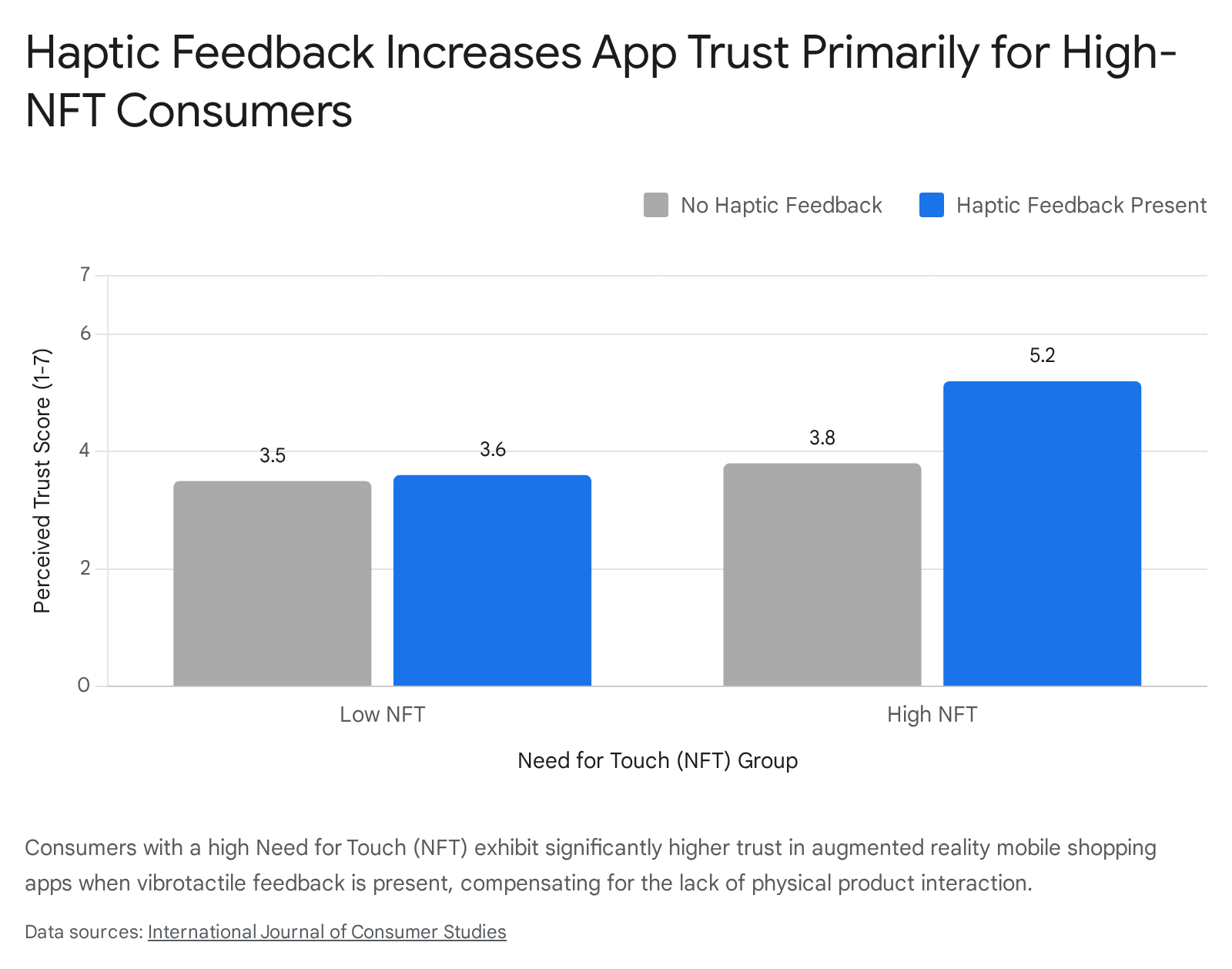
The effectiveness of mobile haptics is heavily moderated by individual traits, specifically a consumer's "Need for Touch" (NFT) 31. Consumers with a high NFT usually struggle more with digital shopping due to the lack of physical validation. However, providing vibrotactile feedback (e.g., simulating the weight or click of an item) significantly increases app trust, perceived usefulness, and purchase likelihood specifically among high-NFT individuals, effectively bridging the digital sensory gap 31.
Augmented Reality and Virtual Reality Interfaces
As hardware advances, augmented reality (AR) and virtual reality (VR) systems are moving beyond visual overlays to include advanced haptic technologies. VR and AR adoption in digital marketing relies heavily on the capacity to create deeply immersive experiences that non-interactive mediums cannot match 3233. In environments where consumers can utilize virtual try-on technology for apparel, eyewear, or furniture placement, the addition of haptic feedback elevates the realism 333435.
Current developments involve haptic feedback systems that simulate touch, texture, and resistance through precise vibration patterns or pneumatic actuators, such as advanced haptic gloves or full-body suits like the TeslaSuit 3341. Research from Stanford University highlights that users engaging in VR simulations featuring full haptic feedback reported a 30% increase in emotional engagement and a 40% improvement in information recall compared to those engaging in visual-only simulations 41. Although mainstream consumer deployment of full haptic hardware remains limited by implementation costs and accessibility hurdles, the integration of haptics into specialized enterprise marketing, automotive virtual test drives, and high-end experiential e-commerce is expanding rapidly 3235.
Cultural Variations in Tactile Marketing
The application of embodied cognition and tactile marketing cannot be universally applied without significant modification. Consumer responses to physical proximity, touch, and contextual cues are deeply governed by cultural norms 3644. Anthropological frameworks, particularly those developed by Edward T. Hall in the 1970s, divide cultures along two primary spectrums highly relevant to sensory marketing: contact and context.
Proxemics and High-Contact versus Low-Contact Cultures
Proxemics, the study of how humans use physical space and touch in communication, categorizes societies into high-contact and low-contact cultures based on their interpersonal distance preferences 4546.
High-contact cultures, predominantly found in Latin America, Southern Europe, and the Middle East, prefer closer interpersonal distances and utilize physical touch frequently in social and commercial interactions 454647. The underlying environmental demands and socioemotional orientations in these regions, often correlated with warmer climates, prioritize sensory experiences and physical warmth 37. In these markets, consumers respond highly favorably to direct tactile engagement. Interpersonal touch from sales associates (e.g., a light, culturally appropriate touch on the arm) or interactive, physically engaging product displays can significantly elevate gratitude, trust, and brand perception 4738.
Conversely, low-contact cultures, prevalent in Northern Europe, the United States, and East Asia, value larger personal space boundaries and employ minimal physical contact outside of intimate relationships 454647. In these regions, uninvited interpersonal touch in a retail environment may trigger discomfort, withdrawal, or feelings of aggression, as personal space is closely linked to biological instincts for safety and control 4647. Consequently, tactile marketing in low-contact cultures must be restricted to the product level - such as package textures, unboxing experiences, and digital haptic interfaces - rather than interpersonal staff-to-customer touch 4439.
High-Context versus Low-Context Communication Styles
Parallel to proxemics is the cultural reliance on contextual cues for information processing, which governs how marketing messages and sensory stimuli are received 4041.
In high-context cultures, such as Japan, China, Brazil, and Saudi Arabia, communication relies heavily on implicit cues, shared history, non-verbal signals, and the surrounding environmental context rather than explicit verbal messaging 3640. Consumers in these collective-leaning societies are highly attuned to non-verbal sensory inputs and symbolic nuances 42. Advertising and retail environments in high-context regions benefit from immersive, multisensory storytelling, relying heavily on ambient factors like music, color, movement, and spatial layout to convey brand prestige and meaning 3640434445.
Low-context cultures, found in nations like the US, Germany, and Switzerland, approach communication directly, explicitly, and literally 3640. Consumers in these individualistic societies prioritize transparency, efficiency, and detailed information 4244. While sensory cues such as packaging texture still influence low-context consumers, these elements are typically secondary to explicit product features, verbal documentation, and linear purchasing processes 4344. Marketing campaigns in these areas must favor straightforward exchanges that minimize ambiguity, using tactile elements to reinforce explicitly stated claims rather than replace them.
| Cultural Classification | Core Characteristics | Marketing & Tactile Strategy Implications |
|---|---|---|
| High-Contact (e.g., Brazil, Italy, Arab nations) | Close physical proximity; frequent social touch; value physical warmth. | Positive response to interpersonal touch in service; interactive product displays; high sensory engagement. |
| Low-Contact (e.g., USA, Germany, Japan) | Strict personal space boundaries; minimal social touch; touch reserved for intimates. | Avoid interpersonal staff touch; channel haptic strategies exclusively into packaging, product finishes, and digital interfaces. |
| High-Context (e.g., China, Spain, Saudi Arabia) | Meaning derived from environment, relationships, and implicit non-verbal cues. | Emphasize multisensory ambient design, symbolic visual storytelling, and rich environmental aesthetics. |
| Low-Context (e.g., UK, Scandinavia, Australia) | Meaning derived from explicit, direct, and literal communication. | Prioritize clear textual information, linear layouts, and functional packaging; use texture to reinforce explicit claims. |
Methodological Robustness and the Replication Crisis
While the literature on embodied cognition provides compelling avenues for sensory marketing, it is imperative to evaluate the scientific validity of these theories. Over the past decade, the behavioral, cognitive, and social sciences have undergone a profound methodological reckoning known as the "replication crisis" 464748. This ongoing audit has forced academia and industry professionals to reassess the robustness of findings related to behavioral priming and embodied cognition.
Challenges to Behavioral Priming
The replication crisis emerged prominently between 2012 and 2015 when large-scale, multi-lab initiatives, such as the Reproducibility Project initiated by the Open Science Collaboration, attempted to replicate classic psychological findings from top-tier journals 46496162. The results were startling: only 36% of the 100 replicated studies yielded statistically significant results, and the observed effect sizes were generally half the magnitude of the original reports 496162.
Research within social priming and embodied cognition faced particularly intense scrutiny. Classic studies that once served as foundational pillars for behavioral marketing frequently failed to replicate under rigorous, pre-registered conditions 3486150. Notable failures included studies asserting that reading words related to the elderly causes slower walking speeds, that assuming physical "power poses" alters hormonal profiles and confidence, and the ego depletion theory, which posited that willpower is a finite resource 3486162. A 2016 massive replication involving over 2,000 participants across 23 labs found no evidence for ego depletion 62.
These replication failures were attributed to systemic structural flaws in historical academic research practices: low statistical power due to small sample sizes, publication bias favoring novel positive results over null findings, and questionable researcher degrees of freedom, such as p-hacking and Hypothesizing After Results are Known (HARKing) 4647486162. In the context of sensory marketing, findings like the clipboard studies linking physical weight directly to judgments of abstract importance must be approached with calibrated uncertainty 510. Critics highlight that many embodied "nudges" are highly fragile, extremely sensitive to demand characteristics, and easily overridden by the complexities and competing stimuli of the real-world marketplace 34849.
The Credibility Revolution and Meta-Analytic Findings
Despite the turmoil of the replication crisis, methodologists emphasize that a failure to replicate an individual study does not inherently nullify the underlying theoretical mechanism 49. Instead, the crisis has catalyzed a "credibility revolution," characterized by procedural improvements such as pre-registered hypotheses, transparent open data sharing, and immense sample sizes designed to capture true effect parameters 464850.
When evaluated through rigorous meta-analyses - which aggregate data across hundreds of studies while explicitly controlling for publication bias and weighting by sample size - evidence suggests that behavioral priming and embodied cognition are indeed real phenomena 495051. However, the confirmed effect sizes are significantly smaller and subject to stricter boundary conditions than initially claimed by early literature 484950.
For marketing professionals, the takeaway from the replication crisis is not to abandon tactile and embodied strategies, but to moderate expectations regarding their absolute predictable power. Incidental haptic cues (e.g., the subtle texture of a flyer or a subliminal semantic prime) are highly unlikely to override a consumer's conscious financial constraints or fundamentally alter a lack of desire for a product 49. However, when an embodied cue is highly relevant to the consumer's pre-existing motivations, and when the sensory input logically aligns with the product category (e.g., a robust, heavy handle on a professional power tool), the effects remain robust and commercially viable 134950. The science of embodied marketing is transitioning from an era of publishing surprising, counterintuitive anomalies to a mature phase focused on understanding the precise contexts in which sensory integration genuinely supports consumer decision-making.