Optimal Structure of Persuasive Speeches
The structural optimization of a persuasive speech represents a complex intersection of cognitive psychology, neurobiology, and linguistic framework design. To successfully alter an audience's attitudes, beliefs, or behaviors, a speaker must navigate the physiological limitations of human attention, the neurochemical mechanisms of narrative processing, and the cognitive constraints of decision-making. Current research demonstrates that the efficacy of a persuasive speech does not merely rely on the isolated strength of its opening hooks, middle arguments, or closing calls to action, but rather on the highly coordinated interaction between these three phases. The initial hook must bypass neurobiological filters to establish an orienting response; the middle arguments must subsequently sustain this attention through narrative transportation and emotional variation; and the final call to action must translate this heightened cognitive arousal into specific, localized behavioral changes without triggering psychological reactance.
Cognitive Frameworks of Audience Attention
The architectural foundation of any persuasive speech relies fundamentally on the initial capture and subsequent retention of audience attention. In contemporary communication environments, cognitive load and environmental stimuli continuously compete for working memory capacity. Developing optimal opening structures requires a precise understanding of how the human brain filters, prioritizes, and maintains focus on novel auditory and visual inputs.
Demystification of Attention Span Metrics
Recent pedagogical and corporate communication frameworks have frequently relied on the assertion that the average human attention span has degraded to eight seconds - a metric often pejoratively compared to that of a goldfish. However, physiological and psychological research indicates that this widely circulated statistic did not originate from peer-reviewed scientific literature, but rather from an unvetted internal corporate project 12. Comparative neuropsychological research on nonhuman animals, such as the goldfish, measures working memory rather than sustained attention, rendering such cross-species generalizations scientifically invalid 1. The underlying biological capacity for sustained human attention remains intact; what has shifted is the environmental threshold for stimulation.
While the fundamental biological capacity for sustained attention has not inherently degraded, the environmental conditioning of digital-native audiences has drastically altered behavioral task-switching patterns. The proliferation of short-form, algorithmically driven video platforms has introduced a phenomenon frequently categorized under the "scan-and-shift hypothesis" 1. This hypothesis posits that constant exposure to rapid-fire media environments, characterized by 15-second to three-minute bursts of highly stimulating content, conditions the brain to expect quick neurochemical rewards 123. Consequently, the cognitive leap required to transition from the passive consumption of short-form media to the active concentration required by long-form persuasive discourse demands significant mental exertion 1.
Empirical data reveals that task-switching frequencies have accelerated significantly. Longitudinal observations of digital behavior demonstrate that average device task-switching intervals have decreased from 2.5 minutes in 2004 to approximately 47 seconds in recent years 6. Furthermore, eye-tracking studies demonstrate that even brief, five-minute exposures to short-form scrolling can subsequently impair a listener's or reader's focus during sustained, long-form comprehension tasks 1. Therefore, while the biological attention span remains robust, a persuasive speaker faces intense competition against digital saturation fatigue and auto-filtering cognitive mechanisms. This necessitates opening hooks that can penetrate these barriers within the first few seconds of a presentation 36.
Digital Saturation and Auto-Filtering Mechanisms
The modern listener encounters an estimated 10,000 distinct persuasive messages or advertisements daily 3. To cope with this massive influx of information, the human brain has developed sophisticated "auto-filtering" mechanisms, which instantly recognize and discard stimuli that do not immediately present relevance, novelty, or threat 37. This saturation fatigue implies that audience disengagement is rarely a product of laziness, but rather an evolutionary adaptation to cognitive overwhelm 6.
To bypass the reticular activating system - the neural network acting as the brain's gatekeeper for novel and significant stimuli - speakers must strategically deploy what neuroscientists term an "orienting response" 7. An orienting response is an inborn physiological reaction to new, unexpected, or highly relevant stimuli. Speakers who strategically utilize novelty, contrast, and emotional relevance in their opening remarks can successfully trigger this response, thereby resetting the audience's cognitive filtering mechanisms and securing the critical initial window of engagement 7. Research indicates that a speaker has roughly 27 seconds to formulate a solid first impression, but the initial cognitive decision to either engage with or filter out the message occurs within the first 1.7 to 3 seconds 8910.
Optimization of Opening Hooks
Because the initial moments of a speech dictate the audience's willingness to expend cognitive resources, the opening hook is a critical structural element. Historically, persuasive communication relied heavily on verbal hooks, such as provocative questions, startling statistics, or dramatic anecdotes delivered in the opening sentences 456. However, analyses of high-performing contemporary communication formats indicate a paradigm shift toward multimodal and visual primacy.
Verbal and Linguistic Hook Typologies
Despite the shift toward visual media, the linguistic structure of the opening hook remains vital. A highly effective verbal hook relies on creating an immediate curiosity gap or emotional resonance. One established psychological mechanism utilized in effective opening structures is the "Zeigarnik loop" 5. The Zeigarnik effect is a psychological phenomenon wherein the human brain experiences cognitive tension when a concept or narrative is introduced but intentionally left incomplete. By establishing an unresolved narrative or posing an unanswerable paradox in the first seconds of a speech, the speaker creates a state of cognitive dissonance; the audience is biologically compelled to sustain attention to resolve the narrative loop 5.
Other successful verbal hooks include contrarian statements, time-based promises, and direct audience address. Framing a hook as a direct challenge to a commonly held belief ("contrarian hook") disrupts pattern recognition, forcing the listener to pay attention to the unexpected deviation 7. Similarly, time-based hooks and numbered lists set clear cognitive expectations, explicitly defining the temporal boundaries of the cognitive load the audience will be asked to bear 78. However, speakers must ensure that verbal hooks are not overly predictable; audience habituation to standard opening rhetoric (e.g., "Have you ever wondered...") can lead to rapid tune-out behaviors 4.
Visual and Multimodal Hook Efficacy
In modern digital and live presentation environments, visual hooks have emerged as a dominant strategy, particularly considering that up to 92% of mobile video content is initially viewed without sound 64. A visual hook leverages sudden movement, striking contrast, facial expressiveness, or physical demonstration to create a pattern interrupt before a single word is processed 6910.
The most effective modern openings synthesize verbal and visual elements into a compound hook 710. While a visual hook anchors the audience's gaze and triggers the orienting response, the verbal hook provides the necessary semantic context 10. For example, pairing a bold, unexpected visual aid or a sudden physical movement on stage with a provocative question creates a compound interrupt that is neurologically difficult to ignore 710. Furthermore, non-verbal communication accounts for a massive percentage of early impression formation. Studies indicate that approximately 55% of early message impact is derived from non-verbal cues, with 38% coming from vocal tone and merely 7% from the literal text 91011. Therefore, the physical delivery, eye contact, and spatial presence of the speaker during the delivery of the hook are as structural to the speech's success as the words themselves 111220.
Architecture of Middle Arguments
Once the initial orienting response is secured by the opening hook, the persuasive speech must transition into the middle arguments. This phase carries the heaviest informational burden, requiring the audience to process complex data, evaluate logical claims, and relate these concepts to their personal value systems. Neuroscientific research indicates that raw statistical data and logical assertions, while necessary for empirical validation, often fail to sustain engagement or facilitate long-term memory encoding when presented in isolation 1322. Instead, optimal persuasive architectures rely heavily on "narrative transportation."
Narrative Transportation Mechanisms
Narrative transportation is a temporary cognitive state wherein the listener becomes deeply immersed in a story, temporarily disengaging from their immediate physical surroundings and experiencing a suspension of reality 1415161727. When an audience achieves this state, they experience high levels of empathy for the narrative subjects and vivid mental imagery 141517.
The efficacy of narrative in persuasion is grounded in distinct neurobiological processes. Naturalistic functional magnetic resonance imaging (fMRI) studies analyzing audience responses to varying forms of public communication reveal that highly engaging narratives elicit profound "interbrain neural synchronization" or intersubject correlation (ISC) 1819. When an audience listens to a compelling narrative, their neural activity synchronizes across a broad range of brain regions, specifically those associated with language processing, visuospatial attention, and the theory of mind 18.
The brain utilizes two core networks responsible for processing narratives over extended timescales. Early narrative construction activates the right intraparietal sulcus, bilateral angular gyrus, bilateral precuneus, and left fusiform gyrus 19. As the story progresses into longer-term integration, neural activity shifts to the right ventral frontal cortex and bilateral parahippocampal cortices 19. This extensive neural networking demonstrates that storytelling forces the brain to construct vivid internal representations, shifting the cognitive load from evaluating abstract logic to processing simulated experiences 16.
By reducing cognitive load through "processing fluency," narratives lower the recipient's psychological resistance to the persuasive message 16. Transported listeners exhibit decreased psychological reactance and a diminished propensity to generate counterarguments 1417. Because their cognitive resources are entirely occupied by the processing of the narrative world, they are less likely to critically analyze or argue against the underlying persuasive subtext 1417.
Integration of Statistical Evidence
However, contemporary communication research cautions against abandoning statistical evidence entirely in favor of pure narrative. The optimal structure requires embedding logical data within the narrative framework - a practice formally termed "data-driven storytelling" 1320. While narratives generate the emotional momentum necessary to proximize threats and reduce psychological distance, statistical evidence is crucial for reinforcing attitudes and solidifying the logical justification for the forthcoming call to action 2122.
The integration of precise data into a fluid narrative reduces the perceived manipulative intent of the speaker, effectively bridging the gap between empathy and rational decision-making 1317. For example, presenting hypothetical scenarios based on data trends, or utilizing case studies that merge empirical outcomes with personal journeys, satisfies the audience's need for both emotional connection and logical proof 13. The narrative creates a void or a question in the listener's mind, which the statistical data then cleanly answers, creating a deeply satisfying cognitive resolution 1322.
Emotionality Flips and Narrative Arcs
Sustained attention during the middle portion of a persuasive speech also relies on structural and emotional variability. Audiences experience rapid cognitive habituation to uniform emotional tones, whether consistently positive or negative. Research analyzing thousands of TED Talks, podcasts, and long-form narratives identifies "emotionality flips" as the primary driver of sustained audience engagement 15.
An emotionality flip occurs when the narrative valence shifts direction - transitioning from a positive, uplifting segment to a negative, challenging one, or vice versa 15. These semantic shifts create local peaks and troughs throughout the discourse. The sheer volume and frequency of these flips serve as affective signals that trigger physiological arousal and expectancy violation (surprise) in the listener 15.
Rather than relying on a monotonic trajectory, a persuasive speaker must architect an "engagement arc" characterized by frequent tension and release. By strategically staging logical tension, paradox resolution, and stakes elevation, speakers maintain high levels of narrativity even within highly factual or scientific presentations 715. The brain is a prediction engine; when a speaker intentionally thwarts narrative predictions through strategic surprise, the resulting spike in arousal resets the audience's attention baseline 7.
Structural Models and Cognitive Load
The macro-organization of a persuasive speech directs the flow of information, determining how seamlessly an audience can follow the logical progression from hook to conclusion. While the human brain reacts predictably to neurochemical stimuli like surprise and narrative, the overarching architectural model dictates the clarity and persuasiveness of the presentation.
Evaluation of Traditional and Modern Frameworks
For decades, Monroe's Motivated Sequence has served as the dominant pedagogical model for persuasive structuring. Developed in the 1930s by Alan H. Monroe, the sequence utilizes a five-step psychological progression designed to mirror the human problem-solving process 6232425.
Despite its pervasive use in public speaking instruction, empirical studies evaluating Monroe's Motivated Sequence provide mixed results regarding its absolute persuasive superiority over other models. While audiences consistently perceive speeches utilizing this sequence as highly organized and structurally sound, experimental data has not definitively proven that it yields higher rates of attitude or behavior change compared to alternative frameworks, such as the Problem-Cause-Solution or Comparative Advantage models 2325.
In response to changing audience demographics and digital consumption habits, more concise structural formulas have gained prominence in corporate and digital arenas. One such framework is the WHAC formula, which condenses persuasion into four distinct phases optimized for rapid cognitive processing 5.
| Structural Element | Monroe's Motivated Sequence 62324 | WHAC Formula 5 | Primary Cognitive Function |
|---|---|---|---|
| Opening Phase | Attention: Capture focus via story, statistic, or rhetorical question. | What's in it for me (W) & Hook (H): Immediately establish audience benefit, followed by an emotional trigger. | Orienting response; establish relevance and break pre-existing cognitive preoccupation. |
| Problem Definition | Need: Detail the core issue, its causes, and its direct impact on the audience to create tension. | Integrated into Argument phase. | Induce cognitive dissonance or highlight a specific deficit that requires resolution. |
| Solution & Logic | Satisfaction: Present a clear, step-by-step mechanism to resolve the stated need. | Argument (A): Deliver three primary points backed by empirical evidence or narrative. | Facilitate processing fluency; provide logical scaffolding to justify upcoming behavioral requests. |
| Future Casting | Visualization: Emotionally illustrate the future state (positive benefits or negative consequences of inaction). | Implicitly woven into Argument/Hook phases. | Trigger narrative transportation and emotional arousal. |
| Resolution | Action: Deliver a specific, concrete request for the audience to execute immediately. | Call to Action (C): A specific, measurable, and achievable directive. | Overcome pseudo-inefficacy; convert heightened emotional states into localized behavior change. |
Both frameworks rely heavily on establishing a distinct gap between the audience's current reality and a proposed optimal future. However, modern iterations prioritize immediate audience relevance ("What's in it for me?") over delayed thesis reveals, accommodating the accelerated attention decay characteristic of contemporary audiences 525.
The Rule of Three in Information Processing
Regardless of the macro-structural model employed, the internal sequencing of arguments is subject to fundamental cognitive constraints. The "Rule of Three" operates as a critical structural heuristic designed to optimize working memory capacity. Cognitive science demonstrates that the human working memory can comfortably process and retain three to four discrete items simultaneously before experiencing cognitive overload 2627.
Presenting supporting arguments, examples, or data points in triads creates an easily recognizable rhythmic pattern that the brain encodes and retrieves efficiently 262839. The triadic structure primes the audience to anticipate a sequence, and the fulfillment of that sequence generates cognitive satisfaction without overwhelming processing resources 26. Extensive analyses of historical rhetoric, marketing copy, and mathematical theorems confirm the pervasive cultural and psychological efficacy of trichotomy 28. Providing more than three core arguments within a single segment risks diluting the message and increasing psychological reactance due to cognitive fatigue. By distilling complexity into manageable triads, a speaker ensures that their claims remain memorable without feeling reductive 26.
Interactive Pacing and the Rule of Four
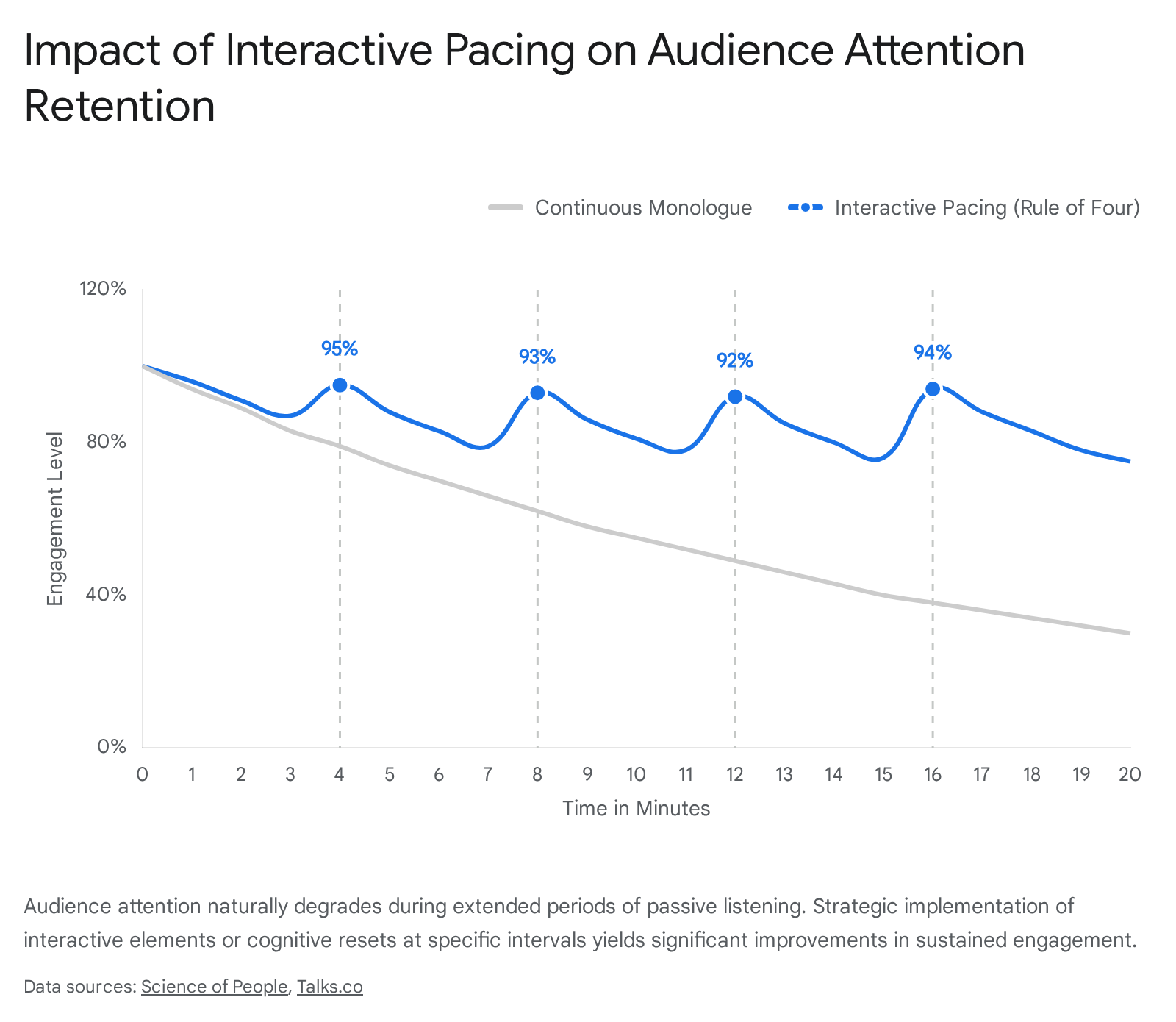
While the Rule of Three governs structural logic, the "Rule of Four" governs temporal pacing in extended persuasive contexts. Analyses of audience engagement during prolonged presentations indicate that listeners require active interaction or cognitive resets every three to four minutes to prevent the rapid degradation of visual and auditory focus 29.
A continuous, passive monologue results in a steady decline in attention. However, introducing an interactive element - such as a rhetorical poll, a chat prompt, a show of hands, or a brief physical activity - every four minutes creates a "sawtooth" pattern of engagement 29. The anticipation of an interaction, and the subsequent revelation of social consensus (e.g., seeing how others voted), triggers minor dopamine releases, structurally preventing the audience from fully disengaging 29.
Linguistics and Temporal Delivery Dynamics
Beyond the conceptual organization of arguments, the actual temporal delivery of the speech - measured in words per minute (wpm) and sentence duration - significantly dictates audience comprehension and perceived speaker credibility.
Pacing and Word Processing Metrics
While a normal conversational pace ranges from 120 to 150 wpm, optimal persuasive public speaking generally requires a decelerated rate of 100 to 120 wpm 41. This intentional deceleration provides the audience with critical processing time, allowing for the absorption of complex data and the resonance of emotional narratives 41.
Conversely, excessive deceleration or rapid acceleration yields negative cognitive outcomes. Studies analyzing comprehension among diverse listener cohorts demonstrate that moderately fast speech significantly reduces understanding, particularly when conveying dense empirical data 41. On the other hand, speaking too slowly risks severing the emotional connection established by the narrative arc, causing the audience to disconnect 41. A sophisticated speaker's pacing must dynamically shift in accordance with the emotionality flips of the text - slowing down to underscore complex logic or severe consequences, and accelerating slightly to convey urgency, enthusiasm, or positive resolution 4130.
Historical Trends in Sentence Length
The syntactical structure of persuasive claims has also evolved systematically. Historical linguistic analyses of high-stakes persuasive rhetoric - ranging from United States presidential inaugurations to United Kingdom parliamentary speeches - reveal a steady, linear decrease in average sentence length over the past century 31.
| Rhetorical Era | Average Sentence Length (Words) | Trend Direction | Underlying Statistical Model |
|---|---|---|---|
| Early 1900s | ~30 words | - | Weibull Distribution |
| Mid 20th Century | ~23 words | Decreasing | Weibull Distribution |
| Year 2000 & Beyond | ~16 words | Decreasing | Weibull Distribution |
Data synthesized from cross-century linguistic analysis of major political addresses 31.
Driven by the linguistic "principle of least effort," sentence lengths have condensed at an average rate of 0.13 words per year, moving from 30 words in 1900 to roughly 16 words in contemporary settings 31. This distribution reliably conforms to a Weibull statistical model, indicating a systemic, universal shift in human communication preferences 31. This trend underscores the modern necessity for syntactical brevity in persuasive structuring. Overly complex, multi-clause sentences demand high cognitive exertion, thereby detracting from the audience's ability to engage with the thematic substance of the persuasion 31. Speeches optimized for modern attention dynamics must prioritize short, declarative syntax to maintain processing fluency.
Calibration of the Call to Action
The ultimate objective of a persuasive speech is the mobilization of the audience toward a specific attitudinal shift or behavioral outcome. The transition from the visualization of a solution to the Call to Action (CTA) represents the most critical vulnerability in the persuasive structure. If the closing request is improperly calibrated, the accumulated emotional and logical momentum dissipates without generating tangible results.
Specificity and Pseudo-Inefficacy Mitigation
A common structural failure in persuasive communication involves concluding with abstract, overarching requests (e.g., "We must stand up for the climate" or "Join the fight for justice"). Broad abstractions shift the cognitive burden of determining the appropriate intervention onto the listener, frequently resulting in decision paralysis, stress, and inaction 32.
Behavioral science research dictates that highly effective CTAs must be specific, concrete, and immediately actionable 532. A targeted CTA restricts the scope of options, mitigating cognitive overload and allowing the audience to channel their heightened emotional arousal into a discrete, achievable task 32.
When individuals are presented with massive, systemic challenges, they often experience "pseudo-inefficacy" - a psychological state where the positive emotions associated with taking a small action are overwhelmed by the perception that their individual effort is merely a "drop in the bucket" 32. To effectively combat pseudo-inefficacy, the speaker must explicitly link the specific, requested micro-behavior to the broader macro-solution, proving the localized efficacy of the audience's action 32. Concrete actions close the psychological gap between the audience's expectations and the reality of what they can actually accomplish, leaving them feeling more successful and satisfied with their participation 32.
Moderated Mediation in Persuasive Delivery
The success of the CTA is also subject to moderated mediation models involving the speaker's delivery mechanics and the audience's elaboration likelihood. A speaker's perceived confidence, often conveyed through non-verbal cues such as steady eye contact and falling vocal intonation at the ends of sentences, acts as a primary mediating variable 33.
High vocal confidence signals to the audience that the message is credible and warrants the expenditure of limited cognitive resources, thereby increasing the audience's "elaboration likelihood" - their motivation to process the argument deeply 33. When the audience devotes high cognitive scrutiny to the message due to the speaker's confident delivery, the underlying quality of the argument becomes the primary moderator of persuasion 33.
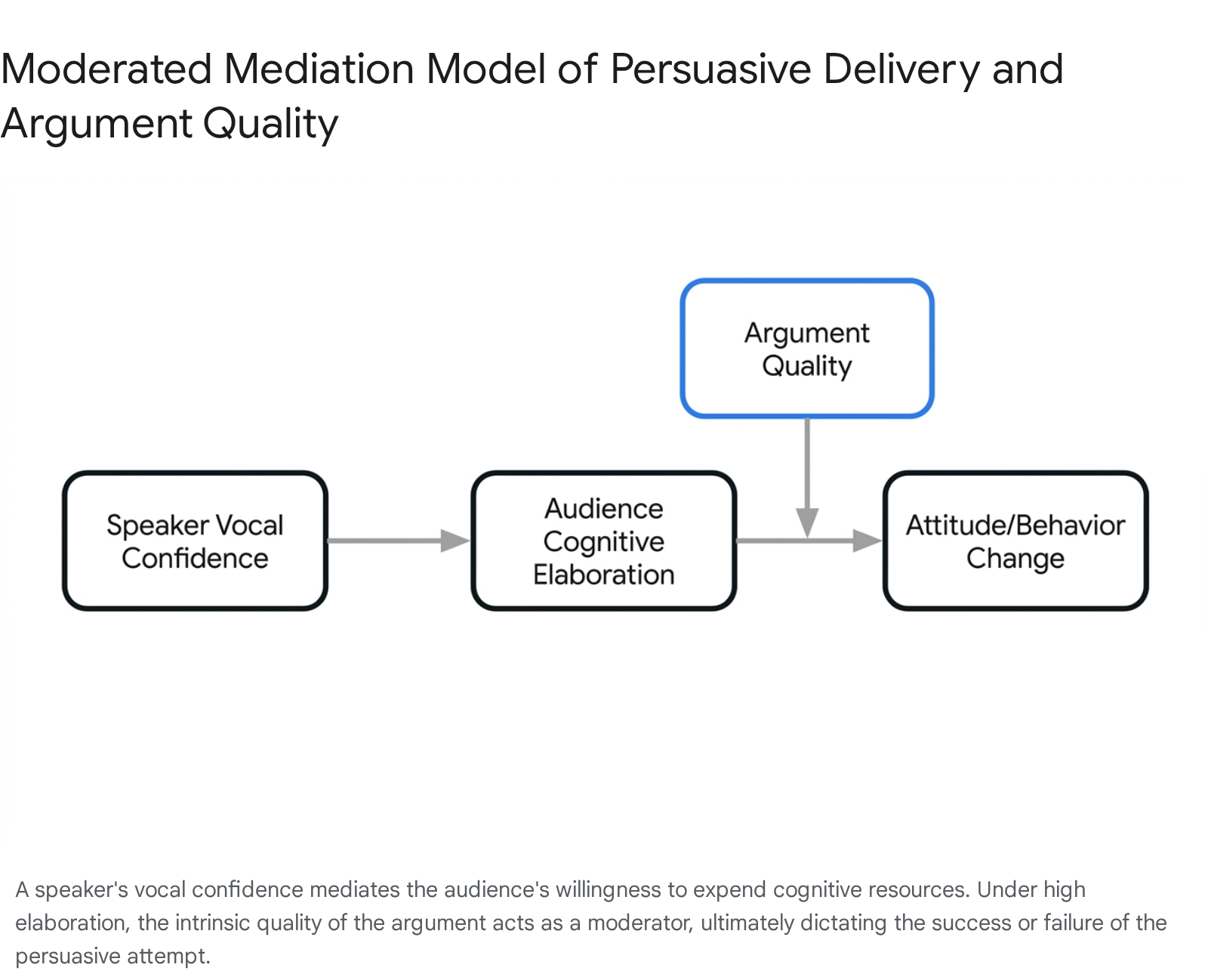
Under high scrutiny, strong, evidence-backed arguments succeed brilliantly, while weak arguments fail entirely 33. Therefore, confident delivery cannot mask a structurally weak Call to Action; rather, it amplifies the audience's reliance on the logical merit of the request.
Evidence Types and Behavioral Change Stages
The structure and format of the final persuasive appeal must also be tailored to the audience's current stage within the behavioral change process. Psychological research categorizing audiences into pre-action stages versus active-engagement stages reveals that the type of evidence presented in the CTA significantly impacts success rates 21.
For audiences in the pre-action stage - those who have not yet committed to a behavioral shift or are largely uneducated on the issue - narrative evidence is highly effective 2122. A story-driven conclusion reduces the perceived psychological distance of the threat and increases the perceived efficacy of the proposed solution 21. Conversely, for individuals already contemplating or actively engaging in the desired behavior, explicit statistical data in the CTA serves as a stronger mechanism 2122. For these active audiences, logical proof reinforces their existing attitudes and solidifies their ongoing commitment 21.
Finally, persuasive interventions must be carefully designed to avoid "backfiring." When a CTA is perceived as overly aggressive, legally coercive, or reliant on undue social pressure, it can trigger psychological reactance 343536. This reactance causes the audience to actively demotivate or stubbornly adopt the inverse behavior to preserve their sense of autonomy 3536. Validating audience agency while framing the specific action as a highly effective, low-friction choice minimizes the risk of intervention backfire and preserves the trust established earlier in the speech 3235.
Cross-Cultural Variables in Persuasive Design
While the cognitive mechanics of working memory, narrative transportation, and specificity in calls to action represent universal human phenomena, the structural application of these tools must be heavily calibrated to cultural contexts. Relying on standardized Western templates for persuasive architecture risks significant miscommunication, psychological reactance, and diminished efficacy in global environments.
Limitations of Traditional Cultural Binaries
Historically, cross-cultural psychological research relied heavily on a rigid East-versus-West binary, contrasting individualistic North American and European cultures with collectivistic East Asian cultures 3738. However, contemporary data-driven analyses surveying thousands of participants across dozens of nations reveal that this bipolar framework is overly simplistic and obscures critical regional nuances 38.
For example, Latin American cultural dimensions present a unique hybridity that challenges traditional models. While traditionally classified by sociological frameworks (such as Hofstede's dimensions) as highly collectivistic and interdependent, Latin American populations score exceptionally high in emotional self-expression - often surpassing individualistic Western cohorts 38. Unlike some East Asian cultures that may suppress individual emotion to preserve social harmony, the Latin American persuasive context relies on the highly expressive communication of positive, socially engaging emotions to foster interdependence and community connection 3738. A persuasive speech operating in this context must prioritize high-arousal, emotionally expressive narratives and highly communal CTAs, rather than subdued, logic-dominant, or strictly individualistic structures 38.
High-Context Communication and Regional Adaptation
Similarly, optimal persuasive structures in Southeast Asia rely heavily on Edward T. Hall's theories of high-context communication 3940. In high-context cultures, much of the persuasive message is not explicitly stated in the verbal argument itself. Instead, meaning is embedded in implicit non-verbal cues, relational context, social hierarchies, and shared community values 4041.
| Cultural Region | Primary Communication Context | Dominant Persuasive Sensitivities | Structural Adaptation Required |
|---|---|---|---|
| North America / Western Europe | Low-Context (Individualistic) | Personal freedom, comparative advantage, scarcity, direct logical appeal. | Explicit verbal hooks; highly specific, individual-focused CTAs. |
| Latin America | Collectivistic but Highly Expressive | Positive emotional arousal, social engagement, relational interdependence. | High-arousal narrative transportation; communal rather than individual CTAs. |
| Southeast Asia | High-Context (Collectivistic) | Implicit cues, community trust, visual storytelling, social hierarchy. | Visual primacy; authority-based social proof; implicit framing. |
| Arabic / Middle East | High-Context (Collectivistic) | Reciprocity, consensus, authoritative figures, shared moral values. | Emphasis on long-term relational trust and reciprocal obligations. |
Note: Cultural dimensions represent broad societal trends and may vary significantly among individuals within these regions 37383942.
Studies on cross-cultural advertising and digital persuasion in Southeast Asia indicate that standardized, low-context global templates fail significantly in these markets 3940. Successful persuasion in this region requires extreme localization, visual storytelling that respects local relational mobility, and the utilization of community-trusted influencers or authoritative figures to establish necessary social proof before delivering arguments 394041.
Furthermore, persuasion in other collectivist cultures, such as those in Arabic regions, demonstrates higher susceptibility to persuasion strategies based on reciprocity, broad consensus, and authoritative validation 42. In contrast, individualistic cultures frequently respond more favorably to themes highlighting personal freedom, comparative advantages, and time-based scarcity 4243. Consequently, the global public speaker must modulate not only the non-verbal delivery but the core organizational framework of the speech - shifting the balance of explicit statistical reasoning versus implicit narrative context - to precisely align with the specific cultural dimensions and values of the target audience 444546.
In summation, the optimal structure of a persuasive speech is not a static pedagogical template, but rather a dynamic, neurobiologically and culturally informed architecture. It requires the rapid capture of a fragmented attention span via multimodal compound hooks, the reduction of cognitive resistance through carefully paced narrative transportation and emotionality flips, and the mobilization of effort through culturally calibrated, highly specific calls to action. By aligning organizational strategy with cognitive processing capacities and cultural sensibilities, communicators can reliably overcome ambient digital noise and facilitate durable behavioral change.