
Neuromarketing and brain imaging in consumer decision-making
Definitional Frameworks and Historical Context
The convergence of cognitive neuroscience, behavioral economics, and marketing strategy has catalyzed the development of distinct but interrelated epistemological domains designed to decode consumer decision-making. Within the academic literature and industry practice, a critical demarcation exists between "consumer neuroscience" and "neuromarketing." Consumer neuroscience represents an academic discipline dedicated to investigating the fundamental neural and physiological mechanisms that underlie consumer behavior, with findings typically subject to peer review and published in scientific journals 123. In contrast, neuromarketing refers to the commercial application of these neuroscientific insights and methodologies to address practical managerial challenges, optimize advertising creatives, and influence purchasing behavior in the private sector 124.
The term "neuromarketing" was introduced in 2002 by Dutch marketing professor Ale Smidts, though the commercial utilization of physiological measurement in advertising research precedes this specific designation 566. The discipline emerged partly through early physiological studies utilizing techniques such as the Zaltman Metaphor Elicitation Technique (ZMET) in the 1990s, and it gained significant public traction following early functional magnetic resonance imaging (fMRI) studies, most notably the replication of the Pepsi Challenge inside a brain scanner 578. Early on, the field was characterized by a severe divide between rigorous academic inquiry and commercial exploitation. Many private neuromarketing agencies made proprietary claims regarding their ability to decode consumer thought that lacked peer-reviewed validation, leading to skepticism among academic neuroscientists who viewed the discipline as scientifically premature and ethically questionable 14710. As the field has matured, however, the boundary between academic consumer neuroscience and commercial neuromarketing has become increasingly porous, with advanced machine learning algorithms and established neuroimaging techniques providing a rigorous empirical foundation for both domains 239.
The Epistemological Origins of the Buy Button Myth
During the nascent commercial stages of neuromarketing in the 2000s, commercial entities and popular science authors actively promoted the concept of a "buy button in the brain" 7810. This reductionist paradigm - popularized by books and consulting frameworks - suggested that specific marketing stimuli could reliably activate a localized neural structure governing automatic purchasing behavior, thereby bypassing conscious consumer agency and rational deliberation 7811.
Current neuroscientific research systematically refutes the existence of a singular "buy button" 71112. Human decision-making relies on highly complex, distributed neural networks involving multiple cognitive and affective domains, including attention, memory, reward valuation, and emotional processing 71314. Brain structures such as the mesolimbic reward system, featuring the nucleus accumbens, respond to a vast array of stimuli, rendering deterministic predictions about specific purchasing behaviors based on isolated regional activation scientifically invalid 712. Furthermore, neuroimaging data is inherently correlational; while fMRI can demonstrate parallel mental activity and behavioral outcomes, it does not establish deterministic causal connections that can coerce a consumer to purchase a product against their will .
Instead, pioneering researchers such as Erik du Plessis applied Antonio Damasio's somatic marker hypothesis to the field, challenging the traditional view that emotions interfere with logic 18. This framework posits that emotional responses actually cause and enable rational decision-making, shifting the focus of neuromarketing from searching for a nonexistent "buy button" toward understanding the complex neural architecture of emotional engagement, attention, and memory formation 18.
Measurement Modalities in Neuromarketing
The empirical measurement of subconscious consumer responses relies on a spectrum of non-invasive neuroimaging and biometric technologies. Each modality presents distinct technical specifications, advantages, and limitations regarding spatial resolution, temporal precision, and ecological validity. To yield accurate consumer insights, researchers often employ a multimodal approach, combining distinct sensor types to triangulate cognitive, emotional, and behavioral phenomena 15.
Functional Magnetic Resonance Imaging
Functional Magnetic Resonance Imaging (fMRI) represents the highest echelon of spatial precision in non-invasive neuroimaging. The technique indirectly maps brain activity by measuring changes in blood flow, specifically utilizing the blood oxygenation level-dependent (BOLD) signal 151617. When a specific neural population becomes active, it consumes more oxygen, leading to localized hemodynamic changes that alter the magnetic properties of the blood, which the fMRI scanner subsequently detects 1517.
The primary advantage of fMRI in consumer research is its exceptional spatial resolution, typically ranging from 1 to 2 millimeters 1819. This allows researchers to pinpoint activation not only in the cerebral cortex but also in deep subcortical structures critical to emotion and reward, such as the amygdala and the ventral striatum 151819. However, fMRI is constrained by poor temporal resolution; the BOLD signal is a slow hemodynamic response that peaks approximately four to six seconds after the initiating neural event, making it difficult to isolate rapid reactions to dynamic advertising stimuli 171820. Additionally, fMRI lacks portability and imposes severe constraints on experimental design, requiring participants to lie motionless within a narrow, highly enclosed scanner 715.
Electroencephalography
Electroencephalography (EEG) directly measures the electrical fields generated by the synchronized firing of post-synaptic cortical neurons via non-invasive electrodes placed on the scalp 15172021. Because it measures electrical activity directly rather than relying on a delayed proxy like blood flow, EEG provides exceptional temporal resolution in the range of 1 to 2 milliseconds 171821. This microsecond precision makes EEG highly effective for analyzing dynamic marketing stimuli, such as tracking moment-by-moment engagement during television commercials, analyzing website usability, and detecting rapid cognitive load 1517182021.
The fundamental limitation of EEG is its low spatial resolution, typically constrained to a superficial 1 to 3 centimeters 18. Electrical signals are subjected to "volume conduction," meaning they spread, blend, and smear as they travel through the conductive tissue of the brain, the cerebrospinal fluid, the skull, and the scalp 1821. Consequently, localizing the exact subcortical origin of an electrical signal using scalp EEG requires complex mathematical source localization techniques, which remain inherently imprecise 18. EEG is also highly susceptible to motion artifacts, ocular movements, and ambient electrical noise, requiring rigorous data preprocessing and artifact rejection 182021. Within neuromarketing, EEG signals are frequently analyzed across different frequency bands (alpha, beta, theta, delta) to assess concentration, relaxation, emotional engagement, and the left-right asymmetry of frontal EEG signals, which serves as a proxy for positive "approach motivation" versus negative withdrawal 151722.
Functional Near-Infrared Spectroscopy
Functional Near-Infrared Spectroscopy (fNIRS) has emerged as a powerful intermediary technology that measures cerebral hemodynamic activity, sharing conceptual similarities with fMRI but utilizing optical rather than magnetic principles 2021. By emitting near-infrared light through the scalp and detecting changes in the absorption of oxygenated and deoxygenated hemoglobin, fNIRS provides localized mapping of cortical blood flow 1921.
Unlike EEG, fNIRS largely avoids the volume conduction problem, offering an improved spatial resolution of roughly 1 to 2 centimeters specifically on the cortical surface 1821. While it cannot penetrate to measure deep brain structures like fMRI, it provides greater spatial specificity than EEG for mapping prefrontal and cortical activity 181920. Because it measures blood flow, its temporal resolution is slow, functioning on the order of seconds rather than milliseconds 1821. However, fNIRS systems present significant logistical advantages: they are highly portable, relatively inexpensive, and largely immune to electromagnetic interference and minor motion artifacts 192021. This makes fNIRS ideal for naturalistic, real-world consumer environments, such as tracking shoppers navigating a physical retail store or engaging in complex social interactions 192021.
Autonomic and Psychophysiological Sensors
Beyond direct cortical and subcortical measurement, consumer neuroscience heavily utilizes peripheral physiological metrics to capture autonomic nervous system responses, providing an immediate window into consumer arousal and attention 215.
Eye-tracking is widely considered the most accessible and fundamental physiological tool in the neuromarketing arsenal. It measures visual attention, fixation duration, saccades, and pupil dilation 21523. Eye-tracking enables marketers to construct precise heat maps detailing visual paths across product packaging, digital interfaces, and advertisements, quantifying exactly which visual elements successfully capture and retain consumer attention 261523.
Galvanic Skin Response (GSR), also known as electrodermal activity (EDA), measures micro-variations in skin conductivity driven by sweat gland activity 21522. GSR serves as an immediate indicator of autonomic arousal and emotional intensity, detecting the instantaneous emotional variations triggered by marketing stimuli 1522. While GSR is highly effective at quantifying the magnitude of an emotional reaction, it cannot independently distinguish between positive and negative valence; for example, it cannot differentiate the arousal of joy from the arousal of stress without supplementary data from facial coding or neural asymmetry metrics 1522.
Comparison of Measurement Modalities
The appropriate selection of a neuromarketing tool requires balancing methodological constraints related to temporal precision, spatial localization, subject mobility, and financial cost.
| Modality | Primary Measurement | Temporal Resolution | Spatial Resolution | Signal Penetration Depth | Ecological Validity & Mobility |
|---|---|---|---|---|---|
| fMRI | Hemodynamic (BOLD signal) | Low (Seconds) | High (1 - 2 mm) | Deep Subcortical | Low (Stationary scanner) |
| EEG | Electrical (Cortical potentials) | High (Milliseconds) | Low (1 - 3 cm) | Superficial Cortical | High (Portable headsets) |
| fNIRS | Hemodynamic (Oxygenation) | Low (Seconds) | Moderate (1 - 2 cm) | Outer Cortex (1 - 2.5 cm) | High (Tolerant of motion) |
| Eye-Tracking | Visual (Fixations, saccades) | High (Milliseconds) | N/A | N/A | High (Screen-based/wearable) |
| GSR / EDA | Autonomic (Skin conductance) | High (Milliseconds) | N/A | N/A | High (Wearable sensors) |
Data synthesized from neurophysiological literature comparing structural imaging and autonomic biometric capabilities 1518202123.
Neural Correlates of Consumer Decision-Making
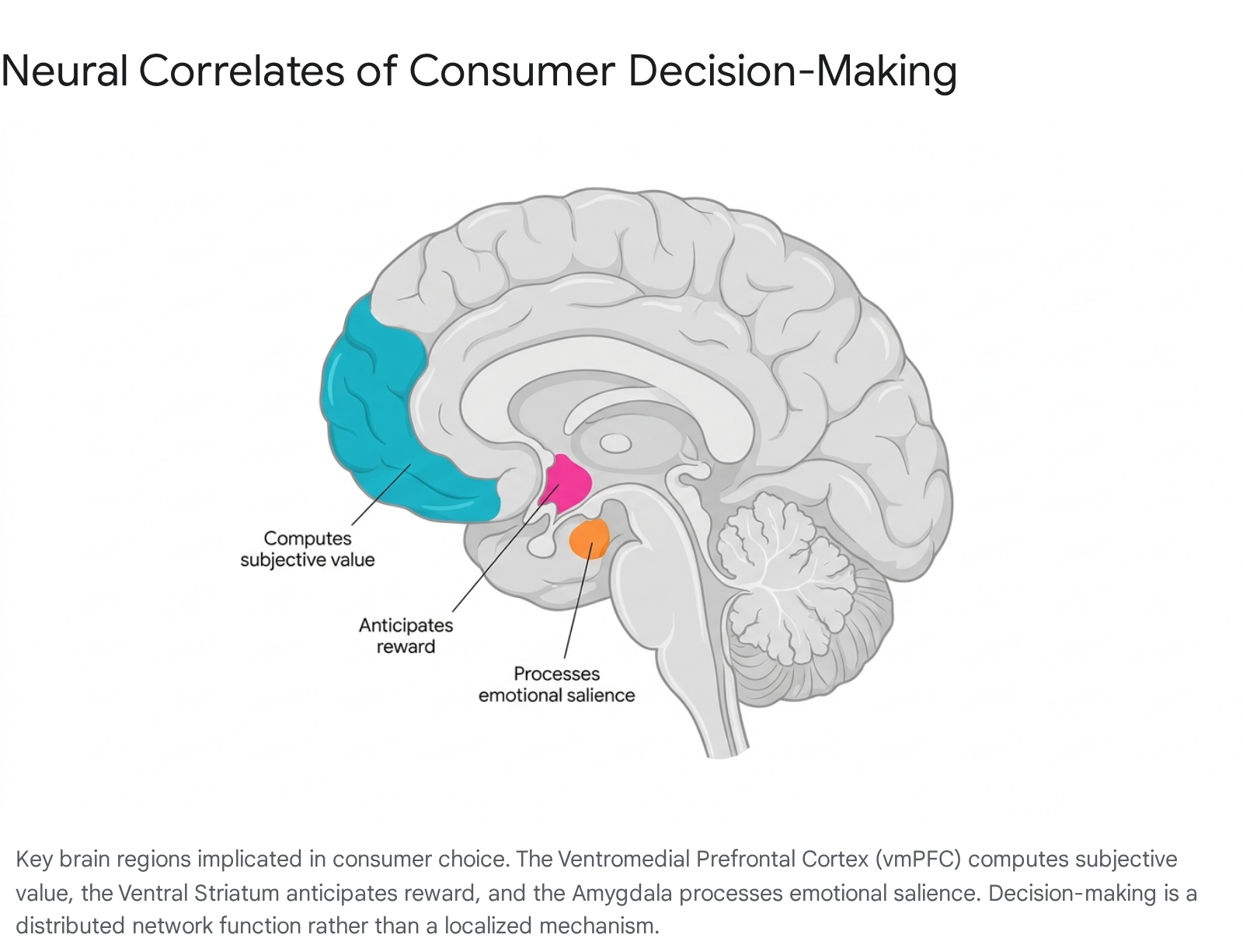
Consumer neuroscience has successfully identified distinct, interacting neural networks that correlate with phases of the purchasing decision. Far from operating as a single localized trigger, the architecture of consumer choice relies on the complex integration of reward valuation, emotional processing, subjective utility computation, and executive control 671314.
Reward Anticipation and the Ventral Striatum
The ventral striatum, particularly encompassing the nucleus accumbens, functions as a central component of the brain's dopaminergic reward system 72429. Neuroeconomic research consistently demonstrates that activity in the ventral striatum scales with the anticipation and magnitude of delayed monetary rewards as well as desirable consumer products 152430.
In functional imaging studies, when a consumer views a product they intrinsically wish to purchase, activation in this subcortical region increases significantly 152430. Furthermore, anatomical studies reveal functional heterogeneity within the striatum; as one progresses from the ventral-medial regions (which are deeply involved in goal-directed behavior and value encoding) to the dorsal-lateral striatum, activity becomes more closely related to the associative and motor aspects of decision-making, which govern habitual action control as purchasing routines become ingrained 29.
Subjective Value Computation in the Prefrontal Cortex
The ventromedial prefrontal cortex (vmPFC) and the adjacent medial orbitofrontal cortex (mOFC) are highly instrumental in computing the subjective value of marketing stimuli 24252627. While the objective parameters of a product, such as its listed retail price, remain mathematically constant, economic decision-makers assign varying subjective values based on personal preference, context, and perceived utility 24.
Activity in the vmPFC reliably tracks these revealed preferences. Research indicates that the vmPFC serves as a valuation hub that aggregates disparate inputs regarding brand familiarity, social cognition, and anticipated utility, distilling them into a common neural currency to guide choice 24252627. The vmPFC is also fundamentally implicated in the valuation of abstract and social rewards, such as the utility derived from charitable donations or the decision to share information 272835. In the realm of product branding, classical fMRI experiments - such as the widely cited replication of the Coca-Cola versus Pepsi blind taste test - demonstrated that while blind consumption activated purely sensory regions, knowing the brand name recruited the prefrontal cortex and memory zones, actively altering the consumer's neurological valuation of the beverage 7815.
Emotional Processing and the Limbic System
Subcortical limbic regions, most notably the amygdala and the insula, are tasked with evaluating the emotional salience and potential aversiveness of consumer stimuli 132526. The amygdala is rapidly activated by emotionally arousing stimuli, providing an initial valence assessment that informs the overall marketing response 25.
The anterior insula serves an equally critical, though often inhibitory, role in purchasing decisions. In the context of pricing and transaction, when a cost is perceived as excessive or unfair, the insula - a region classically associated with the processing of physical pain and visceral disgust - activates strongly 1526. Therefore, the final consumer decision can be conceptually modeled as a neuroeconomic calculation: the anticipated reward valuation originating from the ventral striatum and the subjective utility computed by the vmPFC are weighed against the financial "pain" registered in the insula 1526. Dysfunction in these networks, or manipulations that bypass executive control, can significantly alter purchasing behavior 26.
Predictive Analytics and Artificial Intelligence
The integration of artificial intelligence (AI) and machine learning (ML) has fundamentally transformed neuromarketing from a descriptive observational science into a highly predictive analytics discipline 5293730. Early neuromarketing relied on basic correlational analyses; contemporary methodologies utilize deep learning frameworks to decode complex, multidimensional neural data arrays in real-time 53730.
Machine Learning Pipelines for Neural Decoding
Consumer researchers now deploy advanced algorithms, including Support Vector Machines (SVM), Random Forests (RF), and Long Short-Term Memory (LSTM) networks, to accurately predict purchase intent based on neural and biometric inputs 3132. Neural signals are inherently noisy, high-dimensional, and non-linear, rendering traditional linear regression models inadequate for optimal prediction 3334.
In highly controlled experimental settings, researchers extract multi-modal feature sets - such as spectral power bands from EEG (theta, alpha, beta, gamma) and localized hemodynamic responses from fNIRS - and feed these disparate datasets into deep learning architectures 313235. In one study evaluating online shopping behavior, an LSTM model, which uniquely excels at capturing the temporal dynamics of time-series neural data, achieved an unprecedented predictive accuracy of 92.4% in classifying purchase intent 31. The integration of both electrical (EEG) and hemodynamic (fNIRS) modalities yielded a synergistic 12% improvement in model accuracy compared to single-modality baseline models 31. Other empirical studies utilizing SVMs with Gaussian kernels on EEG power spectral density data alongside prefrontal asymmetry indices have reliably predicted online consumer decisions with 87.1% accuracy 32.
Beyond individualized neural decoding, Multilayer Perceptron (MLP) neural networks are being applied to macroeconomic consumer choice theory, simulating and forecasting broader market-level behavior in response to fluctuating prices and product characteristics 33. AI is also increasingly utilized to decode unstructured textual data - such as product reviews and social media sentiment - into "Demand Embedding Vectors," which are subsequently mapped to econometric market outcomes through attention-based language models 36.
Accuracy of Neuromarketing Versus Traditional Methods
The primary commercial value proposition of neuromarketing relies on addressing the fundamental methodological flaw of traditional market research: consumers frequently cannot accurately articulate their true subconscious motivations 3746. Traditional methodologies, such as focus groups, stated-preference surveys, and demographic historical analyses, rely heavily on conscious rationalization 247. Research in consumer psychology indicates that humans often rationalize their choices retroactively; thus, verbal feedback represents a logical reconstruction of a decision rather than the actual affective mechanism that drove the purchase 37.
Meta-analytical reviews of commercial campaigns suggest that traditional self-reported studies accurately predict future commercial performance at a rate of 50% to 60% 37. By bypassing the cognitive filters of self-reporting and measuring the autonomic and neural drivers of choice directly, multi-modal neuromarketing models have demonstrated the capacity to predict actual buying behavior with 80% to 90% accuracy in specific commercial contexts 2237.
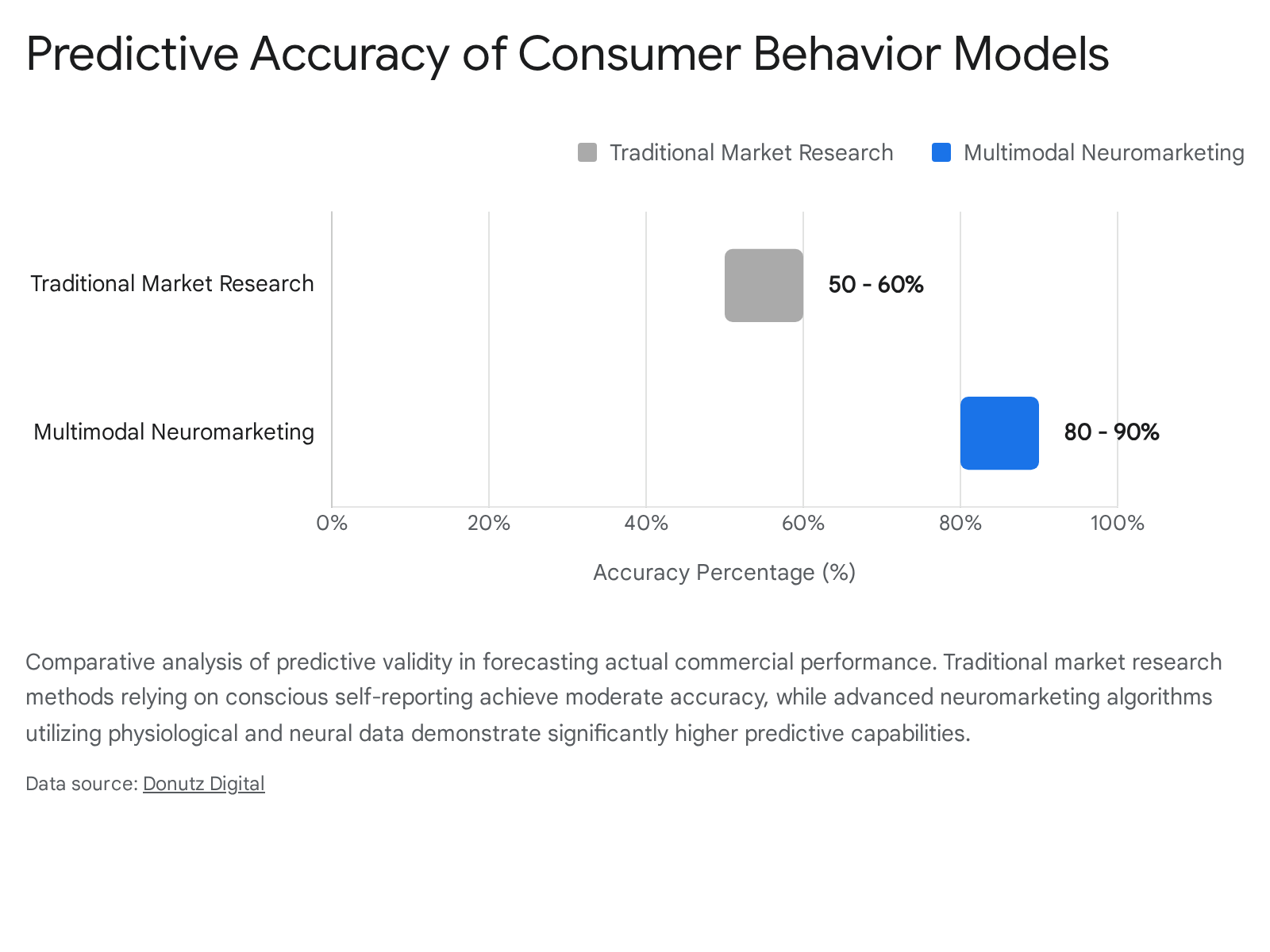
Studies combining EDA peaks, EEG, and eye-tracking have repeatedly demonstrated that immediate physiological reactions to dynamic stimuli (like television advertisements) explain a significantly larger variance in the final purchase decision than brand familiarity or self-reported preference alone 22.
Neuroforecasting and Population-Level Predictions
One of the most consequential developments in consumer neuroscience is the "brain-as-predictor" approach, commonly referred to as neuroforecasting 302834. Neuroforecasting posits a paradigm shift: that neural data gathered from a remarkably small, localized sample of individuals can reliably predict aggregate, population-level market behavior 283438.
The Brain-as-Predictor Paradigm
Early validation of the neuroforecasting paradigm occurred within the commercial music industry. In a seminal study, researchers scanned the brains of a small sample (28 participants) while they listened to previously unfamiliar songs 3034. The participants' subjective, self-reported likability ratings completely failed to predict the songs' subsequent commercial success. However, aggregate activation levels within the ventral striatum significantly correlated with the actual number of units sold over the next three years 3034. This foundational finding indicated that specific neural circuits capture a generalized value signal that scales up to predict the preferences of the broader population, bypassing individual self-report biases 3035.
Neuroforecasting has since been successfully applied across diverse domains, demonstrating the capacity to predict the virality of online news articles, the funding success rates of internet crowdfunding requests, the long-term efficacy of anti-smoking public health campaigns, and the aggregate behavioral responses to Super Bowl advertisements 28353438. Studies consistently indicate that signals emanating from the ventromedial prefrontal cortex and nucleus accumbens capture consensus judgments of value that conscious self-reports frequently obscure due to social desirability biases, limited introspective access, or post-hoc cognitive rationalization 283538.
Cross-Cultural Generalizability of Neural Value Signals
Recent preregistered neuroimaging studies have further demonstrated the replicability and cross-cultural generalizability of brain-based prediction models 35. When testing the likelihood of information sharing, neural signals derived from a group of individuals tracked the population sharing of news articles across different national demographics 35. Crucially, brain-based models trained on one demographic group proved generalizable to new data sets, explaining more variance in population sharing than self-report ratings 35. The research suggests that neural signals - particularly those tied to self- and social-relevance within the value networks of the brain - more reliably predict sharing cross-culturally because they capture universal psychological mechanisms rather than culturally specific linguistic responses 35.
Methodological Challenges and Ecological Validity
Despite notable advancements in predictive modeling and machine learning integration, consumer neuroscience faces persistent methodological and operational constraints. These limitations are primarily centered on concerns regarding ecological validity, the high capital costs of imaging, and the generalizability of constrained laboratory findings.
The Decontextualization of the Laboratory Environment
Ecological validity refers to the extent to which research findings obtained in a highly controlled experimental environment can be confidently generalized to real-world, naturalistic contexts 7394041. Neuroimaging studies - particularly those utilizing stationary fMRI technology - suffer from inherently low ecological validity 6741. A participant immobilized in a loud, confined MRI scanner tube, viewing isolated product images on a small screen via a mirror, is experiencing a cognitive and sensory state entirely distinct from a consumer actively navigating a crowded, multi-sensory, socially complex supermarket environment 6741.
Critics emphasize that this physical and environmental decontextualization artificially alters the individual's sense of agency, embodiment, and information processing 41. Furthermore, the practice of "reverse inference" - deducing the presence of a specific, complex psychological state (e.g., "consumer desire" or "brand loyalty") simply because a brain region frequently associated with that state is active - remains a highly controversial analytical leap, especially within unregulated commercial reporting 7. To mitigate these issues, consumer neuroscience is increasingly shifting toward portable fNIRS and mobile EEG systems, allowing participants to interact naturally with physical products, walk through aisles, and navigate virtual or physical retail spaces without the spatial confinement of a scanner 181921.
Capital Intensity and Research Scalability
The deployment of advanced neuroimaging technology is highly capital-intensive, significantly constraining sample sizes and overall study scalability compared to traditional market research 61522. While traditional marketing surveys can poll thousands of consumers simultaneously at marginal cost via the internet, neuroimaging requires individual, time-intensive sessions moderated by highly trained technicians and neuroscientists.
The costs associated with fMRI are prohibitive for all but the largest enterprise applications. In academic and institutional research settings, standard fMRI hourly rates are heavily subsidized but still range between $450 and $650 per hour 424344. However, within commercial healthcare and private facility networks, negotiated facility and professional fees for MRI and fMRI services exhibit massive variance, frequently running into thousands of dollars per hour depending on the geographic market and the commercial payer 425545. For instance, recent transparency data indicates that facility prices for commercial scans can range wildly, with some insurers reporting payments up to 85% above market average for specific imaging studies 42. Consequently, commercial neuromarketing fMRI studies are generally reserved for strategic, high-stakes enterprise decisions - such as multinational corporate rebranding efforts or major product launches - where the financial risks justify the exorbitant neuroimaging expenditure 15. Small-to-medium enterprises typically rely on the more cost-effective, scalable tools of applied neuromarketing: eye-tracking, GSR, facial coding, and EEG 15.
Ethical Implications and Regulatory Frameworks
The unprecedented capacity to extract, analyze, and commercialize subconscious neural and biometric data has precipitated a wave of legislative scrutiny. The commercial goal of bypassing conscious thought inherently raises concerns regarding consumer manipulation, data privacy, and informed consent. Regulatory bodies globally are attempting to balance technological innovation with the protection of "mental privacy" and consumer autonomy 674647.
The European Union Artificial Intelligence Act
The European Union's Artificial Intelligence Act (AI Act) represents the most comprehensive regulatory framework governing the deployment of AI-enabled biometric, generative, and emotion recognition systems 5948.
Under Article 5(1)(f), the AI Act explicitly prohibits the use of AI systems designed to infer the emotions of natural persons within the workplace and educational institutions, with narrow exceptions granted solely for medical or safety reasons (e.g., detecting professional pilot fatigue) 59496250. This strict prohibition is rooted in the inherent power imbalances present within employment and academic contexts, where individuals are deemed vulnerable and potentially incapable of providing uncoerced consent to continuous subconscious monitoring 6250.
However, emotion recognition systems utilized in general commercial, marketing, and retail environments are not outright prohibited by Article 5(1)(f) 4962. Retailers employing AI to personalize customer experiences based on biometric voice patterns, typing patterns, or physiological responses may do so, provided they do not violate other prohibitions regarding purposefully manipulative or deceptive techniques that materially distort behavior (Articles 5(1)(a) and 5(1)(b)) 496250. When deployed legally in commercial spaces, these technologies are classified as "high-risk" and are subject to stringent transparency obligations 6251.
Under Article 50 of the AI Act, deployers of emotion recognition or biometric categorization systems must actively inform all exposed natural persons about the system's operation 48515253. This transparency requirement mandates clear disclosure at the point of first interaction, effectively ensuring that consumers are aware their physiological responses are being monitored and analyzed for marketing optimization 525354.
United States State-Level Neural Data Protections
In the absence of a comprehensive federal data privacy statute encompassing neurotechnology, state legislatures in the United States have initiated targeted legal protections for neural data 4647. Historically, the Health Insurance Portability and Accountability Act (HIPAA) only protected neural data when handled by traditional healthcare entities, leaving a critical regulatory gap for consumer neurotechnology, wearable biosensors, and commercial neuromarketing applications 4647.
California has addressed this deficiency by enacting a sweeping amendment (SB 1223) to the California Consumer Privacy Act (CCPA), officially categorizing "neural data" as a highly protected form of "sensitive personal information" 556956. The California statute defines neural data precisely as "information that is generated by measuring the activity of a consumer's central or peripheral nervous system, and that is not inferred from nonneural information" 5556. This classification grants consumers explicit rights to know what neural data is collected, to formally opt out of its sale or processing for secondary marketing purposes, and to demand its permanent deletion 6957.
Colorado preceded California by amending the Colorado Privacy Act to similarly shield neural data from unrestricted commercial exploitation 4647. Furthermore, the state of Illinois is considering legislation (HB 2984) to amend its notoriously stringent Biometric Information Privacy Act (BIPA) to include neural data as a statutory "biometric identifier," which would mandate explicit written consent prior to any data collection and provide consumers with a private right of action for violations 555859.
Biometric Data Regulations in China
In response to the widespread deployment of biometric identification systems, the Cyberspace Administration of China (CAC) and the Ministry of Public Security introduced the Security Management Measures for the Application of Facial Recognition Technology (effective June 2025) 60616263. These regulations impose strict commercial boundaries on how consumer biometrics, which are often utilized in conjunction with facial coding and neuromarketing analytics, can be harvested and processed.
The Chinese regulatory framework mandates the principle of necessity: facial recognition can no longer be the default or mandatory option for accessing commercial services, and consumers must always be provided with alternative, non-biometric identification methods (such as ID cards or PINs) 606364. Crucially, the regulations strictly govern biometric data storage; consumer facial data must remain on the local collection device and cannot be transmitted over the internet without separate, explicit, and informed consumer consent 626364. Organizations that process or store facial recognition records for more than 100,000 individuals are subjected to rigorous state oversight and must file detailed Privacy Impact Assessments (PIAs) and security architecture reports with provincial cyberspace authorities 606364.
Conclusion
Neuromarketing and consumer neuroscience have evolved from highly speculative commercial concepts - plagued by pseudoscientific assertions of a singular "buy button" - into sophisticated, data-driven disciplines grounded in cognitive neurology and behavioral economics. By integrating advanced non-invasive neuroimaging techniques - such as fMRI, EEG, and fNIRS - with powerful machine learning algorithms, researchers can map the distributed neural networks that actively govern economic choice. Current brain imaging research definitively demonstrates that purchasing decisions emerge from the complex, simultaneous integration of subjective value computation within the ventromedial prefrontal cortex, reward anticipation in the ventral striatum, and emotional arousal processed by the amygdala and insula.
While the application of predictive analytics and neuroforecasting provides market insights with significantly higher predictive validity than traditional self-reported surveys, the field must continuously navigate persistent methodological challenges regarding ecological validity, high capital costs, and small sample sizes. Concurrently, the unprecedented ability to access, decode, and commercialize subconscious neural and physiological data has triggered rapid global legislative action. Landmark frameworks such as the EU AI Act, state-level amendments to the California CCPA, and stringent biometric regulations in China signify a structural shift toward establishing fundamental "neurorights." These legal evolutions aim to ensure that the future of consumer research balances the commercial benefits of scientific advancement with strict ethical mandates for consumer privacy, transparency, and cognitive autonomy.