
How the Attention Economy Affects Your Brain and Choices
The attention economy is a structural business model where human focus is treated as a scarce, monetizable commodity, driving technology platforms to deploy persuasive design to maximize user engagement. While constant digital stimulation does not permanently shrink your biological attention span to that of a goldfish, it does severely fragment your focus, drain your executive function through rapid task-switching, and subtly offload your independent decision-making to algorithms. As artificial intelligence advances, this ecosystem is shifting from merely capturing your screen time to proactively anticipating, steering, and executing your intentions.
What Is the Attention Economy?
For decades, human attention has been the primary currency of the internet 12. Because the human brain has a finite number of waking hours, there is an absolute biological limit to how much information a person can consume. Every moment you spend paying attention to one screen, you are actively not paying attention to something else 3.
The attention economy represents the fierce, multi-billion-dollar competition among digital platforms - social media, news outlets, streaming services, and mobile applications - to capture and hold that limited focus. In this ecosystem, companies do not merely sell software; they sell influence 3. By offering free products, these platforms collect granular behavioral data, mapping how individual users react to varying stimuli 33. They then sell this predictive influence to advertisers, political campaigns, and corporate interests.
To maximize revenue, platform engineers, data scientists, and psychologists actively collaborate to design user interfaces that exploit human behavioral vulnerabilities 35. Features like variable reward notifications, infinite scrolling, and personalized algorithmic feeds are not accidental; they are deliberately engineered to ensure users keep coming back, effectively manufacturing a continuous cycle of stimulation and response 35.
While this model began with desktop internet browsing and search engines, the proliferation of smartphones has evolved the attention economy into a ubiquitous mobile ecosystem that captures users from the moment they wake up until they fall asleep.
The Rise of the Super-App Ecosystems
Nowhere is the maturation of the attention economy more deeply entrenched than in the Global South, where the rise of "super-apps" has created self-contained digital ecosystems that capture nearly every aspect of daily life 648.
In traditional Western digital markets, user attention is heavily fragmented. A user might open Uber for a ride, DoorDash for food, WhatsApp for messaging, and Apple Pay for transactions. In contrast, markets in Latin America and Asia have bypassed this fragmentation in favor of massive, centralized platforms that bundle services to offer a seamless, mobile-first experience 48.
In Latin America, Mercado Libre - often dubbed the "Amazon of the South" - has evolved from a simple e-commerce marketplace founded in 1999 into the region's indispensable digital backbone 56. By integrating Mercado Pago (a fintech wallet originally built to solve online payment trust issues) and Mercado Envios (a vast logistics network), the company created a multi-layered flywheel effect 51112. With over 60 million unique marketplace buyers and a market capitalization hovering near $100 billion as of early 2026, Mercado Libre essentially functions as critical infrastructure, processing commerce, credit, and logistics within a single, inescapable ecosystem 5611.
Similarly, Southeast Asia is dominated by super-apps like Grab and Gojek 47. Gojek began as an Indonesian motorcycle taxi call center in 2010 but quickly recognized the untapped potential of a massive, mobile-first population 7. By transforming into a super-app, Gojek now offers over 20 services, capturing users' daily routines from transportation to package delivery and digital payments 714.
These platforms thrive by solving real-world friction. For example, in regions where up to 70% of the adult population is unbanked, super-apps bridge the gap by offering accessible financial services, thereby making themselves indispensable 8. Furthermore, to monetize the downtime between transactions, these platforms lean heavily into the gaming sector. The Southeast Asian mobile gaming market, projected to generate massive revenue growth, sees heavy investment in hyper-casual and IP-based mini-games that capture user attention during idle moments 1617.
The Regulatory Dilemma of Algorithmic Monopolies
While super-apps drive digital inclusion, they also represent a concentration of data and algorithmic power that existing regulatory frameworks were not designed to handle 4.
| Economic Model | Primary Architecture | Focus of Attention Capture | Regulatory Challenge |
|---|---|---|---|
| Western App Ecosystem | Fragmented, single-purpose apps (e.g., separate apps for banking, transit, messaging). | Highly competitive, competing for bursts of screen time across multiple walled gardens. | Managing data privacy and antitrust issues across disjointed technology sectors. |
| Asian/LatAm Super-Apps | Conglomerated ecosystems (e.g., WeChat, Grab, Gojek, Mercado Libre) 68. | Monopolizing the entire daily routine within a single ecosystem 64. | Categorizing platforms that act simultaneously as banks, transport networks, and media publishers 4. |
These platforms operate via algorithmic management, replacing traditional managerial oversight with automated decision-making systems 9. For the millions of gig workers reliant on platforms like Grab and Gojek, this algorithms-as-boss dynamic individualizes work and disrupts traditional labor relations 9. Furthermore, because a single super-app controls payments, logistics, and merchant visibility, it gains an "ecosystem advantage," allowing it to subtly shape consumer behavior and edge out competitors without engaging in overt monopoly abuse 48.
Is Our Attention Span Actually Shrinking?
A pervasive claim in modern popular psychology - frequently repeated in social media commentary and corporate wellness seminars - is that the average human attention span has dropped from 12 seconds in the year 2000 to just 8.25 seconds today 1021. This statistic, which supposedly places human focus below that of a nine-second goldfish, is routinely cited as definitive proof that the digital age is destroying human cognition 1022.
However, neuroscience, psychology, and behavioral research indicate that the "goldfish myth" is entirely unfounded 2223.
Debunking the Goldfish Myth
The claim of an eight-second attention span traces back to a 2015 report published by a Microsoft Canada consumer insights team. Notably, this report sourced its data from a marketing agency called Statistics Brain, rather than a peer-reviewed empirical neuroscience study 2223. There is no scientific literature supporting these numbers, nor is there any evidence that goldfish have a nine-second attention span 22. The claim was repeated so often in the media that it became accepted as truth, despite a complete lack of empirical foundation.
The fundamental flaw in this myth is the concept of a universal, static "attention span." Human attention is not a fixed biological capacity that shrinks like a muscle losing mass; it is a highly adaptable, context-dependent resource 23.
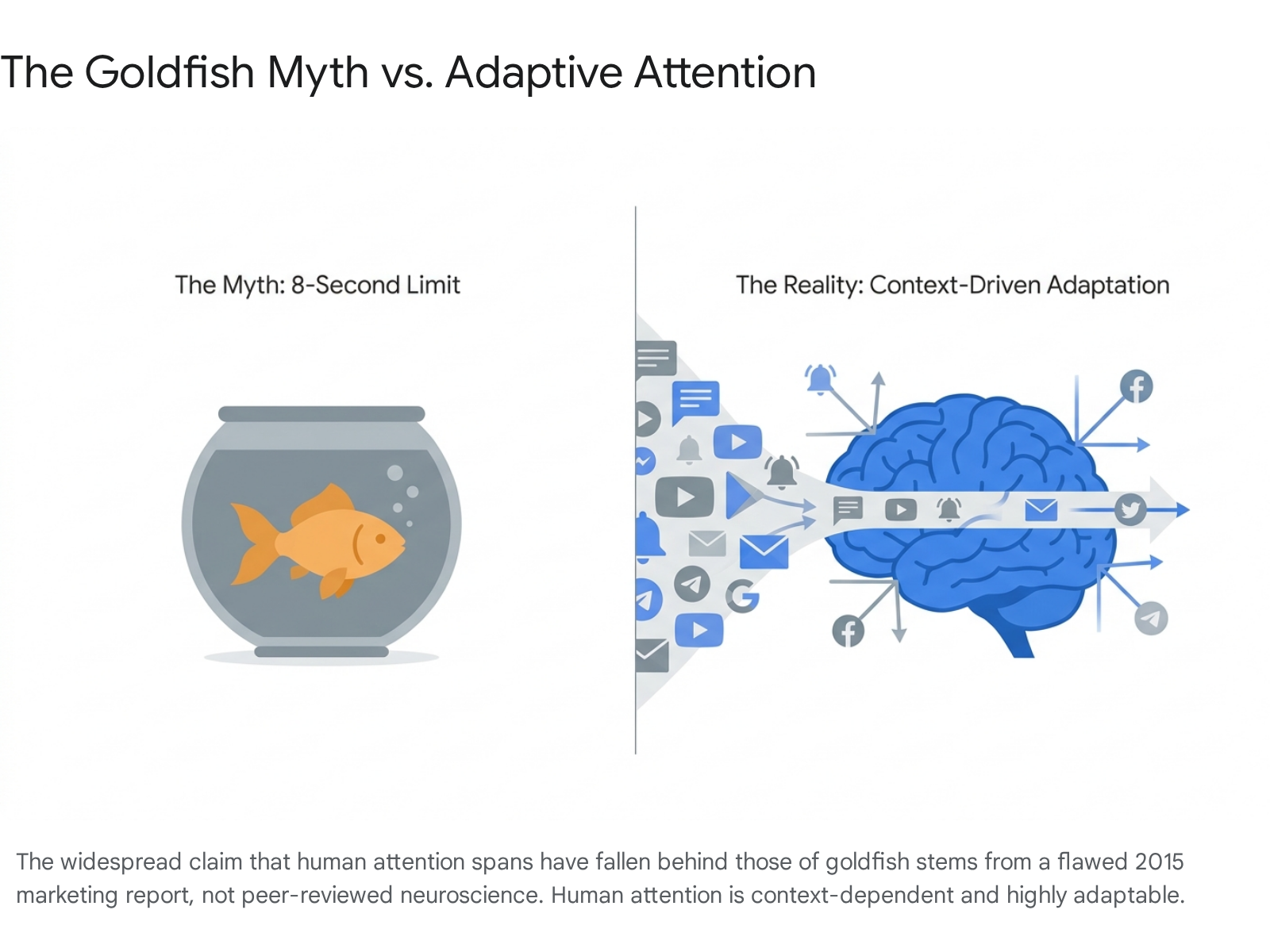
Our minds are dynamic systems that constantly reorganize and refocus our mental faculties to suit our immediate environment 23.
When a young adult rapidly scrolls through a dozen short-form videos and stops paying attention after a few seconds, it is not because they have lost the biological capacity to focus 22. Rather, they are demonstrating a learned behavioral adaptation to a highly stimulating, information-dense environment. In fact, studies show that when engaged in activities requiring sustained focus, such as complex video gaming or deep reading, modern adults can easily concentrate for extended periods. Habitual video gamers have even demonstrated better attentional abilities and visual processing speeds than non-players in specific contexts 23.
The real crisis is not that our biological attention span is shrinking. The crisis is that our digital environments are heavily engineered to fragment our focus and reward constant context-switching 2224.
The Hidden Cost of Multitasking: Attention Residue
While our baseline capacity to focus remains intact, the attention economy forces us into a state of continuous, rapid task-switching. A digital worker or student is routinely bombarded with emails, push notifications, and social media alerts while trying to complete deep work 25.
Contrary to popular belief, the human brain cannot truly multitask; it can only rapidly switch its focus back and forth between different targets 1112. This switching comes with a heavy cognitive tax known as attention residue, a phenomenon extensively documented by organizational behavior researcher Dr. Sophie Leroy 251213.
When a person switches from Task A to Task B, they assume their brain seamlessly transfers 100% of its focus to the new task. Research shows this is a fallacy 1214. Because the brain craves completion, a portion of the user's cognitive capacity remains stuck thinking about the unfinished Task A 1314. This residual attention means the individual has fewer cognitive resources available for Task B, leading to reduced accuracy, slower processing speeds, and shallower cognitive engagement 1314.
Attention residue is not a fleeting phenomenon; the cognitive performance decrements can persist for the entire duration of the subsequent task 1315. Furthermore, research by Gloria Mark indicates that it takes an average of 23 minutes and 15 seconds to fully return to an original task after a major interruption 13.
This cognitive drag is notably amplified under specific conditions: 1. Time Pressure: If a user feels rushed away from a task, the sense of unfinished urgency intensifies the cognitive loop, keeping more attention anchored to the past 1315. 2. Lack of Closure: Tasks left entirely open-ended generate more residue than tasks paused at a natural stopping point 1415. 3. Emotional Stakes: An emotionally charged interruption - such as a stressful news alert or an anxious text message - creates a much "stickier" residue than a routine administrative interruption 13.
In a digital environment where the average user engages in micro-switching dozens of times an hour, attention residue accumulates. Because so many tasks remain mentally unfinished, the brain juggles multiple thoughts at once, causing mental overload 25. This explains why a workday filled with rapid switching between emails, spreadsheets, and social feeds leaves individuals feeling mentally exhausted, even if they accomplished very little deep work 2513.
How Does Constant Scrolling Affect the Brain?
While the goldfish metric is false, heavy consumption of algorithmic digital media - particularly short-form video - does have profound neurocognitive effects.
The Short-Form Video Impact on Executive Function
Platforms like TikTok, Instagram Reels, and YouTube Shorts have exploded in popularity, relying on highly stimulating, algorithmically tailored, fast-paced content 243132. A robust body of systematic reviews and electroencephalogram (EEG) studies published in 2024 and 2025 has investigated the impact of heavy short-form video (SFV) consumption on young adults 313216.
The findings consistently associate high-frequency SFV use with attentional disruption, reduced executive functioning, and emotional dysregulation 3216. To measure this, researchers utilize the Attention Network Test (ANT) alongside real-time EEG recordings. A 2024 study involving young adults found a significant negative correlation between SFV addiction tendencies and theta power in the prefrontal cortex - the brain region heavily involved in executive control and self-regulation 17.
Heavy SFV users exhibited reduced neural engagement during cognitive control tasks, suggesting that constant exposure to rapid-fire algorithmic content diminishes the brain's inhibitory control, even when behavioral performance appears outwardly intact 311718.
Furthermore, repeated exposure to this highly stimulating format contributes to habituation. Users become desensitized to slower, effortful cognitive tasks such as deep reading, complex problem solving, or sustained reasoning 18. This process gradually weakens cognitive endurance. While users possess the biological capacity to pay attention, they find it increasingly uncomfortable and exhausting to sustain focus on non-stimulating tasks, leading to academic procrastination and digital escapism 243118.
The Dopamine Detox Misconception
As public awareness of these cognitive effects has grown, so has the internet trend of "dopamine detoxing" or "dopamine fasting." Popularized by wellness influencers, the concept suggests that abstaining from digital screens, junk food, and socializing for a set period will "reset" the brain's dopamine receptors and cure digital addiction 363719.
Neuroscientists and psychiatric researchers stress that this is a fundamental misunderstanding of brain chemistry 361920. Dopamine is not a "pleasure hormone" or a toxin that builds up and can be flushed from the system 1940. Rather, it is a vital neurotransmitter responsible for motivation, learning, and anticipating rewards 3619. It helps the brain evaluate what matters and drives us to act; it does not simply cause feelings of euphoria 3619.
The brain naturally regulates neurotransmitter activity in a complex system involving at least five major pathways and numerous receptor subtypes 3719. A brief period of fasting will not physically "reset" dopamine levels or unlearn deep-rooted behavioral habits 371920.
| Wellness Claim | Neuroscience Reality |
|---|---|
| Dopamine is a "pleasure chemical." | Dopamine is a neurotransmitter that drives motivation, anticipation, and learning. It tells the brain an action is worth repeating 363719. |
| Technology causes a "dopamine overdose." | While tech usage triggers dopamine release, it does not cause a literal chemical overdose. The brain naturally and continuously regulates production 3719. |
| Fasting "flushes out" excess dopamine. | Dopamine is not a toxin; it cannot be detoxed or flushed. Abstaining does not alter structural dopamine levels 192040. |
| A one-day detox cures screen addiction. | Habits formed over years require new learning and sustained cognitive behavioral change over time, not a quick chemical reset 2040. |
The term "dopamine fasting" was originally coined by psychologist Dr. Cameron Sepah as a catchy label for a cognitive behavioral therapy (CBT) technique aimed at reducing impulsive, instant-reward-seeking behaviors - not as a literal chemical detox 3620. While taking mindful breaks from overstimulating screens is beneficial for emotional balance, reducing distraction, and lowering anxiety, framing it as a biological "dopamine reset" spreads scientific misinformation 363720. Extreme fasting practices can actually lead to emotional isolation, boredom, and worsened mental health 1940.
Generative AI and the Future of Cognitive Offloading
As the attention economy matures, it is colliding with the rapid, widespread deployment of Generative Artificial Intelligence (GenAI). GenAI tools - ranging from conversational agents to code copilots - are increasingly embedded into daily workflows, raising complex psychological questions about cognitive offloading 412122.
Cognitive offloading is the practice of delegating mental tasks to external tools to reduce cognitive load 4122. Historically, humans have offloaded memory to notebooks, arithmetic to calculators, and navigation to GPS systems. This process can support adaptive coping by conserving mental resources for higher-order tasks 22. However, GenAI represents a paradigm shift because it allows for the offloading of not just data retrieval, but ideation, structural reasoning, and executive functioning 2244.
The Law of Least Effort and Critical Thinking
Recent empirical studies highlight a growing tension: while GenAI vastly improves short-term productivity and speed, unguided reliance on it threatens to erode critical thinking skills and cognitive resilience 41452347.
A 2025 study utilizing EEG measurements examined participants conducting writing tasks across three conditions: unaided, search-assisted, and LLM-assisted. The researchers found that participants using LLMs showed reduced neural connectivity and lower task engagement, essentially acting as passive evaluators rather than active thinkers 4447. Similarly, a large-scale survey of knowledge workers found that higher trust and dependence on GenAI correlated with reduced cognitive effort, diminished critical thinking scores, and increased cognitive fatigue 214423. In one mixed-methods study, 58% of adult participants admitted that "AI did most of the thinking" during executive tasks 21.
When users operate under the "law of least effort," they tend to input prompts and accept the AI's output with minimal scrutiny 4447. By outsourcing the deep cognitive work, individuals lose out on "desirable difficulties" - the slow, sometimes uncomfortable mental effort necessary for building intuition, long-term memory, and transferable skills 47. Over-reliance on AI acts as a crutch, preventing the strengthening of internal cognitive resources and potentially fostering "cognitive laziness" 4122.
Structured vs. Unguided Use
Crucially, the research indicates that GenAI is not inherently harmful to cognition; the impact is entirely dependent on how the tool is used 2144.
When AI use is unguided - where users are simply given access to a chatbot and left to their own devices - cognitive offloading undermines thinking 44. However, when AI use is structured through deliberate scaffolding, cognitive offloading actually improves critical reasoning and engagement 4445. Structured use requires users to outline their own ideas first, constrain the AI to specific functions (e.g., brainstorming or formatting), and explicitly evaluate the AI outputs against their own analytical standards 44.
When treated as a collaborative extension of the mind rather than a replacement for it, GenAI can augment human capacity. If organizations and educational institutions fail to establish these structured guardrails, the long-term reliance on AI could lead to the atrophy of analytical thinking 4124.
From Attention to Intention: The Agentic Economy
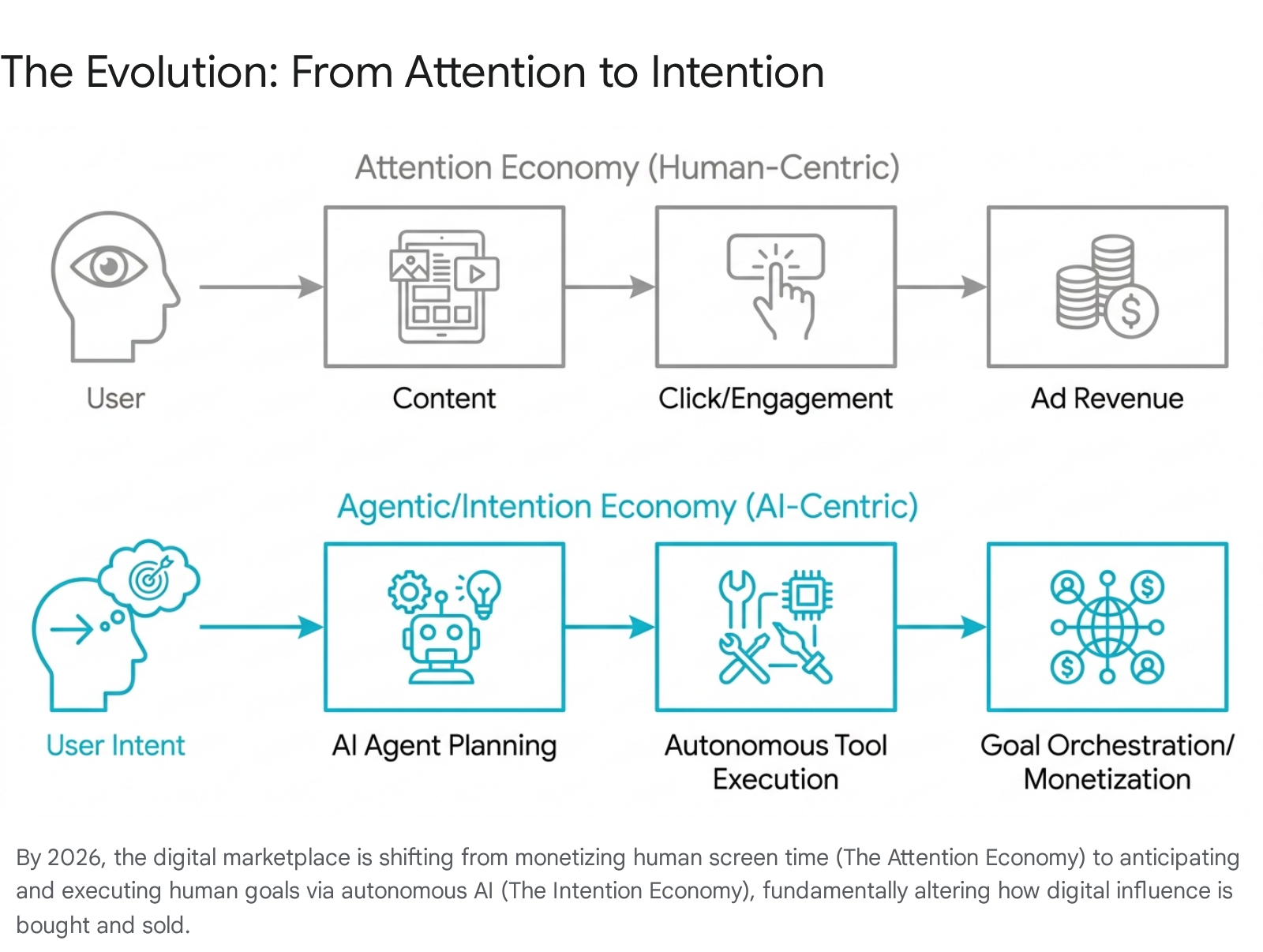
The widespread adoption of AI is catalyzing a fundamental transition in the digital marketplace. By 2025 and 2026, technology historians and researchers at the University of Cambridge anticipate that the traditional attention economy will evolve into the Intention Economy (often referred to as the Agentic Economy) 14925.
In the traditional attention economy, social media platforms and advertisers monetized passive human engagement - clicks, views, scrolling, and time spent on a screen 149. In the intention economy, human motivations, goals, and developing decisions become the primary commodity 12627.
The Agentic Shift
This structural shift is driven by the deployment of autonomous AI agents. Unlike passive chatbots that wait for a prompt to retrieve information, agentic AI systems possess the ability to reason, plan, use tools, and execute multi-step workflows independently to achieve a specific goal 25535428.
Researchers warn that these systems, which leverage vast amounts of psychological, behavioral, and biometric data, can anticipate user desires and subtly steer human decision-making before a conscious choice is even made 12627. For instance, a conversational AI agent acting as a trusted digital tutor or assistant could infer a user's intent to travel or purchase a product based on ambient conversational cues 12627. The agent could then proactively broker real-time bids with airlines or retailers on backend exchanges, subtly steering the user toward a specific transaction while mimicking a comforting, personalized interaction 1227.
The Perceived Control Gap
As AI agents mature, they are beginning to take over final decision authority in sectors like hiring, medical diagnostics, legal contract reviews, and finance 2856. In these implementations, AI doesn't just assist; it makes routine, pattern-based decisions entirely without human oversight 56.
This dynamic creates a phenomenon known as the "Perceived Control Gap" 57. Humans feel they are in control because they initiated the AI and oversee the process subjectively, but their actual decisions are heavily constrained, nudged, and shaped by the algorithm's invisible framing 5729.
While industry forecasts suggest AI agents could automate up to 70% of routine office tasks over the next decade, freeing humans for relationship-building and creative thinking, this transition raises severe ethical concerns 2529. Without stringent regulatory guardrails, the intention economy risks commodifying human aspirations on an industrial scale, eroding cognitive autonomy, and severely diluting accountability when automated systems inevitably fail 1262856.
Do Digital Well-Being Hacks Actually Work?
Given the overwhelming mechanics of the attention economy and the rising tide of cognitive offloading, a massive market for digital well-being solutions has emerged. Users are desperately seeking ways to reclaim their focus. But which strategies are actually supported by clinical evidence?
The Efficacy of Grayscale Mode
One of the most highly recommended "hacks" is switching a smartphone screen to grayscale mode. The logic is simple: digital platforms use bright, saturated colors - particularly reds for notifications - to trigger emotional urgency and visual attraction 596030. Removing color strips the interface of its psychological hook, making the device less stimulating to the brain 6062.
Unlike dopamine detoxes, grayscale interventions have robust empirical backing. In a pre-registered randomized field experiment, activating grayscale mode led to an immediate, significant reduction in objectively measured screen time 31. Across multiple studies, undergraduate students and general adults who utilized grayscale reduced their daily screen time by an average of 20 to 38 minutes, gaining back hours of cognitive space each week 59626465.
Qualitative data reveals that users experience a marked decrease in the "allure" of social media, feeling greater perceived control over their devices, reduced stress, and lower levels of online vigilance 306465. The lack of color also lessens the emotional toll of doomscrolling through disturbing news or polarizing content 6030.
However, the intervention is not a flawless cure. Studies indicate that while total screen time falls, the actual number of times a user unlocks their phone daily often remains unchanged, pointing to deep-rooted checking habits that color removal alone cannot break 6465. Furthermore, grayscale does not appear to significantly improve objective productivity or sleep quality on its own, and some users find the lack of color so frustrating that they abandon the intervention 303164.
Digital Interventions and Mental Health
To combat the anxiety, depression, and cognitive fatigue exacerbated by digital overload, developers have ironically turned to digital solutions. Extensive umbrella meta-analyses of digital well-being interventions - spanning mobile apps, web platforms, and telehealth - reveal small but statistically credible positive impacts on youth and adult mental health 3233.
Digital behavioral activation (BA) programs and Positive Psychology Interventions (PPIs) delivered via smartphone have been shown to significantly reduce depressive symptoms, stress, and cognitive biases over 3 to 6-month periods 3435. These apps work by augmenting feelings of purpose, gratitude, and resilience 35. Furthermore, WeChat mini-programs used for nutrition and lifestyle management in China have demonstrated high clinical efficacy for weight loss and health monitoring. These tools successfully leverage the same sticky retention mechanics used by super-apps, but direct them toward positive clinical outcomes 363738.
However, researchers consistently note that the effectiveness of these digital health interventions relies heavily on user engagement. Interventions that pair the digital tool with human support (like a therapist, coach, or peer group) consistently yield lower dropout rates and higher efficacy than purely self-administered apps 394041.
Comparing Well-Being Strategies
| Intervention Type | Clinical Evidence Base | Primary Mechanism of Action | Proven Outcomes | Limitations |
|---|---|---|---|---|
| Grayscale Mode | High (Field experiments, longitudinal studies) 593164 | Reduces visual stimulation and emotional urgency by removing saturated colors 6062. | Reduces screen time (20-38 mins/day); lowers perceived device anxiety 5964. | Does not break the habit of frequently unlocking the phone; mixed effects on productivity 316465. |
| Dopamine Detoxing | Low (Conceptual misunderstanding) 3620 | Behavioral abstinence to break compulsive loops (based loosely on CBT principles) 3620. | Can improve short-term focus if practiced mindfully 3720. | Does not actually "reset" dopamine. Extreme fasting risks emotional isolation and anxiety 361940. |
| Digital BA / PPI Apps | High (Umbrella meta-analyses, RCTs) 323435 | Structured behavioral activation, mindfulness, and cognitive reframing 3435. | Small-to-moderate reduction in depressive, stress, and anxiety symptoms 323435. | Suffers from high dropout rates unless paired with human accountability or support 394041. |
| Structured GenAI Use | Moderate (Recent empirical studies) 44 | Constraining AI to evaluation tasks rather than raw ideation to maintain cognitive load 44. | Maintains critical thinking and cognitive engagement during knowledge work 44. | Requires significant metacognitive discipline; easily subverted by the "law of least effort" 4447. |
Bottom line
The attention economy is not merely a metaphor; it is a structurally engineered environment designed to capture human focus, resulting in widespread cognitive fatigue, attention residue, and diminished executive control. While popular myths about goldfish attention spans and chemical dopamine detoxes distract from the real issues, empirical evidence shows that targeted interventions - like grayscale mode and structured digital boundaries - can meaningfully return cognitive agency to the user. However, as the digital landscape transitions from passive content consumption to an "Intention Economy" driven by autonomous AI agents, the central challenge will shift from merely protecting our attention to fiercely guarding our independent decision-making capabilities.