
Neuroscience of brand recall and advertising effectiveness
The intersection of cognitive neuroscience and consumer behavior has fundamentally transformed the methodological paradigms used to assess advertising effectiveness, brand recall, and purchase intent. Historically, consumer research relied on explicit, self-reported data derived from surveys and focus groups. However, decades of behavioral economics and cognitive research indicate that over 90% of consumer decision-making is influenced by subconscious cognitive and affective processes that cannot be accurately articulated through explicit recall 12. As the digital advertising ecosystem transitions toward highly fragmented, algorithm-driven distribution models, understanding the neurobiological underpinnings of memory encoding and emotional resonance has become imperative for accurate market prediction. This exhaustive research report analyzes the current neuroscientific literature on brand recall and emotional advertising, delineating rigorous academic findings from commercial neuromarketing frameworks, evaluating cross-cultural neurocognitive variations, and comparing the efficacy of short-form versus long-form advertising mediums.
Neural Pathways of Emotional Memory Encoding
The formation, retention, and retrieval of brand memories are active neurobiological processes governed by distributed networks within the brain. Advertising effectiveness heavily depends on an advertisement's capacity to engage the brain's emotional and memory centers, specifically through the functional connectivity of the amygdala, the hippocampus, and the prefrontal cortex (PFC).
The Amygdala-Hippocampus-Prefrontal Cortex Triad
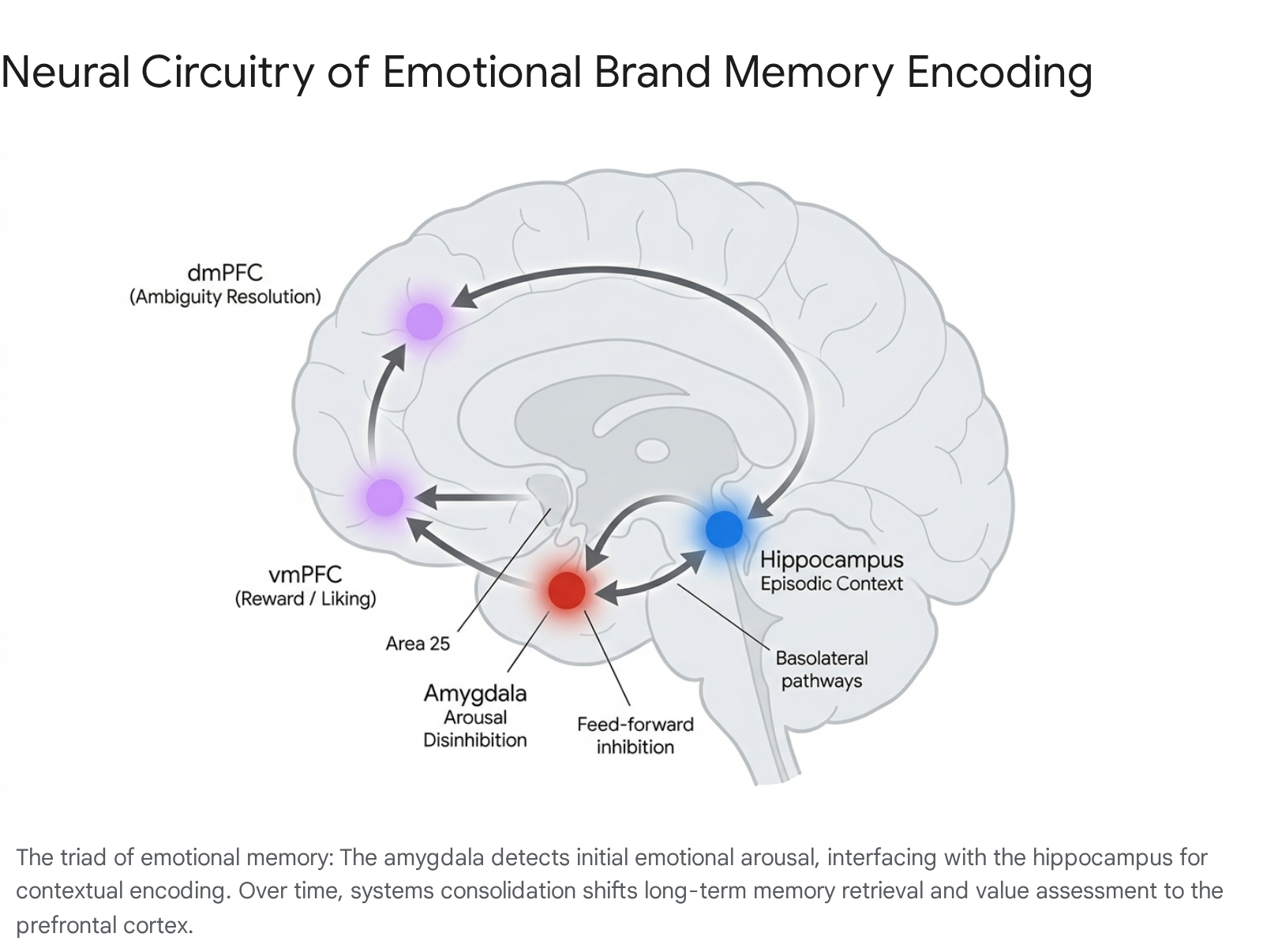
At the core of emotional memory encoding is a complex, orchestrated interaction between subcortical emotional processing hubs and cortical executive regions. The amygdala acts as the brain's primary detector for emotional arousal, threat, and novelty 34. When an advertising stimulus elicits an emotional response, the basolateral (BL) nucleus of the amygdala is activated. Recent high-resolution neural tracing reveals that pathways from the hippocampus and the subgenual cortex area 25 (A25) heavily innervate the BL amygdala, interfacing with excitatory and inhibitory microcircuits to modulate emotional learning and expression 5. Specifically, these pathways preferentially form synapses with calretinin (CR) neurons, which are responsible for disinhibition, effectively boosting the excitatory drive in the amygdala to solidify emotional significance 5. Simultaneously, hippocampal pathways uniquely interact with intrinsic amygdalar nuclei associated with plasticity, facilitating the flexible processing of signals within specific contexts for long-term learning 5.
The hippocampus, a critical structure for spatial navigation and episodic memory, does not merely store factual data; it actively integrates affective features into contextual memory 4. During the initial exposure to an emotionally resonant brand message, the anterior hippocampus works in tandem with the amygdala to encode the novelty and emotional weight of the stimulus 3. Data shows that amygdala and anterior hippocampal activity is most prominent during the initial exposure to an aversive or highly arousing stimulus and decreases markedly with repeated exposure 3. As the memory transitions from short-term retention to long-term storage - a process known as systems consolidation - the neural dependency shifts from the hippocampus to the prefrontal cortex 4. This developmental transition of the prefrontal representation of contextual memory is highly dependent on coordinated inputs from the entorhinal cortex, the hippocampus, and the basolateral amygdala during the initial learning phase 4.
The prefrontal cortex, particularly the ventromedial prefrontal cortex (vmPFC) and dorsomedial prefrontal cortex (dmPFC), provides top-down regulatory control over these subcortical structures 46. The vmPFC is heavily implicated in registering subjective value, reward, and brand preference. Functional magnetic resonance imaging (fMRI) studies demonstrate that the vmPFC highly correlates with brand liking and reward anticipation, driving preference untainted by explicit brand cues until hippocampal integration occurs 7. When a consumer interacts with a brand - for example, tasting a beverage or completing a digital purchase - the bilateral hippocampus captures a combination of the affective state generated by the vmPFC alongside the specific environmental cues 7. Furthermore, complex advertising narratives require the resolution of emotional ambiguity, which is managed by directional effective connectivity where the dmPFC top-down regulates amygdala activity, balancing bottom-up affective processes with cognitive evaluation 6.
Inhibitory Control and Affective Regulation
Memory encoding is further modulated by intricate inhibitory networks. Research on fear extinction and retrieval stopping indicates that the prefrontal cortex exerts inhibitory control over the hippocampus and amygdala to suppress unwanted or aversive affective responses 8. When an individual encounters a brand associated with negative past experiences or cognitive dissonance, the medial prefrontal cortex (mPFC) actively recruits parvalbumin-expressing interneurons to orchestrate feed-forward inhibition 6. This specific inhibitory circuit dictates whether an extinguished fear memory or a negative brand association is recalled or suppressed 6.
Abnormalities in this connectivity - such as increased task-dependent functional connectivity between the amygdala and dorsolateral prefrontal cortex during emotional face processing - are highly associated with neuroticism and emotional volatility 10. Such dysregulated interactions within fronto-limbic and salience circuits severely alter how an individual perceives brand messaging, suggesting that personality traits directly modulate the neural pathways responsible for advertising receptivity 10. Furthermore, the midline thalamic nucleus reuniens (RE) serves as a critical indirect pathway from the hippocampus to the mPFC, facilitating the contextual control of emotion and spatial memory processing, thus providing an additional layer of cognitive regulation over primitive emotional responses 7.
The Intention-Behavior Gap
A fundamental limitation in traditional consumer behavior research is the pervasive disconnect between what consumers state they value and their actual purchasing behavior - a phenomenon formalized in academic literature as the intention-behavior gap 89.
Limitations of Explicit Self-Report Metrics
The foundation of the intention-behavior gap is rooted in Ajzen's theory of planned behavior, which establishes that intentions alone are insufficient to guarantee action; follow-through strictly relies on situational support, perceived behavioral control, and the absence of immediate cognitive barriers 8. In modern commercial environments, consumers rarely make decisions in calm, abstract settings. They operate under intense time pressure, navigate imperfect information, and face heavy cognitive loads 8. Consequently, ethical considerations - such as sustainability, fair trade, or corporate social responsibility - often fail to transition from active consideration to actual search behavior 8.
Explicit survey methods, such as focus groups and questionnaires, are inherently flawed because they depend on conscious introspection, leaving them highly vulnerable to social desirability bias and memory inaccuracies 9. Consumers may genuinely endorse green consumption during a survey, yet base their ultimate point-of-sale decisions on price, habit, and convenience, rendering explicit data highly unreliable for predicting market outcomes 814. Traditional self-report measures fail to capture the implicit cognitive and emotional mechanisms that truly drive purchase behavior, creating a blind spot for marketers relying solely on stated preferences 14.
Subconscious Predictors of Purchase Intent
Consumer neuroscience bridges the intention-behavior gap by measuring real-time, involuntary physiological and neural responses. Neurophysiological metrics evaluate the affective and cognitive components of the consumer journey directly at the source, bypassing the conscious filters that generate explicit bias 1011.
Electroencephalography (EEG) and eye-tracking (ET) data repeatedly demonstrate higher predictive validity for purchase intent than traditional questionnaires. In experiments utilizing branded advertising stimuli, implicit subconscious brand recall - measured via frontal alpha asymmetry (a marker of approach motivation) and galvanic skin response (GSR) for emotional arousal - proved to be a stronger, more statistically significant predictor of final purchase intent than self-reported recall 914. For instance, combining EEG and ET data with multiple regression analysis reveals that emotional advertisements yield significantly higher engagement signatures in the brain compared to informational advertisements 9. The integration of these modalities allows researchers to identify the exact temporal moments when an advertisement captures attention and triggers the specific emotional responses that precede consumer action 12. Therefore, understanding the intention-behavior gap requires redefining consumer choice not as a sequence of rational evaluations, but as a rapid, context-dependent neurobiological calculation of value and effort 811.
Debunking Commercial Neuromarketing Misconceptions
As neuromarketing has grown into a multi-billion dollar commercial sector, the translation of complex neuroscientific data into accessible business strategies has generated significant conceptual distortions. Differentiating rigorous academic findings from the pseudoscientific claims frequently propagated by commercial neuromarketing agencies is a necessary step for the field's maturation 1319.
The Myth of the "Buy Button" in the Brain
The most pervasive and scientifically untenable misconception in commercial neuromarketing is the existence of a neurological "buy button" - a discrete neural structure that, when stimulated by specific advertising cues, reliably triggers mindless purchasing behavior 131415. This reductionist metaphor grossly misrepresents the sophisticated, distributed nature of human cognition.
Brain imaging confirms that decision-making cannot be localized to a single neurological switch. A purchase decision is a highly complex, temporal behavior that requires constant trade-offs between the anticipation of reward (mediated by the ventral striatum and mesolimbic dopamine system) and the pain of paying (often correlating with insula activation) 11315. Furthermore, an individual's pre-existing financial constraints, emotional state, and immediate physical environment serve as powerful top-down modulators that easily override marketing stimuli 15. Peer-reviewed neuroscience dismisses the "buy button" as marketing rhetoric designed to sell consulting services, emphasizing that while advertising can influence preference and elevate brand salience, it cannot override human executive control to force a compulsory purchase 1316. Instead of a "buy button," prominent behavioral economists like Richard Thaler conceptualize this influence as a "neuro-nudge" - a subtle optimization of decision architecture that influences behavior without coercion or certainty of outcome 16.
Delineating Academic Rigor from Commercial Pseudoscience
A stark divide exists between academic consumer neuroscience and proprietary commercial neuromarketing. Academic research published in peer-reviewed journals utilizes robust sample sizes, transparent methodologies, and advanced statistical modeling - such as spectral Dynamic Causal Modeling (spDCM) of rs-fMRI data - to understand the causal interactions between distributed brain regions and predict individual differences in behavior 1317.
Conversely, many commercial agencies utilize opaque, proprietary algorithms with extremely small sample sizes to generate highly exaggerated claims about ad effectiveness, suffering from low ecological validity and a severe lack of peer oversight 13. The scientific reality of consumer behavior is one of probability, not absolute determinism. While neuroscience can demonstrate that supraliminal, unattended primes affect consumer preferences outside of conscious awareness, it also confirms that human behavior is safeguarded by resilient, interconnected inhibitory networks 14. Thus, the objective of scientifically valid neuromarketing is not behavioral control, but rather the reduction of cognitive friction and the optimization of brand resonance to align with the brain's natural processing pathways 1624.
Cross-Cultural Differences in Consumer Neuroscience
Historically, psychology and cognitive neuroscience have drawn over 95% of their sample populations from Western, Educated, Industrialized, Rich, and Democratic (WEIRD) societies, fundamentally skewing the global understanding of consumer behavior 1826. Recent advancements in cultural neuroscience demonstrate that cultural values and ecological backgrounds structurally and functionally modulate how the brain processes social, emotional, and consumer information 1920.
Neurological Variations in Memory Encoding
Cultural backgrounds influence not just social interactions, but the fundamental mechanics of visual perception and memory specificity. In neuroimaging studies comparing American and East Asian populations, significant cross-cultural differences were observed at the exact time of memory encoding 21. When processing advertising stimuli or visual objects, individuals from Western (individualistic) cultures typically show enhanced activation in the right fusiform gyrus and the right hippocampus, regions closely associated with the encoding of specific, isolated object details 21.
Conversely, individuals from East Asian (Confucian/collectivist) cultures demonstrate greater activation in the left fusiform and left hippocampus, reflecting a cognitive style that prioritizes holistic, contextual integration and background relationship processing 21. Furthermore, cross-cultural comparative analyses utilizing fMRI and EEG indicate that Western participants exhibit stronger activation in brain regions associated with individualistic values and reward processing when viewing marketing stimuli, whereas Eastern participants show heightened activity in brain areas linked to collectivist values and social harmony 22. These variations challenge the universality of Western consumer models, proving that standard brand recall metrics must account for how culturally conditioned neural pathways fundamentally alter what consumers notice and remember.
Cultural Embeddedness in the Global South
Beyond the traditional East-West paradigm, research into the Middle East, North Africa (MENA), and Latin American regions reveals highly complex cognitive architectures. Schwartz's cultural value theory categorizes Latin American and Middle Eastern cultures as possessing high embeddedness, where social relationships, hierarchy, and collective well-being are heavily prioritized over the autonomous individualism seen in Western spheres 2023.
When exposed to localized, culturally embedded advertising campaigns, audiences in these regions display unique neurophysiological engagement. For example, in the MENA region, cultural globalization and openness significantly alter intertemporal consumption behaviors, directly influencing the neurological trade-offs between present reward consumption and future savings 24. Furthermore, studies tracking consumer resonance in Latin America and the Middle East show that marketing messages aligned with collective cultural symbolism generate vastly higher engagement than generic campaigns. An analysis of social media advertising by the Almaza brand in Lebanon demonstrated that campaigns infused with deep cultural symbolism and resilience narratives achieved exponentially higher engagement metrics, aligning with collectivist orientations and the United Nations Sustainable Development Goals (SDG 8 and 12) 33.
Similarly, within the United States, targeted assessments of Hispanic and Black American consumer cohorts utilizing the Cultural Relevance ScoreTM indicate that authentic representation and collective resonance drastically elevate Purchase Intent and Likeability indices, tapping into universal cultural truths that generic advertising fails to stimulate 34. Consequently, global brands must transition from homogeneous messaging to culturally tailored neural strategies that respect diverse epistemologies and localized emotional triggers 2634.
Neuromarketing Measurement Tools
The commercial and academic deployment of consumer neuroscience relies on a spectrum of biometric and neuroimaging technologies. The efficacy of these tools depends on balancing spatial resolution (the ability to pinpoint specific brain regions) with temporal resolution (the ability to track rapid, millisecond-to-millisecond changes in cognitive state). While no single tool provides a comprehensive view of consumer behavior, their integrated application offers unprecedented predictive power regarding advertising effectiveness.
| Test Technique | Primary Application | Key Advantage | Key Limitation |
|---|---|---|---|
| Functional Magnetic Resonance Imaging (fMRI) | Deep subcortical activity tracking (e.g., reward center activation, emotional appraisal). | Exceptional spatial resolution (millimeter accuracy); identifies precise neural structures (amygdala, striatum) driving subconscious preference. Dominates ~33% of the market revenue share. | Highly expensive, lacks ecological validity (participants must remain motionless in a scanner), low temporal resolution (delayed by seconds). 111935 |
| Electroencephalography (EEG) | Real-time cognitive load, approach/avoidance motivation (frontal alpha asymmetry), and attention tracking. | Excellent temporal resolution (milliseconds); highly portable, relatively cost-effective, and predicts product sales with approximately 80% accuracy. Appears in ~35-40% of all studies. | Poor spatial resolution; cannot accurately measure activation in deep subcortical brain structures associated with primary emotions. 91119 |
| Functional Near-Infrared Spectroscopy (fNIRS) | Measuring cortical oxygenation in naturalistic consumer environments. | Combines decent spatial resolution with the portability of EEG; allows for physical movement, making it ideal for in-store retail testing. | Restricted to measuring the outer cortical layers; depth of penetration is limited, preventing analysis of deep limbic structures. 1035 |
| Eye-Tracking (ET) | Visual attention mapping, gaze fixation, and packaging design optimization. | High ecological validity; seamlessly integrates with digital and mobile advertising platforms to optimize user interface elements. | Measures where visual attention is focused, but cannot explain the why (emotional valence) without being paired with EEG or fMRI. 910 |
| Galvanic Skin Response (GSR/EDA) | Measuring raw emotional arousal and sympathetic nervous system activation. | Non-invasive, highly reliable indicator of physiological excitement and stress; easily deployable at scale. | Cannot determine the exact valence of the emotion (i.e., whether the high arousal is due to joy, fear, or frustration). 1036 |
Emotional Advertising Appeals: Neurological Signatures and Recall
Emotions serve as the primary catalyst for long-term memory retention. The application of specific emotional appeals - humor, fear, and nostalgia - activates distinct neural networks, yielding highly divergent outcomes in brand recall, attitude modulation, and purchase intent. Understanding these discrete neurological signatures enables advertisers to engineer campaigns that optimize both attention and subsequent behavior.
The Neuroscience of Humor
Humorous advertising operates by hijacking attention through expectation violation and cognitive resolution, directly triggering the brain's reward networks 37. Anticipating a punchline primes the brain, creating measurable spikes in focus. Upon resolution, humor activates the ventral striatum, stimulating rapid dopamine release, which drives positive emotional valence and enjoyment 3738.
However, humor presents a profound paradox in brand recall known as the "vampire video" effect. Because the brain locks memory storage quickly around the emotional peak of the joke, if the brand is not intrinsically woven into the humorous narrative, the memory trace encodes the punchline but completely discards the product 37. While 90% of consumers are more likely to recall a brand linked with a properly integrated humorous treatment 3725, late brand reveals following a joke result in severe deficits in explicit brand recall 37. When executed correctly - such as Snickers' highly successful "You're Not You When You're Hungry" campaign where the product serves as the literal punchline - humor outperforms rational and fear appeals in generating click-through rates and brand likeability, though it remains less effective at altering deep-seated attitudes or long-term risk perceptions 373826.
Fear Appeals and Threat Processing
Fear appeals leverage the brain's evolutionary survival mechanisms to drive immediate behavioral change. When confronted with a fear-inducing advertisement, the brain exhibits heightened, rapid activation in the amygdala, the anterior cingulate cortex (ACC), and the orbitofrontal cortex (OFC) 4127. The ACC is crucial for contingency awareness, evaluating the severity of the incoming threat, while the amygdala dictates the immediate emotional appraisal and physiological arousal 41.
Neurologically, fear-based messages bypass rational deliberation and create robust implicit memories 3827. In direct comparative studies, such as evaluations of youth-targeted tobacco prevention campaigns, fear appeals generate significantly higher scores for implicit memory retention, perceived ad effectiveness, and modified risk perception compared to humor 2627. Because fear commands immediate executive attention, it is highly effective for public health campaigns and awareness generation. However, if the fear stimulus is too intense and lacks an actionable resolution, the prefrontal cortex may engage defensive inhibitory mechanisms to suppress the aversive memory, resulting in consumer avoidance and psychological reactance 82829.
Nostalgia and Autobiographical Reactivation
Nostalgia is a complex, mixed-valence emotion that relies on the cooperative co-activation of the brain's memory and reward systems. Functional magnetic resonance imaging reveals that nostalgic advertising triggers the hippocampus (HPC) for autobiographical memory retrieval, the precuneus and posterior cingulate cortex (PCC) for self-reflection, and the substantia nigra/ventral tegmental area (SN/VTA) for reward processing 4530.
Nostalgia functions across two distinct neural dimensions: emotional/personal significance (which correlates with the caudal SN/VTA and left anterior hippocampus) and chronological remoteness (which correlates with the rostral SN/VTA) 4531. By reactivating brand-related autobiographical memories, nostalgic digital marketing effectively bypasses critical cognitive filters, significantly enhancing brand trust, emotional resilience, and purchase intention - particularly among younger demographics experiencing severe digital fatigue, such as Generation Z 324933. Neural data demonstrates that compared to high-arousal excitement ads, love- and nostalgia-themed content generates smoother, more stable EEG waveforms, indicative of profound affective resonance, introspection, and long-term brand attachment 34.
| Emotional Appeal | Primary Neural Correlates | Effect on Brand Recall and Advertising Effectiveness |
|---|---|---|
| Humor | Ventral Striatum, Dopaminergic Pathways, Prefrontal Cortex | Generates extremely high engagement and positive valence. Recall is exceptionally high only if the brand is central to the punchline; otherwise, explicit brand recall fails due to memory locking on the joke itself. 373835 |
| Fear | Amygdala, Anterior Cingulate Cortex (ACC), Orbitofrontal Cortex (OFC) | Produces powerful implicit memory encoding and high perceived ad effectiveness. Excellent for altering risk perception and immediate behavioral shifts, but risks triggering defensive avoidance mechanisms. 264127 |
| Nostalgia | Hippocampus, Ventral Tegmental Area (VTA), Posterior Cingulate Cortex (PCC) | Facilitates deep, stable memory encoding tied directly to autobiographical self-reflection. Highly effective for building long-term brand trust, loyalty, and mitigating cognitive defense barriers. 45304934 |
Comparing Advertising Mediums: Short-Form Digital Media vs. Traditional Long-Form
The proliferation of mobile-first digital environments has bifurcated video advertising into two distinct mediums: traditional long-form narrative media and algorithmic short-form digital media (e.g., TikTok, Instagram Reels, YouTube Shorts). These formats place fundamentally different demands on the human neurocognitive architecture, resulting in highly varied outcomes for brand recall and emotional encoding.
Cognitive Load and Dopaminergic Responses in Short-Form Media
Short-form video platforms rely on fast-paced, high-arousal content explicitly designed to deliver rapid dopaminergic spikes. While these environments excel at capturing immediate, bottom-up visual attention, they exact a severe toll on executive function and sustained cognition. Prolonged consumption of short-form media is correlated with measurable neurophysiological deficits in sustained attention and impulse control 36.
EEG analyses of heavy short-form video consumers reveal a significant negative correlation between addiction tendency and theta power in the frontal cortex during executive control tasks . This diminished prefrontal theta power suggests that the brain exerts less neural engagement in cognitive control, leading to attentional depletion, increased variability in response times, and fragmented memory encoding 36. Furthermore, clinical evaluations of school-aged children indicate a strong association between high short-form video consumption and elevated inattentive behaviors, underscoring the neuropsychiatric impact of hyper-compressed media 37.
In an advertising context, the average viewing time for a mobile short-form ad has plummeted to roughly 2.2 seconds, representing a 35% decrease in baseline attention over a seven-year period 56. Consequently, marketers are forced to rely on "1-second strategies" that hyper-compress emotional hooks 56. While short-form ads achieve massive reach and leverage perceived authenticity (often mimicking amateur user-generated content to lower defensive barriers and simulate word-of-mouth), their fragmented nature limits the brain's ability to encode complex product information or foster deep brand equity 57. The rapid scrolling mechanism inherent to these platforms disrupts the systems consolidation phase required for the hippocampus to transfer episodic data to the prefrontal cortex, heavily impairing explicit brand recall.
Narrative Transportation and Social Cognition in Long-Form Media
Conversely, traditional long-form video advertising provides the necessary temporal runway for narrative transportation and complex neural synchronization. Real-time fMRI data reveals that consumer liking of a long-form video ad is not driven by a single emotional peak, but is rather a cumulative psychological process 12.
Initially, early emotional signals capture attention within the first three seconds of exposure, activating basic affective networks. However, these initial emotional spikes decline rapidly. Sustained attention and ultimate ad enjoyment are instead predicted by the prolonged activation of social cognition and mentalizing networks 12. Long-form media allows viewers to build empathy and engage in active perspective-taking with the characters on screen. This sustained social-affective response creates a highly receptive neural state, permitting the seamless integration of complex brand messaging without triggering cognitive friction 12.
Furthermore, neuro-contextual alignment plays a pivotal role in long-form and premium digital environments. When the emotional tone of an advertisement matches the semantic and emotional context of the surrounding content, researchers observe a 3.5x higher neural engagement and a massive increase in left-side frontal alpha brain activity 2438. This left-frontal asymmetry governs approach-oriented emotions, proving that when the brain experiences contextual harmony, it exerts less cognitive effort while simultaneously recording stronger, more actionable brand memories 2438. Traditional mediums, such as cinema and premium television, provide an immersive environment that minimizes external cognitive load, making them vastly superior for establishing brand equity through detailed storytelling 56.
Conclusion
The integration of cognitive neuroscience into marketing research has fundamentally redefined the empirical understanding of consumer behavior. The evidence demonstrates that effective advertising relies not on a mythical, deterministic "buy button," but rather on the nuanced, probabilistic orchestration of the amygdala, hippocampus, and prefrontal cortex. As brands navigate an increasingly saturated digital landscape, the ability to bridge the intention-behavior gap requires abandoning flawed self-report metrics in favor of highly predictive neurophysiological indicators of subconscious emotional resonance. Furthermore, the future of global advertising necessitates a departure from WEIRD-centric paradigms; acknowledging the diverse neural encoding styles of collectivist and non-Western cultures is essential for authentic, ethical engagement. Ultimately, whether a brand leverages the rapid dopaminergic hit of a humorous short-form video or the sustained social cognition of a nostalgic long-form narrative, advertising effectiveness is dictated by the marketer's ability to align messaging architecture with the brain's inherent biological pathways.