
Network Effects vs Virality: What's the Difference
Virality brings users through the front door at breakneck speed, but network effects are the architectural foundations that prevent them from leaving. While viral growth focuses on the rapid, low-cost acquisition of new users through word-of-mouth and social sharing, network effects fundamentally increase a product's underlying utility and value as more people use it. Confusing these two distinct mechanisms often leads digital businesses to experience explosive early growth followed by a rapid, unrecoverable collapse when the novelty inevitably wears off.
Decoding the Buzzwords: Acquisition vs. Defensibility
In the contemporary digital economy, the terms "virality" and "network effects" are frequently used interchangeably by startup founders, marketers, and even seasoned venture capitalists 12. However, treating them as synonymous concepts is a profound strategic error that misguides product development and investment allocations. They are entirely distinct operational forces with different objectives, psychological triggers, and long-term business implications 24.
Virality is fundamentally an engine for user acquisition and the speed of market adoption 15. It occurs when existing users pull new users into a product ecosystem, ideally at zero marginal cost to the company 15. A product achieves virality when the mere act of using it inherently advertises it to non-users, or when users are highly incentivized to share the product within their existing social circles 16. Ultimately, virality solves the problem of distribution. During the so-called "Golden Age of Virality" between 2000 and 2012, numerous platforms built massive audiences entirely on the back of aggressive referral loops and social sharing mechanics 1.
Network effects, conversely, are the bedrock of value creation, user retention, and long-term defensibility 12. A network effect exists when every new user who joins a platform adds incremental, tangible value to all other existing users 17. The more individuals who participate in the network, the better the product functions, making it increasingly difficult and irrational for users to switch to a competitor 28. While virality solves the problem of distribution, network effects solve the far more difficult problem of churn.
To illustrate this distinction practically, consider the trajectory of a viral mobile puzzle game compared to a global messaging application. A puzzle game might spread like wildfire because players share their daily scores on social media, generating an emotional payoff and social validation 26. This is pure virality. However, the puzzle game itself does not become inherently more mathematically complex or enjoyable simply because a million other strangers in different countries are playing it simultaneously 6. It lacks a network effect. Conversely, a messaging platform might initially grow quite slowly through direct word-of-mouth. Yet, once an individual's entire family and professional circle adopt the application, leaving that platform means severing digital ties with their most important contacts 93. The messaging app possesses a strong network effect that locks the user into the ecosystem.
| Strategic Dimension | Viral Effects | Network Effects |
|---|---|---|
| Primary Organizational Goal | Rapid growth of new users (Customer Acquisition) | Enduring value creation and competitive defensibility (Customer Retention) |
| Core Mechanisms | Referrals, social sharing, word-of-mouth, gamified incentives | Platform density, cross-side liquidity, data aggregation, interoperability |
| Typical Time Horizon | Often short-lived; highly subject to platform fatigue and novelty decay | Enduring; generates compounding value over multiple years |
| Primary Business Value | Drastically lowers Customer Acquisition Cost (CAC) | Increases Customer Lifetime Value (LTV) and creates insurmountable moats |
| Key Performance Metrics | K-factor (Viral Coefficient), Time-to-Value, Share Rate | Organic retention cohorts, Multi-tenanting rate, Network density |
| Classic Examples | Wordle, The Ice Bucket Challenge, Quibi | WhatsApp, Uber, Google Search, WeChat |
The Anatomy of Virality: Engineering the Spark
If network effects represent the structural integrity of a digital enterprise, virality is the combustible fuel used to ignite initial traction. To engineer a product that successfully goes viral, developers and marketers must understand both the mathematical realities of transmission and the psychological triggers that compel human beings to share information with their peers.
The Mathematics of the Viral Loop
Growth engineers and venture analysts frequently evaluate virality using the K-factor, a metric originally derived from the field of epidemiology to track the spread of biological viruses 11124. In the context of software and digital platforms, the viral coefficient is calculated as the product of the number of invitations sent by an average user and the conversion rate of those specific invitations 512.
If the K-factor is greater than 1.0, the growth of the user base becomes exponential, meaning each new cohort of users brings in an even larger subsequent cohort 12. If the K-factor is less than 1.0, the viral spread alone cannot sustain the product's growth indefinitely; the momentum will eventually decay unless the company injects paid advertising capital to artificially acquire users 12. Viral growth curves typically feature a slow initial start, followed by a steep upward trajectory once a tipping point is reached, creating a multiplying effect as existing users canvas their networks 11.
However, relying solely on the K-factor provides a narrow lens. It primarily captures explicit referral mechanics but often fails to account for organic discovery, content sharing, and the broader richness of self-reinforcing growth loops 12. Modern growth theory emphasizes circular systems where the output of one process - such as a user creating a piece of engaging content - acts as the direct input for acquiring the next user, effectively turning the end of the traditional marketing funnel into the beginning of a new acquisition cycle 12.
Psychological Triggers and Memetic Spread
Applications do not achieve viral escape velocity simply because they possess a sleek user interface or benefit from a massive venture capital marketing budget. They explode in popularity because their architects have masterfully engineered psychological and mechanical triggers directly into the product's core functionality 614.
The most potent psychological driver of virality is the human desire for social validation and conformity 15. As social creatures, individuals possess an innate need to feel accepted and embedded within a larger community 15. When a digital meme, an interactive challenge, or a novel application begins gaining traction, it generates profound social proof. Engaging with the viral product becomes a signal of cultural awareness, providing an emotional payoff and a sense of belonging to an "in-group" 216. This emotional contagion acts as a self-reinforcing cycle, propelling the trend forward 15.
Furthermore, successful viral products universally minimize friction. Applications that fail frequently demand too much effort upfront, requiring users to navigate lengthy tutorials, complete complex account creations, or face subscription prompts before they even comprehend the software's underlying purpose 6. Viral applications, by contrast, engineer a near-zero "time to value." They deliver their core benefit within seconds of opening the application 6.
Additionally, companies deploy various tactical strategies to force virality, ranging from incentivized loops (where users receive free product access or monetary rewards for referrals) to link-planting (where users are encouraged to embed promotional links in their public social media bios) 1. While these tactics can manipulate the K-factor temporarily, they rarely result in long-term engagement if the underlying product lacks utility.
The Mathematics of Value: Metcalfe's Law and Beyond
While virality explains how users arrive at a platform, network effects explain why they refuse to leave. To truly comprehend the power of network effects, one must examine the underlying mathematics that govern connected systems and combinatorial economics.
From Ethernet Cables to Social Graphs
The foundational concept of network value was articulated in 1980 and later popularized by Robert Metcalfe, a co-inventor of the Ethernet protocol and co-founder of the networking company 3Com 17185. While initially pitching 3Com's networking cards to enterprise clients, Metcalfe made a critical observation regarding the economics of connectivity 1718.
He explained that while the financial cost of building a local network scaled in direct, linear proportion to the number of hardware cards purchased, the actual value derived from that network grew exponentially 1718. This principle eventually became known as Metcalfe's Law, positing that the financial value or overarching influence of a telecommunications network is proportional to the square of the number of connected users or compatible communicating devices within the system 520.
The logic behind Metcalfe's Law rests on the mathematics of potential connections. The number of unique, possible connections within an $n$-node network can be expressed as the triangular number $n(n-1)/2$, which is asymptotically proportional to $n^2$ 521. To simplify, if you have two telephones, only one connection is possible. If you have five telephones, ten distinct connections can be made. If you scale that to twelve telephones, the network accommodates 66 potential connections 5. Therefore, if a digital network possesses 10 users, its theoretical inherent value is roughly 100. Adding a single additional user jumps the value to 121, and adding another pushes it to 144 171820. This relentless, non-linear growth paradigm is the primary reason that modern digital platforms can achieve multi-billion dollar valuations with relatively small teams 217.
Asymptotes, Saturation, and Real-World Growth Curves
While Metcalfe's Law serves as an excellent theoretical heuristic for understanding digital businesses, modern technology strategists and venture analysts actively warn against treating it as an immutable law of physics 32122. In reality, the notion that network value will grow exponentially toward infinity is a mathematical fallacy when applied to human systems 323.
Network size and its corresponding value are ultimately constrained by highly practical limitations. These constraints include physical infrastructure caps, access to requisite technology, technical obsolescence, and the emergence of superior substitutes 5. More importantly, networks are limited by human cognitive capacity, often referred to as "bounded rationality." Concepts such as Dunbar's number dictate that human beings can only maintain a finite number of stable, meaningful social relationships, placing a natural ceiling on the utility of infinite social connections 5.
Consequently, it is almost universally true that user growth will reach a saturation point 5. Rather than an endless exponential curve, real-world network effects typically map to an S-curve, commonly modeled using sigmoid functions like a logistic or Gompertz curve 3523.
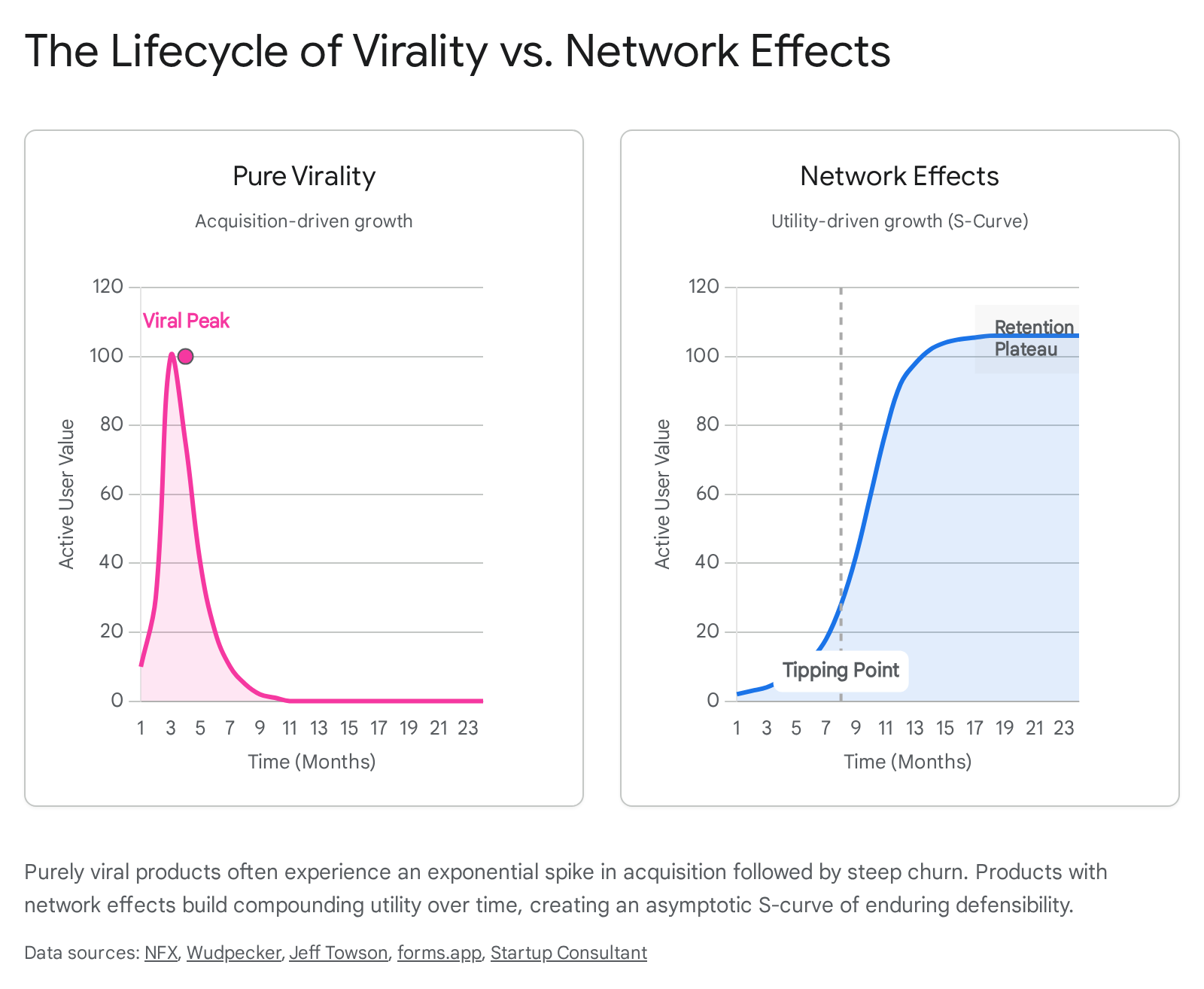
The network starts slow, hits a critical mass where value explodes exponentially in the middle of the curve, and eventually plateaus at an asymptote 323. At this plateau, the marginal value of adding one more user diminishes significantly; adding the two-billionth user to a social network does not meaningfully improve the daily experience for the average user 3.
Analysts also debate alternatives to Metcalfe's model. Reed's Law, for example, suggests that the value of networks that allow for the formation of sub-groups grows even faster than $n^2$, scaling exponentially with the number of possible sub-groups 2024. Conversely, Zipf's Law provides a more conservative model, predicting a slower, logarithmically scaled increase in value as user volume expands 24. Despite the academic debates over the precise mathematical slope, the fundamental premise remains undeniable: businesses with strong network effects are responsible for roughly 70% of the total value created by technology companies since the mainstream adoption of the internet in 1994 21722.
Distinct Typologies of Network Effects
Network effects are not a monolith; they manifest in several distinct structural forms, each requiring different strategic playbooks to harness effectively 272526.
- Direct Network Effects: This is the most classical model, where an increase in usage leads to a direct increase in value for all other users 726. Messaging applications like WhatsApp and social platforms like Facebook are prime examples. The primary value lies in ubiquitous connectivity; a user chooses WhatsApp simply because their existing social circle is already heavily active on the platform 26.
- Multi-Sided (Cross-Side) Network Effects: Common in marketplace and platform business models, this occurs when two or more distinct user groups provide reciprocal value to each other 726. Ride-hailing services like Uber and delivery platforms rely on this structure. A massive influx of riders reduces idle time for drivers, making the platform more lucrative. This attracts more drivers, which in turn reduces wait times and lowers prices for riders, creating a virtuous, self-perpetuating cycle of liquidity 926.
- Data Network Effects: In this model, a product's core functionality improves as it consumes more user-generated data and interaction signals 226. Search engines like Google exemplify this. Each search query and subsequent click refines the underlying algorithmic models, enabling the engine to deliver more relevant results to future users 2426. However, simply hoarding large datasets does not constitute a data network effect; the data must continuously and automatically translate into meaningful product improvements that attract more usage 2.
- Local Network Effects: Some platforms derive their value from highly localized interactions rather than global scale 7. A food delivery service may have millions of users nationally, but its utility to a consumer in Chicago is dictated entirely by the density of restaurants and couriers within a three-mile radius of their specific neighborhood 25.
- Protocol Network Effects: These arise when a specific computational or communications standard is declared, and nodes can interoperate seamlessly. The foundational protocols of the internet, as well as modern decentralized blockchain networks like Bitcoin and Ethereum, derive immense value because thousands of disparate applications and developers agree to build upon the same underlying ruleset 28.
The Illusion of Scale: When Viral Products Collapse
The distinction between virality and network effects becomes glaringly obvious when analyzing the digital graveyard of highly funded technology startups. When founders conflate rapid viral acquisition with enduring defensibility, they often treat a massive spike in downloads as validation of their core product, ignoring the underlying retention metrics 27. When the contextual tailwinds that drove the virality inevitably dissipate, the product collapses.
The Rise and Fall of Clubhouse
The trajectory of the audio-social application Clubhouse serves as the definitive modern case study of viral marketing outstripping sustainable network value. Launched in April 2020 during the height of the COVID-19 pandemic lockdowns, Clubhouse introduced live, unscripted, and ephemeral audio rooms 2728.
The application executed a masterclass in scarcity-driven growth marketing. By restricting the platform to iOS devices and implementing a strict invite-only policy, Clubhouse manufactured intense intrigue and FOMO (Fear Of Missing Out) 2729. Invitations essentially became digital status symbols. As high-profile venture capitalists, celebrities, and tech luminaries hosted exclusive public debates, screenshots of the rooms flooded external social networks 27. This engineered scarcity, combined with the unique pandemic conditions where physical conferences and social gatherings were outlawed, acted as rocket fuel 272830.
The viral loop was astonishingly effective. By January 2021, the app had drawn 2 million users. Just one month later, in February 2021, the user base exploded to 10 million, resulting in a staggering $4 billion valuation backed by premier Silicon Valley venture capital firms 28296. Clubhouse was hailed as the future of social media.
However, within a year, the application's cultural relevance severely faded, and download metrics plummeted 276. Clubhouse had achieved unprecedented virality, but it completely failed to establish a durable network effect 30.
The collapse was driven by several structural flaws. First, the application suffered from a severe retention problem rooted in its synchronous nature. Unlike platforms like YouTube or Twitter, where content is asynchronous and accrues compounding value over time, Clubhouse required users to be present in real-time. If a user was busy during a high-value conversation, the content vanished, significantly reducing the platform's utility as a reliable resource 2730.
Second, the platform experienced an inverse network effect - a scenario where adding more users actually degrades the overall experience 3. As the user base expanded rapidly, the initial intimacy and high-quality discourse were diluted. Discovery mechanisms failed under the weight of millions of new users, making it incredibly difficult for individuals to filter through "drama rooms" and low-quality conversations 306.
Finally, Clubhouse lacked meaningful switching costs. Once its viral novelty was proven, established tech giants immediately replicated the functionality. Twitter launched "Spaces," and Spotify integrated live audio tools 296. Because Clubhouse had not yet entrenched users deeply enough into an indispensable ecosystem, consumers easily multi-homed or abandoned the app entirely as the world reopened and pandemic lockdowns lifted 286. Clubhouse proved that virality is highly fragile; it is merely a spotlight that illuminates a product, not a foundational moat that protects it 27.
Cautionary Tales: Yik Yak, Hailo, and Google+
The digital landscape is littered with similar failures where massive capitalization and early virality could not overcome the absence of true network effects.
Yik Yak, an anonymous location-based messaging application, launched in 2013 and quickly swept across American college campuses 3233. Riding a massive wave of localized virality, the company raised roughly $75 million in venture capital and achieved a peak valuation of $400 million in 2014 32. However, the core premise of the app - anonymity - actively prevented the formation of identity-based network effects. Users formed no lasting connections with specific individuals. When the platform inevitably became overrun with cyberbullying, harassment, and toxic behavior, the lack of interpersonal ties meant users had no reason to stay 3233. By the end of 2016, downloads had cratered by 75%, and the company laid off the majority of its staff, eventually shutting down entirely in 2017 32.
Hailo, a British-based taxi-hailing application, highlights the danger of misunderstanding local network effects. After achieving massive success and liquidity in London with over 2.5 million users, the company confidently expanded into the North American market, launching in New York City with over $100 million in financial backing 3234. Hailo assumed their existing technology and brand momentum would effortlessly translate across the Atlantic. However, network effects in ride-hailing are hyper-local. Having millions of users in London provides zero value to a rider waiting on a street corner in Manhattan. Furthermore, Hailo failed to recognize that a significant portion of New York City's traditional yellow cab drivers did not utilize smartphones at the time, crippling the supply side of their marketplace 32. Unable to build local network density against fierce domestic competition like Uber, Hailo abandoned the North American market just two years later, suffering catastrophic financial losses 3334.
Even massive corporate incumbents can fail if they underestimate the strength of existing network effects. In 2011, Google launched Google+, an ambitious social network designed to act as a direct "Facebook killer" 3435. Despite leveraging Google's near-infinite financial resources, pre-installing the service across their ecosystem, and boasting 425 million active Gmail users to jumpstart adoption, the platform was a spectacular failure 3435. The barrier was not distribution or technical functionality; it was the insurmountable switching costs created by Facebook's entrenched network effects. Users had already spent years building their social graphs, uploading photo albums, and cultivating their digital identities on Facebook 2534. Google+ offered no radically superior, 10x utility that justified the immense friction of abandoning those established connections to rebuild a network from scratch. Users averaged a mere 3 minutes per month on Google+, compared to over 400 minutes on Facebook, leading to its eventual shutdown 3435.
Constructing the Ultimate Moat: The Super App Phenomenon
If applications like Clubhouse and Yik Yak represent the fragility of viral growth, the "Super App" model represents the absolute pinnacle of engineering deep, inescapable network value.
The digital evolution of Western markets was largely predicated on the desktop computer. By the time smartphones achieved ubiquity, Western consumers had already established deeply ingrained habits around specialized, single-use websites and siloed applications 367. Today, a typical consumer uses one dedicated application to hail a ride, another distinct application to order dinner, and a third to process mobile payments 36.
Conversely, emerging markets - particularly China and Southeast Asia - largely leapfrogged the desktop era 36. Hundreds of millions of citizens accessed the internet for the very first time via a mobile device in the 2010s 3638. Without the legacy habits of the "app silo" model, technology companies in these regions were free to construct massive, unified digital ecosystems 36.
WeChat and the Mobile-First Paradigm Shift
Tencent's WeChat is the archetypal super app, representing a radical departure from Western product philosophy. Originating as a straightforward instant messaging application in 2011, WeChat aggressively pivoted away from the standard Western monetization model of relying heavily on digital advertising 39. Instead, WeChat generated revenue by transforming its interface into a central hub for thousands of disparate utility services 3639.
The core innovation was the introduction of "mini-programs" - lightweight, fully functional applications built by third-party developers that run entirely within the WeChat environment 363839. This structure allowed WeChat to evolve from a mere communication tool into a comprehensive "mobile lifestyle" operating system 3638.
WeChat exhibits incredibly dense, multi-layered network effects. It leverages a profound direct network effect (nearly 90% of China's messaging market uses it to communicate with family and colleagues), a massive two-sided marketplace effect (connecting over a billion consumers with millions of embedded merchants), and an unparalleled data network effect 3840. Today, a user in China can text a friend, book a doctor's appointment, pay a municipal water bill, order groceries, and apply for a wealth management product without ever closing the WeChat application 3638.
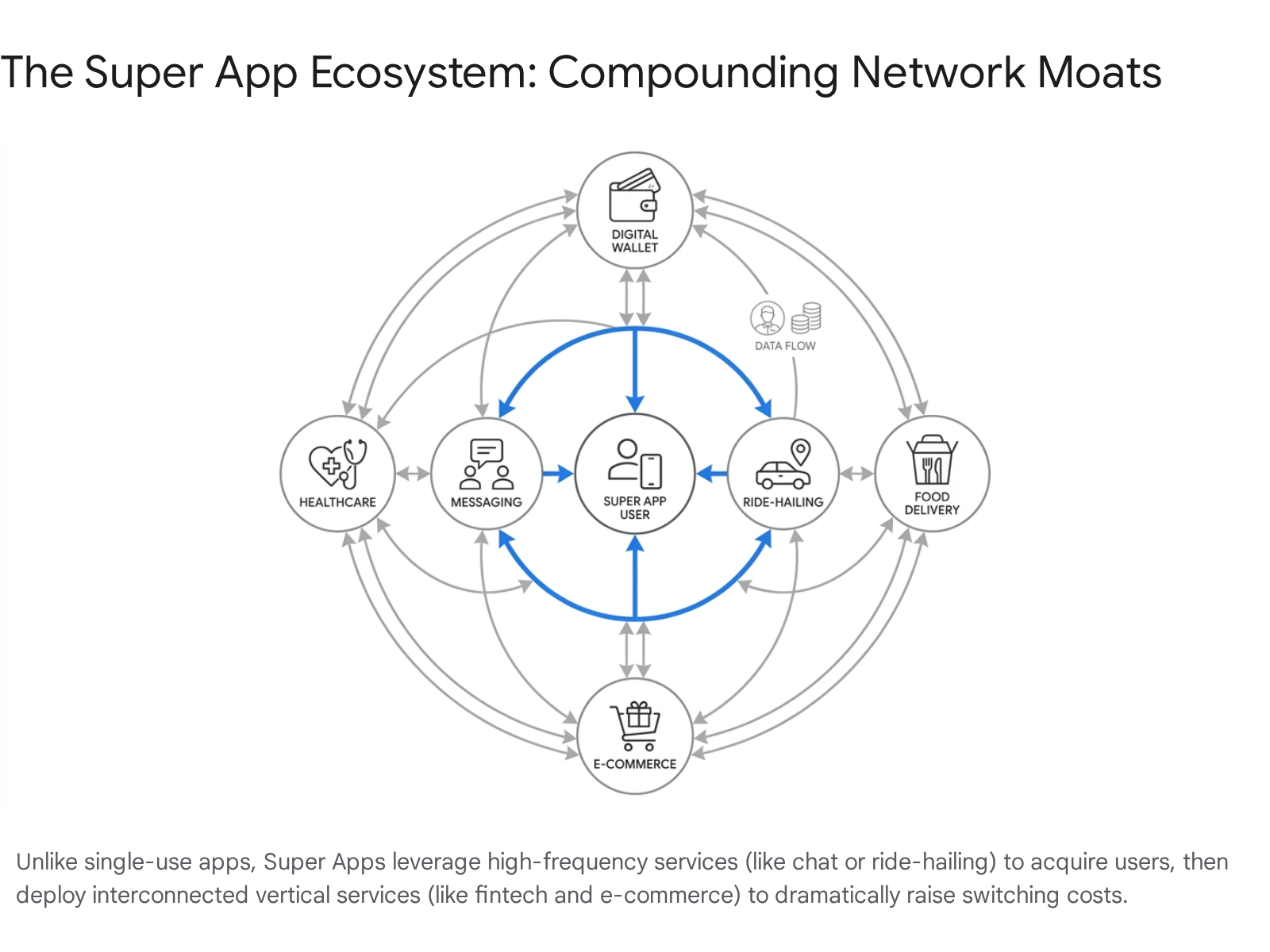
Because an individual's entire social graph, digital wallet, and daily utilities are inextricably entangled within this single platform, the switching costs are practically infinite. Relinquishing WeChat equates to exiting modern Chinese society 40. Western companies, such as Elon Musk's attempts with X, frequently struggle to replicate this model due to entrenched consumer habits, stricter antitrust regulations, and the robust defensive postures of incumbent banks and specialized platforms 36739.
The Southeast Asian Battlefield: Grab vs. Gojek
While WeChat monopolized China, the battle to build the definitive super app of Southeast Asia has been waged by two fiercely competitive behemoths: Grab (headquartered in Singapore) and Gojek (part of Indonesia's GoTo Group) 41428.
Both companies utilized a brilliantly executed "wedge" strategy. They began exclusively as ride-hailing and motorcycle-taxi services 42. Historically, ride-hailing is a notoriously low-margin, capital-intensive business 42. However, Grab and Gojek treated transportation not as a primary profit center, but as a viral acquisition hook to build a massive, highly engaged user base that opened the app daily 42.
Once liquidity was established and millions of citizens had their payment credentials stored in the system, both platforms rapidly expanded horizontally, layering on food delivery, package logistics, and critically, proprietary financial services like GrabPay and GoPay 414445. This deliberate ecosystem expansion supercharged their multi-sided network effects. A massive pool of daily riders attracted a massive fleet of drivers; that dense driver network enabled hyper-fast, low-cost food delivery; the sheer volume of daily transactions incentivized offline merchants to adopt the platform's digital wallets; and the resulting avalanche of financial data allowed the companies to accurately underwrite micro-loans and insurance policies for unbanked populations 94144.
As the market matured into 2025 and 2026, the strategic differences between the two giants became stark. Grab pursued aggressive regional scale, operating across eight Southeast Asian nations 4647. Gojek, conversely, doubled down on hyper-local depth, focusing fiercely on dominating its home market of Indonesia - the region's largest economy - and integrating closely with e-commerce giant Tokopedia 424446.
| Strategic Dimension | Grab Holdings | Gojek (GoTo Group) |
|---|---|---|
| Primary Geographic Focus | Regional scale across 8 Southeast Asian nations | Hyper-local dominance within Indonesia |
| Ride-Hailing Market Share | Commands ~70% across Southeast Asia | Primary adversary holding ~20% in Indonesia |
| Ecosystem Synergy | Average MAU utilizes 1.7 services, driving 3x LTV | Deep integration with local merchants and e-commerce |
| Financial Performance (2025) | Record $3.37B revenue; achieved full-year net profit | Cut losses by 29%; 3.9 trillion rupiah Q3 revenue |
| Top Revenue Market (2025) | Malaysia ($1.04B), followed by Singapore ($727M) | Indonesia |
Data reflecting financial filings and market analysis through late 2025 and early 2026 846474849.
By early 2026, Grab's strategy of relentless cross-selling yielded spectacular results. In 2025, the company posted a record $3.37 billion in revenue, growing 20% year-over-year, and officially achieved its first full-year net profit of $200 million, alongside an adjusted EBITDA of $500 million 4749. Grab demonstrated that an average user engaging with 1.7 different services generates a lifetime value three times higher than a user isolated to a single vertical 47. Grab successfully transitioned its network effects from an engine that merely subsidized unprofitable growth into a moat that prints sustainable, scalable profits 4749.
Porting the Social Graph: Threads vs. X in 2026
Building a multi-sided network effect entirely from scratch is notoriously brutal. Founders face the dreaded "cold start problem": prospective users refuse to join a platform because there is no content, and content creators refuse to invest time in a platform because there are no users to consume it 25. Overcoming this friction usually requires massive capital expenditure or a once-in-a-generation viral spark.
However, Meta's launch of the microblogging platform Threads in July 2023 provided a masterclass in bypassing the cold start problem altogether by leveraging - or "porting" - an existing network graph. Built by the engineering team behind Instagram, Meta strategically tied a user's new Threads identity directly to their established Instagram account 50. When individuals downloaded Threads, they were given the option to automatically follow everyone they were already connected to on Instagram 5051.
This architectural decision resulted in unprecedented, historic viral growth. Threads accumulated 100 million sign-ups in a mere five days, obliterating the previous speed-to-scale records held by generative AI applications like ChatGPT 5253. But unlike the ephemeral spike seen with Clubhouse, Threads was not an empty room. Because the social graph was imported instantly, users experienced immediate network liquidity. Their feeds were immediately populated with recognizable content from established relationships 5054.
While the initial media narrative fixated heavily on the platform's early engagement volatility - dropping from 41.8 million daily active users on launch day to roughly 10 million by August 2023 - Meta continuously deployed rigorous, algorithm-driven retention strategies 5053. They aggressively shipped highly requested features, refined content discovery without relying heavily on traditional hashtags, and prioritized community-first, conversational interactions over passive broadcast media 505455.
By 2025 and moving deeply into 2026, Threads had definitively proven its staying power, completing a remarkable transition from a reactive, hastily launched alternative into a dominant, standalone social media force 56. The competitive dynamics against Elon Musk's X (formerly Twitter) reached a pivotal inflection point, representing one of the rare instances in tech history where a challenger network successfully fractured the moat of a deeply entrenched incumbent.
| Engagement Metric (Early 2026) | Threads | X (Formerly Twitter) |
|---|---|---|
| Global Monthly Active Users (MAUs) | > 400 million | ~ 550 million |
| Mobile Daily Active Users (DAUs) | 143.2 million (Growing ~37.8% YoY) | 126.2 million (Declining ~11.9% YoY) |
| Median Engagement Rate Per Post | 6.25% | 3.60% |
| Daily Active Web Visits (Global) | ~ 8.9 million | 149.4 million |
| U.S. Mobile DAUs | 19.5 million | 21.2 million |
Data aggregated from Similarweb and corporate reporting spanning January to May 2026 505253559.
The 2026 data illustrates a deeply nuanced battlefield. On mobile devices, Threads has achieved what many analysts considered impossible: surpassing X in global Daily Active Users. In the first weeks of January 2026, Threads averaged 143.2 million mobile DAUs worldwide, leaving X trailing at 126.2 million 9. Furthermore, content on Threads generates substantially deeper interactions; a comprehensive analysis of over 10 million posts revealed that Threads achieves a median engagement rate of 6.25%, dwarfing X's 3.6% 55.
However, asserting that Threads has entirely "defeated" X ignores a critical dimension of network behavior. Despite hemorrhaging mobile users, X maintains an absolute, almost unassailable dominance in traditional web traffic. In early 2026, X continued to record nearly 150 million daily active web users globally, while Threads languished at roughly 8.9 million 9. This discrepancy highlights that X remains deeply embedded in the desktop-oriented workflows of journalists, financial analysts, and breaking-news infrastructure. Threads successfully captured the conversational, casual social graph via mobile app integration, but X retains its specific utility as a real-time, desktop-centric information terminal 50910.
The Investor's Blueprint: Quantifying Defensibility
Venture capitalists, private equity analysts, and specialized growth engineers do not view virality and network effects as abstract, philosophical concepts. They evaluate them meticulously through rigorous quantitative frameworks. Prominent venture firms like Andreessen Horowitz (a16z) and NFX have developed specific matrices to determine if an application truly possesses compounding network effects or if it is merely riding a transient viral wave 12559.
When institutional investors evaluate a digital product's defensibility and long-term staying power, they scrutinize several core metrics 25:
1. The Trajectory of Organic vs. Paid Acquisition In a business fortified by authentic network effects, the percentage of organic, unpaid users relative to paid users must consistently increase over time 25. As the network expands and its inherent utility grows, new users should naturally seek out the platform to extract that value. If a consumer application has been operating for several years but still relies on paid marketing channels to acquire more than 20% of its new users, it is a severe red flag indicating the product lacks intrinsic network pull 59.
2. Cohort Retention Curves The absolute defining characteristic of a compounding network effect is that newer user cohorts should demonstrate superior retention rates compared to older cohorts 25. Consider a user joining a marketplace in Year 3 versus Year 1. By Year 3, the platform offers exponentially more supply, diverse content, and community interaction. Because the product is objectively better due to increased density, the Year 3 user should theoretically churn at a much lower rate than the pioneer who joined an empty platform in Year 1 25.
3. The Prevalence of "Multi-Tenanting" and Switching Costs Investors rigorously assess how easily users can operate on the target platform and a rival platform simultaneously - a behavior known as "multi-homing" or "multi-tenanting" 25. In the ride-hailing sector, drivers and riders routinely flip between Uber and Lyft depending on minute-by-minute pricing algorithms 25. This high prevalence of multi-tenanting forces companies into perpetual price wars, severely compressing profit margins. Conversely, B2B enterprise software or professional networks like LinkedIn boast massive switching costs; it is highly impractical for a user to actively maintain their professional identity and connections across three competing networks simultaneously. High switching costs equal robust defensibility.
4. Time Series of Local Unit Economics For companies reliant on local network effects - such as food delivery platforms like DoorDash or Instacart - the impact of the network must manifest directly in the unit economics on a city-by-city basis 25. As density increases within a specific municipal market, the Customer Acquisition Cost (CAC) should plummet, delivery route efficiency should surge, and the localized profit margins should steadily rise, creating a self-sustaining local monopoly 25.
The power of networks extends even to the capitalization of the startups themselves. Recent market data from PitchBook reveals a fascinating meta-trend: startups led by well-connected, highly networked lead investors experience failure rates up to 10 percentage points lower than identical peers backed by peripheral, isolated investors 11. Just as a digital product derives utility from the density of its user base, a nascent company derives tangible survival advantages from the information networks, talent pipelines, and follow-on capital connections of its backers 11.
Bottom line
The critical difference between virality and network effects is the difference between an ephemeral cultural trend and a durable, cash-generating business. Virality is a powerful, highly visible acquisition mechanism that leverages psychological hooks and social validation to drive rapid, low-cost growth. Network effects, conversely, are structural, mathematical economic advantages where a product becomes inherently more indispensable as its user base expands. While it is entirely possible for clever marketers to manufacture a short-term viral spike, true market dominance - as evidenced by the rise of Southeast Asian super apps and the intricate battle between Threads and X - requires the painstaking construction of high switching costs and continuous, compounding value that makes abandoning the network a painful proposition for the user.