
How a Viral Product Launch Unfolds Step by Step
A viral product launch is rarely an accident; it is an engineered collision of social media momentum, artificial scarcity, and psychological triggers. However, the true test of a launch is not the initial spike in sales, but the immediate operational fallout, as crushing server loads, supply chain bottlenecks, and an avalanche of customer support tickets determine whether the company survives. Ultimately, the success of a viral product is measured by its ability to navigate the "retention cliff" and convert impulsive, trend-driven buyers into long-term, repeat customers.
The Illusion of Spontaneous Virality: The Pre-Launch Phase
Going viral is often perceived by consumers as a spontaneous, organic phenomenon where a product magically captures the cultural zeitgeist overnight. In reality, modern product launches are meticulously orchestrated campaigns that spend months building a foundation before a single unit is sold to the public. The most successful consumer and digital product launches leverage deep behavioral psychology, specifically the principles of social proof and scarcity marketing.
The industry standard for engineering a high-impact launch typically follows a structured 90-day cycle designed to maximize anticipation while controlling the release of information 1.
Phase 1: The Foundation and Messaging (Days 1 - 30)
Long before a product is teased, brands engage in deep-dive market research to define their Ideal Customer Profile (ICP) and core messaging 1. This phase is about identifying the specific friction points in the current market and positioning the new product as the definitive solution. In the modern landscape, where consumers are highly skeptical of polished corporate advertising, the messaging must feel authentic, community-driven, and slightly raw 23. Brands actively map out their "viral loops" - the mechanisms by which the regular use of the product inherently exposes it to new potential users 4.
Phase 2: The Hype Machine and Artificial Scarcity (Days 31 - 60)
During the second month, the brand begins its public-facing operations without actually releasing the product. The goal here is to build a massive audience and generate hype 1. This is often achieved through the creation of a "viral waitlist" 1. By asking consumers to sign up for early access, brands accomplish two things: they capture high-intent, first-party data (email addresses and phone numbers), and they manufacture a sense of exclusivity.
This period is characterized by strategic product seeding. Brands send early production units to a carefully curated mix of macro-influencers and micro-influencers 56. Micro-influencers - creators with smaller but highly engaged audiences - often yield higher engagement rates than celebrities, making their endorsements feel like genuine recommendations from a peer rather than paid advertisements 57. Content is embargoed until specific dates, creating a coordinated wave of unboxing videos and reviews that flood social media algorithms simultaneously.
Phase 3: The Runway and Launch Event (Days 61 - 90)
In the final 30 days, the brand shifts from teasing to aggressive acceleration. This involves "runway" email sequences that educate the waitlist about the product's benefits, behind-the-scenes content that builds founder affinity, and the announcement of strict launch times 16.
When executed correctly, this scarcity marketing turns a standard e-commerce transaction into an event. The psychological trigger of scarcity - the fear of missing out (FOMO) - compels consumers to act immediately rather than waiting 89. As demonstrated by brands across industries, limiting initial supply can drive secondary market prices up, creating a feedback loop where the product's sheer unavailability makes it even more desirable 910.
The Digital Avalanche: Surviving the Traffic Spike
When the countdown timer hits zero and the cart finally opens, the immediate impact of a viral launch is felt by the brand's digital infrastructure. A viral traffic spike does not behave like steady, organic business growth. Instead of a gradual increase in visitors over months, a viral event drives tens of thousands of concurrent users to a website in a matter of minutes 23.
The Architecture of Server Collapse
If a website is hosted on a traditional shared server, the sudden influx of visitors acts almost like a distributed denial-of-service (DDoS) attack. A web server has finite resources - specifically CPU, RAM, and bandwidth 23. Every time a user loads a page, the server must execute scripts, load high-resolution product images, and query the database for current inventory levels 3.
During a viral spike, these database reading operations surge dramatically. According to industry performance reports, unoptimized query executions can suddenly consume more than 80% of a server's resource utilization under heavy load 3. When the server's capacity is breached, the website will experience severe latency, timeout errors, or a complete crash 23.
The financial consequences of digital failure are immediate and severe. Consumer patience in the digital age is practically nonexistent. Research indicates that if a website takes longer than eight seconds to load, the vast majority of visitors will abandon the site entirely 2. Furthermore, for every one-second delay in page load time, a brand can expect to lose up to 20% of its potential conversions 3. The excitement of a viral moment can instantly evaporate into consumer frustration, damaging the brand's credibility 2.
Cloud Infrastructure Mitigation Strategies
To survive the digital avalanche, enterprise-level brands and savvy direct-to-consumer (DTC) startups rely on highly elastic cloud infrastructures. Managing these spikes requires a combination of proactive planning and automated technological safeguards:
- Auto-Scaling Environments: Modern cloud architectures utilize auto-scaling to monitor resource usage continuously. When predefined thresholds are breached (e.g., CPU usage hits 75%), the system automatically spins up additional server instances within minutes to handle the load, ensuring optimal performance 4.
- Container Orchestration: Utilizing platforms like Kubernetes allows engineering teams to package applications into isolated containers. These containers can be started, stopped, or duplicated incredibly quickly in response to traffic demands, allowing the infrastructure to scale horizontally with high efficiency 4.
- Load Balancing: A load balancer acts as a digital traffic cop, evenly distributing incoming network requests across a cluster of servers. This ensures that no single machine becomes a bottleneck, maintaining reliability even when overall traffic volume is massive 24.
- Content Delivery Networks (CDNs): To alleviate the strain on the primary origin server, brands utilize CDNs to cache static assets (like HTML files, javascript, and high-resolution product images) on a globally distributed network of edge servers. When a user visits the site, the heavy visual assets are delivered from a server geographically close to them, drastically reducing load times and backend server stress 4.
- Simulated Load Testing: Under normal conditions, hidden weaknesses in code, memory leaks, and slow database queries remain dormant. Operational research shows that companies performing routine load tests - simulating peak concurrency scenarios before the actual launch - see a 40% decrease in overall outages 3.
The Operational Stress Test: Supply Chain and Logistics
If the cloud infrastructure holds and the sales process seamlessly, the crisis immediately shifts from the digital realm to the physical warehouse. A viral product does not simply generate more revenue; it fundamentally destabilizes inventory management, fulfillment capacity, and cash flow 5.
The Fulfillment Bottleneck
Normal e-commerce growth allows a business time to adapt. A warehouse can transition from processing 30 orders a day to 100, and eventually 500, by gradually optimizing warehouse routing, hiring additional staff, and upgrading their order management software 5. Viral demand strips away the luxury of time. A TikTok video taking off can catapult daily order volumes from a few dozen to several thousand overnight 56.
The sheer volume of picking, packing, and coordinating with approved shippers creates an instant bottleneck 7. Warehouse teams, rushing to meet the sudden demand, inevitably experience a drop in quality control. The risk of improper packaging rises, leading to damaged goods in transit 517. Labeling errors - such as incorrect SKU mapping or unreadable barcodes - cause shipments to be delayed or returned by the carrier 17.
The Realities of Modern Shipping Delays
Even when a brand manages to get the product out the warehouse door, the macroeconomic realities of global logistics can quickly derail the customer experience. Up to 80% of online consumers have reported experiencing delivery delays in recent years, a phenomenon that only compounds during peak viral spikes 18.
The root causes of these delays extend far beyond simple courier inefficiency: * Inventory Visibility Failures: A lack of real-time synchronization between the e-commerce storefront, the Order Management System (OMS), and the Warehouse Management System (WMS) leads to the overselling of out-of-stock items, creating massive backlogs 17. * Global Supply Chain Brittleness: Hardware and complex consumer products are rarely manufactured in a single location. A product might be assembled in China, but rely on specialized components sourced from Japan, Taiwan, and Germany 8. The trend toward "lean manufacturing" - minimizing warehouse storage to save costs - means that brands are often only a few weeks away from running out of parts 8. When a viral spike depletes inventory, the lead time to manufacture and ship new units across the ocean can stretch into months, killing the product's momentum 8. * Weather and Carrier Disruptions: Extreme weather events account for nearly 23% of all systemic shipping delays 17. When compounded with port congestion, labor shortages, and seasonal volume peaks, the final-mile delivery network frequently collapses under the weight of unexpected viral volume 18.
TikTok Shop Compliance and The Algorithmic Punishment
The operational risks of viral fulfillment have been drastically amplified by the rise of integrated social commerce, particularly TikTok Shop. Unlike traditional platforms like Shopify, where a brand fully controls the customer relationship and shipping timelines, TikTok Shop operates as a heavily regulated marketplace that prioritizes consumer experience above all else 7.
TikTok imposes a strict Service Level Agreement (SLA) on its merchants. The most critical metric is the Late Dispatch Rate (LDR), which must remain under 4% 7. In practical terms, this gives a brand a maximum of 48 hours (two business days) to pick, pack, and have a courier physically scan a package into their tracking system 7.
For a small or mid-sized business hit with thousands of viral orders, maintaining a 4% LDR is nearly impossible without highly automated, enterprise-grade logistics 67. If a brand misses this 48-hour window, TikTok's automated enforcement system engages without human intervention. The penalties are draconian: the platform will impose Order Volume Limits (actively capping the number of sales the brand can process), levy financial fines that can reach up to 20% of the total order value, delay cash payouts, and suppress the brand's visibility in the algorithm 7. In essence, an operational failure on TikTok Shop doesn't just result in angry customers; it actively destroys the viral momentum the brand fought to achieve.
TikTok has attempted to solve these issues by introducing "Fulfilled by TikTok" (FBT), demanding that sellers move inventory into TikTok-controlled warehouses 209. However, this centralization creates a massive conflict for brands operating multi-channel businesses. Sending bulk inventory into a TikTok warehouse requires the brand to accurately forecast demand on a platform famous for unpredictable spikes. If the inventory is locked in an FBT warehouse, it cannot be used to fulfill orders on the brand's primary website or Amazon store 209. Facing immense pressure and threats of sellers abandoning the platform, TikTok was recently forced to pause its mandate eliminating independent shipping, highlighting the intense friction between viral platforms and physical logistics 20.
A Tale of Two Supply Chains: The U.S. vs. China Live-Commerce Model
The operational failures frequently experienced by Western brands during viral spikes underscore a massive structural gap between the supply chain infrastructure in the United States and the mature live-commerce ecosystem in Asia.
Asia, led predominantly by China, is the undisputed global epicenter of live-streaming e-commerce. In 2024, the Asian live-streaming market generated an estimated $370 billion in revenue, with China alone accounting for roughly $350 billion of that total 10. Other estimates place the total Chinese live commerce market value even higher, projecting it to reach $800 billion, representing a massive slice of the country's total online retail sales 1112. By comparison, the entirety of the Americas generated roughly $27 billion in live-streaming revenue, with the United States contributing just under $17 billion 10.
This vast disparity in revenue is not merely a reflection of consumer preference; it is the result of fundamentally different backend architectures.
The Chinese Infrastructure Advantage
In China, platforms like Douyin (ByteDance's domestic equivalent to TikTok), Taobao Live, and Kuaishou have evolved beyond simple entertainment apps; they are the operating systems for modern retail 101213. Market penetration is astonishing, reaching 30% for categories like food and 15% for electronics 10. Conversion rates during Chinese live streams frequently exceed 30%, dwarfing the conversion metrics of traditional Western e-commerce sites 2627.
This high-velocity sales environment is sustained by a deeply integrated, hyper-efficient supply chain 12. The ecosystem is managed by professional Multi-Channel Networks (MCNs) 12. These MCNs act as institutional talent agencies, production studios, and logistical coordinators combined. They manage the top Key Opinion Leaders (KOLs), providing them with rigorous Standard Operating Procedures (SOPs) for broadcasting, real-time data analysis, and direct coordination with factories 12.
China's manufacturing dominance is not just about cheap labor; it is about density, proximity, and infrastructure 282930. The country has spent decades building the largest high-speed rail system in the world, connecting inland manufacturing hubs directly to massive coastal export ports 30. Furthermore, the material supply chain is localized. A factory producing electronics or textiles in China can source nearly all its raw materials and sub-components from neighboring facilities 29.
This proximity enables the "Wuhu Model" (or no-inventory model), where trending products are sourced directly from platforms like 1688 and listed on platforms like TikTok Shop using ERP tools, allowing for low-cost, hyper-fast fulfillment without the brand taking on heavy inventory risks 31. When a KOL generates a million orders in a single hour on Douyin, the deeply integrated MCN and factory ecosystem can spin up production and utilize the advanced rail network to fulfill the orders with a speed that Western supply chains simply cannot match 1230.
The Western Logistics Disconnect
Conversely, the United States relies heavily on imported goods and a fragmented, legacy logistics network. Brands operating in the US generally design products locally, source materials globally, manufacture in Asia, ship via slow ocean freight to the West Coast, and then distribute through a complex web of 3PL (Third-Party Logistics) warehouses 830.
While US brands often excel in technological innovation, brand storytelling, and strict quality control, they are structurally ill-equipped to handle real-time, volatile sales environments 28. As live-commerce and viral TikTok trends attempt to graft themselves onto this slower, traditional retail model, the resulting friction creates the stockouts, delayed shipping, and operational chaos that define so many viral US launches 2832.
| Feature | Chinese Live-Commerce Ecosystem | U.S. E-Commerce Ecosystem |
|---|---|---|
| Market Size (2024 Est.) | ~$350B - $800B 1011 | ~$17B 10 |
| Conversion Rates | Frequently > 30% during live sessions 2627 | Typically 2% - 5% (traditional e-commerce metrics) |
| Operational Management | Institutional MCNs managing talent, data, and factories 12. | Fragmented; agencies handle marketing, 3PLs handle logistics. |
| Supply Chain Proximity | Highly localized; raw materials and assembly closely co-located 2930. | Highly distributed; heavy reliance on trans-Pacific ocean freight 8. |
| Dominant Platforms | Douyin, Taobao Live, Kuaishou 101213 | TikTok Shop, Instagram, Amazon Live 3233 |
The Support Scaling Paradox: When Customer Service Breaks
As fulfillment bottlenecks cause shipping delays, the operational crisis inevitably crashes into the customer support department. A common, yet highly destructive, assumption among scaling startups is that support ticket volume will grow linearly with revenue. This is a fatal miscalculation.
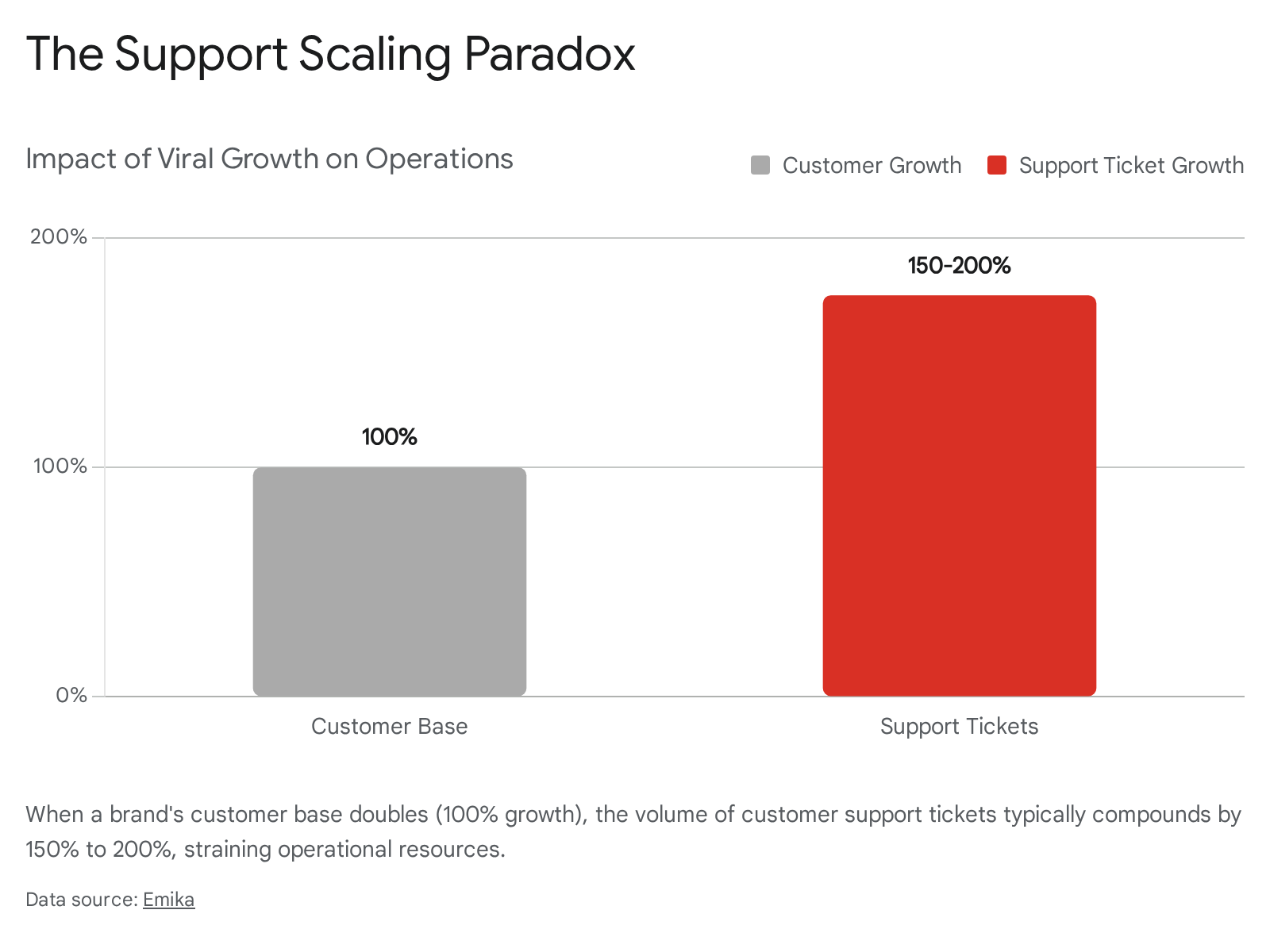
When a brand successfully executes a viral launch and doubles its total customer base, the volume of customer support tickets does not merely double. Operational data indicates that businesses commonly experience a 150% to 200% increase in support ticket volume for every 100% increase in customers 34. This compounding phenomenon is known as the "support scaling paradox" 34.
Why Ticket Volume Compounds
During the first week of a major product launch or viral event, it is standard for ticket volume to spike to 3x or even 5x its normal baseline 35. This disproportionate surge is driven by several compounding factors:
- The New Customer Tax: First-time buyers inherently generate more support requests than legacy customers. They are unfamiliar with the brand's sizing, return policies, and product interfaces, requiring more hand-holding 34.
- WISMO Requests: The single largest driver of the support paradox is the WISMO ("Where Is My Order?") ticket. The moment the warehouse falls behind and shipping delays occur, anxious consumers flood the inbox demanding tracking updates 34.
- Product Complexity and Edge Cases: Scaling a product exposes it to environments and use cases that internal testing could never replicate. As the user base expands rapidly, new edge cases, integrations issues, and previously undiscovered bugs emerge, generating complex, time-consuming support tickets 3435.
The Cost of Support Failure
If a brand fails to manage this backlog, the financial implications stretch far beyond the immediate cost of hiring extra agents. Customer support interactions serve as an early warning system for product health and customer sentiment 36.
When ticket queues back up, resolution times stretch from hours to days. Research from ProfitWell indicates that SaaS and e-commerce companies experiencing a 30% increase in product-related support tickets see a corresponding 10% to 15% increase in customer churn over the following quarter if those issues are not resolved swiftly 36. Furthermore, support data shows that customer sentiment correlates directly with retention; prolonged resolution times and repeat issues drastically increase the probability of an account churning 37.
To mitigate the support scaling paradox, modern operations teams cannot rely solely on manual labor. Industry estimates suggest that a manually processed support ticket costs a company between $20 and $30 when factoring in staffing, tooling, and management overhead 34. Instead, brands must implement aggressive deflection strategies. This includes establishing robust, user-friendly self-service portals and knowledge bases, allowing customers to resolve simple queries without agent intervention 3638. Additionally, deploying AI-assisted workflows and auto-responders during a launch spike can cut human reply times by up to 30%, allowing a strained team to triage the backlog effectively 3435.
The Dangers of Going Viral: Fads, Quality Control, and Backlash
The intoxicating rush of going viral often blinds business owners to a harsh reality: virality is not validation. E-commerce experts and product analysts draw a strict line between a fad and a trend. Understanding this difference is the key to surviving the post-launch lifecycle.
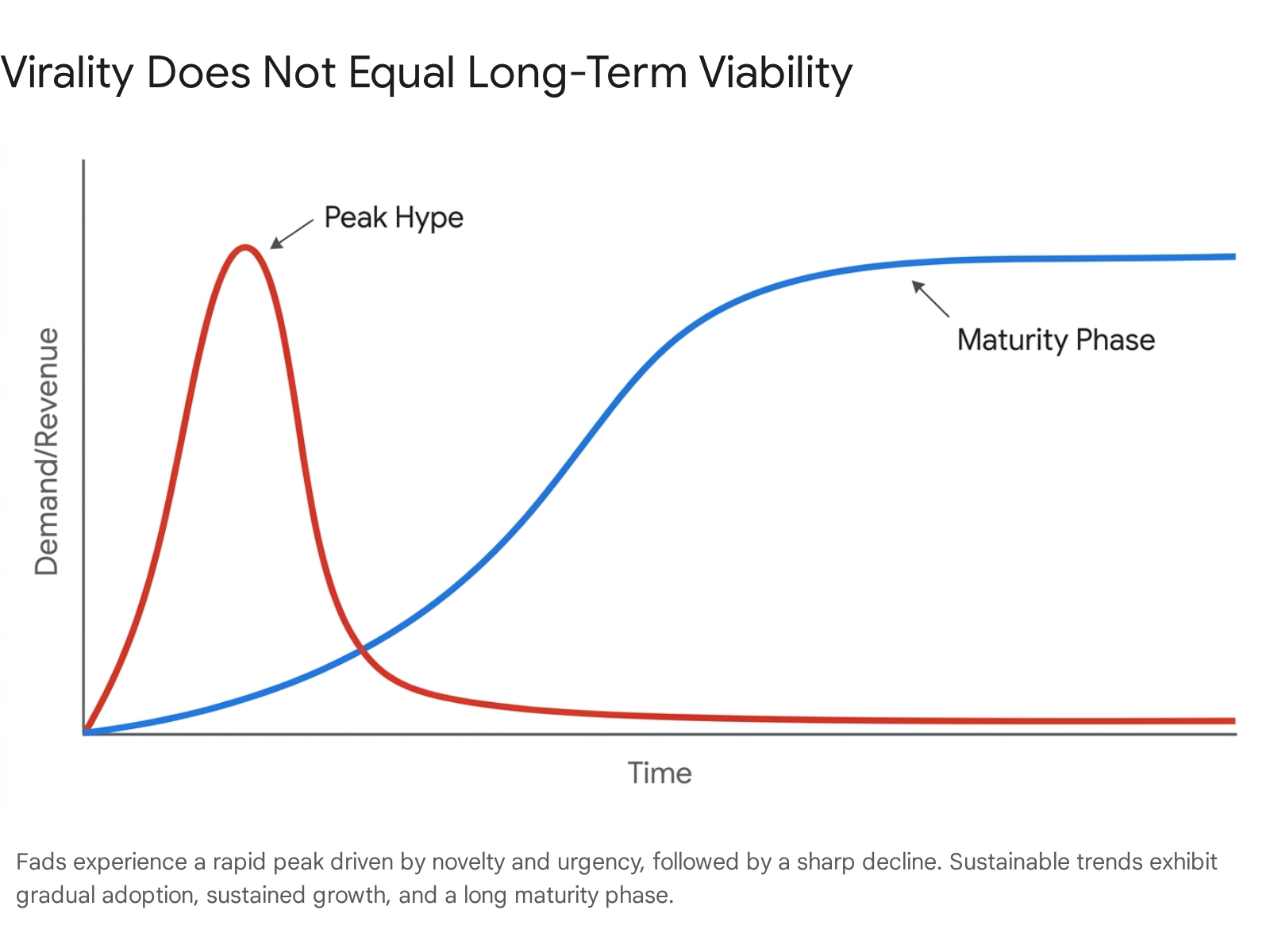
A fad is characterized by intense, short-lived enthusiasm driven purely by novelty, social pressure, and artificial urgency 39. Fads lack underlying utility; they spike dramatically over a few months and then suffer a terminal crash 39. Conversely, a trend is driven by genuine shifts in consumer behavior or technology, solving real problems, and exhibiting a gradual, sustained growth curve that settles into a long maturity phase 39.
The statistics surrounding trend-driven products are sobering: approximately 75% of new consumer packaged goods (CPG) fail within their first year, and only 15% maintain commercial viability after two years 39. When a fad goes viral, it often triggers a disastrous cycle of overproduction and quality degradation. The internet moves faster than the market, resulting in a relentless cycle where micro-trends generate immense consumer demand, brands rush to overproduce to meet it, and the market becomes saturated with copycats and inferior products just as consumer interest inevitably collapses 1441.
Case Study: The Pink Sauce Quality Control Disaster
Perhaps no product exemplifies the dangers of unchecked virality and premature scaling better than the "Pink Sauce" phenomenon. In the summer of 2022, a Miami-based private chef went viral on TikTok by showcasing a vibrant, Pepto-Bismol-colored condiment poured generously over fried chicken 4215. The visual novelty sent the internet into a frenzy.
The creator capitalized immediately, launching a pre-sale that sold out instantly. At $20 a bottle, she moved 1,600 units within 30 days, generating $50,000 in revenue 42. However, this was a catastrophic operational failure disguised as a marketing success. The product was entirely unready for mass commercial distribution.
The sauce, which contained milk, was shipped across the country via standard ground mail in the middle of summer without proper refrigeration, protective packaging, or stabilizing preservatives 154416. The results were predictable: consumers received swollen, exploded bottles containing a rancid, spoiled product 424446.
Adding to the chaos, the nutritional labels were wildly inaccurate, infamously claiming 444 servings per bottle - which would make a single bottle of condiment contain nearly 40,000 calories - and misspelled basic ingredients like "vinegar" 4246. The public backlash was severe. The unknown pH levels of the unrefrigerated sauce sparked genuine fears of botulism, drawing the scrutiny of the Food and Drug Administration (FDA), which strictly regulates food safety standards for mass-marketed condiments 421544.
The Pink Sauce saga serves as a brutal masterclass in what happens when the hype outpaces the infrastructure. As industry experts noted, mail-ordering a perishable food product while it is effectively still in a trial phase is an accident waiting to happen 15. The creator assumed that virality equated to business readiness, severely underestimating the rigorous quality control required to scale a physical product safely.
The Scarcity Trap: The Rise and Fall of Prime Hydration
While Pink Sauce failed on quality control, Prime Hydration illustrates how a massive success can cannibalize itself through "masstige dilution." Launched in 2022 by mega-influencers Logan Paul and KSI (who boast tens of millions of highly engaged teenage followers), Prime eschewed traditional marketing in favor of extreme artificial scarcity 84748.
By severely limiting the initial supply shipped to retailers, Prime engineered a frenzy. The inability to find the product turned it into a bizarre luxury good and a digital status symbol for Gen Alpha and Gen Z consumers 9. Secondary markets exploded, with bottles of the energy drink being resold for heavily inflated prices - sometimes reaching £100 a bottle in the UK 8. This scarcity-driven hype loop propelled the brand to a staggering $1.2 billion in sales in 2023, moving nearly a billion bottles 48.
However, the brand fell into the classic fad trap: building for the spike, not the plateau 39. As Congo Brands (the operational company behind Prime) scaled up factories and flooded supermarkets to meet the perceived demand, the scarcity vanished. When a product whose primary value proposition is its exclusivity becomes easily available on every shelf in Target or Aldi, it immediately loses its cultural cachet 8948.
By the first quarter of 2024, the bubble burst. Prime's UK sales plummeted by 50% year-over-year, dropping from £26.8 million to £12.8 million 9. The very bottles that teenagers had previously queued at dawn to purchase were suddenly lingering in bargain bins, marked down by 90% to a mere 31 pence 9. Despite attempting to pivot to traditional brand-building by throwing massive sponsorship money at the UFC and Arsenal Football Club, Prime discovered that once the viral illusion of scarcity breaks, retaining a fickle, trend-driven audience is nearly impossible 8948.
The Software Side: Viral Loops and Bottom-Up Adoption
While physical consumer packaged goods struggle with shipping and inventory during viral spikes, the software and digital product sector faces its own unique launch dynamics. In the SaaS (Software as a Service) and app space, successful virality is rarely driven by a single funny video. Instead, the most valuable tech companies build "viral loops" directly into the core architecture of their products 4.
A viral loop exists when the normal, intended use of a product naturally exposes it to non-users, turning every active customer into an acquisition channel 4.
Post-Mortems of Digital Launches
An analysis of massive digital product launches reveals a stark contrast between platforms that engineered sustainable product-led growth versus those that relied purely on expensive marketing or artificial exclusivity.
- Figma (The Success): When Figma launched into a market dominated by Adobe, they did not rely on massive ad spend. Instead, they made their design tool entirely browser-based and defaulted to multiplayer collaboration 4. A single designer would discover Figma, create a project, and share a link with developers or copywriters to collaborate. Because the tool was freemium and required no installation, those collaborators immediately became users. This "bottom-up" adoption created an unstoppable viral loop that eventually led to a $20 billion acquisition attempt by Adobe 4.
- Notion (The Success): Notion achieved a $10 billion valuation with nearly zero marketing spend by tapping into community creation 4. They built a genuinely useful free tier and targeted "power users." More importantly, they built a "template economy." Users created complex workflows and shared them publicly. Every shared template acted as free, highly targeted marketing, demonstrating the product's value and pulling new users into the ecosystem 4.
- Quibi (The Failure): Quibi raised $1.75 billion before launch, relying entirely on Hollywood star power and aggressive marketing 4. However, they ignored fundamental user behavior. Launched during the pandemic lockdowns (destroying their "on-the-go" commuting use case), the platform stubbornly refused to let users take screenshots or share clips on social media 4. By disabling sharing, they intentionally killed any chance of organic, meme-driven virality. Facing a 90% trial churn rate and missing subscriber targets by 93%, the company shut down in six months 4.
- Clubhouse (The Fad): The audio-chat app exploded during the pandemic, driven by extreme exclusivity (invite-only access) and appearances by celebrities like Elon Musk. It reached a peak of 10 million weekly users and a $4 billion valuation 4. However, the product lacked a sustainable moat. As they delayed opening the platform to the public, giants like Twitter (Spaces) and Facebook simply cloned the feature. When Clubhouse finally opened up, the market window had closed, and they lost 70% of their user base within months 4.
| Launch Strategy | Viral Loop Mechanism | Outcome | Lesson Learned |
|---|---|---|---|
| Figma | Browser-based, frictionless multiplayer collaboration 4. | $20B acquisition attempt 4. | Product use naturally drives acquisition. |
| Notion | User-generated template economy and public sharing 4. | $10B valuation; 90% organic growth 4. | Empower community to create marketing assets. |
| Quibi | Locked ecosystem; screenshot sharing disabled 4. | Shut down in 6 months; 90% churn 4. | You cannot force behavior against platform norms. |
| Clubhouse | Invite-only exclusivity; FOMO 4. | Lost 70% of users as giants cloned features 4. | Artificial scarcity is a temporary moat. |
Surviving the Retention Cliff: Building a Billion-Dollar Brand
The fundamental truth of modern business is that going viral is an acquisition strategy, not a business model. Once the servers stop crashing and the warehouse catches its breath, executives must confront the most terrifying metric in e-commerce: the retention rate.
The mathematics of customer loyalty are unforgiving. Across industries, acquiring a new customer is consistently 5 to 25 times more expensive than retaining an existing one 495051. If a brand continuously relies on viral stunts or expensive ad campaigns to acquire one-time buyers, the upfront Customer Acquisition Cost (CAC) will eventually completely erode their profitability 5152. Conversely, the ROI on retention is astronomical; increasing customer retention by a mere 5% can boost a company's bottom-line profits by 25% to 95% 495051525354.
Brands that successfully transition from a viral moment to a billion-dollar valuation achieve this by rigorously tracking the CLV:CAC ratio (Customer Lifetime Value to Customer Acquisition Cost) 4950. A healthy business aims for a ratio of 3:1 or higher, meaning a customer will spend three times what it cost to acquire them over the course of their relationship with the brand 49.
Achieving this requires turning a viral fad into a sustained cultural trend. Two recent beauty and beverage brands provide the blueprint for navigating this transition.
Rhode: The Power of Premium Restraint
Launched in June 2022 by Hailey Bieber, Rhode defied the notoriously high failure rate of celebrity beauty brands - where 80% of lines fail to reach profitability 55. Rather than launching a sprawling, 50-item catalog to capitalize on her fame, Rhode entered the market with radical minimalism: just three meticulously formulated skincare products 55.
Rhode mastered the art of the viral "drop," generating massive hype around products like their Peptide Lip Treatment and the viral lip-gloss phone case 5556. However, unlike brands that rely purely on hype, Rhode obsessed over the underlying product quality to ensure repeat purchases. E-commerce data from late 2025 reveals that Rhode maintained incredibly consistent pricing (around $30 for skincare) with absolutely zero discounting or promotional price slashing 57.
By refusing to discount, Rhode positioned itself in the "premium accessible" category, training customers to perceive value in the product itself rather than waiting for a sale 57. This confidence in pricing was backed by product performance; staple products like their Glazing Milk achieved a massive 80.52 Net Promoter Score (NPS) and generated $179k in average weekly revenue continuously, accounting for a highly stable 40% of the brand's total weekly revenue 57.
This loyalty paid off exponentially. Rhode generated $212 million in revenue in the 12 months ending March 2025, doubled its customer base year-over-year, and became the #1 skincare brand by Earned Media Value in 2024 555859. Within just three years of launching, the brand secured a monumental acquisition by e.l.f. Beauty for up to $1 billion ($800 million upfront, plus a $200 million earnout) 555817. Rhode proved that viral marketing gets customers in the door, but a tightly curated, high-NPS product catalog keeps them there.
Poppi: The "Cinderella Rebrand"
The journey of the prebiotic soda brand Poppi demonstrates how a brilliant pivot in brand positioning can ride the wave of a massive consumer trend. When the founders originally pitched their product on Shark Tank in 2018, it was called "Mother" - packaged in glass bottles with a Victorian script logo and heavily marketed as an apple cider vinegar gut-health remedy 6162. While the product was functional, its branding limited it to a niche, health-conscious demographic 62.
Recognizing that the liquid inside the bottle was highly viable but the branding was holding it back, the company executed a comprehensive "Cinderella rebrand" 62. "Mother" became "Poppi." The medicinal glass bottles were replaced with brightly colored, Instagram-worthy aluminum cans. Most importantly, the product description shifted from an "apple cider vinegar beverage" to a "prebiotic soda" 62.
Without fundamentally changing the core product, this rebranding aligned perfectly with the massive cultural shift of Gen Z and Millennial consumers seeking low-sugar, functional alternatives to traditional sodas 621819. Poppi leaned heavily into a digital-first, TikTok-native strategy 19. Authentic, behind-the-scenes founder videos and influencer campaigns caused massive viral spikes; in one instance, a single TikTok video generated $100,000 in sales in just 24 hours 62.
But Poppi didn't just build for the spike. They utilized that viral awareness to secure massive retail distribution, aggressively expanding into over 36,000 retail locations and securing premium end-cap placements in grocery stores previously reserved for legacy soda brands 6118. By 2024, Poppi had captured a 19% market share in the prebiotic soda category, generated an estimated $500 million in annual revenue, and ultimately achieved a $1.95 billion acquisition by PepsiCo in early 2025 616218.
Poppi's success highlights that virality is most effective when it acts as an accelerant for an underlying, durable consumer trend - in this case, the $315 billion functional beverage market 19.
The Future of Viral Commerce
As we look toward the future, the mechanics of viral product launches are shifting. The "golden era" of easily achieved organic reach on platforms like TikTok is waning. In 2023 and early 2024, TikTok heavily subsidized its e-commerce platform, offering merchants incredibly low fees, covering shipping costs, and algorithmically boosting store videos to capture market share 33.
By late 2024 and 2025, these "freebies" evaporated. Subsidies were slashed, commission rates were raised from 2% to 8%, and the algorithm tightened, turning TikTok Shop from an organic discovery engine into a "pay-to-play" environment 33. Small brands that previously relied on "cheat code" viral hits saw their organic reach plummet by up to 95%, forcing them to shift massive budgets into paid media and influencer affiliates just to maintain visibility 33.
Despite these platform shifts, the fundamental psychology of the consumer remains unchanged. Viral content excels at sparking curiosity, but it rarely closes a sale on its own without underlying trust 20. Beauty consumers, for example, have become highly skilled at navigating hype, often combining new viral products with timeless, proven staples 20. Moving forward, the brands that succeed will be those that use viral launches as a precise top-of-funnel acquisition tool, backed by an airtight operational infrastructure capable of delivering a flawless customer experience from the moment the cart opens.
Bottom line
A viral product launch is a high-wire act where marketing success can immediately trigger an operational disaster. While manufactured scarcity and viral social media loops can drive massive upfront revenue, this sudden volume ruthlessly exposes frailties in a company's cloud server architecture, shipping logistics, and customer support capacity. Ultimately, long-term survival dictates that a brand must quickly transition from managing hype to prioritizing retention, as acquiring a new customer costs drastically more than keeping an existing one. For brands, the true test is not whether a product can capture the internet's attention for a week, but whether its underlying quality and supply chain can convert a fleeting viral moment into a durable, multi-million dollar business.