
Moral licensing effects on indulgent consumer behavior
The architecture of consumer decision-making is rarely a linear progression of rational utility maximization. Instead, it is frequently governed by a complex, subconscious balancing act of self-perception, identity maintenance, and cognitive homeostasis. At the center of this psychological ecosystem lies the phenomenon of moral licensing, a cognitive bias wherein individuals who have engaged in a virtuous, ethical, or socially desirable behavior subsequently feel liberated to engage in self-indulgent, morally questionable, or unethical actions without threatening their self-image as a moral person 1123. It is as if the human psyche maintains an internal moral ledger, where past good deeds are deposited as psychological currency, generating a "license" that can be cashed in for future transgressions 45.
Historically, psychological literature has leaned heavily on theories of behavioral consistency, such as cognitive dissonance theory and self-perception theory, which posit that an individual's past behaviors inform their attitudes and dictate an alignment of future actions 468. Under these paradigms, a consumer who purchases an eco-friendly product should logically develop a stronger pro-environmental identity and continue making sustainable choices. However, empirical evidence consistently demonstrates a paradox: ethical consumption can act as a catalyst for subsequent excess 27. For instance, consumers who bring their own reusable shopping bags have been shown to subsequently purchase more junk food, and those who install residential solar panels may vindicate wasteful, habitual energy consumption 27.
The implications of moral licensing extend deeply into consumer behavior, retail strategy, corporate social responsibility (CSR), and public policy. As global markets increasingly pivot toward ethical consumption, environmental, social, and governance (ESG) imperatives, and green marketing, understanding the mechanics of this moral spillover is critical 7108. Recent meta-analyses and empirical investigations conducted between 2023 and 2025 have fundamentally reshaped the understanding of this phenomenon, revealing that moral licensing is not a guaranteed, uniform outcome but rather a highly malleable, socially embedded process contingent upon numerous boundary conditions, framing effects, and cultural orientations 91011.
Theoretical Frameworks: The Architecture of Sequential Moral Behavior
To comprehend how consumers justify indulgent purchases after virtuous behaviors, it is necessary to parse the specific psychological mechanisms that govern sequential moral behavior. The literature primarily differentiates between moral balancing (which encompasses both licensing and cleansing) and moral consistency, while further dividing moral licensing into two distinct cognitive pathways: moral credits and moral credentials 5121314.
Differentiating Moral Licensing from Moral Cleansing
The concept of "moral balancing" suggests that human beings operate akin to a moral thermostat, striving to maintain a baseline state of moral equilibrium over time 10121516. When an individual deviates from this baseline, compensatory mechanisms are triggered to restore balance. This dynamic manifests in two opposing but complementary directions: moral licensing and moral cleansing 151718.
Moral licensing occurs when an initial positive or ethical act creates a surplus in the individual's moral self-worth 11519. Feeling secure in their moral standing, the individual experiences weakened self-monitoring and allows themselves to engage in subsequent negative, indulgent, or selfish behavior 11519. For example, a consumer who volunteers for a community service organization may feel justified in subsequently purchasing a luxury, hedonic item over a utilitarian one, viewing the initial act as having satisfied their moral obligations for the given timeframe 2021.
Conversely, moral cleansing operates in the reverse direction. It occurs when an individual first engages in an immoral, selfish, or unethical act, which triggers feelings of guilt, cognitive dissonance, and a deficit in moral self-worth 6151718. To offset these negative feelings and restore their moral equilibrium, the individual is subsequently motivated to engage in prosocial, ethical, or altruistic behavior 6101517. If a consumer makes a highly polluting purchase or acts selfishly in an economic game, they are statistically more likely to donate to charity or seek out green products in their next interaction to "cleanse" their psychological palette 101516. Thus, while both mechanisms serve to maintain a moral homeostatic balance, licensing represents a downward deviation from a peak of virtue, whereas cleansing represents an upward correction from a trough of transgression.
Recent extensive meta-analytic research from 2024 into sequential moral behavior (SMB) provides robust quantitative backing for these phenomena. An analysis of 217 effect sizes across 31,242 participants revealed that engaging in an initial positive behavior reliably resulted in moral licensing (balancing) when the subsequent target behavior was negative, yielding a Hedges' $g$ of 0.25 22. A parallel analysis of 132 effect sizes across 14,443 participants demonstrated that initial negative behaviors reliably resulted in moral compensation (cleansing) when the target behavior was positive, yielding a Hedges' $g$ of 0.27 22. Interestingly, these comprehensive syntheses found no reliable evidence for negative consistency effects, suggesting that individuals are far more motivated to balance their transgressions than to spiral into sustained unethical patterns 22.
The Dual-Process Mechanisms: Moral Credits versus Moral Credentials
When exploring how moral licensing specifically operates, consumer psychologists rely on two predominant explanatory models: the moral credits model and the moral credentials model 513142327. While both result in the licensing of questionable behavior, their underlying cognitive paths and the way they manipulate evaluative standards differ fundamentally. Both models alleviate the psychological tension of making an indulgent or unethical choice, but they do so through entirely distinct rationalizations.
The moral credits model operates on a compensatory logic grounded in the metaphor of a bank account 52425. When a consumer engages in an ethical behavior, they accumulate "moral capital" or "credits." If they later wish to engage in an indulgent or unethical behavior, they can draw upon these saved credits to offset the negative psychological impact 31425. Crucially, in the moral credits model, the consumer explicitly acknowledges that the subsequent behavior is objectively bad, indulgent, or immoral 31424. A consumer who eats a highly caloric dessert knows that the dessert is unhealthy; however, they rationalize the choice by mentally withdrawing the credits earned from a rigorous morning workout 42627. The behavior's negative attributes remain unchanged in the consumer's mind, but the accumulated moral assets are deemed sufficient to cover the moral liability, indirectly motivating the behavior by weakening self-control 1314.
In contrast, the moral credentials model does not operate as an economic exchange; instead, it fundamentally alters the cognitive lens through which subsequent behaviors are interpreted 514. When a consumer performs a virtuous act, they establish a "moral credential" - a verified proof of their good character 2724. This credential provides a psychological endorsement that empowers the consumer to redefine future, morally ambiguous actions as non-immoral 1425. Under this framework, the consumer's past good behavior proves that they are a "good person," and since a good person would not do a bad thing, their subsequent questionable action must logically be acceptable, or driven by pragmatic rather than malicious intent 525.
Because moral credentials rely on altering interpretations, they are most potent when the subsequent behavior is inherently ambiguous and affords multiple interpretations 2325. For example, a 2022 study by Ryoo demonstrated that the degree of self-brand connection (SBC) determines which licensing path a consumer utilizes when a brand commits a transgression 2328. Consumers with low self-brand connection utilize the moral credits pathway to forgive ambiguous brand transgressions, effectively viewing the brand's past corporate social responsibility (CSR) as a deposit that offsets the current mistake 23. However, consumers with high self-brand connection utilize the moral credentials pathway, viewing the brand's past good deeds as proof of inherent corporate virtue 23. This credentialing allows highly connected consumers to reinterpret and excuse even blatant, unambiguous transgressions, effectively insulating both the brand and the consumer's own associated identity from moral judgment 23.
To elucidate these structural and cognitive distinctions, the differences between the two models are summarized in Table 1.
| Dimension | Moral Credits Model | Moral Credentials Model |
|---|---|---|
| Core Metaphor | A bank account where deposits and withdrawals are made. | A lens of interpretation or a verified certificate of character. |
| Cognitive Mechanism | Compensatory logic: Accumulated good deeds offset the liability of bad deeds. | Reinterpretation: Past good deeds change the meaning of subsequent actions. |
| Perception of Transgression | The subsequent act is explicitly acknowledged as indulgent, unhealthy, or immoral. | The subsequent act is reframed; its immorality is blurred or denied entirely. |
| Optimal Condition | Highly effective for blatantly bad or indulgent behaviors where costs are clear. | Highly effective for ambiguous behaviors that afford multiple interpretations. |
| Impact on Self-Control | Weakens self-control by providing a psychological "buy-out" option. | Bypasses self-control by convincing the individual no transgression is occurring. |
| Example Application | Employee bootleg innovation justified by past dedication to the firm. | Brand transgressions excused because the brand is deemed fundamentally ethical. |
Table 1: Comparative analysis of the Moral Credits and Moral Credentials models in consumer psychology 3514232425.
Mapping Virtuous Triggers to Indulgent Justifications
The manifestation of moral licensing across diverse consumer domains reveals how easily isolated virtuous actions - which serve as triggers - can cascade into seemingly contradictory, indulgent, or unsustainable outcomes - the justifications. The effect is frequently observed across both "within-domain" scenarios, where the good and bad deeds exist in the same conceptual category such as diet or energy consumption, and "cross-domain" scenarios, where an ethical act in one sphere licenses a transgression in a completely unrelated sphere, such as pro-environmental purchasing leading to subsequent academic or financial dishonesty 21293031.
Recent studies emphasize that the modern marketplace, which is rich with eco-labels, ethical certifications, and health halos, provides an abundance of easily accessible virtuous triggers. Purchasing a product with a "cruelty-free" logo, for instance, has been shown to elevate altruistic motivation, which, once satisfied, can paradoxically disinhibit the consumer from making further ethical choices if economic constraints become salient 9. The energy sector provides another striking example of the rebound effect driven by moral licensing. Research examining solar households in Australia demonstrated that the initial ethical choice of installing solar technology significantly reduced concerns about future wasteful behavior 2. In this context, moral licensing acts as a demotivator, directly interrupting and weakening the relationship between perceived behavioral control and energy curtailment intentions 2. Consumers vindicated their wasteful, habitual use of high-draw appliances - such as leaving air conditioning running when not at home - because they felt they had already accrued sufficient "moral currency" from their capital investment in solar technology 2.
This dynamic illustrates how structural investments in sustainability can be undermined by the very cognitive biases they activate. Table 2 outlines empirical mappings of how specific virtuous triggers provide the psychological runway for subsequent indulgent justifications across various consumer domains.
| Domain | Virtuous Trigger (The Moral Deposit) | Indulgent Justification (The Moral Withdrawal) | Theoretical Mechanism Observed |
|---|---|---|---|
| Diet & Health | Completing a rigorous exercise routine or restricting calories for a week. | Purchasing or consuming a highly caloric, unhealthy dessert. | Credits: "I burned the calories, so I have earned a free pass to treat myself." 42627 |
| Environmental | Bringing reusable bags to the grocery store. | Purchasing an increased volume of junk food or non-essential packaged items. | Cross-Domain Credits: "I helped the planet, so I can indulge my personal cravings." 78 |
| Ethical Sourcing | Purchasing a highly visible, eco-friendly, or organic product. | Buying heavily polluting, exploitative fast-fashion apparel later. | Credentials: "I am clearly a conscious consumer; this cheap shirt is just a practical necessity." 43632 |
| Energy Usage | Investing high capital in residential solar panel installation. | Habitually leaving air conditioning units running when not at home. | Credits: "I generate my own clean power, so I don't need to monitor my usage." 2 |
| Charity/Prosocial | Volunteering time for a community service project or donating to a cause. | Choosing a luxury, hedonic item over a utilitarian equivalent. | Cross-Domain Credits: "I sacrificed for others; now I deserve to reward myself." 42021 |
| Corporate Brands | A brand highlighting its extensive CSR and philanthropic history. | Consumers forgiving the brand for a blatant supply-chain labor violation. | Credentials: "They are a fundamentally good company; this must have been a rogue supplier." 2328 |
Table 2: Empirical mapping of virtuous triggers to indulgent justifications across consumer domains 2478202123262732.
Boundary Conditions: The Tipping Point Between Licensing and Consistency
Despite the robust framework of moral licensing, consumer behavior is not entirely deterministic. The replication crisis in psychology over the past decade - including several high-profile failures to replicate classic moral licensing effects - has forced researchers to meticulously identify the exact boundary conditions under which licensing occurs versus when moral consistency prevails 6171830313334. Recent meta-analyses indicate that the effect size of moral licensing ($d \approx 0.31$) is highly dependent on moderators that were previously overlooked in initial foundational studies, such as how the action is construed, temporal distance, and whether the consumer is being observed 82235.
Progress Versus Commitment Framing
The most critical moderator determining whether a consumer will exhibit moral licensing or moral consistency is how the initial virtuous behavior is framed and subsequently construed by the individual 1921313637.
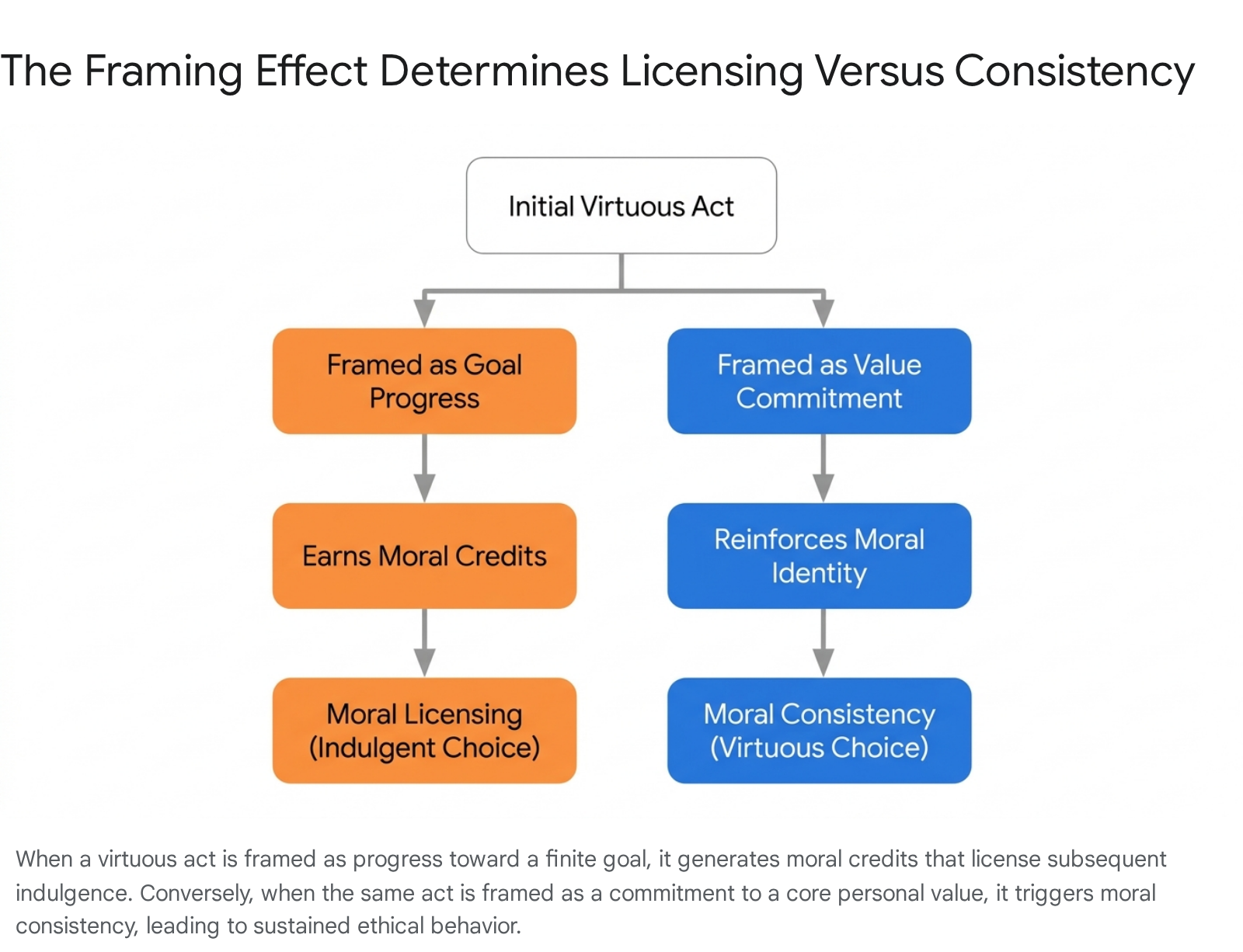
When an individual frames their initial good deed as progress toward a goal, they are highly susceptible to licensing. Viewing behavior through the lens of progress triggers a sense of task completion; the consumer feels they have taken a sufficient step forward, which reduces the perceived urgency of the goal and liberates them to pursue conflicting, self-indulgent objectives 192131. In these low-construal mindsets, the consumer focuses concretely on what has been accomplished in the immediate term, allowing the moral credits model to take effect 3637.
Conversely, when the initial good deed is framed abstractly as an expression of commitment to a core value or a reflection of their true identity, the consumer is significantly more likely to exhibit moral consistency 19213637. If purchasing an organic product is seen not merely as "checking off the environmental box for the week" but as a reaffirmation of the consumer's deep-seated ecological values, the act reinforces their moral identity 102138. Because the behavior is central to their self-concept, engaging in a subsequent destructive act would cause severe cognitive dissonance; thus, they continue to act ethically to maintain self-completeness and avoid hypocrisy 10192138. Research affirms that consumers with strong moral identities or those operating under rule-based mindsets are highly resistant to licensing effects, displaying instead an enduring commitment to their initial values 293839.
The Replication Crisis and Interpersonal Observation
The study of moral licensing has not been immune to the broader replication crisis traversing the psychological sciences. Numerous attempts to replicate foundational licensing experiments have yielded null results 617183034. For instance, three separate, high-powered attempts to replicate the classic Sachdeva et al. (2009) study - which posited that writing about one's positive traits decreases subsequent charitable donations - completely failed to confirm the original moral licensing effect, even when using large online participant pools 63334. Similar failures have been noted in attempting to replicate cross-domain licensing between green consumption and academic dishonesty 3031.
These replication failures forced a theoretical reckoning, leading to the discovery of a profound boundary condition: moral licensing is heavily driven by interpersonal reputation management rather than purely intrapsychic self-worth 1011. A robust 2025 multi-level meta-analysis by Rotella, examining 115 experiments with 21,770 participants, revealed that moral licensing is significantly stronger when participants are observed ($g = 0.65$) compared to when they are unobserved ($g = 0.13$) 11. When accounting for publication bias, the evidence for licensing in completely anonymous, unobserved settings was virtually non-existent, explaining why so many online, anonymous replication attempts failed 111718. This suggests that once an individual has publicly established their moral credentials to an audience, they feel insulated from external social judgment, granting them the social license to indulge. The core mechanism is less about maintaining internal homeostasis and more about maintaining an external reputational baseline 101117.
The Paradox of Social Sharing
Interestingly, the medium of observation plays a highly nuanced role. While being observed by peers generally increases licensing, actively self-promoting those deeds changes the cognitive calculus. Research by Wen and Hu (2023) indicates that when consumers actively share their prior moral behaviors on social media, it can actually suspend the moral licensing effect 1045.
The act of public virtue signaling on digital platforms can lead to a drop in internal moral self-regard - perhaps due to a subconscious awareness of the performative, self-serving nature of the act 10. This drop in perceived moral authenticity subsequently boosts the consumer's intention to engage in a genuine moral act in the present to re-establish true moral worth 10. However, this moderating effect of social sharing is highly sensitive to temporal distance; the suspension of licensing is robust when the subsequent decision is made in the present, but diminishes rapidly if the consumer is making a decision for the distant future, where self-control typically wanes 1045.
Cross-Cultural Dynamics: Individualism vs. Collectivism
The underlying architecture of the moral ledger is not universally standard; it is deeply shaped by the prevailing cultural values of the society in which the consumer operates. The dichotomy between individualistic and collectivistic cultures provides a profound lens through which to view the prevalence and intensity of moral licensing, as these orientations fundamentally alter how moral capital is valued and utilized 464740414243.
The Individualistic Moral Ledger
In individualistic cultures - predominantly found in Western societies - values such as autonomy, personal achievement, independence, and separation from ingroups are paramount 46474142. Consumers in these societies are culturally conditioned to view themselves as distinct from their context, relying heavily on analytic thinking rather than holistic thinking 42.
Consequently, moral actions are frequently internalized as personal achievements. When an individualistic consumer performs a good deed, the resulting moral credit is highly valued and tightly bound to their personal self-esteem 4647. This high valuation of personal moral capital creates an environment exceptionally ripe for moral licensing 4647. Because the "deposits" into the moral bank account are celebrated as individual triumphs, the consumer feels a strong, individualized sense of entitlement to "spend" that capital on self-indulgent or selfish behaviors later 464740. The cultural focus on personal freedom, individual rights, and transactional relationships further lowers the psychological barrier to indulgence once a baseline of perceived personal morality has been achieved 464742.
The Collectivistic Moral Ledger
Conversely, collectivistic cultures - often found in Eastern societies - emphasize interdependence, group cohesion, extended obligations, and the subordination of personal goals to the welfare of the larger community 46474142. In these holistic cognitive frameworks, moral behavior is not viewed as an exceptional personal achievement that merits an individual reward; rather, it is the expected baseline required to maintain group harmony and social solidarity 46404142.
As a result, collectivistic societies tend to exhibit significantly less moral licensing 46. The cultural emphasis on continuous group contribution and avoiding disruptions to the social fabric precludes the concept of "cashing out" moral chips for selfish behavior 4642. Empirical studies from 2024 and 2025 demonstrate that collectivists exhibit significantly higher moral judgment levels for selfless, pro-social behaviors compared to individualists, and their moral judgments track dynamically with the degree of selflessness exhibited by an actor, whereas individualist judgments remain relatively static 40.
This distinction is particularly evident in contexts of harm and third-party intervention. When evaluating norm violations using realistic judicial scenarios, collectivists (e.g., Chinese samples) are more likely than individualists (e.g., American samples) to engage in both severe third-party punishment to deter future violations and generous third-party compensation to repair social bonds 43. Because their ethical framework is deeply embedded in continuous, homeostatic relational obligations rather than transactional moral accounting, the pathway from virtue to indulgence is fundamentally constricted 464043.
Retail Architecture: Spatial Exploitation of the Moral Ledger
The psychological mechanics of moral licensing do not exist merely as abstract academic concepts; they are actively operationalized in the physical and digital world by retailers seeking to maximize consumer expenditure. Supermarket architecture and store layouts are perhaps the most universally experienced manifestations of spatial design explicitly tailored to exploit the moral ledger, leveraging sensory cues and cognitive fatigue to drive up to 70% of grocery purchases as unplanned impulse buys 5253545556.
The Decompression Zone and the Produce Entrance
Retail designers meticulously craft the consumer journey starting from the "decompression zone" - the first 10 to 15 feet inside a store where shoppers transition from the outside world, slow down, and orient themselves to the retail environment 52. Immediately following this zone, the vast majority of supermarkets intentionally place the fresh produce, floral, or bakery departments 52535556.
While vibrant colors and pleasant scents create a welcoming sensory experience that elevates mood, the strategic placement of fresh produce serves a deeper, highly effective psychological purpose: it triggers a "health halo" and initiates the moral licensing sequence 8525356. By selecting vegetables or healthy fruits at the very beginning of the shopping trip, the consumer immediately deposits a massive moral credit into their psychological account 5356. They have psychologically affirmed their identity as a healthy, responsible shopper. With this moral credential firmly established in the first three minutes of a 23.4-minute average trip, the consumer's self-regulatory defenses are significantly lowered for the remainder of their time in the store 525356.
The Racetrack Layout and the Checkout Gauntlet
Armed with a licensed sense of virtue, the consumer is then funneled into a "racetrack" or loop layout, subconsciously guided counterclockwise - capitalizing on the right-handed dominance of the general population - past thousands of products 5256. Essential staples like milk and eggs are placed at the furthest rear of the store, forcing the consumer to navigate through central aisles heavily stocked with high-margin, processed, and indulgent foods placed strategically at eye level 52535556. Because the consumer has already earned their health credits at the entrance, they are highly susceptible to these indulgent middle-aisle temptations, effortlessly rationalizing that a box of cookies is an acceptable reward for the spinach sitting in their cart 525356.
The exploitation culminates at the checkout line. As the consumer waits, they experience ego depletion - a state of diminished willpower resulting from the hundreds of micro-decisions made throughout the aisles 5356. The checkout area is historically stocked with candy, magazines, and single-serve indulgences. Fatigued, and still operating under the overarching moral license granted by their cart full of groceries, the consumer easily succumbs to these final, high-margin impulse buys 535556.
The profound impact of this layout is not merely theoretical; it is empirically proven. A comprehensive study conducted by the University of Southampton in collaboration with Iceland Foods Ltd investigated the effects of reversing these traditional layouts 54. The researchers found that when supermarkets removed confectionery products from the checkout aisles and relocated expanded fruit and vegetable sections to the store entrances, the moral licensing effect was disrupted 54. This healthier store layout led to nearly 10,000 extra portions of fruit and vegetables and approximately 1,500 fewer portions of confectionery being sold on a weekly basis in each store, proving the immense power of spatial priming on consumer dietary choices 54.
Corporate Social Responsibility, Premium Pricing, and Greenwashing
The dynamics of moral licensing are not limited to individual consumer acts within a retail aisle; they scale up to influence how consumers interact with entire corporate entities. As brands increasingly invest billions in Corporate Social Responsibility (CSR), sustainability initiatives, cause-related marketing, and ethical sourcing, they navigate the highly complex waters of corporate moral licensing 8285744.
The Halo Effect and Moral Decoupling
When a brand aggressively markets a single sustainable initiative - such as eco-friendly packaging, an inclusive marketing campaign, or a localized charitable donation - it can trigger a "halo effect" wherein consumers automatically assume the entirety of the corporation's operations are equally ethical 5359. This perceived corporate virtue can serve as a form of vicarious moral licensing for the consumer 293659. Purchasing from a brand perceived as highly ethical allows the consumer to feel they have "done their part," which may paradoxically reduce their willingness to engage in more arduous, direct environmental or social actions in their personal lives 293659.
Furthermore, this dynamic makes both the market and the consumer highly vulnerable to greenwashing. A brand that successfully establishes moral credentials through selective CSR marketing can easily obscure broader, harmful supply-chain practices 325945. Because the brand has built a reservoir of moral credits, consumers who identify with the brand are highly motivated to maintain their positive view, leading to a phenomenon known as "moral decoupling" 5946. In a state of moral decoupling, consumers separate the brand's positive attributes and performance from its unethical actions, allowing them to justify continued consumption and loyalty despite glaring evidence of transgressions 5946. This contrasts with moral rationalization; the consumer does not necessarily condone the immoral act, but they successfully decouple it from their purchasing decision, maintaining their support for the brand 46.
Premium Pricing and the Intention-Behavior Gap
CSR initiatives and eco-friendly claims are frequently leveraged by corporations to justify premium pricing. Empirical studies from 2024 and 2025 demonstrate that consumer willingness to pay (WTP) a premium is significantly and positively influenced by transparent CSR practices, particularly among younger demographics such as Generation Z and female consumers, who historically prioritize ethical consumption 47484950. The perception that a company is acting as a good corporate citizen validates the higher price point, as the consumer feels they are purchasing not just a functional product, but a share of the brand's moral equity 4951. In emerging markets, such as Saudi Arabia, recent research shows that integrating blockchain technology to prove supply chain transparency significantly enhances consumer trust, which directly amplifies their willingness to pay a premium for local, ethically sourced food 51.
However, the high costs of sustainable goods - particularly in the sustainable luxury sector - often expose a severe intention-behavior gap 324549. While a 2025 comprehensive meta-analysis by Coelho do Vale et al., encompassing 67,270 participants, confirmed that CSR generally yields a medium magnitude effect on brand loyalty, it also revealed that multidimensional CSR initiatives can sometimes dilute consumer response, especially in discretionary industries 44. Consumers express strong pro-sustainability values, but financial constraints often trigger a reversion to moral licensing to avoid the premium. If a consumer feels they have acted ethically in a low-cost domain (e.g., recycling their household waste), they may use that moral credit to justify abandoning their sustainable values when faced with the high premium of an ethical luxury garment, opting instead for a cheaper, conventional, and less sustainable alternative 932. Price fairness acts as a critical moderator in this equation; a consumer's altruistic motivation only converts to an actual premium purchase when the markup is deemed fair and directly proportionate to the CSR effort 1095067.
Conclusion and Strategic Directions
The moral licensing effect exposes the profound complexities of consumer psychology, demonstrating that the human pursuit of morality is less a rigid adherence to absolute ethical principles and more a dynamic, continuous, and highly contextual negotiation of self-worth. By understanding the critical divergence between the compensatory nature of the moral credits model and the interpretative manipulation of the moral credentials model, researchers and practitioners can decode how consumers masterfully construct justifications for indulgent, unsustainable, or unethical behaviors following virtuous acts.
Recent empirical data and extensive meta-analyses underscore that this phenomenon is not an inescapable biological imperative, but rather a socially embedded process. Whether a good deed leads to a bad deed depends heavily on progress versus commitment framing, the presence of interpersonal observation, the nuances of social sharing, and macro-cultural orientations separating individualistic and collectivistic societies. The practical applications of this knowledge are vast. Retailers successfully weaponize these psychological loops through spatial architecture to drive impulse purchasing, while brands leverage CSR to build moral capital that insulates them from consumer backlash, enables moral decoupling, and justifies premium pricing.
For policymakers, marketing professionals, and sustainability advocates aiming to foster genuine behavioral change, the objective must be to mitigate the unintended backfire of moral licensing. Interventions must pivot away from praising consumers for isolated "green" or ethical choices, a tactic that prematurely signals goal completion and issues a moral license. Instead, marketing strategies and public policy must focus on identity-linking - framing ethical behaviors as ongoing, uncompleted commitments to deeply held personal, cultural, and communal values. By shifting the consumer narrative from transactional moral accounting to sustained moral consistency, it is possible to close the intention-behavior gap and foster genuinely sustainable global markets.