
Minimum viable product definitions in disruption contexts
The minimum viable product (MVP) serves as a foundational construct in modern product development and innovation strategy. Initially conceived to mitigate market risk by validating core business assumptions with minimal resource expenditure, the concept has become ubiquitous across entrepreneurial and corporate environments. However, as organizations increasingly navigate highly disruptive contexts - spanning capital-intensive deep technology research, artificial intelligence, and resource-constrained emerging markets - the operational definition of a minimum viable product has fractured.
Distinct strategic paradigms, notably the Lean Startup methodology, the Jobs-to-be-Done (JTBD) theory, and Outcome-Driven Innovation (ODI), offer divergent definitions of what constitutes "minimum" effort and "viable" market value. This report examines the theoretical underpinnings of the minimum viable product across these three frameworks and analyzes how its application adapts to high-uncertainty and disruptive market environments.
The Lean Startup Methodology
The Lean Startup methodology, popularized by Eric Ries, establishes the minimum viable product not as a smaller, cheaper, or half-finished version of a final product, but as a systematic vehicle for validated learning 112. The framework was developed as a direct response to the inefficiencies of traditional Waterfall development, where prolonged, isolated engineering phases often resulted in products that failed to meet actual market demand 45.
Build-Measure-Learn Mechanics
The core operational mechanism of the Lean Startup is the Build-Measure-Learn feedback loop 143. In this framework, new ventures do not begin with concrete product ideas, but rather with hypotheses - educated guesses regarding market needs and potential solutions that require empirical data to validate or invalidate 45.
The "minimum" in a Lean Startup MVP refers to the absolute least amount of effort and development required to run a credible experiment that yields this validated learning 147. Early iterations of an MVP under this definition need not even be functional software; they can take the form of landing pages, explainer videos, wireframes, or manual concierge services, provided they accurately test a specific behavioral hypothesis regarding customer demand 143.
The "viable" aspect denotes the threshold at which early adopters can perceive the product's value proposition well enough to provide meaningful feedback or commit resources, such as time, data, or financial payment 74. Consequently, the Lean Startup defines viability empirically: a product is viable if the target market interacts with it in a way that confirms the foundational business hypothesis 37.
Vulnerabilities in Application
Despite its widespread adoption, the Lean Startup approach frequently suffers from execution failures. The most prevalent vulnerability is the bastardization of the MVP concept into an excuse for launching substandard, poorly conceived products. Founders frequently engage in a "build-launch-hope" cycle rather than rigorous "build-measure-learn," treating the MVP as a shrunken version of their grand vision rather than a precise scientific experiment designed to test market demand 5.
Furthermore, the Lean approach can create a hyper-focus on iterating product features based on early feedback at the expense of commercial business model validation. Critics argue that MVP-focused development often overlooks willingness-to-pay and structural growth metrics, leading to products that users enjoy but are unwilling to financially support 10. In business-to-business (B2B) contexts, launching unpolished MVPs to a limited pool of high-value enterprise prospects can permanently damage brand credibility and alienate key early adopters 6.
Jobs-to-be-Done Theory
The Jobs-to-be-Done theory, pioneered by Clayton Christensen and Bob Moesta, offers a fundamentally different lens on product viability by shifting the unit of analysis away from the product itself and the customer's demographic profile, focusing instead on the "progress" a customer is trying to achieve in a specific circumstance 71314.
Progress and Circumstance over Product
JTBD postulates that customers do not buy products; rather, they "hire" them to execute specific functional, emotional, and social jobs 71415. Under this paradigm, the definition of an initial product offering diverges significantly from the Lean Startup approach. Instead of guessing at a solution and iterating through market failure, JTBD emphasizes understanding the causal drivers of customer choice prior to any product development 713.
A product achieves minimum viability in the JTBD paradigm only when it successfully resolves the targeted job better than the customer's current alternative or compensatory behavior 78. If an initial product does a poor job at facilitating the required progress, the customer will "fire" it and revert to previous solutions 148. Therefore, the threshold for viability is tied directly to the product's functional and emotional efficacy in a given context, requiring a deeper foundational understanding of the problem space before the build phase commences 1314.
Implementation Challenges
While JTBD provides profound theoretical clarity, organizations frequently struggle to operationalize it. The framework often stalls during execution due to a lack of cross-functional alignment; marketing teams may extract messaging from JTBD research, while product teams struggle to translate abstract, solution-independent job statements into tangible engineering roadmaps 9.
Methodological errors in surveying also plague JTBD implementations. If researchers anchor survey items on current product features rather than the underlying job, the data suffers from status quo bias, yielding fragmented insights that measure satisfaction with the present rather than the progress sought across contexts 18. Furthermore, the framework's focus on functional tasks can occasionally obscure identity-based, emotional, and social needs. In markets driven by brand identity or social signaling, evaluating pure functional jobs may fail to capture the true drivers of market viability 15.
Outcome-Driven Innovation
Outcome-Driven Innovation (ODI), developed by Tony Ulwick, operationalizes the JTBD theory into a highly structured, quantitative mathematical process 102021. ODI operates on the premise that innovation predictability requires defining customer needs as measurable outcomes rather than vague preferences or feature requests 1112.
The Universal Job Map and Desired Outcomes
To execute ODI, practitioners deconstruct the customer's core functional job into an eight-step Universal Job Map: define, locate, prepare, confirm, execute, monitor, modify, and conclude 1314. For each step, analysts identify specific "desired outcomes," which are performance metrics the customer uses to judge success 101415. A standard job may contain between 50 and 150 of these discrete, measurable outcome statements 101415.
The Opportunity Algorithm
ODI defines viability mathematically through the Opportunity Algorithm, expressed as: Opportunity = Importance + Max(0, Importance - Satisfaction) 101215. Customers score the importance of each outcome and their current satisfaction with existing solutions on a 1 - 10 scale 2816.
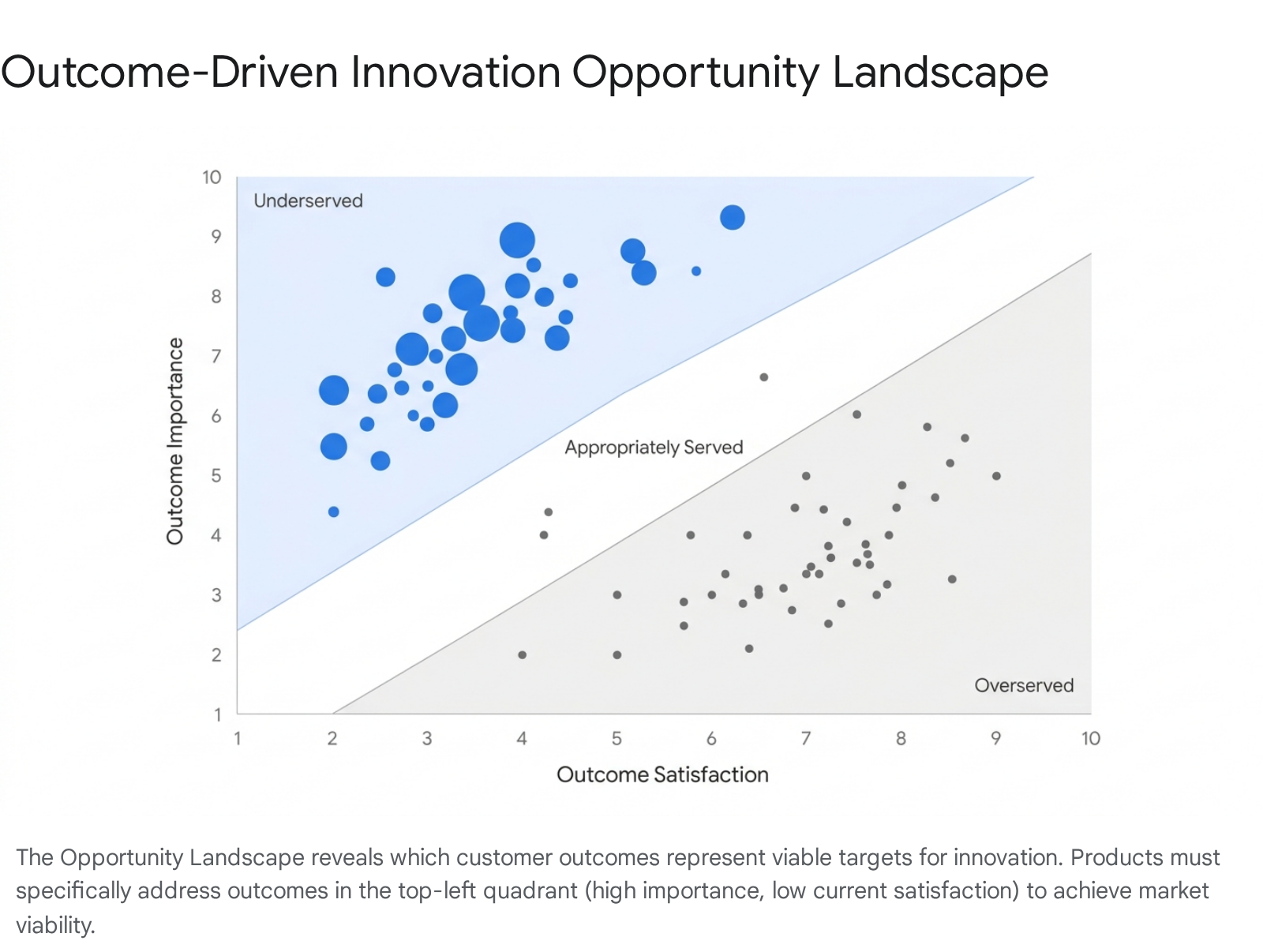
In the ODI framework, a minimum viable product is not defined by a lack of features or rapid speed to market. Instead, it is defined by its ability to demonstrably improve the satisfaction score of a highly important, currently underserved outcome 1316. For instance, outcomes yielding an opportunity score above a specific mathematical threshold (e.g., greater than 10, or >129 on scaled variations) represent definitive market gaps 1312.
Viability is achieved when a solution successfully addresses these exact metrics, rendering the Lean Startup's experimental "guess and pivot" strategy unnecessarily risky and inefficient 1417. However, achieving this level of quantitative rigor requires extensive upfront research, making the ODI process highly capital and time-intensive. For early-stage startups or ventures in entirely novel markets, securing a sample size large enough to accurately compute the Opportunity Algorithm can be cost-prohibitive 1832.
Framework Comparison
The definition of product viability and the minimum threshold for market entry changes drastically depending on the chosen theoretical framework.
| Dimension | Lean Startup | Jobs-to-be-Done (JTBD) | Outcome-Driven Innovation (ODI) |
|---|---|---|---|
| Core Philosophy | Build-Measure-Learn; iterate rapidly to test hypotheses and find product-market fit. | Understand the causal progress the customer seeks in a specific, situational context. | Mathematically quantify unmet needs and segments before conceptualizing solutions. |
| Definition of 'Minimum' | The least effort required to run an experiment and gather validated market learning. | The essential functional, emotional, and social elements required to fulfill a specific job. | A solution targeting only the specific process steps with the highest Opportunity Scores. |
| Definition of 'Viable' | The product generates actionable user data, feedback, or revenue commitments. | The product successfully allows the user to make progress, outperforming compensatory behaviors. | The product demonstrably increases the satisfaction score of a highly important, unmet outcome. |
| Primary Risk Mitigated | Building a product nobody wants (Desirability / Market Risk). | Misunderstanding the underlying motivation for customer choice and adoption. | Wasting R&D capital on overserved markets or non-critical features. |
| Initial Output Form | Often a low-fidelity proxy (landing page, wireframe, concierge service). | A functional solution focused tightly on the core job, ignoring tangential features. | A targeted innovation addressing mathematically verified market gaps. |
Application in High-Uncertainty and Disruption Contexts
The conventional definition of the minimum viable product - particularly the Lean Startup interpretation - often degrades when applied outside of traditional business-to-consumer software development. In highly disruptive contexts, these frameworks must be heavily adapted to maintain their utility.
Technological Uncertainty in Deep Technology
Deep tech ventures - characterized by breakthroughs in quantum computing, synthetic biology, advanced materials, and sustainable energy - face fundamental technological uncertainty rather than mere market uncertainty 3319. These projects require massive upfront capital, specialized infrastructure, and prolonged research and development cycles, creating a "valley of death" between laboratory inception and commercialization 33202122.
In these environments, the Lean Startup's Build-Measure-Learn loop breaks down. Releasing an incomplete or "minimum" version of a nuclear reactor, a medical device subject to stringent regulatory approval, or a novel semiconductor architecture is neither safe nor feasible 332123. Corporate investors and private equity funds often struggle to evaluate deep tech through traditional MVP lenses because the foundational science must be validated before market demand can be tested 2022. Instead of an MVP, deep tech relies on demonstrating a "Proof of Concept" supported by compelling, milestone-driven scientific data to mitigate technical risk and secure sustained venture funding 19.
The Minimum Viable Testing Methodology
To bridge the gap between traditional software iteration and deep tech timelines, practitioners have developed the "Minimum Viable Testing" (MVT) methodology 242541. Propounded by operators like Gagan Biyani, MVT argues against building a proxy product. Instead, teams identify the single riskiest assumption - the "atomic unit" of the idea - and design a standalone test solely for that assumption 25414243.
If an MVP attempts to simulate an entire vehicle to see if users want to drive, an MVT only tests whether the electric drivetrain functions under load 25. This allows deep-tech and capital-intensive startups to validate foundational components of their business model without the technical debt and organizational overhead of maintaining a premature, full-scale product 43.
Artificial Intelligence and the Inversion of Risk
The proliferation of generative AI, large language models, and advanced no-code platforms (e.g., Base44, GitHub Copilot, Momen) has fundamentally altered the economics of software development 44454647. Historically, the Lean Startup MVP was a rational response to the high cost of software engineering; building less saved significant capital and time 26.
As AI lowers the cost and time of software creation to near-zero, the "minimum" threshold for an MVP has expanded rapidly 452649. Startups can now launch near-production-quality, full-stack applications in days 4527. Consequently, the core risk profile has inverted. The primary danger is no longer the sunk cost of building the wrong thing, but rather "speed without learning" 26. When shipping new features becomes frictionless, teams are tempted to iterate constantly based on shallow feedback, accumulating product complexity without gaining validated insight into the customer's core needs or jobs to be done 26.
Furthermore, the rise of AI-native products raises the threshold for what consumers consider "viable." To be adopted, an AI solution must often operate with superhuman accuracy to solve hyper-specific problems. The traditional "ship fast and iterate" strategy of launching buggy MVPs is increasingly obsolete in the AI space, where users expect high fidelity and reliability from day one 4749.
Frugal Innovation in Emerging Markets
Startup ecosystems in regions such as Sub-Saharan Africa and South Asia operate under severe infrastructural deficits, complex regulatory environments, and highly fragmented consumer bases 515253. In these contexts, the Western conception of a Lean MVP - a stripped-down prototype used merely as a disposable learning tool - is frequently insufficient and can hinder growth 51.
Emerging markets demand a functional baseline product immediately. Because traditional digital and physical infrastructure may be lacking, an MVP in these regions must often "leapfrog" legacy systems, requiring highly robust, mobile-first, and low-bandwidth optimized solutions 5153. Investors in these ecosystems also demand early evidence of monetization, forcing startups to merge the validation phase with actual value delivery 51. This shift necessitates building a "Minimum Lovable Product" (MLP) or employing frugal innovation: the process of stripping out unnecessary complexity to lower costs while strictly retaining core functionality suited for resource-constrained environments 51522829.
A notable example of frugal innovation adaptation is the Torchit Saarthi mobility aid for the visually impaired, developed for users in India and Africa. The initial MVP was built using simple embedded systems and computer-aided design, undergoing over 16 rigorous design iterations based purely on grassroots field feedback 56. The viability of the product was strictly tied to its physical durability and extreme affordability. This demonstrates that in resource-scarce environments, an MVP must act as a reliable, functional utility immediately, rather than a fragile vehicle for gathering data 5630.
Synthesis and Future Outlook
The concept of the minimum viable product is not a monolithic standard, but a highly contextual strategy that must be calibrated to the specific type of uncertainty a venture faces. The Lean Startup framework relies on rapid, empirical testing to reduce market risk through minimal engineering effort. Conversely, the Jobs-to-be-Done theory redefines viability as the successful facilitation of customer progress in a specific circumstance. Outcome-Driven Innovation transforms this progress into strict mathematical thresholds, demanding that viability be proven through statistical data before engineering begins.
As technological paradigms shift, so too must the application of these product development frameworks. Capital-intensive deep tech ventures must abandon the traditional software MVP in favor of Minimum Viable Testing and rigorous scientific proof of concept to secure funding and mitigate technical risk. In the age of AI, where the actual building of software is heavily commoditized, the operational discipline of extracting actionable learning from rapid iterations is more critical than the speed of deployment itself. Meanwhile, in emerging markets, frugal innovation dictates that the "minimum" must still be fully functional, highly durable, and locally adapted to overcome infrastructural constraints. Ultimately, successful product innovation in disruptive contexts requires synthesizing the rapid experimentation capabilities of Lean methodologies with the deep, outcome-driven customer empathy of JTBD and ODI.