
Relationship between disruptive innovation and design thinking
Introduction and Theoretical Context
In contemporary business strategy, organizational theory, and academic literature, "innovation" is frequently treated as a monolithic concept, universally prescribed as the remedy for market stagnation. However, the theoretical frameworks that guide corporate innovation operate on fundamentally divergent paradigms. Two of the most influential frameworks in modern management literature - Disruptive Innovation and Design Thinking - are often conflated in corporate discourse. Yet, they describe entirely different dimensions of the innovation landscape.
Disruptive Innovation is a structural, macroeconomic market theory. It explains the specific trajectories through which under-resourced entrants displace established incumbents by altering economic models and technological accessibility 12. Conversely, Design Thinking is an epistemological methodology and cognitive framework. It is focused on human-centered problem-solving, iterative prototyping, and the profound ethnographic understanding of user friction 34.
This research report provides an exhaustive analysis of how these two paradigms intersect within organizational strategy. By deconstructing their theoretical foundations, this analysis identifies where Design Thinking and Disruptive Innovation conflict - most notably in how extreme customer empathy can inadvertently lead to sustaining, rather than disruptive, market outcomes. Furthermore, it examines where the two methodologies complement each other, particularly in identifying non-consumers, operating under severe resource constraints, and scaling novel business models.
Foundational Principles of the Methodologies
To accurately analyze the intersection of these two paradigms, it is necessary to first delineate their strict academic definitions. Both terms have suffered from semantic dilution, frequently reduced to buzzwords or misapplied to any successful technological advancement 15.
Theoretical Underpinnings of Disruptive Innovation
Coined by Harvard Business School professor Clayton Christensen in the mid-1990s, the theory of Disruptive Innovation does not describe a mere breakthrough technology, nor does it apply to every successful startup 16. Rather, it defines a highly specific evolutionary market process.
According to Christensen's framework, disruption occurs when a smaller company with fewer resources successfully challenges established incumbent businesses 78. Incumbents almost universally focus on improving their products and services for their most demanding, and usually most profitable, customers 8. This pursuit of "sustaining innovation" ultimately leads incumbents to over-engineer their offerings, inadvertently overshooting the performance requirements of mainstream and low-end customers who do not require, nor wish to pay for, advanced features 8.
Disruptive entrants exploit this vulnerability by securing specific, often overlooked market footholds. The first mechanism is the low-end foothold, wherein the entrant introduces a "good enough," lower-cost product to over-served customers who are unwilling to pay a premium for complex features 18. The second mechanism is the new-market foothold, wherein the entrant creates a market where none previously existed, turning demographic "non-consumers" into consumers by offering affordable, accessible solutions 18.
Crucially, disruptive innovations are initially considered inferior by the incumbent's mainstream customer base 8. The entrant relies heavily on business model innovation, rather than purely technological superiority, to gain initial traction 89. Over time, the entrant steadily improves its performance trajectory, moving upmarket to eventually capture the incumbent's core customer base, at which point disruption has officially occurred 78.
Historical Trajectory of Design Thinking
Design Thinking emerged from the intersection of design methodology, engineering, and cognitive science. The notion of design as a specific "way of thinking" can be traced to Herbert A. Simon's 1969 publication, The Sciences of the Artificial, and Robert McKim's 1973 work on visual thinking 3. However, the methodology was significantly advanced in academic circles by Richard Buchanan's seminal 1992 paper, Wicked Problems in Design Thinking 31010.
Buchanan posited that design methodologies could be synthesized to address "wicked problems" - intractable, ambiguous, and multi-dimensional human challenges that defy traditional, linear scientific problem-solving 1211. Unlike traditional scientific methods that rely on deduction or induction, Design Thinking operates heavily on abductive reasoning - the logic of possibilities and the exploration of what could be 1213.
In the early 2000s, the methodology was codified and widely commercialized by the global design consultancy IDEO and the Stanford d.school 1014. These institutions translated complex design cognition into a highly teachable, iterative framework generally consisting of five stages: Empathize, Define, Ideate, Prototype, and Test 141516.
The core tenets of modern Design Thinking rely on human-centered empathy, requiring deep ethnographic observation to understand the unarticulated needs, emotions, and frictions of users 1718. It fundamentally embraces ambiguity, encouraging practitioners to suspend judgment and avoid premature optimization 1213. Finally, it demands iterative prototyping, establishing a bias toward action and rapid experimentation designed to validate assumptions through tangible artifacts 1518.
Methodological Conflicts and Structural Tensions
While both frameworks seek to drive business growth and competitive advantage, integrating them within a single organizational strategy reveals severe structural frictions. If applied without strategic calibration, the mechanics of Design Thinking can actively inhibit an organization's capacity to recognize or produce Disruptive Innovation.
The Proximity Trap and Customer Empathy
The most profound conflict between the two methodologies lies in their treatment of the end-user. Design Thinking is fundamentally built on user empathy 111719. It relies on gathering deep, qualitative insights from current users to solve their specific, observable pain points 2023. Practitioners are trained to obsess over the customer experience, optimizing every interaction to remove friction.
However, in the context of Disruptive Innovation, listening too closely to current customers is precisely the catalyst that causes great firms to fail. In their foundational 1995 literature, Joseph Bower and Clayton Christensen explicitly warned against the "management dogma" of staying too close to customers 2122. By deploying Design Thinking methodologies to empathize with their most profitable, established clients, incumbent organizations inevitably create Sustaining Innovations. They make existing products better, more feature-rich, and frequently more expensive 121.
This optimization process ensures the firm overshoots the needs of the broader, less demanding market, creating the very low-end vacuum that disruptors exploit 8. Good management's insistence on listening to current customers traps companies in their existing value network, blinding them to disruptive technologies that appeal to fringe users 26.
Case Analyses of Empathy Failures
The historical downfall of mobile telecommunications incumbents perfectly illustrates this methodological blind spot. BlackBerry (formerly Research In Motion) possessed a highly capable Design Thinking apparatus focused heavily on user-centered design 27. However, their empathy was entirely anchored to their existing enterprise users, who demanded incremental improvements in physical keyboards, battery life, and secure email infrastructure 27.
Similarly, Nokia focused on extensive user research and testing for incremental hardware variations, assuming their market dominance was secure based on current user satisfaction 192723. Both firms executed Design Thinking effectively for their existing customer bases, resulting in highly optimized, sustainable innovations. Yet, this exact process blinded them to the disruptive, new-market architectural shifts introduced by Apple's iPhone and the Android ecosystem 192723. By defining the problem solely through the lens of current users, they failed to anticipate the emergence of app ecosystems and the shift toward touch-based interfaces that initially lacked the tactile precision of a physical keyboard but offered vast new utilities 2723.
This phenomenon extends beyond telecommunications. Legacy retailers like JC Penney have experienced highly publicized failures when attempting to modernize their business models using Design Thinking without understanding disruptive market dynamics 24. By focusing on aesthetic modernizations of the shopping experience without addressing the core pricing and value needs of their traditional discount buyers, they alienated their base without capturing a new demographic, proving that design improvements detached from market realities often accelerate decline 24.
Incrementalism Versus Radical Market Creation
Recent academic discourse has further highlighted the limitations of Design Thinking in producing radical or disruptive outcomes. Post-2018 critiques, particularly from innovation scholars, have increasingly challenged the assumption that Design Thinking inherently drives breakthrough innovation 4.
One major critique is the phenomenon of "userism" and intrinsic path dependency. Because Design Thinking heavily relies on observing current behaviors to solve existing frictions, it intrinsically tethers the innovation process to the past or the present 4. Critics argue that extreme userism limits the ability to address large-scale, systemic challenges that require reimagining the future rather than simply alleviating contemporary inconveniences 4.
Traditional Design Thinking struggles with complex, ambiguous macroeconomic challenges where user needs cannot be articulated because the market does not yet exist 2627. The hallmarks of good management - careful market research, detailed user personas, and methodological planning - become acute liabilities when dealing with disruptive technologies 26. Christensen's research demonstrates that forecasts for the size and scope of disruptive markets are consistently wrong because the consumer base is fundamentally undefined 26.
If Disruptive Innovation requires capitalizing on a new technology to upend widely held societal beliefs about what ought to be, traditional Design Thinking's reliance on validating existing user comfort zones can prematurely kill disruptive ideas 2124. Disruptive concepts routinely fail early Design Thinking validation tests because consumers reject paradigms they do not yet understand 2627.
Academic Critiques and Innovation Theater
As Design Thinking has scaled across global enterprises, it has faced severe critique regarding its practical efficacy, often being labeled as "innovation theater" 530. In many corporate contexts, organizations implement the superficial artifacts of the methodology - sticky notes, rapid hackathons, and multi-day offsite workshops - without embedding the structural autonomy or capital required to actually launch a disruptive product 530.
When project stakeholders treat Design Thinking as a point-in-time intervention rather than an ongoing strategic imperative, it invariably fails to challenge the core business model 5. Critics, including prominent voices in design literature, argue that the widely commercialized "five-step ritual" was necessary scaffolding for an era when empathy was scarce in engineering-led organizations 30. However, executing standard Design Thinking frameworks no longer provides a competitive advantage on its own; it has become a commodity process 30.
Furthermore, scholarly skepticism has grown. An informal poll conducted at the DRUID 2019 conference revealed that a vast majority of participating innovation scholars voted against the motion that Design Thinking represented a major theoretical advance in the understanding of innovation, strategy, or entrepreneurship compared to traditional approaches 4. The critique centers on the fact that without robust business model innovation and aggressive capital reallocation, Design Thinking merely produces slide decks and incremental service optimizations rather than true disruptive market entry 43025.
Comparative Analysis of Framework Attributes
To understand why these frameworks frequently clash in corporate environments, it is necessary to contrast their core operating parameters, mechanisms, and success metrics.
| Methodological Attribute | Design Thinking Framework | Disruptive Innovation Theory |
|---|---|---|
| Core Objective | Solve human problems through creative, human-centered design and empathy. | Displace incumbents by altering the market's economic models and accessibility. |
| Primary Catalyst | User friction, unarticulated psychological needs, and observational empathy. | Technological enablement, asymmetric resource allocation, and business models. |
| Target Audience | Focuses heavily on the defined user currently experiencing the problem. | Focuses on the "non-consumer" or the over-served, highly price-sensitive low-end customer. |
| Process Trajectory | Cyclical and iterative (Empathize, Define, Ideate, Prototype, Test). | Linear market movement (Fringe foothold $\rightarrow$ Mainstream acceptance $\rightarrow$ High-end dominance). |
| Risk Profile | Mitigates risk by failing fast and incorporating continuous user feedback early. | Embraces structural market risk by targeting low-margin, unproven consumer bases initially. |
| Primary Output | Incremental to radical product/service improvements and optimized user experiences. | New value networks, new business models, and macroeconomic market democratization. |
| Analytical Logic | Abductive reasoning (the logic of possibilities and hypothesis generation). | Deductive economic analysis (cost structures, profit margins, and resource allocation). |
Divergent Measurement Regimes and Key Performance Indicators
The difficulty of integrating these frameworks is further exacerbated by their conflicting measurement regimes and Key Performance Indicators (KPIs). Organizations fundamentally struggle to assess the Return on Investment (ROI) of innovation when the methodologies define success through entirely different metrics 322627.
Disruptive innovation success is eventually measured through hard quantitative and financial metrics. These include traditional revenue growth, gross margin trajectories, market share capture, cost savings through operational restructuring, and the rate of incumbent customer displacement 732. The ultimate metric of disruption is the bankruptcy or market capitulation of the incumbent 1.
Conversely, Design Thinking outcomes are highly qualitative and notoriously difficult to tie directly to financial ledgers due to the "attribution problem" 3226. Standard business metrics struggle to capture the value of empathy and iteration 27. Design Thinking is typically measured via Customer Satisfaction Scores (CSAT), Net Promoter Scores (NPS), task success rates in user interfaces, and the volume of ideas generated during ideation phases 2635. Internally, it is measured by employee engagement metrics and the frequency of cross-functional collaboration 3226.
The inability to easily quantify the financial ROI of the "messy front end" of Design Thinking often causes large organizations to abandon highly innovative, disruptive concepts in favor of safe, incremental improvements that promise predictable quarterly yields 263227.
Synergies and Complementary Applications
Despite the inherent tensions regarding user proximity and path dependency, Design Thinking and Disruptive Innovation are highly complementary when an organization actively bridges the gap between them. Design Thinking provides the granular, qualitative mechanisms required to execute the broader macroeconomic theory of disruption.
Utilizing Design Thinking for New-Market Discovery
The conflict between the two theories dissolves when the subject of Design Thinking's "empathy" is strategically shifted. If an organization points its ethnographic research not at its most profitable customers, but at Christensen's defined "non-consumers," Design Thinking becomes an unparalleled engine for new-market disruption 89.
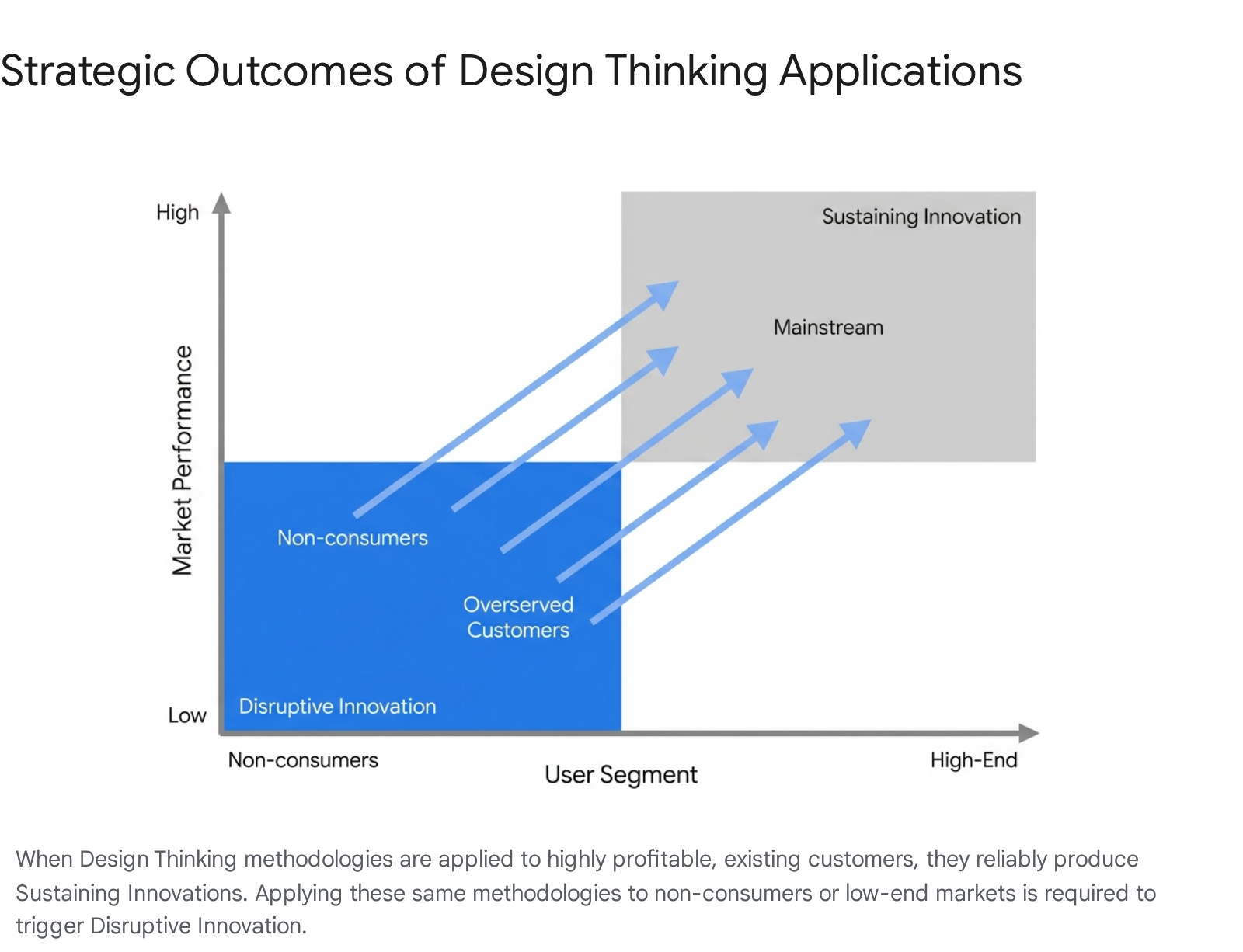
Disruptive innovations often begin as sub-par products that are technologically straightforward, combining off-the-shelf components in novel architectures 29. The challenge for the disruptor is not engineering a flawless technological product, but designing a business model and user experience that makes an initially inferior technology acceptable, accessible, and desirable. Design Thinking excels in this exact domain. By utilizing frameworks such as "Jobs to Be Done" - a concept heavily associated with both Christensen's market theories and modern design methodology - innovators can bypass rigid demographic assumptions and design simple, elegant solutions for specific, underserved scenarios 36.
Case Analyses of Synergistic Application
The trajectory of the peer-to-peer lodging platform Airbnb perfectly illustrates the necessary synthesis of these methodologies. Operating firmly in a new-market foothold, Airbnb introduced a highly disruptive business model that challenged the established hospitality industry's capital-intensive hotel networks 2124. However, the platform initially struggled with severe user retention issues because the listings were visually unappealing, which inhibited the crucial element of user trust 24.
By applying the empathy phase of Design Thinking, the founders recognized the specific psychological barriers preventing adoption 24. They instituted professional photography, rapid prototyping, and iterative user experience improvements 24. Design Thinking did not invent the disruptive macroeconomic model of peer-to-peer lodging, but it provided the human-centered refinement necessary for that disruptive model to overcome societal skepticism and scale into mainstream acceptance 2124.
Similarly, industrial applications demonstrate how empathetic observation unlocks market expansion. When IBM sought to innovate within pediatric dental care, traditional assumptions suggested that children's toothbrushes should simply be scaled-down versions of adult models 24. Through direct observational empathy, design thinkers realized that young children lack fine motor skills and actually require thicker handles for better grip 24. While this represents a product innovation rather than a pure market disruption, it highlights how observing behavioral realities, rather than relying on assumed market trajectories, unlocks new value propositions 24.
Procter & Gamble's development of the Swiffer similarly relied on observational empathy 24. By watching consumers in their homes, P&G recognized the friction of traditional mopping, leading to the creation of an entirely new product category that disrupted the traditional floor-cleaning market 24.
Frugal Innovation as a Bridging Mechanism
The theoretical intersection of Design Thinking and Disruptive Innovation is perhaps most visible in the concept of "Frugal Innovation," or Jugaad. Emerging largely from non-Western contexts - specifically the resource-constrained environments of India, Kenya, Bangladesh, and broader African nations - Jugaad is a colloquial term for an improvised, flexible workaround born from extreme adversity 37282930.
Resource Constraints and Bottom-of-the-Pyramid Markets
Frugal innovation serves as a vital theoretical and practical bridge between the two dominant methodologies. On one side, it aligns perfectly with the ethos of Design Thinking. Frugal innovation relies heavily on a strict design discipline that focuses on cutting non-value-adding features, utilizing deep empathy for local conditions, and iterating rapidly outside formal corporate Research & Development structures 37294131. Innovators must design for real-world frictions that traditional UX design often ignores, such as intermittent electricity, shared technological ownership, and severe financial limitations 372930.
On the other side, frugal innovation structurally aligns with Disruptive Innovation by naturally targeting the "bottom of the pyramid" (BoP) or established non-consumers 293041. By drastically lowering costs - often reducing them to one-third of existing Western solutions - and utilizing clever business models rather than advanced technological specifications, frugal products establish the classic low-end footholds defined by Christensen 304132.
Reverse Innovation and Upmarket Trajectories
While academic scholars debate whether all frugal innovation is inherently disruptive - as some frugal products remain indefinitely in niche markets and never mount a challenge against Western incumbents - frugal design provides the exact cost-performance optimization required to launch a low-end disruption 303233. Examples such as the Aakash tablet demonstrate the potential of ultra-low-cost tech, even if specific products occasionally fail to fully displace incumbents 33.
Furthermore, the concept of "reverse innovation" - wherein frugal products initially developed for emerging markets are eventually exported to developed markets - directly mirrors the upward trajectory of disruptive innovation 3729. Western firms are increasingly adapting these low-cost ideas to challenge their own home markets, proving that the constraints of the developing world act as a crucible for the very technologies that eventually disrupt the developed world 29.
Integration Models for Organizational Strategy
To harness the strengths of both frameworks without succumbing to their respective blind spots, organizations must integrate them across the entire product lifecycle, utilizing Design Thinking for discovery and distinct scaling mechanisms for disruption.
The Ideation, Incubation, and Scaling Lifecycle
Corporate responses to disruptive change require mastery of three distinct organizational disciplines: ideation, incubation, and scaling 2545.
- Ideation: This is the front-end of the innovation process. Here, Design Thinking acts as the primary tool. Through techniques like "Painstorming" (as opposed to standard brainstorming), teams explore user friction and generate a massive volume of potential solutions 202335. The goal is divergence and deep contextual understanding.
- Incubation: This represents the validation phase. Organizations increasingly integrate Lean Startup methodologies with Design Thinking at this stage. While Design Thinking focuses on value discovery (determining desirability), Lean Startup focuses on value validation (determining viability). Lean methodologies utilize business-hypothesis-driven experimentation to discover if a theoretically disruptive business model is actually sustainable in the market 152046.
- Scaling: This is the execution phase, where existing assets and capabilities are reallocated to help the new venture grow 2545. Once a disruptive foothold is validated, Agile software development methodologies are applied for rapid value delivery and continuous improvement 152046.
While models proposed by consulting firms sometimes suggest a sequential hand-off (Design Thinking yielding to Lean, which yields to Agile), advanced design theorists argue that these methodologies must operate as concurrent, layered spirals 4647. Design Thinking must remain active during the scaling phase to ensure the disruptive product retains its human-centered appeal and usability as it moves upmarket to challenge the incumbent 2446.
Cultivating Tolerance for Ambiguity
A critical intersection point between the two theories is the shared psychological and cultural requirement for a "tolerance for ambiguity" 1234. Disruptive innovations require navigating the profound ambiguity of markets that do not yet exist, rendering traditional financial projections, quarterly earnings expectations, and historical market research virtually useless 26.
Similarly, the Design Thinking process intentionally induces ambiguity. The "ambiguity rule" explicitly asks designers to suspend judgment, operate outside their standard mental schemas, and embrace the severe discomfort of unstructured problem spaces 183435.
Organizations that successfully merge these frameworks treat this tolerance not as a soft skill, but as a core dynamic organizational capability 363738. It requires leadership to shift from a mindset of predictive control and operational efficiency (which heavily favors sustaining innovation) to one of iterative adaptation 1339. This is frequently hindered by internal structural barriers. Employees and middle management in traditional corporate settings often view the abductive logic and "fail fast" mentality of Design Thinking as threatening to their established expertise, leading to profound organizational resistance 1339. Overcoming this requires triple-loop learning, wherein an organization continuously questions not just its actions, but the underlying assumptions and institutional norms governing those actions 39.
Incumbent Survival and Exploitative Strategies
While Disruptive Innovation theory traditionally casts incumbents as the inevitable victims of their own success, recent management literature explores how established firms actively use Design Thinking to mount "exploitative response strategies" 40.
When faced with a disruptive threat from a low-end entrant, the assumption is often that the incumbent must completely abandon its existing business model or immediately launch a cheaper, inferior product. However, Design Thinking can be leveraged to build dynamic capabilities that exploit an incumbent's established resources 223638. By engaging in deep user observation, an incumbent can identify heterogeneous demand - specific, highly profitable niches that the disruptive technology cannot immediately satisfy 2240.
Design Thinking allows incumbents to rapidly prototype hybrid solutions or radically optimize their existing internal processes 2240. This maximizes their competitive advantage and profitability in the high-end market, buying them the crucial time necessary to orchestrate a longer-term, structural response to the disruption. Furthermore, leveraging digital transformation strategies alongside entrepreneurial orientation allows established firms to reconfigure their resources dynamically, turning digital capabilities into protective moats against disruption 36373855.
The Future of Innovation Frameworks
As both frameworks have matured and saturated the corporate landscape, they face critical re-evaluation regarding their efficacy in the modern digital and technological economy.
Sensemaking and Complex Systems
The difficulty of integrating these frameworks is exacerbated as the global economy transitions toward data-driven, AI-enabled environments. The traditional, manual ideation phases of Design Thinking are increasingly subject to automation 4. Consequently, the future of the design discipline is shifting away from simple creative problem-solving toward "sensemaking" 4.
Sensemaking involves applying critical and strategic thinking to ensure the organization is identifying the correct systemic challenges - such as sustainability, circular economies, or algorithmic bias - rather than merely designing aesthetically pleasing digital interfaces for outdated paradigms 44041. Addressing modern "wicked problems" requires a constructivist approach, where the problem is not an input to be solved, but an output of continuous interpretation and critical reflection involving multiple, often conflicting, stakeholders 4.
In this evolving context, organizations cannot rely on isolated design workshops to generate disruptive innovation. Technology alone, devoid of human empathy, creates market noise rather than genuine connection, resulting in technical interaction that lacks true participatory engagement 42. Empathy remains the fundamental architecture of market connection 42. Therefore, to survive the continuous wave of technological disruption, organizations must embed the human-centered principles of Design Thinking deeply into their core strategic planning, utilizing it not just to design products, but to design the very business models that will dictate the future of their industries.