Comparison of Outcome-Driven Innovation and Jobs to Be Done
The realization that demographic correlations do not adequately explain consumer purchasing behavior represents a pivotal shift in product development and innovation strategy. Foundational to this shift is the concept that consumers do not simply purchase products; rather, they "hire" products or services to accomplish specific tasks or make progress in their lives 112. This theoretical repositioning, often traced back to Theodore Levitt's observation that consumers desire a quarter-inch hole rather than a quarter-inch drill, forms the conceptual bedrock for both Outcome-Driven Innovation (ODI) and the Jobs to Be Done (JTBD) theory 13.
While both frameworks emerge from this shared theoretical lineage and prioritize customer-centricity over product-centricity, they have evolved into fundamentally distinct methodologies. They diverge sharply regarding the definition of a customer's primary objective, the unit of analytical measurement, the treatment of psychological variables, and their execution models . This report provides an exhaustive examination of the divergence between Anthony Ulwick's Outcome-Driven Innovation and Clayton Christensen's Jobs to Be Done theory, analyzing their historical origins, theoretical constructs, methodological practices, applications in agile software development, and the primary criticisms directed at each framework.
Theoretical Origins
The historical development of these theories is deeply intertwined, a factor that frequently contributes to the confusion surrounding their definitions and applications within the market. Both frameworks emerged as responses to the high failure rates of traditional product development pipelines and the inadequacy of standard market research methods.
Genesis of Outcome-Driven Innovation
The concept of focusing on the underlying process a customer is trying to execute was originally formulated by Anthony Ulwick in the early 1990s 4. Ulwick's methodology was born out of product failure. In 1983, while working as an engineer on the IBM product team, Ulwick witnessed the highly anticipated IBM PCjr flop in the marketplace . Seeking to understand how the press quickly predicted the failure of a product that had extensive internal support, Ulwick hypothesized that innovation lacked the predictability of other business functions .
Ulwick sought to apply statistical process control principles, such as Six Sigma and Quality Function Deployment (QFD), directly to the innovation process 4. By making the customer's functional task the subject of investigation, he determined that innovators could break a job down into sequential steps and attach measurable metrics to each step 4. In 1990, Ulwick formalized this into the JTBD theory and founded the consulting firm Strategyn to put the methodology into practice 4. He later named the operationalized process Outcome-Driven Innovation (ODI) 1. ODI achieved its first major documented success in 1992 with the Cordis Corporation, helping the company identify underserved outcomes to introduce a new line of angioplasty balloons 4. By addressing unmet needs with products like the Palmz-Schatz stent, Cordis increased its market share from 1 percent to 20 percent 4596.
Emergence of Jobs to Be Done
After a decade of localized consulting success, Ulwick introduced his methodology to Clayton Christensen, a professor at Harvard Business School, in 1999 147. Christensen was exploring solutions to the "innovator's dilemma" and recognized the value of looking at markets through the lens of the tasks customers wish to accomplish 4. Christensen subsequently popularized the underlying theory in his 2003 book, The Innovator's Solution, utilizing the specific phrase "Jobs to Be Done" and referencing examples from Ulwick and Richard Pedi of Gage Foods 147.
While Christensen credited Ulwick's work regarding the "outcomes that customers are seeking," Christensen and his collaborators, particularly Bob Moesta and Rick Pedi, began shaping the theory in a fundamentally different direction 7. Rather than focusing on statistical process control and rigorous functional metrics, the Harvard Business School cohort focused heavily on the psychological, emotional, and circumstantial forces that drive consumer decision-making 2.
Consequently, the discipline fractured. Anthony Ulwick positioned ODI as the rigorous, data-driven practice of a functional JTBD theory, while Christensen and Moesta evolved JTBD into a distinct, broader theory of circumstantial progress 1.
Fundamental Theoretical Divergence
The most significant difference between Outcome-Driven Innovation and Jobs to Be Done lies in their foundational definition of why a consumer purchases a product. This philosophical divergence dictates their respective analytical approaches, segmentation strategies, and methods for identifying market competition.
Interpretations of Customer Objectives
The core theoretical split between the two methodologies is characterized by the "Jobs-As-Activities" model versus the "Jobs-As-Progress" model .
Ulwick's Outcome-Driven Innovation relies on the "Jobs-As-Activities" interpretation. Under this model, a job is defined as a specific task, goal, or objective a person is trying to accomplish, or a problem they are attempting to resolve . The underlying assumption is that customers fundamentally want to "do work" and hire products to accomplish that work faster, better, more predictably, or less expensively 89. The unit of analysis is the process of the job itself, which is viewed as inherently stable over time regardless of the technology utilized 310. For example, "listening to music" or "cutting a piece of wood in a straight line" are stable functional jobs 310. Under ODI, business strategy should focus strictly on improving the execution of these activities .
Conversely, Christensen's Jobs to Be Done theory relies on the "Jobs-As-Progress" interpretation. Christensen formally replaces the concept of "outcomes" with "progress," defining a job as the progress an individual seeks in a given circumstance 915. Under this model, consumers do not necessarily want to "do work" or complete physical tasks; they want to achieve a positive transformation in their lives 16. Tasks and activities are merely a means to an end . For instance, a customer does not merely want to "manage cash flow" functionally; they want the peace of mind and progress associated with financial stability 18.
Treatment of Social and Emotional Variables
Because they define the core objective differently, ODI and JTBD handle the functional, emotional, and social dimensions of customer needs in contrasting ways.
In Christensen's Jobs-As-Progress theory, jobs are multifaceted and inherently bound to the specific circumstances in which they occur. A job is never viewed as simply functional; the emotional and social dimensions are considered critical, powerful drivers of decision-making 211. Christensen argues that these intertwined dimensions constitute the single circumstance in which a customer buys, making it impossible to separate the functional utility of a product from how it makes the user feel or how it alters their social perception 15. For instance, when analyzing condo developers targeting retirees, Christensen notes that sales were weak when the focus was solely on construction (functional). Sales only accelerated when developers realized their business was "transitioning lives" (emotional/circumstantial), prompting them to offer moving and downsizing services alongside the physical real estate 2.
Ulwick's Outcome-Driven Innovation approaches these variables through strict compartmentalization. Ulwick argues that the core functional job does not possess intrinsic emotional and social dimensions 15. Instead, ODI separates these elements into distinct, secondary categories within the broader Customer Needs Framework 152012. The "core functional job-to-be-done" is isolated and mapped as a stable physical or cognitive process 12. Emotional jobs (defining how the customer wants to feel or avoid feeling) and social jobs (defining how the customer wants to be perceived by others) are documented in separate statements and analyzed independently from the functional steps 23. By making the core functional job the primary unit of analysis, ODI attempts to neutralize subjective psychological variables, arguing that functional metrics are required to make innovation a predictable science 15.
Definitions of Market Competition
This divergence regarding customer objectives and psychological variables drastically alters how each framework defines a market and identifies competitors.
Under the Jobs-As-Activities model (ODI), competition is generally restricted to products that share functionality or address the same physical task . If the market is defined around the functional job of "restoring blood flow in an artery," the competitors are other medical interventions capable of performing that precise biological task 1024.
Under the Jobs-As-Progress model (JTBD), competition expands radically. Because the goal is progress within a circumstance, a product often competes with entirely unrelated industries, or even with "non-consumption" (the choice to do nothing) 25. This is best illustrated by Christensen's seminal milkshake case study 1113. Researchers observing a fast-food chain found that a significant portion of milkshakes were sold in the early morning 11. Customers were not hiring the milkshake simply for nutritional sustenance (functional); they were hiring it to make a long, boring commute more interesting and to stave off mid-morning hunger (circumstantial/emotional) 13. Therefore, the milkshake was not competing against other milkshakes; it was competing against bagels, bananas, doughnuts, and the boredom of the radio 1113. A one-size-fits-all product approach fails when the competitive landscape shifts based on time of day and circumstance 11.
Similarly, in a case study involving Southern New Hampshire University (SNHU), the institution realized that its online continuing education programs were not just competing with other universities. The "job" adult learners were trying to complete involved transitioning their careers or fulfilling familial expectations. The competition was the friction of daily life and the status quo 1114.
| Analytical Parameter | Outcome-Driven Innovation (Ulwick) | Jobs to Be Done (Christensen/Moesta) |
|---|---|---|
| Primary Philosophy | Jobs-As-Activities | Jobs-As-Progress |
| Core Customer Goal | Execute a specific task efficiently. | Make a positive transformation in life. |
| Role of Emotion | Separated into distinct "Emotional/Social Jobs." | Integrated as an inseparable core dimension. |
| Unit of Analysis | The functional process of the job itself. | The struggling circumstance of the individual. |
| Market Definition | A group of people trying to get a specific task done. | Individuals striving toward an aspiration. |
| Competitive Landscape | Solutions performing the same functional activity. | Any solution (including non-consumption) offering progress. |
Qualitative Dynamics in Jobs to Be Done
Because JTBD treats the fundamental nature of a "job" as a circumstantial and emotional struggle, its methodological execution relies heavily on qualitative inquiry into human psychology. The operationalization of JTBD, spearheaded largely by Bob Moesta through the Demand-Side Sales framework, utilizes specialized interview techniques and psychological mapping to understand consumer behavior 11529.
The Purchasing Timeline
JTBD practitioners reject large-scale demographic surveys in favor of "Switch Interviews" 1617. These are in-depth, qualitative conversations conducted with individuals who have recently adopted a new product or abandoned an old one 163233. The primary objective is to construct a detailed chronological timeline of the purchase journey to expose causality rather than correlation 3218.
The JTBD timeline generally maps the customer journey across six distinct phases: 1. First Thought: The initial moment the customer realizes a problem exists or considers that life could be improved, often triggered by a question or an external story 18. 2. Passive Looking: The customer accumulates information casually, and their internal language begins to revolve around the problem 18. 3. Active Looking: Triggered by an event that mandates action, the customer begins actively comparing solutions and trade-offs, evaluating potential progress without necessarily committing to a price 18. 4. Deciding: The formal commitment to adopt a new solution or switch from the status quo 1. 5. Onboarding: The first experience with the product, where the customer decides if the initial reality meets their expectations of progress 1. 6. Ongoing Use: Continued application of the product where the desired outcome and continuous progress are realized 1.
Forces of Progress
Parallel to the timeline, Moesta posits that in any situation involving change or a switch in behavior, four distinct psychological forces are at play 91529. These forces dictate whether a consumer will overcome the inertia of the status quo.
The first two forces drive demand generation and compel change: * The Push of the Situation: The pain, frustration, or friction encountered with current circumstances or the existing solution. This force repels the customer from what they are currently doing 25151618. For example, a customer's physical film camera is large, heavy, and the film is increasingly difficult to source 16. * The Pull of the New Solution: The magnetism and attractiveness of a new product. This represents the perceived benefits and the visualization of a better future state 251516. The pull involves reason and emotion based on potential progress, such as visualizing how a digital camera allows for sharper images that are instantly shareable 16.
The second two forces drive demand reduction and oppose change: * The Anxiety of the New Solution: The inherent fear and uncertainty regarding the new product. This includes concerns about steep learning curves, unforeseen costs, or the potential that the solution will fail to deliver the promised progress 15291619. When evaluating a new software tool, anxiety manifests as a fear of data loss or integration failures 29. * The Habit of the Present (Allegiance): The emotional attachment to the existing solution and the natural human resistance to change 152916. This inertia is based on existing biases and the comfort of known routines, such as a customer feeling attached to an old film camera because it captured their children's early years 16.
For a switch to occur, the combined power of the Push and the Pull must exceed the friction generated by Anxiety and Habit 3218. This framework treats product adoption as a deeply contextual decision. To illustrate the power of these forces, practitioners frequently apply the framework to human relationships: in dating or partner selection, the true competitor is often "non-consumption" - the high-quality, frictionless status quo of single life 25. To succeed, the "pull" of a partnership must be visceral enough to overcome the "allegiance" to independence and the "anxiety" of shared burdens 25.
| Force Category | Name of Force | Function in Decision Making | Example (Switching to a Smartphone) |
|---|---|---|---|
| Demand Generation | Push of the Situation | Repels consumer from the status quo. | "My current mobile phone drops calls and the battery dies rapidly." |
| Demand Generation | Pull of the New Solution | Attracts consumer to the new offering. | "A smartphone will allow me to check emails instantly and navigate via GPS." |
| Demand Reduction | Anxiety of the Unknown | Creates fear regarding the new offering. | "Will the touch screen be too difficult to type on? Is the data plan too expensive?" |
| Demand Reduction | Habit of the Present | Roots consumer in existing routines. | "I can currently type on my old physical keyboard without looking at the device." |
Quantitative Architecture of Outcome-Driven Innovation
While JTBD relies on qualitative psychological models, Anthony Ulwick's Outcome-Driven Innovation positions product development as a predictive science requiring statistical validity 9620. ODI utilizes a highly structured, formulaic process designed to eliminate the ambiguity and variability of traditional research methods, translating broad customer goals into specific engineering directives.
The Universal Job Map
The foundational architecture of ODI relies on deconstructing the core functional job. Ulwick's research across hundreds of markets indicates that all jobs consist of a stable sequence of steps 1020. To capture this, ODI utilizes a "Universal Job Map." A job map does not track the customer journey, the purchase process, or the consumption experience (e.g., buying, setting up, cleaning, or disposing of a product) . Instead, it strictly outlines the ideal process flow required to execute the functional task efficiently, independent of the current solution being used .
The Universal Job Map mandates analyzing the core task across eight fundamental phases:
| Job Step | Description of Customer Action | Example of Innovation Opportunity |
|---|---|---|
| 1. Define | Determine objectives and plan resources required. | Weight Watchers simplifying diet planning by removing calorie counting 21. |
| 2. Locate | Gather the inputs and items required to get the job done. | U-Haul providing prepackaged moving kits with exact box counts 21. |
| 3. Prepare | Set up the physical or digital environment for execution. | Bosch adding adjustable levers to circular saws to accommodate standard roof angles 21. |
| 4. Confirm | Verify readiness and ensure all parameters are correct. | Oracle software confirming optimal timing for store markdowns 21. |
| 5. Execute | Carry out the primary functional task. | Kimberly-Clark preventing patient complications during medical procedures 21. |
| 6. Monitor | Assess the process to ensure execution is succeeding. | Health applications tracking real-time vital signs during a workout 21. |
| 7. Modify | Make required alterations if the monitoring phase reveals errors. | Software auto-correcting typing errors during data entry 21. |
| 8. Conclude | Finish the task, take stock of the situation, and assess results. | Automated reporting systems generating final analytics summaries 2021. |
Desired Outcome Statements
Once the job is mapped, ODI practitioners extract "Desired Outcome Statements" for each step in the process . Outcomes are defined strictly as customer-defined performance metrics that measure success and value while executing the job 12.
These statements are constructed using a rigid syntactical format comprising an improvement direction, a unit of measurement, an object, and a contextual clarifier 2022. An example outcome statement for the job of cutting wood is to "minimize the time it takes to place a saw back in service" or "minimize the likelihood of the cut going off track" 515. For a single market, ODI typically uncovers between 50 and 150 distinct measurable outcomes 1020. Ulwick stresses that while technologies and solutions change rapidly, these desired outcomes remain remarkably stable over time 20.
Opportunity Scoring Metrics
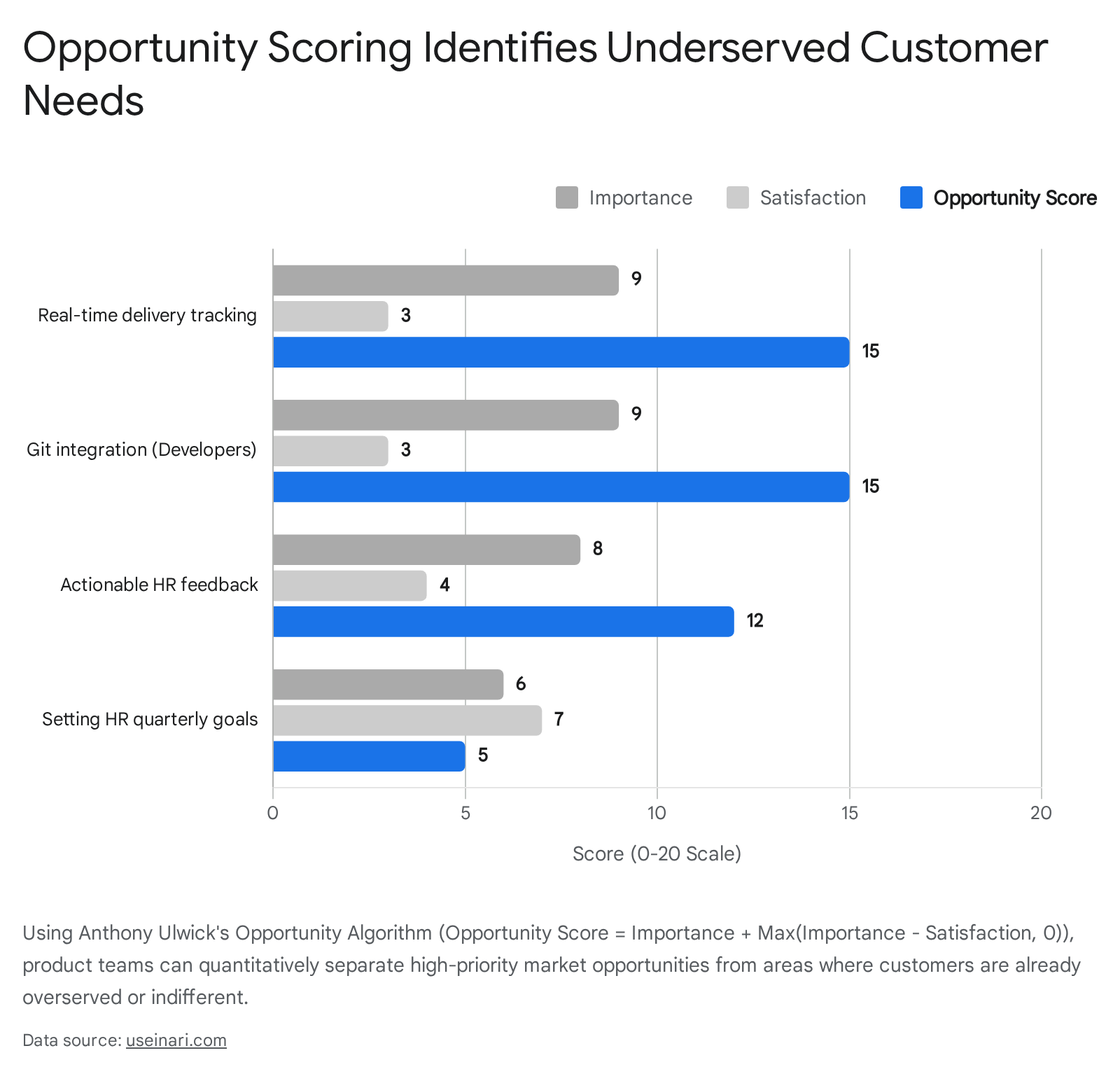
The collection of these desired outcomes forms the basis for quantitative market research. ODI practitioners deploy surveys to statistically valid representative samples (usually between 180 and 3,000 customers) 20. Respondents are asked to rate each of the 50 to 150 outcomes on two scales: the Importance of the outcome, and their current Satisfaction with the ability to achieve that outcome using existing solutions 20.
The core of the ODI methodology is the application of these survey results to the Opportunity Algorithm: Opportunity Score = Importance + Max(Importance - Satisfaction, 0) 72324.
By weighting importance twice, the formula heavily penalizes areas where satisfaction exceeds importance, while elevating areas where satisfaction lags significantly behind high importance 724.
The resulting scores (typically ranging from 0 to 20) are plotted on an "Opportunity Landscape" 25. This landscape visually isolates distinct market segment opportunities: * Underserved Outcomes: High importance, low satisfaction. These represent primary targets for breakthrough innovation and new product development . * Overserved Outcomes: Low importance, high satisfaction. These represent areas where a company can reduce costs or simplify offerings without damaging the core value proposition . * Table Stakes: High importance, high satisfaction. These outcomes are already well-addressed by the market, meaning new products must match this performance to compete, but improving upon them will yield diminishing returns .
By segmenting markets according to these unmet needs rather than demographic profiles, ODI dictates precise areas for product development, attempting to eliminate the guesswork inherent in traditional ideation 52026.
Product Development Execution
Both frameworks attempt to solve the innovator's dilemma and provide a mechanism for sustainable growth. However, their integration into modern software and product management methodologies - such as Agile frameworks and Product-Led Growth - reveals distinct operational realities and challenges.
Integration with Agile Software Development
Agile software development has become the dominant operational paradigm in the technology sector, prioritizing rapid iteration, decentralized decision-making, minimal viable architecture, and real-time customer feedback through continuous deployment 272829. Agile teams focus on launching small modules of code and utilizing A/B testing to refine features based on live user data 2729.
Research indicates that Agile processes are structurally at odds with the deep, foundational research required by both JTBD and ODI 2728. Agile methodologies treat product complexity as a purely technical challenge and assume that autonomous teams can iterate their way to a holistic solution using live metrics 27. However, in large platform markets (e.g., advertising technology, social networks, or labor marketplaces), environments are highly adversarial and reactive 27. A localized change in a module based on an Agile A/B test (such as altering search relevance) frequently triggers strategic reactions from users (e.g., deploying SEO spam or reallocating budgets) 27. This constant flux renders the experimental control groups obsolete, violating Agile's core assumption of a stable testing environment 27.
Because both JTBD and ODI insist on a stable, slow-changing definition of the "job" that is completely separate from the underlying technology, they act as strategic counterweights to Agile's rapid iterations 31027. Ulwick's Job Map, which advocates for viewing the entire process sequentially, demands a high-level architectural view that Agile teams often neglect in their push to deliver iterative code 2028. Conversely, Christensen's JTBD is heavily criticized by Agile practitioners as being too abstract for daily engineering tasks. To function effectively, organizations must create specific "integrator roles" or matrix structures to align autonomous Agile feature teams with the broader, long-term job strategy of the platform 2730.
Product-Led Growth Strategies
Product-Led Growth (PLG) is a go-to-market strategy that relies on the product itself as the primary driver of customer acquisition, retention, and expansion, typically utilizing freemium models or self-serve trials pioneered by companies like Slack and Atlassian 17. In a PLG environment, JTBD is highly applicable for optimizing the top of the funnel and user onboarding.
By focusing on the "Push" and "Pull" forces of progress, product teams can engineer the digital onboarding experience to immediately demonstrate how the product resolves the user's specific struggling moment 117. A successful PLG strategy explicitly targets the "Anxiety" force by allowing users to experience value rapidly with zero friction, eliminating barriers such as mandatory sales calls or complex setups 25.
However, scaling PLG often requires transitioning to a Product-Led Sales (PLS) hybrid model, combining self-serve adoption with traditional enterprise sales motions . In this mature stage, Outcome-Driven Innovation is frequently utilized to prioritize massive feature backlogs. Using the strict mathematics of opportunity scoring, PLG product managers can cut through subjective internal debates - often driven by the "loudest voice in the room" - by pointing to quantitative survey data demonstrating exactly which features are highly important to enterprise users but currently causing dissatisfaction 24.
Evolution of Product Management Roles
The widespread adoption of both frameworks has prompted discussions regarding the fundamental nature of the product management profession. Strategyn advocates for abolishing the traditional title of "Product Manager" in favor of "Job Manager" .
The rationale is that anchoring a role to a specific "product" inherently creates market myopia . A product manager focuses on defending an existing technology, whereas a Job Manager focuses on defending the customer's desired progress . For example, if a product manager at Intuit focuses solely on "QuickBooks," they may miss disruptive technologies. If they act as a Job Manager focused on helping customers "manage cash flow," their purview expands significantly, fostering new thinking that extends beyond the current software architecture . Similarly, a Garmin executive focused on the job of "improving physical fitness" rather than the product category of "fitness trackers" is better positioned to pivot into software, coaching, or alternative hardware .
Methodological Critiques
Despite their widespread adoption in the technology and manufacturing sectors, both methodologies have faced significant academic and industry criticism, largely stemming from their opposing views on the validity of quantitative data and their theoretical boundaries.
Vulnerabilities in Outcome-Driven Innovation
While ODI champions its quantitative rigor and predictive nature, its mathematical foundations and rigid structuring have been challenged. Market researchers Gerry Katz and Jeffery Pinegar published critiques arguing that Ulwick's Opportunity Algorithm is "technically and intellectually flawed" 23. They assert that importance and satisfaction are two entirely separate psychological constructs. Combining them in a single linear formula - subtracting satisfaction from importance - is akin to "subtracting apples from broccoli" 23. While Ulwick dismisses this criticism by stating the math applies specifically to outcomes and constraints, critics argue the formula creates a pseudo-scientific facade that masks the inherent subjectivity of survey responses 23.
Additionally, ODI has been criticized for constructing a "straw man" argument regarding traditional Voice of the Customer (VOC) research. Critics argue that ODI is not a radical departure from established VOC practices, but rather an evolution of them, and that Ulwick's claim of rendering traditional market research obsolete relies on an artificially naive definition of how VOC is actually practiced by experienced professionals 31.
From a psychological and behavioral economics standpoint, proponents of the Moesta/Christensen school argue that ODI's extreme focus on functional execution ignores the fundamental irrationality of human behavior 2529. By forcefully separating emotional and social drivers from the core functional job, ODI risks optimizing a product for pure efficiency while entirely ignoring the underlying anxieties or allegiances that actually drive the purchasing decision 1525.
Limitations of Jobs to Be Done
The primary criticism of Christensen's JTBD theory is its abstraction and lack of a rigid, step-by-step methodology suitable for engineering execution 1. Because JTBD functions as a conceptual mindset rather than a prescriptive operational manual, enterprise implementations frequently stall due to cross-functional misalignment 32. For instance, a marketing department might successfully use JTBD research to design emotional messaging based on the "Pull" of a new solution, while the product engineering team ignores the research entirely because it lacks specific, actionable technical requirements 32.
Furthermore, the abstraction of "progress" is notoriously difficult to quantify and act upon in Business-to-Business (B2B) environments. In enterprise software, the purchaser (e.g., a CFO or Procurement Officer) is often entirely different from the end-user 30. JTBD's focus on the personal progress and struggling moment of the daily user can sometimes obscure the fact that the actual "job" required for product survival is satisfying the rigid financial and security criteria of the executive sponsor 30.
Finally, some industry professionals argue that JTBD is more effective for preventing existing, mature businesses from growing stale than it is for guiding early-stage startups 30. Startups often need to take massive, disruptive swings based on technological breakthroughs, a process that relies heavily on rapid iteration rather than the slow, foundational psychological research mandated by JTBD 30. Christensen himself allegedly highlighted the theory's aversion to rigid data, stating that "data always lie" because spreadsheets strip away the human context of the struggle 33. Proponents of ODI argue this data-dissing approach leaves companies relying purely on intuition, severely damaging the predictability of innovation 33.
| Critique Category | Criticisms of Jobs To Be Done (Christensen/Moesta) | Criticisms of Outcome-Driven Innovation (Ulwick) |
|---|---|---|
| Methodology | Highly abstract; lacks prescriptive, step-by-step processes for engineering execution 1. | Formulaic math is conceptually flawed ("subtracting apples from broccoli") 23. |
| Data Utilization | Openly dismissive of quantitative data; difficult to scale or measure statistically 33. | Over-reliant on surveys; ignores the irrationality and emotional nature of human purchasing behavior 25. |
| Organizational Fit | Frequently fails when diverse teams (Product vs. Marketing) interpret the qualitative insights differently 32. | Can be highly cumbersome and overly complex for rapid, agile startup environments 3053. |
| Theoretical Scope | Often ignores the B2B buyer dynamic (the disconnect between the executive purchaser and the daily user) 30. | Rebrands existing, standard "Voice of the Customer" concepts as proprietary, revolutionary frameworks 31. |
Strategic Application Ecosystems
The profound divergence between Outcome-Driven Innovation and Jobs to Be Done dictates that they are best utilized in completely different strategic contexts. The academic and industry debate is not necessarily about which framework is objectively superior, but rather which tool correctly solves the specific growth challenge a business faces at a given moment in its lifecycle.
Contexts for Transformation Analysis
Christensen and Moesta's JTBD is the optimal framework for high-level business strategy, new market entry, and brand positioning 217. Because it incorporates the emotional and social dimensions directly into the core analysis, it excels at identifying entirely new markets and understanding the root causes of non-consumption 225.
JTBD is the appropriate framework when a company is attempting to understand erratic consumer switching behavior, design marketing campaigns that speak directly to the "Push" and "Pull" forces, or pivot a legacy business model into a new sector 111416. By viewing the competitive landscape through the lens of human progress, companies can identify asymmetric threats - such as a fast-food chain realizing its breakfast items are competing against the boredom of a commute rather than other restaurants 1113. It fundamentally answers the question: Why does a consumer choose to alter their life?
Contexts for Optimization Analysis
Ulwick's ODI is best suited for tactical product execution, feature prioritization, and precise engineering alignment within established, well-defined markets 124. Large enterprises with extensive product portfolios and the capital required to fund statistically significant, large-scale market research benefit immensely from ODI's mathematical precision 126.
When a product development team faces a backlog of hundreds of potential features and needs to eliminate internal bias, the Universal Job Map and the Opportunity Algorithm provide a neutral, quantitatively grounded roadmap 2426. ODI is the appropriate framework when the strategic goal is to systematically dismantle an incumbent competitor by engineering a tool to execute a known functional task faster, more predictably, and with higher output 934. By isolating the exact metrics customers use to measure success, companies can avoid investing in "overserved" areas and direct capital exclusively toward highly critical, "underserved" outcomes 9. It fundamentally answers the question: How can we engineer a superior tool to execute this specific task?
Ultimately, while both frameworks operate on the foundational premise that customers "hire" products to achieve an end, they diverge completely at the definition of that end. For Christensen, the end is human progress and the resolution of a circumstantial struggle. For Ulwick, the end is functional efficiency and predictable execution. Recognizing this distinction is necessary for practitioners to effectively leverage the correct theory in the pursuit of sustainable innovation.