
Continuous innovation framework for digital product teams
The rapid acceleration of global digital markets has fundamentally altered the parameters of product development, corporate strategy, and competitive advantage. In contemporary digital environments, where technological iteration is functionally instantaneous and the marginal costs of software distribution approach zero, traditional methodologies for managing innovation have proven increasingly inadequate 123. Methodologies spanning from rigid, linear development planning to classical theories of market disruption struggle to account for the velocity at which user needs and competitive landscapes now evolve 234. In response to these environmental pressures, the continuous innovation framework has emerged as a synthesized operational paradigm 56.
This framework operates as a meta-discipline, merging the most effective principles from the Lean Startup methodology, Design Thinking, and agile software development 15. The primary mandate of continuous innovation is treating the business model itself - rather than the standalone software solution or physical commodity - as the primary product 178. Executing continuous innovation demands that organizations shift from episodic, batch-based release cycles to a sustained rhythm of rapid experimentation, business modeling, and problem prioritization 19. By executing a perpetual cycle of uncovering, prioritizing, and delivering on unmet customer needs, organizations generate a speed of learning that serves as a new, highly durable mechanism for market defensibility 110. This paradigm significantly updates and recontextualizes legacy frameworks, specifically Jobs-to-be-Done (JTBD) theory and Clayton Christensen's theory of disruptive innovation, adapting them for fast-cycle digital ecosystems where the boundaries between sustaining improvements and disruptive market entries are highly fluid.
Evolution of Product Engineering
To comprehensively understand the architecture and necessity of continuous innovation, it is critical to trace the historical evolution of product engineering and software development life cycle (SDLC) methodologies. Each generational shift in project management philosophy was designed to address the inadequacies of its predecessor, culminating in the necessity for continuous discovery and validation.
Traditional Waterfall Methodologies
Historically, organizations relied heavily on the Waterfall methodology, a linear, sequential, and heavily structured approach to product development 111213. Waterfall is characterized by extensive ex ante planning, rigorous documentation, and distinct, non-overlapping phases: requirements gathering, system design, implementation, testing, deployment, and maintenance 111214. This plan-driven methodology provided predictability, clear budgeting, and strict risk management, making it highly effective for logistically complex physical infrastructure projects where the cost of post-construction alteration is prohibitive 121315.
However, Waterfall demonstrated severe vulnerabilities when applied to modern software and digital product markets. The methodology is inherently rigid and struggles to accommodate rapidly changing customer requirements or shifting market conditions during the long development cycle 1112. Because functional products are only delivered at the very end of the cycle - often months or years after the initial requirements were gathered - Waterfall creates an enormous temporal gap between the formulation of a business assumption and its empirical validation in the market 111516. In fast-moving technology sectors, this lag frequently results in the delivery of a perfectly engineered product for a market need that no longer exists.
Agile Development and the Feature Factory
The introduction of Agile software development marked a critical transition toward iterative and adaptive engineering. Agile grew out of direct frustration with the inflexibility of Waterfall, replacing monolithic, multi-year release schedules with time-boxed iterations or "sprints" typically lasting two to four weeks 111213. Agile frameworks, such as Scrum, prioritize the rapid delivery of functional software chunks, close customer collaboration, and the ability to pivot requirements continuously based on interim feedback 111416.
Despite solving the delivery velocity problem, the widespread adoption of Agile across enterprise environments frequently birthed a new organizational pathology characterized as the "Feature Factory" 161718. Coined by product management expert John Cutler, a feature factory describes an organization that measures its success strictly by the quantity and speed of features shipped (output), rather than the actual business impact or customer value generated by those features (outcomes) 161819.
Feature factories arise from a combination of misaligned organizational incentives and a desperate corporate desire for predictability 19. In these environments, product managers are relegated to the role of project managers or "order-takers," sequentially clearing backlogs of features demanded by sales teams, executives, or vocal minority customers without validating whether the underlying problems warrant solving 161819. This output-obsessed culture invariably leads to severe product bloat, immense technical debt, and a disjointed user experience 161719. Furthermore, because the team is disconnected from the strategic "why" of their work and unable to measure genuine market impact, feature factories suffer from high rates of developer and product manager burnout 16171921.
Emergence of Continuous Innovation
The continuous innovation framework builds upon the rapid execution capabilities of Agile but explicitly rejects the feature factory anti-pattern 11619. It incorporates the "Build-Measure-Learn" feedback loop and rapid prototyping techniques of the Lean Startup to empirically validate assumptions before heavy engineering resources are ever committed 1920. Continuous innovation recognizes that while Agile optimized the speed of delivery, it failed to optimize the speed of discovery 1819. In this evolved state, the organizational focus elevates from merely building software efficiently to systematically engineering, testing, and scaling a sustainable business model 178.
Mechanics of Continuous Discovery
A core operational mechanism within the continuous innovation framework is the formalized practice of "continuous discovery." Pioneered and extensively documented by product researcher Teresa Torres, continuous discovery is defined as the habit of a product team engaging in direct customer touchpoints on at least a weekly basis 212223. The objective is to conduct small-scale, iterative research activities in direct pursuit of a specific, desired business outcome, thereby dismantling the traditional dichotomy that historically isolated upfront market research from downstream product delivery 212425.
Cross-Functional Product Trios
To execute continuous discovery effectively and avoid organizational silos, modern frameworks deploy a cross-functional unit known as the "Product Trio." This atomic unit typically consists of a Product Manager, a Lead Designer, and a Lead Software Engineer 2224252627. This collaborative structure fundamentally changes the decision-making paradigm. Rather than requirements being handed down sequentially from product to design to engineering, the trio works jointly to synthesize customer feedback and analyze data 2425.
This joint operational model ensures that the three critical risks of product development are evaluated concurrently: desirability (is this solving a real customer problem?), viability (does this advance our business metrics?), and feasibility (can our engineering team effectively build this?) 8222530. By conducting joint customer interviews and sharing the synthesis of qualitative insights on a weekly basis, the product trio continuously refines its collective understanding of the market, effectively preventing the organization from building unvalidated, assumption-based solutions 21242728.
Opportunity Solution Tree Architecture
To map the highly complex relationship between abstract business goals and qualitative customer feedback, continuous discovery utilizes an analytical tool known as the Opportunity Solution Tree (OST) 29303132. The OST is a visual synthesis framework that anchors all product discovery and development activities to a specific, measurable business outcome (such as a key performance indicator or OKR) at its absolute root 26303233.
Branching downward from the primary business outcome are "opportunities." In this framework, opportunities are strictly defined as the unmet needs, pain points, and desires expressed by customers during discovery interviews 26303234. Opportunities are never internally generated feature ideas; they must be derived entirely from actual customer narratives 34. Below the opportunity layer sit potential "solutions," which are the various strategic interventions the team might build to address a specific customer need 2630. Finally, branching below the solutions are the rapid "experiments" or assumption tests required to empirically validate the risk profile of each proposed solution before full-scale development begins 223038.
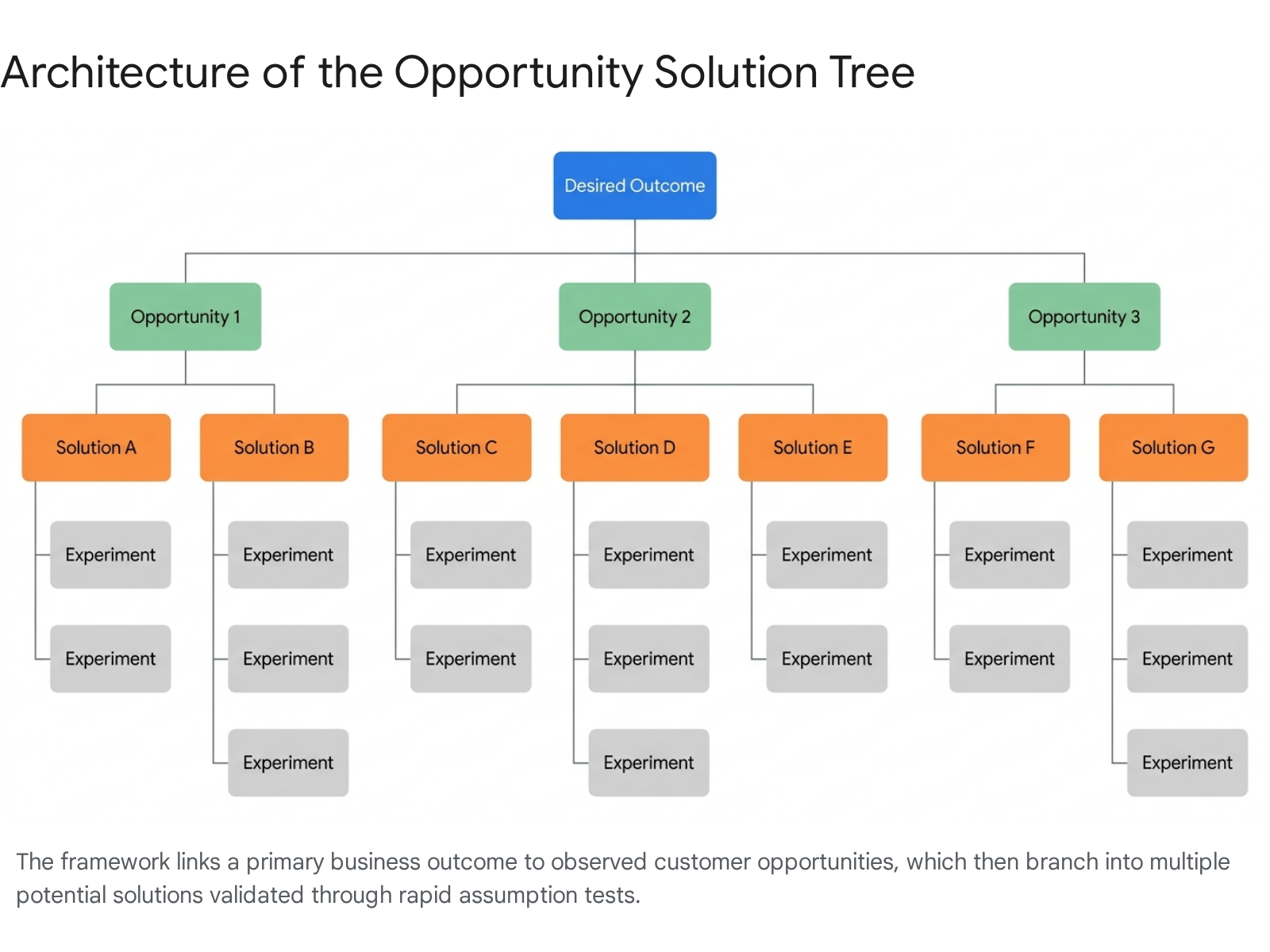
The OST is critical because it visually enforces an outcome-based methodology. It explicitly prevents the product trio from falling into "shiny object syndrome" or prematurely committing to a single favored solution without first exploring the broader opportunity space 30333435. By forcing teams to generate at least three distinct solutions for a single opportunity and compare them concurrently via rapid assumption testing, the OST actively curtails confirmation bias 3038.
Transition to Outcome-Based Roadmaps
The adoption of continuous discovery and the OST necessitates a paradigm shift in how organizations plan their strategic futures, moving away from traditional feature-based roadmaps toward outcome-based roadmaps 333540. Traditional roadmaps resemble Gantt charts, listing specific software features plotted against hard delivery dates 1935. Because software development inherently involves massive uncertainty, projecting firm dates for unbuilt features creates a false sense of precision, ultimately forcing teams to compromise on quality and discovery just to meet an arbitrary deadline 1934.
Outcome-based roadmaps, by contrast, outline the strategic themes or business outcomes the organization intends to pursue over broader time horizons (e.g., Now, Next, Later) 35. This approach grants the product trio the autonomy and bounded flexibility required to dynamically discover the optimal technological solutions to achieve the stated outcome, rather than being contractually obligated to deliver a predetermined, and potentially flawed, feature 3335.
Recontextualization of Jobs to be Done Theory
The integration of the continuous innovation framework deeply updates and recontextualizes the traditional "Jobs-to-be-Done" (JTBD) theory. Recognizing JTBD principles is vital for modern product teams aiming to navigate the complexities of digital market saturation.
Traditional Definitions of Customer Jobs
Originally developed and popularized by innovation scholars including Clayton Christensen and Anthony Ulwick, JTBD theory reframes traditional market and demographic analysis 23364243. The core premise posits that customers do not simply purchase products based on demographic alignment; rather, they "hire" products or services to help them make progress in a specific, contextual circumstance 2329. A JTBD encompasses functional, emotional, and social dimensions 23. Historically, JTBD analysis has often functioned as a discrete, heavy research phase utilized at the genesis of a product to define market positioning and desired outcomes 2342.
Continuous Evaluation of the Bigger Context
Under the continuous innovation framework, as specifically articulated by Ash Maurya, JTBD is liberated from being a static research event and is instead treated as a dynamic, continuous process. Maurya refines the definition of a JTBD as the direct instantiation of an unmet need or want that occurs in response to a specific trigger 10. In fast-cycle digital markets, organizations must differentiate between operating in the "solution context" and operating in the "bigger context" 10.
For example, if a consumer seeks to hire a power drill, the manufacturer operating strictly in the solution context will focus on incrementally improving the drill bit so it does not break 10. However, a "hole in the wall" is merely an intermediate activity, not the desirable outcome 1029. Leveling up to the bigger context requires recognizing the actual job: securely hanging a painting or bookshelf 1029. By focusing on this bigger context, organizations open the door to entirely new, solution-agnostic business models - such as 3M developing high-strength mounting tape, or Samsung designing the Frame TV to replace wall art entirely 10.
Continuous innovation updates JTBD by insisting that product teams must repeatedly "level up" into this bigger context to uncover uncontested spaces for innovation, rather than endlessly optimizing existing solutions 10. The synergy between JTBD and continuous discovery is highly evident in practice; the "opportunities" identified within Teresa Torres's Opportunity Solution Tree frequently function identically to "Jobs" in the JTBD framework, as both models prioritize the unearthing of a hierarchy of user goals independent of specific technological implementations 232938.
Acquisition and Retention Dynamics
Furthermore, continuous innovation expands the application of JTBD beyond initial customer acquisition. While classical JTBD often focuses heavily on the mechanics of "hiring and firing" - analyzing what causes a consumer to switch from a competitor's product to a new offering - continuous innovation emphasizes that this is only half the equation 10. Once a customer is acquired, the product must rapidly deliver value to establish a habit 10. By continuously delivering on the bigger context, the organization actively positions its business model against competitive threats. Thus, continuous innovation utilizes JTBD just as heavily for customer retention (preventing a switch) as it does for acquisition (causing a switch), ensuring the product remains perpetually relevant to the user's evolving life circumstances 10.
Disruption Theory in Digital Markets
Beyond JTBD, the continuous innovation framework fundamentally challenges and updates the traditional boundaries of Disruption Theory, adapting it for the unique physics of the digital age.
Classical Models of Disruptive Innovation
Clayton Christensen's seminal theory of disruptive innovation, initially outlined in his 1997 book The Innovator's Dilemma, established the foundational understanding of how industry titans fall to upstart competitors 374538. The classical theory describes a highly specific, asymmetrical competitive process. Established incumbent businesses typically focus their engineering efforts on "sustaining innovations" - incremental improvements designed to satisfy the demands of their most sophisticated and profitable customers 3639404142. In doing so, incumbents inevitably overshoot the actual performance requirements of mainstream or less demanding users 3641.
This overshooting creates market vulnerabilities. A disruptive entrant successfully challenges the incumbent by targeting these overlooked segments with a product that is initially inferior in raw performance, but vastly more affordable, convenient, or accessible 36373940. Disruption originates from two distinct vectors: "low-end footholds," which capture overserved customers at the bottom of the market, and "new-market footholds," which turn previous non-consumers into consumers by creating a market where none existed 36383941. Because there is little profit incentive to defend the low end of the market, incumbents typically ignore the disrupter or flee upmarket 394143. Over time, the disruptive product relentlessly improves, moves upmarket, and eventually displaces the incumbent when its performance reaches the threshold demanded by mainstream customers 3637394043. Classical examples of this process include steel minimills displacing integrated mills, and personal computers displacing mainframes 3640.
The Uber Anomaly and Definitional Rigor
Despite the widespread adoption of the term "disruption" in Silicon Valley to describe any successful technological advancement, the classical theory maintains strict boundaries 45383940. In a 2015 Harvard Business Review update, Christensen explicitly clarified that many highly successful digital platforms - most notably the ride-hailing giant Uber - do not actually qualify as disruptive innovations under the academic definition 45384143.
Uber did not originate in a low-end or new-market foothold 38. It launched in San Francisco, an established market with existing taxi services, and targeted mainstream consumers directly by offering a superior core experience (seamless booking, digital payments) rather than an inferior, low-cost alternative 384144. Because Uber's market already existed and it competed directly on product superiority, it represents a highly aggressive sustaining innovation, not a disruptive one 3842.
Compression of Sustaining and Disruptive Cycles
However, the continuous innovation framework posits that in fast-cycle digital markets, the distinct definitional boundary between sustaining and disruptive innovation collapses almost entirely. Ash Maurya argues that when a digital organization is moving with extreme velocity - continuously uncovering and prioritizing unmet customer needs - it is no longer purposefully pursuing "disruptive" or "sustaining" innovation; rather, it is engaging purely in continuous innovation 10.
In traditional physical product markets, the trial-and-error cycle was inherently slow, giving disruptive entrants years to establish footholds and refine their technologies 23. Conversely, modern digital product innovation confronts an open, rapidly changing dynamic where the marginal cost of distribution is near zero 345. The widespread deployment of AI-driven analytics, cloud computing, and real-time data streams embeds "algorithmic rationality" directly into organizational cognition 2.
This digital infrastructure facilitates proactive innovation orchestration 2. Digital technologies compress the innovation timeline, merging long-term exploration (disruptive leaps) and short-term exploitation (sustaining refinements) into a single, continuous continuum 245. Consequently, the primary defensive moat for both incumbents and startups in the modern ecosystem is no longer scale, brand legacy, or specific market positioning, but the absolute, organizational speed of learning 12.
Experimentation Risks and the Local Maxima
While rapid experimentation and A/B testing serve as the tactical engines of continuous innovation, an over-reliance on purely quantitative, iterative optimization introduces profound strategic risks, most notably the mathematical and psychological trap of the "local maxima" 4647.
Limitations of Iterative Optimization
In mathematical optimization and product design, a local maximum occurs when a series of incremental changes yields steady improvements until a plateau is reached 4647. At this peak, any small, iterative tweak - such as modifying button colors, adjusting typography, or shifting UI layouts - results in either neutral or negative metric shifts 4657. Teams operating strictly within a feature factory mindset, heavily anchored to immediate data feedback, often mistakenly identify this local peak as the absolute limit of the product's market potential (the global maximum) 464757.
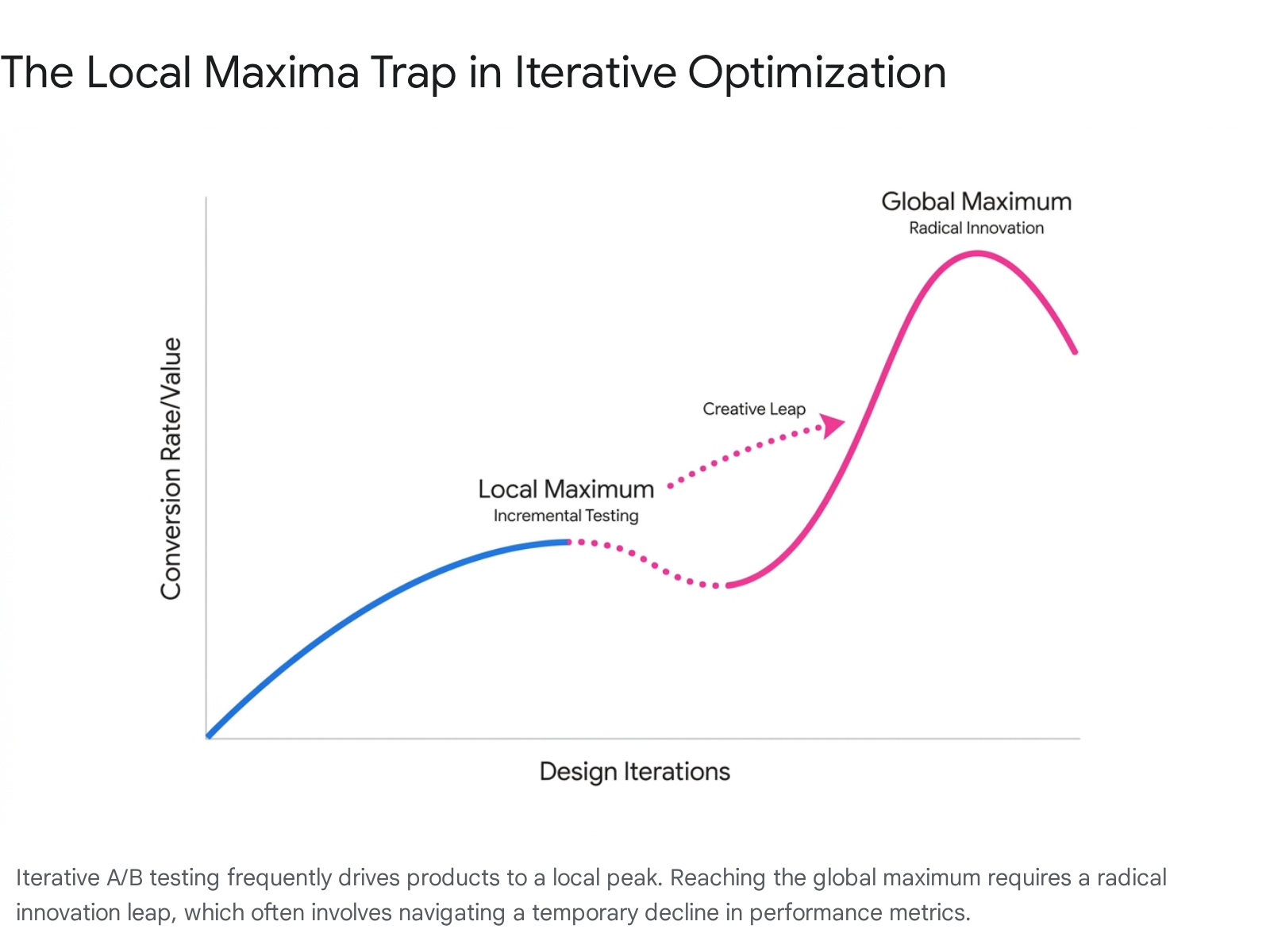
Iterative testing inherently limits a team to refining the current paradigm. For example, a team might spend months A/B testing the layout of a fast-food breakfast menu to maximize conversion, missing the fact that launching an entirely new product category (e.g., the Egg McMuffin) would fundamentally redefine customer behavior and drive massive revenue growth 47. As noted by industry practitioners, optimization is a tool, but innovation must be the outcome 47.
Artificial Intelligence in Experimentation
The introduction of Artificial Intelligence (AI) into modern experimentation pipelines acts as a double-edged sword regarding the local maxima problem. Advanced AI and intelligent feature flagging allow organizations to execute multivariant tests at unprecedented scales, automatically routing traffic to winning variants in real-time 58.
However, AI systems - particularly those reliant on reinforcement learning - are highly susceptible to becoming trapped in local maxima . Left unchecked, an AI algorithm will ruthlessly exploit short-term, easily measurable metrics (such as click-through rates or immediate engagement) without considering broader, long-term strategic implications like customer lifetime value or brand degradation . This myopic optimization ensures the system finds a "good" solution but frequently fails to explore riskier, potentially superior alternatives .
Discontinuous Innovation and Radical Leaps
To systematically overcome the local maxima trap, continuous innovation frameworks insist on a dual approach that actively balances data-driven exploitation (incremental continuous improvement) with intuition-driven exploration (discontinuous or radical innovation) 4546574849.
Jumping from a local maximum to a global maximum cannot be achieved through minor UI tweaks; it requires a "radical redesign" or discontinuous leap that fundamentally reframes the core user problem 4648. This is conceptually formalized in the "Leap and Run" framework, which argues that organizations must alternate between executing bold, transformational steps that redefine the business model (Leaps), followed by periods of disciplined, agile A/B testing to optimize those new models (Runs) 45. Advanced organizational models actively cultivate "structured chaos" or entropy to prevent the stagnation of local maxima, purposefully injecting diversity into the experimentation pipeline to force the system to explore beyond its learned comfort zones 49. In-depth qualitative user research and ethnographic studies provide the insights necessary to make these creative leaps with conviction 46.
Quantitative Measurement and Innovation Metrics
The operationalization of the continuous innovation framework requires a fundamental restructuring of how a corporation measures success and allocates capital.
Deficiencies of Traditional Financial Indicators
Traditional financial metrics - such as Return on Investment (ROI), Net Present Value (NPV), and Discounted Cash Flow (DCF) - are designed to measure efficiency and profitability in mature, predictable markets 505152. These metrics are fundamentally misaligned with early-stage continuous innovation because they require accurate forecasts of both the capital investment required and the total potential earnings 505152. In the context of true innovation, both of these variables are completely unknown.
Applying strict ROI thresholds to high-uncertainty initiatives creates a severe time horizon mismatch 50. Transformative innovations often look financially unviable in their nascent stages 3850. If leadership demands immediate, predictable returns, the organization will naturally suffer from an "internal traffic jam" of safe, incremental updates that defend the core business but completely fail to generate new competitive advantages 952.
Metrics for Innovation Accounting
Instead of standard financial accounting, continuous innovation relies on a system of "innovation accounting" 51. This system tracks the velocity of learning and the progressive validation of business models, empowering organizations to make evidence-based investment decisions without relying on fabricated long-term revenue projections 5153.
Innovation accounting divides measurement into distinct phases. During early experimentation, teams measure "leading indicators" such as the ideation rate, experimentation velocity (how quickly concepts are tested), and initial customer engagement 5153. As the innovation proves desirable and feasible, it moves into a scaling phase, where metrics shift to "lagging indicators" such as the commercialization ratio, user stickiness, virality, and adoption growth rates 5153.
Methodological Comparison
The following table synthesizes the structural and metrical differences between traditional (plan-driven) innovation and continuous (agile/discovery-driven) innovation frameworks 23141550515354:
| Metric / Dimension | Traditional Innovation (Waterfall / Linear) | Continuous Innovation (Agile / Discovery) |
|---|---|---|
| Core Philosophy | Ex ante planning; linear execution of a predetermined scope. | Empirical learning; continuous adaptation to market feedback. |
| Cycle Time | Months to years (Logistically complex, low frequency). | Days to weeks (Rapid iteration, high frequency). |
| Risk Management | Controlled via rigorous upfront validation, heavy documentation, and stage-gates. | Controlled via rapid prototyping, minimum viable products (MVPs), and rapid assumption testing. |
| Interaction Frequency | Episodic; heavy upfront research, minimal interaction during active development. | Continuous; weekly product trio touchpoints with customers throughout the lifecycle. |
| Leading Indicators | Adherence to forecasted budget, timeline, and scope documentation. | Ideation rate, learning velocity, experiment throughput, prototype frequency. |
| Lagging Indicators | Return on Investment (ROI), Net Present Value (NPV), market share post-launch. | Commercialization ratio, adoption growth rate, stickiness, virality, pivot rate. |
| Handling of Assumptions | Embedded deeply in business plans; often remain untested until final market launch. | Extracted immediately and tested iteratively via the Opportunity Solution Tree. |
In the continuous model, teams frequently utilize frameworks such as the OODA Loop (Observe, Orient, Decide, Act) to translate real-time data signals into immediate product adaptations 66. The tempo of this loop dictates the organization's overall adaptability; high-traffic digital platforms may execute full observation-to-action cycles in a matter of days, leveraging telemetry to minimize risk while maximizing the ingestion of empirical evidence 66.
Market Implementations and Platform Strategies
The theoretical principles of continuous innovation, continuous discovery, and the preemption of traditional disruption models are vividly demonstrated by the operational strategies of leading global "super-apps" and digital platforms.
Southeast Asian Super-App Ecosystems
Grab, operating extensively across Southeast Asia, exemplifies the continuous innovation framework executed at massive scale. Evolving from a simple regional ride-hailing application into a comprehensive digital ecosystem offering food delivery, logistics, and digital banking (such as GXS Bank), Grab utilizes continuous experimentation as its primary mechanism for growth and defensibility 5556.
Rather than relying on monolithic, high-risk software releases, Grab executes over 200 concurrent experiments 57. Central to this is the "Grab Early Access" (GEA) application, an internal tool that allows employees and segmented public user pools to validate experimental features rapidly before broad deployment 57. This continuous feedback loop actively prevents the feature factory trap by ensuring new deployments are tied to quantifiable outcomes, such as improving merchant conversion rates or increasing driver utilization via multi-order batching 5758. Furthermore, Grab utilizes Generative AI to parse vast troves of previously unstructured customer delivery notes, dynamically and continuously updating their proprietary high-definition mapping systems (GrabMaps) 555859. By empowering local country teams to identify unique regional problems and test solutions autonomously, Grab embodies the decentralized, high-velocity learning model that defends against both established incumbents and new digital entrants 58.
European Financial Technology Scaling
Revolut disrupted the traditional European retail banking sector not by finding a quiet, low-end foothold, but by attacking the core inefficiencies of foreign exchange and consumer finance simultaneously 7273. Traditional financial technology strategy heavily advocated for conquering a single product category or geographic market sequentially 73. Revolut explicitly rejected this conventional wisdom, opting instead for a highly aggressive continuous innovation strategy, shipping multiple financial products across multiple international borders concurrently 73.
This relentless product velocity was underpinned by a heavy strategic investment in user experience and viral, product-led growth mechanisms - such as seamless bill splitting and artificial scarcity via waitlists - that organically lowered customer acquisition costs and drove retention 7274. To successfully manage exponential scaling from 30 million to 70 million users in roughly three years, Revolut integrated advanced AI infrastructure 75. Utilizing the Nebius AI Cloud powered by over 200 NVIDIA H100 GPUs, Revolut processes behavioral data from 40 billion events to operate continuous fraud detection models and resolve up to 1.2 million automated support tickets monthly 75. Crucially, their product development teams treat inference quality and response times as core product features, continuously observing and refining algorithms to maintain an exceptionally high Trustpilot rating and user retention 75.
Chinese Social Commerce Environments
In the Chinese market, Tencent's WeChat ecosystem provides a unique structural infrastructure for continuous innovation via its "Mini Programs." These lightweight, web-based applications run natively within the overarching WeChat environment, completely eliminating the friction associated with traditional app store downloads while instantly leveraging WeChat's massive existing user base (over 1.1 billion MAU) and integrated payment infrastructure 7677.
For brands and independent developers, Mini Programs serve as ideal vessels for rapid prototyping and continuous discovery 6079. Prominent global brands, such as Starbucks and Lululemon, utilize Mini Programs to orchestrate private domain traffic, testing loyalty features, social commerce integrations, and localized community engagement campaigns in real-time 7677. Because the development cycle for a Mini Program is significantly shorter than that of a standalone native application - often requiring only a few weeks from concept to launch - organizations can execute rigorous A/B tests, analyze behavioral analytics, and iterate their underlying business models seamlessly 6079. This environment perfectly encapsulates the continuous innovation ethos: low-risk, high-speed experimentation directly embedded into the user's daily digital context.
Conclusion
The continuous innovation framework represents a necessary evolutionary step in product development and corporate strategy, specifically engineered for the realities of fast-cycle digital markets. By treating the business model itself as the ultimate product and leveraging rigorous discovery methodologies such as the Opportunity Solution Tree, organizations can systematically link high-level business outcomes to continuous customer touchpoints and rapid assumption testing.
This paradigm successfully updates and recontextualizes legacy frameworks. It evolves Jobs-to-be-Done theory from a static analytical tool into a continuous pursuit of the customer's "bigger context," focusing equally on acquiring new users and insulating existing users from competitive switching. Concurrently, it forces a profound reevaluation of traditional Disruption Theory. In an era defined by zero marginal distribution costs and AI-accelerated feedback loops, the rigid distinction between sustaining and disruptive innovation is superseded by the absolute velocity of an organization's capability to learn and adapt. To survive and scale, modern product teams must actively avoid the output-obsessed trap of the feature factory, purposefully mitigate the plateau of local maxima through discontinuous strategic leaps, and measure their progress not by the sheer volume of their engineering pipelines, but by the continuous, validated impact they deliver to the market.