
Minimum Viable Segment and Jobs to be Done in Customer Discovery
Evolution of Customer Discovery Frameworks
The modern entrepreneurial ecosystem operates under conditions of extreme uncertainty, necessitating frameworks that mitigate risk prior to large-scale capital deployment. Traditional business planning methodologies rely heavily on extensive upfront market research, prolonged product development phases, and rigid financial projections 12. While these traditional structures remain effective for proven business models operating in well-understood markets, such as franchise operations or retail, they frequently falter when applied to highly innovative ventures or unproven technological markets 1. To address this inherent unpredictability, the Lean Startup methodology, pioneered by Steve Blank and Eric Ries, introduced a foundational paradigm shift 345.
Drawing inspiration from lean manufacturing principles developed by Toyota, the Lean Startup approach emphasizes rapid experimentation, iterative product releases, and validated learning 2. The core operational mechanism of this methodology is the "build-measure-learn" feedback loop 567. By engaging customers early through a Minimum Viable Product (MVP), organizations aim to test fundamental business hypotheses empirically before committing substantial resources to full-scale production 67. Furthermore, Steve Blank's complementary Customer Development framework delineates a systematic approach to discovering and validating a customer base concurrently with product development, ensuring that product engineering does not outpace market demand 589.
Despite the widespread adoption of the Lean Startup methodology, practitioners and researchers have identified critical structural vulnerabilities in its execution. A primary limitation is the common overemphasis on the product dimension of the "product-market fit" equation 101112. Startups frequently launch an MVP to a broad audience, capturing behavioral data and feedback from users with highly divergent needs 1011. When a product team responds to this heterogeneous feedback without a stringent market boundary, the product is pulled in conflicting directions 1112. The methodology, when misapplied as agnostic experimentation without a compelling strategic anchor, results in incremental feature accumulation rather than coherent product innovation 13.
Limitations of Rapid Iteration and Minimum Viable Products
The reliance on rapid iteration within the Lean Startup framework is designed to reduce market risk, but speed without strategic direction often yields diminishing returns 14. The continuous integration of disparate customer feedback loops frequently leads to a phenomenon termed the "Maximum Bloated Product" 12. In this scenario, the MVP deviates from its minimal nature, as developers attempt to satisfy too many use cases simultaneously, thereby depleting startup resources and confusing the core value proposition 101112.
Furthermore, frequent iterations without adequate qualitative analysis can dilute the overarching product vision 14. Startups risk falling into a trap where they chase every piece of feedback, resulting in a cluttered, inconsistent offering that fails to resonate deeply with any specific user group 14. This scattergun approach is often exacerbated by a reliance on "vanity metrics" - such as total page views or gross application downloads - which present a superficial illusion of growth but offer no actionable insight into sustainable business viability or customer retention 915.
Eric Ries addressed some of these challenges by outlining the "pivot or persevere" decision point, wherein a startup must decide whether its original hypothesis is correct or if a fundamental change in strategy is required 515. Pivots can take several forms, including zoom-in pivots (where a single feature becomes the entire product) and customer segment pivots (where the product remains the same but is targeted at a completely different audience) 15. However, the necessity of frequent pivoting often highlights an initial failure to adequately constrain the target market during the MVP's inception. To rectify this, the concept of the Minimum Viable Segment (MVS) emerged as a necessary counterbalance, providing the strict market boundaries required to keep the MVP genuinely minimal.
Foundational Mechanics of the Minimum Viable Segment
The Minimum Viable Segment shifts the organizational focus from building a minimal product to targeting a minimal audience. The MVS is defined as the smallest, most homogenous group of potential customers who share the exact same unmet needs, related problems, and contextual challenges 101112. Defining and isolating this audience requires strict parameters to prevent scope creep during early go-to-market efforts.
The structural characteristics of an effective MVS include absolute homogeneity in pain points and the ability for the segment to be dominated rapidly. The "minimum" aspect dictates that the segment must be kept as small as possible to allow the startup to claim market leadership quickly, which is highly valuable for positioning and securing referenceability for future expansion 101117. The "viable" aspect dictates that the segment must possess sufficient purchasing power or user volume to sustain the initial product iteration and provide a credible path to early profitability 1011.
Targeting an MVS generates crucial operational efficiencies. By focusing on users with identical needs, early adopters become relevant reference customers for one another, which is critical for word-of-mouth marketing and reducing the Cost of Customer Acquisition (CAC) 101116. Furthermore, customer service and support teams face uniform problem sets rather than disparate edge cases, preventing the paralysis of the early business model 1011.
Delineation from Ideal Customer Profiles and Addressable Markets
A common failure mode in customer discovery involves confusing the MVS with the Total Addressable Market (TAM) or the Ideal Customer Profile (ICP). TAM provides a macroeconomic view of maximum potential revenue, typically calculated via top-down approaches using industry reports 17. While TAM is necessary for securing venture capital funding by demonstrating ultimate scalability, it is practically useless for early-stage operational execution 1718. Effective market sizing for an MVS relies instead on a bottom-up approach, defining the specific revenue potential of the beachhead market 17.
Similarly, the traditional ICP relies heavily on demographic and firmographic attributes - such as industry, company size, region, and job title 1218. While an ICP aids outbound sales teams in identifying who to contact, it fails to explain the underlying causality of a purchase 1718. A highly polished ICP can still result in unpredictable pipelines and stalled deals because it clusters buyers by identity rather than by behavior, urgency, or specific struggling moments 18.
| Feature | Ideal Customer Profile (ICP) | Minimum Viable Segment (MVS) |
|---|---|---|
| Primary Data Source | Demographics, Firmographics, Job Titles, Industry categorization 1218. | Behaviors, shared struggles, urgent situational needs, contextual data 1718. |
| Operational Function | Identifies the hypothetical perfect buyer for mature scaling and marketing qualification 17. | Identifies the most accessible, highly motivated early adopters to validate the MVP 16. |
| Target Scale | Broad representation of the long-term target audience across multiple verticals 18. | The smallest, most homogenous group necessary to achieve initial traction and referenceability 1012. |
| Execution Risk | Leads to generalized messaging that fails to convert early, risk-averse adopters 18. | If defined too narrowly without financial foresight, the segment may lack economic viability . |
Attempting to target a broad ICP early in a startup's lifecycle severely degrades engineering focus. For instance, a software startup attempting to serve both FMCG (Fast-Moving Consumer Goods) and IT sectors simultaneously will encounter diverging custom demands 17. The resulting requirement to develop separate messaging, customized workflows, and varied integrations inevitably bogs down product development 17. The MVS acts as the operational antidote to this phenomenon.
The Jobs-to-be-Done Framework as a Segmentation Mechanism
To accurately define the behavioral and circumstantial boundaries of an MVS, the Jobs-to-be-Done (JTBD) framework acts as a highly effective analytical lens. Popularized by Clayton Christensen, Anthony Ulwick, Bob Moesta, and others, JTBD posits a fundamental shift in market analysis: customers do not buy products based on demographic alignment; rather, they "hire" products or services to perform specific jobs in their lives to achieve progress 3919.
The JTBD framework addresses the limitations of correlation-based market research. Knowing that a user is a 35-year-old mid-level manager provides demographic correlation, but it offers no predictive power regarding their likelihood to purchase a novel software tool 91923. JTBD reframes the inquiry around the underlying causality of the purchase decision 19.
Defining Constraints and Forces of Progress
A "Job" encompasses multiple dimensions: functional, emotional, and social. For instance, a customer purchasing a luxury vehicle is not merely fulfilling the functional job of transportation; they are likely fulfilling the social job of signaling status to peers or the emotional job of feeling successful 1920. By itemizing the overarching mission of a startup into these granular jobs, product development teams can narrow their product scope considerably while retaining significant value generation 25.
Furthermore, understanding a job requires mapping the context and constraints that shape the customer's environment. JTBD theory incorporates the "Forces of Progress" model, which outlines the psychological push and pull factors involved in adopting a new solution 319. To successfully create demand, an organization must generate enough "pull" toward a new solution to overcome the inertia of existing habits and the anxiety associated with switching costs 3.
When customers have a job to be done, they evaluate available options across traditional industry boundaries and select the tool with the least resistance. Consequently, competition is no longer defined strictly by product categories but by alternative solutions to the job 325. Christensen's seminal milkshake study demonstrated that a fast-food milkshake competes not only with other milkshakes but with bagels, bananas, and energy bars for the specific job of providing tidy, one-handed sustenance and entertainment during a morning commute 192627.
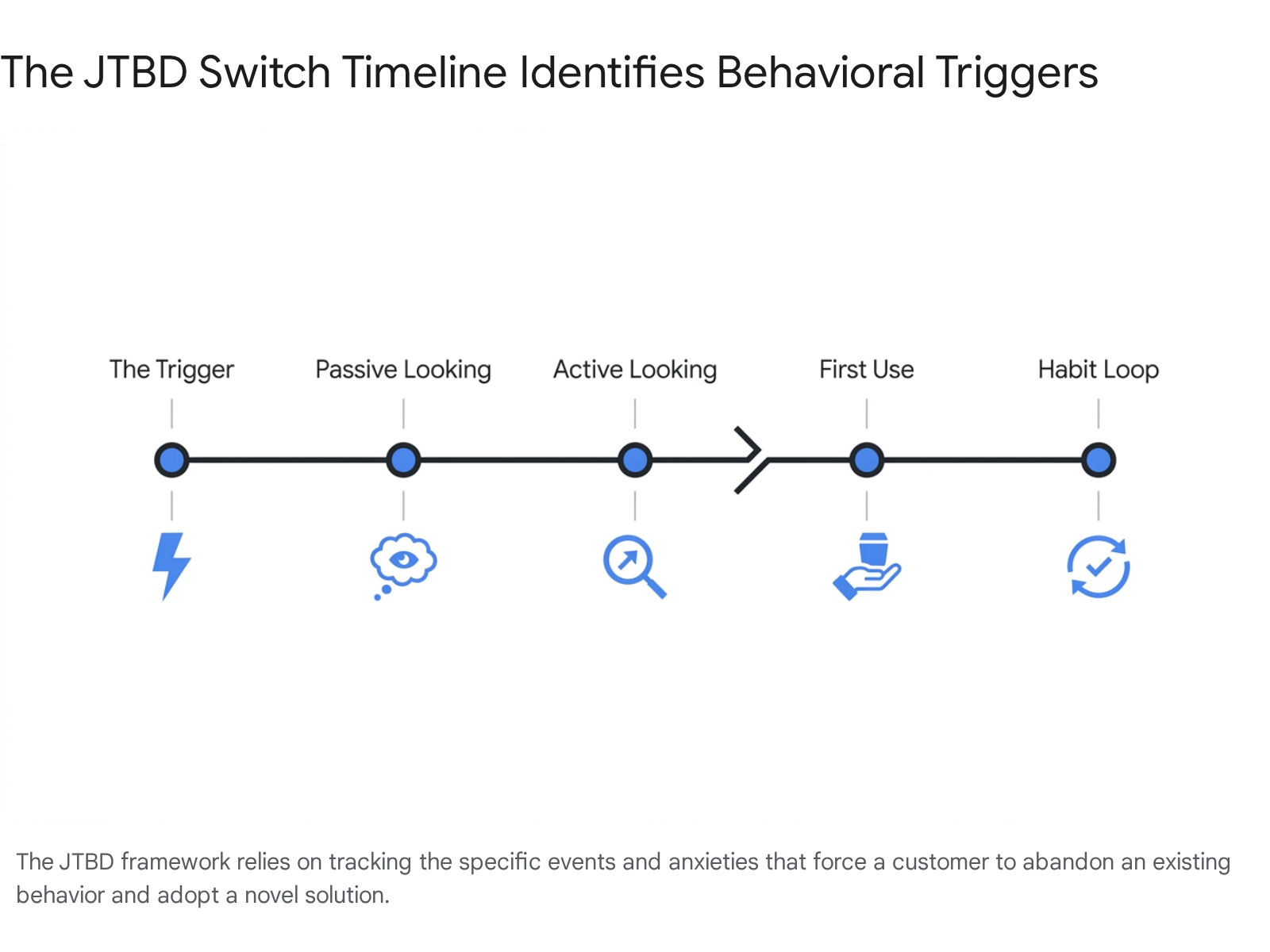
The Switch Interview, depicted above, forms the qualitative backbone of JTBD research, mapping motivation and anxiety by probing concrete events rather than abstract preferences 21. By tracing the timeline from the initial trigger through passive and active looking, researchers isolate the exact circumstances that constitute a viable segment.
Integrating Jobs-to-be-Done with the Minimum Viable Segment
Applying JTBD principles to the MVS significantly refines customer discovery. While the MVS provides a structural limit regarding market size and homogeneity, JTBD provides the defining characteristic of that homogeneity: the audience shares the exact same functional job and the exact same struggling moment 18.
Constraining the Minimum Viable Product
When Lean Startup methodologies are deployed without a JTBD-defined MVS, entrepreneurs often fall into a feature-development trap 1011. The synthesis of these frameworks reveals a precise operational overlap. A highly specific Job-to-be-Done identifies the functional and emotional needs of the user; the Minimum Viable Product dictates the technical constraints and capabilities of the startup; and the market demand dictates the economic viability of the endeavor 101225.
Operating outside this intersection introduces severe risk. If an organization builds an MVP without incorporating JTBD insights, it risks severe feature bloat as it attempts to satisfy conflicting user feedback 1012. Conversely, if an organization maps a JTBD perfectly but fails to deploy a rapid MVP, it relies entirely on untested assumptions and risks prolonged development cycles 229. The strategic intersection of technical capability, economic viability, and precise customer struggle forms the true Minimum Viable Segment.
The MVP is thus restricted to solving one specific job for one specific customer group, proving retention and value before expanding to adjacent jobs 25. This aligns with the "MVP Tree" strategy, which breaks a broad organizational mission down into smaller, testable candidate MVPs that satisfy three strict criteria: 1. Meaningful Job: The product addresses a highly frequent or critical job where the customer is actively spending time or money 2522. 2. Significant Advantage: The MVP offers a clear, measurable advantage - such as speed, cost, or quality - over competing incumbent solutions 25. 3. Growth Engine: The solution inherently builds a mechanism for scalable user acquisition or viral coefficient 2531.
When a product team adheres to an MVS defined by a single job, they can confidently ignore feature requests that fall outside the parameters of that job. This disciplined constraint preserves capital, simplifies the user experience, and significantly accelerates time-to-market 112324.
Operational Workflows and Validation Diagnostics
The traditional Lean Startup workflow relies heavily on iterative building and generalized customer feedback. However, when enhanced by JTBD and MVS parameters, the preliminary discovery and validation phases undergo substantial modification, prioritizing qualitative problem definition before quantitative engineering.
| Phase | Traditional Lean Startup Workflow | JTBD & MVS Enhanced Workflow |
|---|---|---|
| Problem Definition | Identify a broad problem space and hypothesize a generalized value proposition 6. | Identify a specific "struggling moment" and map the functional/emotional "Job" steps 182425. |
| Market Targeting | Define an Ideal Customer Profile (ICP) based on demographics and industry verticals 1718. | Isolate the Minimum Viable Segment (MVS) united strictly by the exact same job context 101218. |
| MVP Development | Build a minimum feature set to test aggregate market demand broadly 6. | Build a strict solution tailored to execute one specific job perfectly for the MVS 2526. |
| Feedback Loop | Measure generalized product usage and pivot based on aggregate customer satisfaction 615. | Measure Outcome-Driven Innovation metrics (opportunity scores) and specific task completion rates 2125. |
| Scaling Strategy | Expand features organically based on requests from the highest-paying users 1136. | Dominate the initial MVS, then systematically expand to adjacent segments with overlapping jobs 1116. |
Quantitative Metrics for Segment Validation
The synthesis of Lean Startup and JTBD requires specialized metrics to evaluate whether the MVP successfully aligns with the MVS. A robust validation system prevents confirmation bias and measures actual behavioral change rather than stated preferences. While traditional startup metrics such as Customer Acquisition Cost (CAC), Lifetime Value (CLV), and Monthly Recurring Revenue (MRR) remain vital for evaluating financial health 1537, they are lagging indicators. Evaluating JTBD alignment requires leading experience metrics.
Anthony Ulwick's Outcome-Driven Innovation (ODI) methodology provides a mathematical approach to validating JTBD alignment prior to writing any code. Within any given job, customers have desired outcomes - the specific metrics by which they measure success (e.g., minimizing the time it takes to verify data, reducing the likelihood of a compliance error) 2125. To calculate the viability of a segment, organizations survey users to quantify the importance of an outcome and their current satisfaction with existing solutions 2125. The resulting calculation is the Opportunity Score:
Opportunity Score = Importance + (Importance - Satisfaction)
Opportunity scores above 12 typically indicate highly underserved outcomes, representing the optimal targets for an MVP 25. Conversely, if an MVP targets an outcome with a low Opportunity Score, it indicates the market is overserved, meaning the MVS will lack the urgency required to overcome switching costs and adopt a novel solution 25.
Once the MVP is deployed, the HEART framework - originally developed by Google - can be adapted to track JTBD alignment continuously 21. By tracking Happiness, Engagement, Adoption, Retention, and Task success specifically mapped against crucial job steps, product teams can isolate exact friction points. For example, rather than measuring generalized application engagement, an analytics team might measure the "time to confident decision" for a specific verification step in the user journey 21.
Additionally, the Customer Effort Score (CES) serves as a vital diagnostic tool. CES measures the percentage of customers who report difficulty completing specific job steps 39. By weighting Job Importance against Current Effort Level, product managers can construct a feature prioritization matrix that roots roadmap decisions entirely in quantitative customer reality rather than internal engineering assumptions 39.
Case Studies in Minimum Viable Segment Implementation
The successful deployment of an MVS governed by JTBD principles shifts the goalpost from a generalized "Product-Market Fit" to a highly specific "Product-Segment Fit" 12. Achieving fit within a homogenous MVS allows for rapid scaling.
When Slack launched, it did not target the broad corporate communication market or the enterprise collaboration software ICP. Its MVS was strictly defined as tech-savvy developer teams 2640. These users shared a highly specific job: seamlessly integrating code repositories, automated alerts, and team communication in real-time. By hyper-focusing on the precise job parameters of this MVS, Slack was able to refine its core mechanics, achieve high retention, and build product evangelism before scaling to general enterprise users 26.
Similarly, in the artificial intelligence landscape, Perplexity AI successfully circumvented established search engine monopolies by defining a highly specific MVS: "knowledge workers" (coders, researchers, and writers) who were actively frustrated by the job of filtering out AI hallucinations in existing Large Language Models 41. Rather than attempting to serve every consumer executing a generic internet search, the company optimized its MVP strictly for deep research jobs. By fostering a high-signal community on platforms like Discord, they achieved rapid, community-led validation and a viral coefficient that bypassed traditional, expensive performance marketing 41.
This MVS approach is also visible in emerging markets. For example, Agritech startups operating in Africa often fail when they focus on developing generalized technological solutions without understanding the specific job of the local farmer 42. Success in this sector requires identifying an MVS - such as a specific crop cooperative facing a distinct supply chain bottleneck - and achieving "Problem-Solution Fit" before building scalable software 42. Bottom-up market sizing is heavily utilized in these scenarios to ensure the MVS is economically viable before deployment 17.
Application in Deep Technology and Novel Markets
While integrating JTBD and MVS methodologies provides substantial benefits to early customer discovery, the framework is not universally applicable. Deep Tech startups - those commercializing radical innovations in fields like quantum computing, advanced materials, biotechnology, or acoustics - often face severe limitations when applying this lens 274445.
Deep tech ventures are characterized by extensive research and development timelines, heavy capital intensity, and significant regulatory certification hurdles 274428. More critically, these startups do not typically replicate existing markets or solve highly visible, existing jobs; they create entirely new markets based on fundamental scientific breakthroughs 2745. Because the technology may not yet exist in the public consciousness, prospective customers cannot accurately articulate a job-to-be-done for it. Educating a market on a non-existent technology introduces extreme friction into standard JTBD interview techniques, as customers lack the context to evaluate their unmet needs accurately 2745.
Furthermore, the "valley of death" between deep tech R&D and commercialization is notoriously prolonged 27. The rapid iteration principles of the Lean Startup methodology - shipping a fast, lightweight MVP to gauge MVS reaction - are frequently impossible when hardware certification or clinical trials alone require years of upfront capital investment 2744. In these environments, product development relies more heavily on technology push rather than market pull, making MVS identification a secondary concern until the core science is validated 28.
Strategic Limitations and Contextual Constraints
Beyond the confines of deep technology, the synthesis of Lean Startup and JTBD faces broader philosophical and strategic critiques. A primary critique of the Lean Startup methodology, even when tempered by MVS and JTBD, is the risk of continuous over-iteration. Prioritizing speed and continuous feedback loops can sometimes equate movement with progress, leading teams into a constant cycle of churn 14. If a founding team reacts to every signal from the MVS, they risk creating a fragmented product architecture that satisfies immediate, short-term pain points but fails to scale securely or align with long-term strategic objectives 14.
Additionally, critics of the Jobs-to-be-Done theory argue that it can unnecessarily overcomplicate simple product development cycles. The intensive qualitative research required to map functional, emotional, and social jobs can lead to analysis paralysis 2326. For early-stage founders operating with limited runway, the time spent conducting extensive switch interviews and calculating ODI opportunity scores may detract from actual product building 2326. Furthermore, JTBD is often criticized for generating advice that functions better in high-level management consulting than in agile, on-the-ground product development 26.
Finally, neither Lean Startup nor JTBD is appropriate for all business endeavors. For entrepreneurs launching proven business models - such as a franchise restaurant, a retail storefront, or a standard service business - traditional business planning remains superior 1. These businesses operate in well-understood markets where execution matters more than innovation 1. Securing bank loans or franchise approvals requires detailed, traditional financial projections and comprehensive risk analysis (often spanning 30 to 50 pages), rendering the one-page Lean Canvas and rapid MVP experimentation inadequate for the task 129.
Despite these constraints, for organizations operating in high-uncertainty environments, the integration of the Minimum Viable Segment with the Jobs-to-be-Done framework represents a critical maturation of early customer discovery. By explicitly acknowledging that rapid experimentation is counterproductive without strict market boundaries, organizations can utilize JTBD to isolate the precise behavioral triggers that define their most valuable early adopters, drastically improving capital efficiency and the probability of long-term commercial success.