
Lean Startup methodology and assumptions testing in new ventures
The traditional paradigm of entrepreneurial management and new product development historically relied on the execution of static, comprehensive business plans. Operating under the implicit assumption that market dynamics, customer preferences, and technological feasibility could be accurately forecasted through extensive upfront research, ventures dedicated months or years to isolated engineering and product design. The Lean Startup methodology fundamentally disrupts this conventional paradigm by reframing the early-stage venture as an institution designed specifically to operate under conditions of extreme uncertainty. Under this empirical framework, the primary objective of a nascent venture is not immediate commercial execution, flawless product delivery, or short-term revenue maximization, but rather the rapid and systematic acquisition of validated learning 123.
By applying the principles of the scientific method to business model innovation, the Lean Startup methodology operationalizes the rigorous testing of core assumptions. It demands that founders and corporate innovators decompose their overarching visions into granular, falsifiable hypotheses. Rather than relying on intuition or extended forecasting, teams are required to construct the minimum necessary vehicles to test these specific claims in the open market, subsequently utilizing the resulting empirical data to inform iterative strategic decisions. Despite its ubiquitous adoption across global entrepreneurial ecosystems, the methodology is increasingly subject to rigorous empirical scrutiny. Recent longitudinal data, peer-reviewed academic analyses, and industry-specific post-mortems reveal a highly complex landscape. While the framework drastically improves capital efficiency, mitigates early-stage risk, and drives product-market alignment for many digital ventures, it presents distinct structural limitations when applied to deep tech sectors, business-to-business environments, and ecosystems characterized by severe infrastructural deficits. Furthermore, an over-reliance on localized customer validation can occasionally trap ventures in a state of continuous incrementalism, famously referred to as the local maxima problem 12634.
Epistemological Foundations and Theoretical Precursors
The Lean Startup methodology does not exist in an intellectual vacuum; it is the synthesis of several robust management theories adapted specifically for high-uncertainty environments. The framework fundamentally draws its nomenclature and philosophical grounding from the Lean Manufacturing principles pioneered by Toyota in the mid-twentieth century. Lean Manufacturing sought to systematically eliminate waste from production cycles, defining "waste" as any activity or process that does not directly create value for the end customer. The Lean Startup methodology translates this concept from the realm of physical production into the realm of innovation and knowledge creation. In the context of a startup, waste is redefined as any developmental effort, engineering time, or capital expenditure devoted to building a product or feature that the market ultimately rejects 356.
Complementing this manufacturing philosophy is the Customer Development methodology pioneered by Steve Blank. Traditional product development processes typically featured isolated phases of concept, development, alpha/beta testing, and finally, market launch. Blank's Customer Development model argued that startups should parallel their product engineering efforts with aggressive, out-of-the-building customer discovery efforts. This ensures that the venture is actively seeking a problem worth solving and securing early validation from prospective buyers before committing heavy resources to product finalization. The Lean Startup methodology, formalized heavily by Eric Ries in 2011, amalgamates Lean Manufacturing's obsession with waste reduction and rapid cycle times with Customer Development's insistence on market validation, creating a cohesive framework for continuous, hypothesis-driven innovation 578.
The Construct of Leap of Faith Assumptions
At the structural core of the Lean Startup framework is the stark acknowledgment that every new business idea, regardless of the founder's conviction or the depth of secondary market research, initially rests upon a foundation of unproven beliefs. The methodology categorizes the most critical, foundational, and precarious of these beliefs as "Leap of Faith Assumptions" (LOFAs) 123. These assumptions represent the indispensable conditions that must hold true for the envisioned business model to succeed. They are the load-bearing pillars of the strategic plan; if empirical testing invalidates these specific assumptions, the entire business model inevitably collapses, necessitating a fundamental change in direction.
Operationalizing these assumptions requires the deliberate translation of broad strategic goals into specific, testable, and falsifiable hypotheses. In order to construct an actionable roadmap for experimentation, founders must isolate variables and systematically test them. This process typically bifurcates into two distinct categories of empirical inquiry: the Value Hypothesis and the Growth Hypothesis 12.
Validating the Value Hypothesis
The Value Hypothesis is fundamentally concerned with desirability and utility. It tests whether a proposed product or service actually delivers tangible value to the customer once they begin interacting with it 2. The objective is to rigorously answer a dual-pronged question: do target consumers organically recognize that they possess the specific problem the startup is attempting to solve, and does the proposed solution effectively address that pain point in a manner superior to existing alternatives?
Testing the Value Hypothesis requires a departure from traditional qualitative market research. While focus groups and stated-preference surveys can generate initial insights, they frequently fail to accurately capture actual consumer behavior, as individuals are notoriously poor at predicting their own future purchasing decisions. Instead, Lean Startup practitioners operationalize the Value Hypothesis by measuring behavioral commitments in the real world. Metrics indicative of a validated Value Hypothesis include high user retention rates, repeated usage frequency, and the willingness of early adopters to either pay a premium or endure the friction of a suboptimal, unpolished user experience to access the core solution 13910. If an early user cohort rapidly abandons the product after initial trial, the Value Hypothesis is considered invalidated, regardless of how elegantly the software was engineered.
Establishing the Growth Hypothesis
While the Value Hypothesis concerns the fundamental utility of the product, the Growth Hypothesis tests the mathematical and structural mechanisms through which the startup will successfully scale operations and acquire new customers at a sustainable cost 12. It requires the venture to identify, test, and validate a highly specific "Engine of Growth." The methodology outlines three primary, distinct engines that dictate how a venture achieves scale.
The Sticky Engine of growth relies predominantly on exceptionally high long-term retention and negligible churn rates. In this model, if the rate of new customer acquisition simply exceeds the rate of customer attrition, the user base will compound naturally over time. The Viral Engine is driven by direct user-to-user transmission, where the inherent daily use of the product serves as a marketing vector. This engine is validated by measuring the viral coefficient - the mathematical calculation determining how many new users each existing user brings into the ecosystem. Finally, the Paid Engine of growth is driven by a mathematically sustainable margin where the Customer Lifetime Value (CLV) significantly and consistently exceeds the Customer Acquisition Cost (CAC) 211.
By conceptually isolating the Value Hypothesis from the Growth Hypothesis, the Lean Startup framework actively prevents one of the most common and fatal failure modes in traditional entrepreneurship: the premature scaling of operations. Startups frequently err by injecting massive capital into a Paid Engine of Growth (such as exorbitant digital marketing campaigns) before the underlying Value Hypothesis has been rigorously validated. This systemic error results in the expensive acquisition of thousands of users who subsequently experience zero value and churn immediately, rapidly depleting the venture's financial reserves 1317.
Minimum Viable Product Typologies and Experimental Design
To empirically test Leap of Faith Assumptions without dedicating immense capital to speculative development, the Lean Startup methodology utilizes the Minimum Viable Product (MVP). Crucially, the methodology redefines the MVP not as a scaled-down, half-finished, or low-quality iteration of the final commercial offering. Rather, it is strictly defined as the specific version of a new product that enables a full turn of the feedback loop with the minimum amount of effort and the least amount of development time 2518. The MVP is fundamentally an experimental setup designed to yield maximum validated learning, not an early revenue-generating asset 51312.
The operationalization of assumptions testing dictates that the precise type of MVP deployed must perfectly align with the specific hypothesis currently under scrutiny. Startups utilize various distinct MVP typologies to isolate variables, eliminate engineering waste, and test psychological desirability prior to committing to technical feasibility.
| MVP Typology | Operational Mechanism | Primary Application and Tested Hypothesis | Bias Profile and Contextual Risk |
|---|---|---|---|
| Smoke Test / Fake Door | A landing page or marketing artifact offering a non-existent product to measure organic click-through rates, pre-orders, or email signups 1213. | Validates initial market demand, pricing tolerance, and the Growth Hypothesis before any engineering occurs. | Carries a high risk of brand damage if overused; provides evidence of conceptual interest, not actual product utility or retention. |
| Concierge Test | Delivering the proposed value proposition entirely manually, with the customer fully aware that a human is executing the background service 2122. | Generative research; helps define the exact operational solution when the problem space is understood but the software is not yet defined. | Introduces heavy social bias, as customers may react favorably due to personalized human interaction rather than the underlying concept 21. |
| Wizard of Oz Prototype | Delivering the value proposition manually, but obscuring the human element so the user believes the system is fully automated 211424. | Evaluative testing of a specific solution hypothesis; rigorously tests the UX flow and perceived value of automation without building the backend. | Features a high operational cost per user; cannot scale commercially, designed solely for rapid hypothesis falsification. |
| Digital Twin / Simulation | Creating a virtual, high-fidelity computational model of a physical product to computationally test functionality and real-world physics 15. | Deep Tech and Hardware applications; validates the technical feasibility and core physics of a proposed physical innovation. | Requires high upfront computational modeling costs and demands highly accurate foundational data to ensure the simulation mirrors physical reality 15. |
The critical distinction among these experimental setups lies in user awareness and the specific taxonomy of data required. For instance, a Concierge Test is optimal for high-touch service discovery. When founders personally perform tasks for early clients - such as hand-picking groceries based on a user's dietary preferences - they gain rich, qualitative insights into what algorithms eventually need to accomplish. Conversely, a Wizard of Oz test isolates the user's interaction with the proposed interface, stripping away the social bias of friendly human-to-human contact. By faking the backend technology with hidden human labor, the startup can deliver unvarnished behavioral data regarding whether users will actually trust and utilize an automated system before investing heavily in complex machine learning models 2114. Historically, successful ventures like Zappos validated the hypothesis that consumers would buy shoes online via simple smoke-test photography, while companies like Dropbox utilized low-production video demonstrations to drive waitlist signups, proving massive market demand without a fully functional backend infrastructure 51214.
The Mechanics of the Build-Measure-Learn Feedback Loop
The mechanical engine powering the entire Lean Startup methodology is the Build-Measure-Learn (BML) feedback loop. This iterative cycle is the primary mechanism for transforming unproven assumptions into actionable, empirical knowledge 1313. While the nomenclature implies a sequential chronological order - Build an artifact, Measure its performance, Learn from the data - the actual strategic application of the loop operates precisely in reverse.
When executing a rigorous BML cycle, the venture must first identify the core assumption it needs to Learn about, formulating a highly specific hypothesis. Following the definition of the hypothesis, the team must determine the precise behavioral data required to Measure and validate that specific learning, establishing strict quantitative thresholds. Only after the learning goal and measurement criteria are solidified does the team design the minimum artifact or experimental vehicle to Build 132728.
The efficiency of a startup is ultimately determined by its cycle time - the speed at which it can successfully navigate the entire loop from ideation to data-driven conclusion. Fast cycle times prevent the over-allocation of capital to dead-end strategies and enable rapid course correction in highly volatile markets.
Transition Thresholds and Innovation Accounting
A profound and persistent weakness in ad-hoc entrepreneurial experimentation is the cognitive bias toward retroactive justification. Without strict parameters, founders exhibit a tendency to move goalposts retroactively, engaging in what industry analysts term "success theater." In this scenario, ambiguous or mediocre data is creatively interpreted as positive validation, encouraging the team to persist with a flawed model 1329. The Lean Startup operationalizes discipline through "Innovation Accounting" - a quantitative, systemic approach to establishing the empirical baseline of the current product, tuning the business engine to measurably improve that baseline, and making an objective, data-backed decision to either pivot or persevere 5816.
Entering and exiting the phases of the BML loop requires rigorous transition thresholds. During the entry phase, before any engineering or building commences, the team must explicitly declare the target hypothesis, define the minimum credible experiment required to test it, and pre-commit to strict decision thresholds. For example, a team must establish beforehand that if less than a specific percentage of users complete an onboarding flow or convert from a free trial to a paid tier, the hypothesis is definitively invalidated 132729. Measurement criteria must subsequently yield statistically significant or highly directional cohort data. The reliance on broad averages is strongly discouraged in favor of inspecting data distributions and confidence intervals across specific user cohorts, isolating behavioral changes across different timeframes 1331.
The ultimate test of Innovation Accounting arrives at the exit criteria - the critical pivot or persevere decision.
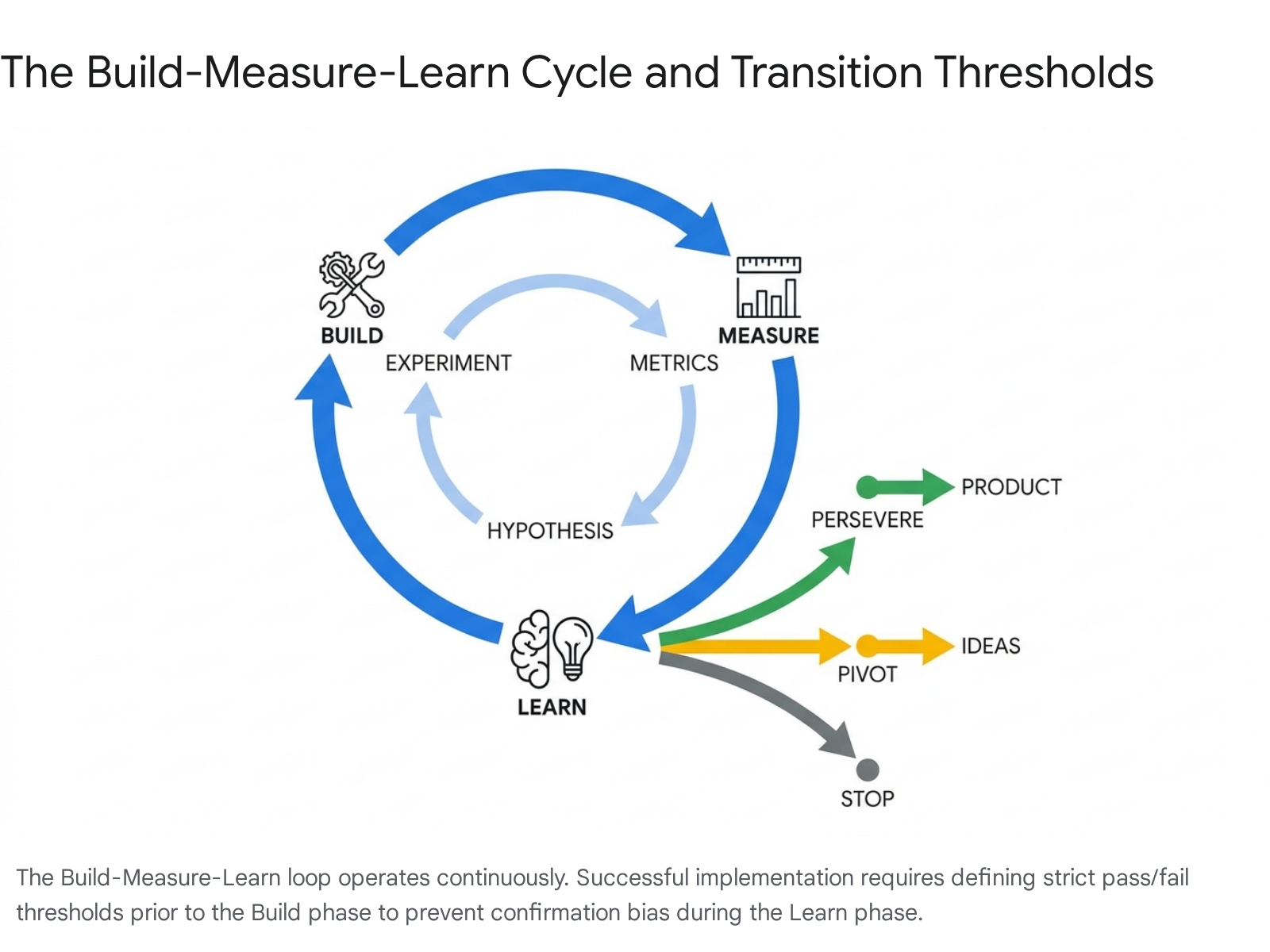
Upon comparing the empirical results against the pre-committed thresholds, the venture must objectively decide its strategic direction. If the empirical threshold is met or exceeded, the venture validates the assumption and perseveres, either scaling the validated mechanism or moving systematically to test the next riskiest assumption on the roadmap 1327. Conversely, if the empirical evidence strictly invalidates the assumption, the venture executes a pivot. A pivot is fundamentally defined as a structured change in tactical strategy while maintaining the overarching corporate vision. Pivots take numerous forms, such as zooming in on a single feature to become the entire product, changing the target customer segment, altering the value capture and pricing model, or fundamentally switching the engine of growth 32716. If a venture executes multiple pivots, continuously exhausting available tactical options and capital without ever yielding a positive market signal, the most rational decision is to perish - ceasing operations and intelligently redeploying human and financial resources elsewhere before accumulating massive debt 1329.
Actionable Measurement and the Metric Dichotomy
The methodological efficacy of the Build-Measure-Learn loop is entirely dependent on the integrity, clarity, and applicability of the data collected during the Measure phase. Data that does not directly inform a strategic decision is considered waste. Consequently, the Lean Startup methodology enforces a strict analytical dichotomy between "Actionable Metrics" and "Vanity Metrics" 5917.
Vanity metrics are superficial, highly visible indicators that consistently reflect gross activity, cumulative volume, or broad visibility, but utterly fail to explain underlying user behavior, product performance, or the structural health of the business model 91717. They are almost exclusively cumulative numbers that inevitably trend upward - such as total registered accounts, aggregate application downloads, gross page views, or total social media impressions. Because these metrics lack temporal context and can be effortlessly manipulated through untargeted paid marketing spend or broad public relations campaigns, they cannot establish empirical cause and effect. A sudden, dramatic spike in gross website traffic cannot definitively dictate whether the product engineering team should alter the core user interface, adjust the pricing model, or maintain current feature development; the metric looks impressive to external stakeholders but offers zero strategic guidance 91733.
In sharp contrast, actionable metrics directly tie specific, repeatable company actions to observed, measurable market results 917. They provide a clear, causal link to core business objectives and serve as the sole appropriate inputs for the pivot-or-persevere decision. Actionable metrics predominantly utilize ratios, unit economics, and distinct cohort analyses to track the specific behavioral journeys of segmented user groups over time 1731.
Contextual Metric Mapping by Venture Typology
The precise definition of what constitutes an actionable metric is highly variable; it shifts dramatically depending on the specific operational context, the industry vertical, and the underlying business model of the venture in question.
| Venture Typology | Prevailing Vanity Metrics | Actionable Metric Imperatives | Strategic Focus and Validation Goal |
|---|---|---|---|
| SaaS and B2B Software | Total historical registered users, gross raw trial downloads, website impressions 111819. | Conversion rate from trial to paid tier, granular cohort churn rate, Customer Acquisition Cost (CAC), exact Monthly Recurring Revenue (MRR) 11. | Establishing a mathematically sustainable LTV:CAC ratio; predicting and securing long-term cohort retention and account expansion opportunities 711. |
| E-Commerce and Digital Marketplaces | Cumulative gross page views, total social media follower counts, aggregate monthly sessions 1718. | Customer repurchase rate, average spend per processed order, Customer Lifetime Value (CLV), specific funnel cart abandonment rates 101718. | Shifting operational focus away from simple top-of-funnel traffic generation toward rigorous bottom-of-funnel transaction efficiency and brand loyalty. |
| Deep Tech and Hardware | Total count of physical prototype iterations, volume of press mentions, aggregate raw sensor data points. | Mean Time to Failure (MTTF) of physical components, simulation accuracy variance against real-world physics, exact technical milestone attainment 2. | Proving fundamental scientific and technical feasibility; definitively resolving technological uncertainty long before scaling costly physical manufacturing 2. |
Successfully transitioning a nascent startup's culture from a reliance on vanity metrics to an obsession with actionable metrics requires isolating specific behavioral insights. For example, rather than a consumer software team proudly tracking "10,000 total application downloads" - a classic vanity metric that hides immediate abandonment - a disciplined Lean Startup exclusively tracks the "Activation Rate." This represents the exact percentage of those 10,000 downloads that successfully complete a critical, value-generating core task within their first twenty-four hours on the platform. This subtle shift fundamentally reorients the entire team's focus from generating noisy marketing volume to proving deep product efficacy and addressing immediate user friction 171920.
Empirical Assessments of Methodology Efficacy
While the Lean Startup is widely lauded in practitioner circles, often bordering on entrepreneurial dogma, the rigorous academic and empirical assessment of its effectiveness yields a highly nuanced, and occasionally contradictory, landscape. For much of its early history, the methodology relied heavily on anecdotal success stories and survivorship bias. However, recent peer-reviewed longitudinal studies, institutional surveys, and randomized control trials have begun to accurately quantify its true commercial and organizational impact 7213822.
Valuation Enhancements and Iterative Learning Capacity
Strong empirical evidence suggests that rigorous adherence to Lean Startup principles can significantly enhance precise performance metrics, particularly within the domains of software and digital platforms. A landmark, peer-reviewed randomized control trial conducted by Camuffo, Cordova, Gambardella, and Spina on 116 early-stage Italian startups found compelling results. The study demonstrated that entrepreneurs who were strictly taught and subsequently utilized a rigorous, hypothesis-driven scientific approach - mirroring the core tenets of Lean methodology - performed significantly better than control groups who relied on traditional intuition and ad-hoc planning 723. The startups utilizing the structured scientific approach exhibited a highly optimal rate of pivoting. By moving away from flawed, unvalidated ideas much more rapidly than their peers, these ventures experienced stronger seed equity valuation growth and achieved faster initial revenue generation 7.
Furthermore, expansive research highlights that the methodology acts as a powerful catalyst for institutionalizing "organizational iterative learning." In a comprehensive study examining the research and development departments of 325 technology ventures in China, analysts demonstrated that deploying a Lean Startup strategy positively affects the sustainable performance of new ventures. By establishing a robust, formalized internal learning mechanism - focused on rapid customer feedback loops and data visualization - these ventures were able to systematically mitigate severe resource constraints. The empirical data indicated that this iterative capability allowed Lean enterprises to navigate both market dynamics and rapid technological shifts significantly more effectively than competitors adhering to rigid, traditional planning models 24.
Interestingly, academic background and prior professional conditioning play a measurable role in methodology adoption and success rates. Empirical research conducted by Michael Leatherbee and Riitta Katila indicates that while individuals holding Master of Business Administration (MBA) degrees often display high initial hesitation to embrace rapid, unstructured customer discovery - preferring the safety of traditional, comprehensive business planning - those MBAs who eventually overcome this resistance and adopt Lean methodologies tend to achieve exceptional, disproportionate success in rapidly converging on highly viable business models 25.
Macro Survival Rates and The Red Queen Effect
Despite strong positive indicators regarding localized equity valuation and accelerated learning speeds, broad macroeconomic data challenges the popular narrative that the Lean Startup serves as a universal, guaranteed panacea for venture survival. Long-term longitudinal tracking studies spanning the 2021-2026 period confirm a sobering reality: the overarching failure rate of startups remains stubbornly consistent with historical norms. The data reveals that roughly 90% of all ventures cease operations within their first decade, with a massive 70% failing in the vulnerable window between years two and five 2627.
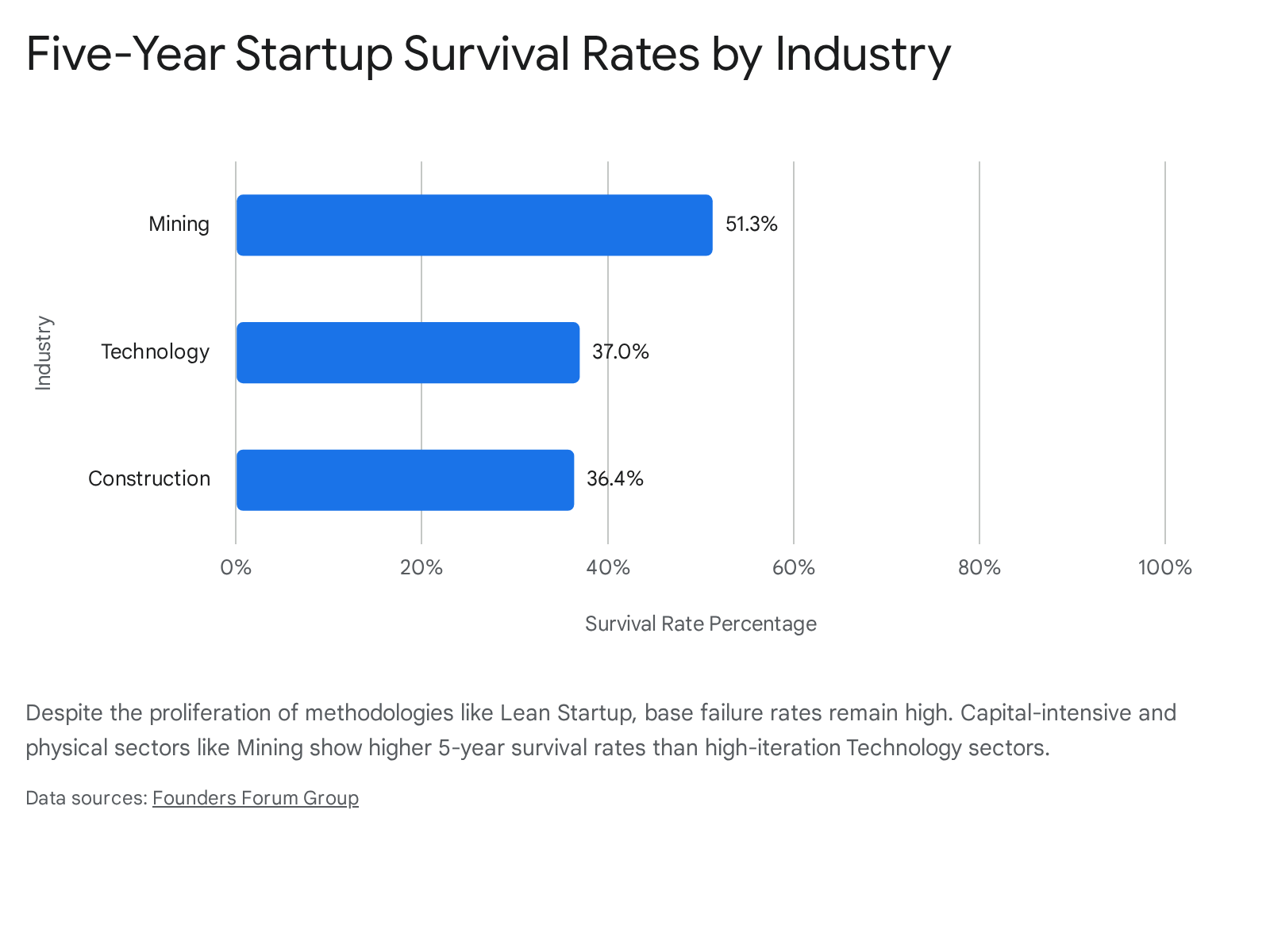
Comprehensive analyses of U.S. government data, combined with independent academic reviews spanning decades, argue forcefully that the widespread, mainstream adoption of Lean Startup, Customer Development, and the Business Model Canvas over the past thirty years has not statistically improved the macro survival rates of new businesses 4546.
This apparent paradox - where individual firm execution improves but overall market survival rates remain flat - is frequently explained by economists through the lens of the "Red Queen Effect." Originating in evolutionary biology and applied to business strategy, the Red Queen Effect postulates that organisms (or companies) must constantly adapt and evolve simply to survive against ever-evolving opposing organisms. In the context of venture capital, as the "science of entrepreneurship" becomes deeply democratized and universally adopted, it fundamentally ceases to be a distinct competitive advantage 4. If virtually every startup operating in a highly competitive sector simultaneously utilizes the exact same hypothesis-driven framework, employs rapid digital iteration, and conducts rigorous customer discovery, they inevitably converge on highly similar strategic approaches. Consequently, the baseline operational efficiency of the entire market rises dramatically, but the relative, outsized advantage of any single firm utilizing the methodology zeroes out, keeping macro success and failure rates functionally flat over time 428.
Contextual Constraints and Structural Adaptations
The Lean Startup was originally formulated and battle-tested almost exclusively within the highly specific context of consumer software and digital platforms based in Silicon Valley. These environments are uniquely characterized by incredibly low initial capital requirements, exceptionally high market uncertainty, and near-zero technological uncertainty. When the methodology is imported wholesale into radically different operational contexts, profound structural frictions emerge, requiring systemic, highly tailored adaptations.
Deep Tech and Hard Science Environments
Deep Tech ventures - startups founded squarely upon advanced scientific breakthroughs, novel engineering architectures, or hard physical technologies such as quantum computing, advanced robotics, or novel electrochemistry - face an entirely different risk profile than typical SaaS companies. While software startups must ruthlessly mitigate market uncertainty (answering the question: "Does anyone actually want this feature?"), Deep Tech startups must predominantly mitigate extreme technological uncertainty (answering the question: "Does the fundamental physics of the universe allow this process to scale?") 2.
Applying standard, fast-iteration Lean Startup practices in Deep Tech environments frequently fails due to several severe structural constraints. Building a minimum viable piece of complex hardware or a functional biological assay involves prohibitive, non-recoverable engineering risks and massive sunk costs. The ethos of rapid, low-cost prototyping executed in a matter of weeks is virtually impossible when manipulating underlying physics requires months of controlled laboratory R&D and millions of dollars in highly specialized equipment capital 129. Furthermore, consumer software leans heavily on rapid speed-to-market and network effects for its primary competitive advantage. Deep Tech, however, relies absolutely on defensible Intellectual Property (IP) and patents. Releasing early, half-baked physical prototypes into the market for early customer validation can severely compromise IP secrecy, inadvertently educating well-funded competitors and jeopardizing future lucrative patent filings 29. Additionally, Deep Tech innovations suffer from the "Tech-Push" dilemma. These breakthroughs often originate deep within university research laboratories as brilliant solutions actively looking for a problem. The academic founders may possess groundbreaking technology but completely lack a defined customer demographic or problem space, making standard early customer validation exercises highly abstract and incredibly difficult to execute 1.
To navigate these formidable barriers, Deep Tech ventures actively adapt Lean principles by shifting entirely from physical iteration to virtual iteration. Instead of pouring capital into building physical MVPs, these startups utilize highly sophisticated, computationally intensive simulation software to create "Digital Twins." These virtual representations allow founders to rigorously test the physical laws, structural robustness, and performance characteristics of a product computationally, safely satisfying the Build-Measure-Learn loop without incurring the exorbitant capital expenditure of physical manufacturing or risking intellectual property leaks 15. Furthermore, rather than pursuing immediate, broad market launch, Deep Tech firms redefine the concept of "progress." They track momentum through highly specific technical "Proof of Concept" milestones, utilizing early simulation data to secure vital strategic partnerships, win federal grants, and navigate stringent regulatory landscapes years before a physical product ever reaches an end-user 2.
Frictions in Business-to-Business (B2B) Implementations
The Business-to-Business (B2B) context introduces severe, relationship-driven frictions to the traditional Lean Startup methodology. B2B enterprise sales cycles are notoriously protracted, the software products involved are highly complex and deeply integrated into critical corporate infrastructure, and the final purchasing decisions require arduous consensus among multiple, disparate organizational stakeholders, including end-users, procurement officers, IT security compliance teams, and high-level executive sponsors 649.
In the realm of consumer software, an ambitious entrepreneur might test an idea by launching a rapid, low-fidelity landing page to thousands of anonymous internet users, rapidly achieving statistical significance on a conversion rate without ever speaking to a customer. In enterprise B2B, an entrepreneur may only have realistic access to a handful of high-value, highly discerning corporate prospects within a niche industry. Launching a flawed, buggy, or excessively "minimum" product in this unforgiving environment does not yield valuable validated learning; instead, it rapidly destroys professional trust, inflicts severe brand damage, and permanently burns relationships with a very limited, irreplaceable pool of potential buyers 649. Consequently, B2B startups cannot rely on simple Lean Startup mechanisms. They must heavily augment the methodology with established frameworks like traditional Customer Development and complex Strategic Selling methodologies. Progress in B2B Lean innovation relies on maintaining high-proximity, white-glove partnerships, executing carefully controlled pilot programs governed by strict Service Level Agreements (SLAs), and utilizing deep co-creation models with a few trusted early enterprise adopters, rather than relying on the anonymous, high-volume split-testing favored by consumer applications 6.
Emerging Markets and Infrastructure Deficits
The implementation of Lean Startup methodologies in emerging markets - such as the rapidly developing ecosystems across Southeast Asia, Latin America, and Africa - requires profound adaptation to harsh macroeconomic realities and severe institutional constraints. In regions frequently characterized by heavily fragmented geographic markets, inconsistent or unreliable energy supply grids, poor physical transport networks, and low overall digital penetration, the foundational assumptions underlying rapid digital iteration and seamless cloud deployment often collapse entirely 50303132.
Entrepreneurs operating in these environments face extreme capital scarcity. The luxurious "runway" enjoyed by Silicon Valley firms to execute multiple, expensive pivots and write off failed experiments is practically non-existent. A single failed MVP can bankrupt a promising venture. Furthermore, the socio-economic context in emerging markets frequently necessitates a strategic focus on addressing fundamental subsistence needs and severe infrastructural gaps - such as establishing baseline access to remote healthcare, optimizing sustainable agriculture, or building foundational financial inclusion networks - rather than optimizing the marginal digital conveniences that dominate Western startup culture 5032.
In response to these unique pressures, founders in African and Southeast Asian ecosystems are developing highly localized "hybrid approaches." They strategically utilize the operational agility, deep customer-centricity, and waste-reduction tenets of the Lean Startup, while simultaneously reintroducing the rigorous, traditional business planning, long-term strategic forecasting, and deep financial modeling that Lean purists often eschew 5033. This hybrid model is not merely a preference; it is an absolute necessity for survival. Local and international Private Equity (PE) and Venture Capital (VC) investors operating in these regions remain highly conservative compared to their Western counterparts. They demand exceptionally clear paths to near-term profitability, demonstrable structural resilience, and robust, proven unit economics prior to releasing funding. They fundamentally reject the high-burn, highly speculative, multi-pivot iterations tolerated in mature innovation hubs 305534.
In ecosystems like India, this adaptation has sparked the phenomenon of "high-tech jugaad" or "Lean Spark" innovation. Driven by intense geoeconomic pressures and resource constraints, Indian enterprises apply deeply frugal principles to high-tech domains, aiming for scaled, affordable solutions from the very inception of a project. Examples ranging from the mass deployment of the Aadhaar digital identity system to the highly cost-effective space missions of the Indian Space Research Organisation (ISRO) demonstrate how combining Lean principles with intentional simplicity and extreme affordability allows ventures to bypass traditional developmental bottlenecks and achieve massive scale in resource-constrained environments 35.
Methodological Pitfalls and Innovation Traps
When misapplied by inexperienced teams, or treated as an infallible, dogmatic doctrine rather than a flexible, context-dependent scientific framework, the Lean Startup methodology can inadvertently generate severe negative externalities that threaten the existence of the venture.
The Risk of Premature MVPs and Sustained Brand Damage
A persistent, highly destructive misinterpretation of the Minimum Viable Product concept is equating the word "minimum" with "shoddy," "broken," or "low quality" 131329. When founders rush to release half-finished, deeply flawed applications under the guise of an MVP, they fundamentally fail to test the actual Value Hypothesis. If a cohort of customers aggressively rejects a low-quality product, the startup's data is hopelessly contaminated; the team cannot definitively determine whether the underlying conceptual problem-solution fit was flawed, or if the execution was simply too poor and frustrating to provide any actual utility 1329.
This risk is exponentially magnified for established, mature companies or later-stage ventures attempting to retroactively utilize Lean methods to launch new divisions. Releasing premature, buggy MVPs carries the severe risk of permanent brand damage. Unlike an unknown garage startup with zero existing market expectation or reputation to lose, a highly recognizable brand launching a subpar product faces reputational hangovers that can persist for years. A failed MVP in a corporate context can actively alienate the core, loyal customer base and negatively impact the market perception and sales of their highly profitable, existing mature product lines 493637.
Agnostic Experimentation and the Absence of Strategic Vision
The Lean Startup is exceptionally effective at refining execution and optimizing product-market fit, but it cannot fundamentally replace the necessity for foundational, visionary business strategy. A critical pitfall observed across the tech ecosystem is teams engaging in continuous "agnostic experimentation" - running endless iterations of A/B tests, modifying button colors, and executing minor feature tweaks without a compelling, overarching strategic vision guiding the tests 1260. Startups utilizing this approach often fall into the trap of developing highly optimized, yet fundamentally incremental and uninspiring products, completely missing the crucial opportunity for radical, disruptive innovation 1260.
As recent research out of the University of Oxford and MIT highlights, relying exclusively on Lean frameworks and tools like the Business Model Canvas frequently results in entrepreneurs simply cataloging existing, known market data. Rather than formulating unique, highly differentiated strategies that carve out uncontested market space, they inadvertently design derivative businesses perfectly modeled around existing, highly competitive paradigms 3.
The Local Maxima Trap and Customer Myopia
Perhaps the most deeply structural and difficult-to-avoid limitation of the Lean Startup is its heavy, almost absolute reliance on iterative customer validation, which can unknowingly trap a company at a "local maxima." Customers are inherently backward-looking and heavily anchored to the present; their imaginations and requested features are generally strictly constrained by current technological paradigms and the immediate, recognizable problems they face today 34.
If a startup relies entirely on customer feedback to dictate its overarching product direction, it will successfully optimize the current solution to its absolute peak efficiency - reaching the local maxima. However, it will fundamentally fail to recognize or make the structural, visionary leap to an entirely new paradigm - the global maxima 3438. This phenomenon is particularly evident and dangerous in rapidly advancing fields like Artificial Intelligence. Startups that rigidly followed customer requests to build highly complex software scaffolding (such as optimizing vector databases for early AI models) found their entire business models and codebases rendered completely obsolete just months later when the foundational AI models improved natively through sheer raw compute power, eliminating the need for the scaffolding entirely. In scenarios demanding total paradigm shifts, the methodology's strict reliance on near-term customer validation can actively hinder breakthrough technological advancement, trapping founders in the optimization of dying technologies 43963.
Conclusion
The Lean Startup methodology has unquestionably rewired the global entrepreneurial ecosystem, successfully shifting the prevailing paradigm away from rigid, speculative business planning toward empirical, hypothesis-driven agility. By effectively operationalizing Leap of Faith Assumptions through the disciplined engine of the Build-Measure-Learn loop, and fiercely enforcing the use of actionable metrics over deceptive vanity data, the framework equips ambitious founders with a scientific toolkit to systematically dismantle extreme uncertainty and aggressively reduce the wasting of precious developmental capital.
However, the evolving empirical literature, the stabilization of macro startup failure rates, and the complex realities of global implementation demonstrate conclusively that it is not a universally applicable, infallible doctrine. Its efficacy remains highly contextual. In the realms of consumer software and digital services, it reliably enhances capital efficiency and accelerates the journey to product-market fit. Yet, in Deep Tech, enterprise hardware, and emerging macroeconomic environments, the fundamental assumptions of rapid, low-cost iteration frequently break down, necessitating highly sophisticated adaptations ranging from the utilization of computational digital twins to the re-embrace of hybrid strategic planning. Furthermore, an uncritical, dogmatic reliance on customer-driven iteration carries the distinct risk of trapping innovative ventures in endless cycles of incremental optimization, blinding them to radical technological shifts and visionary leaps. Ultimately, the Lean Startup is a remarkably powerful epistemological tool for testing risk and refining tactical execution, but it remains a mechanism for validating strategy - it can never act as a substitute for the visionary strategy itself.