
The Long-Term Impact of Early Childhood Education
High-quality early childhood interventions generate substantial, lifelong returns by boosting educational attainment, adult earnings, and physical health while simultaneously reducing crime. Although initial academic advantages often fade during elementary school, the underlying socio-emotional skills persist to drive long-term career and life success, often benefiting the next generation as well.
The Science and Economics of Early Investment
For decades, early childhood care was viewed through a largely custodial lens - a safe place for children to stay so parents could participate in the labor force. However, modern neuroscience and economic research have dismantled the myth that early childcare is merely "babysitting" 132. The period from birth to age five represents a window of unparalleled neural plasticity. During this phase, more than one million neural connections are formed every second, a biological pace never repeated later in life 34. A child's environment during this window - whether rich in responsive caregiving or fraught with toxic stress - literally shapes the architecture of their brain 35.
The economic implications of this biological reality were famously codified by Nobel Laureate James J. Heckman. "The Heckman Curve" demonstrates a simple but powerful macroeconomic principle: the highest rate of economic and social return comes from the earliest investments in children 678.
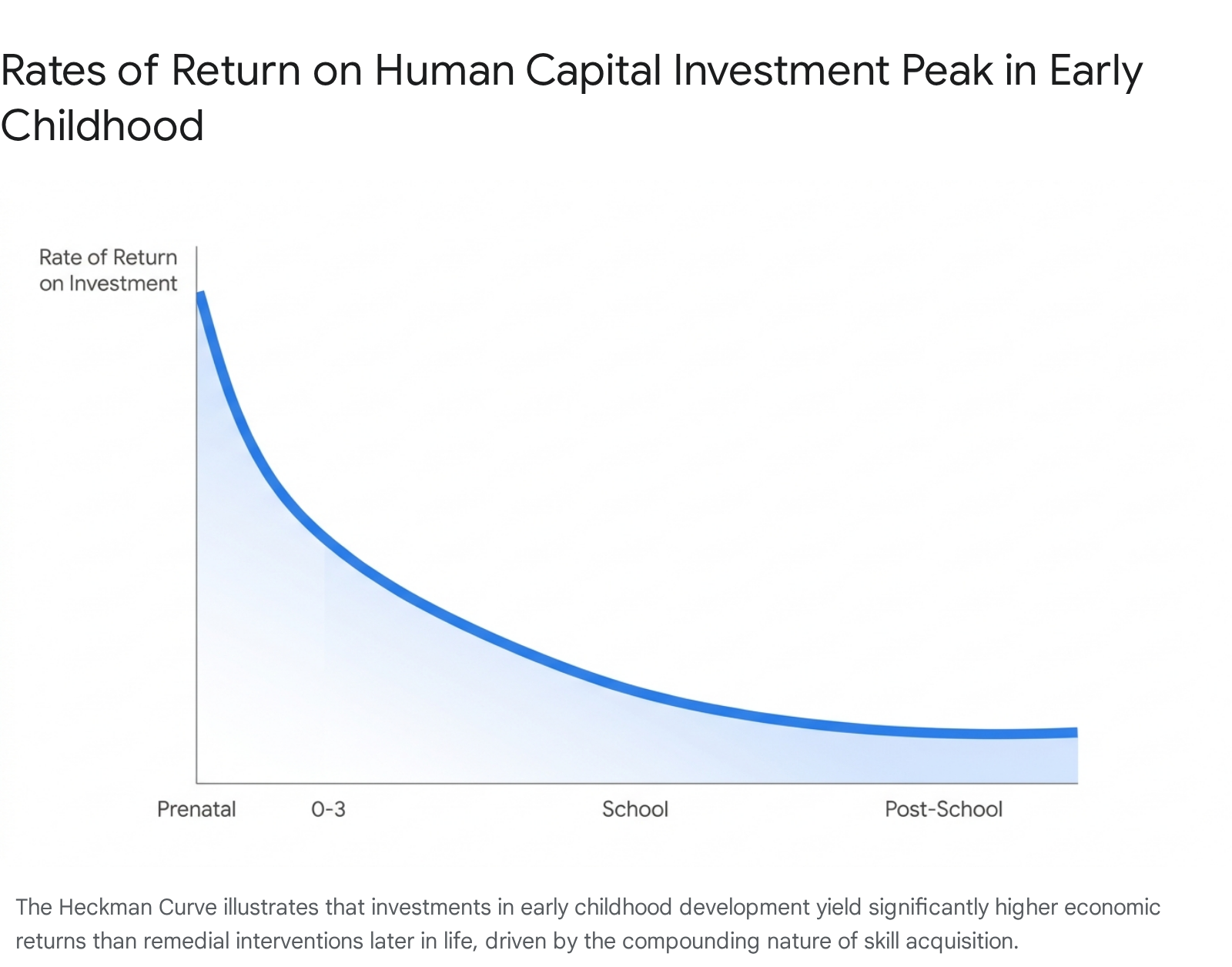
The logic rests on a concept known as "dynamic complementarity," often summarized as "skills beget skills" 79. When a child develops a strong foundational base of cognitive and socio-emotional skills early in life, it acts like compounding interest. They are better prepared to learn in kindergarten, more likely to graduate high school, and more capable of absorbing job training or college education in adulthood 910.
Conversely, society spends vast sums on later-life remediation - such as adult literacy programs, the criminal justice system, and public health interventions - when human capital is much harder and more expensive to build 71011.
Critiques and Calibrated Uncertainty
While the Heckman Curve is widely accepted as a guiding heuristic for human capital investment, it is not without academic challenge. Some economists and public policy analysts caution against interpreting the curve as an absolute mathematical law. An analysis of program benefit-cost ratios using the Washington State Institute for Public Policy dataset suggested that the relationship is not always perfectly linear 121314. Researchers David Rea and Tony Burton found that while early interventions are undeniably crucial, the data does not universally support the claim that all programs targeting young children have higher rates of return than all programs targeting older groups 13. Certain high-quality interventions for adults or adolescents can still yield benefit-cost ratios significantly greater than one 13.
Furthermore, researchers like Grover Whitehurst at the Brookings Institution have debated the necessity of intensive, highly structured early environments. Whitehurst has advanced a "good enough" theory, suggesting that while removing a child from severe deprivation yields massive gains, beyond a certain minimal level of safety and stimulation, marginal improvements to the early childhood environment may not drastically alter later-life outcomes 12.
This debate does not invalidate the importance of early childhood education (ECE); rather, it refines the framework. It suggests a modified "Human Development Framework" where early investments are critical but sometimes insufficient in isolation, requiring sustained, high-quality environments throughout the life course to prevent the erosion of early gains 1415.
Unpacking the "Fade-Out" Phenomenon
One of the most persistent controversies in early childhood research is the "fade-out" effect 8151617. When children from high-quality preschool programs enter elementary school, they typically boast significantly higher cognitive test scores (such as early literacy, numeracy, and IQ) than their non-attending peers 1518. However, longitudinal studies of several large-scale public programs, including Tennessee's Voluntary Prekindergarten program and the federal Head Start Impact Study, have shown that this academic achievement gap often narrows, and sometimes completely dissipates, by the third to sixth grade 1518.
For years, skeptics used test score fade-out as proof that early childhood interventions were an ineffective use of taxpayer money 151819. However, deeper longitudinal analyses have revealed a crucial misunderstanding of how early education impacts human capital formation.
The Sleeper Effect of Non-Cognitive Skills
Modern research distinguishes between cognitive skills (like knowing the alphabet or solving a math problem) and non-cognitive skills (like executive function, self-control, inhibitory control, and social-emotional regulation) 10152021.
While rote academic advantages may converge as non-attending peers catch up in early elementary school, the non-cognitive skills built through play-based, high-quality early education endure 81516. These socio-emotional competencies act as a "sleeper effect." They may not be perfectly captured by a third-grade standardized reading test, but they are highly predictive of long-term life success 81520.
A comprehensive 2024 meta-analysis by McCoy et al. reviewing 22 high-quality studies from 1960 to 2016 demonstrated this clearly. While cognitive scores faded, participation in ECE led to a statistically significant 8.1 percentage point reduction in special education placement and an 8.3 percentage point reduction in grade retention 22. Children who develop strong self-regulation in their early years are more engaged in school, leading to an 11.4 percentage point increase in high school graduation rates 22.
The Role of Elementary School Environments
Many scholars also note that the so-called fade-out of academic achievement should be more accurately described as a "convergence" 15. It is not necessarily that preschool attendees lose their skills, but that non-attendees eventually catch up when exposed to formal schooling 15. However, recent meta-analytic data on IQ testing suggests that children do sometimes lose the explicit IQ gains acquired during interventions, highlighting that intelligence is not permanently fixed by early environmental boosts if those boosts are subsequently removed 16.
This points to a vital mismatch in the educational system: early gains fade most rapidly when children transition from a high-quality preschool into a disorganized, under-resourced, or stressful elementary school environment 1518. Alignment between early childhood curricula and early elementary (K-3) practices is critical to sustain the initial developmental boost 18.
The Landmark Longitudinal Studies (The "Gold Standard")
To understand the true, long-term return on investment (ROI) of early childhood development, economists and developmental psychologists rely on a handful of foundational, randomized controlled trials that have tracked participants for nearly half a century.
The Perry Preschool Project (Michigan, 1960s)
Initiated in the 1960s in Ypsilanti, Michigan, the HighScope Perry Preschool Project is perhaps the most famous early childhood study in the world 232425. Visionary psychologist David Weikart and principal Charles Eugene Beatty identified 123 low-income African American children (ages 3 and 4) with IQ scores between 70 and 85, placing them at high risk for school failure 23242627. Fifty-eight were randomly assigned to a high-quality preschool program, while 65 formed a control group 2324.
The intervention featured active learning, child-led choices, high-quality adult-child interactions (with a 6:1 student-to-teacher ratio), and weekly 1.5-hour home visits to engage mothers in the educational process 192428.
At midlife (ages 40 to 54), the results were staggering. Compared to the control group, Perry participants: * Were 44% more likely to graduate high school (66% vs. 45%) 24. * Were 46% less likely to have served time in jail or prison by age 40 (28% vs. 52%) 2429. * Experienced significantly higher employment rates and lifetime earnings, with greater likelihoods of owning a home and a car 232730.
Addressing the Critics: Over the years, the Perry study has faced criticism regarding its small sample size (123 children) and minor flaws in its randomization (e.g., a few children swapped to the control group because their working mothers could not accommodate the half-day schedule or home visits) 19242931. Critics argued that working mothers might inherently raise higher-achieving children, biasing the control group upward and thus underestimating the true treatment effect 19.
Subsequent rigorous re-analyses by independent economists - most notably James Heckman, Rodrigo Pinto, and Azeem Shaikh - utilized exact small-sample inference, corrected for compromised randomization, and controlled for the familywise error rate (the probability of even one false rejection in multiple hypothesis testing) 1925293132. These modern econometric audits confirmed that the original findings remain scientifically robust and statistically significant 2531.
The Carolina Abecedarian Project (North Carolina, 1970s)
While Perry began at age 3, the Carolina Abecedarian Project (initiated in 1972) tested an even more intensive intervention: high-quality, full-time educational childcare starting in early infancy (average age of entry was 4.4 months) and continuing year-round until age 5 33343536. Like Perry, it focused on infants born into multi-risk, extreme-poverty environments, enrolling 111 infants in Orange County, North Carolina 33343537.
Follow-ups into the participants' mid-30s and 40s (funded by the National Institutes on Aging and conducted by NORC at the University of Chicago) revealed powerful academic and economic outcomes. The treated group attained significantly more years of education (13.46 years vs 12.31 years), were four times more likely to graduate from a four-year college, and delayed parenthood longer 33353839.
Most remarkably, the Abecedarian Project proved that early education is also a powerful preventive public health intervention. In their mid-30s, males treated in the Abecedarian program exhibited significantly lower rates of hypertension and a reduced risk of total coronary heart disease 3740. Furthermore, none of the men in the treatment group developed "metabolic syndrome" (a cluster of conditions increasing the risk of heart disease, stroke, and diabetes), compared to 25% of the control group 40. The early, stable, and enriched environment appears to have mitigated the biological wear-and-tear of toxic stress 3739.
Intergenerational and Multiplier Effects
Recent data suggests that traditional ROI metrics may actually under-calculate the value of early childhood programs because they fail to measure intergenerational spillover.
In a massive mid-life update on the Perry Preschool cohort, researchers tracked not just the original participants, but their adult children (who are now in their mid-20s) 26274142. The data revealed that the children of Perry participants grew up in significantly more stable, often two-parent households with higher parental earnings 304142. Male participants' children spent 15 times more of their childhood with stable married parents than the children of non-participants 42.
As a result, this second generation - despite growing up in similar socio-economic neighborhoods as the control group - exhibited drastically better life outcomes. The children of Perry participants were: * Over 30 percentage points less likely to be suspended from school, and significantly more likely to complete high school 2641. * 26 percentage points more likely to be employed full-time or self-employed 262842. * Substantially less likely to have been arrested (18 percentage points lower for male children) or to suffer from addiction 26284142.
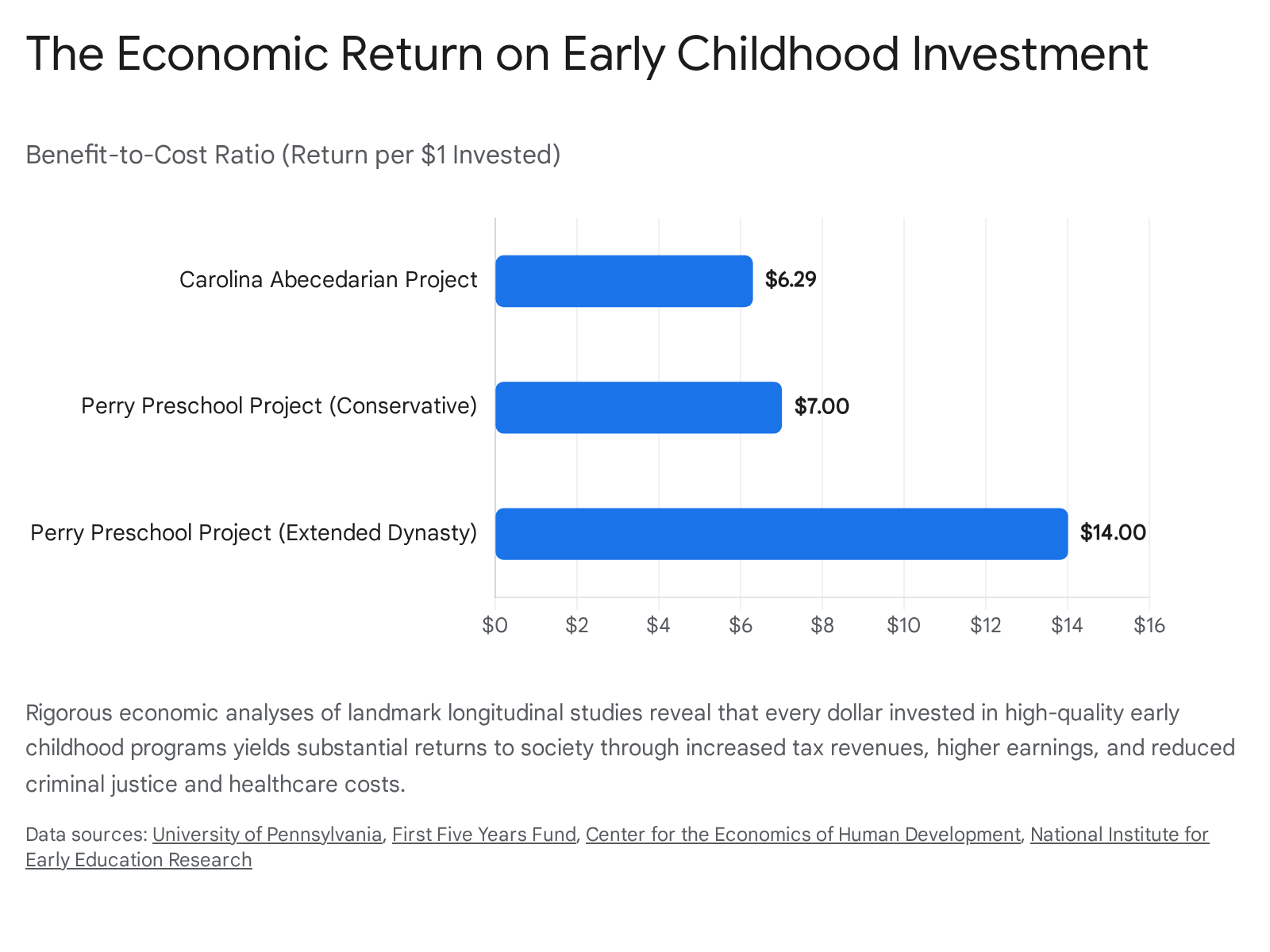
This transmission of positive effects proves that high-quality early childhood education is not merely a tool for individual advancement; it is a mechanism capable of breaking cyclical, intergenerational poverty 262745. When these "extended-dynasty benefits" are factored in, some models suggest the Perry program generated upwards of $14 for every dollar invested 30.
Summary of Landmark Intervention Outcomes
| Study | Target Population & Age | Intervention Type | Key Long-Term Outcomes (Midlife) | Estimated Benefit-Cost Ratio |
|---|---|---|---|---|
| Perry Preschool 232430 | Low-income, high-risk (ages 3 - 4) | Center-based active learning + home visits (1-2 years) | Higher high school graduation, higher earnings, 46% lower incarceration. Strong intergenerational effects. | ~$7 to $14 per $1 invested. |
| Abecedarian Project 33354046 | Extreme poverty (infancy - age 5) | Full-time, high-quality educational childcare | Higher college graduation, higher earnings, significantly lower risk of heart disease/hypertension. | ~$6.30 to $7.30 per $1 invested. |
| Jamaica Study (Detailed below) 434445 | Growth-stunted toddlers (9 - 24 mos) | Weekly home visits focusing on maternal play/stimulation | 25% higher adult wages, higher IQ, better mental health parity with non-stunted peers. | Cost-effective; specifically designed for community delivery in LMICs. |
Global Evidence: Low- and Middle-Income Countries (LMICs)
Amidst an abundance of research from Western nations, the expansion of evidence from low- and middle-income countries (LMICs) has become urgent. These regions are home to the vast majority of the estimated 250 million children globally who are at risk of not reaching their developmental potential due to poverty, malnutrition, and limited stimulation 43464748.
The Jamaica Home Visit Study (Reach Up)
To determine if early interventions work outside wealthy, high-income nations, researchers in Kingston, Jamaica launched a randomized trial in 1987 targeting 127 toddlers (ages 9 to 24 months) suffering from stunted growth - a severe indicator of malnutrition and extreme poverty 434445.
Children were divided into groups receiving: (1) psychosocial stimulation via weekly home visits from community health workers; (2) nutritional supplements (1 kg of milk-based formula per week); (3) both; or (4) a control group receiving neither 434445. The home visitors taught mothers how to interact, play, and speak with their children using homemade toys to foster cognitive development 444549.
Three decades later (at average age 31), the findings were unequivocal. The children who received psychosocial stimulation had caught up to their non-stunted, wealthier peers in IQ, mental health, and cognitive flexibility 4344. Furthermore, their adult earnings were 25% higher than the control group, effectively erasing the wage gap caused by early childhood stunting 544.
Conversely, the group that received only nutritional supplements showed virtually no long-term benefits in any measured outcome 4445. This suggests that while basic nutrition is necessary for physical survival, targeted cognitive and socio-emotional stimulation is the true engine of human capital formation 4445. The curriculum has since been packaged as "Reach Up" and successfully replicated in countries like Bangladesh, Colombia, and Peru 49. A 4.5-year follow-up of a similar home-visiting trial in India also demonstrated persistent improvements in early numeracy and parental investment, though IQ differences eventually faded 50.
Meta-Analyses of LMIC Childcare Interventions
Scaling beyond home visits to center-based care in LMICs also yields strong results. A 2024 systematic review by Evans et al. (published by the Center for Global Development) analyzed 71 studies of center-based childcare interventions across LMICs 515253.
The review found that 93% of the studies and 81% of the total estimates reported positive point estimates for child development 515253. Breaking it down by domain, 86% of results showed positive impacts on socio-emotional development, and 83% on cognitive outcomes 52. Notably, the analysis revealed that girls tend to benefit more from these interventions than boys in LMIC contexts, but poorer children do not consistently benefit more or less than wealthier children, highlighting the universal utility of quality care 515253.
Evaluating Universal Pre-K at Scale
While gold-standard interventions like Perry and Abecedarian prove what is possible in highly controlled, intensely resourced environments, policymakers today grapple with how to scale these benefits to entire populations. Universal Pre-K (UPK) programs - publicly funded preschool available to all children regardless of income - have proliferated globally 18545556. Evaluating these modern, scaled-up programs yields a more mixed, but generally positive, picture.
The Tulsa and Boston Success Stories
Studies of UPK programs in cities like Boston and Tulsa show that scaled public preschool can indeed generate lasting impacts 185657. In Boston, researchers found that while elementary test score differences faded, UPK students were ultimately more likely to graduate from high school, have higher SAT scores, and exhibit fewer disciplinary problems 18.
In Tulsa, Oklahoma, the CROCUS research team at Georgetown University has tracked students for nearly 20 years. Tulsa UPK alumni demonstrated higher high school graduation rates and a 12 percentage-point increase in college enrollment (both two-year and four-year) compared to non-attenders 57. Economic modeling by Timothy Bartik estimates that the long-term benefits of the Tulsa UPK program exceed its short-term costs by 2.65 to 1 57.
Market Spillovers and Equilibrium Effects
Evaluating UPK is mathematically complex because implementing a massive, free public system alters the entire local childcare market. A 2024 working paper by Jordan Berne analyzed the long-run impacts of Georgia's statewide UPK program using a difference-in-differences design 56.
Children exposed to the Georgia UPK were 1.7% more likely to graduate high school, 11.1% less likely to receive SNAP benefits (food stamps) as adults, and girls were 10.6% less likely to have children as teenagers 56. However, Berne notes that massive public expansions force private childcare centers to adjust their prices, alter their quality, or close entirely 56. Consequently, focusing only on children enrolled in the public program misses the "spillover" effects on children who remained in the altered private market, complicating traditional cost-benefit analyses 56.
Similarly, European reviews of universal preschool (such as Blau 2021) demonstrate that while universal programs provide substantial short- and long-run benefits to disadvantaged children, the benefits to more advantaged children are relatively modest, fueling debate over whether targeted or universal funding models are more economically efficient 58.
Structural vs. Process Quality in Early Education
As governments attempt to scale ECE, a critical debate has emerged over how to measure and mandate "quality." Researchers distinguish between two types of quality: 1. Structural Quality: Easily measurable inputs like staff-to-child ratios, class sizes, physical facility safety, and the formal education credentials of the teachers 5960. 2. Process Quality: The actual lived experience of the child in the classroom, specifically the warmth, responsiveness, and educational richness of the interactions between the caregiver and the child, and the degree of play-based learning 606162.
Across global contexts, research converges on a single truth: while structural elements facilitate good environments, process quality is the actual driver of child development 25326061. A 2023 PLOS ONE meta-analysis analyzing 1,044 effect sizes from global literature found that higher levels of process quality - specifically instructional support by the teacher - were significantly related to higher academic outcomes in literacy and math, as well as greater social competence 60. A separate longitudinal meta-analysis confirmed that process quality is a small but highly significant predictor of children's socio-emotional development extending all the way to age 18 61.
Evidence from Colombia's Nationwide Expansion
A massive evaluation of Colombia's public preschool expansion asked a critical policy question: How do you improve quality efficiently? 63.
The government tested two approaches. The first provided funding to hire extra teaching assistants (TAs). Strikingly, this costly addition to structural quality had almost no impact on child development. Lead teachers simply delegated classroom management to the untrained assistants and reduced their own instructional time 63.
The second approach - which cost very little - provided professional development training for the existing teachers, instructing them on how to effectively utilize TAs and focus more time on high-quality learning activities 63. This process quality intervention resulted in significant, positive impacts on children's cognitive development, especially for the most disadvantaged children 63.
China's One Village One Preschool (OVOP)
In rural China, where immense gaps in human capital exist compared to urban centers, the "One Village One Preschool" (OVOP) program provides a powerful case study in scaling process quality 64656667. Initiated by the China Development Research Foundation, OVOP utilizes vacant rural buildings and recruits local educators to provide free ECE in mountainous and poverty-stricken provinces 656668.
Longitudinal tracking of 23,775 children into elementary school in Guizhou Province showed that OVOP attendees significantly outperformed peers who received no early education 6566. Furthermore, dosage matters: children who attended OVOP for three years matched the 4th-grade performance of children in well-resourced public urban kindergartens. Those who attended for only two years lagged slightly behind (by about 0.2 standard deviations), indicating that an extra year of early education can effectively counteract long-term fade-out effects in high-poverty regions 6566. Subsequent studies in Zhejiang province further confirm that within Chinese kindergartens, the specific dimension of teaching and interactions is the primary predictor of child outcomes in language, math, and social cognition 69.
The Global Imperative: WHO and UNICEF Frameworks
Recognizing that early childhood development is a fundamental human right and a macroeconomic necessity, global institutions have shifted from a pure child-survival framework to a child-thriving framework 37071.
In 2025, a joint global report by UNESCO and UNICEF revealed a stark reality: 400 million children globally are deprived of essential services, and without immediate action, over 300 million children will not reach minimum reading proficiency by 2030 7273. The financial gap to provide just one year of pre-primary education in lower-income countries sits at an estimated $21 billion annually, requiring the recruitment of 6 million more educators by 2030 7274.
The Nurturing Care Framework
To address this, the World Health Organization (WHO) and UNICEF advocate for the Nurturing Care Framework 47075. This evidence-informed guideline emphasizes that early childhood development cannot be siloed into "education" alone. It requires a holistic ecosystem comprising five indivisible components 7576: 1. Good Health: Immunizations, hygiene, and disease prevention. 2. Adequate Nutrition: Maternal nutrition, breastfeeding, and micronutrients. 3. Responsive Caregiving: Observing and responding to a child's cues, which builds secure attachments and neural pathways. 4. Opportunities for Early Learning: Talking, playing, singing, and exploring the environment from birth. 5. Security and Safety: Protection from violence, pollution, and toxic stress.
Crucially, modern WHO guidelines stress that you cannot support the child without supporting the caregiver. The framework strongly recommends integrating interventions for maternal mental health (such as treatments for postpartum depression and anxiety) directly into routine child health visits, as parental well-being is intrinsically linked to the ability to provide responsive, nurturing care 47071.
Attempts to scale this parental support through technology have seen mixed results. A World Bank study in rural Nicaragua utilized behavioral nudges, sending text messages to parents about nutrition, health, and stimulation 48. While the texts successfully changed self-reported parenting practices, they failed to translate into measurable improvements in children's cognitive development 48. Furthermore, when local community leaders received the texts, parental investments paradoxically declined, suggesting that digital interventions can inadvertently crowd out vital face-to-face community support networks 48. This reinforces that human interaction remains the irreplaceable core of early childhood development.
Bottom line
The consensus across decades of neurobiology, economics, and pedagogical research is clear: high-quality early childhood development programs represent one of the most powerful and cost-effective investments a society can make. While short-term spikes in rote academic test scores may fade upon entry to elementary school, the foundational socio-emotional and executive functioning skills built in the first five years endure, driving massive long-term improvements in health, adult earnings, and social stability. What remains uncertain is how governments can best scale these highly effective, intensive models into universal public systems without diluting the process quality - the warm, responsive, play-based interactions - that ultimately drives human capital formation.