
How Spaced Repetition Helps Us Learn
Spaced repetition leverages the brain's natural forgetting curve by strategically scheduling reviews of information at gradually expanding intervals, dramatically enhancing long-term memory retention over traditional massed studying. Recent advancements in machine-learning algorithms have further optimized this biological process, allowing learners to significantly cut total study time while maintaining near-perfect recall. While highly effective for foundational factual knowledge in fields like medicine, contemporary research suggests its application to complex conceptual reasoning and high-cognitive-load mathematics requires careful, strategic implementation to avoid diminishing returns.
The Cognitive Mechanics of Memory Decay
To understand the efficacy of spaced repetition, one must first examine the foundational mechanics of how the human brain discards information. The biological reality of human memory is that it is not a static, permanent recording; rather, it is a dynamic neural trace that requires repeated structural reinforcement to survive long-term.
The Ebbinghaus Forgetting Curve and Modern Replications
The empirical foundation of spaced repetition traces back over a century to 1885, when German psychologist Hermann Ebbinghaus plotted the very first "forgetting curve" by rigorously testing his own ability to memorize and recall lists of nonsense syllables over time 122. Ebbinghaus discovered that memory decay operates on a roughly exponential trajectory. Without active intervention, the human brain loses approximately 50% of newly acquired information within the first 24 hours, and up to 80% by the end of a single week 45.
For decades, this curve was accepted as conventional wisdom, but in 2015, cognitive researchers Jaap Murre and Joeri Dros at the University of Amsterdam undertook a rigorous modern replication of the classic experiment. Using a subject who logged roughly 70 hours of testing, they reproduced the original Ebbinghaus curve almost exactly 126. The only notable modern addition to the curve was a small, temporary upward bump in retention observed around the 24-hour mark, which the researchers attributed to the biological process of sleep-dependent memory consolidation 12.
The Spacing Effect and Desirable Difficulty
The core psychological mechanism designed to arrest this rapid decay is known as the "spacing effect." Extensive research demonstrates that when learning sessions are distributed across expanding intervals of time, rather than massed together in single, intense cramming sessions, long-term retention improves dramatically 46. The classroom-scale evidence for this phenomenon is remarkably old; a 1939 study by Herbert F. Spitzer in the Journal of Educational Psychology tested over 3,600 sixth-graders in Iowa on their retention of reading passages and found clear, statistically significant advantages for distributed review over massed study 12.
The success of the spacing effect hinges entirely on a concept cognitive psychologists refer to as "desirable difficulty." The underlying theory posits that the harder the brain has to work to successfully retrieve a memory, the stronger the resulting neural pathway becomes upon successful recall 57. If a concept is reviewed too early, the retrieval process is too easy, and the memory trace receives minimal neurobiological reinforcement. Conversely, if the information is reviewed too late, the trace has already degraded beyond the point of retrieval, and the student must engage in the time-consuming process of relearning the material from scratch 5.
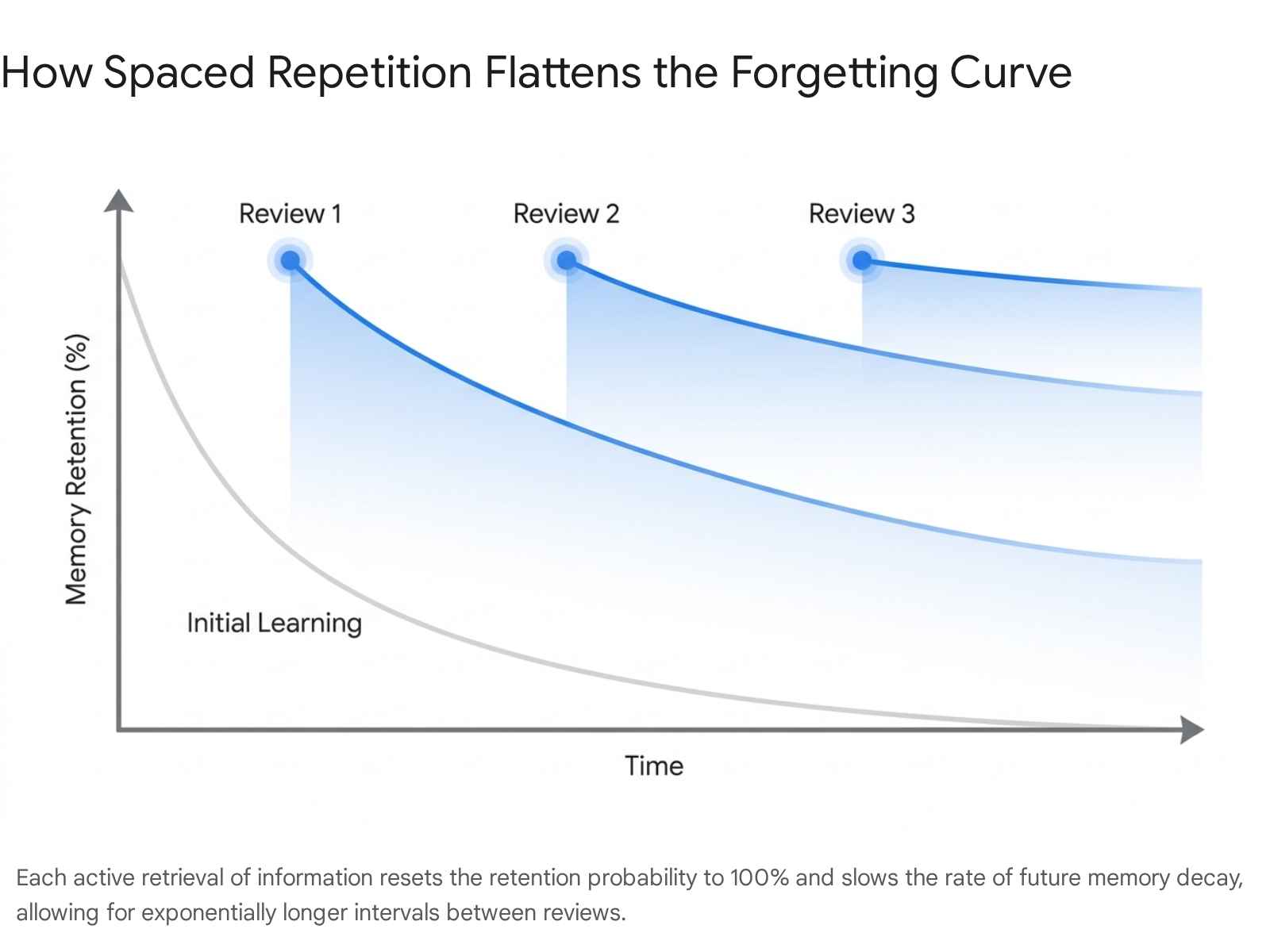
The modern synthesis of this vast body of evidence was cemented in a landmark 2006 meta-analysis by Cepeda et al., published in Psychological Bulletin. By pooling 839 effect-size contrasts across 317 separate experiments and 184 articles, the researchers established a median effect size of d = 0.60 in favor of distributed practice over massed practice, an effect considered quite large by behavioral-science standards 22.
Determining Optimal Intervals for Long-Term Retention
Understanding that spacing works is only half the battle; determining exactly when to space reviews is the core challenge of the discipline. In a follow-up 2008 study involving over 1,350 participants, Cepeda and colleagues sought to map the exact relationship between the length of the study gap and the final retention interval 289.
Their findings provided a highly useful rule of thumb for educational design: the optimal gap between study sessions scales to roughly 10% to 20% of the target retention interval. If an individual needs to remember a piece of information for 100 days, the optimal gap between study sessions is roughly 10 to 20 days. If the goal is to remember the information for four years, the optimal gap stretches to roughly 5 to 10 months 28. This mathematical relationship underscores why simple cramming is fundamentally incompatible with long-term knowledge retention.
Evaluating Effectiveness Across Academic Domains
While the underlying cognitive mechanisms of spaced repetition are universally applicable to the human brain, recent meta-analyses indicate that the magnitude of its real-world effectiveness varies significantly depending on the complexity of the material being learned and the specific educational context in which it is deployed.
The Medical School Benchmark
Spaced repetition has seen its most widespread, culturally embedded, and rigorously studied adoption within undergraduate and postgraduate medical education. Medical students are routinely required to permanently internalize vast quantities of factual and procedural knowledge, making the domain a perfect testing ground for memory optimization strategies.
A comprehensive 2026 meta-analysis conducted by Maye and Hurley, published in The Clinical Teacher, provided definitive evidence for the practice in this high-stakes environment. The researchers pooled data from 14 distinct studies involving a massive cohort of 21,415 medical learners. They found an overwhelming, statistically significant overall effect in favor of spaced repetition compared to standard studying techniques, yielding a standardized mean difference (SMD) of 0.78 101134.
In these medical settings, spaced repetition is most commonly operationalized via digital flashcard software like Anki. The interventions studied included faculty-created flashcards, third-party commercial decks, multiple-choice questions delivered sequentially via email, and systematically spaced classroom quizzes 101134. The evidence showed that these methods drastically improved objective test performance on high-stakes licensing exams and practical assessments. For instance, an isolated 2025 study examining undergraduate pediatric education found that students utilizing spaced repetition scored an average of 16.24 on post-tests compared to a control group average of 11.89, with over 64% of participants reporting that the method significantly reinforced their understanding of complex topics like developmental milestones and immunization schedules 4.
Applications in STEM and Complex Problem-Solving
When the focus shifts from the immense declarative knowledge demands of medicine to the procedural, problem-solving demands of mathematics and broader STEM fields, the spacing effect remains robustly present, but the measured effect sizes are notably smaller.
A comprehensive 2025 meta-analysis investigating the integration of spaced and retrieval practice specifically for mathematics learning reviewed 27 studies yielding 53 effect sizes. The researchers found a robust, but ultimately small-to-medium overall effect size of g = 0.28 1415. Interestingly, the study revealed that efficacy in mathematics depends heavily on how the instructional material is architected. When mathematical concepts were taught and tested in strict isolation, the effect size was noticeably stronger (g = 0.43). However, when the spaced practice was embedded more naturally into the flow of a standard, multi-topic mathematics course, the effect size dropped to g = 0.24 1415.
This nuanced outcome is further supported by a single-paper meta-analysis by Bego et al., which investigated spaced retrieval practice across nine different introductory undergraduate STEM courses. They embedded retrieval practice opportunities into bi-weekly quizzes and found significant positive effects on the final criterial test in only two of the courses: Calculus I for Engineers and Chemistry for Health Professionals 1617. In fact, when the researchers excluded the calculus course from their aggregate data, the overall spacing effect across the remaining STEM courses ceased to be statistically significant, indicating that the generalizability of spaced retrieval across highly diverse STEM disciplines remains an open question requiring further pragmatic research 1617.
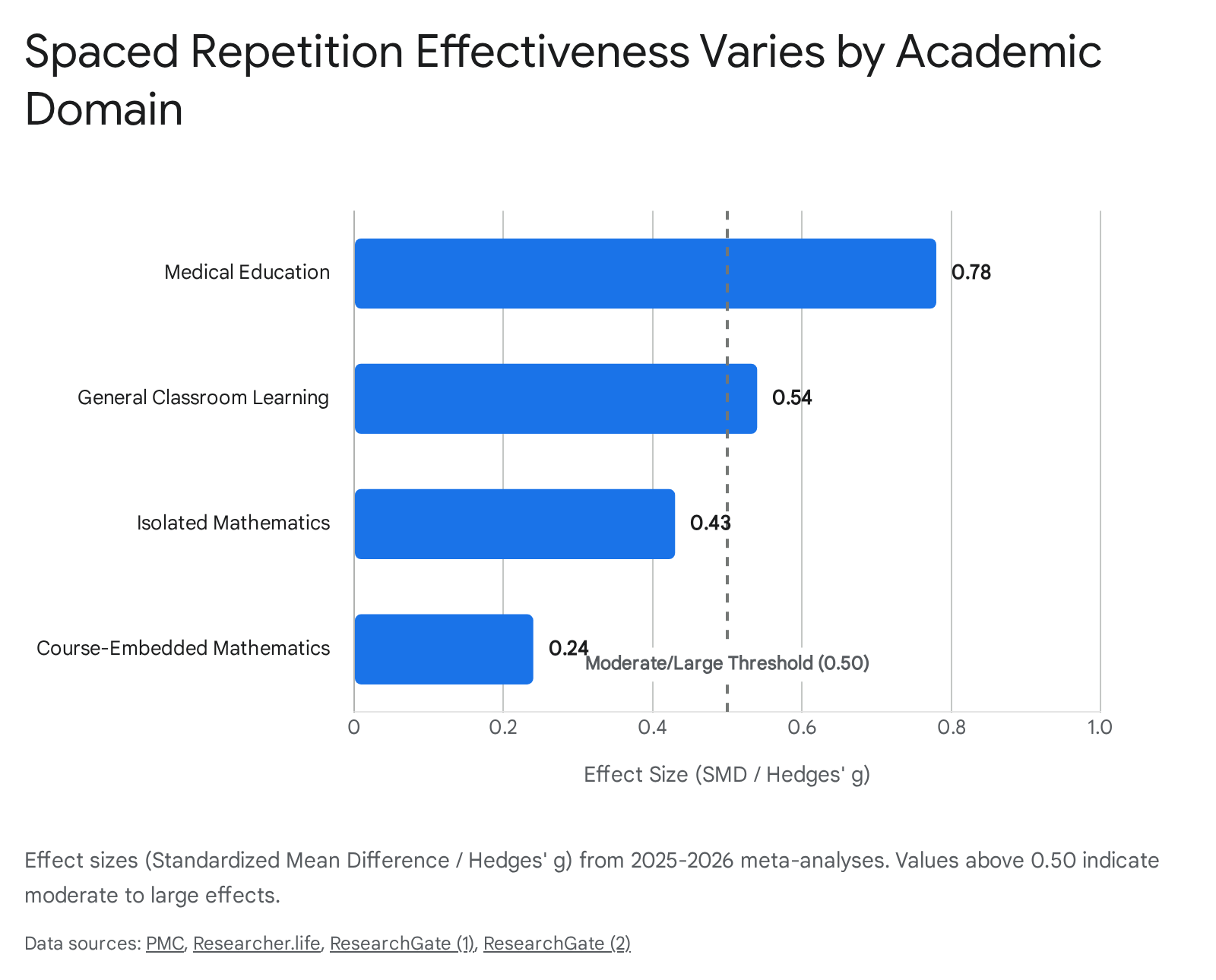
The variance in these outcomes is likely rooted in the distinction between declarative knowledge (remembering distinct facts or vocabulary) and procedural knowledge (the ability to successfully execute a multi-step mathematical operation). Spaced repetition excels at solidifying the conceptual "triggers" that tell a student when to apply a specific mathematical formula, but attempting to use a flashcard algorithm to repeatedly practice a complex, 20-step calculus calculation is an inherently inefficient use of the tool 5.
Interventions in Early Childhood and Primary Education
The spacing effect is also a subject of intense study in early childhood and primary education, particularly concerning foundational literacy and numeracy. A notable study examining the effects of early grade repetition in South African primary schools utilized a fuzzy regression discontinuity design across six provinces to track the long-term impact of repeating Grade 1 versus Grade 4. The data revealed that repeating Grade 1 - a crude but systemic form of massed restudy and spaced review - raised achievement in Home Language, Mathematics, and English by over one standard deviation in the following year. While these massive initial effects diminished over time, they remained sizeable for at least three grades, suggesting that forced repetition in early developmental years can act as a powerful, albeit costly, remedial tool for severe literacy deficits 5.
However, tightly controlled classroom experiments yield more mixed results in young children. A study by Goossens et al. looked at spaced practice for vocabulary learning in primary school children across grades 2, 3, 4, and 6. The researchers compared initial learning concentrated within a single week against learning spread across two weeks. Surprisingly, they found no significant benefit for the longer spaced condition over the shorter one, and in some instances, the shorter spacing actually outperformed the longer spacing 6. This underscores a vital nuance: the ideal length of the spacing interval interacts deeply with the total length of time before the final test, and intervals that are perfectly optimized for adult professionals may not seamlessly translate to the developing neural architecture of children.
The Algorithmic Evolution: From SM-2 to FSRS
While the biological principles of the spacing effect have remained constant since Ebbinghaus, the software algorithms utilized to calculate and automate optimal review intervals have undergone a massive paradigm shift throughout the mid-2020s.
The Limitations of the Legacy SM-2 Model
For nearly four decades, the underlying engine powering the vast majority of spaced repetition applications, including the immensely popular default version of Anki, was the SuperMemo-2 (SM-2) algorithm, originally developed in 1987 82021.
SM-2 relies on a relatively rigid mathematical formula heavily dependent on an "ease factor." When a user correctly answers a flashcard, the interval until the next review is multiplied by the ease factor to push it further into the future. If the user fails to recall the card, the interval is drastically reset, and the ease factor is permanently penalized. While revolutionary for its era, SM-2 is now considered rudimentary by modern data science standards. Its primary functional flaw is its inflexibility: repeated early failures while acquiring a new concept can cause a card's ease factor to plummet so low that the user becomes trapped in what the community refers to as "low interval hell." In this state, the algorithm forces the user to review the same card with punishing frequency, long after the concept has actually been mastered, simply because the historical ease factor was damaged during the initial learning phase 21.
The Free Spaced Repetition Scheduler (FSRS) Breakthrough
Between 2022 and 2026, the open-source cognitive science community developed, refined, and deployed the Free Spaced Repetition Scheduler (FSRS). This advanced machine-learning algorithm has rapidly become the new standard in modern study platforms, natively replacing SM-2 in Anki, Mochi, and a host of newer educational technology applications 820227.
FSRS completely abandons the archaic concept of the "ease factor." Instead, it grounds its scheduling logic in the "Three Component Model of Memory," which asserts that the status of any unitary memory in the human brain can be accurately described by modeling three distinct, continuously updated variables 821: * Retrievability (R): The exact probability, ranging from 0% to 100%, that the user can successfully recall the specific memory at the current moment in time. This value decays daily. * Stability (S): The durability of the memory trace. In FSRS, this is strictly mathematically defined as the amount of time required for Retrievability (R) to decay from 100% down to 90%. Stability only changes after a card is actively reviewed. * Difficulty (D): The inherent cognitive complexity of the specific piece of information. This variable dictates how hard it is to increase the Stability of the memory during subsequent successful reviews 2122.
Unlike SM-2, which dictates intervals via fixed, universal formulas applied equally to all users, FSRS relies on machine learning to analyze an individual user's personal review history. It uses this historical data to fit 19 distinct mathematical parameters (weights) that perfectly model the user's specific memory patterns 187.
Machine Learning and Personalized Forgetting Curves
Trained on a massive open dataset of over 1.7 billion flashcard reviews across tens of thousands of actual users, the developers of FSRS discovered that human memory decay is better modeled by advanced power functions rather than the simple exponential curves assumed by older theories. For example, researchers demonstrated that if you take two different exponential decay curves representing different memory stabilities and average them together, the resulting aggregate curve is actually fit much more accurately by a power approximation 2224.
By utilizing these power functions and precisely targeting the exact day a memory is statistically predicted to fall below a user's desired retention threshold, FSRS essentially eliminates the problem of "overlearning." Empirical benchmark tests reveal that for a standard medical student managing a deck of 15,000 active cards, FSRS produces roughly 10% to 30% fewer total reviews than SM-2 while achieving the exact same, or slightly better, overall retention rate. This leap in algorithmic efficiency translates to hundreds of hours of saved study time per year 82526.
Furthermore, the late-2025 rollout of FSRS version 6 introduced custom "forgetting curves" directly into the algorithm. Through an optimizable parameter known as w20, the algorithm now accounts for exactly how an individual user's brain decays information over time, allowing the shape of the forgetting curve to be steeper or flatter depending entirely on personal neurocognitive habits and historical performance 2227.
Algorithmic Comparison
| Feature | SuperMemo 2 (SM-2) | Free Spaced Repetition Scheduler (FSRS v5 / v6) |
|---|---|---|
| Origin Era | 1987 | 2023 - 2026 |
| Underlying Logic | Fixed multipliers and a punitive "ease factor." | Machine learning applied to actual historical review data. |
| Memory Variables Tracked | Ease factor, current interval length. | Retrievability (R), Stability (S), Difficulty (D). |
| Forgetting Curve Model | Assumes universal exponential decay for all information. | Uses power functions customized to individual users. |
| User Personalization | None. Universal formulas are applied to all users. | Highly personalized; optimizes up to 19 unique parameters per user profile. |
| Review Efficiency | Baseline efficiency standard. | Reduces total reviews by ~10% to 30% while maintaining the exact same retention rate. |
Can Spaced Repetition Build Conceptual Understanding?
A frequent critique leveled against spaced repetition is the assumption that it is merely a tool for the rote memorization of simple, disconnected facts - useful for medical terminology or language vocabulary, but ill-suited for deep, conceptual synthesis. However, cognitive psychology indicates that the "testing effect," which forms the foundation of active recall, applies robustly to conceptual knowledge as well 28.
The challenge lies in how the information is encoded. To utilize spaced repetition for deep conceptual understanding, the broad learning material must be carefully broken down into atomic, highly focused prompts. Rather than simply asking for a definition, these conceptually oriented prompts must test the user on specific connections, implications, structural causes, and systemic consequences from multiple angles 28.
When complex ideas are encoded in this multi-faceted manner, learners are forced to engage with higher-level relationships over extending periods of time. This repeated engagement keeps the user in constant contact with the systemic logic of a topic, helping them internalize the conceptual framework far more deeply than passive reading. It is a vital retort to the modern belief that rote memory is completely unimportant to deep, creative intellectual work; one cannot synthesize concepts that one cannot rapidly and reliably retrieve from working memory 28.
Where Spaced Retrieval Fails: Limitations and Risks
Despite its empirically proven efficacy, spaced repetition is not a universal educational panacea. Contemporary research has increasingly highlighted several critical boundaries, edge-cases, and behavioral risks where the technique breaks down or is actively detrimental to the learning process.
Cognitive Overload and the Limits of Testing
The cognitive benefits of retrieval practice can vanish entirely if the underlying task demands exceed the learner's maximum cognitive load limits. A revealing 2026 study by Redifer et al. demonstrated that when undergraduate students were asked to study and then retrieve information from lengthy, conceptually demanding academic texts, the well-documented "testing advantage" disappeared. The researchers found that higher cognitive load directly mediated the relationship between retrieval practice and final test performance. In these high-load scenarios, the intense cognitive effort required just to parse the complexity of the material completely overrode the neurobiological benefits of spacing, resulting in poorer delayed recall compared to less demanding strategies 8.
The Danger of Premature Retrieval
For spaced repetition to function effectively, a solid representation of the information must actually exist in the brain's semantic network prior to testing. Educational linguists and cognitive scientists note a troubling contemporary trend of viewing retrieval practice as the "engine" that creates learning, rather than as a powerful tool to "consolidate" learning that has already taken place 30.
If a student attempts to repeatedly retrieve a complex concept that they have not yet properly encoded or understood, they are forced to divert their limited working memory resources away from processing the fundamental input and toward struggling with the mechanics of output. Under these premature conditions, retrieval tasks not only fail to support long-term learning but can actively impair the initial encoding process 730.
Furthermore, tightly controlled experimental data sometimes contradicts the blanket assumption that active recall always beats passive review. A complex 2024 study by Higham et al. investigated spaced retrieval in covert settings - such as a student swiping through flashcards in a library without explicitly speaking or writing the answer. Surprisingly, the researchers found that under certain specific experimental conditions where users were not forced to explicitly rate their memory confidence, spaced restudying actually outperformed spaced covert retrieval practice on the final exam 9. This suggests that the metacognitive act of judging one's own memory strength is a crucial component of why modern spaced repetition algorithms work.
AI Study Tools and the Trap of "Reasoning Debt"
In the era of widespread generative artificial intelligence (2025 - 2026), learners frequently utilize sophisticated tools to automatically generate hundreds of flashcards, quizzes, and study modules directly from uploaded PDFs and lecture notes in seconds 103334.
While this entirely eliminates the friction of creating study materials, it introduces a severe pedagogical risk characterized by analysts as "reasoning debt." Cognitive psychologists warn that by outsourcing the synthesis and organization of information to an AI, students entirely bypass the vital initial encoding and processing phase of learning 34.
Spaced repetition functions optimally when the user has already struggled to understand the material and condense it into their own words before attempting to memorize it 34. If artificial intelligence removes the cognitive struggle of identifying what is important, the resulting spaced repetition practice devolves into a shallow, mechanical exercise in recognizing text patterns rather than transferring true conceptual understanding to new scenarios. Experts advise that while AI is excellent for organizing study schedules and generating practice questions, the fundamental human work of retrieving, struggling, and transferring the knowledge must remain intact for learning to occur 34.
Extreme Spaced Practice: Insights from the Gaokao
To observe the principles of spaced repetition operating at their absolute maximum capacity in a real-world, high-stakes environment, educational researchers frequently analyze China's National College Entrance Examination, universally known as the Gaokao.
The Gaokao is widely considered one of the most grueling academic assessments in the world, determining university placement for over 13 million registered students annually 911. The modern exam operates on a "3+1+2" model, testing students on three mandatory foundational subjects (Chinese, Mathematics, English) alongside one primary elective (Physics or History) and two secondary electives 9. Unlike Western standardized tests such as the SAT or A-Levels, which allow for multiple retakes to incrementally improve scores, the Gaokao offers extremely limited flexibility. For the vast majority of Chinese students, this single, intense multi-day exam permanently shapes their entire academic and professional trajectory 9.
To survive this immense pressure, Chinese high school students organically execute highly aggressive forms of spaced practice, often without relying on digital flashcard algorithms. Their cultural pedagogy relies on a strict, analog "learn, repeat, test" cycle that is deeply embedded into hyper-rigid daily routines. Rather than engaging in massive, 12-hour cramming sessions right before the exam, students engage in highly focused, distraction-free study sessions at the exact same time every single day 36.
A core tenet of this methodology involves continually rewriting short, clear notes and aggressively testing themselves on older material without looking at reference texts. By embracing the philosophy that "if you can't recall it without notes, you haven't learned it yet," these students are biologically harnessing the exact principles of the spacing effect and desirable difficulty 36. This cultural approach underscores a fundamental biological reality: the spacing effect does not strictly require a machine-learning algorithm or an app to function; it ultimately only requires discipline, routine, and the willingness to self-test at consistent, regular intervals.
Bottom line
Spaced repetition stands as one of the most consistently replicated and empirically validated phenomena in cognitive psychology. By scheduling active retrieval attempts precisely at the threshold of memory decay, learners can drastically enhance their long-term retention while simultaneously reducing their total time spent studying. The transition from legacy algorithms like SM-2 to modern, machine-learning models like FSRS has made this process heavily personalized, adapting to individual forgetting curves to maximize efficiency. However, spaced repetition remains a consolidator of knowledge, not a replacement for initial comprehension; it is highly effective for massive factual retention, but requires careful, strategic application when dealing with complex conceptual synthesis or high-cognitive-load environments.