
Discovery-driven planning for disruptive innovation
Introduction to Planning Under Uncertainty
Strategic management literature has long grappled with the optimal mechanisms for allocating resources, forecasting market behavior, and securing competitive advantage. Historically, enterprise planning frameworks evolved during periods of relative industrial stability, relying on the epistemological premise that the future can be reliably extrapolated from historical data. In such environments, conventional business planning operates effectively as an optimization mechanism, ensuring that resources are deployed efficiently to maximize returns on known operational models. However, as technological cycles compress, market boundaries become porous, and digitalization alters consumer behavior, organizations increasingly face contexts defined by disruptive innovation and extreme unpredictability.
In these contexts, the foundational assumptions of conventional planning fail. Recognizing this failure, Rita Gunther McGrath and Ian C. MacMillan introduced discovery-driven planning in 1995 as a systematic framework designed explicitly for highly uncertain, entrepreneurial, and disruptive environments 11. The core thesis of discovery-driven planning is that when an initiative's ratio of assumptions to knowledge is exceptionally high, the objective of planning must shift from predicting outcomes to facilitating rapid, low-cost learning 234.
The transition from conventional to discovery-driven planning represents a paradigm shift in organizational resource allocation, governance, and managerial cognition. It requires treating assumptions not as factual premises but as explicit hypotheses to be tested, and it fundamentally alters how enterprises view project variance, funding triggers, and failure tolerance 56. This report exhaustively analyzes the architectural differences between conventional and discovery-driven planning, elucidating why the latter is structurally and economically superior for managing disruptive innovation.
Mechanisms of Conventional Business Planning
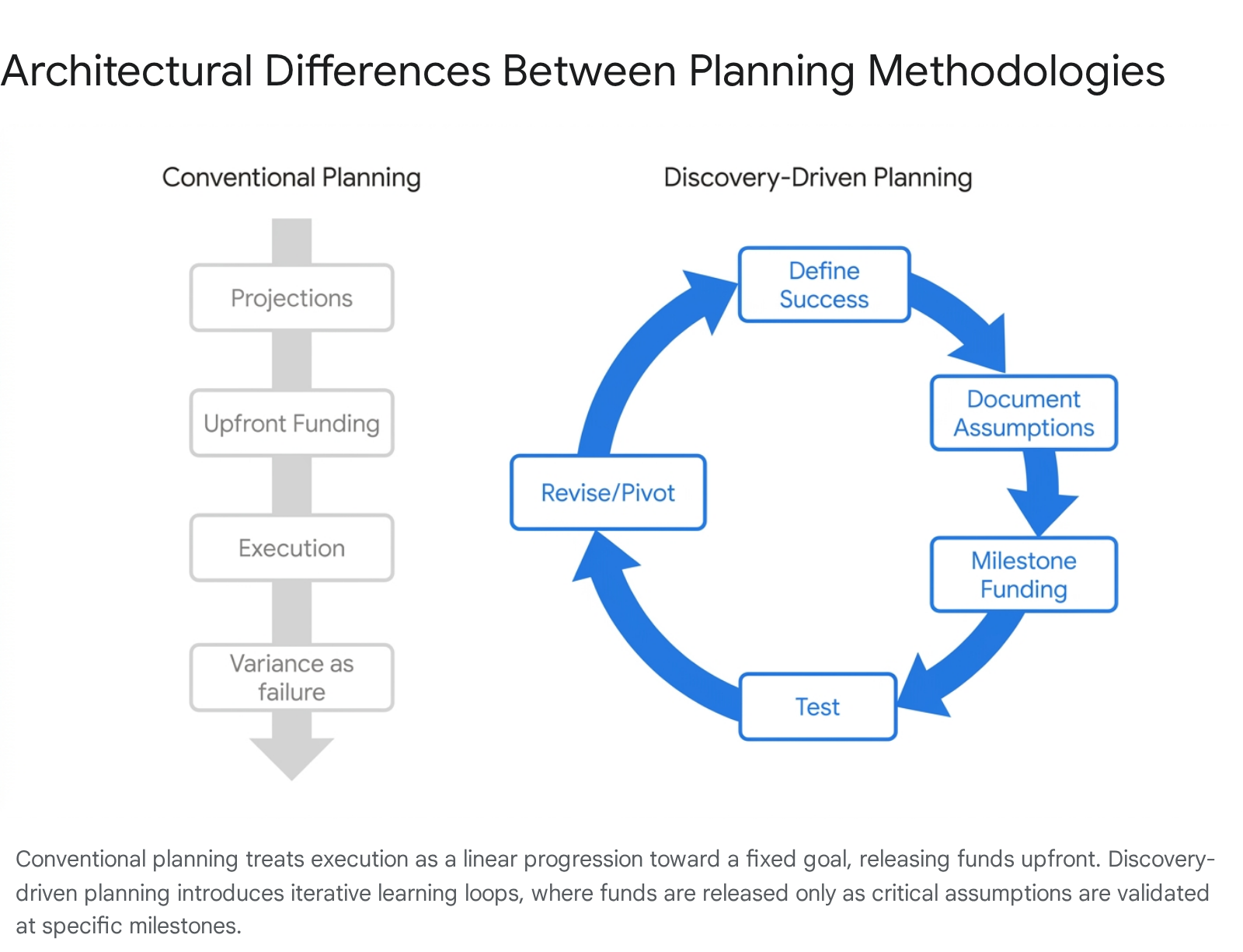
To understand the utility of discovery-driven planning, it is necessary to deconstruct the mechanics and limitations of conventional business planning. Conventional planning is frequently operationalized through stage-gate processes, discounted cash flow analyses, and annual budgeting cycles. These mechanisms are rooted in a doctrine of predictability. The core assumption is that an organization possesses sufficient operational knowledge and market data to construct reliable forecasts regarding revenue, costs, and market penetration over a multi-year horizon 17.
The primary metric of a conventional plan's correctness is the degree to which operational outcomes align with initial projections 18. If a business unit projects a specific revenue growth target and achieves it precisely, the plan is deemed successful, and the management team is rewarded. Consequently, variances from the plan are inherently treated as execution failures, forecasting errors, or managerial incompetence. Because variance is penalized, conventional planning incentivizes managers to focus entirely on environments where variables are highly controllable, actively discouraging exploration into unknown markets.
When corporate leaders attempt to apply these conventional planning models to highly uncertain ventures, managers frequently engage in fabricated forecasting to satisfy corporate governance requirements. To clear internal hurdle rates and secure upfront capital, venture leaders construct aggressive, unsubstantiated revenue projections that mask the inherent uncertainty of the project 79. This dynamic creates an illusion of certainty that ultimately misallocates capital and obscures the actual risk profile of the venture.
Resource Allocation and the Upfront Funding Trap
In conventional strategic planning, project funding is typically negotiated and allocated at the inception of an initiative. Based on the perceived reliability of the business plan, an enterprise will commit a monolithic block of capital 8. This upfront funding model creates several structural vulnerabilities in the context of innovation. Once capital is allocated based on a rigid projection, the organization becomes tethered to a specific operational trajectory. Deviating from this path to accommodate new market information is organizationally difficult and politically costly 4.
Furthermore, because the initial plan was sold to leadership as a high-probability success, managers exhibit significant reluctance to admit when underlying assumptions prove false. Driven by the sunk cost fallacy, they often deploy additional capital to rescue failing initiatives rather than pivoting or abandoning the project 1110. Conventional plans weave facts and untested assumptions together into unified financial projections. Because the assumptions are not isolated or explicitly tracked, the enterprise cannot tell whether early market signals validate or invalidate the core premise of the venture 17.
Architecture of Discovery-Driven Planning
To counteract the dysfunctions of conventional planning in unpredictable environments, McGrath and MacMillan engineered discovery-driven planning to systematically convert assumptions into knowledge. The framework accomplishes this by operationalizing the scientific method for business strategy 56. Rather than creating an illusion of certainty, discovery-driven planning makes uncertainty explicit and provides a mechanism to test it efficiently.
The methodology is deeply embedded in the Popperian tradition of falsifiability, emphasizing rigorous planning, testing, and revising of hypotheses 5. It requires the continuous integration and updating of a specific set of organizational documents, which impose a discipline different from, but equally rigorous to, traditional financial forecasting 15. These documents form the operational architecture of the planning process.
The Reverse Income Statement
Unlike conventional financial models that build bottom-up revenue projections to arrive at an eventual profit, discovery-driven planning utilizes a reverse income statement. This process begins at the end state, defining the minimum acceptable level of profitability required to justify the risk of the venture to the corporate board or investors 1511.
From this required profit margin, the planner works backward to impute the necessary revenues required to deliver that profit. Subsequently, the planner calculates the maximum allowable costs that the enterprise can incur while still meeting the profitability threshold 511. This top-down constraint forces the management team to immediately confront the mathematical realities of the market. If the required revenue implies a market share that is logically impossible to achieve, or if the allowable costs are vastly lower than the industry baseline, the team knows immediately that the current business model is unviable before significant capital is deployed 5.
Market Benchmarking and Competitive Parameters
Once the reverse income statement establishes the basic economic constraints, the venture must be benchmarked against known market parameters and competitive dynamics 1. This process provides a reality check on the assumptions embedded in the reverse income statement. For instance, if the reverse income statement dictates that the venture must sell a highly specific volume of units in its first year, benchmarking asks what percentage of the total addressable market that volume represents.
If the total market consumption is only marginally higher than the venture's required sales volume, capturing a near-monopolistic share in year one is flagged as a highly improbable assumption. Benchmarking ensures that the financial models are grounded in physical, demographic, and market reality rather than speculative spreadsheet manipulation 14. It forces entrepreneurs to align their internal economic requirements with external market carrying capacities.
Pro Forma Operations Specifications
The pro forma operations specifications detail the exact systemic activities required to produce, sell, distribute, and service the product or service 112. This step forces entrepreneurs and corporate intrapreneurs to map the logistical architecture of the venture, defining the precise sequence of events required to deliver value to the end user.
The primary utility of the operations specification is to identify whether the business model can be executed using standard operational capabilities or if it requires unprecedented breakthroughs. If achieving the allowable cost metric outlined in the reverse income statement requires a manufacturing process to operate at an efficiency rate never before achieved in the industry, this is flagged as a critical vulnerability 13. By laying out these activities, the management team exposes the hidden operational assumptions necessary for the venture's survival, effectively translating high-level financial goals into tangible, testable operational realities 1217.
The Key Assumptions Checklist
The core epistemological vulnerability of new ventures is that leaders forget they are making assumptions and begin treating those assumptions as empirical facts 7. The key assumptions checklist is a formal repository where every assumption underpinning the reverse income statement and the pro forma operations specifications is logged, categorized, and tracked 1518.
Assumptions range from customer acquisition costs and regulatory approval timelines to component pricing and competitor response latency. By centralizing these assumptions, the enterprise ensures that they remain visible and open to continuous scrutiny 5. As the venture unfolds and real-world data is collected, the assumptions checklist is actively updated. This mechanism directly reduces the assumption-to-knowledge ratio, providing a quantitative measure of how much risk has been retired as the project progresses 314.
Milestone Planning and Event-Driven Funding Triggers
In a discovery-driven model, chronological time is an irrelevant metric for progress; validated learning is the only valid metric. Therefore, the milestone planning chart completely replaces the traditional calendar-based project timeline. Milestones are defined as specific, observable events where critical assumptions can be empirically tested against market realities 1718.
Crucially, discovery-driven planning links the milestone chart directly to capital allocation. Instead of funding a project upfront, capital is released in sequential tranches, triggered only by the successful validation of assumptions at each milestone 1820. This converts the venture from a monolithic sunk cost into a series of strategic options. If an assumption proves false at a milestone, the organization can choose to revise the plan, pivot to a new market segment, or abandon the project entirely, having only spent a fraction of the total allocated budget 1421.
Comparative Analysis of Planning Methodologies
To clarify the structural and philosophical divergences between these two frameworks, the following table summarizes their fundamental characteristics across key strategic dimensions.
| Strategic Dimension | Conventional Business Planning | Discovery-Driven Planning |
|---|---|---|
| Epistemological Premise | Knowns exceed unknowns; the future is a linear extrapolation of historical performance data. | Unknowns exceed knowns; the future is highly uncertain and must be actively discovered. |
| Definition of Success | Measured by how closely actual operational outcomes match initial financial projections. | Measured by how efficiently critical assumptions are converted to knowledge, thereby retiring risk. |
| Financial Modeling Approach | Bottom-up forecasting, adding projected costs and revenues to arrive at an estimated profit. | Top-down reverse income statement, starting with required profit to dictate allowable costs and revenues. |
| Capital Allocation Mechanism | Upfront funding based on the perceived accuracy and persuasion of the initial business plan. | Staged, tranche-based funding released exclusively upon the empirical validation of assumptions at milestones. |
| Treatment of Deviations | Deviations from the plan are viewed as negative execution failures or forecasting errors. | Deviations from the plan are expected, embraced, and represent valuable validated learning. |
| Optimal Context for Application | Stable, mature markets with abundant historical data, suited for sustaining innovations. | Highly volatile, emerging, or disruptive markets lacking historical data, suited for radical innovations. |
Application in Disruptive Innovation Contexts
The concept of disruptive innovation describes a process by which a smaller company with fewer resources successfully challenges established incumbent businesses, typically by initially targeting overserved or unserved market segments before moving upmarket 15. Disruptive contexts are uniquely hostile to conventional planning frameworks, necessitating an alternative approach to strategic governance.
The Failure of Extrapolation in Disruption
When an organization attempts to launch a disruptive innovation, it operates in a space where markets do not yet exist, consumer behavior is unproven, and technological feasibility remains uncertain. Conventional market research fails in these environments because pattern recognition and data-driven analysis inherently rely on existing, historical data sets 15. If an enterprise uses conventional planning to assess a disruptive opportunity, it will demand precise return on investment projections, detailed market sizing, and definitive execution timelines.
Because these metrics cannot be reliably provided for disruptive initiatives, conventional corporate resource allocation processes consistently kill disruptive ideas in their infancy. Instead, capital is redirected toward safe, sustaining innovations that offer predictable, short-term returns but leave the enterprise vulnerable to long-term disruption. Discovery-driven planning bypasses this trap by reframing the initial investment not as a bet on a guaranteed return, but as a bet on the cost of acquiring critical market information 34.
Real Options Reasoning and Risk Mitigation
Discovery-driven planning is intrinsically aligned with the economic logic of real options theory 141617. In financial terms, an option is a small investment made today that buys the organization the right, but not the obligation, to make further investments in the future as uncertainty resolves 1.
By demanding that ventures break down their strategic architecture into testable assumptions and by tying funding strictly to milestone validation, discovery-driven planning transforms a high-risk venture into a structured portfolio of real options 17. The enterprise can investigate highly disruptive, high-potential technologies without betting the entire company balance sheet on a single, untested business plan. This drastically lowers the cost of failure. If the disruptive premise is fundamentally flawed, the company learns this cheaply at the first or second milestone, rather than after fully funding and launching a doomed product to the mass market 1114.
Complex Adaptive Systems and Failure Tolerance
Disruptive innovation requires an organizational culture that exhibits a high degree of failure tolerance 1826. Conventional planning cultures penalize failure, which inherently encourages risk aversion and incrementalism. Because discovery-driven planning explicitly frames the planning process as an exercise in hypothesis testing, it systematically destigmatizes project abandonment. When an assumption is invalidated, it is not viewed as an operational failure, but as intelligent failure resulting in validated learning 102619.
The shift from executing a fixed plan to probing a complex system reflects the realities of modern complexity theory. In complex adaptive systems, standard operating procedures and linear forecasting fail; instead, actors must probe the system, sense the response, and adapt their strategies accordingly 16. Futurists and strategic foresight practitioners utilize frameworks like Cynefin to categorize these environments, demonstrating that in chaotic or complex domains, decision-makers must deploy safe-to-fail probes rather than rigid plans 16. Discovery-driven planning provides the rigorous corporate governance framework required to probe these complex markets without descending into organizational chaos 13.
Comparison with the Lean Startup Methodology
While frequently compared to the Lean Startup methodology - which similarly advocates for hypothesis testing, customer discovery, and minimum viable products - discovery-driven planning possesses distinct theoretical roots and is specifically tailored for different organizational scales 120. The Lean Startup movement, popularized by Steve Blank and Eric Ries, explicitly cites discovery-driven planning as a foundational inspiration, sharing its emphasis on validated learning and the scientific method 162930. However, critical divergences exist in their application.
The Lean Startup method is highly effective for rapid, customer-facing iterations, optimizing for early product-market fit. It is primarily utilized by early-stage ventures seeking to validate a core value proposition 30. However, it often lacks the stringent financial and operational stress-testing required by corporate boards of publicly traded companies 129.
Discovery-driven planning bridges this gap for established enterprises. The reverse income statement and the pro forma operations specifications ensure that an initiative is not only desirable to customers but is also economically viable and operationally feasible at an enterprise scale 520. While a startup's primary risk is building something nobody wants, an enterprise's primary risk is building something that customers want but that cannot achieve the significant financial scale necessary to materially impact the corporation's overall growth trajectory 1. Discovery-driven planning systematically addresses this specific enterprise risk profile.
Enterprise Implementation and Case Studies
The principles of discovery-driven planning have been operationalized in various global enterprise transformations, providing empirical evidence of the methodology's efficacy in navigating disruptive change and complex market environments.
Haier and the RenDanHeYi Model
A premier example of discovery-driven principles deployed at scale is the Chinese home appliance manufacturer Haier. In an industry traditionally dominated by rigid manufacturing forecasts and stage-gate engineering, Haier dismantled its traditional corporate bureaucracy in favor of the RenDanHeYi management model 312122.
Haier divided its massive workforce into thousands of autonomous microenterprises. Rather than executing top-down conventional strategic plans, these microenterprises operate on discovery-driven principles. They maintain zero distance to the customer, launching rapid probes and experiments to test consumer assumptions in real-time 21. Funding and resource allocation at Haier are tied directly to these market validations. When a microenterprise validates a new use-case scenario - such as adapting a specific cooling technology for a niche agricultural application or integrating AI into smart home ecosystems - it unlocks further investment 2223. This structure ensures continuous organizational adaptation, prevents the company from being locked into obsolete product roadmaps, and aligns human resource management directly with strategic discovery 31.
Fintech Infrastructure and Scalability Constraints
In the rapidly evolving financial technology sector, the limits of conventional planning became acutely apparent during the macroeconomic shifts of the mid-2020s. Firms relying on rigid, feature-driven product roadmaps found their assumptions invalidated by rapid advancements in artificial intelligence, shifting consumer behavior, and evolving regulatory environments 24. Historical data indicated that an estimated 74 percent of high-growth startups failed due to premature scaling, a pathology where organizations expand headcount and infrastructure before validating their core economic assumptions 24.
In response, successful fintech enterprises pivoted from tracking execution velocity against static plans to measuring failure tolerance and system resilience. They adopted funding triggers aligned with assumption testing, ensuring that infrastructure investments scaled only as usage hypotheses were empirically validated 2425. By treating infrastructure resilience as an operational specification rather than an afterthought, these organizations utilized discovery-driven methodologies to avoid the costs of premature expansion while remaining agile enough to exploit emerging AI workflows 2425.
Healthcare and Service Innovation
The utility of discovery-driven planning extends beyond technology and manufacturing into complex service environments. In the healthcare sector, organizations like India's Apollo Hospitals and Aravind Eye Care System have utilized adaptive, assumption-testing models to disrupt traditional healthcare economics at the bottom of the pyramid 2627. By challenging conventional assumptions regarding the cost of care delivery and operational specifications, these organizations designed high-volume, low-margin business models that delivered world-class outcomes 27.
Similarly, service design discovery relies heavily on prototyping and the gradual retirement of risk. Whether a firm is developing new knowledge-based consulting models or skill-based entertainment services, the core principles of the reverse income statement ensure that the service can be delivered profitably before widespread hiring or facility expansion occurs 12.
Limitations and Boundary Conditions
Despite its theoretical robustness and practical utility in disruptive contexts, discovery-driven planning is not universally applicable. Its implementation is constrained by several systemic barriers, cognitive biases, and specific industrial boundary conditions 292840.
Cognitive Dissonance and Incentive Structures
The most significant barrier to the widespread adoption of discovery-driven planning is the deeply ingrained training of corporate managers. Modern business education and corporate finance departments are steeped in the logic of variance reduction, discounted cash flow modeling, and stage-gate predictability 2941. Transitioning to a model that openly embraces uncertainty and treats financial projections as mere tools for assumption-surfacing causes severe cognitive dissonance among executives 21.
Furthermore, incentive structures in large enterprises are typically tied to executing a predetermined plan. If an executive's compensation and career progression are based on hitting a predetermined annual revenue target, they will actively resist a methodology that might require them to abandon that target based on new market discoveries 1129. Without a fundamental redesign of corporate incentives and performance management metrics - shifting rewards from execution fidelity to learning velocity - discovery-driven planning is often reduced to innovation theater, where the vocabulary of discovery is used to mask conventional planning behaviors 2021. Research indicates that over 84 percent of strategic projects fail to reach completion, frequently due to these misaligned incentives and poor communication regarding strategic intent 43.
Knightian Uncertainty and Unknown Unknowns
Discovery-driven planning operates within the bounds of anticipatory logic; it requires that entrepreneurs and planners can explicitly formulate the assumptions they are making 5. However, in environments characterized by extreme Knightian uncertainty, organizations frequently encounter unknown unknowns - variables so novel, interconnected, or complex that planners do not even realize they need to make assumptions about them 1330.
When the underlying structure of a market is completely opaque, it is impossible to construct a meaningful reverse income statement or identify all critical variables for a key assumptions checklist 13. In such environments of profound ambiguity, heuristic approaches like effectuation may offer a superior theoretical lens 33031. Effectuation focuses on leveraging available means and building opportunistic partnerships to co-create the future, rather than setting fixed end-goals and anticipating the assumptions required to reach them 330. Therefore, discovery-driven planning reaches its theoretical limit when planners cannot reliably bound the scope of their ignorance.
Heavy-Asset Manufacturing Constraints
While discovery-driven planning excels in digital, service, and software-driven innovations where the cost of prototyping is marginal, its application in capital-intensive heavy industries requires careful adaptation 3233. In sectors such as semiconductor manufacturing, aerospace, or advanced robotics, testing a single operational assumption may require laying down substantial capital for fixed infrastructure 3435.
While the methodology helps structure the phasing of these investments and clarifies the assumptions being tested, the inherent lumpiness of capital requirements in heavy manufacturing places a hard limit on how cheaply an enterprise can fail and learn 3435. In these environments, the cost of retiring risk at early milestones remains significantly higher than in software development, necessitating hybrid approaches that integrate predictive engineering with discovery-driven market testing.
Conclusion
The persistence of high failure rates among corporate innovation initiatives is rarely due to a lack of technical resources or market opportunity. Rather, it represents a structural failure of strategic governance. When organizations attempt to manage highly uncertain, disruptive innovations using conventional business planning tools, they mandate predictability where none exists, thereby ensuring capital misallocation and stifling adaptive learning.
Discovery-driven planning resolves this tension by realigning the epistemological foundation of business strategy. By explicitly acknowledging that assumptions heavily outweigh facts in new ventures, it replaces the rigid, linear execution of historical extrapolation with a dynamic, cyclical process of hypothesis generation and empirical validation. Through its core mechanisms - the reverse income statement, pro forma operations specifications, assumptions checklists, and milestone-driven funding triggers - the methodology provides established enterprises with a disciplined framework to execute real options reasoning.
While its successful implementation demands a rigorous cultural shift away from variance-punishment toward failure-tolerance, discovery-driven planning remains an essential strategic architecture. It allows enterprises to probe complex, disruptive futures, strictly limiting downside financial risk while systematically uncovering the market knowledge required to forge sustainable competitive advantage in highly volatile domains.