
Lean Startup loops and Jobs to Be Done hypothesis formation
Foundational Principles of Product Development Frameworks
The discipline of modern product management relies upon methodologies that mitigate the inherent risks of bringing new products to market. Historically, product development operated on linear, predictive models that assumed customer needs were known and static. However, as markets became increasingly complex and technology cycles accelerated, these predictive models yielded high failure rates. In response, iterative and customer-centric frameworks emerged. The Lean Startup methodology and the Jobs to Be Done (JTBD) theory represent two of the most influential paradigms in this space. While often treated as distinct disciplines, their theoretical convergence provides a comprehensive operating system for product innovation, addressing both the identification of market demand and the systematic validation of proposed solutions.
The Lean Startup Methodology and Market Uncertainty
The Lean Startup methodology, formalized by Eric Ries, redefined entrepreneurship by treating the creation of a new business model as a scientific process of discovery rather than a mere execution of a predetermined plan. The framework is grounded in the premise that a startup, or any new corporate innovation venture, operates under conditions of extreme uncertainty 2. To navigate this volatile environment, the methodology eschews traditional, rigid business planning in favor of a hypothesis-driven approach centered on continuous learning and rapid adaptation 3.
The operational core of the Lean Startup is the Build-Measure-Learn (BML) feedback loop 1. The fundamental objective of this iterative cycle is to convert theoretical assumptions into empirical knowledge as rapidly and cost-effectively as possible. The process begins with the identification of "leap-of-faith assumptions" - the critical, foundational beliefs about market demand and customer behavior that must be true for the business model to succeed 5.
To test these assumptions without committing excessive capital or engineering resources, teams construct a Minimum Viable Product (MVP). The MVP is specifically defined as the version of a new product that enables a team to collect the maximum amount of validated learning about its customers with the least amount of effort 2. The MVP is deployed to the target market to initiate the "Measure" phase of the loop. Crucially, the Lean Startup demands the use of "actionable metrics" - data points that demonstrate genuine customer behavior and engagement - rather than "vanity metrics" such as gross page views or superficial registration numbers, which often paint a misleading picture of product-market fit 3.
Based on the quantitative and qualitative data gathered during the measurement phase, the organization enters the "Learn" phase, where a strategic decision is required. The team must choose whether to persevere with the current strategic direction or to execute a pivot. A pivot constitutes a fundamental, structured course correction designed to test a new foundational hypothesis about the product, the business model, or the target customer segment 32. Various types of pivots exist, such as a zoom-in pivot (where a single feature becomes the entire product), a zoom-out pivot (where the whole product becomes a single feature of a larger platform), or a customer segment pivot (solving the same problem for a different audience) 7.
Despite its dominance in agile environments, the Lean Startup framework possesses a structural vulnerability. The Build-Measure-Learn loop is exceptionally efficient at testing solutions, but its efficacy is strictly bound by the quality of the initial hypotheses fed into it. When teams utilize the BML loop without a rigorous method for defining the initial problem space, they risk building MVPs based on flawed, internal biases. This results in the "garbage in, garbage out" phenomenon, wherein teams efficiently iterate and optimize products that solve problems no one actually cares about 189.
The Jobs to Be Done Theory
To address the ambiguity of the initial ideation and problem-definition phase, the Jobs to Be Done (JTBD) theory offers a structured, sociological lens through which customer motivation can be understood. Popularized by Harvard Business School professor Clayton Christensen, along with innovation practitioners Tony Ulwick and Bob Moesta, JTBD postulates a fundamental shift in how organizations should view consumption 31112. The core tenet of the theory is that customers do not simply purchase products or services for their own sake; rather, they "hire" these solutions to make specific progress in their lives or work when faced with a particular circumstance 134.
JTBD reframes market segmentation, arguing that traditional demographic attributes (e.g., age, income, geography) and product categories are poor predictors of buying behavior. Needs are deeply contextual, arising at the intersection of a person's life and the specific circumstances they encounter 12155. Christensen's foundational case study involving fast-food milkshakes perfectly illustrates this paradigm. A restaurant chain attempting to increase milkshake sales initially failed when optimizing the product based on the preferences of a traditional demographic segment. Success was only achieved when researchers realized that a large portion of customers "hired" the milkshake in the early morning specifically to provide a thick, engaging, and slow-to-consume distraction during a long, boring commute 136. By segmenting the market based on the job rather than the demographic, the company could optimize the product's viscosity and dispensing mechanism to fulfill that exact functional need, successfully competing against alternative "hires" like bagels or bananas 136.
As JTBD evolved, two primary interpretations emerged within the innovation community, each offering distinct methodologies for understanding customer needs and formulating product hypotheses: Outcome-Driven Innovation and the Switch Framework.
Outcome-Driven Innovation: Jobs as Activities
Championed by Tony Ulwick and his firm Strategyn, Outcome-Driven Innovation (ODI) views JTBD through a highly structured, quantitative lens, defining "jobs" primarily as fundamental processes or activities 7. In this model, the core functional job (e.g., "cut wood in a straight line" or "safely transport a patient") is the central unit of analysis, around which all other emotional and consumption chain needs are anchored 520.
The ODI methodology argues that while customers may not know what technical solutions they want, they are acutely aware of the underlying metrics they use to judge the successful execution of a job 157. The process begins with qualitative research to construct a "Universal Job Map." This map deconstructs any job into eight chronological, solution-agnostic steps: define, locate, prepare, confirm, execute, monitor, modify, and conclude 7.
For each step in the job map, researchers capture "Desired Outcome Statements." These statements follow a strict syntactic formula designed to remove solution bias: a direction of improvement (e.g., minimize, increase), a performance metric (e.g., time, likelihood), an object of control, and a contextual clarifier 7. A single market analysis might yield between 50 and 150 distinct desired outcome statements 228.
Following the qualitative mapping, ODI employs rigorous quantitative surveying across a statistically valid population. Respondents rate each desired outcome on two axes: its importance to them and their current level of satisfaction with existing solutions 2089. Outcomes that score high in importance but low in satisfaction highlight underserved market gaps. These quantitative gaps generate an "Opportunity Score," providing product teams with highly precise, data-driven targets for innovation before any engineering resources are expended 7925.
The Switch Framework: Jobs as Progress
In contrast to the activity-centric model of ODI, the Switch Framework, developed by Bob Moesta and Clayton Christensen, defines a job strictly as the progress an individual seeks to make under specific constraints 11. This approach places a heavy emphasis on the psychological and emotional dynamics of consumer behavior, identifying the "struggling moment" as the ultimate catalyst for innovation 1011.
The Switch Framework utilizes qualitative timeline interviews to trace the precise psychological journey a customer takes from the "first thought" of needing a change to the eventual "continuous use" of a new solution 28. Central to this methodology is the analysis of the Four Forces of Progress, which dictate switching behavior 28.
Two of these are promoting forces that generate demand: 1. The Push of the Current Situation: The frustration, pain, or inadequacy of the customer's current context that forces them to seek an alternative 410. 2. The Pull of the New Solution: The magnetism of a new product, driven by the promise of a better life or the appeal of specific features 410.
Conversely, two blocking forces actively reduce demand and prevent the customer from making progress: 3. The Habit of the Present: The inertia, existing routines, and allegiance to the current way of doing things, even if it is inefficient 4. 4. The Anxiety of the New: The fear of the unknown, the learning curve, and the potential risks or switching costs associated with adopting the new solution 4.
For a customer to "hire" a new product and "fire" the old one, the combined power of the Push and Pull must overcome the friction created by Habit and Anxiety. By mapping these specific emotional and functional forces, product managers can understand precisely why a technically superior product might fail to gain market traction, enabling them to design interventions that address the exact psychological barriers blocking adoption 28.
Theoretical Synthesis of Hypothesis Formation
The critical convergence of the Lean Startup and JTBD methodologies occurs at the absolute beginning of the product lifecycle: the formulation of the initial hypothesis.
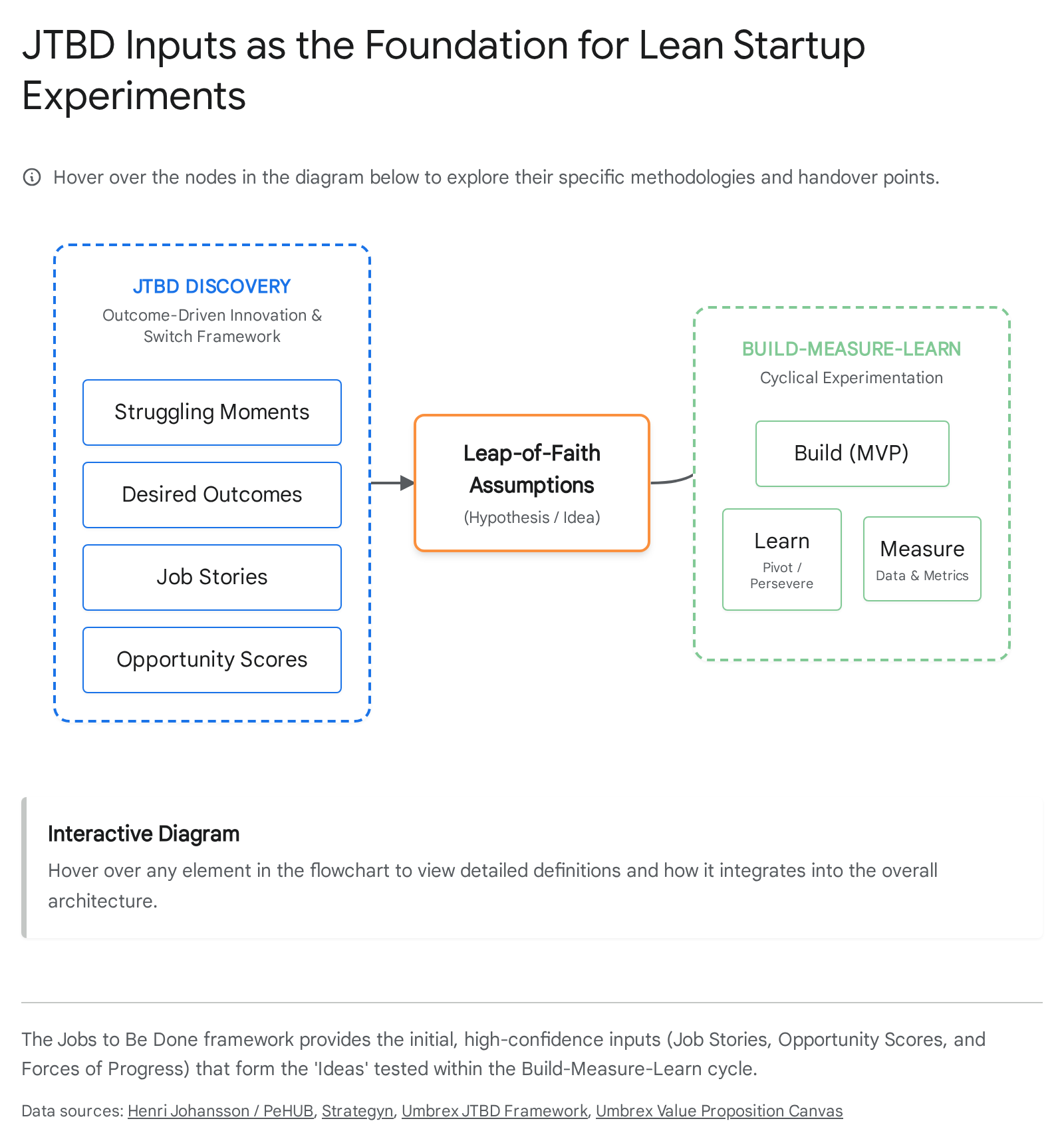
The operational efficiency of the Build-Measure-Learn loop is entirely dependent on the strategic accuracy of the ideas it tests. JTBD provides the necessary theoretical architecture to construct hypotheses that possess a high baseline correlation with actual market demand.
Reframing Leap of Faith Assumptions
In a traditional, un-augmented Lean Startup execution, entrepreneurs often generate leap-of-faith assumptions derived from internal vision, technological capability, or anecdotal market observation 58. These assumptions form the basis of the MVP. However, if an assumption is fundamentally disconnected from a genuine customer struggle, the resulting Build-Measure-Learn loop simply confirms a negative outcome. The team learns that their solution is unwanted, but they gain little actionable insight into what would be wanted, leading to undirected pivoting.
The integration of the JTBD framework systematically replaces these unvetted, solution-oriented assumptions with structured job statements and validated desired outcomes 8. Rather than hypothesizing that a customer desires a specific technical feature, the team posits that a customer is attempting to achieve a measurable outcome within a defined context.
For example, a product team building software for the construction industry might initially formulate a Lean Startup hypothesis such as: "Users want a mobile application to track their tools." If this fails, the team is left guessing why. By applying the JTBD lens, the team first investigates the core functional job. Using Outcome-Driven Innovation, they might discover that a highly important, unsatisfied outcome for site managers is to "minimize the likelihood of equipment being unavailable when a specific phase of construction begins." The leap-of-faith assumption is therefore transformed from a guess about a solution (a mobile app) into a testable assertion about customer progress. The Lean Startup MVP is subsequently designed exclusively to test whether a proposed solution effectively improves that specific metric 78.
Identifying the Struggling Moment to Trigger Experimentation
Moesta's concept of the "struggling moment" acts as a highly effective filter and trigger for BML experimentation 11. If a product discovery team cannot isolate a specific point in a user's workflow where the current solutions fail - where the user experiences measurable frustration, inefficiency, or an inability to complete a task - there is no foundational basis for developing an MVP.
When qualitative JTBD research reveals a struggling moment, the product team can dissect the exact forces at play. The Lean Startup experiment is then calibrated to test whether a proposed intervention can generate sufficient pull to overcome the specific habits and anxieties tethering the user to their current state 4. By grounding Lean Startup experiments in validated struggling moments rather than brainstorming sessions, product teams drastically reduce the "need to fail and pivot," transitioning from a "build-fail-learn" paradigm to a more predictable "predict-build-succeed" model 8.
Methodological Bridges Between Discovery and Delivery
To operationalize the synthesis of these theoretical frameworks, product management practitioners utilize specific visual artifacts and mapping techniques. These tools serve as translation layers, converting the abstract, qualitative insights of JTBD research into the concrete, actionable experiments required by the Lean Startup methodology.
The Opportunity Solution Tree
In contemporary continuous discovery practices, the Opportunity Solution Tree (OST), developed by product discovery coach Teresa Torres, has emerged as the premier artifact for linking JTBD problem framing to Lean Startup execution 303132. The OST is a non-linear, visual map that forces teams to explicitly connect their daily experimentation to overarching strategic goals, preventing the development of "orphaned" features that do not serve a validated customer need 3233.
The OST is structured hierarchically across four distinct tiers: 1. Desired Business Outcome: The tree originates at the top with a single, clear business objective. This is an internal metric the company aims to influence, such as increasing user retention, driving expansion revenue, or reducing churn 3234. 2. Opportunities: Branching downward from the business outcome are the Opportunities. In Torres's nomenclature, an opportunity is synonymous with a customer need, pain point, or desire discovered through generative research 3032. This tier is the direct repository for JTBD insights; an opportunity is the customer's job to be done or their struggling moment 3435. 3. Solutions: Branching from each opportunity are multiple potential Solutions. The tree structure visually enforces the discipline of "compare and contrast" decision-making, ensuring that teams ideate diverse ways to address a single JTBD rather than falling in love with their first idea 3235. 4. Assumption Tests: The final, foundational layer of the tree consists of the Assumption Tests branching off each solution. This is where the Lean Startup methodology is formally integrated. Rather than building the entire solution, the product team deconstructs the solution into its underlying assumptions and designs rapid, low-fidelity experiments (e.g., prototypes, fake-door tests, concierge tests) to validate those specific assumptions 3334.
By mapping the ecosystem in this manner, the OST ensures that every Lean Startup experiment conducted at the bottom of the tree is mathematically traceable up through a validated customer job, ultimately serving a specific business outcome. If an assumption test fails, the team simply discards that branch and moves laterally to test a different solution addressing the same validated opportunity 3334.
The Value Proposition and Business Model Canvases
Another critical bridge between problem discovery and solution delivery is the suite of canvases developed by Alexander Osterwalder and Strategyzer, most notably the Business Model Canvas (BMC) and the Value Proposition Canvas (VPC) 1213. These tools were explicitly designed to serve as hypothesis-framing mechanisms for the Lean Startup process 1314.
The Value Proposition Canvas operates as a direct translation mechanism between JTBD and Lean Startup 39. It is divided into two halves that must achieve "fit": * The Customer Profile (Right Side): This segment maps the customer's world strictly through a JTBD lens. It requires teams to document the specific Customer Jobs they are trying to execute, alongside the Pains (risks, negative emotions, bad outcomes) and Gains (required, expected, or desired positive outcomes) associated with those jobs 1239. * The Value Map (Left Side): This segment represents the proposed solution space. It details the Products and Services offered, explicitly mapping how they act as Pain Relievers (alleviating specific customer pains) and Gain Creators (delivering on specific desired outcomes) 1239.
The VPC forces product teams to articulate their value proposition as a direct response to a deeply understood JTBD profile. The connections between the Value Map and the Customer Profile form the exact hypotheses that must be tested via Lean Startup experiments in the market 3915.
The table below summarizes how the different methodologies approach the core phases of product discovery and delivery, highlighting their systemic integration.
| Methodology Phase | Lean Startup (Ries) | Outcome-Driven Innovation (Ulwick) | The Switch Framework (Moesta) | Opportunity Solution Tree (Torres) |
|---|---|---|---|---|
| Trigger for Innovation | Internal vision or unvalidated "Leap of Faith" assumptions 58. | Identification of highly important, under-satisfied desired outcomes 78. | Observation of a "struggling moment" in the customer's current context 11. | Definition of a clear business outcome (e.g., increase retention) 32. |
| Unit of Analysis | The MVP and the resulting actionable metrics 3. | The core functional job and 50-150 associated outcome metrics 58. | The 4 Forces of Progress (Push, Pull, Anxiety, Habit) . | The "Opportunity" (customer need or pain point) 3233. |
| Method of Validation | Build-Measure-Learn loop; split testing and cohort analysis 1. | Quantitative surveys across a statistically valid population sample 208. | Qualitative timeline interviews tracing the exact path to a past purchase 41. | Rapid assumption testing (prototypes, user interviews) 34. |
| Failure Response | Pivot (change strategy) or Persevere (stay the course) based on data 32. | Re-evaluate the job map and target alternative underserved segments 8. | Re-examine the blocking forces (Habit/Anxiety) preventing the switch . | Discard the solution/assumption and move laterally to the next branch 34. |
Executing the Build-Measure-Learn Loop with JTBD Inputs
Once the theoretical alignment is established via artifacts like the OST or VPC, the operational execution of the Lean Startup loop undergoes a fundamental shift. The design of the MVP, the selection of metrics, and the criteria for strategic pivoting are all recalibrated to reflect customer outcomes rather than product features.
Designing the Minimum Viable Product
When Lean Startup operates independently, MVPs are often designed to test whether a user wants a specific feature. When guided by JTBD, particularly the Switch Framework, MVPs are designed to test interventions against specific psychological and functional forces 2841.
Recognizing that innovation adoption is a battle between promoting forces (Push, Pull) and blocking forces (Anxiety, Habit), teams can design highly targeted, low-fidelity experiments 28. For example, if timeline interviews reveal that the primary barrier to adopting a new financial software platform is intense Anxiety regarding data migration and security, the MVP should not focus on building more advanced reporting features (which merely increases the Pull). Instead, the MVP might be a concierge service or a localized pilot program designed exclusively to test whether a risk-free, human-assisted onboarding process reduces the Anxiety enough to trigger a switch 41. The "Build" phase is thus optimized to dismantle specific barriers identified by JTBD, saving vast amounts of engineering effort.
Establishing Actionable Metrics from Desired Outcomes
The "Measure" phase of the Lean Startup loop requires actionable metrics to determine success 3. JTBD, specifically Outcome-Driven Innovation, provides these metrics intrinsically. Because ODI requires teams to define desired outcomes mathematically (e.g., "reduce the time it takes to process a payroll run," "increase the percentage of plants that emerge at the same time"), the success criteria for the MVP are pre-established before any code is written 741.
By infusing JTBD into the product roadmap, development epics can be organized entirely by desired outcomes rather than technical components. If the MVP does not yield a statistically significant improvement in the targeted outcome metric compared to the customer's current alternative, the product team has empirical evidence that their solution has failed to adequately address the job 841. This alignment guarantees that teams measure behavior tied to actual value creation, rather than tracking vanity metrics that obscure strategic failure 39.
Objective Triggers for Pivoting or Persevering
The decision to pivot or persevere is arguably the most emotionally fraught aspect of the Lean Startup methodology. Without an objective framework, founders and product managers often fall victim to the sunk-cost fallacy, persevering far too long on a fundamentally flawed premise out of pride or fear of judgment 16. Conversely, they may pivot prematurely due to minor execution failures without giving the core hypothesis time to mature.
JTBD principles provide an objective, data-driven mechanism for this strategic surrender. By establishing an "evidence plan" upfront - pre-agreeing on what metrics regarding adoption, value delivery (outcome delta), and revenue will trigger a pivot, persevere, or "press harder" decision - teams remove emotion from the equation 1643.
Furthermore, when an MVP fails to gain traction, Lean Startup methodology traditionally suggests pivoting the solution. However, JTBD introduces the possibility that the failure lies not in the solution, but in the understanding of the job's boundaries. Ash Maurya's experience with the Lean Canvas product serves as a definitive case study in this dynamic. Initially, Maurya observed high churn rates and assumed his product was failing to provide long-term value. Traditional Lean Startup thinking might have dictated a pivot to add retention-focused features to the solution 45.
However, by conducting JTBD interviews with churned users, Maurya discovered that they were leaving because they had successfully completed their specific job - creating an initial business model to validate their idea. They had "graduated" from the tool 45. This insight fundamentally altered the pivot trajectory. Rather than artificially forcing retention in a product designed for a finite job, Maurya pivoted the company's broader strategy, creating entirely new supplementary products to address the next phase of the entrepreneurial journey (the growth phase) 45. The pivot was successful because it was guided by an accurate understanding of where the customer's progress naturally began and ended.
Artificial Intelligence in Product Management Workflows
The landscape of product development is undergoing a seismic shift due to rapid advancements in Artificial Intelligence (AI). Data from 2024 and 2025 indicates that the integration of AI is not merely automating peripheral tasks, but fundamentally redefining the core workflows of product managers, accelerating both JTBD research and Lean Startup experimentation 461718.
AI-Assisted Discovery and Job Mapping
Historically, the execution of robust JTBD research - particularly the exhaustive qualitative interviews and quantitative surveys required by Outcome-Driven Innovation - demanded significant time, specialized expertise, and capital. Today, the deployment of Natural Language Processing (NLP) and Large Language Models (LLMs) allows product teams to augment and scale this discovery process 1749.
Product managers now utilize AI tools to ingest massive volumes of unstructured qualitative data, including customer support tickets, CRM logs, community forum discussions, sales call transcripts, and competitor reviews 1750. Advanced AI models can rapidly parse this data through a JTBD lens, automatically identifying behavioral patterns, extracting explicit pain points, and drafting initial job maps and desired outcome statements 4950.
For instance, an AI-powered system can crawl a competitor's product reviews and surface the specific "struggling moments" that users face, clustering them into hypothesized JTBD gaps 50. While these generative models are susceptible to "hallucinations" and require strict human validation to ensure accuracy, they dramatically compress the time required to establish a high-confidence problem space 174950. AI acts as an accelerator, moving teams faster from raw data to a defined set of opportunities ready for testing 17.
Agentic AI and Accelerated Experimentation
The operational velocity of the Build-Measure-Learn loop is fundamentally bottlenecked by the "Build" phase. The longer it takes a development team to construct an MVP or prototype, the slower the organization's overall rate of learning 51. The emergence of "Agentic AI" - systems characterized by goal-driven behavior, autonomy, and multi-agent collaboration - is severely compressing this timeline 1852.
AI-driven code generation tools, rapid interface visualizers, and predictive analytics platforms allow product teams to automate the construction of testable artifacts 465019. When a JTBD gap is identified, AI tools can instantly generate multiple functional UI variants, draft the copy for landing page "fake-door" tests, and structure the data collection parameters for the experiment 5019.
By drastically reducing the friction and cost associated with building prototypes, AI enables continuous discovery teams to run a vastly higher volume of experiments per week. This aligns perfectly with Teresa Torres's mandate of minimizing the feedback loop and maintaining continuous, weekly customer touchpoints 2554. As the cost of being wrong approaches zero, product managers can afford to test bolder, more innovative hypotheses derived from their JTBD research, accelerating the path to product-market fit 1920.
| Phase of Lifecycle | Traditional Application | AI-Augmented Application (2025-2026 Trends) |
|---|---|---|
| Problem Discovery (JTBD) | Manual interviews, lengthy ethnographic studies, and manual synthesis of survey data 78. | LLMs process thousands of unstructured data points (support logs, reviews) to auto-generate draft job maps and outcome statements 174950. |
| Hypothesis Generation | Human-led brainstorming and cross-functional workshops to define leap-of-faith assumptions 531. | AI suggests potential correlations between struggling moments and identifies hidden segments of opportunity 1756. |
| Experiment Construction (Lean) | Weeks or months of engineering time to build a functional MVP or high-fidelity prototype 151. | Generative AI and low-code agents instantly build functional UI prototypes, landing pages, and test variants 5019. |
| Measurement & Analysis | Manual cohort analysis and A/B test evaluation to determine statistical significance 31. | AI models analyze user telemetry in real-time, instantly surfacing usage patterns and recommending pivot/persevere actions 1750. |
The proliferation of these tools is actively reshaping the labor market. Reports from PwC and Autodesk in 2025 demonstrate that fluency in AI is becoming a core requirement for product management and design roles, shifting the demand from purely technical execution skills toward strategic orchestration, human-centered empathy, and advanced problem framing 182122.
Industry Applications and Domain Contexts
While both the Lean Startup methodology and JTBD theory originated with strong ties to the software, technology, and consumer goods sectors, their synthesized application has proven highly effective across a broad spectrum of complex domains 12324.
Enterprise Software and B2B Complexity
In business-to-business (B2B) enterprise environments, the synthesis of JTBD and Lean Startup is particularly vital for survival. Enterprise sales cycles are notoriously long, buying committees are complex, and the switching costs for replacing legacy systems are massive 61. Startups attempting to disrupt enterprise markets frequently fail because they build overly robust, feature-heavy platforms (violating the Lean Startup MVP principle) without truly understanding the multi-layered purchasing dynamics of the enterprise 61.
By applying JTBD upfront, B2B product managers can map not only the functional outcomes desired by the end-user, but also the critical social and emotional forces influencing the economic buyer and the procurement department 3962. For example, replacing a legacy financial system may terrify a Chief Financial Officer due to compliance and data loss risks. In this scenario, the Lean Startup experiment must be directed entirely at mitigating that specific risk. The startup might offer a "concierge MVP" - manually migrating a small subset of non-critical data to prove compliance and security, thereby testing the reduction of the buyer's Anxiety before committing millions to full platform development 61.
Physical Products and Mission-Driven Organizations
The frameworks remain equally potent outside the digital realm. In physical product manufacturing or civic engineering, the cost of building a hardware MVP is exceptionally high. Therefore, the upfront qualitative rigor of JTBD is essential. By fully mapping the desired physical outcomes and usage constraints via the Switch Framework or ODI, hardware teams can design targeted physical simulations, 3D-printed prototypes, or localized pilot programs to test specific assumptions without committing to expensive, irreversible manufacturing lines 2263.
Furthermore, the synthesis has been successfully adapted for the public sector and mission-driven non-profits. Recognizing that non-profits do not have "customers" who generate revenue, Strategyzer adapted the Business Model Canvas into the "Mission Model Canvas" 1325. In this adaptation, "Customer Segments" become "Beneficiaries," and "Revenue Streams" become "Mission Achievement" 13. Organizations like the United Nations Development Programme (UNDP) utilize JTBD to thoroughly investigate the contextual constraints of vulnerable populations (e.g., smartphone access, digital literacy, localized anxieties) before deploying digital aid services. By starting with the verified need rather than the technological capability, these organizations avoid building digital infrastructure that the target population cannot or will not use 26.
Conclusion
The integration of the Lean Startup methodology and Jobs to Be Done theory represents a necessary maturation of modern product management and innovation strategy. Lean Startup provides an unparalleled operational engine for rapid market validation, risk reduction, and iterative learning. However, it lacks an inherent compass for initial problem definition; it dictates how to build and measure efficiently, but it cannot dictate what core problem is worth solving.
Jobs to Be Done provides that critical strategic destination. By replacing speculative, internal assumptions with a rigorous, empathetic taxonomy of customer needs, desired outcomes, and forces of progress, JTBD ensures that the Build-Measure-Learn loop is anchored in reality. Through the use of bridging artifacts like the Opportunity Solution Tree and the Value Proposition Canvas, organizations can systematically link deep, qualitative customer discovery to rapid, quantitative delivery. As Artificial Intelligence continues to compress the time required to analyze market feedback and deploy experimental prototypes, the competitive advantage will increasingly belong to organizations that master this synthesis. Ultimately, market success relies not merely on an organization's velocity in building and measuring, but on its precision in defining the exact job the customer is attempting to accomplish.