
Startup idea selection and validation methods in 2026
The contemporary landscape of entrepreneurship has undergone a fundamental restructuring, altering the epistemological approach to how new ventures are conceived, tested, and scaled. For over a decade, the architectural baseline for early-stage venture validation was governed by the foundational frameworks of Steve Blank's customer development models and Eric Ries's Lean Startup methodologies 11. These canonical texts established the premise that startups must iteratively test hypotheses through rapid "build-measure-learn" cycles, deploying Minimum Viable Products (MVPs) to achieve product-market fit while minimizing resource waste. However, as the global entrepreneurial ecosystem advances through 2026, the mechanics, costs, and geographic distribution of this validation process have shifted dramatically.
Driven by the proliferation of artificial intelligence (AI) agents, advanced no-code and low-code architectures, and the controversial rise of synthetic market data, the historical barriers to testing early-stage concepts have plummeted. Simultaneously, empirical post-mortem analyses reveal a stark paradox: while the speed of technological iteration has exponentially increased, the fundamental root causes of startup mortality - primarily rooted in psychological biases and a misunderstanding of market needs - remain remarkably consistent. This exhaustive report provides a peer-reviewed analysis of the state of startup validation in 2026. It deconstructs the technological catalysts altering the field, dissects persistent cognitive misconceptions, defines the hard limitations of lean methodologies in deep-tech and highly regulated sectors, and maps how regional startup ecosystems across the globe navigate these complex, modern dynamics.
The 2026 Technological Context: Compressing Cost, Speed, and the "Building" Constraint
The traditional cost and temporal requirements to validate an early-stage startup have been compressed by orders of magnitude since the economic realignments of 2023. Historically, constructing a functional MVP required significant capital allocation, specialized technical co-founders, and extensive software engineering life cycles. Today, the convergence of three technological vectors has completely redefined the early-stage validation phase, shifting the primary entrepreneurial constraint from "execution" to "cognition."
Advanced No-Code and Low-Code Architectures
By the close of 2025, technology research firm Gartner reported that 70% of new enterprise applications were developed utilizing low-code or no-code (LCNC) technologies, signaling a mass democratization of software engineering 34. Platforms such as Bubble, Webflow, Mendix, and OutSystems have matured from simplistic landing-page builders into enterprise-grade, full-stack application development environments 56. These platforms natively integrate with complex relational databases, dynamic API endpoints, and machine learning models, allowing non-technical founders to architect sophisticated systems. Specific tools have carved out deep validation niches: Glide enables the instantaneous transformation of spreadsheet data into functional mobile applications, while Retool and Superblocks allow for the rapid deployment of internal administrative tools and data dashboards 456.
For early-stage founders, this technological accessibility drastically lowers the pre-seed capital requirement, allowing them to validate their core value proposition with a fully operational product rather than a static mockup. This reduces technological risk long before raising institutional capital 57. In previous eras, a validation cycle might require six to eight weeks of engineering; utilizing current low-code tools alongside AI assistance, complex prototypes can be deployed to the market in a matter of days, effectively allowing founders to run fifty validation cycles in the time it previously took to run eight 8. However, this democratization carries a severe second-order consequence: the market is now flooded with functionally competent digital products. Consequently, basic utility and superior user interface design are no longer competitive moats; they are merely baseline consumer expectations 9. The competitive advantage has shifted entirely toward proprietary data loops, learning velocity, and profound customer intimacy 9.
AI-Assisted Prototyping and Agent-Based Workflows
The integration of generative AI and autonomous agents has birthed the concept of "agent-native" or "vibe" startups 810.
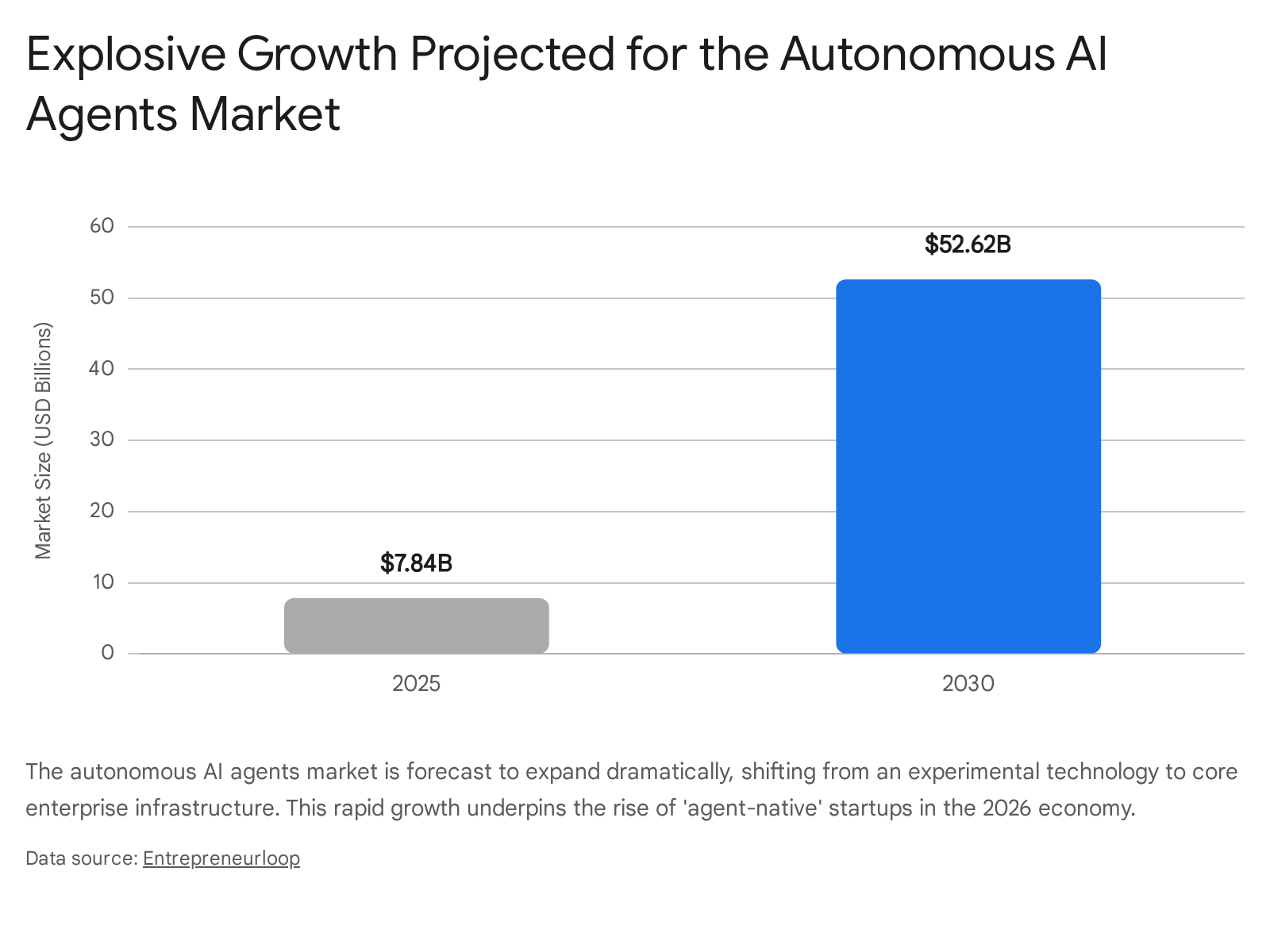
AI is no longer utilized merely as an assistive coding tool; it has evolved into a comprehensive validation and operational engine. In 2026, the frontier of startup validation involves the deployment of autonomous AI agents capable of executing end-to-end workflows, observing market data, planning interventions, and executing tasks with minimal human oversight 11. Research indicates a massive developer shift: a 2026 survey of over 1,850 developers revealed that 78% are now building AI agents, compared to just 34% in 2023 12. Platforms like LangChain and CrewAI are dominating this space, enabling multi-agent collaboration where specialized digital personas handle complex workflows such as legal contract review, real estate analysis, and medical diagnostic triage 1213.
For early-stage validation, the rise of agent-based systems allows startups to orchestrate highly sophisticated, personalized user experiences without requiring a massive workforce 1013. A prototype is no longer just a static interface; it is a dynamic, artificially intelligent system that adapts to user inputs in real-time. This provides significantly higher fidelity data during early customer testing, proving that a startup can safely operationalize autonomy before scaling 1011. The strategic question for founders has transitioned from "What are we building?" to "How fast are our systems learning and evolving?" 9.
Synthetic Data and Virtual Personas in Market Research
Perhaps the most radical, and hotly debated, methodological shift in 2026 is the deployment of synthetic data and AI-generated customer personas for market research. The $140 billion market research industry is currently undergoing massive disruption as enterprise teams and startups utilize Large Language Models (LLMs) to create "digital twins" and synthetic customer panels to simulate market responses 23. Research indicates that these generative agents, when rigorously calibrated on rich, qualitative real-world data, can mirror human survey responses with astonishing accuracy; a landmark 2024 study by Google DeepMind and Stanford University researchers demonstrated that a cohort of over 1,000 AI agents closely matched human participants on the General Social Survey 164.
Synthetic data solves several critical bottlenecks in early validation. It allows founders to generate thousands of statistically plausible customer profiles without touching sensitive personally identifiable information (PII), thereby accelerating compliance and reducing risk in heavily regulated sectors like healthcare, finance, and telecommunications 318. Furthermore, it permits teams to run rapid, discreet A/B tests on pricing models, marketing messaging, and feature roadmaps in a simulated environment before deploying them to the live market 165. It effectively allows startups to test the "edge cases" of their business models without incurring the financial or reputational costs of a failed live-market launch 6.
However, the academic literature warns of severe epistemological limitations. Synthetic personas inherently suffer from "optimism bias," frequently overestimating the appeal of novel products and generating false positive validation signals 7. Moreover, synthetic data does not boost actual statistical confidence; it merely gives the illusion of it 8. Every idea tested via synthetic panels is inherently validated against "yesterday's consumer" data, as the models are constrained by their historical training sets 8. Consequently, leading researchers and data scientists assert that synthetic validation must be used strictly as a top-of-funnel ideation filter and a mechanism to generate falsifiable hypotheses. It should never serve as a replacement for empirical, human-in-the-loop qualitative discovery, as the core of validation still requires human judgment, domain expertise, and contextual awareness 46.
Deconstructing Early-Stage Misconceptions and Cognitive Biases
Despite the influx of sophisticated validation technologies, startups continue to fail at alarming rates. This persistence is frequently tied to deeply ingrained psychological biases and cultural mythologies that distort a founder's perception of market reality, rendering even the fastest prototyping tools useless if aimed in the wrong direction.
The Fallacy of the Visionary Hero
A pervasive misconception within entrepreneurial culture is the "Steve Jobs" myth - the belief that a lone, prescient visionary can skip rigorous customer discovery because they inherently "know" what the market wants before the market itself can articulate it. This narrative is highly dangerous for early-stage validation, breeding an arrogance that views customer feedback as an unnecessary friction rather than a vital compass.
Recent peer-reviewed research in the Journal of Business Venturing and other organizational management literature aggressively deconstructs this trope. Academic consensus posits that the "hero entrepreneur" is largely a media construct designed to simplify complex historical narratives 910. Successful entrepreneurship is almost entirely a collective, iterative achievement involving vast teams, complementary skill sets, and extensive, continuous market feedback 910. While Steve Jobs undeniably possessed unique personality traits, a distinct aesthetic intuition, and an uncompromising standard for design, his approach was an extreme statistical outlier operating in a highly specific historical context (the dawn of personal computing) 111213. In the highly saturated, hyper-competitive markets of 2026, relying purely on founder intuition without empirical customer validation inevitably leads to building a solution for a non-existent problem 28.
The Trap of False Positives: Survey Intent vs. Actual Behavior
When founders do attempt validation, they frequently fall victim to false positive signals, most notably the severe gap between stated survey intent and actual willingness-to-pay (WTP). The "intention-behavior gap" is a thoroughly documented psychological phenomenon where consumers confidently state they will purchase a product, adopt a new software, or pay a premium in a hypothetical survey, but completely fail to execute that behavior when the product requires actual capital or effort 29.
A comprehensive meta-analysis published in the Journal of the Academy of Marketing Science, which synthesized findings from 77 studies and encompassed over 45,000 observations, revealed that this hypothetical bias is not random noise; it is a structural flaw. Across various methodologies and product categories, hypothetical bias results in a systematic 21% overestimation of actual willingness-to-pay 2914. This discrepancy is driven by "social desirability bias" (the pressure the respondent feels to give a "good" or polite answer to the researcher), cognitive dissonance, and the "self-generated validity" effect. The latter occurs when the mere act of asking a consumer about their purchase intent artificially inflates their cognitive accessibility to the product, making them view it favorably in the short term, but failing to translate into long-term behavioral change 291516.
Furthermore, the integrity of digital validation has been severely compromised by malicious actors. The proliferation of automated bots and AI-assisted respondents designed to exploit financial incentives in online surveys has resulted in highly polluted datasets 17. Quantitative survey data gathered via traditional digital marketing channels is often completely divorced from genuine human intent, meaning founders who rely solely on digital surveys are essentially building products based on the preferences of algorithms rather than human consumers.
Mitigating Bias: Structured Qualitative Defenses
To counteract the inherent flaws of human cognition, the unreliability of hypothetical surveys, and the risk of AI-generated echo chambers, founders must deploy structured qualitative techniques designed specifically to bypass bias. The most effective methodologies shift the focus from predicting the future to analyzing the past.
| Cognitive Bias | Definition & Startup Impact | Targeted Qualitative Mitigation Technique | Mechanism of Action |
|---|---|---|---|
| Confirmation Bias | The tendency to search for, interpret, and favor information that confirms prior beliefs. Founders ignore critical feedback that challenges their core thesis, selectively hearing only praise. 343536 | Active Disconfirmation & Blind Analysis | Actively seeking evidence that disproves the hypothesis. Designing experiments with metrics that could explicitly contradict assumptions, or having a neutral third party analyze raw data without knowing the desired outcome. 3536 |
| False-Consensus Effect | Assuming others share the same beliefs, values, and behaviors. Founders assume their personal pain point is a universal, urgent market need. 34 | The Mom Test (3L Method) | Asking questions strictly about past behavior rather than future intent (e.g., "How did you solve this problem last month?" instead of "Would you buy this app?"). It focuses on Listening, Learning the 'why', and Leaping to non-leading exploration. 3738 |
| Sunk-Cost Fallacy | Continuing to invest resources into a failing endeavor because of prior investments of time or capital. Results in a fatal reluctance to pivot away from a flawed MVP. 34 | Pre-Mortem Analysis | A strategic exercise where the team imagines the project has already failed spectacularly, working backward to identify the systemic causes before writing any code or spending capital. Reduces optimism bias by 30%. 39 |
| Innovator's / Optimism Bias | Overestimating the likelihood of positive events and the appeal of novelty, while underestimating risks and execution difficulty. Believing the product will achieve viral adoption instantly. 739 | Concierge / Wizard of Oz Testing | Manually executing the backend service for a small number of users without building the automated technology first. Proves actual demand and willingness to pay before committing to expensive engineering. 18 |
Methodological Divergence: Problem-First Discovery vs. Solution-First Development
The failure to mitigate cognitive biases and properly contextualize validation data invariably results in the most common, and fatal, error in entrepreneurship: building a solution before deeply validating the problem.
Empirical post-mortem data continually reinforces this harsh reality. In a massive 2024 update, CB Insights analyzed the detailed autopsies of 431 failed venture-backed startups, specifically reframing the data to separate underlying root causes from late-stage symptoms. The analysis revealed that while 70% of startups ultimately failed because they "ran out of cash," this was merely a terminal symptom of earlier strategic failures 4119. The primary root cause of death - accounting for 42% to 43% of all venture failures - was a profound lack of market need, commonly referred to as poor product-market fit 414320.
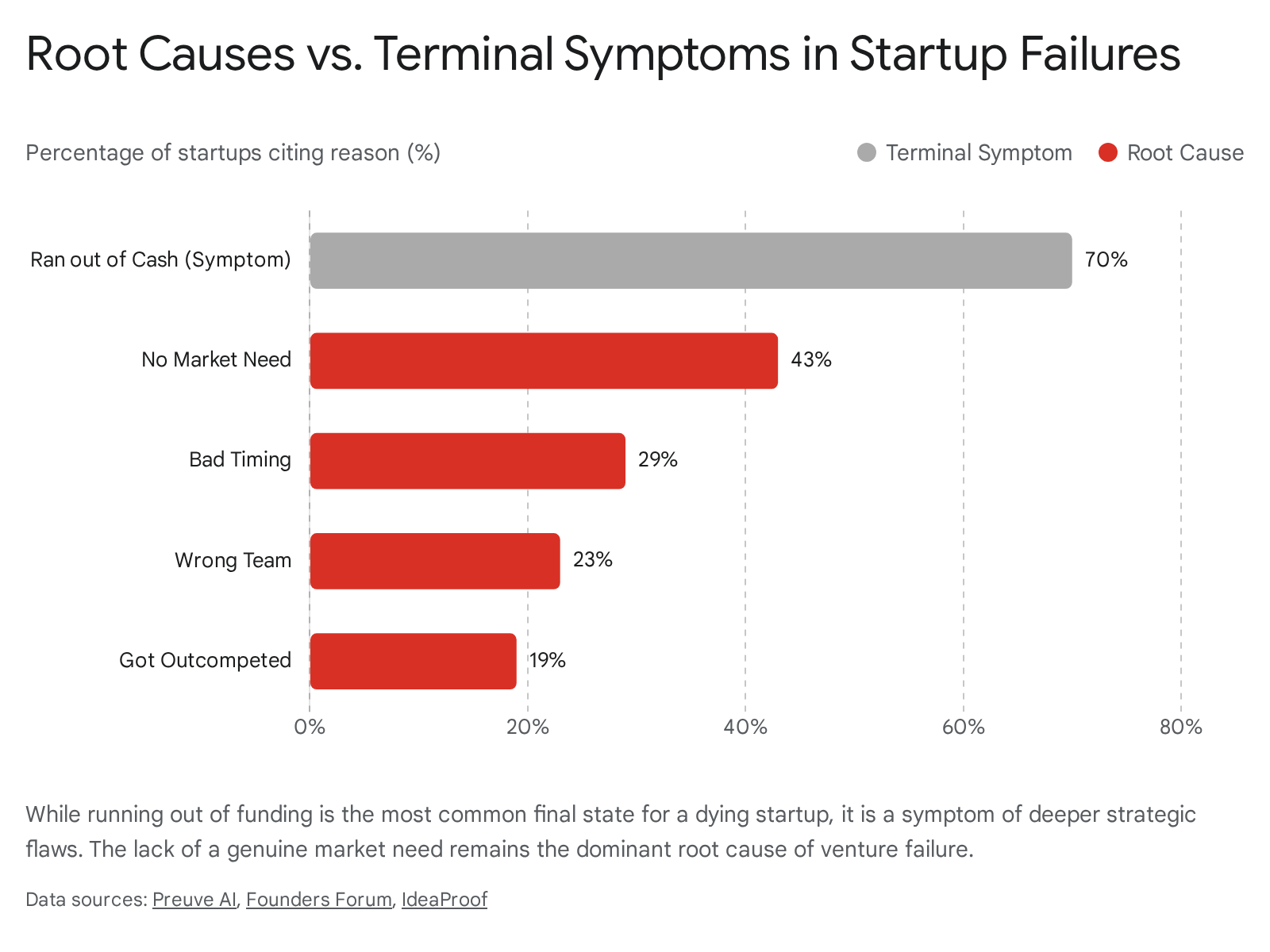
Founders spent millions of dollars and years of their lives engineering brilliant technical solutions that the market simply did not want, need, or care to pay for. Other major market-driven root causes included bad timing (29%), internal team friction and wrong hires (23%), and being outcompeted by rivals with better distribution networks or fundamentally superior unit economics (19%) 411943.
The distinction between successful navigation of early-stage risk and eventual failure often comes down to the underlying entrepreneurial philosophy. Founders who succeed generally adopt a "Problem-first" methodology, whereas those who fail typically default to "Solution-first" thinking.
| Dimension | Problem-First Discovery | Solution-First Development |
|---|---|---|
| Core Philosophy | Obsessive focus on understanding a specific, underserved market pain point or "job to be done." The actual technological solution is highly flexible, agnostic, and secondary to the problem. 182146 | Fixation on a specific technology, feature, or proprietary product idea. The team attempts to retrofit the market to their invention. 28 |
| Initial Actions | Conducting unstructured interviews, observing target users in their native environments, and executing concierge tests without writing code. 18 | Immediately writing code, filing patents, finalizing branding/logos, and focusing on aesthetic deliverables. 28 |
| Risk Profile | High initial ambiguity and slow perceived progress, but drastically lower financial and execution risk during later scaling phases. 2147 | The illusion of rapid early progress, followed by catastrophic market-rejection risk and total capital loss post-launch. 2843 |
| Capital Requirements | Near-zero initial capital; early funds are utilized almost exclusively for discovery, travel, and highly targeted, inexpensive prototype tests. 18 | Extremely high initial capital burn to fund engineering, design, cloud hosting, and preemptive marketing campaigns. 2843 |
| Ideal Use Cases | B2B enterprise software, complex workflow optimization, and addressing shifting macro consumer behaviors. 21 | Almost never recommended, unless applying a known, commoditized solution to a newly deregulated or geographically unmapped market. 28 |
Historically, almost every major technological conglomerate began by isolating a singular, painful problem for a hyper-specific demographic, completely separate from the eventual scale of their technological solution. Facebook initially targeted the specific inability of Ivy League students to connect digitally; Stripe addressed the immense, granular complexity of setting up online payments for early-stage developers 46. These companies achieved scale not by launching with a grand vision of connecting the globe or revolutionizing finance, but by achieving "Problem-Solution Fit" with a tiny group of early evangelists who were willing to endure bad UX and manual workarounds simply because the core problem being solved was so acute 2146.
The Boundaries of Lean: Validation in Deep-Tech and Regulated Industries
While the Lean Startup methodology - centered on rapid MVPs and customer feedback loops - is an effective bulwark against solution-first thinking in traditional consumer apps and enterprise SaaS, it demonstrates severe, often fatal limitations when applied to deep-tech ventures. Deep-tech encompasses startups operating at the absolute frontier of scientific discovery, engineering, and mathematics, including quantum computing, synthetic biology, advanced clean materials, and sustainable nuclear energy infrastructure 48222351.
The Insufficiency of Lean in the Face of Technological Risk
The fundamental premise of the Lean methodology is the rapid deployment of a minimal product to gauge market reaction, thereby mitigating market uncertainty 52. However, deep-tech startups face a fundamentally inverted risk profile: they generally know the market demands their theoretical product (e.g., an emission-free energy source or a cure for a specific cancer); their primary existential hurdle is mitigating technological uncertainty 4852.
For a startup developing commercial quantum processors or novel mRNA therapeutics, the immediate "problem space" is often undefined. These are inherently "technology-push" ventures originating from breakthrough scientific inventions in academic or corporate laboratories. This means founders often possess a revolutionary solution before they fully understand the myriad of commercial applications it might serve across different industries 1. Consequently, traditional customer discovery is rendered highly theoretical. Potential clients cannot accurately evaluate or provide feedback on a technology that does not yet physically exist, operates on unproven physics, and for which no prior market precedent has been established 53.
Furthermore, the physical mechanics of Lean fall apart in the face of deep-tech engineering and government regulations. Building a rapid, "hacky" physical prototype is completely impractical, and often illegal, when dealing with hardware-driven robotics, autonomous vehicles, or highly regulated medical devices where human safety, stringent compliance, and clinical trials are paramount 15224.
Navigating the "Valley of Death" with Minimum Viable Technology
Because rapid, cheap iteration is impossible, deep-tech startups face what venture capitalists term the "Valley of Death" - a prolonged, treacherous period spanning several years where research and development consumes massive amounts of capital with zero commercial revenue generated 22.
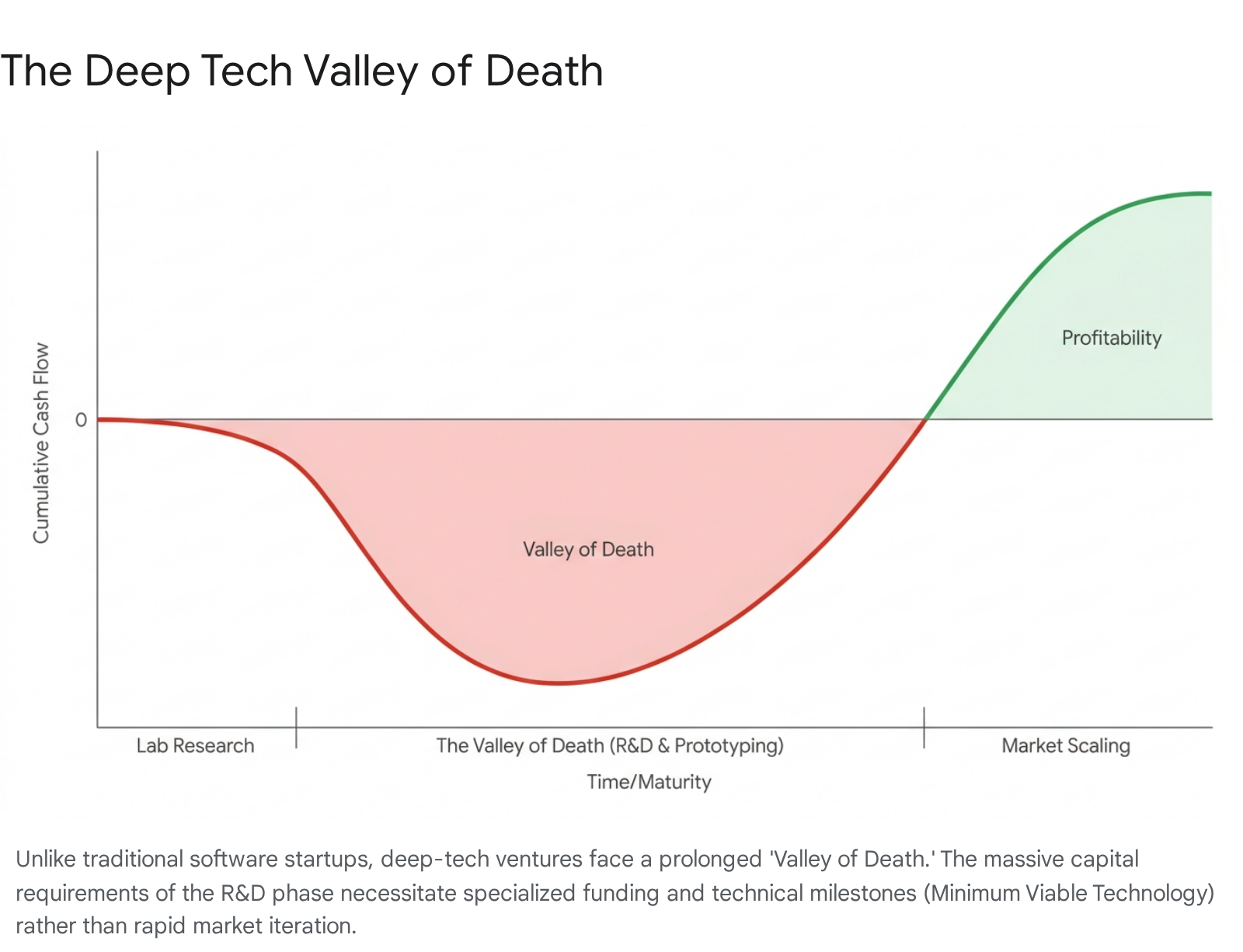
The failure rate for deep-tech ventures can exceed 90%, heavily concentrated in this specific gap between basic scientific research and industrial commercialization 2225.
The biotech sector illustrates this perfectly. While biotech represents one of the most scientifically ambitious categories, companies entering this space face extraordinarily high barriers to entry requiring deep scientific expertise and patience that extends far beyond typical software startup timelines 56. A post-mortem analysis of the sector reveals an average lifespan of 5.8 years for failed biotech startups, with many companies spending years in R&D before ever reaching a market-facing product 56. When the funding environment shifts - as seen in the post-pandemic market corrections of 2022-2025 - biotech firms that require hundreds of millions in follow-on capital simply collapse. The most notable example is Zymergen, a synthetic biology platform that burned through $900 million in venture capital before collapsing because its unit economics failed to materialize at an industrial scale, proving that even massive funding cannot overcome fundamental technological and economic physics 56. In Europe, the gap is similarly acute in quantum computing, where startups often secure initial seed rounds locally but struggle to raise the mega-rounds required for hardware development, forcing them to seek Asian or American capital or face acquisition 57.
To survive, successful deep-tech founders have largely abandoned the concept of the MVP in favor of the "Minimum Viable Technology" (MVT). Validation in deep-tech is not about tracking customer acquisition cost (CAC) or daily active users (DAU); it is about proving technical milestones, demonstrating irrefutable proof-of-concept in controlled lab settings, and securing robust, defensible intellectual property 5258. Strategic survival relies heavily on assembling networks of complementary partners (universities, enterprise labs), navigating complex regulatory landscapes early, and securing "patient capital" from specialized deep-tech investors or government grants that fundamentally understand the inherently slow, capital-intensive nature of scientific commercialization 222557.
Regional Divergence in Entrepreneurial Ecosystems
The strategies, risks, and success factors for startup validation are not universally homogenous; they are highly contingent on the macroeconomic, infrastructural, and cultural realities of their specific geographic ecosystems. Analyzing validation purely through the lens of Silicon Valley or Western accelerators like Y Combinator provides an incomplete picture.
The 2025 Global Startup Ecosystem Report (GSER) by Startup Genome highlighted a dramatic, unprecedented global shake-up in venture capital and startup performance. While overall global ecosystem value contracted by 31% - driven by plummeting late-stage exits and high interest rates - ecosystems across Asia and Sub-Saharan Africa surged forward, compensating for severe stumbles in traditional European and North American hubs 2627. The metrics defining ecosystem success in these reports emphasize diverse factors: Performance (exits and startup success ratios), Funding (access and quality of investors), Market Reach, and the depth of local Tech Talent 282930. Expanding the scope to non-Western accelerators reveals deep regional variances in how startups validate and scale.
Southeast Asia: Scaling Through the Informal Economy
Southeast Asia (SEA) has rapidly matured into a formidable global entrepreneurial powerhouse. In the first half of 2024 alone, venture funding in the region crossed the $10 billion mark, driven heavily by massive deals in fintech, e-commerce, and food delivery platforms 64. By early 2026, Singapore had cemented its status as the undisputed regional capital, capturing an astounding 92% of all startup funding in SEA, largely acting as the financial conduit for ventures operating across Indonesia, Vietnam, and the Philippines 65.
The defining validation characteristic for SEA startups is the necessity to interact with and digitize massive informal economies. More than 70 million micro, small, and medium enterprises (MSMEs) - often traditional "mom-and-pop" shops - dominate the region, accounting for 99% of all businesses and employing over half the workforce 31. Leading global accelerators operating heavily in the region, such as 500 Global (which has backed over 300 companies in SEA, including unicorns like Grab and Carousell), emphasize that successful validation in this market requires extreme localized pragmatism 3233. Startups must address rural digitalization, build inclusive financial infrastructure (embedded finance and micro-credit), and design exceptionally low-friction digital tools for merchants who may be interacting with enterprise software for the first time 32. Furthermore, because customer acquisition and logistics in fragmented, multi-national SEA markets can be slow and highly expensive, a key survival metric for regional founders is raising capital quickly to outlast the monetization timeline, making speed-to-funding just as critical as product iteration 31.
Africa: Navigating Severe Infrastructural Constraints
The African startup ecosystem is experiencing dynamic, albeit uneven, growth. Southern Africa led the continent with a 24.9% increase in startup activity heading into 2025, closely followed by Northern Africa 34. However, the continent suffered a severe funding winter; data indicated a 52% drop in VC deals between 2022 and 2024 35. This contraction highlighted a critical regional vulnerability: roughly 80% of African startup funding relies on foreign venture capital (primarily from the US and Europe), which retreats rapidly during global macroeconomic downturns, leaving promising local startups starved of growth equity 35.
Validation methodologies in Africa are fundamentally shaped by severe physical infrastructure deficits, fractured logistics, and complex regulatory hurdles 71. Accelerators such as CcHub (Nigeria), Injini (specializing in EdTech), and I'M IN operate differently than their Western counterparts by providing highly localized, hands-on mentorship and bridging immediate financial gaps with micro, equity-free pre-seed grants just to get founders off the ground 3673. Startups cannot simply deploy lightweight Western SaaS software paradigms; validation requires deep cultural intelligence and the building of extensive cross-border partnerships to circumvent fragmented supply chains and banking systems 74. Founders in Africa who validate their business models through phased, sustainable growth, maintaining tight unit economics rather than pursuing rapid, cash-burn scaling, are significantly more likely to survive the continent's inherent capital scarcity 7136.
Latin America: Breaking the Local Market Barrier
Latin America presents a complex validation environment, heavily influenced by state-sponsored innovation. Chile remains a standout, ranking as one of the most competitive economies for startups in the region and maintaining the 3rd spot in South America behind Brazil and Colombia 76. Government intervention plays a massive role here; the state-backed Start-Up Chile program (run by the economic agency Corfo) acts as a foundational anchor. By providing equity-free funding, R&D tax credits, fast-track tech visas for foreign founders, and rigorous accelerator programming, Start-Up Chile has generated a portfolio valuation exceeding $2 billion over the last decade, generating over $1 billion in global sales 76373839.
Despite the production of regional unicorns like NotCo and Betterfly, the broader Latin American ecosystem experienced a severe 45% aggregate drop in ecosystem value in the latest GSER metrics 27. A primary validation hurdle in Chile, and the wider Latin American region, is the relatively small size of the domestic market . Startups often successfully validate their MVP locally but fail to achieve venture-scale returns because they optimize their product solely for a limited population. Therefore, a critical success factor for Latin American incubators is forcing founders to validate their solutions against broader, global market standards from day one. Startups that leverage international trade agreements (like the Pacific Alliance and MERCOSUR) to scale across borders rapidly out of their home countries are the ones that command the attention of major global venture capitalists 76.
Conclusion
The science and strategy of startup validation in 2026 is defined by a complex, often paradoxical landscape. On one hand, advanced generative AI, synthetic data personas, and enterprise-grade no-code architectures have virtually eradicated historical barriers to entry, enabling unprecedented speed and capital efficiency in prototype development. Building the product is no longer the bottleneck. On the other hand, the foundational root causes of venture failure - building solutions without a defined market need, and succumbing to deeply ingrained cognitive biases like the visionary myth - remain largely immune to technological intervention.
Founders today must navigate a bifurcated reality. For consumer software and enterprise SaaS ventures, success demands the rigorous application of qualitative bias mitigation techniques (such as the Mom Test and Pre-Mortem analyses) to defend against the false positives routinely generated by hypothetical surveys and overly optimistic synthetic data. Conversely, for deep-tech innovators in biotech, quantum computing, and climate tech, standard lean principles must be discarded entirely. They must focus instead on achieving Minimum Viable Technology, navigating complex regulations, and securing the patient capital required to cross the prolonged Valley of Death. Finally, as global ecosystems evolve, the geographic context of validation cannot be ignored. Startups in Southeast Asia, Africa, and Latin America cannot copy-paste Silicon Valley playbooks; their solutions must be intimately tailored to the infrastructural, cultural, and capital realities of the distinct regions they intend to serve. Ultimately, while technology has exponentially accelerated the mechanics of building a product, the disciplined, empathetic identification of genuine human problems remains the sole arbiter of entrepreneurial survival.