
Large language models and the division of labor in education
The integration of artificial intelligence (AI), specifically large language models (LLMs), into educational ecosystems represents a structural shift in pedagogical methodology, administrative workflows, and the fundamental responsibilities of human educators. Between 2015 and 2022, the proportion of students in OECD countries whose principals reported instructional shortages rose from 29% to 46.7% 12.
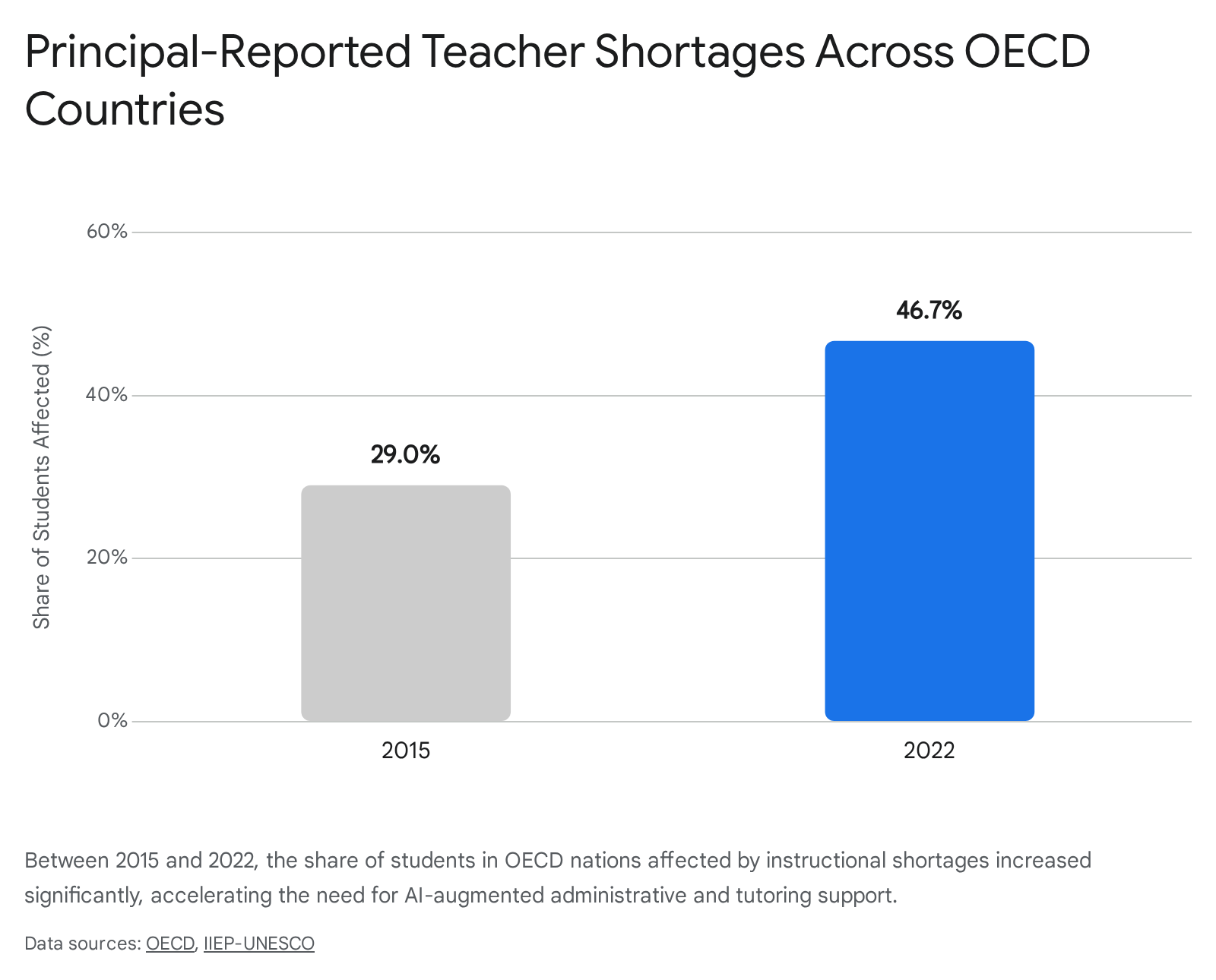
This intensifying labor shortage, compounded by rapid technological advancements and evolving socio-economic demands, necessitates scalable technological interventions. LLMs process expansive datasets, generate customized content, and facilitate predictive analytics, effectively transforming the traditional teacher-student dyad into a complex teacher-AI-student dynamic 23. This transformation requires a rigorous reconceptualization of the optimal division of labor between human educators and AI tutors, ensuring that computational efficiency augments rather than replaces human pedagogical agency.
Macroeconomic Pressures and Educational Shifts
The discourse surrounding AI in education frequently centers on classroom technology, yet the underlying drivers of this integration are fundamentally macroeconomic. Data from the Teaching and Learning International Survey (TALIS) 2024, encompassing 280,000 teachers across 50 education systems, highlights the severe strain on current educational infrastructures 45. Demographic imbalances and workforce attrition have left education systems struggling to maintain baseline instructional quality. The gender distribution within the profession also remains highly skewed globally, with female teachers comprising 86% of the workforce in Latvia and 85% in Lithuania, compared to 41% in Japan and 49% in Saudi Arabia 4. These varied demographic landscapes dictate different regional urgencies for automated support.
Simultaneously, the penetration of AI technologies into daily teaching workflows remains geographically heterogeneous. While approximately 75% of teachers in Singapore and the United Arab Emirates report using AI in their professional duties, fewer than 20% do so in France and Japan 4. This uneven adoption underscores the need for formalized frameworks to guide the integration of generative tools.
The economic rationale for the division of labor between AI and human educators is further clarified by analyses from the International Monetary Fund (IMF) and the International Labour Organization (ILO). Research modeling the economic impacts of AI from a task-based perspective reveals that fundamental tasks characterized by low AI execution costs - such as basic auditory, visual, numerical, and text information processing - are highly susceptible to near-term automation 67. Conversely, tasks requiring solution generation, management, and care or nursing exhibit significant resistance to substitution 7. Translating these economic models to the educational sphere suggests that while AI can efficiently handle information delivery and quantitative assessment, the human educator remains indispensable for the managerial, empathetic, and complex problem-solving dimensions of teaching.
Frameworks for Educator Competency
The integration of LLMs in classrooms necessitates a formal infrastructure for teacher training and continuous professional development. Historically, education systems have lagged in formalizing AI training; prior to 2023, only seven countries had established national AI competency frameworks or professional development programs for teachers 2. To address this deficit, UNESCO released the AI Competency Framework for Teachers in 2024. This standardized architecture defines the knowledge, skills, and values educators require to operate safely and effectively in AI-enhanced environments 38.
The UNESCO framework outlines 15 distinct competencies categorized across five core dimensions and structured across three progressive proficiency levels: Acquire, Deepen, and Create 10910. The core philosophy of this framework is human-centered, prioritizing the protection of teachers' rights, the enhancement of human agency, and the mitigation of algorithmic biases 810.
| Competency Dimension | Description of Required Educator Knowledge and Application |
|---|---|
| Human-Centered Mindset | Ensuring AI deployment enhances human capacity and agency rather than replacing it; focusing on social responsibility, equity, and the protection of educator autonomy 811. |
| Ethics of Artificial Intelligence | Understanding data privacy, algorithmic bias, and security protocols; implementing "ethics-by-design" principles to ensure fair use and academic integrity 81114. |
| Foundations and Applications | Mastering the technical mechanisms of LLMs, including data processing, prompt engineering, and the functional capabilities and limitations of generative algorithms 81114. |
| Pedagogical Integration | Embedding AI into lesson design, differentiated instruction, and formative assessment without compromising core pedagogical principles or teacher oversight 81011. |
| Professional Development | Utilizing AI tools for self-reflection, peer collaboration, continuous lifelong learning, and curriculum co-creation to adapt to evolving technological landscapes 3811. |
To operationalize these competencies, researchers have mapped AI integration onto the established Technological Pedagogical Content Knowledge (TPACK) framework. Within this context, AI agents function in three capacities: as "Cognitive Tools" that assist in content generation, "Reflective Mediators" that provide immediate data-driven feedback on teaching practices, and "Practical Partners" that simulate complex pedagogical scenarios 1213. This synthesis facilitates the deepening of a teacher's Technological Pedagogical Knowledge (TPK), provided the AI is "pedagogy-aware." A pedagogy-aware AI is deliberately designed to stimulate diverse perspectives, expose cognitive gaps, and encourage innovative risk-taking, rather than simply supplying automated, frictionless answers 12. This distinction separates basic technological adoption from genuine pedagogical augmentation.
The Optimal Division of Labor
The introduction of LLMs into educational environments necessitates a strategic division of labor to ensure that computational systems augment rather than automate the instructional process. Empirical frameworks suggest that the most sustainable paradigm relies on a "Human-in-the-Loop" (HITL) architecture, maintaining the educator as the ultimate arbiter of pedagogical quality 1415.
The 70/30 Integration Model
To harness the computational advantages of LLMs without undermining the essential human elements of education, researchers propose a 70/30 integration model. In this paradigm, roughly 70% of the educational process remains human-driven, while 30% is augmented by AI 16. The 30% allocated to AI comprises tasks characterized by high scalability, routine data processing, and algorithmic predictability. LLMs excel at executing repetitive practice drills, answering basic factual queries, generating initial lesson plan drafts, and providing real-time, low-stakes formative feedback 1617.
Conversely, the 70% allocated to human educators encompasses domains requiring emotional intelligence, complex contextual judgment, and ethical oversight. Teachers retain absolute responsibility for facilitating critical discussions, providing socio-emotional mentorship, managing classroom dynamics, and validating the pedagogical accuracy of AI-generated content 1617. This model positions AI as a powerful assistant rather than a replacement, leveraging machine scalability while preserving the centrality of human mentorship.
Co-Teaching and Human-in-the-Loop Architectures
Effective division of labor relies on formalized co-teaching and HITL mechanisms. In these models, the teacher transitions from a primary knowledge transmitter to a curriculum orchestrator and AI collaborator 181920. The literature distinguishes between human-in-the-loop (requiring human intervention for decisions), human-over-the-loop, and human-out-of-the-loop systems. In educational contexts, HITL ensures that high-stakes decisions regarding student trajectories and instructional content benefit from human intuition and contextual awareness 14.
A practical manifestation of this architecture is the Shiksha copilot, an AI system deployed in Karnataka, India, designed to assist grade 5 - 10 teachers with bilingual lesson planning in English and Kannada 2122. Using Retrieval-Augmented Generation (RAG) frameworks, the LLM generates initial instructional drafts based on localized curricula. However, these drafts are not deployed directly to students. A workflow of human curators and educators critically reviews the materials for pedagogical quality, cultural relevance, and factual accuracy before adapting them for classroom implementation 21.
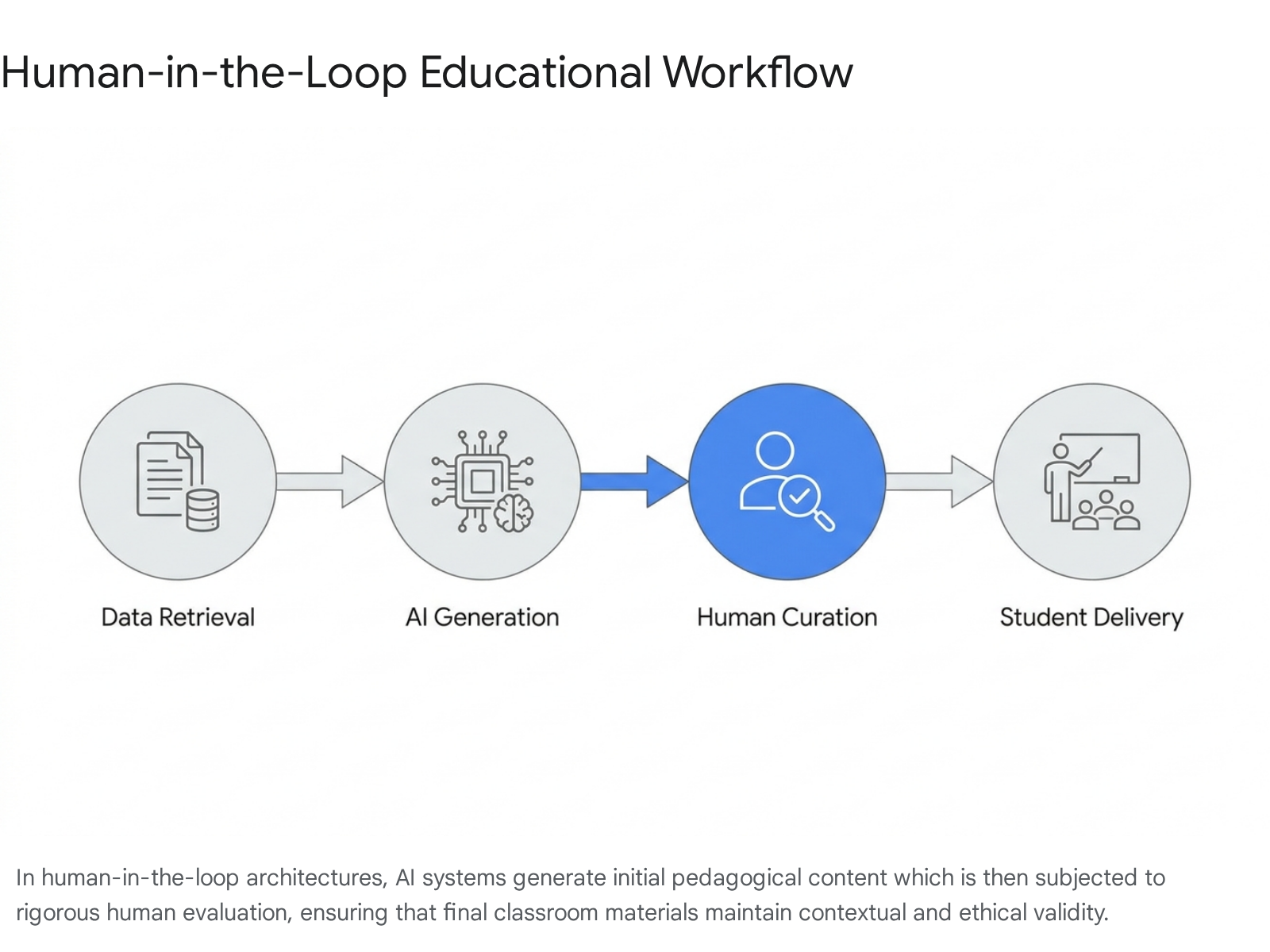
A large-scale mixed-methods study involving 1,043 teachers and 23 curators demonstrated that this tool effectively eased bureaucratic workload, reduced lesson planning time, and lowered teaching-related stress, while simultaneously promoting a shift toward activity-based pedagogy 22.
This workflow effectively mitigates the bureaucratic workload and reduces planning time, yet maintains human pedagogical primacy and accountability 2226. By transforming passive consumption of AI output into an interactive, feedback-driven loop, the system promotes student and teacher agency, ensuring that algorithms serve educational goals rather than dictating them 27.
| Task Category | AI Responsibility (The 30%) | Human Educator Responsibility (The 70%) |
|---|---|---|
| Instructional Delivery | Providing real-time adaptive tutoring, automated translation, and repetitive skills practice 1623. | Facilitating Socratic dialogue, managing classroom culture, and adapting interventions for complex learning disabilities 1624. |
| Content Creation | Generating localized reading materials, baseline lesson plans, and multiple-choice question banks 2125. | Curating generated materials for pedagogical validity, cultural nuance, and alignment with institutional goals 2126. |
| Assessment & Grading | Executing rapid quantitative grading, syntax checking, and basic structural feedback 2632. | Evaluating deep critical reasoning, identifying academic plagiarism, and assessing creative originality 2632. |
| Student Support | Identifying real-time performance gaps through data analytics and offering immediate procedural hints 2728. | Providing empathetic mentorship, addressing behavioral issues, and building long-term academic resilience 282936. |
Reconceptualizing Cognitive Taxonomies and Assessment
The capacity of LLMs to instantly retrieve, synthesize, and format vast amounts of information necessitates a critical reevaluation of traditional pedagogical objectives. Historically, frameworks such as Bloom's Taxonomy have served as the foundation for instructional design and assessment, categorizing cognitive skills from basic recall to complex creation 3031. In an AI-saturated environment, the lower tiers of this taxonomy - specifically rote memorization and basic factual understanding - are increasingly outsourced to algorithmic systems. If virtually any piece of information can be accessed in seconds, the value of rote memorization diminishes, shifting the pedagogical focus toward higher-order skills that machines cannot replicate 39.
The Post-AI Bloom's Taxonomy
Educators are actively reconceptualizing Bloom's Taxonomy to reflect the reality of human-AI collaboration. Advanced proposals advocate viewing cognitive skills as interconnected nodes rather than hierarchical steps, reflecting the nuanced interactions between learners and AI tools 3032. This updated framework introduces several new cognitive paradigms:
- Ventriloquising: This newly proposed cognitive level involves utilizing AI strictly for information retrieval without human judgment 3032. It acknowledges that the machine acts as an external memory bank, altering the necessity for humans to retain extensive factual repositories.
- Critical Understanding: Combining traditional levels of application, analysis, and evaluation, this node requires humans to interrogate AI-generated content. Learners must possess the domain knowledge to identify hallucinations, assess biases, and synthesize AI outputs with peer-reviewed data 3032.
- Co-curating: Replacing traditional autonomous creation, this level involves humans directing AI as a co-pilot. Students and educators generate initial drafts via prompt engineering and subsequently refine, edit, and orchestrate the outputs to produce final, nuanced work 3032.
Process-Oriented Assessment Design
Because generative models can effortlessly produce essays, summaries, and code, educational assessments must shift from evaluating the final output to measuring the cognitive process. Universities are increasingly integrating "AI literacy" directly into assessment rubrics. Rather than attempting futile bans on LLM usage, educators are designing assignments that require students to use AI to generate an outline or draft, and then submit a critical reflection detailing how they evaluated, corrected, and improved upon the algorithmic output 33.
At the institutional level, frameworks such as those observed at the University of Hong Kong permit AI tools under strict conditions, focusing on teaching students originality and proper attribution in the context of generative technology 33. This paradigm shifts the assessment focus to process measures, critical judgment, and academic integrity, utilizing project-based learning and authentic assessments that AI cannot easily fabricate 3033.
Empirical Analyses of AI in Grading and Feedback
The transition to AI-augmented education forces a rigorous examination of assessment mechanics. Studies comparing the grading efficacy of LLMs against human educators reveal nuanced performance differentials, indicating that while AI offers scalability, it cannot entirely replace the interpretive nuance of a human marker.
Quantitative Reliability in Structured Grading
In controlled evaluations involving university-level scripts, LLMs have demonstrated high competency in evaluating objective, structured formats. A comprehensive study comparing human graders against GPT-3.5 and GPT-4 across 195 scripts initially found that manually marked scripts exhibited a 24% score variance among human graders 2632. When a subset was evaluated using GPT-4, the discrepancy margin dropped to just 4%, suggesting higher precision and consistency in structured grading. A subsequent phase of the study utilizing 3,508 scripts confirmed that AI remains highly efficient when provided with a well-structured grading memorandum, particularly in objective modules like Statistics and Logistics Management 2632.
Similarly, research assessing the grading of dental education Short Answer Questions (SAQs) compared human graders against commercial and open-weight models. The open-weight DeepSeek-3 model demonstrated an Intraclass Correlation Coefficient (ICC) of 0.87 against a human benchmark (considered excellent reliability), while ChatGPT-4 achieved an ICC of 0.64 (moderate reliability) 34. Neither model showed statistically significant overall bias in mean scores compared to human baselines, and both models' mean scores (~7.0) closely mirrored the human graders' mean of 6.8 34.
Student Perception and the Value of Human Oversight
Despite quantitative reliability in specific domains, qualitative limitations persist. Empirical findings universally agree that while AI excels in scalability and structured objective marking, human educators remain superior at interpreting complex, ambiguous answers, evaluating creative divergence, and detecting nuanced instances of plagiarism 2632.
Furthermore, student perception of AI-generated feedback highlights a fascinating convergence. A controlled experiment involving 60 secondary school students in Brazil compared traditional teacher feedback with LLM-assisted feedback. The results showed no significant difference in students' perceptions of feedback quality; notably, 85% of students were unable to distinguish LLM-generated feedback from human-provided feedback 35. The LLM assistance produced feedback messages that were 2.6 times longer without significantly increasing grading time for the instructors 35. However, students consistently express that they are more accepting of AI grading systems when human oversight is explicitly incorporated, fearing algorithmic biases against non-native linguistic patterns or atypical logical structures 263233. Consequently, researchers advocate for an orchestration protocol involving double-marking or moderation, where AI handles initial baseline scoring and human educators retain ultimate oversight 1333.
Socio-Emotional Modeling and Student Motivation
While LLMs demonstrate high proficiency in cognitive task execution and structured grading, their role in socio-emotional development represents a complex and highly debated frontier. Intelligent tutoring systems and conversational agents are increasingly deployed to offer emotional companionship, personalized pacing, and academic encouragement, yet their efficacy is bounded by their mechanical nature.
Algorithmic Encouragement and Social Presence
Recent investigations indicate that AI can effectively mediate certain socio-emotional experiences. In studies assessing child interactions with LLMs, the need for emotional companionship was identified as urgent, and acceptance of AI companions was high, with 85% of subjects expressing a desire for AI interaction 36. Children specifically favored an "encourager" persona that assists with academic anxiety and provides proactive emotional support 36. AI chatbots designed with social presence attributes have been shown to provide immediate, non-judgmental feedback, which correlates with measurable increases in student self-efficacy, confidence, and motivation, particularly in foreign language learning contexts 28.
For marginalized demographics or students lacking robust support structures at elite institutions, access to persistent, real-time AI "teaching assistants" (such as Harvard's CS50 Duck) has been characterized as deeply empowering. In comparative studies, students given access to an AI tutor learned more than twice as much in less time compared to those reliant solely on traditional in-class instruction, driven by the immediate availability of customized feedback 44.
The Limits of Artificial Empathy
Despite these gains, the efficacy of AI in emotional support is constrained by profound technical and psychological limitations. Participants in socio-emotional studies frequently note that AI lacks the "warmth" and genuine emotional resonance of human beings 36. Furthermore, research evaluating the emotional comprehension of popular LLMs reveals structural blind spots. During a comprehension experiment analyzing five core emotions, LLMs generally performed adequately but demonstrated a specific weakness in interpreting "sadness" compared to other emotional states 36.
To address the cultural and emotional limitations of LLMs, researchers recently introduced the CultureCare dataset, encompassing 1,729 distress messages across four cultures to train models in culturally sensitive emotional support 37. While fine-tuning models on this data improves their ability to offer contextually relevant responses, AI systems ultimately operate via probabilistic language generation, simulating empathy without experiential understanding.
Moreover, scaling LLMs introduces risks in emotionally sensitive contexts. A study evaluating the emotional safety classification of various LLaMA models (1B to 70B parameters) across 15,000 mental health samples found that while larger models achieve stronger multi-label classification in zero-shot settings, they are also more capable of generating harmful or stereotyped outputs due to greater exposure to toxic training data 38. This highlights the necessity of treating emotional safety not just as a moderation problem, but as an intrinsic model property requiring careful tuning 38.
The Irreplaceability of Human Mentorship
The comparative literature overwhelmingly concludes that human teachers remain indispensable for delivering high academic motivation, learning satisfaction, and psychological safety 2428. A teacher's ability to interpret non-verbal cues, understand a student's socioeconomic background, and build enduring trust cannot currently be digitized 2429. Trust in human-AI systems is defined by clear ethical boundaries; in studies with children, "no disclosure of secrets" formed the strongest consensus for trusting an AI companion 36.
Therefore, the optimal deployment of AI involves utilizing chatbots for immediate, low-level emotional encouragement and academic pacing, thereby freeing human educators to engage in high-level mentoring, crisis intervention, and the cultivation of intrinsic motivation 1729.
Technical Limitations and the Challenge of Hallucinations
The deployment of LLMs in classrooms is accompanied by severe systemic and technical limitations. The most prominent technical vulnerability is the phenomenon of "hallucinations" - instances where an LLM generates fluent, coherent, yet factually incorrect, logically inconsistent, or entirely fabricated information 4839.
The Mechanics of Algorithmic Fabrication
In an educational context, factual accuracy is paramount. Because LLMs operate fundamentally as probabilistic next-token predictors rather than grounded knowledge bases, they do not "know" facts; they predict statistically likely linguistic sequences based on their training parameters 40. Hallucinations stem from two primary vectors:
- Prompting-induced hallucinations: These occur when user inputs are vague, underspecified, or structurally misleading, forcing the model into speculative generation and reliance on probabilistic associations rather than grounded knowledge 39.
- Model-intrinsic hallucinations: These arise from architectural biases, inference-time sampling flaws, or limitations in the underlying pretraining data distribution 39. If an LLM encounters queries outside its training distribution, its reliability degrades severely 41.
The authoritative and confident tone employed by LLMs obfuscates these inaccuracies, making it exceedingly difficult for non-expert learners to critically evaluate the content 4042. If left unchecked, such outputs misinform learners, compromise academic integrity, and reinforce misconceptions rather than building real understanding 40.
Cognitive Bias and Misinformation
Studies have quantified the profound risk hallucinations pose to learning and decision-making. In controlled experiments evaluating AI reliability, LLMs hallucinated up to 60% of the time when answering questions outside their core training data 41. Furthermore, these models introduce cognitive biases. In a UC San Diego study evaluating the influence of LLM-generated summaries on user decision-making, researchers found that LLMs changed the sentiment of the original text in 26.5% of cases, often omitting crucial nuances 41. When 70 participants read these summaries, LLM framing shifted behavioral intent drastically: 84% of participants who read the LLM summaries chose to "buy" the product, compared to only 52% who read the original human reviews 41. This demonstrates a dangerous inability for users to reliably differentiate algorithmic fabrication from objective reality.
In academic research contexts, the consequences are equally stark. In a double-blind study evaluating AI-generated scientific papers, ChatGPT successfully fabricated a highly plausible short essay detailing liver involvement in late-onset Pompe disease 43. The AI followed instructions flawlessly and produced convincing background literature, despite the fact that liver involvement has never been described in the literature for the late-onset form of the disease 43. This highlights that while AI can assist in content generation, it cannot replace an expert reviewer who strictly adheres to the scientific process.
Grounding and Mitigation Strategies
To counter these limitations, educational technologists are moving beyond generic LLM deployment toward structured interventions. Mitigation relies heavily on "Grounding" and Retrieval-Augmented Generation (RAG) 54. Rather than relying solely on the LLM's parametric memory, a RAG framework anchors the AI's responses to a verified, external database of educational texts 2754. When a student queries the system, it retrieves the factual data from the closed corpus and uses the LLM solely to synthesize and format the explanation, severely limiting the model's ability to hallucinate niche subject matter 54.
Furthermore, combating AI limitations requires robust institutional policy and the cultivation of critical AI literacy among students. Educational institutions must shift from treating AI as a niche computer science subject to a foundational curriculum competency, training students to audit algorithmic outputs, recognize systemic biases, and practice epistemological vigilance 44.
Infrastructure Disparities and Global Implementation
The global integration of AI in education is highly asymmetrical, threatened by a severe digital and infrastructural divide. Current generative AI systems are predominantly trained on data from WEIRD (Western, Educated, Industrialized, Rich, and Democratic) populations, which represent less than 15% of the global populace 45. This homogeneity results in models that struggle with cultural sensitivity, local contextualization, and multilingual accuracy when deployed in the Global South 2737.
The Compute and Energy Divide
The disparity extends far beyond software algorithms into physical infrastructure. Developing, training, and accessing frontier AI models requires massive computational power, vast data centers, stable energy grids, and high-speed network connectivity 46. Access to these resources is wildly unequal. Africa, despite housing 18% of the world's population, accounts for less than 1% of global data center capacity 46. India generates approximately 20% of the world's data but possesses only about 3% of the global data center infrastructure 46.
As AI becomes deeply embedded in routine study, access to fast, affordable, and reliable computing becomes a primary vector of educational justice 47. The energy demands of AI are staggering and represent a critical bottleneck. In the United States alone, data centers consumed about 176 terawatt-hours of electricity in 2023 (4.4% of national demand), with projections rising to 325-580 terawatt-hours by 2028 47. Globally, data-center electricity usage is projected to reach 945 terawatt-hours by 2030 47. For regions with fragile power grids, training or running frontier-scale models is biologically and physically unsustainable 46. Without equitable infrastructure, AI threatens to exacerbate cross-country income inequality and erode the labor advantages of regions with large youth demographics, such as South Asia, where nearly 100,000 young people enter the labor market daily 46.
Offline-Capable Educational Technologies
To bypass these infrastructural bottlenecks, technological development in the Global South is pivoting toward low-bandwidth and offline-capable AI platforms. Recognizing that approximately 3 billion people globally lack basic internet connectivity, researchers are designing localized interventions 59.
Systems such as the C3 Micro-Cloud and SolarSPELL EDge AI are designed to function in zero-connectivity environments. The SolarSPELL initiative utilizes solar-powered digital libraries that emit localized, offline Wi-Fi hotspots, providing remote villages with access to an open-source AI tool that mimics search engine experiences without requiring broadband 5948. Ensuring the factual accuracy of these localized systems requires pre-loading them with highly vetted, curated educational content, effectively operating as closed-loop grounding systems 48.
Other initiatives focus on mobile and low-bandwidth accessibility. Kwame for Science, a bilingual AI teaching assistant deployed across 32 countries in West Africa, achieved 87% accuracy in delivering curated science lessons and past exam content 61. Similarly, the Ferby generative AI chatbot delivers localized, offline-first learning resources to millions in India, circumventing both linguistic and infrastructural barriers 61.
Policy Frameworks for Developing Nations
At the governance level, international coalitions are actively formulating strategies to protect developing nations from digital marginalization. In September 2024, Rwanda and Singapore launched the world's first AI Playbook for Small States at the United Nations Summit of the Future, gathering insights from the Digital Forum of Small States (FOSS), a group of 108 nations 4964.
This framework outlines strategies for nations with limited financial resources and peripheral technological positions to responsibly integrate AI. It emphasizes upskilling the existing workforce, fostering digital literacy, securing data privacy, and prioritizing AI deployment in critical public sectors like education, healthcare, and agriculture 4964. Rwanda's specific approach includes committing to infrastructure improvements, expanding cloud capacities, and prioritizing STEM education to become a global center for AI research in Africa 64.
Similarly, the African Union's Continental Artificial Intelligence Strategy outlines comprehensive plans for formulating inclusive national policies. The strategy emphasizes three themes - learning with AI, learning about AI, and preparing for AI - ensuring that member states develop national AI competencies for teachers and students that reflect local cultural values and linguistic diversity 50.
Conclusion
The proliferation of large language models is irreversibly reshaping the educational landscape, demanding a fundamental redefinition of the teacher's role. Extensive research and macroeconomic labor analyses indicate that AI should not be viewed as a substitute for human educators, but as an advanced cognitive tool that necessitates a deliberate, human-in-the-loop division of labor. By absorbing routine administrative tasks, basic content generation, structured quantitative grading, and low-level tutoring, AI empowers educators to transition into roles centered on complex facilitation, socio-emotional mentorship, and critical evaluation.
However, this transition is contingent upon the proactive development of formalized AI competencies among teaching professionals, as outlined by global frameworks like UNESCO's. Teachers must be equipped to orchestrate digital workflows, mitigate the severe risks of algorithmic hallucinations through grounding and RAG architectures, and maintain absolute pedagogical supremacy. Furthermore, realizing the democratizing potential of AI requires urgent global cooperation to address the severe computational and energy divides marginalizing the Global South. As educational frameworks evolve to incorporate AI, the ultimate success of this technological integration will depend not on the processing power of the algorithms, but on the ethical, critical, and empathetic capacities of the human educators who guide them.