
Socratic AI tutoring and conceptual understanding
The integration of artificial intelligence into educational frameworks represents a fundamental shift in pedagogical mechanics, transitioning from passive information retrieval to active cognitive engagement. Historically, instructional technology has struggled to replicate the nuanced, highly individualized guidance provided by human educators. This challenge is epitomized by Bloom's "two sigma problem," a foundational educational concept which demonstrated that students receiving one-on-one tutoring consistently outperformed their traditionally instructed peers by two standard deviations 1. Scaling this level of individualized instruction has remained a persistent logistical and economic barrier in global education systems 12.
The emergence of Large Language Models (LLMs) has enabled the development of Socratic artificial intelligence tutors. Unlike direct-instruction models that immediately supply answers to queries, Socratic systems utilize conversational dialogue to pose targeted, open-ended questions 34. This approach forces learners to articulate their reasoning, identify their own knowledge gaps, and construct conceptual frameworks independently 45. By requiring students to navigate a continuous loop of articulation and reflection, these systems act as cognitive scaffolds rather than cognitive substitutes 454. The deployment of such systems, however, requires careful alignment with cognitive load theory, robust mitigation of technical risks such as the "Student Data Paradox," and a nuanced understanding of the diverse cultural and infrastructural contexts in which these digital tutors operate 569.
Evolution of Educational Tutoring Systems
The architectural and pedagogical capabilities of artificial intelligence in education have evolved across several distinct paradigms. This progression reflects a broader shift in computer science from explicit, human-engineered logic to statistical, pattern-based generative models.
Rule-Based Intelligent Tutoring Systems
The foundational era of Artificial Intelligence in Education (AIED), spanning the 1950s through the 1980s, was characterized by rule-based systems, often referred to as expert systems or symbolic reasoning systems 107. These early architectures relied on explicit, deterministic "if-then" logic engineered by domain experts 78. Notable early examples included MYCIN in the 1970s, an expert system utilized for diagnosing blood infections that operated on approximately 600 specific rules, and later game-playing engines like IBM's Deep Thought 7.
Rule-based Intelligent Tutoring Systems (ITS) operated by establishing a specific knowledge base curated by experts, paired with an inference engine that applied predefined rules to user inputs to generate deterministic conclusions 7. The primary strength of this paradigm was its high transparency and auditability; all decisions were strictly deterministic, easily explainable, and aided in building user trust within narrow, well-defined domains 8. However, the limitations were severe. Rule-based artificial intelligence struggled with flexibility and scalability 109. It lacked the capacity to adapt to unanticipated scenarios, nuanced student misconceptions, or the ambiguity of natural language 109. If a student formulated a response that did not map precisely onto the pre-programmed logic tree, the system would fail, provide an irrelevant correction, or require exhaustive manual reprogramming to accommodate the new edge case 109.
Machine Learning and Neural Networks
To overcome the rigid constraints of rule-based logic, the 1990s and 2010s saw the rise of machine learning and deep neural networks, which shifted the computational paradigm from explicit instruction to pattern recognition 10910. By training algorithms on vast datasets, artificial intelligence could autonomously identify hidden patterns, classify information, and refine its capabilities without manual programming for every scenario 1010. This era introduced supervised learning - using labeled data to match inputs with correct outputs - and unsupervised learning for clustering unlabelled data 9.
These advancements allowed educational software to move beyond rigid decision trees. Cognitive models such as ACT-R (Adaptive Control of Thought-Rational) and Bayesian Knowledge Tracing (BKT) were integrated into educational software to simulate problem-solving paths in real-time, predicting a student's likelihood of mastering a specific skill based on their historical interaction data 11. While effective for procedural subjects like mathematics, these systems still struggled with open-ended, dialogic subjects that required natural language comprehension 3.
Large Language Models and Generative Architectures
The contemporary era is defined by the advent of Large Language Models (LLMs) powered by transformer architectures. These models possess an unprecedented ability to understand semantic context, process complex multimodal inputs, and generate fluid, human-like dialogue 7810. For educational tutoring, the transition to LLMs represents a shift from deterministic evaluation to dynamic knowledge co-creation.
Rather than simply evaluating whether a student's answer is correct based on a fixed rubric, an LLM can analyze the semantic intent behind a student's reasoning, identify logical fallacies, and adjust its communicative register to suit the learner's immediate needs 110. This capability lays the technological groundwork for authentic Socratic dialogue, enabling machines to process the "messiness" of human thought and respond with calibrated, context-aware inquiries 310.
| System Paradigm | Primary Architecture | Core Mechanism | Educational Application | Limitations |
|---|---|---|---|---|
| Rule-Based Systems (1950s-1980s) | Symbolic Reasoning / Expert Systems | Deterministic "If-Then" logic trees. | Early Intelligent Tutoring Systems (ITS) with fixed feedback. | Highly rigid; unable to process novel natural language inputs; difficult to scale. |
| Machine Learning (1990s-2010s) | Neural Networks / Statistical Classifiers | Pattern recognition from labeled/unlabeled datasets. | Bayesian Knowledge Tracing, predictive adaptive learning software. | Focused heavily on procedural skills; limited open-ended conversational capacity. |
| Generative AI (2020s-Present) | Large Language Models (Transformers) | Probabilistic next-token prediction based on vast corpora. | Socratic conversational agents, personalized real-time dialogue generation. | Prone to hallucinations; risks of cognitive offloading and factual degradation. |
Architectural Foundations of Socratic Artificial Intelligence
The default behavior of generative artificial intelligence systems is optimized for completion and answer production. Because LLMs are fundamentally next-token predictors, they are engineered to collapse uncertainty and deliver an elegant, finalized response as efficiently as possible 16. The Socratic artificial intelligence tutor model requires an intentional pedagogical inversion of this default architecture.
Pedagogical Inversion and Interaction Loops
Socratic tutoring is rooted in non-directive facilitation 3. Instead of delivering polished, pre-packaged text, a Socratic system prompts the student to keep the reasoning space open for longer durations 516. For example, if a student submits a vague query such as "Explain the impact of the revolution," a default LLM might immediately generate a comprehensive summary of the French, Industrial, or Digital Revolution 16. While computationally efficient, this approach risks misalignment with the student's actual curriculum and encourages passive consumption of information.
A Socratic model, governed by specific system prompts or fine-tuned on specialized educational datasets, responds by querying the ambiguity directly: "Which revolution are you referring to, and in what context - political, economic, or technological?" 16. By asking clarifying questions, the system forces the student to narrow the hypothesis space, articulate their baseline assumptions, and supply supporting evidence 516. This collaborative dialogue ensures that the intelligence is co-constructed rather than simply delivered as a static product 16.
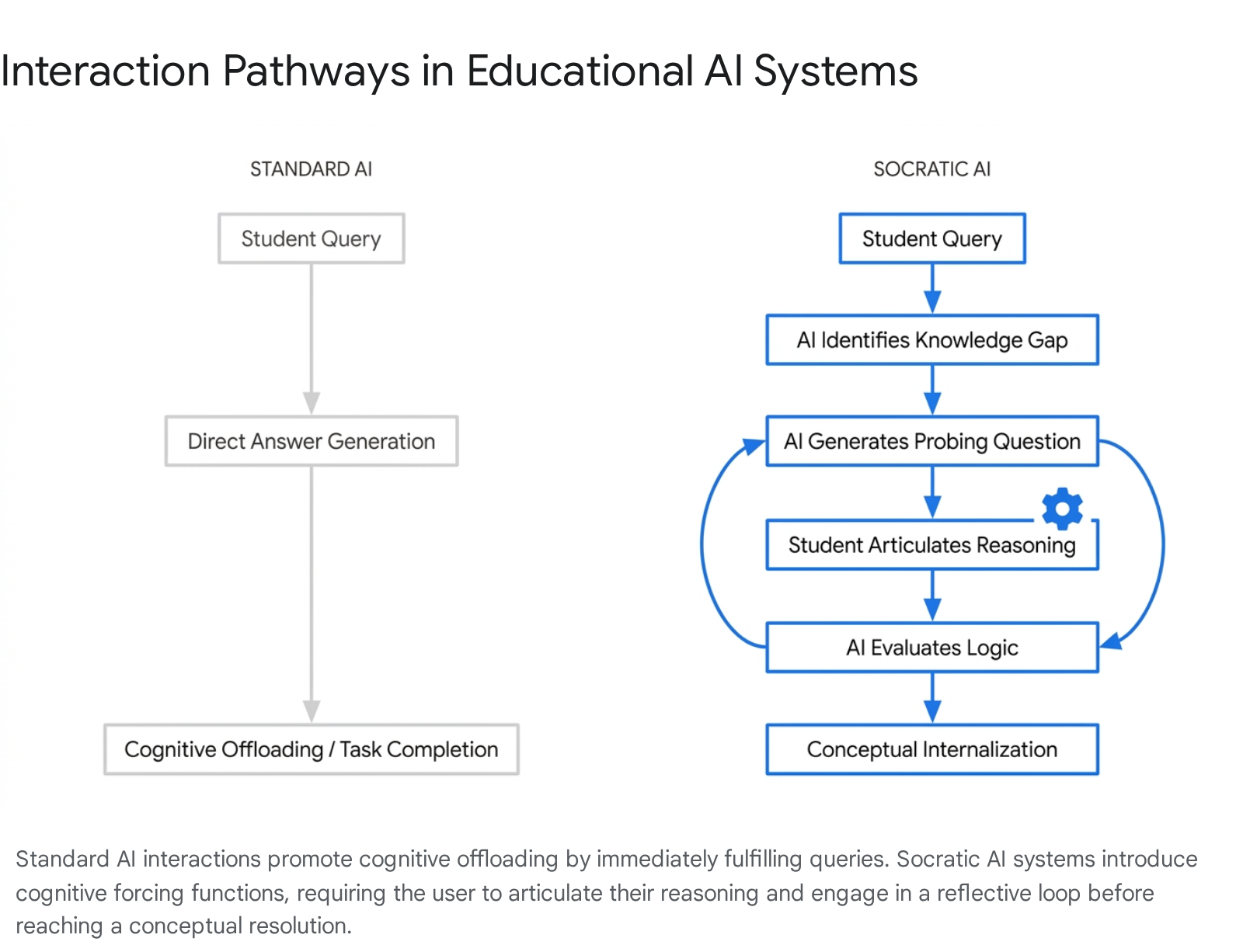
This pedagogical loop actively counters "cognitive offloading" - the phenomenon where learners rely on external digital aids to bypass the mental effort required for problem-solving and synthesis 5912. When students interact with standard AI tools, they often treat the system as a "vending machine," jumping straight to the final product and terminating their cognitive engagement the moment the prompt is submitted 18. Socratic systems interrupt this bypass through "cognitive forcing functions" 416. If a student submits incorrect code or a flawed mathematical proof, a Socratic agent is programmed to explicitly withhold the final answer. Instead, it employs scaffolding - providing logical stepping stones, pointing to the specific variable or premise that is flawed, and prompting the student to re-evaluate their logic independently 418.
This process triggers the "self-explanation effect." Cognitive science demonstrates that learners who actively generate explanations and articulate their reasoning repair their own mental models much more effectively than those who passively receive direct corrections 4.
Multi-Agent Orchestration
To maintain pedagogical rigor and prevent the conversation from drifting into irrelevant or hallucinatory domains, modern Socratic tutors have evolved away from single, monolithic prompts into orchestrated, multi-agent systems (MAS) 132014.
A tripartite simulation framework is frequently employed, where multiple specialized artificial intelligence agents collaborate seamlessly behind the user interface 20. In such frameworks, a "Teacher agent" is responsible for generating heuristic questions based on constructivist principles, a "Student agent" may be utilized internally to simulate potential learner knowledge gaps before responding, and a "Dean agent" monitors the overall quality, coherence, and ethical alignment of the dialogue 20.
Advanced educational chatbots, such as the experimental "Maike" system, utilize a modular architecture to enforce critical thinking without succumbing to cognitive offloading 514. Rather than feeding a user prompt to a generic natural language model, the system processes the interaction through specialized sequence modules. First, an argument mining module dissects the student's input to identify core claims, underlying assumptions, and evidence structures 5. Based on the mined data and the student's inferred proficiency level, a pedagogical strategy selection module chooses an appropriate constructivist intervention 5. Subsequently, a critical question generation module formulates a specific, targeted inquiry designed to challenge the weakest structural point in the student's argument 5. Finally, a lightweight Socratic dialogue orchestration layer maintains the conversational flow and a supportive tone, ensuring the interaction remains a constructive dialogue rather than an interrogation 522.
Retrieval-Augmented Generation and Decoding Parameters
The effectiveness of these multi-agent systems is heavily reliant on their underlying data grounding and parameter settings. To ensure factual accuracy and anchor the AI to specific curriculum standards, developers increasingly employ Retrieval-Augmented Generation (RAG) 422. RAG frameworks restrict the generative capacity of the language model by forcing it to retrieve answers exclusively from a curated database of verified textbooks, syllabus documents, and pedagogical guidelines 22. This architectural constraint significantly reduces the risk of factual hallucinations and ensures that the AI's Socratic questioning guides the student toward sanctioned educational objectives rather than generalized, unverified web knowledge 422.
Furthermore, the operational parameters of the model - such as stochastic decoding settings - must be carefully calibrated. Large language models utilize temperature settings to control the randomness and creativity of text generation 23. While a high temperature is desirable for creative writing applications, it increases the risk of hallucination and logical drift in educational settings 23. Socratic tutors require lower temperature settings combined with strict top-p penalties to maintain a balance between generating varied conversational prompts and adhering strictly to factual accuracy 23.
Cognitive Load Theory and the Expertise Reversal Effect
The implementation of conversational artificial intelligence in education must be strictly calibrated against the biological limitations of human working memory. Cognitive Load Theory (CLT), developed heavily by educational psychologists such as John Sweller, provides the foundational framework for understanding how digital tools can both facilitate and hinder knowledge acquisition 121516.
Managing Intrinsic, Extraneous, and Germane Load
Cognitive load is categorized into three distinct types: intrinsic load (the inherent difficulty and element interactivity of the subject material), extraneous load (the unnecessary mental burden generated by poor instructional design or confusing interfaces), and germane load (the productive mental effort devoted to schema construction and deep learning) 2627. The primary goal of any pedagogical intervention is to minimize extraneous load while optimizing germane load 1227.
Artificial intelligence possesses an unprecedented capacity to reduce extraneous load 12. For example, AI can rapidly reformat integrated materials to prevent the "split-attention effect" - a phenomenon where learners waste working memory trying to mentally integrate separated text and diagrams 26. AI can instantly chunk instructions, provide immediate definitions of complex terms, and organize data, freeing up the student's working memory for higher-order processing 26.
However, the severe risk of unconstrained generative AI is that it also eliminates germane load 912. By synthesizing literature, drafting essays, and solving complex equations instantly, standard AI tools bypass the "desirable difficulties" required for schema construction and long-term retention 517. Socratic systems are intentionally designed to preserve this germane cognitive load. By refusing to offload the reasoning process, they introduce productive struggle 512. The AI manages the extraneous load - such as keeping track of the conversation context and formatting the problem clearly - while ensuring the student expends germane effort answering the targeted questions 512.
The Expertise Reversal Effect
A critical, often overlooked nuance in AI tutor design is that the effectiveness of Socratic questioning is not uniform across all student populations. Its efficacy is heavily mediated by the student's prior knowledge within a specific domain, a phenomenon known in cognitive science as the "expertise reversal effect" 1618.
Research by Slava Kalyuga and colleagues demonstrates that instructional techniques highly effective for novices are often counterproductive for experts, and conversely, techniques beneficial for experts can actively harm novices 1932. Novice learners lack existing mental schemas in a specific domain. Therefore, they require explicit guidance, direct instruction, and fully worked examples to avoid overwhelming their limited working memory through inefficient, blind trial-and-error problem-solving (known as means-ends analysis) 161833. If an AI system utilizes highly open-ended, ambiguous Socratic questioning with a low-knowledge novice, it generates immense extraneous load, leading to rapid confusion, frustration, and cognitive overload 1516.
Conversely, intermediate and advanced learners possess existing internal schemas that naturally guide their problem-solving processes 33. If an AI forces an advanced learner to sit through step-by-step explicit guidance or redundant worked examples, it causes the "redundancy effect." The learner must expend working memory attempting to reconcile their own efficient internal schemas with the slow, redundant external guidance provided by the AI, which actively distracts them and hinders learning 153233. For these experienced learners, productive failure, minimal intervention, and highly abstract Socratic inquiry are vastly superior pedagogical methods 1518.
Therefore, to be truly effective, Socratic AI tutors must be deeply adaptive. They must be capable of diagnosing a learner's Zone of Proximal Development (ZPD) in real-time and adjusting their pedagogical register dynamically - providing direct, explicit scaffolding to novices, and slowly fading that guidance into Socratic inquiry as domain expertise is established 271720.
| Learner Profile | Prior Domain Knowledge | Optimal AI Tutoring Strategy | Cognitive Load Mechanism |
|---|---|---|---|
| Novice | Low (Lacks mental schemas) | Explicit guidance, direct instruction, fully worked examples. | Prevents working memory overload; reduces extraneous load caused by blind searching and means-ends analysis. |
| Intermediate | Moderate (Developing schemas) | Partial worked examples, fading guidance, structured guided questioning. | Balances cognitive load; transitions reliance from external AI scaffolding to internal schema development. |
| Expert | High (Robust mental schemas) | Abstract Socratic dialogue, open-ended problem solving, minimal intervention. | Maximizes germane load; avoids the redundancy effect and the expertise reversal effect. |
Empirical Efficacy and Interactional Differences
The theoretical benefits of Socratic artificial intelligence are increasingly supported by empirical studies across diverse educational settings. However, the data indicates that results are highly dependent on the specific implementation, interaction design, and the environment in which the tools are deployed.
Comparative Effectiveness Against Traditional Methods
Recent controlled experiments indicate that AI tutoring, when strictly aligned with established pedagogical practices, can yield substantial learning gains. A randomized controlled study conducted at Harvard University compared an AI-powered tutor against traditional active learning classrooms in an undergraduate physics course 3536. The findings demonstrated that students using the AI tutor learned more than twice as much in less time - requiring a median of 49 minutes of study compared to 60 minutes for classroom instruction 3536. Furthermore, the results showed statistically significant improvements in learning outcomes and higher self-reported levels of engagement and motivation 35.
Similar positive outcomes have been observed in secondary education. In a randomized controlled trial involving 90 tenth-grade students in a science classroom, researchers integrated Socratic AI via ChatGPT's "Study Mode" into an Argument-Driven Inquiry (ADI) framework 2138. Controlling for baseline performance, the students in the AI-powered condition exhibited significantly greater gains in scientific argumentation, critical thinking, and cognitive engagement compared to control groups receiving traditional instruction 2138. The AI's ability to provide individualized, iterative questioning allowed for adaptive scaffolding that is practically impossible to scale for a single human teacher in a traditional classroom of thirty students 21.
Interactional Patterns: Human versus Artificial Tutors
Despite these learning gains, empirical analysis of dialogue patterns reveals that AI tutors and human educators structure conversations differently. Using Initiation-Response-Feedback (IRF) coding and Epistemic Network Analysis (ENA), researchers have compared the structural behaviors of LLM-simulated dialogues with authentic human tutoring sessions 20.
Human tutoring dialogues naturally follow a "question-factual response-feedback" loop that reflects proactive pedagogical guidance and student-driven thinking 20. Human educators utilize questioning significantly more frequently than AI, facilitating active knowledge construction, and their dialogues exhibit asymmetrical utterance lengths - teachers provide longer, complex guidance while students offer short turns 20. Furthermore, human dialogues are characterized by cognitive nonlinearity, diversity, and "leapfrogging" between concepts as the teacher diagnoses subtle emotional or contextual cues 20.
In contrast, AI-simulated dialogues tend to default to an "explanation-simplistic response" loop, which functions primarily as a mechanism for efficient information transfer 20. Artificial tutors show a significant advantage in explaining complex topics rapidly, but they tend toward structural simplification, exhibiting more uniform utterance lengths and a more reactive, standardized communication style 20. This structural rigidity highlights that while AI can simulate Socratic questioning, it lacks the intuitive, nonlinear cognitive leaps characteristic of expert human pedagogy.
Desirable Difficulties and Systemic Barriers
Empirical studies also reveal significant risks regarding student perception and systemic implementation. When students use uninstructed, general-purpose AI chatbots, they frequently succumb to cognitive offloading. A study by Stadler et al. (2024) found that students using standard chatbots exerted lower mental effort and produced weaker reasoning and argumentation compared to peers utilizing traditional search methods 17. Neuroscientific evidence even suggests that heavy reliance on AI writing tools reduces the engagement of brain regions associated with deep cognitive processing, potentially leading to long-term deskilling 4.
Furthermore, students often express a preference for AI chatbots that provide direct answers, rating Socratic chatbots as "less helpful" or frustrating in short-term laboratory settings 17. This perception is indicative of the "desirable difficulties" paradigm; the friction of having to answer questions feels less efficient to the learner in the moment, but it ultimately produces durable learning and superior knowledge transfer 51720. Direct answers, conversely, result in tool-dependent performance that evaporates once the AI is removed from the testing environment 1720.
Real-world deployments also face profound infrastructural barriers that mute theoretical efficacy. An empirical evaluation of Khan Academy's "Khanmigo" Socratic tutor across schools in Puerto Rico demonstrated strong qualitative reception. Students reported feeling less "afraid" of mathematics and appreciated the patient, step-by-step guidance, while teachers valued the automated lesson planning features 22. However, quantitative self-efficacy and math motivation scores actually decreased over the academic year 22. The research team attributed this to severe systemic limitations: unreliable internet, network blocks by the Department of Education, extreme device shortages (e.g., five laptops for a class of twenty students), and power grid instability 22. These findings underscore that AI tutoring cannot transcend the physical and logistical limitations of the educational environments in which they are deployed 22.
The Student Data Paradox and Epistemic Risks
Developing an AI capable of operating as an expert Socratic tutor requires the model to understand not just the correct answers, but the specific, nuanced ways in which students make mistakes. This requirement introduces severe technical and epistemic risks, challenging the fundamental integrity of the models.
Factual Degradation in Misconception Modeling
To create adaptive tutors that recognize individual learner needs, developers have attempted to fine-tune foundational LLMs on extensive datasets of authentic student-tutor dialogues, such as the CLASS dataset (which contains college-level biology conversations) 232442. These datasets are inherently valuable because they capture the authentic errors, flawed logic, and misunderstandings that actual students exhibit 42.
However, training a language model on this "noisy" student data triggers a phenomenon termed the "Student Data Paradox" 5244243. LLMs are typically trained on high-quality, accurate data to establish factual baselines 42. When an LLM is fine-tuned to accurately predict and simulate learner behavior from student dialogue datasets, it inadvertently internalizes those misconceptions, compromising its own factual knowledge, consistency, and reasoning abilities 52442. The model becomes highly adept at conversing like a confused student, but it regresses in its ability to act as a reliable, authoritative tutor.
Empirical evaluations across multiple benchmarks highlight the severity of this degradation. For example, when a Llama-based model was fine-tuned on student dialogue, its accuracy on the ARC reasoning challenge - which assesses the ability to reason through complex science problems - plummeted from 53.24% to 40.61% 23. More critically, the model's performance on TruthfulQA tasks dropped significantly (by 15 points in some settings), indicating a severe loss in the ability to generate truthful responses and avoid learned falsehoods 23. Findings from the MemoTrap benchmark also suggested that training on student data encouraged models to rely more on rote memorization rather than flexible, logical reasoning 23.
In educational environments, where factual accuracy is paramount, this degradation poses a severe epistemic risk. If a model generates information unsupported by facts or logical consistency, it can confidently reinforce erroneous concepts, spread misinformation, and ultimately undermine the development of critical thinking skills in the student population 232526.
Hallucination Tokens as a Mitigation Strategy
To resolve the paradox of needing a model to understand human misconceptions while remaining a reliable, factual tutor, researchers have developed "hallucination tokens" as a technical mitigation strategy 232443.
During the fine-tuning process, special control tokens (e.g., [hal] and [/hal]) are wrapped around the specific student responses within the training data 42. This structural framing acts as a distinct cue to the LLM during training 542. It instructs the model to differentiate its learning process: when generating text within the hallucination tokens, it is permitted to replicate potential misconceptions and flawed logic (simulating the student); when generating text outside of those tokens, it must adhere strictly to factual accuracy and logical rigor (acting as the tutor) 542.
The application of hallucination tokens has proven highly effective at recovering degraded model performance. In experimental testing with a Vicuna-7b model, the ability to generate truthful, relevant responses (measured by ROUGE scores) dropped precipitously after basic student-data training.
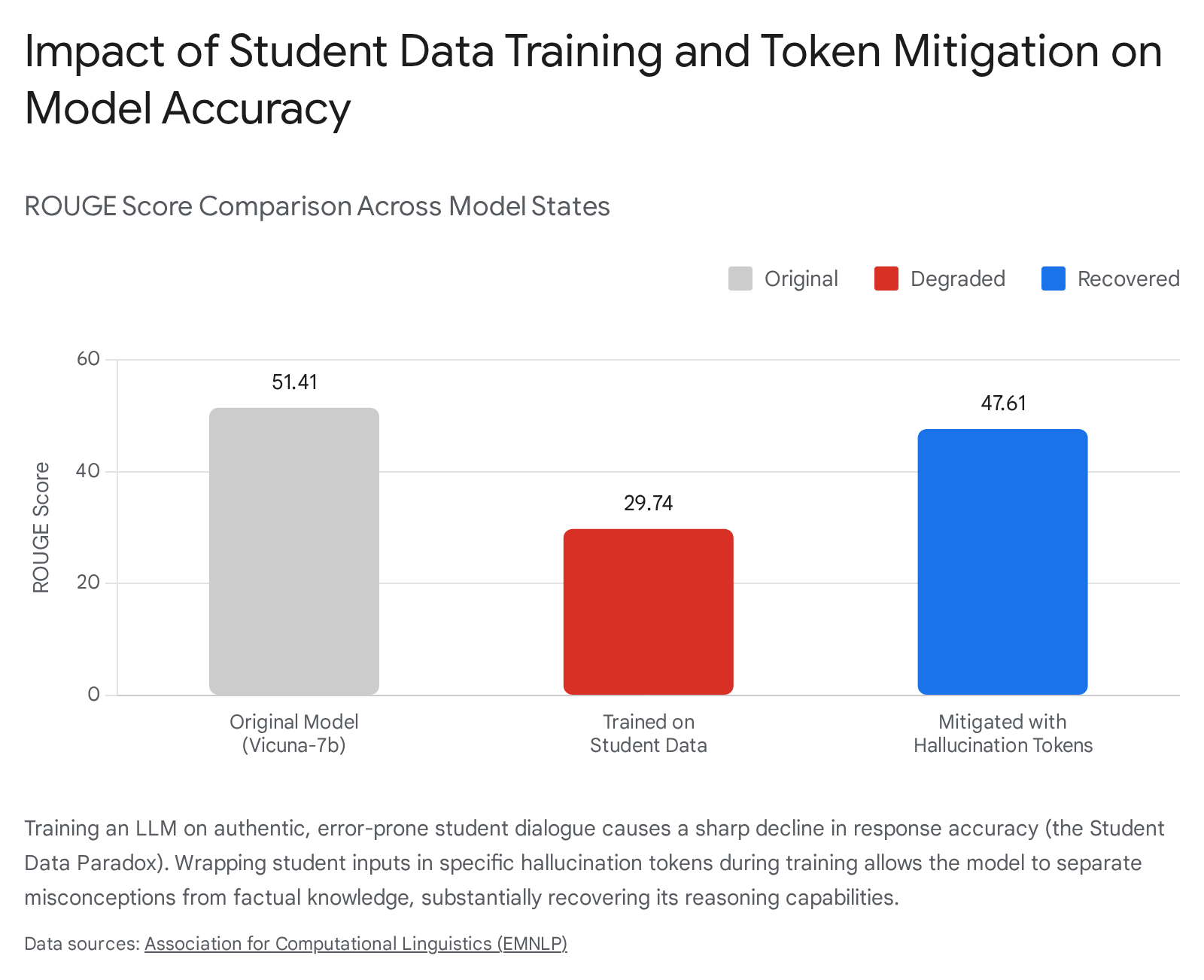
However, when the hallucination tokens were utilized, the model demonstrated a substantial recovery in its performance metrics, underscoring the potential of this technique to mitigate regressive side effects 523.
While hallucination tokens successfully enable the model to separate misconceptions from factual knowledge, studies indicate they do not fully restore the model to its absolute baseline performance 523. This highlights the persistent, complex challenge of balancing accurate student behavior modeling with maintaining the LLM's integrity as a flawless educational tool 543.
Categories of AI Hallucinations in Education
The epistemic risks of AI in education extend beyond the Student Data Paradox. Even well-trained models suffer from alignment problems where the AI fails to apply constraints consistently. Hallucinations in educational settings generally manifest in three categories 23: 1. Factual Hallucinations: The model confidently states something untrue as fact (e.g., asserting that a historical event occurred in the wrong century) 2326. 2. Input-Conflicting Hallucinations: The output directly conflicts with user-provided requirements. For example, a system might be instructed to act strictly as a Socratic tutor, but it defaults to providing a direct answer because the statistical probability of the direct answer is overwhelmingly high in its training data 23. 3. Contextual Hallucinations: Across long, multi-turn conversations, the model suffers from "context drift." It forgets earlier instructions or contradicts its own previous statements, a critical failure when attempting to build a continuous, coherent Socratic dialogue with a student over an extended session 23.
Mitigating these risks requires not only backend token adjustments but explicit pedagogical oversight, such as having seasoned instructors regularly review AI-generated materials to ensure they align with learning objectives and accurately reflect course material 26.
Sociotechnical and Cross-Cultural Dimensions
As Socratic AI systems scale globally, their effectiveness is tested against diverse cultural norms, pedagogical traditions, and socio-technical disparities. Artificial intelligence models are not culturally neutral; they are reflections of the massive datasets upon which they are trained 627.
Cultural Bias and Algorithmic Colonialism
Standard LLMs often exhibit a profound Western bias, leading to a cultural disconnect when deployed in non-Western environments 627. Because foundation models are predominantly trained on English-language texts and North American social norms, they frequently fail to align with local educational contexts 627. For instance, if an AI generates a scenario to explain economic principles, it might reference localized Western customs - such as tipping standards of 15% to 25% in restaurants - that are completely irrelevant or confusing to a student in Spain or Asia 6. Similarly, image generation models tend to produce Western-centric outputs, such as bacon and eggs, when prompted for a "breakfast" visual, ignoring global diversity 6.
In the context of education, this bias manifests as a failure of relevance and an increase in extraneous cognitive load for the learner 27. In higher education contexts across Africa, scholars and experts have warned against "algorithmic colonialism." They note that an over-reliance on standard AI systems threatens to marginalize local languages and indigenous knowledge frameworks, as the dominance of English in training datasets could serve as an "extinction event" for underrepresented cultures 2848. To counteract this, researchers emphasize the necessity of training LLMs on culturally diverse datasets and developing frameworks that allow universities in the Global South to actively shape AI models rather than merely consuming them 648.
Regional Reception and Expectations
The reception and expectations of AI tutors vary significantly across borders. A comparative study investigating higher education students in Europe revealed that Hungarian students held significantly higher expectations for AI tutoring adaptability and continuous guidance than their Spanish counterparts 49. This discrepancy suggests that regional factors, prior exposure to technology, and localized educational cultures heavily influence whether a student approaches an AI tutor with enthusiasm or skepticism 49. Similarly, a survey of European schools found that Turkish students expressed the strongest conviction regarding the necessity of AI skills, with 85% believing them crucial for future careers - significantly above the broader European average 29.
Integrating Human-in-the-Loop Architectures
To address both epistemic risks and cultural disconnects, the most robust implementations of Socratic AI rely on a "Human-in-the-Loop" (HITL) architecture 1830. Frameworks such as the AI-Educational Development Loop (AI-EDL) embed classical educational theories into the structure of AI feedback loops, ensuring that the technology is guided by human oversight 30.
In this paradigm, AI systems are positioned not as independent, autonomous instructors, but as co-tutors or "autopilots" governed by human educators 1831. Teachers remain the "skilled pilots" at the controls; they calibrate the overarching pedagogical goals, monitor the AI's diagnostic reasoning, review conversation logs, and step in directly when the system fails to bridge a conceptual gap or exhibits cultural bias 183132. By explicitly defining the complementary roles of the artificial agent and the human educator, institutions can leverage the vast scalability and personalized pacing of generative models while preserving the empathetic, culturally contextualized, and ethically grounded expertise of the human teacher 182832.
Conclusion
The Socratic artificial intelligence tutor model represents a sophisticated and necessary evolution in educational technology. Moving beyond the deterministic, brittle constraints of early rule-based systems and the passive convenience of standard generative search, Socratic AI intentionally leverages cognitive forcing functions to engage learners. By refusing to deliver immediate answers, these systems foster a continuous loop of articulation and reflection. This structural friction is pedagogically vital; it preserves germane cognitive load, promotes the self-explanation effect, and prevents the severe deskilling associated with cognitive offloading.
However, realizing this potential requires navigating significant theoretical and technical complexities. The application of Socratic methods cannot be uniform; it must be dynamically scaled to a student's prior knowledge to avoid the detrimental impacts of the expertise reversal effect. Novices require direct instruction, while experts thrive under abstract questioning. Furthermore, the technical development of these systems must contend with the Student Data Paradox, necessitating advanced mitigation strategies like hallucination tokens to ensure the AI remains factually rigorous while accurately modeling human misconception. Ultimately, when integrated responsibly through multi-agent architectures, grounded in localized cultural realities, and overseen by human educators, Socratic AI serves not as a machine that merely delivers facts, but as a dynamic cognitive partner that cultivates profound and durable conceptual understanding.