
Is Global Mental Health Getting Better or Worse in 2026
In 2026, the global mental health landscape is defined by a fierce race between escalating environmental and psychological pressures and rapidly innovating models of care. While youth anxiety and chronic structural underfunding continue to drive a worsening worldwide crisis, immense progress is being made through the statutory reimbursement of digital therapeutics, legally enforceable workplace safety standards, and highly effective community-based care interventions. Ultimately, the future of global well-being will depend on scaling these localized innovations to match the unprecedented volume of modern clinical demand.
The Surging Demand and the Diagnostic Debate
Over the past decade, the global conversation surrounding psychological well-being has fundamentally shifted. Mental health is no longer relegated to the periphery of public health; it is firmly positioned alongside cardiovascular disease, cancer, and diabetes as a top global priority 1. However, as the volume of people seeking treatment surges to unprecedented levels, researchers, clinicians, and health economists are grappling with a highly contested question: is the actual prevalence of mental illness rising at pandemic levels, or are modern societies simply better at detecting, destigmatizing, and labeling it?
The Reality of Rising Clinical Utilization
Clinical data from across the globe points to a staggering and sustained increase in the utilization of formal mental health services. A comprehensive analysis of nationwide outpatient claims data in Germany revealed that the diagnostic prevalence of mental disorders rose by a relative 13.4% between 2012 and 2022. This upward trajectory was not distributed evenly; the greatest diagnostic increases were observed among male patients (an 18.3% increase compared to 10.8% in females), and specifically within adolescent and older adult demographics 1.
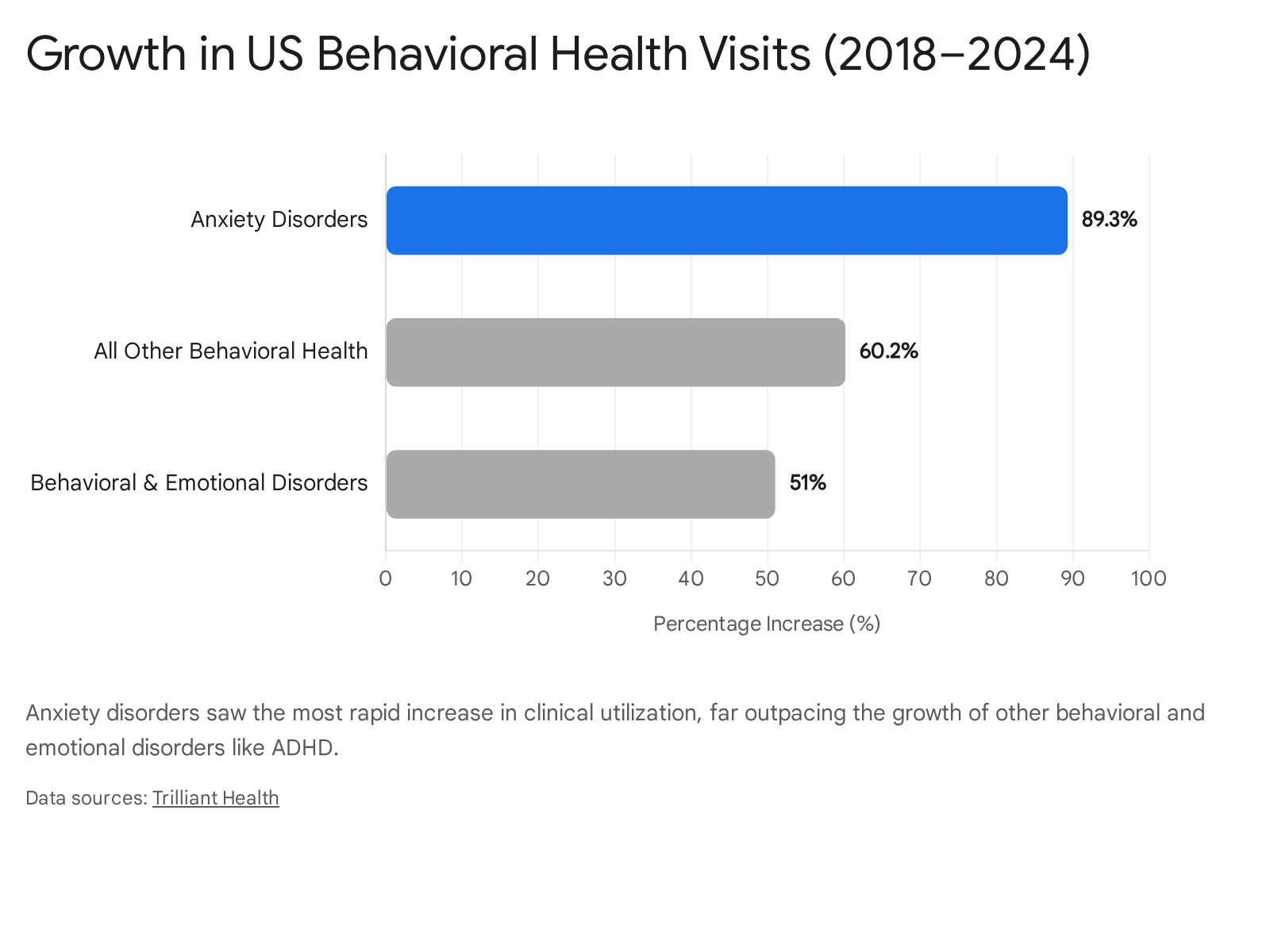
In the United States, the acceleration has been even more dramatic. Research tracking behavioral health trends indicates that overall behavioral health visits increased by 62.6% between 2018 and 2024. Within this massive expansion, the utilization rate for anxiety disorders surged by an astonishing 89.3%, vastly outpacing the growth of other behavioral and emotional disorders, such as Attention-Deficit Hyperactivity Disorder (ADHD), which grew by 51.0% 3.
This surge in clinical engagement is undeniably tied to successful destigmatization campaigns. By 2026, conversations about mental health are more open across cultures, age groups, and socioeconomic contexts, encouraging millions of previously silent individuals to seek help 1. However, the influx has placed immense strain on care networks, revealing a deeply fragmented infrastructure where patients patch together providers, schedules, and digital interventions to secure continuity of care 4.
The Danger of Diagnostic Inflation
As spending on mental health reaches historic highs - with behavioral health spending in the United States alone hitting $329 billion recently, a 94% increase over a decade - experts are raising alarms about "diagnostic inflation" 5. Despite record investments, macro-level outcomes such as suicide rates have not seen proportional declines, leading watchdogs and neurologists to question the validity of modern diagnostic frameworks 5.
Critics point directly to the American Psychiatric Association's Diagnostic and Statistical Manual of Mental Disorders (DSM). Since its inception in 1952 with 106 diagnoses, the DSM has ballooned to encompass over 300 diagnoses spanning more than 900 pages in the DSM-5 5. Prominent psychiatrists and watchdog organizations argue that this expansion pathologizes the baseline human condition, medicalizing everyday emotions, grief, and stress reactions 52. The phenomenon of diagnostic exuberance results in millions of people being screened and labeled with mental disorders, potentially driving them toward unnecessary psychotropic drug treatments and inflating healthcare costs without yielding long-term prognostic improvements 52. Furthermore, investigations into the financial ties behind these diagnostic expansions have revealed significant conflicts of interest, with task force members responsible for defining disorders receiving millions in pharmaceutical industry remuneration 5.
However, pediatric and public health advocates strongly push back against the idea that the current crisis is merely an artifact of over-diagnosis. Emory University researchers tracking nearly 30 million publicly insured children found that mental health and neurodevelopmental diagnoses rose from 10.7% to 16.5% in the decade strictly preceding the COVID-19 pandemic 3. This 6.7 percentage point increase is viewed as an alarming and clinically genuine surge, representing a highly vulnerable demographic requiring immediate, funded intervention 3. Whether the overarching trend represents better detection, diagnostic inflation, or a true rise in distress, the practical reality remains identical: global healthcare systems are buckling under unprecedented, escalating demand 38.
What Is Getting Worse? A Look at the Macro Data
To move beyond the diagnostic debate, public health officials rely on structural, demographic, and mortality metrics to gauge the true state of global mental health. Unflinchingly, these indicators reveal that in several critical areas, the crisis is deepening.
The Youth Mental Health Paradox
Historically, improvements in a nation's wealth, physical health infrastructure, and technological access correlated directly with better overall population well-being. Yet, by 2026, researchers are documenting a stark "paradox of progress." Contemporary young adults living in some of the world's wealthiest nations - despite unprecedented technological and educational access - are reporting the lowest levels of mental well-being 9.
The Sapiens Labs' Global Mind Health study quantifies this through the Mind Health Quotient (MHQ). While adults over 55 generally operate in the "succeeding" or "thriving" ranges, young adults (aged 18 to 34) averaged 30 points below the global mean, placing them firmly in distressed categories 9. This decline is heavily influenced by sociocultural shifts. Global data indicates that young adults in nations where close family bonds are frequently reported (such as the Dominican Republic and Finland) exhibit significantly higher mind health scores than their counterparts in countries where family ties have weakened 9. The erosion of community spirituality, poor dietary shifts, and the early adoption of smartphones are consistently identified as primary perpetuating factors 9.
The Generational Impact of Digital Ecosystems
The role of digital environments and social media in this youth crisis is one of the most heavily scrutinized topics in modern epidemiology. Constant connectivity, algorithmically driven information flows, and prolonged screen exposure are fundamentally reshaping attention patterns, stress physiology, and emotional regulation 1011.
Interestingly, longitudinal research demonstrates a complex, non-linear relationship between technology and well-being. Studies following cohorts of young people indicate that low-to-average social media use at ages 11 and 14 does not strongly predict future mental ill health, such as clinical depression or anxiety 4. However, the volume and nature of consumption dictate the risk. Heavy use - defined as two or more hours a day - is linked to notable increases in severe outcomes, including a measured 3% rise in suicide attempts by age 17 4.
The psychological impacts of these digital ecosystems are highly gendered and generation-specific: * Adolescent Girls: Young women are disproportionately vulnerable to the negative impacts of highly visual platforms. Over 91% of young women believe social media negatively impacts their mental health, and 50% of teen girls report that their sleep is actively disrupted by social media usage, compared to 40% of boys 13. The mechanisms driving this include algorithmic amplification of unrealistic beauty standards, leading to upward social comparison, body dissatisfaction, and subsequent depressive symptoms 131415. * Older Adults: While generally immune to the validation-seeking behaviors that plague younger demographics, older adults face unique digital mental health challenges. For this cohort, social media primarily induces cognitive overload, network stress, and feelings of isolation resulting from digital exclusion and rapid technological change 15.
The ultimate tragedy of the youth mental health crisis is visible in mortality rates, particularly in the Global South. In the Americas, suicide among adolescents and young adults aged 10 to 24 increased by 38% over a twenty-year period, becoming the third leading cause of death for this demographic. In 2021 alone, over 18,000 young people died by suicide in the region, with the sharpest acceleration observed in children aged 10 to 14 - a metric that underscores an urgent, systemic failure in early intervention 56.
The Global Atlas of Mental Health: Chronic Underfunding
Despite the escalating human toll, the gap between the demand for mental healthcare and the resources allocated to provide it remains massive. The World Health Organization's (WHO) 2024 Mental Health Atlas - which draws data from 144 countries - paints a grim picture of global resource allocation. Today, over one billion people live with a mental health condition, yet mental health continues to account for a median of only 2% of national health budgets globally. This figure has remained entirely stagnant since 2017 187.
The disparities between nations are stark and highlight a profound global inequity.
| Economic Region | Mental Health Spending (Per Capita) | Proportion of Global Suicides | Treatment Gap |
|---|---|---|---|
| High-Income Countries | $65.89 | ~27% | Moderate |
| Lower-Middle-Income Countries | $0.34 | ~73% (combined with Low) | Severe |
| Low-Income Countries | $0.04 | ~73% (combined with LMI) | Extreme (up to 90%) |
Data synthesized from the World Health Organization Mental Health Atlas 2024 187.
This chronic underfunding has resulted in severe, systemic workforce shortages. Globally, there is a median of just 13 mental health workers per 100,000 people, with extreme deficits reported across low- and middle-income countries (LMICs) 18. In regions like Southeast Asia, where an estimated 260 million individuals live with mental health conditions, the "treatment gap" - the percentage of individuals requiring care who do not receive it - reaches as high as 90% 20. Similar shortages plague the Middle East, where rapid urbanization and work-related stress are driving demand, yet 80% of mental health conditions remain undiagnosed due to a severe lack of specialized professionals, such as child psychiatrists and addiction specialists 2122.
When formal capacity does not keep pace with public demand, the burden inevitably falls back on individuals and informal caregivers. Consequently, a secondary crisis of caregiver burnout has emerged. Data indicates that a vast majority of caregivers spend nearly all waking hours focused on dependent family members, creating sustained emotional pressure and logistical burdens that trigger their own profound mental health consequences 4823.
What Is Getting Better? Innovations Shaping 2026
While the overarching metrics of anxiety, suicide, and funding present a bleak picture, 2026 also marks a profound turning point in how mental health care is conceptualized, regulated, and delivered. The world is actively moving away from a fragmented, crisis-response model that relies solely on psychiatric hospitals, transitioning toward integrated, preventive, and community-driven care.
Enforcing Psychological Safety in the Workplace
One of the most significant paradigm shifts of 2026 is the recognition that mental health is not merely an individual biological issue, but a systemic occupational one. The economic impact of untreated mental health is staggering. Beyond absenteeism, corporations are grappling with "presenteeism" - where employees physically show up but operate at a fraction of their capacity due to stress, burnout, or depression 24. In Southeast Asia alone, surveys reveal intense employment insecurity and cost-of-living anxieties, driving a massive hidden performance crisis across the workforce 242526.
In response, global regulatory agencies are fundamentally changing the rules of corporate compliance. Workplace mental health is transitioning from a voluntary Human Resources perk to a legally enforceable occupational health and safety requirement 8. Australia has emerged as the global leader in this space. By explicitly defining "psychosocial hazards" - such as excessive workloads, bullying, poor role clarity, and exposure to traumatic events - legislators have placed mental well-being on equal footing with physical workplace safety 2829.
Victoria's Occupational Health and Safety (Psychological Health) Regulations, which took effect in late 2025, require employers to proactively identify, assess, and eliminate risks to mental health as far as reasonably practicable 29309. Similarly, in New South Wales, adherence to Codes of Practice regarding psychosocial hazards transitioned from mere guidance to a mandatory compliance benchmark in July 2026 28. These frameworks ensure that corporations can no longer rely on superficial solutions like meditation apps to fix burnout; they must address the root systemic causes of work-related mental injuries, which now represent nearly a fifth of all workers' compensation claims in some jurisdictions 2829.
Digital Therapeutics (DTx) Enter the Medical Mainstream
While consumer mental health apps have existed for years, 2026 is defined by the maturation of Digital Therapeutics (DTx) - evidence-based, clinically validated software interventions prescribed by physicians to treat specific medical conditions 3233.
Historically, the critical barrier to DTx adoption was the lack of reliable payment structures. However, health ministries are now treating software as medicine. Germany pioneered this movement with its DiGA (Digital Health Applications) framework, allowing doctors to prescribe assessed applications that are subsequently reimbursed by statutory health insurance 3334. France quickly followed with the PECAN early-access pathway for remote monitoring and self-use software, while the UK integrated digital tools through NICE evidence standards 3335.
A landmark development occurred recently when Switzerland announced it would officially reimburse certified mental health apps designed for mild-to-moderate depression under its mandatory health insurance system, beginning in July 2026 34. In the United States, alongside the introduction of new billing codes for Remote Therapeutic Monitoring (RTM), legislative efforts like the Access to Prescription Digital Therapeutics Act seek to establish formal Medicare benefit categories for FDA-cleared software 35.
This global shift toward formal reimbursement is a game-changer. It elevates digital therapeutics from consumer wellness products to legitimate medical treatments, providing scalable solutions capable of bridging the massive workforce shortages highlighted in the WHO Atlas 3234. The global Digital Therapeutic Devices market, valued at over $1.1 billion in 2026, is projected to grow aggressively as these regulatory pathways solidify 32.
Precision Psychiatry and the Gut-Brain Axis
Within the clinical and research spheres, psychiatry is slowly abandoning a trial-and-error approach in favor of "precision mental health" 3610. This shift corresponds with a broader understanding of human neurodevelopment. Global wellness initiatives are increasingly adopting an "era-based model" of brain health - recognizing that the brain moves through distinct phases (Adaptive Growth, Cognitive Stability, Resilience, and Longevity) requiring entirely different preventive and cognitive support strategies 1011.
The most heavily funded and publicized frontier in precision psychiatry is the gut-brain axis. Research consistently demonstrates a complex bidirectional relationship between the gut microbiome and brain function, mediated through immune pathways, hormonal signaling, and the vagus nerve 1011. Scientists are identifying specific microbial patterns and metabolites - particularly short-chain fatty acids (SCFAs) like butyrate and acetate - that are directly associated with mood regulation, anxiety, and stress resilience 113811.
However, the clinical integration of this science requires careful calibration. A booming consumer market for gut microbiome testing promises personalized dietary plans and targeted "psychobiotics" 4041. While these tests can flag dysbiosis (microbial imbalance) and encourage healthier behaviors, prominent neurobehavioral scientists warn against over-reliance on current commercial platforms. Much of the current data relies on cross-sectional observation, establishing correlation rather than definitively proving causality 4042. Interventions such as Fecal Microbiota Transplantation (FMT) remain limited in psychiatric scope 11. Despite the hype surrounding personalized microbial nutrition, clinical consensus in 2026 maintains that foundational dietary patterns - most notably the Mediterranean diet, rich in diverse plant food matrices - remain the most validated approach to supporting a resilient microbiome and, by extension, robust mental health 3611.
Grassroots Innovation: Scaling Community Care in the Global South
In regions where specialized psychiatric infrastructure is virtually non-existent, the most impactful innovations are happening at the grassroots level. A growing consensus in the Global South rejects the linear, Eurocentric pipeline of clinical psychiatry in favor of "task-sharing" - training laypeople and community health workers to deliver evidence-based psychological interventions 121314.
The flagship success story of this model is Zimbabwe's Friendship Bench. Founded to bridge an immense treatment gap in a country with fewer than 20 psychiatrists for over 17 million people, the initiative trains community grandmothers and lay workers to deliver structured problem-solving therapy on wooden park benches 15. Operating at a cost of merely $13 to $16.50 per client, clinical trials prove the model delivers up to an 80% reduction in symptoms of depression and anxiety 1516. In 2026, the Friendship Bench was awarded the King Baudouin Foundation Africa Prize and announced a massive strategic partnership with UNESCO to institutionalize the model across 52 tertiary education institutions nationwide 1517.
Similar community-integration models are yielding massive dividends globally:
| Region / Initiative | Core Methodology | Demonstrated Impact in 2026 |
|---|---|---|
| Pakistan (British Asian Trust) | Integrating mental health into primary care; training frontline workers in psychological first aid. | Screened 128,000+ individuals, treating 70,000+, with 27,000 showing measurable well-being improvements 14. |
| Latin America (PRIDE Model) | Community health workers utilize a cognitive-behavioral 'Thoughts-Emotions-Behavior' curriculum. | Fosters resilience in marginalized youth by bypassing specialized clinical bottlenecks with culturally relevant care 18. |
| Philippines (DOH / DMW) | Telemedicine and psychosocial support networks deployed by the government. | Delivers remote crisis intervention for Overseas Filipino Workers (OFWs) caught in conflict zones, bypassing geographic barriers 1951. |
These models prove that highly effective, life-saving mental health care does not inherently require a clinical psychiatrist or an inpatient hospital bed. When anchored in empathy, cultural relevance, and scientific evidence, care can be delivered affordably and sustainably directly where people live 141518.
Global Policy and the 2030 Horizon
At the highest levels of global governance, international institutions are finally attempting to align policy with the scale of the crisis. The 2025 United Nations High-Level Meeting on Noncommunicable Diseases and Mental Health resulted in a historic, albeit highly debated, political declaration. For the first time, mental health was embedded as an essential component of the global disease response 5220. Governments committed to expanding access to mental health care for an additional 150 million people and pledged to raise mental health spending from the stagnant 2% median to at least 5% of national health budgets by 2030 52.
This top-down policy mandate is being matched by significant philanthropic capital. Major funding consortiums, such as the Being Initiative and the Wellcome Trust, are deploying millions of dollars to support proof-of-concept and transition-to-scale mental health interventions specifically targeting underserved youth in the Global South 5421. Combined with the WHO's continued push to deinstitutionalize psychiatric care and integrate services into primary health systems, the architectural blueprint for a healthier global future is slowly being drafted 2223.
Bottom line
The global mental health landscape in 2026 is highly polarized. On the negative side, diagnostic rates are soaring, the youth demographic is facing unprecedented psychological distress tied to ubiquitous digital ecosystems, and national health budgets remain woefully inadequate to meet the surging demand. Conversely, the world has never possessed better tools to combat the crisis; immense strides have been made through the scaling of grassroots community care, the statutory reimbursement of digital therapeutics, and the legislative enforcement of psychological safety in the workplace. Ultimately, the trajectory of global mental health will depend entirely on whether governments and institutions follow through on their recent promises to fund and deploy these proven innovations at scale.