
Global fatigue and workforce exhaustion in 2026
The global population in 2026 is experiencing an unprecedented convergence of physiological, psychological, and occupational stressors, culminating in a measurable epidemic of systemic fatigue. Rather than a localized cultural shift toward overwork, this exhaustion is quantified across multiple scientific and economic disciplines. Epidemiological tracking of post-viral immune responses, meteorological data on extreme heat and human sleep disruption, psychological assessments of global climate anxiety, and macroeconomic evaluations of digital cognitive overload all point toward a profound depletion of human capital. The interplay of these distinct domains demonstrates that global fatigue is a multi-causal phenomenon, deeply embedded in the structures of modern society.
Contemporary data indicates that chronic workplace stress affects nearly half of the global workforce, while biological mechanisms linked to viral infections and environmental shifts are further depleting baseline human energy reserves. Addressing this pervasive exhaustion requires untangling the discrete data clusters - spanning occupational metrics, technological integration, environmental shifts, and immunological research - that collectively define the modern human condition in 2026.
Occupational Burnout and the Measurement of Disengagement
The landscape of occupational health has shifted dramatically over the past half-decade, with chronic stress and burnout evolving from localized human resources challenges into systemic macroeconomic liabilities. The quantification of this exhaustion reveals profound impacts on both global productivity and individual mortality.
Global Engagement Metrics and Economic Costs
Data from 2025 and 2026 underscores a persistent decline in workforce well-being. According to extensive surveys conducted by the Boston Consulting Group, 48% of employees globally report experiencing burnout 12. This condition is no longer viewed as a transient state but rather as a chronic, cyclical depletion of energy that impairs engagement, motivation, and cognitive performance 1. The severity of this trend is lethal; the International Labour Organization (ILO) reported that over 840,000 people die annually from health conditions directly linked to psychosocial workplace risks 345. These risks - which include job insecurity, long working hours, workplace bullying, and an imbalance between effort and reward - are primarily associated with the onset of cardiovascular diseases and severe mental health disorders, including suicide 345.
Furthermore, these psychosocial risks lead to the loss of nearly 45 million disability-adjusted life years (DALYs) annually, reflecting years of healthy life lost to illness or premature death 35. The economic ramifications of this exhaustion are vast. Global employee engagement stagnated at 21% in 2024, dipping to 20% in 2025, leaving 64% of employees unengaged and 16% actively disengaged 667. Gallup estimates that this widespread disengagement costs the global economy approximately $8.9 trillion annually, representing roughly 9% of global GDP 28910.
The burden of exhaustion is also trickling upward into leadership structures. Manager engagement globally declined to 27% in 2024, indicating that the individuals responsible for mitigating team burnout are frequently unresourced and disengaged themselves 67. Given that managers account for 70% of the variance in team engagement, the psychological depletion of organizational leadership creates a cascading effect of disengagement throughout corporate hierarchies 69.
Regional Disparities in Workplace Stress
The experience of workforce exhaustion varies significantly across global regions, heavily influenced by localized economic conditions, cultural expectations, and labor market structures.
In North America, daily stress levels are the highest globally. Half of all employees in the United States and Canada (50%) reported experiencing significant stress during the previous workday in 2025 612. Despite this high level of psychological strain, the region maintains the highest global engagement rate at 31% 611. This paradox suggests that North American workers are highly involved in their roles but are simultaneously absorbing severe cognitive and emotional strain, leading to a highly productive but brittle workforce.
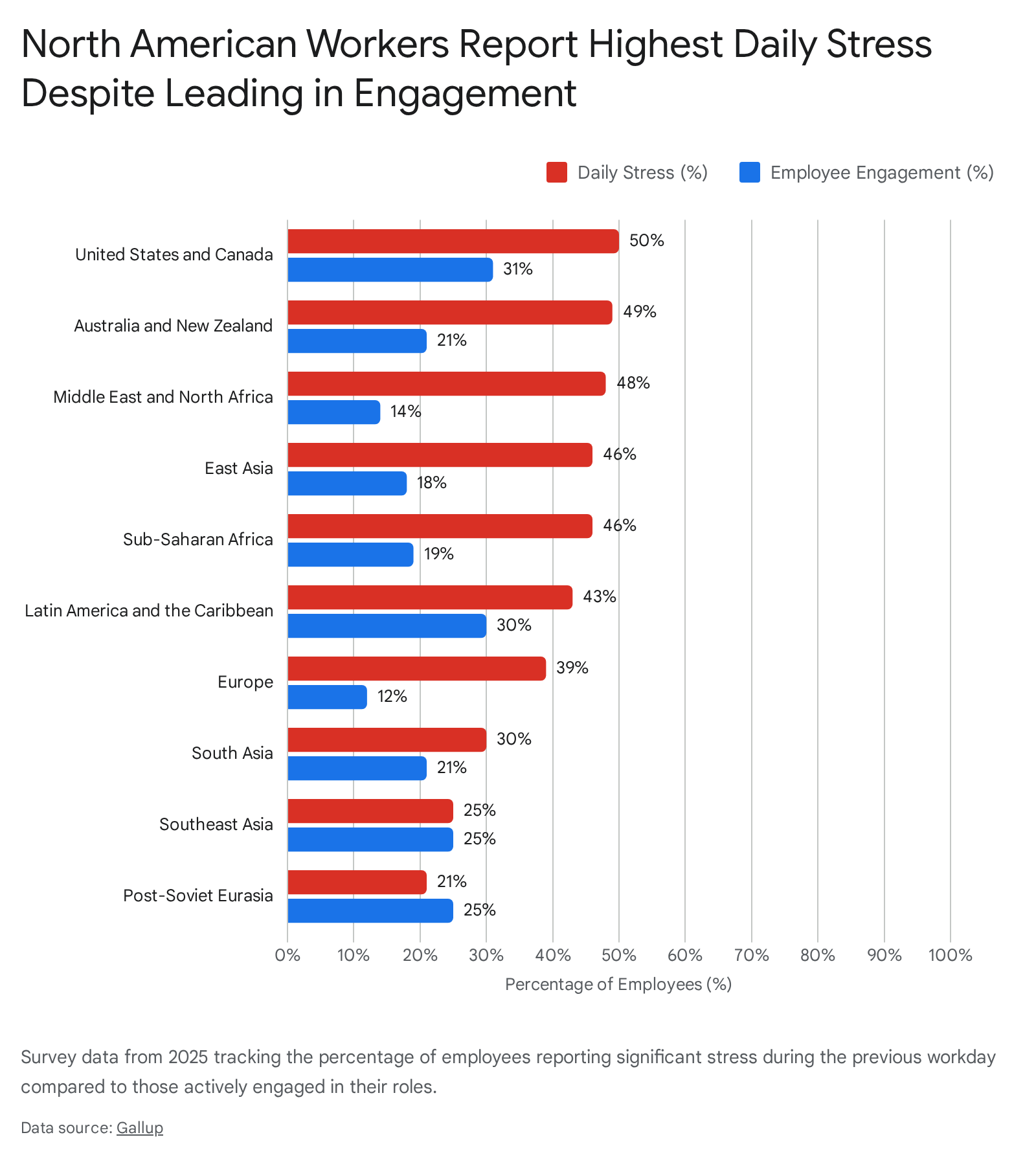
In contrast, the European labor market presents a different profile. European employee engagement sits at a global low of 12%, though reported daily stress is comparatively moderate at 39% 611. Latin America and the Caribbean, while experiencing 43% daily stress, report the highest rates of overall well-being, with 56% of employees classifying themselves as thriving 611. Meanwhile, South Asia faces distinct psychological challenges, reporting the lowest global thriving rate at just 16% and the highest daily sadness rate at 36%, despite moderate stress levels (30%) 611.
Overwork and Karoshi in the Asian Labor Market
The Asian labor market is characterized by severe overwork and an escalating mental health crisis. According to official data from Japan's Ministry of Health, Labor, and Welfare, fiscal year 2024 saw a record 1,304 recognized cases of death and health disorders related to overwork (karōshi), an increase of 196 cases from the previous year 12. The nature of these claims underscores a shift from purely physical exhaustion to acute psychological damage. For the first time, over 1,000 of these recognized cases involved mental health disorders such as depression 12.
The primary trigger for these mental health crises was "abuse of power from superiors," accounting for 224 cases, followed by major changes in duties (119 cases) and customer harassment (108 cases) 1213. In cases involving physical collapse, such as cerebrovascular and cardiovascular diseases (CCVDs), nearly 70% involved employees who had worked 80 hours or more of overtime per month 14. Despite governmental reform efforts that technically reduced the average annual working hours for Japanese employees to 1,654.2 hours in 2024 - lower than the United States average of 1,796 hours - the intensity of the work and the associated social pressures remain severe 17. The transportation, postal services, healthcare, and accommodation sectors exhibited the highest proportion of employees working in excess of 60 hours per week, correlating directly with the highest rates of CCVDs 1214.
Across the broader Asian continent, similar issues persist. Asia's overall workforce productivity score stands at 47.2 out of 100, significantly lagging behind the United States (66.7) and Europe (60.1) 18. Furthermore, 35% of the Asian workforce has been identified as possessing a high mental health risk profile 18. This is exacerbated by financial strain and a lack of trust between employees and employers. In South Korea, labor relations are expected to face unprecedented challenges with the implementation of the "Yellow Envelope Act" in March 2026, which fundamentally redefines employer responsibilities and expands industrial action rights, reflecting deep-seated systemic tensions in the labor market 19.
Working Poverty and Informality in Sub-Saharan Africa
In Sub-Saharan Africa, workforce exhaustion is driven by economic precariousness, youth unemployment, and structural informality rather than corporate overwork. The region is undergoing the largest demographic expansion globally, adding 12 to 15 million young people to the labor market annually 1516. However, the formal economy cannot absorb this influx. Current economic growth patterns, projected at 3.8% for 2025 and accelerating to 4.4% by 2026 - 2027, create only about 3 million formal jobs annually, far short of the 15 million required by 2030 1617.
Consequently, approximately 85% of employment in the region remains concentrated in the informal sector, primarily in low-productivity agriculture 1516. This lack of wage-paying, stable jobs creates chronic socioeconomic fatigue. Despite having high absolute employment rates, working poverty is pervasive. Only 9% of young people in Africa have completed tertiary education as of 2025, leaving the vast majority underprepared for the transition to a services-led economy 17. Even among those with advanced degrees, unemployment remains severe; in nations like South Africa, youth unemployment frequently exceeds 60% 15. Economic wellbeing and the affordability of basic needs severely outweigh concerns about political or security issues across the continent, driving an environment where high labor participation fails to translate into economic security 18.
Sickness Absence and the Physical Toll of Exhaustion
The psychological and structural exhaustion of the global workforce inevitably translates into physical illness. Sickness absence data provides a tangible metric for understanding the failure of human endurance in the modern workplace.
United Kingdom Labor Force Metrics
In the United Kingdom, the Office for National Statistics (ONS) reported that the sickness absence rate in 2025 stood at 2.0%, representing 148.8 million working days lost to illness or injury 1920. This equates to an average of 4.4 days lost per worker 1920. The economic cost of these lost days to the UK economy is estimated at £141 billion 21.
The primary drivers of these absences highlight the diverse nature of modern health struggles. Minor illnesses accounted for the largest share at 30.4%, followed by musculoskeletal problems at 14.6%, and mental health conditions at 8.9% 2021. Demographic analysis reveals distinct vulnerabilities within the workforce. Absence rates were highest among women, older workers, part-time employees, and those employed in the public sector or in process, plant, and machine operative occupations 1920. The sickness absence rate for women was 2.4%, compared to 1.7% for men 19.
Regional disparities within the UK further illustrate varying levels of resilience. While the South West of England observed a 12.5% decrease in days lost to sickness, the East and North East regions saw substantial increases of 29% and 30%, respectively, reflecting localized health and economic inequalities 21. Human health and social work remained the highest reported sector for sickness absence, losing over 30 million days, emphasizing the severe strain on care workers 21.
Presenteeism and Working Under Duress
Despite the high volume of recorded sickness absences, a vast segment of the workforce continues to work while unwell. Research from the Work Foundation at Lancaster University found that 67% of workers have attended work while sick, feeling they should have taken time off but were unable to do so 2223.
This culture of "presenteeism" is deeply tied to financial insecurity and inadequate statutory protections. In the UK, the Statutory Sick Pay (SSP) rate remains one of the lowest in Europe at £123.25 per week, and nearly half of employers do not offer remuneration beyond this statutory minimum 2223. Workers with long-term health conditions are particularly affected; they are four times more likely to take sick leave than those without, yet face a stark choice between pushing through severe symptoms or suffering financial detriment 2223. This systemic failure to provide adequate recovery time ensures that minor ailments or chronic fatigue conditions compound over time, directly contributing to the near 2.8 million people in the UK who are economically inactive due to long-term ill health 2122.
Technological Integration and Cognitive Overload
While technological automation historically alleviated physical labor, the modern integration of digital systems and artificial intelligence (AI) has paradoxically increased cognitive strain for knowledge workers. The digital workplace market, projected to reach $59.4 billion by 2025, has fundamentally altered how humans interact with their daily tasks 29.
The Productivity Paradox of Artificial Intelligence
The rapid implementation of generative AI and automation into enterprise environments has yielded a phenomenon identified by occupational researchers as "AI brain fry" - a state of acute cognitive fatigue linked to managing multiple automated systems simultaneously 2425. A comprehensive 2026 analysis indicates that 88% of heavy AI users report increased feelings of burnout 26. Workers describe this fatigue as a persistent mental fog, slowed decision-making capabilities, and the sensation that their cognitive bandwidth has been entirely consumed by validation tasks 2425.
This fatigue is rooted in a fundamental shift in the nature of human effort. Rather than reducing overall workloads, AI integration frequently expands the employee's "sphere of accountability" 24. Employees are required to produce higher volumes of work, rigorously monitor algorithmic outputs for errors or hallucinations, and manage an unprecedented flow of information in identical timeframes 2425. This shifts the human role from active creation to continuous supervision, which requires a distinct and highly depleting form of sustained executive function 25.
Furthermore, the proliferation of disparate tools necessitates constant context switching. Enterprise data reveals that workers lose an average of 51 minutes per week to "tool fatigue," navigating between applications as many as 100 times per day 26. Consequently, a "productivity paradox" has emerged: 95% of companies deploying AI report no measurable return on investment, as technological abundance dilutes employee focus and expands the scope of work without providing structural support 26. In specific roles, such as software development, workers using AI coding assistants actually took 19% longer to complete tasks due to the increased validation burden 26.
The psychological toll is similarly steep. Almost half (47%) of workers feel unprepared for widespread AI adoption, and 60% fear that utilizing AI tools will lead colleagues to question their competence, generating immense workplace anxiety 26.
Digital Tethering and the Always-On Culture
Beyond AI, the broader proliferation of digital communication tools has dissolved the physical boundaries between professional and personal life. The "always online" culture is reinforced by implicit expectations of rapid responsiveness, regardless of the hour 27. This pervasive connectivity prevents the psychological detachment necessary for neurological and emotional recovery.
According to global data from the ILO, 35% of workers globally labor for more than 48 hours per week 3. The rise of remote work has not necessarily alleviated this burden; while fully remote workers report higher surface-level engagement (31%), only 36% state they are "thriving" in their overall lives, indicating that engagement without well-being is unsustainable 6. In Latin America, ILO time-use surveys highlight how this blurring of boundaries, compounded by long urban commutes and deeply unequal distributions of unpaid domestic labor among women, results in acute "time poverty" and diminished physical and emotional well-being 28.
Legislative Countermeasures to Digital Exhaustion
In direct response to the fatigue generated by digital tethering, governments worldwide are increasingly legislating boundaries around work communications. The "Right to Disconnect" has emerged as a primary legal mechanism to protect cognitive recovery time and restore work-life balance.
Global Evolution of the Right to Disconnect
By 2026, over 15 countries have established active frameworks empowering employees to ignore after-hours work communications without facing professional repercussions 29. The legislative models vary drastically, ranging from process-based negotiations to strict, penalty-driven statutes.
France pioneered this movement in 2017 with the Loi El Khomri, requiring companies with over 50 employees to negotiate annual agreements defining disconnection parameters with employee representatives 2930. If an agreement is not reached, a default company charter is mandatory. In August 2024, Australia enacted a highly enforceable iteration of this right for businesses with over 15 employees, extending it to smaller businesses in August 2025 3132. The Australian law grants employees a statutory right to refuse to monitor, read, or respond to work-related contact from employers or third parties outside contracted hours, unless the refusal is deemed "unreasonable" 3132. Reasonableness is evaluated based on the contact's urgency, the method of communication, the employee's compensation and role, and their personal circumstances 3132. Violations in Australia can be escalated to the Fair Work Commission, exposing employers to general protections claims and financial penalties 3132.
| Country | Implementation Year | Framework Type | Key Enforcement Mechanism |
|---|---|---|---|
| France | 2017 | Process-based | Mandatory annual negotiation for companies with >50 staff. 29 |
| Spain | 2018 | Privacy-based | Tied to data protection; surveillance viewed as privacy breach. 29 |
| Portugal | 2021 | Penalty-based | Employer fines up to €9,690 per violation. 29 |
| Australia | 2024 / 2025 | Enforcement-driven | Individual claims through the Fair Work Commission. 3132 |
| Kenya | 2024 | Statutory | Direct labor inspection and policy structuring. 29 |
| Table 1: Evolution and enforcement models of Right to Disconnect legislation across select jurisdictions. |
Supranational Frameworks and Enforcement Complexities
Other nations are attempting to navigate the complexities of this legislation with varying degrees of commitment. In the United Kingdom, the new Labour government proposed introducing a right to "switch off" through a statutory code of practice; however, recent reports indicate this proposal may be abandoned or heavily diluted, leaving British workers without formalized protection 3039. The Philippines has introduced a Right to Disconnect Bill, though it has not yet been codified into the official Labor Code 30.
At the supranational level, the European Union is currently drafting a comprehensive directive expected for adoption by 2027 or 2028, which would harmonize the right across all 27 Member States 29. For multinational corporations, this rapidly evolving patchwork of legislation presents a massive compliance challenge, requiring them to structure policies that respect stringent penalty-based systems in nations like Portugal while navigating the negotiation-based requirements of France and the enforcement-driven systems of Australia 2939.
Environmental Stressors and Physiological Depletion
Human exhaustion in 2026 is inextricably linked to planetary health. The acceleration of climate change has introduced severe environmental stressors that directly impede the human body's ability to regulate energy, achieve restorative rest, and maintain physiological homeostasis.
Extreme Heat and Sleep Architecture Disruption
The 2025 global report of the Lancet Countdown on health and climate change confirmed that extreme heat represents a severe public health crisis. The rate of heat-related mortality has surged, resulting in approximately 546,000 deaths annually - a 63% increase since the 1990s 3334. High temperatures push the human body into a state of chronic physiological strain; as the body attempts to cool itself by diverting blood to the skin's surface, it places immense pressure on the cardiovascular system 35. Vulnerable populations are disproportionately affected, with infants under one year and adults over 65 experiencing a record average of 13.8 heatwave days per person in 2023 3435.
Crucially, rising temperatures are systematically destroying human sleep architecture. The Lancet reported that in 2024, rising nighttime temperatures caused a 9% increase in sleep loss compared to the 1986 - 2005 baseline, representing the largest percentage increase in lost sleep recorded in the past decade 3334. Elevated nighttime heat disrupts sleep timing, diminishes sleep quality, and reduces overall duration 33. Restorative sleep is a profoundly complex biological function necessary for neurological clearing and mood regulation; its disruption acts as a massive trigger for cognitive fatigue, increased irritability, impaired executive function, and the exacerbation of psychiatric conditions like bipolar disorder 3343.
Economic and Productivity Losses from Heat Exposure
The occupational impact of this physical depletion is staggering. In 2024, an estimated 640 billion potential work hours were lost globally due to heat exposure, exceeding the 1990 - 1999 average by over 98% 33. This loss of labor capacity translated into approximately $1 trillion in lost labor productivity, equivalent to nearly 1% of global GDP 34.
Heat exposure also severely limits safe outdoor activity, fundamentally altering the way populations live and work. Studies from 2026 indicate that one-third of the global population resides in areas where heat severely restricts basic physical activities 36. For individuals over 65, safe outdoor activity is restricted for an average of 900 hours per year, a sharp increase from 600 hours in 1950 36. Without rapid adaptation, numerical modeling suggests that by the 2100s, global average sleep duration could be reduced by 16.37 hours annually, resulting in significant cognitive impairments and a projected economic cost of $2.86 trillion 33.
Psychological Distress in the Climate Era
Beyond the direct physiological impact of heat, the psychological awareness of environmental degradation is fostering a distinct form of chronic distress known as climate anxiety, or eco-anxiety. This phenomenon is defined as a chronic fear of environmental doom, heavily correlated with negative mental well-being and systemic exhaustion 3738.
The Prevalence of Eco-Anxiety
Among younger demographics, the psychological burden of climate change is particularly acute. Global surveys from Lancet Planetary Health demonstrate that 60% of individuals aged 16 to 25 are "very worried" about climate change, with 45% reporting that this anxiety negatively affects their daily functioning 373940. These emotions are not pathologized by clinicians, who view them as a rational response to escalating natural disasters and overshot planetary boundaries 3738. However, the symptoms are severe: young people report high rates of insomnia, panic attacks, depressive symptoms, and a profound sense of grief over the anticipated loss of their future 373840.
The media ecosystem exacerbates this distress. Data shows that 67% of eco-anxious individuals cite news exposure as their primary trigger 39. The constant consumption of headlines regarding extreme weather, biodiversity loss, and global inaction leads to a cycle of doomscrolling that prevents cognitive recovery 39. In the United States alone, the Lancet projects that 1 to 6 degrees Celsius of warming could result in 401 million to 1.8 billion additional anxiety symptom-days annually, with economic damages from these mental health impacts ranging from $24 billion to over $104 billion per year 41. Low-income communities and regions like Appalachia are projected to bear the heaviest psychological burdens 41.
Climate Fatigue and Defense Mechanisms
Paradoxically, a parallel trend of "climate fatigue" is emerging globally. The UNDP's People's Climate Vote 2024 revealed that while two-thirds of respondents consider climate change a global emergency, fewer people now view it as their absolute top concern 50. Decades of alarmist narratives, where every year is declared the "hottest on record," have led to psychological burnout 50. Competing crises, such as post-pandemic financial instability and geopolitical conflict, have forced populations to refocus their priorities on immediate survival 50. Thus, populations oscillate between paralyzing eco-anxiety and desensitized exhaustion, creating a global mood of profound weariness. Therapeutic interventions, such as Cognitive Behavioral Therapy (CBT) programs and meaning-focused coping, are being deployed to cut eco-anxiety symptoms, but the systemic drivers of the fear remain unresolved 3739.
Biomedical Perspectives on Chronic Exhaustion
While technology and climate drain human energy externally, biological shifts following the global infectious disease outbreaks of the 2020s are causing internal energy production failures. The prevalence of post-infective fatigue syndromes (PIFS), including Long COVID, has forced medical science to re-evaluate chronic exhaustion as a quantifiable neuro-immunological condition rather than a psychosomatic complaint.
Immunological Markers of Post-Viral Fatigue Syndromes
Recent medical research from late 2025 provides compelling evidence that PIFS is rooted in persistent immune activation and neurochemical imbalances. A comprehensive systematic review and meta-analysis published in November 2025, which assessed over 5,100 participants, demonstrated that individuals diagnosed with PIFS exhibited sustained alterations in circulating immunologic markers 42. Specifically, when compared to controls who fully recovered from the same acute viral exposures, PIFS cases demonstrated increased white cell counts 3 to 6 months post-infection (Cohen's d: 0.41) 42. Furthermore, these patients exhibited elevated circulating levels of the chemokine RANTES and Tumor Necrosis Factor-alpha (TNFα) at 6 to 12 months post-infection, providing strong biological support for chronic inflammatory responses driving systemic fatigue 42.
Genetic and neurological research further isolates the pathophysiology of viral exhaustion. Mendelian randomization studies published in 2025 highlight a probable causal link between specific immune cell features - notably the upregulation of the CD24 glycoprotein on memory B cells (OR: 1.795) - and an increased risk of developing post-viral fatigue 43. Neurologically, functional magnetic resonance imaging (fMRI) brain scans conducted by the National Institutes of Health reveal that patients with post-infectious myalgic encephalomyelitis/chronic fatigue syndrome (PI-ME/CFS) exhibit lowered activity in the temporal-parietal junction 44. This brain region is critical for processing the decision of how to exert effort; its disruption fundamentally impairs the brain's ability to initiate action, causing profound fatigue 44. Additionally, spinal fluid analysis in these patients revealed abnormally low levels of catecholamines, which correlated directly with severe motor impairment, effort-related behavioral deficits, and cognitive exhaustion 44.
Taxonomical Distinctions in the ICD-11
The widespread impact of these fatigue syndromes has necessitated critical updates to global medical classifications. The World Health Organization's 11th Revision of the International Classification of Diseases (ICD-11), utilizing advanced natural language processing and API integration for global tracking, has established firm boundaries between biological disease and occupational exhaustion 4546.
In the ICD-11, post-viral fatigue syndrome is classified strictly under Chapter 8: Diseases of the Nervous System, utilizing the code 8E49 4547. The diagnostic criteria emphasize post-exertional malaise (PEM) - a severe worsening of symptoms following minor physical or mental exertion - as a core symptom, clearly distinguishing it from general lethargy or depression 4547. In updates slated for 2026, the terminology "myalgic encephalomyelitis/chronic fatigue syndrome" (ME/CFS) was formally included as an index term mapped to 8E49, reflecting medical consensus on its neurological basis and rejecting outdated hypotheses classifying it as a psychiatric disorder 57.
Conversely, the WHO explicitly isolates occupational exhaustion. In the ICD-11, "Burn-out" is not classified as a medical condition. Instead, it is categorized as an "occupational phenomenon" resulting from chronic, mismanaged workplace stress 48. It is characterized by feelings of energy depletion, increased mental distance or negativism toward one's job, and reduced professional efficacy 48. This taxonomical delineation ensures that clinical interventions for post-viral syndromes target immunological and neurological pathways, while burnout interventions demand urgent organizational redesign and labor policy reforms 4748.
Macroeconomic Volatility as a Compounding Stressor
The baseline ability of the global population to recover from physical, mental, and occupational strain is fundamentally compromised by the macroeconomic environment of 2026. The persistence of high inflation and geopolitical instability forces workers to endure exhausting conditions simply to survive, eliminating the financial safety nets necessary for rest.
Geopolitical Instability and Inflationary Pressures
Global economic models in 2026 show a landscape disrupted by geopolitical conflict, particularly tensions in the Middle East resulting in the double blockade of the Strait of Hormuz 4960. Because approximately one-quarter of the world's oil is shipped through this strait, disruptions to these flows have caused significant energy price spikes and reverberated through global supply chains 50. Consequently, major institutions like the International Monetary Fund and the Peterson Institute for International Economics projected global growth to slow to between 3.0% and 3.1% in 2026, down from previous projections of 3.3% to 3.4% 496050.
Headline inflation is tracking around 3.7% globally in 2026, though with severe and destabilizing regional disparities 62. While advanced economies like the United States and Europe see moderate rates (2.4% and sub-2% respectively), emerging markets are facing catastrophic price pressures 62.
| Country | Projected Inflation Rate (2026) | Primary Economic Drivers |
|---|---|---|
| Venezuela | 682.1% | Hyperinflation, currency collapse, oil dependence. 62 |
| Sudan | 54.6% | Conflict, supply disruptions, fiscal strain. 62 |
| Iran | 41.6% | Sanctions, structural governance issues. 62 |
| Türkiye | 24.7% | Currency pressures, policy challenges. 62 |
| Brazil | 4.0% | Moderate stabilization. 62 |
| United States | 2.4% | Technological investment offsetting trade headwinds. 62 |
| Table 2: Variances in projected global inflation rates and driving factors in 2026. |
The Cost-of-Living Crisis and Talent Retention
For the average worker, these macroeconomic shocks translate into diminished purchasing power and heightened financial anxiety. In a Q1 2026 global survey of corporate risks conducted by the ACCA, 25% of respondents cited geopolitical instability as their primary concern, rising to 33% in the Asia Pacific 51. This instability leads to cautious corporate spending, subdued hiring activity, and elevated talent-related risks 51. The pressure on individual disposable income forces many workers to prioritize economic survival over their mental and physical health. Surveys indicate that 34% of workers have considered accepting lower-paying jobs just to escape chronic workplace stress, though persistent inflationary pressures often make such moves financially unfeasible 6. This economic backdrop ensures that even as populations demand better work-life balance and right-to-disconnect laws, financial realities tether them securely to the very systems driving their exhaustion.
Conclusion
The profound fatigue characterizing the global population in 2026 cannot be attributed to a single variable or a simple lack of resilience. It is a compounding, multi-systemic crisis where the physiological damage of extreme nighttime heat and post-viral immune activation collides with the cognitive overload of generative AI and the structural demands of an always-on digital economy.
Data spanning immunological research, meteorological tracking, macroeconomic forecasting, and workplace analytics confirms that the capacity for human endurance is being outpaced by systemic societal demands. Mitigation strategies must evolve far beyond individual wellness initiatives. Resolving this global epidemic requires comprehensive organizational redesigns to manage cognitive load, rigorous legislative enforcement to protect recovery time, aggressive environmental action to curb heat-induced physiological strain, and continued biomedical investment to treat post-viral neurological damage. Without coordinated, structural interventions across all these domains, the depletion of global human capital will continue to accelerate, threatening both economic stability and public health.