
How Social Media Use Affects Mental Health in 2026
In 2026, the average global internet user spends approximately 2 hours and 21 minutes daily traversing an average of 6.8 different social platforms. While overall aggregate screen time has plateaued across the globe, heavy engagement with algorithmically driven short-form video and passive scrolling is consistently linked to increased anxiety, depression, and sleep disruption. Conversely, active communication on messaging apps often correlates with positive well-being, suggesting that how individuals use social media dictates their mental health outcomes far more than simply how much time they log.
The Global State of Screen Time in 2026
Social media adoption has reached a point of near-universal saturation among internet users, fundamentally altering how humanity allocates its waking hours. As of early 2026, there are approximately 5.66 billion social media user identities worldwide, representing roughly 69.9% of the global population and nearly 95% of all internet users 123. The ecosystem continues to grow, adding over 250 million new users between 2025 and 2026 14. This growth is no longer driven by youth adoption in Western nations, but rather by users aged 55 and older in emerging markets and the global expansion of mobile infrastructure 1.
Despite the continually expanding user base, the total amount of time people dedicate to these platforms has hit a structural ceiling. Following an era of explosive growth - most notably during the 2020 pandemic lockdowns - global daily usage has stabilized. Since 2022, the worldwide average has hovered steadily between 141 and 147 minutes per day 67.
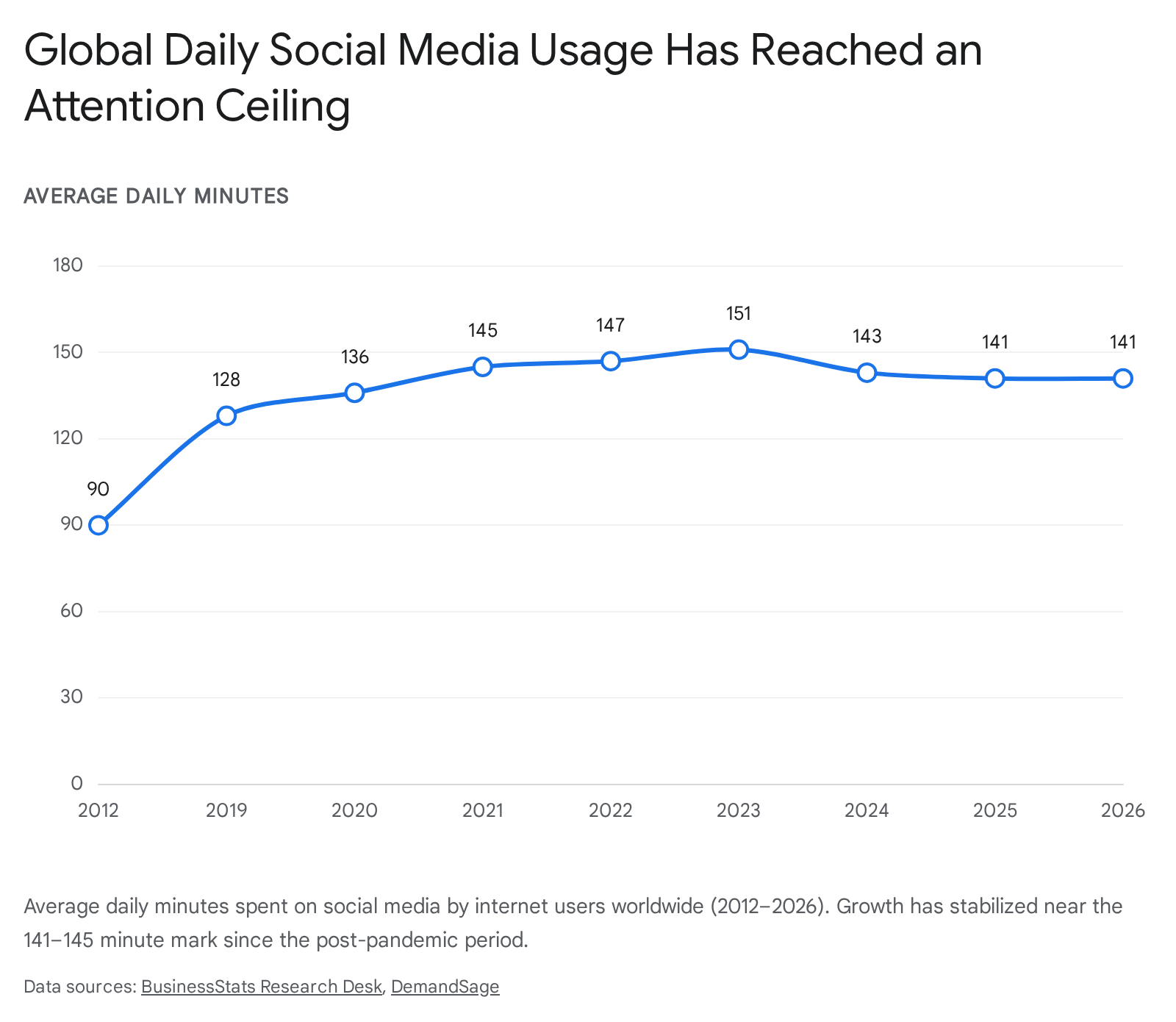
This plateau suggests a natural limit to human attention. Because individuals have a finite number of waking hours balanced against work, sleep, and household responsibilities, platforms are no longer competing for new hours in the day. Instead, they are locked in a zero-sum competition to cannibalize attention from one another 62.
To fully grasp the magnitude of this consumption, it helps to view the data cumulatively. At roughly 2.5 hours per day, the typical internet user spends roughly 18 hours and 36 minutes every week on social networks 23. Assuming an average sleep schedule of seven to eight hours per night, this means humanity spends more than one full waking day every single week exclusively consuming social media feeds 3.
Regional Disparities in Digital Consumption
Global averages obscure significant geographic variations. Nations in the Global South tend to log substantially higher screen time and social media usage than countries in East Asia or Europe 10. This disparity is driven largely by mobile-first internet adoption, where social apps function as the primary gateway to the broader internet.
| Country / Region | Average Daily Social Media Time | Average Total Screen Time |
|---|---|---|
| Philippines | ~3 hours 43 minutes | N/A |
| South Africa | ~3 hours 36 minutes | ~9 hours 24 minutes |
| Brazil | ~3 hours 39 minutes | ~8.4 to 9.9 hours (Latin America) |
| United States | ~2 hours 9 minutes | ~7 hours 11 minutes |
| United Kingdom | ~1 hour 50 minutes | ~6 hours 6 minutes |
| Japan | ~45 minutes | ~4 hours 18 minutes |
Data aggregates for 2026 indicate that the Philippines continues to lead global social media engagement, with users spending approaching four hours daily, followed closely by South Africa and Brazil 671112. By contrast, internet users in Japan spend less than an hour per day on social platforms 11. Overall digital screen time - which includes streaming, gaming, and productivity tools alongside social media - mirrors this trend, with South African users averaging nearly nine and a half hours of total daily screen exposure 1314.
Generational Divides and Gender Dynamics
Average screen time forms a clear inverse relationship with age. Younger cohorts log significantly more hours, primarily driven by video streaming, social networks, and digital communication.
According to 2026 global data, Generation Z (individuals born roughly between 1997 and 2012) leads all demographics, spending an average of up to four hours daily on social platforms 154. When factoring in all online media - including streaming TV, podcasts, and gaming - females aged 16 to 24 log an astounding 6 hours and 7 minutes daily, while males in the same bracket average 5 hours and 43 minutes 5. Millennials (ages 25 to 34) follow closely, utilizing social media for roughly 2.5 to 3 hours daily 26. As age increases, screen time decreases steadily, with Baby Boomers (ages 65 and older) logging between 1 hour and 100 minutes of daily social media time 725.
Interestingly, gender gaps are most pronounced among younger users and narrow significantly with age. Women generally spend more time on social networking and messaging apps than men, who report higher daily averages for gaming and platforms like Reddit, Discord, or X (formerly Twitter) 415. By age 55, the gender gap in digital screen time narrows to less than six minutes per day 5.
The integration of screens is also accelerating in early childhood. The 2025 Common Sense Census revealed a stark convergence of early development and technology. By age two, 40% of children have their own tablet, and by age eight, 51% possess a dedicated mobile device 78. The survey notes that parents increasingly utilize screens as functional tools for behavioral management, relying on mobile devices to assist with mealtimes, bedtime routines, and emotional regulation, setting the foundation for high digital consumption later in adolescence 7.
Platform-Specific Engagement Trends
Social media is no longer a monolithic entity. The average user in 2026 actively maintains accounts on 6.75 different platforms, moving fluidly between apps to satisfy different needs: news discovery, social connection, and entertainment 14. However, the distribution of time across these platforms is highly unequal.
The Unprecedented Rise of Short-Form Video
The defining characteristic of digital engagement in the mid-2020s is the absolute dominance of short-form video. Content formats like TikToks, Instagram Reels, and YouTube Shorts now collectively account for roughly 58% of all time spent on social media 1.
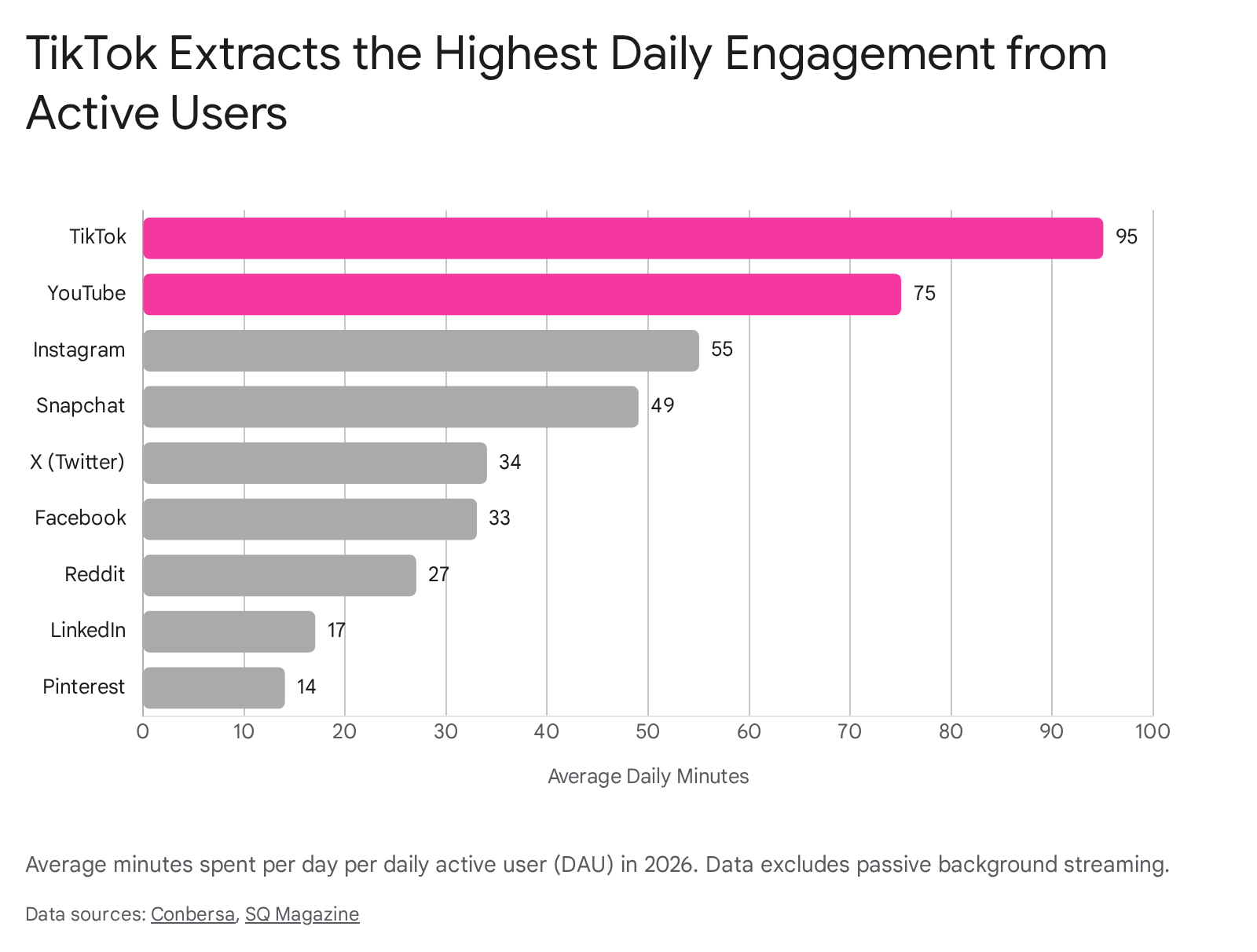
This format commands attention through highly sophisticated, machine-learning-driven recommendation engines. TikTok leads the industry in pure engagement duration. While estimates vary depending on measurement methodologies - some sources cite 52 minutes daily across all users, while daily active user (DAU) metrics indicate figures between 95 minutes and 1 hour 37 minutes - the consensus is clear: TikTok extracts the highest time commitment of any standalone social app 2154. The platform maintains a 72% watch-through rate on videos under 30 seconds, indicating a highly captive, passive audience 1.
YouTube follows closely, with users averaging between 45 and 75 minutes daily, largely driven by younger audiences utilizing the platform for both long-form entertainment and Shorts 2154. Instagram averages between 29 and 55 minutes daily, having successfully staved off user attrition by heavily prioritizing its Reels feature to compete with TikTok 2154.
Beyond Video: Messaging and Professional Networks
While video dominates raw time metrics, other platforms serve distinct functional purposes that secure their place in the daily digital ecosystem. Facebook remains the world's largest platform by sheer volume, boasting over 3 billion monthly active users, though its daily usage duration (roughly 30 to 33 minutes) is increasingly sustained by older demographics 315922.
Messaging applications like WhatsApp and Telegram continue to show massive adoption, especially in India, Latin America, and Europe 9. Furthermore, niche and professional platforms are evolving. LinkedIn users average shorter sessions - around 6 to 17 minutes - but the platform has seen increased video engagement as users prioritize B2B thought leadership 2156. X (formerly Twitter) commands roughly 28 to 34 minutes daily, heavily favored by news-seeking audiences, while Reddit captures roughly 25 to 27 minutes daily, largely among Gen Z males engaging in specialized communities 215422.
The "Double-Edged Scroll": Modes of Engagement
To understand the mental health implications of these staggering screen time statistics, the academic community has moved away from viewing "social media use" as a monolithic activity. The psychological outcome of a digital session depends almost entirely on the user's mode of engagement: active versus passive consumption 1024.
The Perils of Passive Consumption
Passive use involves mindless scrolling, consuming endless video feeds, and observing curated content without interacting 24. This mode of engagement is consistently linked to negative mental health outcomes across multiple global studies.
The primary mechanism of harm in passive consumption is social comparison. Users constantly evaluate their everyday reality against the idealized, filtered, and heavily curated highlights of influencers and peers 242526. This constant exposure fosters feelings of inadequacy, lowers self-esteem, and creates a distorted perception of societal norms 24. Furthermore, passive consumption contributes heavily to information overload and cognitive fatigue. A 2025 meta-analysis confirmed that this relentless stream of updates overwhelms emotional regulation, exacerbating symptoms of stress, loneliness, and depression 241112.
The Protective Effects of Active Engagement
Conversely, active engagement - which includes creating content, messaging friends, participating in community discussions, and actively commenting - often yields neutral or even positive mental health outcomes 102411.
Research published by the University of Oxford Wellbeing Research Centre in 2026 highlighted that platforms designed primarily to facilitate direct social connection, such as WhatsApp, show a clear positive association with user happiness 25. Active use builds a sense of belonging and provides tangible emotional support. Meta-analyses of over 141 studies confirm that while most active use has negligible negative impacts, it strongly correlates with greater online support, higher overall well-being, and positive affect, particularly when utilized within private group contexts rather than public broadcasts 101314.
Platform-Specific Psychological Correlates
Because algorithms and user interfaces dictate how people behave, the mental health risks vary dramatically depending on the architecture of the app in question.
Instagram: Appearance and the Comparison Trap
Research consistently identifies Instagram as posing the highest risk for body image distortion and eating disorders 151617. Internal research from Meta, alongside independent 2025 data, demonstrates that the platform's visual-first, performance-driven nature creates toxic validation loops. Up to 46% of teen girls report that the platform makes them feel worse about their bodies 2515. The constant pursuit of external approval through likes and the normalization of restrictive dietary trends (the "social media diet") lead to severe body dissatisfaction 252618. Heavy use - defined as over three hours daily - is strongly associated with clinical depression and anxiety among young adults 16.
TikTok and Short-Form Video: Attention and Arousal
The infinite-scroll architecture of TikTok, Instagram Reels, and YouTube Shorts delivers rapid dopamine hits that mimic addictive behaviors 25. A comprehensive 2025 systematic review in the Psychological Bulletin linked heavy short-form video consumption to measurable deficits in attention span, reduced inhibitory control, and increased physiological arousal 35. This constant state of cognitive arousal frequently delays sleep onset, displacing vital rest. The loss of sleep, combined with the displacement of physical activity, creates a compounding effect that elevates baseline stress, anxiety, and depressive symptoms 163519.
Snapchat: FOMO and Social Exclusion
Snapchat's interface relies heavily on disappearing messages and "streaks" - a gamified metric showing how many consecutive days users have messaged one another. This design creates powerful psychological obligations. Users, particularly teenagers, frequently report intense feelings of the "Fear Of Missing Out" (FOMO) and severe social anxiety when they are excluded from group exchanges, or when streaks are broken, treating digital metrics as a direct proxy for real-world friendship 1515.
Text-Based Platforms: Hostility and Outrage
Platforms that rely on text and news dissemination, particularly X (Twitter) and Facebook, are frequently cited for high levels of toxicity. Algorithms optimized for high-arousal engagement frequently elevate divisive content, outrage cycles, political hostility, and cyberbullying 1516. Users on these platforms report elevated levels of stress, anger, and fatigue, driven by constant exposure to conflict and the rapid spread of unverified information or cyberhate 163738.
The Methodological Crisis in Screen Time Research
Despite the alarming headlines linking technology to mental illness, the scientific community is engaged in a rigorous debate regarding causation. A significant hurdle in establishing undeniable proof of harm lies in how researchers collect data.
The Flaws of Self-Reported Data
Much of the foundational literature connecting social media to mental health disorders relies on users estimating their own screen time through retrospective surveys. However, studies utilizing passive smartphone tracking tools in 2024 and 2025 have revealed that individuals possess remarkably poor insight into their actual digital habits 2021.
Users frequently overestimate low usage and severely underestimate high usage, heavily skewing data 41. Furthermore, modern "platform swinging" - the act of rapidly bouncing between TikTok, Instagram, and Snapchat within a single session - makes accurate cognitive recall nearly impossible 22. When researchers compare objective device-logged data to subjective self-reported data, the correlations with mental health disorders often weaken or shift. This suggests that some past literature may have captured a user's perception of their screen time (which is colored by their existing anxiety or depression) rather than their actual biological exposure to the screen 2021.
The Social Displacement vs. Stimulation Hypothesis
A central theoretical debate in digital psychology is the "Social Displacement Hypothesis" - the idea that time spent on screens directly robs people of face-to-face interaction with friends and family, thereby causing isolation and depression 2324.
Recent longitudinal and qualitative evidence heavily challenges this assumption. Researchers note that in-person socializing has been declining steadily in nations like the US and UK since long before the invention of modern social media 24. Rather than displacing in-person friendships, social media largely displaces other solitary media consumption, such as watching traditional television or browsing the broader internet 45.
In fact, qualitative studies interviewing adolescents indicate stronger support for the "stimulation hypothesis." Young people frequently use social media to maintain peer connections precisely when offline socializing is impossible due to geography or scheduling 234625. This dynamic often creates a "rich-get-richer" effect, where teens with healthy offline social lives use digital tools to further strengthen their bonds. Conversely, it can trigger a "poor-get-poorer" effect, exacerbating feelings of isolation for those who already lack offline support networks 2346.
Clinical Interventions: Does a Social Media Detox Actually Work?
To move past flawed correlational data, researchers have recently conducted randomized controlled trials (RCTs) to test whether reducing screen time directly causes measurable improvements in mental health.
The findings are highly encouraging in the short term. A 2024 trial published in JAMA Network Open tracked Danish families who surrendered their smartphones and reduced leisure screen time to a maximum of 30 minutes a day for two weeks. The children and adolescents in the intervention group showed significant, moderate-effect-size improvements in behavioral difficulties, emotional regulation, and peer relations compared to the control group 1948.
Similarly, a 2025 study published in BMC Medicine restricted healthy university students' smartphone screen time to a maximum of two hours per day for three weeks. The results were striking: the intervention group experienced a 27% decrease in depressive symptoms, a 16% drop in stress, and a 14% increase in overall well-being 262728. Another 2025 trial from Harvard Medical School researchers found that a simple one-week social media detox reduced clinical anxiety symptoms by 16.1% and insomnia by 14.5% among young adults 29.
However, there is a significant behavioral catch. In almost all clinical trials, once the formal intervention period ends, participants' screen time rapidly rebounds to baseline levels, and the psychological benefits quickly dissipate 2628. This indicates that screen time reduction does have a causal, positive impact on mental health, but maintaining those boundaries in a hyper-connected society requires ongoing, structural lifestyle changes rather than temporary willpower.
Expert Guidelines for a Healthy "Digital Diet"
Because total abstinence from digital platforms is practically impossible and socially isolating for modern citizens, global health authorities have pivoted away from recommending absolute screen bans. Instead, the focus has shifted to "Digital Nutrition" - the concept of consuming technology intentionally, much like maintaining a balanced physical diet 1718.
Between 2023 and 2025, prominent organizations including the American Psychological Association (APA) and the World Health Organization (WHO) issued formal policy frameworks and advisories aimed at protecting youth digital well-being 303132. By synthesizing these major institutional guidelines, several core pillars for healthy digital engagement emerge:
- Prioritize Sleep and Physical Activity: Social media should never displace fundamental biological needs. Both the APA and WHO emphasize that devices must be removed from bedrooms at night to prevent algorithmic disruption of circadian rhythms, ensuring a minimum of eight hours of uninterrupted sleep 373831.
- Screen for Problematic Use: Caregivers and health professionals must actively monitor for behaviors resembling clinical addiction. Warning signs include lying about screen time, suffering academic or social consequences due to device use, and relying on screens exclusively as a coping mechanism to regulate negative moods 8373831.
- Develop Digital Literacy: Young users must be explicitly taught how platforms operate. Education should cover how algorithms manipulate attention, how to identify digitally altered bodies and unrealistic beauty standards, and how to recognize and block cyberhate. This training inoculates users against psychological harm by promoting critical consumption 3738.
- Co-Viewing and Scaffolding for Minors: For younger adolescents, adults should actively monitor use, co-view content, and discuss the implications of what is seen online. Autonomy and privacy should only be granted gradually as the child demonstrates emotional maturity and digital literacy 3738.
- Regulate Platform Architecture: The WHO strongly advocates for structural changes at the corporate and governmental levels. This includes holding technology companies accountable to disable addictive design features - such as infinite scrolling, auto-play videos, and aggressive push notifications - specifically for users under the age of 18 3033.
Bottom line
In 2026, social media claims over two hours of daily attention from the average internet user, functioning as the primary infrastructure for global communication and entertainment. While total time spent online has hit a plateau, the mass shift toward passive, algorithmically driven short-form video consumption is causally linked to rising rates of anxiety, sleep disruption, and attention deficits. However, social media is not inherently toxic; active, communication-based engagement fosters genuine well-being and social connection. The consensus among psychologists is that managing mental health requires treating digital media like a diet - optimizing for high-quality, intentional connections while strictly limiting the algorithmic junk food that displaces sleep and real-world relationships.