
Is ADHD Overdiagnosed or Underdiagnosed in 2026
The 2026 clinical data reveals that attention-deficit/hyperactivity disorder (ADHD) is simultaneously overdiagnosed in specific affluent youth demographics and severely underdiagnosed among adult women, ethnic minorities, and older adults. While broadened diagnostic criteria and telehealth expansions have fueled a massive surge in identification, deeply entrenched systemic biases mean the healthcare system is often diagnosing the wrong populations. The result is a fractured landscape where mild, borderline cases are frequently over-treated, while millions with severe, lifelong impairment remain completely unidentified.
The 2026 Statistical Landscape: A Surge in Adult Identification
Attention-deficit/hyperactivity disorder is no longer categorized strictly as a childhood behavioral issue. The scientific and cultural understanding of the condition has evolved to recognize it as a lifelong neurodevelopmental disorder that profoundly impacts executive functioning, emotional regulation, and physical health 121.
Over the past five years, the narrative surrounding the condition has shifted dramatically, driven by an explosion of new diagnoses across the adult population. According to the latest Centers for Disease Control and Prevention (CDC) rapid surveys conducted for 2024 and analyzed through 2026, 6.0% of U.S. adults - approximately 15.5 million individuals - currently live with an active ADHD diagnosis 123. This represents a sharp rise from the previously accepted 4.4% estimate established in the early 2000s 47.
Globally, the numbers are equally staggering. Current projections estimate that over 404 million adults worldwide are living with symptomatic ADHD 18. However, the most profound shift is in the timing of these diagnoses. For the first time in history, data shows that over half (55.9%) of all U.S. adults with a current ADHD diagnosis received their formal diagnosis in adulthood (age 18 or older) 123. This statistic exposes a massive historical gap in childhood identification, suggesting that the current surge is largely a recalibration - a "catch-up" of individuals missed by earlier, more restrictive diagnostic paradigms 510.
Despite the influx of adult diagnoses, the prevalence among youth remains significantly higher. An estimated 11.4% of U.S. children aged 3 to 17 (roughly 7 million) have been diagnosed with the condition 6. Globally, childhood prevalence sits between 7% and 10%, translating to well over 100 million children worldwide 12.
Widening the Lens vs. Turning Up the Brightness
To understand why diagnostic rates have climbed so rapidly in certain demographics, clinical researchers frequently employ a twofold framework: widening the camera lens and turning up the brightness 2.
Widening the Lens: Diagnostic Evolution
"Widening the lens" refers to the deliberate expansion of clinical definitions. The diagnostic criteria for ADHD have undergone incremental but highly impactful refinements. When the American Psychiatric Association transitioned from the DSM-IV to the DSM-5 (and subsequently the DSM-5-TR), several clinically meaningful modifications were introduced 714.
First, the age of onset criterion was increased from age 7 to age 12. This addressed longstanding concerns that the previous threshold was far too restrictive, particularly for highly intelligent or high-masking individuals whose executive dysfunction only became impairing when academic demands increased in middle school 148.
Second, the symptom threshold for older adolescents and adults (ages 17 and older) was reduced. While children must display six out of nine symptoms in either the inattentive or hyperactive-impulsive domains, adults only need to display five 2148. This change officially recognized that external hyperactive behaviors (like climbing or running) typically decline with age, often transitioning into internal feelings of restlessness, severe rumination, or chronic mental exhaustion 2114.
Furthermore, the DSM-5 removed autism spectrum disorder (ASD) as an exclusion criterion, finally allowing clinicians to concurrently diagnose ADHD and ASD 14. The World Health Organization's ICD-11, which serves as the global diagnostic standard, made similar updates to align more closely with the DSM-5, shifting away from the highly restrictive ICD-10 criteria that required symptoms in all three domains (inattention, hyperactivity, impulsivity) for a single diagnosis 149.
Turning Up the Brightness: Environmental Triggers
"Turning up the brightness" refers to environmental and cultural factors making the condition more visible to the individual and society 217.
The COVID-19 pandemic acted as a massive stress test on executive functioning. When external scaffolding - such as structured office environments, rigid school days, and clear boundaries between work and rest - collapsed, individuals with undiagnosed ADHD lost their primary coping mechanisms 212. A major cohort study in British Columbia noted that while ADHD incidence dipped briefly before 2020, it accelerated sharply from 2020 to 2023, particularly among adolescent and young adult females facing pandemic-era stress and remote working environments 127.
Simultaneously, the cultural destigmatization of mental health has led to an unprecedented rise in online information-seeking. A 2024 global study found that search interest for the term "ADHD" increased by an average of 270.5% across 19 countries between 2019 and 2023 10. As awareness grows, more individuals are recognizing their own lifelong struggles and seeking professional assessment.
The Case for Overdiagnosis: Who Is Being Identified Incorrectly?
While millions are finding necessary relief, the clinical community acknowledges that in specific contexts, ADHD is genuinely overdiagnosed. The rapid rise in diagnoses has sparked intense debate over the medicalization of normal human behavior and the potential harms of overtreatment 1011.
A comprehensive 2021 systematic scoping review analyzed 334 published studies covering children and adolescents 1012. The researchers found convincing evidence of a "reservoir" of mild ADHD cases being diagnosed 10. For individuals on the milder end of the symptom spectrum, the researchers cautioned that the harms associated with a diagnosis - including stigma, altered self-perception, and the side effects of daily psychotropic medication - may actually outweigh the clinical benefits 1012.
Affluent Youth and Academic Optimization
In the United States, geographic and socioeconomic data reveal a counterintuitive trend: ADHD diagnosis rates are frequently higher in affluent, well-resourced areas than in lower-income communities 1113.
Sociologists and educational researchers attribute this to the pressures of academic optimization and the structural incentives embedded in the U.S. education system 1122. Under Section 504 of the Rehabilitation Act, an ADHD diagnosis can secure vital academic accommodations, such as extended time on standardized tests (like the SAT) and college exams 22.
Affluent parents, heavily invested in their children's academic success, possess the financial means to bypass long public health waitlists and pay out-of-pocket for private neuropsychological evaluations 1122. Consequently, there is a recognized phenomenon of "diagnosis shopping," where borderline cases of typical childhood distractibility are medicalized to secure a competitive educational advantage 11. The UK has seen similar trends, where non-selective state school pupils receive extra exam time at far lower rates (27%) than those attending private schools (42%) 11.
The Relative Age Effect
Another well-documented driver of childhood overdiagnosis is the "relative age effect." Clinical research consistently demonstrates that the youngest children in a specific academic cohort are diagnosed with ADHD at significantly higher rates than the oldest children in the same class 14.
For example, in U.S. states utilizing a September 1st cutoff date for kindergarten enrollment, children born in August (the youngest in the grade) are substantially more likely to receive an ADHD diagnosis and medication than their peers born in September (the oldest in the grade) 14. The absolute difference in claims-based diagnosis rates between these two birth months is stark 14.
This phenomenon heavily suggests that teachers and clinicians are frequently comparing the natural developmental immaturity and typical energetic behavior of a younger child against the baseline of peers who are up to 20% older, mistakenly pathologizing age-appropriate behavior as a neurodevelopmental disorder 101415.
The Case for Underdiagnosis: The Missing Demographics
Conversely, focusing solely on the narrative of overdiagnosis is dangerous, as it masks the severe, ongoing crisis of underdiagnosis among historically marginalized populations 16.
The "Lost Generation" of Women
For decades, the clinical understanding of ADHD was fundamentally anchored to the presentation of hyperactive, disruptive young boys 51516. The diagnostic criteria heavily weighted externalizing behaviors - such as interrupting classrooms, physical aggression, and inability to stay seated 115.
Because girls are statistically more likely to present with the predominantly inattentive subtype of ADHD - characterized by chronic daydreaming, internal mental restlessness, and severe disorganization - their symptoms were routinely dismissed or overlooked 715. Girls with ADHD often expend massive amounts of energy "masking" their symptoms to conform to societal expectations of quiet, compliant female behavior 216.
This historical blind spot created a "lost generation" of women who internalized their struggles as personal moral failings, leading to chronic burnout, low self-esteem, and severe secondary mental health challenges 1. It is highly common for women with undiagnosed ADHD to spend years misdiagnosed with primary anxiety, treatment-resistant depression, or borderline personality disorder 117.
The recent data highlights a massive demographic correction. While boys are historically diagnosed at a 2:1 ratio compared to girls in childhood, the ratio in adult clinical settings narrows to roughly 1.2-to-1 17. Today, 44.2% of all diagnosed adults are female 118. Incidence rates among women aged 20 to 24 more than doubled compared to pre-pandemic trends, proving that women always possessed the condition at similar rates; the medical establishment simply lacked the tools to identify them 1219.
Racial and Ethnic Inequities
Deeply entrenched racial and ethnic disparities also continue to plague the diagnostic landscape. Despite longitudinal research indicating that children of color experience ADHD symptoms at identical rates to white children, they are consistently diagnosed and treated at much lower rates 1529.
Recent studies show that after controlling for variables like poverty status and household education, Black youth are 22% less likely to receive an ADHD diagnosis than their white peers 30. The gap is even wider for Latino/Hispanic youth (32% less likely) and Asian youth (73% less likely) 730.
These disparities are driven by systemic factors rather than biology. Cultural stigma within certain communities can discourage parents from seeking psychiatric help 1529. Language barriers and the digital divide also reduce access to diagnostic resources 1530. Most alarmingly, implicit bias in the classroom means that minority youth exhibiting hyperactive or impulsive symptoms are disproportionately penalized and misdiagnosed with behavioral issues like Oppositional Defiant Disorder (ODD) or Conduct Disorder 16. This funnels marginalized children into disciplinary systems rather than providing them with necessary medical and educational support 1629.
The Ignored Older Adult
If adult women constitute a lost generation, older adults (aged 65 and over) remain practically invisible to the psychiatric establishment. ADHD is highly heritable and persistent; it does not spontaneously disappear when a patient reaches retirement age.
Meta-analyses of global data indicate that approximately 2% of individuals over the age of 50 still meet the strict clinical criteria for ADHD 1218. However, very few receive formal assessment or treatment. According to CDC data, while 62.8% of diagnosed adults fall into the 25 - 49 age bracket, only 10.6% are aged 50 - 64, and a mere 4.9% are aged 65 and older 18.
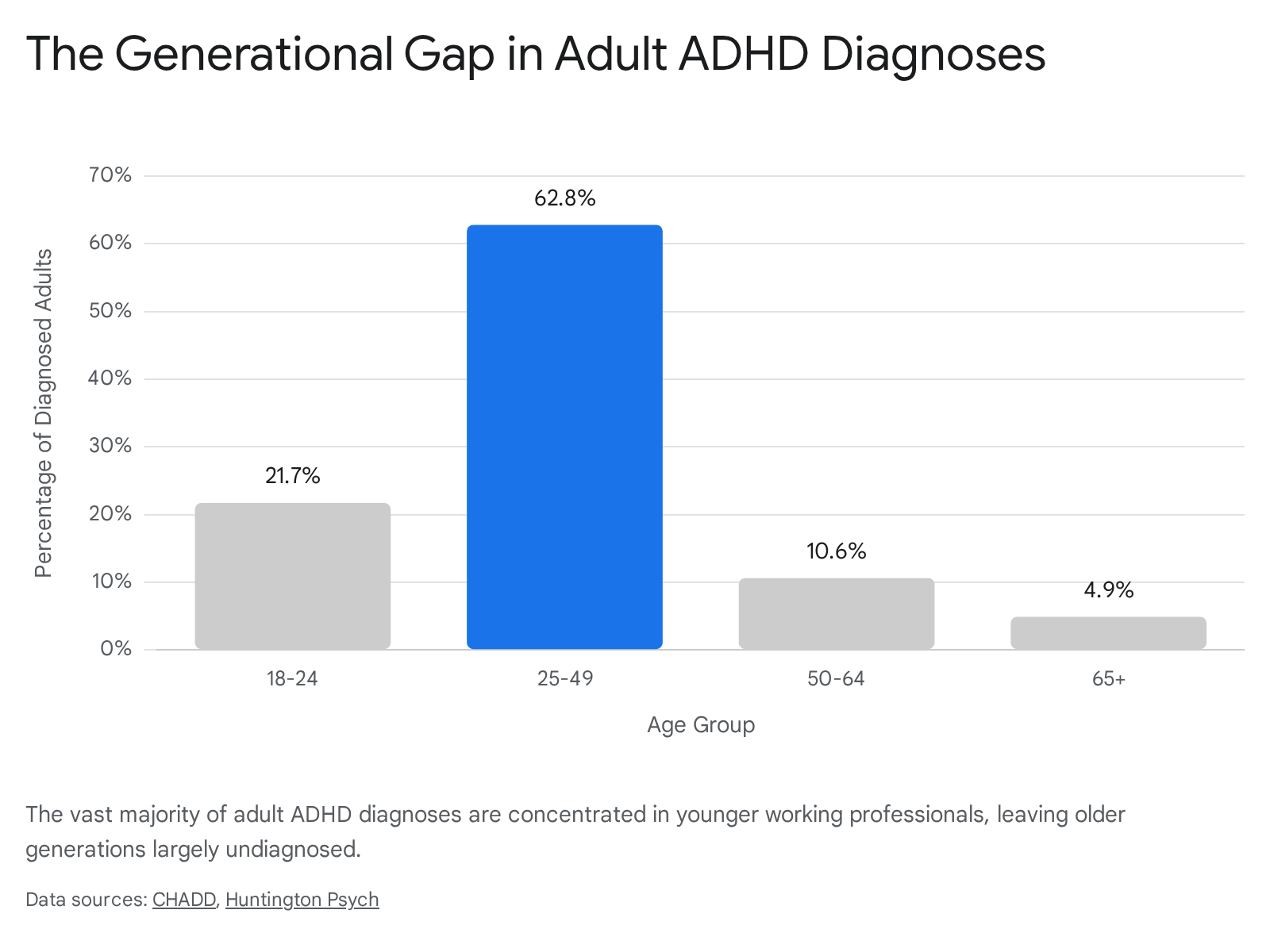
In a vast study of over 20 million older individuals, the actual treatment prevalence for ADHD was an astonishingly low 0.09% 18.
Because older adults grew up in an era where ADHD was effectively non-existent in the public consciousness, they rarely self-advocate for assessment 12. Furthermore, clinicians often mistake inattentive symptoms in older adults for early-onset dementia or age-related cognitive decline 31. Untreated ADHD in older adults is strongly linked to a shorter average life expectancy, higher rates of cardiovascular stress, and increased social isolation 12.
Summary of Diagnostic Disparities
The dual crisis of overdiagnosis and underdiagnosis is highly segmented by demographic lines. The table below summarizes the contrasting realities across different population groups.
| Demographic Group | Current Diagnostic Trend | Core Clinical Issue | Primary Drivers |
|---|---|---|---|
| Affluent Youth | Overdiagnosed | Borderline traits medicalized. | Academic pressure; high access to private testing for 504 plans. |
| Summer-Born Children | Overdiagnosed | Immaturity mistaken for pathology. | School age cutoffs; comparing young children to older peers. |
| Adult Women | Underdiagnosed (Catching up) | Inattentive symptoms historically ignored. | Male-centric clinical history; internalizing of hyperactive behaviors. |
| Ethnic Minorities | Severely Underdiagnosed | Core symptoms viewed as behavioral failures. | Implicit medical bias; systemic inequities; cultural stigma. |
| Adults 65+ | Severely Underdiagnosed | Complete generational blind spot. | Lack of awareness in past decades; symptoms mistaken for cognitive decline. |
The Telehealth and Social Media Accelerants
No analysis of the 2026 ADHD landscape is complete without examining the massive influence of the digital sphere. Social media and telepsychiatry have fundamentally altered how the public recognizes and seeks treatment for neurodevelopmental conditions.
Social Media: Awareness vs. Misinformation
On platforms like TikTok and Instagram, user-generated content regarding ADHD has amassed billions of views 1617. This unprecedented visibility has profoundly destigmatized the condition, helping countless adults recognize their own subtle symptoms, seek clinical assessments, and connect with supportive communities 510.
However, clinical researchers warn that the democratization of medical information has a dark side. A recent university study found that roughly two-thirds of social media content related to ADHD is medically inaccurate or overly generalized 17. The danger of self-diagnosis via social media is that core ADHD symptoms - such as trouble concentrating, executive dysfunction, and chronic fatigue - are highly non-specific. They overlap heavily with a myriad of other conditions, including complex trauma, sleep apnea, anxiety, and depression 817. When individuals anchor their identity to a self-diagnosis of ADHD based on generalized online content, they risk pursuing the wrong treatments, which can exacerbate underlying anxiety or mood disorders 17.
The Telehealth Boom
Simultaneously, the healthcare industry experienced a rapid shift toward telepsychiatry during the COVID-19 pandemic. To maintain access to care, regulatory bodies like the DEA temporarily suspended requirements for in-person evaluations for controlled substances 32.
By 2024, nearly half (46%) of all U.S. adults with ADHD had utilized telehealth services for their condition, and approximately 8.9% received their diagnosis exclusively via telehealth 1320. Telehealth has served as an incredible equalizer, granting access to essential psychiatric care for rural populations, busy working parents, and individuals whose executive dysfunction makes attending physical appointments nearly impossible 3234.
However, the rapid proliferation of direct-to-consumer telehealth platforms has sparked intense regulatory scrutiny. Critics argue that some digital clinics prioritize rapid symptom checklists over comprehensive psychological evaluations, increasing the risk of overdiagnosis 303234. True clinical best practices require a multi-step evaluation, including a thorough developmental history, ruling out comorbid medical conditions, and utilizing multi-informant rating scales 3521. Ensuring that telehealth providers adhere to these rigorous standards remains a central challenge in 2026.
The Global Perspective: How Do Rates Compare Internationally?
While much of the media focus remains on the United States and the United Kingdom, ADHD is a global phenomenon. However, prevalence and diagnosis rates vary wildly across international borders, reflecting vast differences in healthcare infrastructure, cultural attitudes toward mental health, and diagnostic methodologies 37.
A macro-sociological analysis spanning 135 countries over three decades highlights that the increasing rates of ADHD diagnoses worldwide are linked to the global diffusion of "child-centered cultural perspectives" 22. Regions with highly developed public health sectors and a cultural emphasis on individualized education show the highest rates of identification 3722.
Despite a media narrative suggesting an out-of-control global epidemic, nuanced epidemiological data from the Global Burden of Disease study reveals a different reality. The estimated global incidence (new cases) of ADHD actually declined marginally from 12.61 per 100,000 in 1990 to 11.89 per 100,000 in 2021 39. This indicates that the true biological prevalence of ADHD is relatively stable worldwide; what changes is a specific nation's capacity and willingness to diagnose it 1939.
Regional Disparities in Diagnosis Rates
The table below highlights the vast differences in reported ADHD rates (cases per 100,000 population) across various global regions, underscoring how cultural and infrastructural factors shape diagnosis 3723.
| Country / Region | Reported ADHD Rate (per 100k) | Global Classification | Key Contextual Factors |
|---|---|---|---|
| Haiti / Belize | > 2,600 | High | Highest reported global concentration; heavily influenced by regional screening initiatives. |
| United States | ~ 2,200 (2.2% baseline pop.) | High | Widespread awareness, intensive academic environments, and broad DSM-5 adoption. |
| United Kingdom | ~ 1,400 (1.4% baseline pop.) | Moderate | Historically reliant on strict ICD-10 criteria; currently experiencing massive surge in NHS referrals. |
| Germany / France | ~ 250 to 350 | Low to Moderate | Divergent cultural views on medicalization; greater reliance on psychoanalytic or non-pharmacological approaches. |
| Poland / Iraq | < 500 (up to 0.5%) | Low | High cultural stigma; lack of specialized diagnostic infrastructure. |
The Downstream Consequences of the Diagnostic Surge
The massive influx of adult diagnoses over the past five years has severely strained the global healthcare system, leading to profound downstream consequences for patients and providers alike.
The Medication Access Crisis
The most immediate and tangible consequence of the adult diagnosis surge is the ongoing breakdown of the medication supply chain. Stimulant medications (such as methylphenidate and amphetamine salts) remain the first-line, most effective pharmacological treatment for ADHD 38. However, because these are Schedule II controlled substances, their production is strictly capped by federal manufacturing quotas in the United States.
These quotas were completely unprepared for the exponential rise in adult prescriptions. As a result, the healthcare system has faced rolling, multi-year medication shortages. In recent CDC surveys, a staggering 71.5% of adults prescribed stimulant medication reported difficulty filling their prescriptions due to national shortages 138.
This lack of reliable access forces patients into a state of involuntary withdrawal, severely impacting their employment stability and mental health. To circumvent the shortages, clinicians have increasingly turned to non-stimulant alternatives. Prescriptions for atomoxetine (Strattera), for instance, rose by approximately 18% following 2023 8. Non-stimulants offer 24-hour symptom coverage and lack DEA scheduling barriers, but they take longer to reach therapeutic efficacy and cost remains a prohibitive factor for many 8.
The Massive Treatment Gap
While much of the public discourse focuses on the over-prescription of stimulants, the empirical data highlights a massive, corresponding treatment gap. Despite the record number of individuals receiving diagnoses, 36.5% of U.S. adults with ADHD received absolutely no treatment - neither medication nor psychological counseling - in the past 12 months 18.
Untreated ADHD does not exist in a vacuum; it carries immense economic and social costs. It is closely linked to lower educational attainment, higher job turnover, and significant family financial strain 712. Adults with untreated ADHD experience motor vehicle accidents at two to four times the rate of neurotypical peers and face a tripled risk of suicide 141.
Furthermore, untreated ADHD wreaks havoc on chronic physical health. Over 40% of health center visits by adults with ADHD include co-diagnoses for chronic physical conditions heavily linked to poor impulse control and executive dysfunction, including obesity (24.2%) and hypertension (12.8%) 12. Furthermore, nearly 70% of visits feature comorbid psychiatric conditions, particularly severe anxiety and major depressive disorder 2.
The Path Forward: The 2026 APSARD Clinical Guidelines
The chaos of the current diagnostic landscape - marked by overdiagnosis in the affluent, severe underdiagnosis in marginalized groups, and fractured medication supply chains - stems in large part from a lack of standardized clinical training. Historically, U.S. healthcare providers were simply not trained on how to properly evaluate, diagnose, or manage ADHD in the adult population 4142.
To bring order to what has been termed the "Wild West" of adult psychiatry, the American Professional Society for ADHD and Related Disorders (APSARD), in partnership with CHADD and other major psychiatric bodies, undertook a multi-year effort to establish the first-ever U.S. clinical practice guidelines for adult ADHD 314143.
Anticipated for full public release and integration throughout 2025 and 2026, these guidelines represent a monumental shift in ADHD care 24. Developed via a rigorous Delphi process involving leading global researchers, the APSARD guidelines will standardize care across three main domains: 1. Screening and Diagnosis: Establishing firm guardrails for comprehensive evaluations to prevent the hasty overdiagnosis of mild traits, while validating the distinct presentation of ADHD in women and older adults 4345. 2. Medical Treatments: Providing clear frameworks for prescribing, particularly regarding the management of cardiovascular risks in older adults, and addressing the integration of non-stimulants 4345. 3. Psychosocial Interventions: Expanding evidence-based recommendations beyond medication to include cognitive behavioral therapy, workplace accommodations, and digital therapeutics 845.
Furthermore, allied organizations like the American Society of Clinical Psychopharmacology (ASCP) are actively developing consensus recommendations for deprescribing 25. These guidelines will assist clinicians in determining when it is appropriate to taper or stop stimulant medications, particularly for patients whose symptoms have stabilized or who no longer derive meaningful functional benefit, further addressing concerns of lifetime overtreatment 25.
Bottom line
The 2026 clinical landscape proves that framing ADHD strictly as a crisis of "overdiagnosis" is dangerously incomplete. While affluent youth and those born late in the school year are frequently over-medicalized for academic optimization, adult women, racial minorities, and older adults are only just beginning to emerge from a history of profound, systemic underdiagnosis. As telehealth and social media continue to rapidly expand public awareness, the medical community's primary challenge is implementing the new APSARD clinical guidelines to ensure rigorous, equitable diagnosis and to stabilize a fractured treatment pipeline for the millions who genuinely rely on it.