
Is AP, IB, or Dual Enrollment Better for College
There is no single universally superior option; the optimal pathway depends entirely on a student's collegiate targets, academic strengths, and financial objectives. Highly selective private universities universally value the standardized rigor of Advanced Placement (AP) and International Baccalaureate (IB) programs but often strictly limit how these credits transfer. Conversely, public state universities readily accept dual enrollment credits, offering a highly efficient route to secure guaranteed college credit, save thousands of tuition dollars, and accelerate undergraduate degree completion.
The Evolution of High School Academic Acceleration
As the college admissions landscape grows increasingly saturated and competitive, high school students are under immense pressure to demonstrate academic readiness long before setting foot on a university campus. For decades, the standard guidance for ambitious students was simply to take the most difficult classes available. Today, however, families and educational counselors must navigate a highly complex ecosystem of advanced academic pathways, primarily consisting of Advanced Placement (AP), the International Baccalaureate (IB) program, and dual enrollment (frequently referred to as dual credit or concurrent enrollment).
The strategic stakes of these academic decisions have risen significantly over the past half-decade. In the wake of the COVID-19 pandemic, the widespread adoption of "test-optional" admissions policies fundamentally shifted how institutions evaluate applicants. According to the National Association for College Admission Counseling (NACAC) 2023 - 2024 State of College Admission report, standardized test score submission rates have sharply decreased across the nation 12. In the absence of universal SAT or ACT scores, admissions committees now lean far more heavily on the high school transcript as the primary metric of quantitative and qualitative student evaluation 345.
The NACAC data reveals that a student's grades in college preparatory courses and the overall strength of their high school curriculum remain the two most critical factors in admissions decisions across all four-year institutions 12. When testing recedes as a differentiator, the rigor of a student's coursework - and their success within it - becomes the decisive indicator of their intellectual capacity. Consequently, choosing between AP, IB, and dual enrollment is no longer merely a matter of academic preference; it is a profound strategic decision that impacts a student's admissions profile, potential advanced standing, and long-term financial investment in higher education.
Deconstructing the Advanced Pathways
To make an informed, strategic decision, it is essential to deeply understand the pedagogical philosophies, curricular structures, and assessment mechanisms underlying each of these three distinct programs. Each pathway was designed with a different educational objective in mind, and colleges evaluate them through these respective lenses.
Advanced Placement (AP): The Standardized Buffet
Created and managed by the College Board - the same non-profit organization that administers the SAT - the Advanced Placement program is the most widely recognized advanced curriculum in the United States. Over the last two decades, participation in AP courses has surged, with almost 23,000 U.S. high schools currently offering AP coursework, making it highly accessible to the vast majority of domestic students 67.
The AP program operates pedagogically like an academic "buffet." Students are empowered to pick and choose individual courses that align with their specific strengths, relative interests, and future collegiate majors, leaving behind subjects that do not appeal to them 8. For instance, a STEM-oriented student might aggressively pursue AP Calculus BC, AP Chemistry, and AP Physics C, while opting for standard-level or honors history and English classes. The curriculum for each of the 39 available AP courses is rigidly standardized. A teacher instructing AP United States History in a rural public school follows the same overarching syllabus and learning objectives as a teacher in an elite, heavily funded private preparatory academy 910.
The defining characteristic of the AP program is its intense reliance on standardized assessment. AP courses culminate in a single, high-stakes examination administered globally during a designated week each May. These exams are scored on a strict scale of 1 to 5, with a 3 generally considered a "passing" or "qualified" score 911. While a student's grade in the physical AP classroom heavily impacts their high school GPA and demonstrates sustained effort to admissions officers, the actual awarding of college credit is almost entirely dependent on the standardized test score achieved at the end of the year 12.
To counter persistent criticisms that the AP program is merely a collection of disconnected subjects that prioritize rote memorization over holistic thought, the College Board recently introduced the AP Capstone program. This diploma program consists of two sequential courses, AP Seminar and AP Research, which focus entirely on developing long-term research methodologies, presentation skills, and collaborative analysis 11. If a student passes these two specialized exams in addition to passing four other standard AP courses over their high school tenure, they earn the AP Capstone diploma, bringing the program slightly closer to the comprehensive nature of the IB curriculum.
The International Baccalaureate (IB): The Holistic Framework
Originating in Geneva, Switzerland, in 1968, the International Baccalaureate was initially designed to provide a unified, highly rigorous curriculum for the children of diplomats and international workers 13. While the AP program focuses on specialized depth in standalone subjects, the International Baccalaureate Diploma Programme (IBDP) requires a holistic, integrated approach to a student's final two years of secondary education 14. It is significantly less common in the United States than AP, offered in fewer than 2,000 U.S. high schools, though it commands immense global prestige and is highly prevalent in international schools across 160 countries 6.
The IB program functions far more like a "prix fixe" menu. While some secondary schools allow students to take standalone IB courses (thereby earning individual IB certificates), the true hallmark and prestige of the program lie in the pursuit of the full IB Diploma. Diploma candidates must commit to a comprehensive two-year curriculum encompassing six distinct subject groups: Language and Literature, Language Acquisition, Individuals and Societies, Sciences, Mathematics, and the Arts 1415.
Furthermore, the IB Diploma requires three mandatory core components that have no direct structural equivalent in standard AP coursework. The first is Theory of Knowledge (TOK), a philosophical and epistemological course challenging students to reflect on the nature of knowledge itself and how we claim to know what we know. The second is the Extended Essay (EE), an independent, self-directed 4,000-word research paper that mimics the rigor of a collegiate undergraduate thesis 1316. The third is Creativity, Activity, Service (CAS), a mandatory requirement emphasizing extracurricular involvement, physical exertion, and community service, ensuring the student is developing outside the classroom 614.
IB courses are stratified into Standard Level (SL) and Higher Level (HL). To earn the highly coveted diploma, students must take at least three of their six subjects at the intensive HL level 16. The assessment philosophy of the IB program also differs wildly from AP. IB exams place a heavy premium on long-form essay writing, critical synthesis across disciplines, and continuous assessment throughout the academic year. Rather than relying solely on a massive multiple-choice exam, IB grades incorporate "Internal Assessments" (IAs) - projects, oral presentations, and lab work graded by the high school teacher and subsequently moderated by the international IB organization to ensure global parity 13. The final exams are scored on a scale of 1 to 7, with top-tier universities generally looking for scores of 6 or 7 for credit consideration 612.
Dual Enrollment: Authentic Postsecondary Immersion
Dual enrollment (also widely known as dual credit or concurrent enrollment) breaks away from the standardized testing paradigm entirely. This pathway allows high school students to enroll in actual, accredited college courses, simultaneously earning credit toward their high school diploma and a future collegiate degree 12. Unlike AP and IB, which are highly standardized curricula designed specifically for high school students, dual enrollment immerses teenagers directly into authentic postsecondary coursework.
The logistical arrangements for dual enrollment vary immensely depending on state legislation and local school district partnerships. Generally, these arrangements fall into three operational models. The first is on the high school campus, where credentialed college professors or specifically approved high school teachers deliver the college curriculum directly within the high school setting. Data indicates this is the most common model, accounting for roughly 82% of dual enrollment classes 17. The second model requires high school students to physically travel to a local community college or four-year university, attending classes in standard lecture halls alongside traditional undergraduate students 17. The third model utilizes distance learning, where high school students take accredited college courses via asynchronous or synchronous online platforms 17.
The primary allure of dual enrollment is that it is not "exam-centric." Students earn legitimate college credit simply by passing the course, exactly as any traditional, matriculated college student would 1118. There is no singular, high-stakes standardized test at the end of the year dictating whether their nine months of labor will yield college credit. However, this distinct lack of national standardization is a double-edged sword. Because there is no central governing body like the College Board or the IB Organization overseeing the curriculum, the academic rigor of a dual enrollment course at a rural community college might differ vastly from a dual enrollment course at a highly competitive university 8.
Crucially, dual enrollment establishes a permanent collegiate academic record. The grades earned in these courses (whether they are As, Bs, or Cs) will instantly factor into the student's foundational college GPA upon their eventual matriculation at a university that accepts the credits. This early academic record can subsequently impact highly sensitive metrics down the road, including graduate school applications, medical school admissions, and initial post-graduate employment opportunities 12.
Structural Comparison of Academic Programs
To clarify the profound structural, financial, and pedagogical differences between the three programs, the following matrix synthesizes their core characteristics for comparative analysis.
| Feature | Advanced Placement (AP) | International Baccalaureate (IB) | Dual Enrollment (DE) |
|---|---|---|---|
| Curricular Structure | "Buffet" style; students select individual, modular courses tailored to their strengths. | "Prix Fixe" style; an integrated, holistic two-year diploma program requiring cross-disciplinary study. | Individual, authentic college courses taken concurrently with standard high school completion. |
| National Standardization | Extremely high; universally standard curriculum regulated by the College Board. | Extremely high; globally standard curriculum and assessments moderated internationally. | Low to Moderate; rigor and syllabus depend entirely on the specific partner college. |
| Mechanism for Credit | Heavily dependent on a single high-stakes standardized exam (Scored 1-5). | Dependent on standardized exams (Scored 1-7) combined with graded internal assessments. | Dependent entirely on the final course grade; successfully passing the class earns the credit. |
| Primary Admissions Value | Proves baseline academic readiness and standardized quantitative rigor to highly selective colleges. | Proves intense academic stamina, interdisciplinary philosophical thought, and global perspective. | Demonstrates ability to handle real collegiate pacing; highly efficient for state university pathways. |
| Estimated Cost | ~$94 - $99 per exam (public school courses are usually free) 6106. | ~$119 per exam, plus broad program registration fees. Can be very costly 66. | Highly variable: $0 to ~$600+ per course. Often heavily subsidized in-state 10176. |
How College Admissions Officers Evaluate Rigor
One of the most persistent and anxiety-inducing myths in the competitive college admissions landscape is that highly selective universities definitively prefer the IB Diploma over AP classes, or AP classes over dual enrollment. In reality, admissions committees do not evaluate applicants against an abstract, universal standard of what a high school curriculum should be. Instead, they operate heavily upon a singular guiding principle: context.
The "Context of Your High School" Rule
Admissions officers evaluate students almost entirely based on the academic opportunities inherently available to them within their specific geographical and district constraints 15. During the application review process, every high school in the country sends a detailed "school profile" to colleges alongside the student's transcript. This profile explicitly outlines the school's demographic makeup, grading scales, and exactly which AP, IB, and dual enrollment courses are offered.
If an applicant's high school offers an extensive catalog of 20 AP classes and has no IB program, the student is expected to excel in a rigorous, heavily weighted selection of those AP classes. They will not be penalized in any way for lacking an IB Diploma, as it was never an option 1315. Conversely, if a school exclusively utilizes the IB Diploma framework, a student who completes the full diploma with high marks will be viewed with the exact same academic reverence as the AP student 15.
Prestigious institutions are highly transparent about this process. Princeton University's admissions website explicitly states: "Whenever you can, challenge yourself with the most rigorous courses possible, such as honors, Advanced Placement (AP) and dual-enrollment courses. We will evaluate the International Baccalaureate (IB), A-levels or another diploma in the context of the program's curriculum" 13167. Yale University echoes a nearly identical philosophy, noting that incoming applicants are only expected to take advantage of AP or IB courses if their specific secondary school provides them 13. The ultimate goal for the applicant is to seamlessly demonstrate that they pushed themselves to the absolute intellectual limits of their specific educational environment 15.
Test-Optional Dynamics and Transcript Weight
The importance of this coursework has only magnified in recent years. With many elite universities choosing to extend test-optional policies deeply into the mid-2020s - such as the University of Notre Dame, which announced it will remain test-optional for all applicants through the 2026-2027 application cycle - the high school transcript carries unprecedented weight 8.
When students choose not to submit SAT or ACT scores, admissions officers lose their traditional, primary standardized quantitative metric. Consequently, the grades earned in highly rigorous AP, IB, and dual enrollment courses become the dominant, undiluted indicator of collegiate academic readiness 35. Due to widespread high school grade inflation, a pristine 4.0 GPA in standard-level courses is increasingly viewed with skepticism by top-tier institutions. Admissions officers must look closely at the rigor of the classes to determine if the GPA is genuinely reflective of academic exceptionalism. Furthermore, even at test-optional institutions, applicants can choose to submit high AP or IB exam scores as alternative quantitative evidence of their academic strength, serving as a highly effective and powerful substitute for traditional entrance exams 58.
The Standardization Premium at Elite Institutions
While admissions officers generally view AP, IB, and dual enrollment as comparable markers of high academic motivation during the initial application reading phase, highly selective private universities - including the Ivy League and elite technical institutes - often draw a sharp, distinct line between them when it comes to the concept of standardization.
When an admissions officer at an elite university sees a "5" on an AP Chemistry exam or a "7" on an IB Higher Level Chemistry exam, they know exactly what that numerical value represents. Because these specific programs are nationally and internationally normed via external organizations, a top score undeniably signifies the exact same level of scientific mastery whether the student attended an elite, highly funded boarding school in Connecticut, a rural public high school in Alabama, or an international academy in Uruguay 8.
Dual enrollment intrinsically lacks this rigid standardization. A dual enrollment class titled "Introductory Psychology" at a local community college might be highly rigorous and taught by a demanding professor, or it might be significantly less intellectually demanding than a high school AP Psychology course 91822. Because selective colleges cannot realistically verify the syllabus, grading standards, or competitive peer environment of thousands of different local community colleges across the country, they often prioritize AP and IB coursework over dual enrollment when evaluating an applicant's true academic ceiling 823. Educational consultants note that admissions offices at these hyper-selective schools prefer AP and IB because they ultimately want students to engage with advanced materials under a known, verifiable purview 2425.
The Credit Transferability Divide: Public vs. Private
Perhaps the most significant and financially consequential divergence between AP, IB, and dual enrollment occurs in the realm of credit transfer. Being admitted to a university is only the first hurdle; whether that university will actually award college credit for the high school work is an entirely separate bureaucratic battle.
The Ivy League and the "Double-Dipping" Prohibition
Many top-tier private universities enforce incredibly strict credit transfer policies, particularly concerning dual enrollment. A common practice is the prohibition of "double-dipping." If a dual enrollment course was used to satisfy a baseline high school graduation requirement (e.g., taking Dual Enrollment Government to fulfill the high school senior government requirement), the elite university will routinely refuse to grant collegiate credit for it 2627.
The policies of the nation's most prestigious institutions illustrate this strict resistance: * Stanford University: Stanford evaluates incoming transfer credits on a highly restrictive, case-by-case basis. University policy explicitly dictates that "transfer coursework cannot count towards secondary school diploma and/or graduation requirements." Furthermore, Stanford strictly caps external credit, generally refuses to accept any online or correspondence work for credit, and requires a rigorous alignment between the transfer course and Stanford's native curriculum 92910. * Harvard University: Harvard explicitly states in its admissions guidelines that "students cannot receive degree credit for coursework completed before matriculation" under standard transfer rules. Students who have taken substantial dual enrollment courses while in high school are still classified rigidly as first-year applicants, not transfer students, and those credits rarely fulfill Harvard degree requirements 261112. Harvard relies instead on an "Advanced Standing" program that can be triggered by exceptionally high AP or IB scores, rather than community college transcripts 26. * Yale University: Yale allows specific non-traditional students (such as those in the Eli Whitney program) to bring in external credits, but highly strict regulations govern standard first-year admits. Yale generally refuses to transfer credit for online courses or classes taken on a pass/fail basis, requiring a strict letter grade of A or B for any consideration. Most notably, Yale's academic regulations state that course credit cannot be given for any college course taken while the student was still enrolled in secondary school unless done through highly specific, pre-approved native Yale programs 331335.
For highly ambitious students targeting the Ivy League, dual enrollment is certainly beneficial for demonstrating intellectual curiosity and a willingness to step outside the high school bubble, but families should not expect those credits to systematically reduce their future Ivy League tuition bills. For credit-earning potential at elite private schools, achieving 4s and 5s on AP exams, or 6s and 7s on IB Higher Level exams, remains the safest and most reliable strategy 12.
Public Flagships and Articulation Agreements
If elite private schools view dual enrollment credits with intense caution, massive public state universities openly embrace them. For students whose ultimate goal is to attend large, public research universities, dual enrollment is often vastly superior to AP and IB for accumulating guaranteed, bulk college credit 7.
Many states have proactively passed expansive legislation mandating that public universities seamlessly accept dual enrollment credits earned at in-state community colleges, creating a highly efficient educational pipeline. * Texas: The state utilizes the Texas Core Curriculum, a legislative framework that guarantees specific lower-division courses successfully completed at any Texas community college will transfer seamlessly to premier public universities like the University of Texas at Austin. This process actively satisfies core bachelor's degree requirements without friction 36. UT Austin does not limit the number of dual credits a high school student can transfer in, provided the student still completes at least 60 semester hours "in residence" directly on the UT campus to graduate with a UT degree 363738. * Illinois: The state's Dual Credit Quality Act fundamentally requires local community colleges to offer dual credit programs upon official request from local school districts. This law features a strong "Illinois-first" clause, heavily favoring public, in-state pathways over out-of-state alternatives 14. The success of this policy is evident in the data; in fiscal year 2024, the state recorded over 91,000 high school students enrolled in community college dual credit courses 14. * Virginia: The State Council of Higher Education for Virginia strictly enforces a "Principle of Parallel Transferability." This core policy mandates that dual enrollment courses must be treated identically to courses taken natively on a four-year campus for the purposes of degree satisfaction, essentially stripping universities of the ability to arbitrarily reject community college credits 40. * Michigan: The University of Michigan - a highly competitive public flagship - generally allows transferable dual enrollment credits to count toward demanding degree requirements (such as within the College of Literature, Science, and the Arts). However, they enforce quality control measures, stipulating that the course must have been taught by an actual college instructor to college-level peers, and crucially, must not have been used to meet the bare minimum high school graduation prerequisites 414243.
Real-World Outcomes: Graduation Rates and Academic Momentum
The theoretical debates surrounding academic rigor are ultimately settled by real-world collegiate outcomes. Massive longitudinal datasets increasingly demonstrate that early exposure to college-level coursework profoundly alters a student's trajectory.
Insights from the National Student Clearinghouse
The defining advantage of dual enrollment at state schools is the permanent mitigation of test anxiety. With the AP program, a student can maintain an A+ average all year, understand the material flawlessly, have a bad morning on the day of the AP exam in May, score a 2, and walk away with absolutely zero college credit for their year of labor 12. With dual enrollment, consistently passing the class over a semester guarantees the credit (provided the receiving institution accepts it). This structure is highly beneficial for students who suffer from acute test anxiety but possess the executive functioning skills and maturity to manage a continuous, semester-long collegiate syllabus 23.
Data released by the National Student Clearinghouse (NSC) Research Center paints a vivid picture of this program's success. The latest NSC Undergraduate Degree Earners report indicates that 3.4 million learners earned undergraduate credentials in the 2024 - 2025 academic year, an increase driven largely by faster, more flexible pathways like dual enrollment 44.
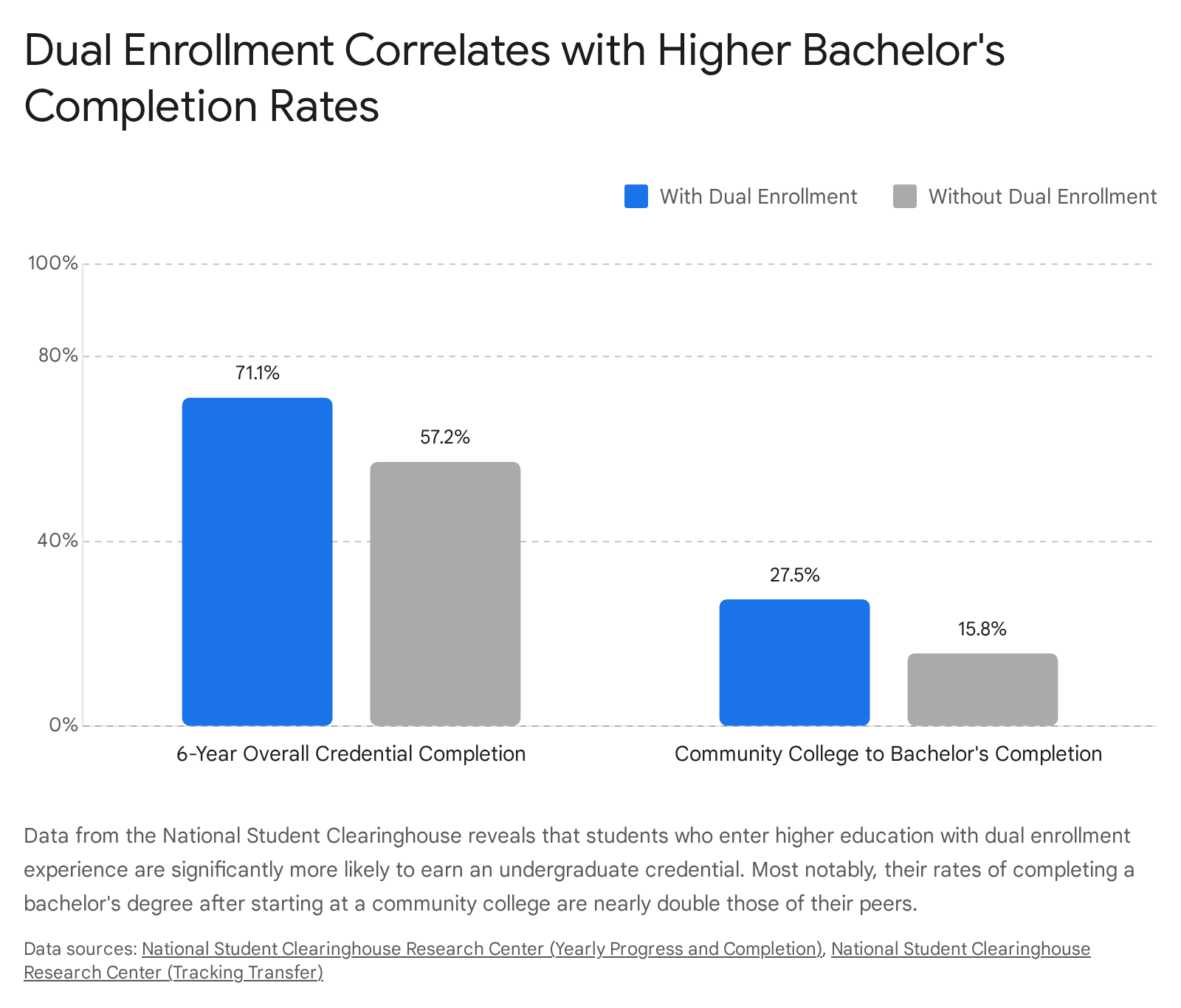
Most compellingly, the NSC's tracking reveals that students who enter higher education with prior dual enrollment experience demonstrate a massive statistical advantage in completing their credentials. According to data released in December 2025 focusing on the Fall 2019 cohort, 71.1% of students with prior dual enrollment earned a credential within six years. In stark contrast, only 57.2% of students without prior dual enrollment achieved the same milestone 1516. Furthermore, dual enrollment actively prevents students from dropping out; by year six, 33.3% (one in three) of students without prior dual enrollment had stopped out of postsecondary education entirely, compared to only 21.0% (one in five) of prior dual enrollees 15.
The advantage remains exceptionally strong for students utilizing the two-year to four-year college transfer pathway - a route that saw a massive comeback with nearly 500,000 transfer enrollees in 2024 44. The NSC's 2026 Tracking Transfer Report found that among students who begin at a community college, those with prior dual enrollment experience have a bachelor's degree completion rate of 27.5%, nearly double the 15.8% completion rate of first-time community college students without that experience 16.
Demographic Disparities in Early College Access
Despite these overwhelmingly positive metrics, access to advanced coursework remains highly uneven. A detailed fact sheet from the Public Policy Institute of California (PPIC) analyzing the class of 2024 highlights deep demographic disparities in dual enrollment participation. While Asian dual enrollment students completed an average of 11 college credits (outpacing other groups), Latino and Black students were significantly underrepresented in specialized College and Career Access Pathways compared to their statewide population shares 47. Furthermore, male students are notably underrepresented in dual enrollment programs, comprising only 43% of dual enrollees despite representing 51% of the broader class of 2024 47. These statistics underscore an ongoing imperative for educational policymakers to expand equitable access to these highly beneficial academic accelerators.
Financial Implications and Return on Investment (ROI)
The financial advantage of aggressively leveraging advanced high school academics cannot be overstated. With the average cost of college tuition skyrocketing over the past two decades - and national student loan debt approaching astronomical figures - knocking out credits early is widely considered one of the most effective, accessible strategies for middle-class families to combat educational debt 48.
The True Cost of a College Credit
To understand the Return on Investment (ROI) of these high school programs, one must first look at the retail cost of higher education. According to the Education Data Initiative, the average cost per credit hour at a public, four-year university for in-state residents hovers around $390 to $406 4849. Because standard undergraduate courses are almost universally worth three credits, a single class costs a student roughly $1,170 to $1,200 in baseline tuition alone, entirely excluding the often-exorbitant costs of mandatory tech fees, student activity fees, and textbooks 174849.
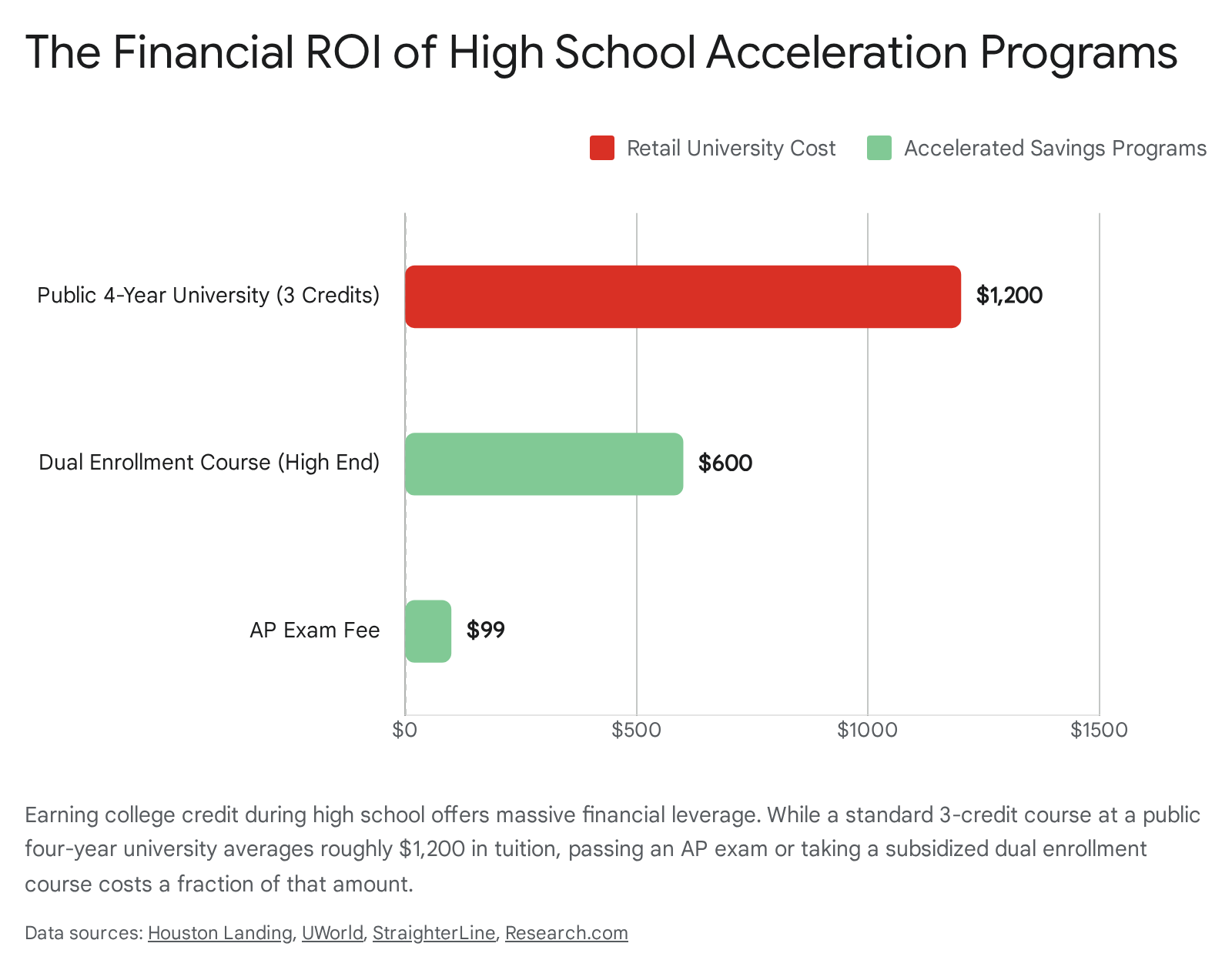
In contrast, high school acceleration programs offer these exact same credits for pennies on the dollar: * AP Exam Costs: Registering for an AP exam costs roughly $94 to $99 10176. If a student scores a 4 or 5 and earns 3 to 6 college credits, they effectively purchased a $1,200 university class for under $100. A highly motivated student who successfully passes six AP exams could realistically save upwards of $7,000 on their future college tuition 48. * Dual Enrollment Costs: The out-of-pocket cost of dual enrollment varies wildly depending on state legislation. In states with aggressive educational outreach like Florida, dual enrollment is completely free for public high school students 6. In Texas, large school districts often fully cover tuition if the student receives administrative approval 10. Even in scenarios where families must pay out of pocket, community college dual enrollment rates are deeply discounted for high schoolers, rarely exceeding a few hundred dollars per full semester course 1750. * IB Costs: The IB program is definitively the most expensive of the three routes. Registration and examination fees can rapidly approach $886 total for the full diploma suite, equating to roughly $119 per individual subject exam 6136. While significantly higher than AP fees, this investment still remains vastly cheaper than paying retail university tuition for the equivalent credits.
Hidden Financial Nuances
Beyond direct tuition savings, performing well in these programs opens secondary financial pathways. High AP or IB scores, combined with strong SAT/ACT results, frequently trigger lucrative, automatic merit-based scholarships at mid-tier private colleges and out-of-state public universities, drastically altering the net price of attendance 4551. However, educational consultants continuously warn that earning college credit is only financially beneficial if the receiving university actually applies those specific credits toward graduation requirements 6. Taking 30 credits of dual enrollment in high school saves no money if an elite private university refuses to accept them upon matriculation.
Strategic Course Selection Based on College Major
When choosing between AP, IB, and dual enrollment, a student's intended collegiate major should heavily influence their overarching strategy. Not all advanced credits are treated equally by highly specialized academic departments.
STEM and Engineering Considerations
For students aiming to gain admission to highly competitive Science, Technology, Engineering, and Mathematics (STEM) programs, AP and IB are frequently the preferred route for core foundational courses. Elite engineering departments want absolute, verifiable certainty that an incoming freshman has mastered foundational calculus and physics to a rigorous national standard.
For example, the highly ranked Grainger College of Engineering at the University of Illinois Urbana-Champaign explicitly advises its high school applicants to take advanced STEM classes like honors, AP Calculus, AP Physics, or IB equivalent courses to be considered competitive 52. While they acknowledge dual enrollment, the rigorous standardization of AP ensures the student is prepared for the extreme, unforgiving pace of collegiate engineering.
However, dual enrollment becomes a massive strategic asset for STEM students who have "maxed out" their high school's math curriculum early. If a gifted student finishes AP Calculus BC by their sophomore year, utilizing dual enrollment to take Multivariable Calculus, Linear Algebra, or Differential Equations at a local community college is viewed incredibly favorably by admissions committees, as it demonstrates relentless academic momentum 2753. Yet, replacing foundational AP Calculus with an unknown, unstandardized community college calculus course is generally viewed as a less competitive choice by elite engineering programs.
The Pre-Med Pathway Challenge
Pre-medical students face a uniquely frustrating challenge when navigating AP and dual enrollment credits. American medical schools typically require applicants to complete core science prerequisites (Biology, Chemistry, Organic Chemistry, Physics) at an accredited four-year university.
If a highly capable high school student uses AP or dual enrollment credit to successfully "test out" of Introductory Biology, medical school admissions committees will still expect that student to take advanced, upper-level biology courses at their four-year undergraduate institution to fulfill the prerequisite requirement 54. Therefore, many pre-med academic advisors strongly recommend a split strategy: use AP or dual enrollment credits to fulfill general education humanities requirements (like history, foreign language, or English), while electing to take the core sciences natively at their four-year undergraduate institution. This ensures a rock-solid scientific foundation, protects the student's college science GPA, and definitively satisfies all medical school admissions criteria without bureaucratic friction 5355.
Humanities, Business, and General Education
For students pursuing the humanities, social sciences, or business - or those simply looking to efficiently knock out mandated general education requirements - dual enrollment truly shines. Taking dual enrollment English Composition, Introduction to Psychology, or U.S. History is an excellent, low-risk way to fulfill basic college prerequisites 2255. This strategy allows students to enter a state university with sophomore standing, immediately freeing up their undergraduate schedule to pursue double majors, engage in extensive study abroad programs, accept fall semester internships, or secure an early graduation to enter the workforce faster 655.
Balancing Rigor with Student Well-being
Amidst the intense strategic calculations of GPA weighting and credit transferability, the psychological and emotional impact of these programs on adolescent development must be carefully considered. High school burnout is a pervasive, systemic issue, and loading a teenager's schedule with maximum academic rigor solely to impress an admissions committee can have severe detrimental effects on their mental health and long-term academic enthusiasm 23.
The AP and IB Pressure Cooker
AP classes are notorious for culminating in a highly stressful, condensed week of exams in May. Students who are incredibly intelligent but are not naturally strong standardized test-takers may endure immense stress for an entire academic year, only to underperform on a single morning, entirely nullifying their chance at college credit 12. The IB Diploma is widely considered the most psychologically demanding of the three options due to its inescapable, comprehensive nature. The concurrent, unyielding demands of the Extended Essay, CAS community service hours, and six rigorous subjects require supreme executive functioning and time-management skills 14. It is generally not recommended for students who struggle with long-form writing, self-directed research, or managing overlapping long-term deadlines.
Executive Functioning in Dual Enrollment
Dual enrollment presents a completely different psychological challenge: it treats high school students entirely like adult college students. Community college professors will not typically hold hands, chase down late assignments, grant unexcused extensions, or communicate with a student's parents regarding their performance 56. However, because dual enrollment grades are earned continuously through a steady rhythm of homework, essays, and midterms - rather than relying on a single, terrifying high-stakes test in May - many students find the day-to-day experience of dual enrollment significantly less stressful and more rewarding than the AP pressure cooker 1118.
Bottom line
Choosing between AP, IB, and dual enrollment requires a pragmatic balancing act between a student's ultimate collegiate ambitions and their practical, day-to-day learning style. For students targeting highly selective, elite private, or Ivy League universities, the universally recognized standardized rigor of AP and the holistic prestige of the IB Diploma remain the absolute safest bets for gaining admission, even if those institutions ultimately refuse to grant transfer credit. Conversely, for students aiming to attend public state universities, dual enrollment is an incredibly efficient, highly cost-effective mechanism to secure guaranteed college credit, bypass foundational courses, and graduate early with minimal debt. Ultimately, there is no inherently "wrong" choice, provided the student is genuinely challenging themselves, diligently protecting their mental well-being, and strategically maximizing the specific academic resources provided by their local high school.