
Impact of Choice Overload on Decision Fatigue and Satisfaction
Introduction to the Paradox of Choice
Historically, neoclassical economic theory operated on the foundational assumption of rational choice, which posits that an increase in available alternatives strictly benefits the consumer. Under this framework, a larger choice set mathematically increases the probability of preference matching, allowing individuals to maximize their utility 12. However, psychological and behavioral economic research over the past few decades has identified a significant boundary condition to this assumption. The phenomenon known as choice overload, or the paradox of choice, suggests that when the complexity of a decision problem exceeds an individual's cognitive resources, the presence of too many options leads to adverse psychological and behavioral consequences 345.
Choice overload typically manifests in reduced motivation to choose, choice deferral, decreased satisfaction with the selected option, and heightened post-decision regret 23. The theoretical underpinning of this phenomenon is often likened to the Aristotelian concept of the mean, which suggests that human virtues and environmental benefits cultivate optimal outcomes at intermediate levels, whereas deficiencies and excesses yield suboptimal results 67. Applied to consumer behavior and human psychology, this dynamic creates an inverted U-shaped relationship between the number of choices and choice satisfaction.
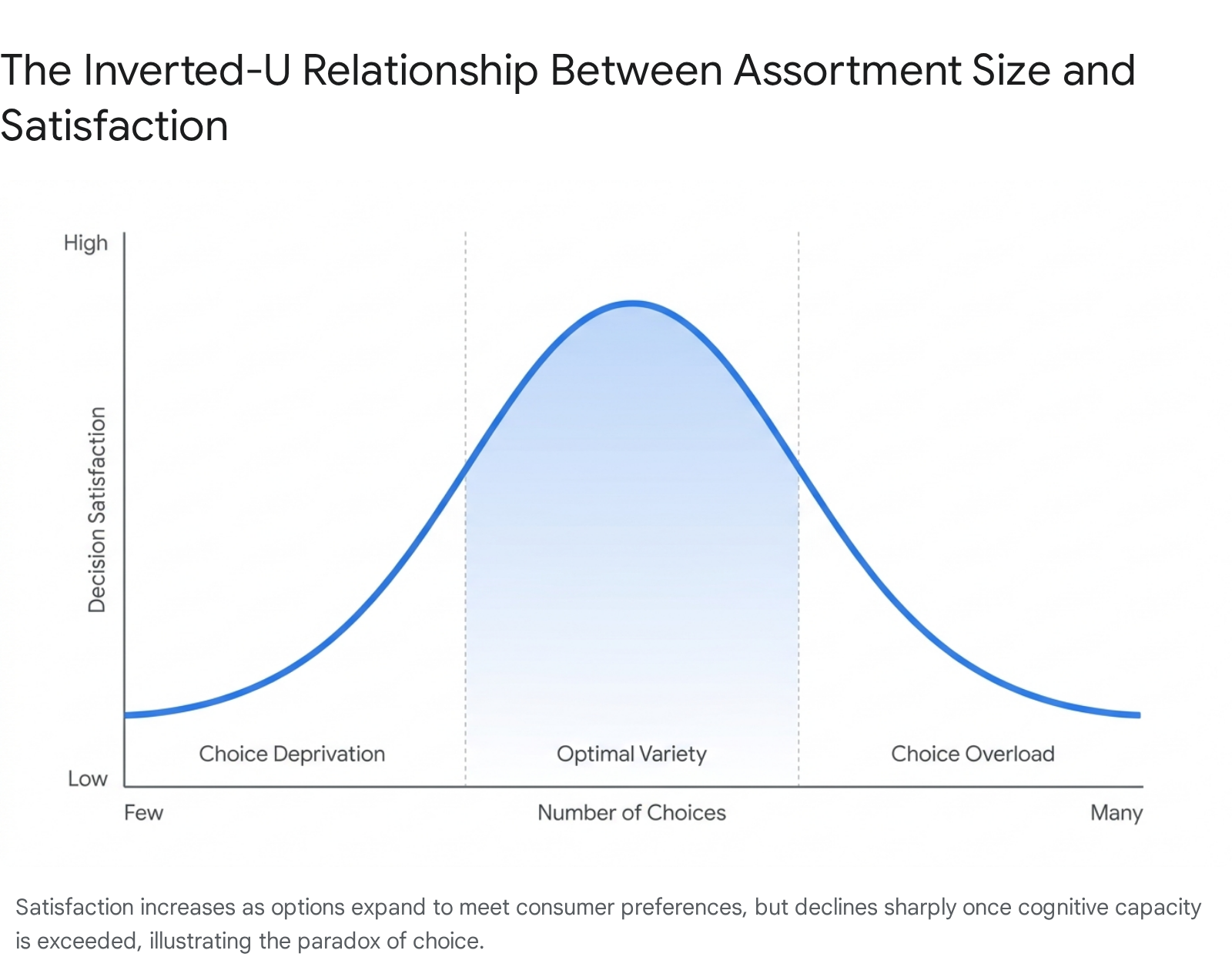
Initial increases in assortment size enhance utility by offering variety and autonomy, but beyond a specific inflection point, the cognitive burden of evaluating these options outpaces the marginal benefits of variety, causing a sharp decline in overall satisfaction 67.
The existence of choice overload is well-documented in specific experimental conditions. The seminal "jam study" conducted by Iyengar and Lepper demonstrated that an extensive display of 24 jams generated significantly fewer purchases than a limited display of 6 jams, marking a resurgence of interest in Lipowski's earlier theories of attractive stimulus overload 2. When consumers face extensive assortments, their expectations regarding the ability to find an ideal preference match inflate. Consequently, choices from larger assortments frequently lead to the disconfirmation of these elevated expectations, resulting in lower satisfaction with the chosen option and an increased propensity for decision regret 13.
The implications of this inverted-U framework extend beyond consumer goods, applying to cognitive and affective well-being. Studies examining subjective well-being (SWB) frequently measure how life satisfaction and momentary happiness interact with cognitive capacity and self-regulation over time. Individuals possessing high degrees of self-control generally report higher cognitive and affective SWB, though researchers continuously examine whether excessive self-regulation creates obsessive-compulsive rigidity that ultimately harms interpersonal relationships and life satisfaction 8. Conversely, researchers studying emotional trajectories during couple conflicts found that rather than an inverted U-shape, emotional arousal follows a U-shape, where couples who subsequently deteriorate in relationship satisfaction are less effective at calming initial emotional arousal, suggesting that the dynamics of human emotional regulation contain complex, non-monotonic variations depending on the domain 912.
Cognitive Mechanisms of Decision Fatigue
The primary driver of choice overload is the exhaustion of executive functioning, commonly referred to as decision fatigue. Decision fatigue describes the deteriorating quality of decisions made by an individual following a prolonged period of sequential decision-making or when confronted with hyper-complex choice sets 101112.
Ego Depletion and Self-Regulation
The mechanics of decision fatigue are rooted in the Strength Model of Self-Control, which is tightly linked to ego depletion theory 111216. This framework posits that human beings possess a limited, finite capacity for active self-regulation, cognitive processing, and emotional control. Similar to a muscle that fatigues after intense physical exertion, the brain's executive resources become depleted after continuous acts of information processing, trade-off evaluation, and choice selection 1011.
When consumers or professionals face a large assortment of options, they initially attempt to deploy compensatory decision-making strategies. This involves a rigorous analytical process wherein the positive and negative attributes of every option are weighed against one another to identify the mathematically optimal choice. However, as the number of options and attributes multiplies, working memory is overwhelmed. To cope with the escalating cognitive load, the fatigued brain defaults to non-compensatory heuristics - mental shortcuts that significantly reduce cognitive effort but often compromise decision quality and accuracy 101112.
Heuristics, Defaults, and Choice Deferral
As decision fatigue sets in, several distinct behavioral shifts manifest. Mentally drained individuals exhibit an impaired ability to make complex trade-offs, leading to impulsivity, an increased reliance on cognitive biases, and a pronounced preference for the path of least resistance 10111314.
One of the most robust manifestations of decision fatigue is the tendency to select the default option. In larger choice problems, the value of ordinary alternatives is subject to the calculus of anticipated regret. Because the evaluation of numerous alternatives subjects the decision-maker to the potential of making a suboptimal choice, larger choice sets magnify the opportunity cost of unchosen alternatives 14. Selecting a default option, or maintaining the status quo, functions as a psychological shield. Behavioral models of asymmetric regret demonstrate that individuals generally assign less personal accountability and regret to default outcomes than to active, affirmative selections, driving fatigued decision-makers toward inaction 14.
When no default option exists, decision fatigue frequently results in complete choice deferral or avoidance. If the cognitive friction of evaluating a complex assortment outweighs the perceived value of the outcome, consumers will abandon the task 310. Furthermore, choice overload contributes to affective ambivalence, where conflicting emotions regarding the options make decision-making inherently stressful 15. This avoidance is not merely a benign delay; in commercial contexts, it translates to abandoned shopping carts and lost revenue, while in high-stakes environments, it can lead to dangerous procrastination in healthcare interventions or financial planning 310.
Meta-Analytic Evaluations of Choice Overload
Despite the intuitive appeal of the choice overload hypothesis and the established neuroscience of ego depletion, empirical research across different domains has historically produced highly inconsistent results. Some studies demonstrate severe negative consequences from large assortments, while others find no effect, or even report that having more choices facilitates decision-making and increases satisfaction 2616.
To reconcile these contradictions, researchers have conducted extensive meta-analyses, most notably the analyses by Scheibehenne, Greifeneder, and Todd (2010), and subsequently by Chernev, Böckenholt, and Goodman (2015).
Reconciling Divergent Empirical Data
The comprehensive meta-analysis by Scheibehenne et al. examined 63 conditions from 50 published and unpublished experiments comprising over 5,036 participants. Their primary conclusion was that the overall mean effect size of choice overload was virtually zero, albeit with considerable variance between studies 216. While they acknowledged that specific preconditions could occasionally trigger choice overload, they argued against the existence of universally sufficient conditions that reliably predict adverse consequences from an increase in assortment size 216.
The findings by Scheibehenne et al. highlighted that decision-makers who possess strong prior preferences or deep expertise in a choice domain actually benefit from having more options, showing increased satisfaction and choice probability. They also identified a "Prometheus effect," noting a publication bias where early, counterintuitive findings demonstrating choice overload were widely published, whereas subsequent experiments showing no negative consequences were frequently relegated to the file drawer 2.
In contrast, the subsequent meta-analysis by Chernev et al. (2015) re-evaluated the literature by shifting the analytical focus away from the mere absolute number of options and toward the structural and contextual moderators that govern the decision environment. By analyzing 99 observations encompassing 7,202 participants, Chernev et al. demonstrated that when specific moderating variables are accounted for, the overall effect of assortment size on choice overload becomes highly significant, refuting the prior claim that the phenomenon is unreliable 14.
The Four Key Moderators of Choice Overload
The current academic consensus in consumer psychology suggests that choice overload does not occur in a vacuum based solely on item count. Instead, it emerges when specific boundary conditions are breached. Chernev et al. identified four critical conceptual factors that dictate whether a large assortment will overwhelm a consumer 4:
- Decision Task Difficulty: This factor relates to the structural characteristics of the choice process itself. Overload is heavily amplified when consumers face severe time pressure, when they are required to explicitly justify their choices to others (decision accountability), or when the options vary along numerous, complex attributes 4. The presentation format also dictates task difficulty; randomly arranged assortments induce much higher cognitive load than categorically organized displays 45.
- Choice Set Complexity: This factor reflects the value-based relationships among the alternatives within the set. Choice overload is highly probable when a choice set lacks a dominant option (i.e., no single option is clearly superior to the rest). Complexity also rises when attributes are non-alignable, meaning consumers must compare options based on entirely different, unique features rather than evaluating varying levels of the same feature 4.
- Preference Uncertainty: Consumers with low product-specific expertise or those who lack a pre-articulated ideal point are highly susceptible to overload. Without a pre-existing mental framework of what constitutes a optimal choice, novice consumers are forced to construct their preferences on the fly while simultaneously evaluating a massive array of options, leading to rapid and severe cognitive exhaustion 4.
- Decision Goal: The underlying psychological intent behind the choice moderates the onset of fatigue. If a consumer's goal is strictly utilitarian, aiming to minimize cognitive effort (e.g., casual browsing or routine purchasing), large assortments feel burdensome. Conversely, if the goal is hedonic exploration, or if the consumer possesses a high need for cognition and variety-seeking intent, large assortments are more likely to be perceived as beneficial and engaging 45.
Summary of Choice Overload Moderators
| Moderator Category | High Risk of Choice Overload | Low Risk of Choice Overload |
|---|---|---|
| Decision Task Difficulty | Severe time constraints; disorganized or random presentation; high decision accountability to third parties. | Ample time for evaluation; categorically structured and filtered layouts; low accountability. |
| Choice Set Complexity | Non-alignable attributes; absence of a clear dominant option; high structural similarity among options. | Alignable attributes; presence of a distinct, superior dominant option. |
| Preference Uncertainty | Novice consumer status; poorly defined ideal point; low category knowledge and experience. | Expert consumer status; strongly defined preferences and a pre-established ideal point. |
| Decision Goal | Utilitarian task; effort-minimization goal; concrete and immediate construal level. | Hedonic exploration; variety-seeking goal; abstract or distant construal level. |
Decision Fatigue in High-Stakes Environments
While choice overload is most frequently studied in the context of retail consumer goods and e-commerce assortments, its most profound and consequential implications occur in high-stakes professional environments. In medicine, finance, emergency response, and the judicial system, professionals are required to make sequential, highly critical decisions. The cognitive mechanisms of decision fatigue observed in consumer studies scale directly up to these environments, often resulting in systemic errors, altered risk preferences, and degraded professional judgment 10121718.
Medical and Clinical Judgment
In the healthcare sector, clinical practitioners average dozens of high-stakes decisions per patient encounter, with internal medicine clinicians making an estimated 15.7 complex decisions per patient 19. The continuous emotional regulation required to navigate complex diagnoses, manage frequent interruptions, and deliver difficult news rapidly depletes a clinician's executive functioning.
Empirical research illustrates that as medical professionals progress through long, demanding shifts, their decision-making patterns alter predictably as ego depletion sets in. A prominent study on surgical decision-making revealed that patients evaluated toward the end of a surgeon's shift were 33 percent less likely to be scheduled for an operation compared to those seen earlier in the same day 10. Operating represents an active, resource-intensive commitment with inherent clinical risks, whereas delaying surgery or maintaining the clinical status quo functions as a heuristic shortcut that requires significantly less immediate cognitive justification and mental effort 10.
Similar degradation of judgment has been observed in prescribing behavior. Physicians suffering from decision fatigue are substantially more likely to inappropriately prescribe antibiotics for viral infections later in the day, succumbing to patient pressure and the path of least resistance rather than adhering to rigorous, evidence-based diagnostic protocols 18. Over prolonged periods, unmitigated decision fatigue contributes heavily to clinical burnout, which currently affects between 25 and 78 percent of physicians. As cognitive depletion becomes chronic, healthcare workers may develop emotional detachment, viewing patients as mere clinical cases rather than individuals. This emotional detachment serves as an automatic defense mechanism adopted to shield a completely exhausted cognitive reserve, ultimately reducing the overall quality of care 1019.
Financial Decision-Making and Economic Stress
In the financial sector, experts such as credit officers, FP&A managers, and financial controllers face intensely data-rich decision environments. The requirement to synthesize volatile market conditions, process dense information, and execute continuous forecasting creates immense cognitive load 2420.
A massive field study analyzing 26,501 loan restructuring decisions at a major commercial bank demonstrated a distinct and measurable decision fatigue curve across the workday. Early in the morning, credit officers actively engaged with applications and exhibited higher restructuring approval rates. However, between the hours of 11:00 and 14:00, approval rates plummeted significantly, marked by negative logistic regression coefficients bottoming out at -0.178 between 13:00 and 13:59 18.
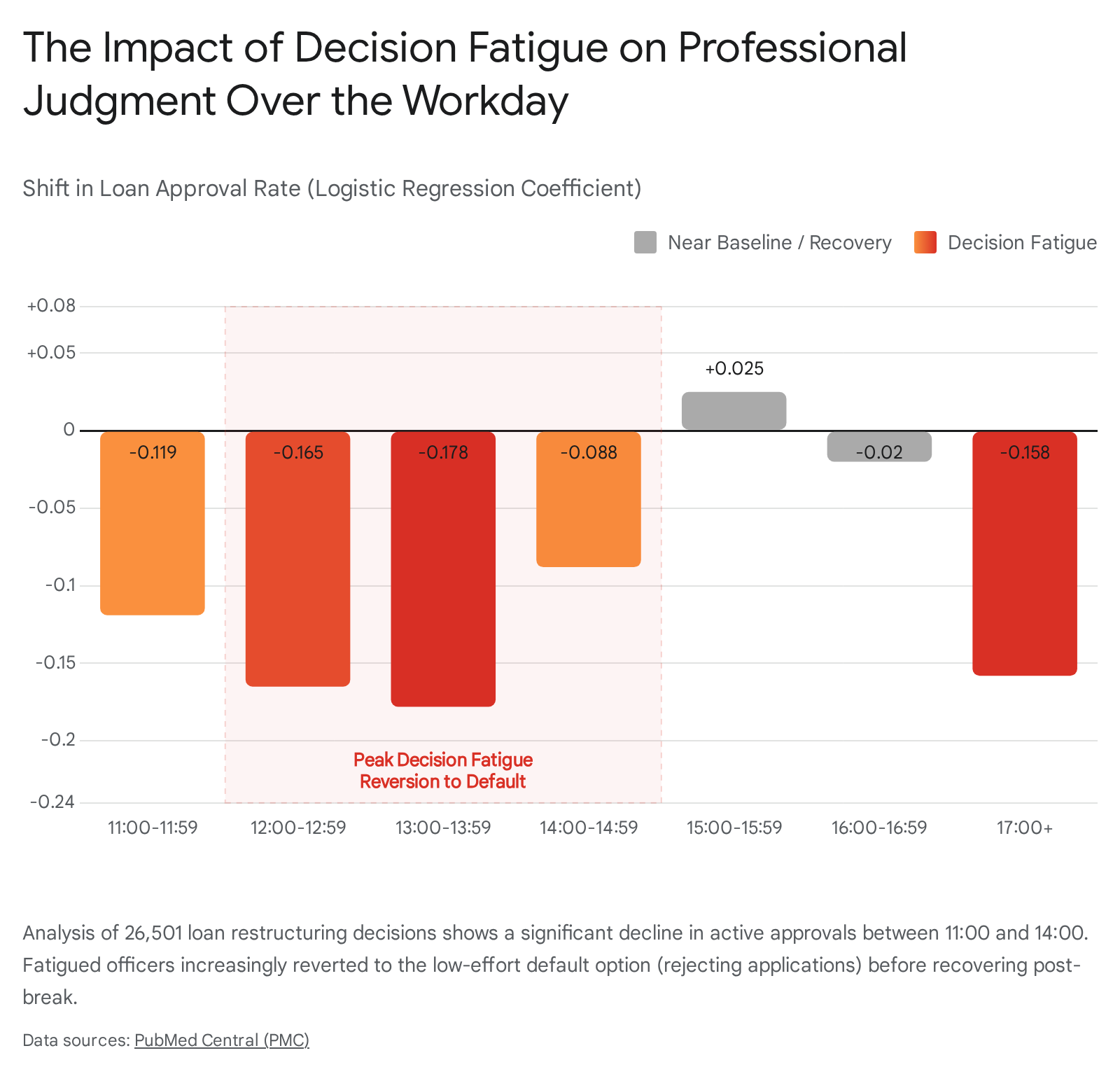
Fatigued officers increasingly reverted to the default decision - rejecting the loan application outright - which required substantially less complex risk calculation and mental effort. Tracking the outcomes revealed that this fatigue-driven behavior carried a tangible economic cost to the bank, as default rejections resulted in subsequent repayment rates of only 38.71 percent, compared to 52.62 percent for actively approved restructuring requests 18.
Furthermore, decision fatigue disproportionately affects marginalized and low-income populations due to the cognitive bandwidth tax imposed by economic scarcity. Behavioral economists have established that poverty acts as a persistent cognitive load. Living paycheck-to-paycheck requires continuous, high-stress financial trade-offs, which rapidly deplete an individual's self-regulatory resources 2122.
A study assessing low-income individuals immediately before and after receiving their paychecks found significant disparities in cognitive function and economic patience. Respondents surveyed immediately before payday - when cash reserves were depleted and financial stress was acute - demonstrated elevated levels of decision fatigue, leading them to exhibit short-term impulsivity and present bias 21. They were significantly more likely to choose smaller, immediate financial payouts over larger, delayed ones. This dynamic highlights that choice overload and decision fatigue are not just retail inconveniences; they are structural barriers that impair financial resilience by degrading the cognitive capacity required to make optimal long-term economic decisions 2122. Financial stress in the workplace is also intrinsically linked to declining physical and mental health, further perpetuating the cycle of fatigue 23.
E-Commerce and Digital Choice Architectures
In the commercial sphere, the digital architecture of e-commerce has effectively eliminated the physical space constraints of brick-and-mortar retail, allowing businesses to present consumers with an essentially infinite assortment of products. While this maximizes the theoretical availability of niche goods, it also establishes a digital environment highly conducive to catastrophic choice overload. E-commerce conversion rate optimization (CRO) relies heavily on identifying points of friction and mitigating consumer decision fatigue.
Baseline Conversion Rates and Industry Variances
The global average e-commerce conversion rate hovers precariously between 2.5 percent and 3.0 percent, indicating that up to 97.5 percent of all digital shopping sessions end in choice deferral or abandonment 292425. This baseline varies dramatically by industry and user intent. The food and beverage sector sees much higher conversion rates, averaging between 4.5 and 6.11 percent 2425. This is primarily because grocery decisions carry lower preference uncertainty and rely heavily on repetitive, habitual purchasing, thus bypassing the cognitive load of evaluating novel choices. Conversely, high-consideration sectors like luxury goods and jewelry suffer from extreme preference uncertainty and high financial stakes, pushing conversion averages down to a mere 0.8 to 1.2 percent 2425.
Extensive A/B testing reveals that simplifying the choice architecture is one of the most reliable methods for driving revenue. When retailers present users with uncurated, massive grids of options lacking adequate filtering tools, shoppers experience choice paralysis and exit the funnel 3. However, structured testing programs that optimize the Product Detail Page (PDP) and streamline the checkout flow by reducing form fields consistently yield 12 to 28 percent improvements in conversion 3233.
Structural Differences Between Mobile and Desktop Interfaces
The physical constraints of digital devices further moderate choice overload. Mobile visitors generally convert at half the rate of desktop users (approximately 1.5 to 2.0 percent for mobile versus 3.0 to 5.0 percent for desktop), despite mobile traffic commanding roughly 65 percent of overall web volume 292526.
This stark discrepancy is largely attributable to the increased interaction costs and decision task difficulty inherent in smaller screens. Evaluating complex choices, comparing non-alignable attributes across multiple tabs, and filling out compressed form fields generate significantly higher cognitive load on a smartphone than on a desktop monitor. Furthermore, page load speeds are critical in maintaining the user's cognitive flow; B2B websites loading in one second experience conversion rates five times higher than those loading in ten seconds 26. E-commerce platforms that fail to adapt their choice architecture for mobile - by failing to reduce the number of visible options, omitting sticky calls-to-action, or lacking one-click checkout functionalities - exacerbate preference uncertainty and trigger rapid choice deferral 3235.
E-Commerce Conversion Rate Benchmarks
| Metric / Industry Segment | Average Conversion Rate | Implications for Choice Architecture and Cognitive Load |
|---|---|---|
| Global Overall Average | 2.5% - 3.0% | The vast majority of traffic succumbs to choice deferral; the baseline requires rigorous A/B testing and CRO. 2425 |
| Food & Beverage | 4.5% - 6.11% | Lower task difficulty and established preferences mitigate overload, yielding the highest industry conversions. 2425 |
| Luxury & Jewelry | 0.8% - 1.2% | High financial stakes and preference uncertainty demand extreme curation and robust trust signals. 2425 |
| Desktop Traffic | 3.5% - 5.0% | Larger visual canvas allows for easier attribute alignment, comparison, and reduced working memory strain. 292526 |
| Mobile Traffic | 1.5% - 2.0% | High cognitive load due to limited screen real estate necessitates severely simplified choice paths and sticky CTAs. 2926 |
Algorithmic Curation and the Digital Choice Environment
To combat the massive choice sets characteristic of digital media and e-commerce, platforms have increasingly turned to artificial intelligence and algorithmic recommender systems. By predicting user preferences and curating personalized feeds, algorithms promise to act as cognitive prosthetics, offloading the burden of choice and protecting the user from decision fatigue 162728. However, empirical and psychological analyses suggest that this relationship is paradoxical, often trading immediate cognitive relief for long-term psychological deskilling and behavioral consequences.
Content Overload and Over-The-Top (OTT) Media
Nowhere is the paradox of digital choice more evident than in the Over-The-Top (OTT) media streaming industry. Despite the deployment of sophisticated recommendation engines designed to filter massive content libraries, users frequently experience intense choice overload. This phenomenon, colloquially termed "Netflix Syndrome," refers to viewers spending excessive amounts of time scrolling through options, evaluating metadata, and ultimately deferring the choice without watching anything 1529.
This deferral process is psychologically taxing. The abundance of options shifts the consumer's cognitive state from active enjoyment to affective ambivalence, where the fear of missing out on a better piece of content paralyzes the decision-maker 15. Consequently, users report feelings of stress, frustration, and digital fatigue. When users do make a choice under this cognitive load, they frequently exhibit avoidance behaviors - such as re-watching highly familiar shows rather than engaging with novel content - to bypass the anxiety associated with evaluating new options 1530. Furthermore, reliance on these algorithms risks confining users within filter bubbles and echo chambers, fundamentally altering how individuals engage with diverse ideas 31.
Algorithmic Trust Fatigue and Deskilling
The integration of AI curation into daily workflows creates a dual psychological effect. While AI facilitates cognitive offloading by minimizing extraneous cognitive load and reducing the immediate friction of decision-making, it simultaneously introduces new psychological hazards 27.
Over-reliance on algorithms to dictate preferences leads to "algorithmic trust fatigue" and a progressive erosion of user agency 324233. When digital environments are hyper-optimized to remove all decision friction, users undergo a subtle process of cognitive deskilling. In high-stakes environments, such as corporate management or clinical settings, excessive reliance on AI recommendations diminishes the human decision-maker's critical scrutiny and independent judgment 2842. The human shifts from an active, analytical decision-maker to a passive validator of machine outputs. Prolonged exposure to predictive curation can result in a state of learned helplessness, where the innate capacity to explore, tolerate ambiguity, and make independent aesthetic or professional choices is severely weakened 1628.
Accuracy Perception and Assortment Expansion Tolerance
Interestingly, the perceived source and accuracy of the curation significantly alter the psychological threshold for choice overload. A study exploring consumer reactions to recommendations generated by Large Language Models (LLMs) such as ChatGPT yielded counter-intuitive results regarding assortment size. While traditional retail environments see choice overload manifest rapidly - often beyond 24 to 30 options - researchers found that consumers preferred much larger choice sets, ranging from 60 to 70 options, when they were explicitly curated by ChatGPT 34.
Because users perceived the AI to possess high accuracy, objectivity, and deep personalization capabilities, their inherent preference uncertainty decreased. The algorithmic authority acted as a psychological buffer against choice overload; participants reported higher satisfaction and increased intent to purchase from these massive, AI-generated assortments because the perceived cognitive cost of verifying the AI's "accurate" selections was lower than the cost of manually filtering a human-curated list 34.
Cross-Cultural Variances in Choice Satisfaction
A critical limitation in early choice overload research was its overwhelming reliance on Western, Educated, Industrialized, Rich, and Democratic (WEIRD) populations. Modern cross-cultural psychology has demonstrated that the paradox of choice is not a universal human trait, but rather a phenomenon heavily moderated by cultural values, specifically along the spectrum of Individualism versus Collectivism 353647.
Individualistic Cultures and Analytic Processing
In highly individualistic cultures - such as the United States, Australia, and the United Kingdom - choice is deeply intertwined with personal identity, autonomy, and self-expression 364748. Western consumers construct their self-image independently of the collective group. Consequently, each choice, whether regarding a career path or a retail product, is viewed as an opportunity to assert individuality. This high psychological stake amplifies the pressure to make the "perfect" choice, making individualistic consumers far more vulnerable to choice overload, post-decision regret, and maximization behaviors 4849.
Cognitively, Western consumers are predominantly analytic thinkers. Analytic processing focuses heavily on the specific, isolated attributes of individual objects, categorizing and dissecting features independently of their context. When faced with an expansive assortment, analytic processors attempt to evaluate every attribute of every single option, which rapidly drains executive functioning and accelerates decision fatigue 4850. Furthermore, research into emotion norms reveals that individuals in individualistic cultures experience greater pressure to conform to socially desirable emotional states, exacerbating the stress of choice dissatisfaction 37.
Collectivistic Cultures and Holistic Processing
Conversely, in collectivistic cultures - prominent in East Asian, Middle Eastern, and Latin American societies - the self is construed interdependently 3647. Decision-making is often guided by social harmony, familial expectations, and relational duties rather than pure autonomous self-expression 3652. Because choices carry less individualistic identity weight, the internal pressure to optimize personal utility is reduced.
Individuals from collectivistic backgrounds tend to employ holistic processing, which focuses on relationships, contexts, and the "big picture" rather than isolated attributes 4853. This holistic cognitive approach allows Eastern consumers to navigate highly complex, large assortments more efficiently. Studies comparing decision-making styles show that Eastern consumers are adept at making inter-comparisons across an entire choice set simultaneously, experiencing less confusion and cognitive overload than Western consumers who attempt to evaluate options individually 5038.
Choice Deprivation as a Global Phenomenon
The cultural bias inherent in the choice overload literature has historically obscured a more pressing global reality: choice deprivation. A large-scale cross-cultural study involving over 7,436 participants across six nations (Brazil, China, India, Japan, Russia, and the United States) examined consumer satisfaction regarding the number of available options in daily life.
The findings revealed that the United States was the only nation where choice overload was a commonly reported environmental stressor 49. Across most domains in the other five nations, choice deprivation - having fewer options than desired - was the prevailing norm. More importantly, choice deprivation was far more strongly correlated with decreased subjective well-being and choice dissatisfaction than choice overload was in the U.S. 49. This suggests that while providing too many options can cause decision fatigue in WEIRD populations, failing to provide adequate choice architecture poses a significantly broader threat to global consumer satisfaction.
Summary of Cross-Cultural Decision Making
| Cultural Dimension | Primary Cognitive Style | View of Choice | Susceptibility to Choice Overload |
|---|---|---|---|
| Individualistic (e.g., U.S., Australia) | Analytic: Focuses on isolated attributes and object details. 4850 | An act of self-expression and personal identity assertion. 364748 | High: Pressure to maximize utility leads to rapid fatigue and regret. 4849 |
| Collectivistic (e.g., China, Japan) | Holistic: Focuses on context, relationships, and inter-comparisons. 4850 | An act influenced by social harmony and relational duty. 364752 | Low: Better equipped to process large assortments via holistic evaluation. 4950 |
Conclusion
The paradox of choice and the ensuing phenomenon of decision fatigue represent a complex intersection of cognitive limitations, environmental architecture, and cultural conditioning. While early behavioral economic literature suggested a simple, universal penalty for expansive assortments, contemporary meta-analytic and psychological evidence dictates a highly nuanced reality. Choice overload is a real, measurable, and consequential phenomenon, but it is deeply conditional.
When decision tasks are structurally complex, options lack dominant traits, and consumers face preference uncertainty or time pressure, expanding an assortment triggers rapid ego depletion. This decision fatigue results in detrimental heuristics, choice deferral, and a systemic reversion to default options. The consequences of this fatigue extend far beyond the retail sector, causing critical degradation of professional judgment in high-stakes medical and financial environments, and driving massive revenue attrition in digital e-commerce marketplaces.
However, the negative impacts of large assortments can be effectively mitigated. Curating options through clear categorization, leveraging trusted algorithmic recommender systems, and aligning choice architecture with the specific goals and constraints of the user can shift the paradigm from cognitive overload back to optimal satisfaction. Furthermore, global market strategies must account for profound cultural cognitive differences, recognizing that the holistic processing prevalent in collectivistic societies allows for a higher tolerance of variety, and that choice deprivation remains a far greater threat to consumer well-being outside the Western sphere. Ultimately, maximizing consumer utility and professional performance relies not on blindly increasing or decreasing the absolute number of options, but on optimizing the clarity, relevance, and cultural resonance of the decision environment.