
Impact of Anthropomorphism and Brand Mascots on Consumer Behavior
Introduction to Brand Anthropomorphism
The integration of anthropomorphism into commercial strategies represents a profound shift in how consumers interact with non-human entities. At its core, anthropomorphism is the psychological process of assigning real or imagined human characteristics, intentions, motivations, or emotions to inanimate objects, animals, or abstract concepts 1. Within the modern business environment, this phenomenon facilitates a critical transition: it moves consumer perception away from a strictly functional evaluation of products and services toward a highly emotional and relational paradigm 2.
Historically, humans have imbued elements of the natural world with human traits to make the unknown comprehensible. Marketers have capitalized on this innate cognitive tendency by deploying brand mascots, virtual influencers, and humanized product designs to foster deep emotional connections 13. Whether deployed as costumed characters in sporting arenas, animated spokes-creatures on packaging, or sophisticated artificial intelligence chatbots in digital commerce, anthropomorphized entities serve as the primary emotional conduits between a corporate entity and its target audience 345.
The strategic utility of brand anthropomorphism is not uniform; its efficacy depends heavily on the specific application, the cultural context of the target demographic, and the baseline physical similarities between the mascot and human beings 12. The practice is no longer relegated strictly to consumer packaged goods or children's entertainment. It has evolved into a multi-billion-dollar apparatus spanning highly technical business-to-business markets, complex financial services, and sovereign regional branding initiatives 576. However, the deployment of humanized assets carries inherent psychological and cultural risks. Over-anthropomorphizing can trigger profound consumer discomfort through the "uncanny valley" effect, while cultural mistranslations and algorithmic unpredictability can rapidly erode brand equity and consumer trust 7811.
Psychological Mechanisms of Anthropomorphism
Cognitive and Neurological Processing
The efficacy of brand mascots is rooted in fundamental neurology and cognitive processing speed. When consumers encounter an anthropomorphized object or character, the brain activates the same social engagement centers utilized during human-to-human interaction 12. This cognitive mapping reduces the psychological distance between the consumer and the brand, fostering an environment where trust can develop more rapidly than it would through interaction with abstract corporate logos or static text 12. Neurological studies confirm that the human brain processes images roughly 60,000 times faster than text, and when those images contain faces or face-like structures, the cognitive absorption effect multiplies significantly 12.
Furthermore, engaging with highly humanized or "cute" characters triggers the release of oxytocin and dopamine, which are the neurochemicals associated with nurturing, trust, and pleasure 9. This physiological response is particularly pronounced when mascots exhibit the "baby schema" (Kindchenschema), a concept originally theorized by ethologist Konrad Lorenz in 1943. The schema involves specific visual properties common in young animals, such as a disproportionately large head, large eyes situated near the center of the face, and round, soft features 1011. These characteristics trigger primal caregiving instincts in the human brain, effectively neutralizing consumer skepticism and establishing a baseline of vulnerability and approachability 911.
Individuals process brand anthropomorphism through different psychological lenses, including implicit self-theories. Consumers generally fall into two categories: "entity theorists," who believe personality traits are fixed, and "incremental theorists," who believe traits are malleable 12. While early hypotheses suggested that entity theorists might react less positively to brand humanization, empirical data reveals that anthropomorphism universally improves brand likability across both groups. However, the specific nuances of how these characters are evaluated rely heavily on the consumer's cognitive disposition, cultural background, and implicit expectations 12.
The Stimulus-Organism-Response Framework
To understand how visual cues translate into purchasing behavior, researchers frequently apply the Stimulus-Organism-Response framework. Within this model, anthropomorphic design features act as the stimuli, cognitive and emotional processing act as the organismic state, and the resulting brand loyalty or purchase intention acts as the final response 1314.
Anthropomorphism can be categorized into distinct typologies, each triggering different psychological pathways and mediating mechanisms: * Appearance Anthropomorphism: This involves giving physical human features, such as eyes or limbs, to an object. Research indicates that appearance anthropomorphism operates primarily through a cognitive route. It exhibits full mediation on purchase intention by first increasing the consumer's product knowledge. By making the product appear human, consumers engage more deeply with its functional attributes before making a purchasing decision 13. * Emotional (Warmth) Anthropomorphism: This involves attributing human feelings, vulnerability, or warmth to a brand. This form bypasses heavy cognitive evaluation and operates through a non-cognitive, affective route, directly driving purchase intention through emotional resonance and nostalgia 13. * Image (Competence) Anthropomorphism: This relates to positioning the brand as capable, intelligent, or resourceful. It follows a dual route, demonstrating partial mediation through both cognitive knowledge and emotional attachment 1314.
Experimental studies confirm that "warmth" anthropomorphism generally has a more significant positive impact on purchase intent than "competence" anthropomorphism, as warmth is more effective at stimulating long-term brand attachment and bypassing the critical filtering mechanisms of the consumer 14.
Theoretical Frameworks Governing Consumer Trust
Social Identity Theory and Brand Affiliation
Developed by Henri Tajfel and John Turner in the late 1970s, Social Identity Theory posits that individuals derive a significant portion of their self-concept from their membership in social groups 31516. In the commercial sphere, brands act as symbolic markers of group affiliation. Consumers actively select brands that resonate with their desired social identities, using these products to signal their status, values, and cultural alignment to the broader world 151621.
Brand mascots serve as the physical embodiment of these social identities, providing a recognizable face for brand communities and shared corporate values 21. In highly tribal environments like sports marketing, humanized mascots are critical extensions of team identity. Studies demonstrate that "team identification" significantly moderates fan responses. For highly identified consumers, interacting with team mascots enhances website satisfaction, social presence, and the intent to purchase merchandise 3. Conversely, for consumers with low group identification, the mascot provides minimal psychological utility and does not meaningfully alter purchasing behavior 3.
The concept of self-image congruity is heavily intertwined with social identity. Consumers inherently favor brands whose anthropomorphized personality aligns with their own self-perception 171824. This alignment is vital when marketing to specific ethnic or cultural demographics. Ethnically targeted advertising that utilizes relatable human models or culturally fluent avatars drastically increases brand love, word-of-mouth engagement, and loyalty. Research utilizing the elaboration likelihood model confirms that this bond is particularly strong within the context of hedonic, pleasure-driven services, as opposed to strictly utilitarian services 19.
Parasocial Interaction Theory in Digital Environments
Parasocial Interaction theory, originally formulated by Donald Horton and R. Richard Wohl in 1956 to describe audience relationships with television personalities, is highly applicable to modern brand mascots and artificial intelligence avatars 202122. Parasocial Interaction refers to the one-sided, illusory psychological relationships wherein media consumers perceive a mediated persona as a genuine social partner, despite the absence of real reciprocal engagement 2123.
With the proliferation of social media platforms and conversational artificial intelligence, the nature of parasocial interaction has shifted from passive observation to simulated reciprocal interaction. Brands design mascots and virtual influencers to approximate a "conversational give and take" with their audiences 2022. When a consumer interacts with an anthropomorphized chatbot, the human-like conversational style, emotional expressiveness, and visual avatar significantly reduce technology-related anxiety and enhance the user's perception of social presence 34.
The strength of the parasocial bond is directly correlated to the perceived source credibility, attractiveness, and authenticity of the mascot 20. Strong parasocial bonds lead to higher emotional engagement, which systematically transfers into brand loyalty and impulsive purchasing behaviors, particularly in immersive environments such as live-stream commerce 2122. However, researchers note that while these bonds drive immediate commercial success, they carry the long-term risk of emotional manipulation, fostering excessive attachment or over-trust in algorithmic systems 24.
Typologies of Brand Character Archetypes
To operationalize anthropomorphism, brands typically deploy one of three broad mascot archetypes: Human, Animal, or Inanimate Object. The selection of the archetype is not arbitrary; it must align with the cognitive demands of the product and the baseline physical similarities required to trigger optimal consumer responses without generating cognitive dissonance 130.
Comparative Efficacy of Mascot Archetypes
| Archetype | Primary Function | Optimal Product Category | Classic Example | Associated Psychological Mechanisms |
|---|---|---|---|---|
| Human / Humanoid | Establishing authority, expertise, and direct relatability. | High-complexity, cognitive processing goods (e.g., finance, insurance, B2B software). | Progressive's Flo, KFC's Colonel Sanders. | Facilitates highest social presence; operates via competence anthropomorphism. Highly vulnerable to the Uncanny Valley if CGI is used. |
| Animal | Eliciting raw emotional resonance, nostalgia, and protective instincts. | Experiential and hedonic products (e.g., food, entertainment, sports). | Duolingo's Duo, Kellogg's Tony the Tiger. | Triggers the baby schema effect. Bypasses cognitive barriers to form rapid affective attachments. |
| Inanimate Object | Personifying the actual product to highlight functional benefits. | Tangible consumer packaged goods, automotive, tech hardware. | Michelin Man, M&M's Characters. | High utility in appearance anthropomorphism. Translates functional utility into a memorable, distinct visual asset. |
Research published in the Journal of Consumer Psychology indicates a clear bifurcation in archetype efficacy: human mascots excel in promoting products requiring deep cognitive processing, such as financial services or enterprise software, while animal mascots are significantly more effective for emotional, low-involvement products like snacks and entertainment 30. This division was evident in the historical evolution of McDonald's marketing; the brand transitioned from Chef Speedee, a functional human mascot emphasizing fast service, to Ronald McDonald, a clown figure that operated closer to the animal archetype by emphasizing emotion and experiential entertainment 30.
Furthermore, biometric measurement methodologies, including eye-tracking studies analyzing visual event-related potentials, demonstrate that animal and object-type mascots generally command higher visual attraction and longer initial focus times from consumers compared to robotic or purely fantastical hero archetypes 2425.
Baseline Physical Similarity and Consumer Evaluation
The degree to which an animal or object resembles a real human being prior to anthropomorphization plays a critical role in consumer evaluation. A foundational empirical study from Cass Business School examined the role of an animal's "baseline physical similarity to humans" in consumer advertising 1.
The research established a crucial boundary condition for marketers. Animals that already possess a high baseline similarity to humans, such as apes or bears, elicit significantly more positive consumer evaluations when they are portrayed in a highly anthropomorphic manner, such as wearing human clothing or speaking 1. Conversely, animals with a low baseline physical similarity to humans, such as insects or reptiles, are evaluated more positively when presented in a non-anthropomorphic, naturalistic manner 1. Forcing human characteristics onto entities with low baseline similarity disrupts the consumer's cognitive processing and diminishes brand trust.
Boundaries and Risks in Visual Execution
The Uncanny Valley Phenomenon
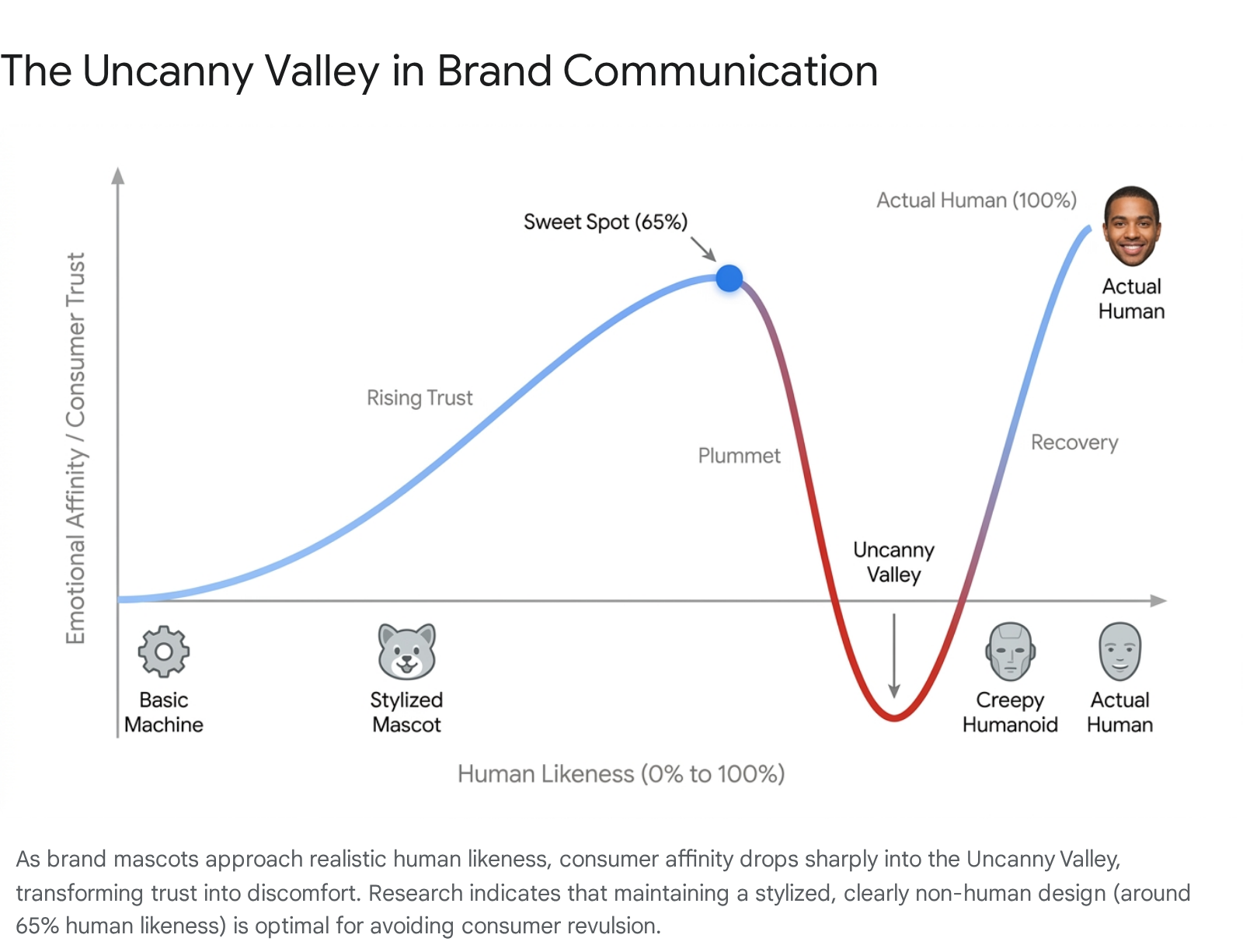
When attempting to anthropomorphize objects or create purely digital humanoids, designers must navigate the boundary of the "Uncanny Valley." Coined by robotics professor Masahiro Mori, this phenomenon occurs when an entity appears almost, but not entirely, human. Instead of eliciting empathy, the slight imperfections trigger a neurological alarm system, resulting in feelings of revulsion, discomfort, and cognitive dissonance 78.
In modern communication, the uncanny valley extends beyond visual aesthetics into conversational tone and artificial intelligence behavior. When an AI chatbot utilizes perfect syntax but responds with absolute emotional flatness, or when a corporate brand attempts "scripted vulnerability," it drops into the communication uncanny valley. The listener is forced to exert higher cognitive load to resolve the mismatch between logical text and synthetic emotion. This psychological friction leads directly to decision fatigue, degraded consumer trust, and eventual disengagement from the brand ecosystem 8. Research spanning human animation demonstrates that restricting human likeness to approximately 65% is the optimal threshold for maintaining approachability without triggering the revulsion response 7.
Kinetic Design and Movement Calibration
Static imagery is frequently insufficient to trigger deep anthropomorphic connections. Physical movement acts as a critical cue for inferring human-like capabilities, sentience, and intent 3. Neuromarketing studies utilizing electroencephalography mapping demonstrate significant differences in brain activity when consumers view mascots versus standard logos, particularly when those mascots exhibit fluid motion 25.
However, movement must be carefully calibrated to align with human biological rhythms. In experimental studies, participants shown an animated entity moving at an "ultra-fast" or "ultra-slow" speed failed to anthropomorphize the object. Only when the entity moved at a pace precisely matching natural human locomotion did participants assign it human characteristics, motivations, and intentions 7. Therefore, kinetic design - whether deployed in digital display advertisements, application user interfaces, or physical service robotics - must replicate the cadence of biological movement to optimize emotional transfer and establish trust 3.
Applications in Business-to-Business Markets
Mitigating Complexity in Enterprise Software
Historically, the business-to-business sector has relied on formal, highly rational marketing communications, operating under the assumption that enterprise purchasing decisions are purely logical. However, recent behavioral economics insights reveal that B2B buyers - who manage high-stakes, multi-million dollar implementations - actually require stronger emotional connections than standard consumer audiences to overcome the inherent fear of a wrong decision 3326.
Mascots in B2B environments act as psychological anchors that mitigate the cognitive friction associated with complex enterprise software, cloud architecture, or financial compliance 633. The enterprise software giant Salesforce provides the most prominent case study. Rather than presenting dense schematics of application programming interfaces, Salesforce utilizes an entire cinematic universe of characters, led by Astro, an inclusive, non-binary mascot. Characters like Codey the Bear serve to represent and guide specific user segments, such as developers, through the platform 6263527.
This strategy humanizes the technology, transforming abstract code into a relatable companion. It shifts the consumer's mental model from evaluating a daunting technical infrastructure to collaborating with a supportive entity. Similar successes are evident with Mailchimp's Freddie the chimp and Cloud Gateway's Cumulus the cloud, where characters embody the brand's commitment to user support and operational innovation 628.
CRM Implementation and Return on Investment
The utilization of character-driven marketing directly impacts core B2B performance metrics, such as time-to-value and customer relationship management adoption. A competitive analysis of CRM platforms reveals that digital channels are projected to account for 80% of all B2B sales engagements by 2025 . In this highly digitized environment, the speed at which a user interface can be adopted determines the platform's return on investment.
Data assessing implementation velocity demonstrates stark differences between competing systems. For instance, studies show that 64% of HubSpot users, a platform known for its highly accessible, human-centric interface, complete their software implementation in three months or less, requiring three or fewer internal employees. This contrasts with Salesforce implementations, where only 51% achieve the same timeline, often requiring deeper customization and broader organizational change management to overcome complexity 3929. The use of mascots to streamline onboarding and reduce software intimidation is a critical variable in accelerating these deployment timelines.
Quantitative Impacts on Profitability
The integration of brand mascots yields highly measurable financial outcomes. Brand characters act as "fluent devices" that build rapid mental availability and category entry points in the buyer's mind 33.
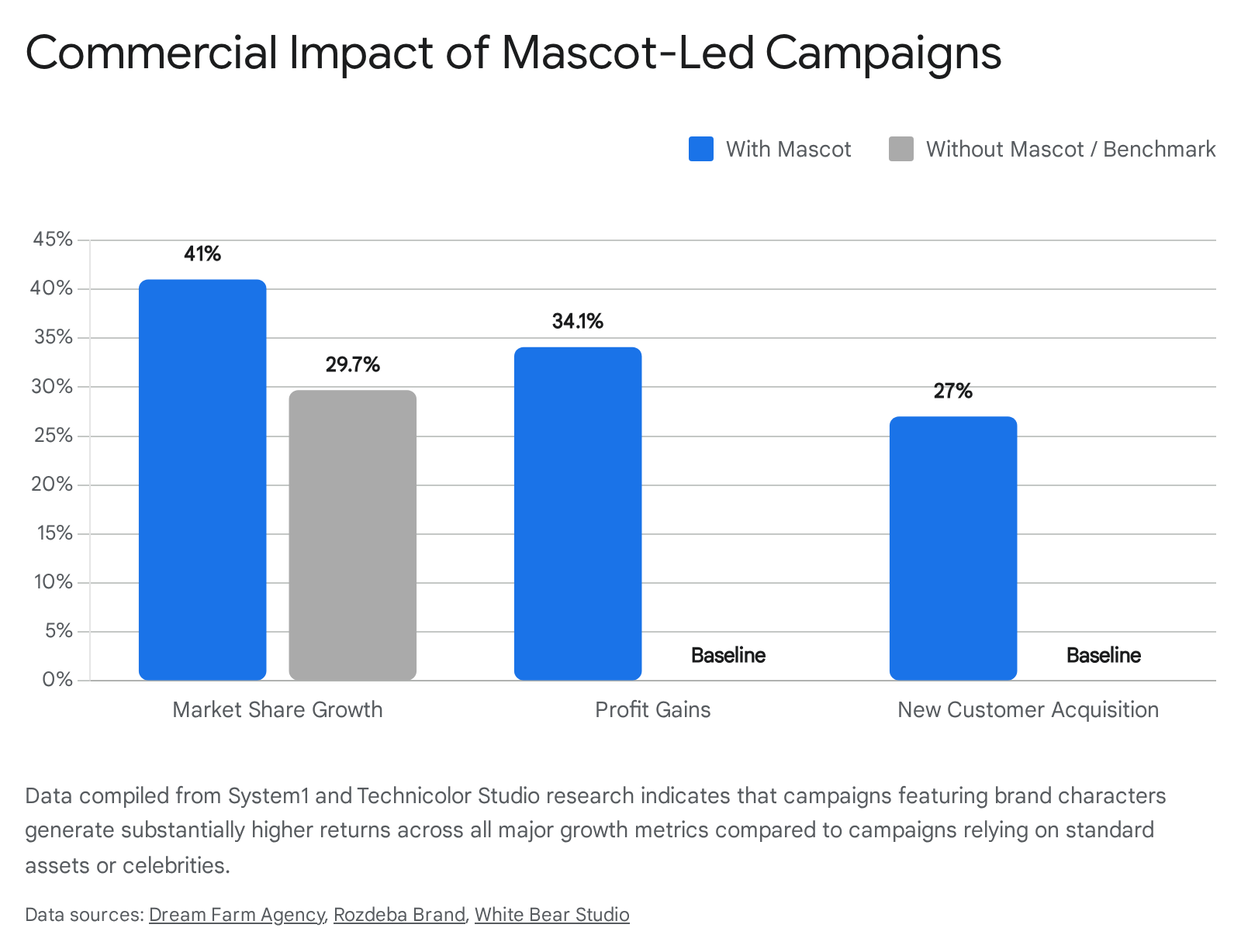
Data from System1, Technicolor Studio, and the Institute of Practitioners in Advertising confirm the profound superiority of character-driven marketing models: * Brand Linkage: Distinctive brand assets research scores characters at 105 on the brand linkage scale, vastly outperforming flat corporate logos (82), icons (67), and typography (31) 5. * Market Share: Campaigns utilizing mascots see an average market share gain increase of 37% to 41%, compared to roughly 29.7% for standard, non-character campaigns 3033. * Profitability: Long-term campaigns featuring mascots report sustained profit increases of up to 34.1%, and are 73% more likely to generate a massive profit increase compared to standard advertising 533. * Consumer Appeal: In a study of 46,200 respondents analyzing over 300 Super Bowl advertisements, ads featuring brand characters averaged 3.8 stars, significantly outperforming celebrity-led advertisements, which scored an average of only 2.7 stars 527.
Regional Branding and the Yuru-Chara Economy
The most comprehensive and economically consequential execution of brand anthropomorphism is found in Japan's "yuru-chara" culture. Translated literally as "loose characters," yuru-chara are regional mascots created by local governments, municipalities, and businesses to stimulate tourism, promote local agriculture, and foster civic identity 303143.
The Kawaii Aesthetic and Civic Identity
Yuru-chara are specifically designed around the Japanese aesthetic of "kawaii," which translates to cuteness. The designs are intentionally unsophisticated, slightly flawed, and amateurish, which drastically lowers the psychological barrier to entry and engenders feelings of warmth, pity, and protectiveness from the viewer 1030. For instance, highly successful characters often lack specific facial features like a mouth; this absence of overt emotional expression forces the viewer to project their own emotions onto the character, creating a highly personalized and intimate psychological bond 1011.
By embedding these mascots into the civic infrastructure - appearing at train stations, on local produce, and within police stations - the Japanese government utilizes anthropomorphism as a primary tool for economic revitalization and soft-power diplomacy. The strategy successfully transitions relatively obscure, rural prefectures into internationally recognized brands, generating an industry valued at roughly $16 billion annually 303143.
Kumamon and Open-Source Licensing
The absolute pinnacle of the yuru-chara movement is Kumamon, the official mascot of Kumamoto Prefecture. Created in 2010 to promote a new bullet train route, the rosy-cheeked black bear transcended local marketing to become a global cultural and economic titan 444546. Over the subsequent decade, sales of Kumamon-branded goods generated a cumulative 1.13 trillion yen, which equates to roughly $8 billion to $9 billion USD 46.
Kumamon's unparalleled commercial success is driven by an unorthodox, open-source licensing strategy. Unlike Western corporations that fiercely protect and monetize their intellectual property through strict royalties, Kumamoto Prefecture allows businesses to utilize Kumamon's image entirely for free, provided the product actively promotes the region or utilizes local agricultural ingredients 434546. This decentralized, barrier-free approach resulted in an explosion of visibility, placing the mascot on thousands of diverse products simultaneously.
Furthermore, Kumamon demonstrates the deep emotional capacity of anthropomorphized brands during times of crisis. Following the devastating 2016 Kumamoto earthquakes, the mascot served as a symbol of resilience and "Fukkou" (recovery). The character's initial silence on social media to respect emergency protocols, followed by his physical deployment to evacuation centers, provided profound psychological comfort to displaced citizens and catalyzed millions in international fundraising for reconstruction 434546.
Mascot Attrition and Transcendent Phenomena
While Kumamon achieved global reverence, the yuru-chara market is highly saturated, leading to phenomena of mascot attrition and controversial breakouts. At one point, the city of Osaka maintained 92 distinct mascots, which resulted in severe brand dilution and confusion. The government was forced to execute a "mascot cull," reducing the active roster to 69 and instituting a moratorium on new character creation 3143.
Conversely, characters like Funassyi - an unofficial pear fairy representing Funabashi City - achieved massive fame through hyperactive, chaotic behavior, eventually appearing at New York Fashion Week and introducing "Funanomics" to stimulate the economy 434532. Another unofficial mascot, Chiitan from Susaki, gained viral notoriety for its destructive, violent stunts, generating immense digital engagement but severe controversy with local government officials, highlighting the tension between traditional civic branding and internet-native entertainment 31.
Social Media and the Unhinged Mascot Paradigm
As consumer demographics shift toward Generation Z and Generation Alpha, traditional, polished corporate marketing is increasingly rejected as inauthentic and sterile 4849. In response, a new paradigm of digital anthropomorphism has emerged: the "unhinged" mascot.
Algorithmic Engagement on TikTok
The unhinged marketing strategy abandons professional corporate guardrails in favor of surrealism, meme culture, and playful antagonism. The primary architect of this movement is the educational technology application Duolingo and its mascot, Duo the Owl. Under the direction of social media managers, Duo was transformed from a static, two-dimensional application logo into a chaotic, emotionally unstable, and mildly threatening three-dimensional character on platforms like TikTok 495051.
Instead of posting about the functional benefits of language learning, the brand posts videos of Duo crying over pop stars, trolling competitor brands like Ryanair and Wendy's, and aggressively threatening users who break their daily learning streaks. This "brain rot" content perfectly aligns with algorithmic platform dynamics. It is highly entertaining, infinitely shareable, and forces the user to stop scrolling 495033.
The financial and operational metrics validate this high-risk strategy. Duolingo's TikTok account exploded from 50,000 followers in 2021 to over 16 million followers by 2025 495051. This immense brand awareness directly fueled massive user acquisition; in the second quarter of 2025, Duolingo reported a 54% year-over-year growth in daily active users and a 41% jump in total revenue, achieving record profitability entirely uncoupled from traditional advertising expenditures 4953.
Manipulating Parasocial Relationships
The psychological genius of the unhinged strategy lies in its deliberate manipulation of parasocial relationships. Traditional consumer advertising focuses on product utility, whereas unhinged marketing focuses entirely on personality. By imbuing Duo the Owl with deep flaws, neuroticism, and a rebellious streak, the brand perfectly mimics the behavior of authentic human digital creators 505154.
Users no longer view the company as a corporate entity; they view the mascot as a volatile internet friend. When the brand orchestrates massive, real-world stunts - such as staging the "death" of Duo by a Tesla Cybertruck in early 2025 - it leverages the authentic, albeit tongue-in-cheek, grief of its community to drive viral engagement across global media outlets 5154. The risk, however, is substantial. Operating without traditional safety rails means the brand must constantly walk a thin line between humor and harassment, risking severe backlash if a joke is poorly calibrated to the cultural moment 5033.
Liability and Failure in Anthropomorphic Strategy
Despite their immense efficacy, brand mascots represent a significant liability if mismanaged. Because consumers form deep psychological bonds with these entities, failures in execution are met with fierce backlash, reputational damage, and rapid revenue declines.
Aesthetic Misfires and Public Backlash
When brands fail to align mascot aesthetics with consumer expectations or inadvertently fall into the uncanny valley, the financial consequences are severe and immediate. * Burger King's "The King": In 2004, Burger King introduced a plastic-faced, silent king mascot. Rather than appearing welcoming, the mascot was placed in surreal, voyeuristic advertisements, such as waking up in customers' beds or requiring psychiatric restraint. The character terrified audiences rather than enticing them. By early 2011, Burger King's sales had declined by 6%, while major competitors grew, forcing the brand to terminate the campaign and retire the mascot 555657. * Quiznos' Spongmonkeys: Attempting to harness bizarre internet culture prematurely, Quiznos launched television advertisements in 2004 featuring mutated, floating rodents singing erratically. The campaign generated over 30,000 complaints in its first week and prompted franchisees to publicly disavow the corporate marketing strategy 55. * Domino's "The Noid": The 1980s claymation mascot designed to steal pizzas became a historic liability when a mentally ill individual named Kenneth Noid, believing the national ad campaign was a targeted personal attack, held employees hostage at an Atlanta Domino's location with a magnum revolver, forcing the immediate termination of the character 5557.
Furthermore, removing a mascot or heritage brand mark without a viable replacement is equally damaging. When Tropicana replaced its iconic orange-and-straw imagery with minimalist text, sales plummeted 20% in two months, erasing $30 million in revenue. Similarly, Jaguar's 2024 "Copy Nothing" rebrand, which completely stripped the iconic leaping jaguar mascot from its marketing in favor of abstract lifestyle imagery, resulted in immediate consumer alienation and accusations of brand destruction 58.
Cultural Mistranslations in Global Markets
Mascots and their accompanying marketing slogans must cross linguistic and cultural borders. When brands fail to execute proper cultural localization, anthropomorphic campaigns collapse into offensive or bizarre mistranslations 1134. * Pepsi in China: The slogan "Come alive with the Pepsi Generation" was famously mistranslated in the Chinese market to mean "Pepsi will bring your ancestors back from the dead" or "from the grave" - a massive faux pas in a culture deeply respectful of ancestral heritage 3536626364. * KFC in China: The anthropomorphized Colonel Sanders was introduced alongside the slogan "Finger-lickin' good," which mistakenly translated to the highly disturbing "Eat your fingers off" 35366264. * Ford in Brazil: Ford introduced the Pinto to the Brazilian market without realizing that "pinto" is local slang for small male genitalia, forcing a rapid rebrand to the "Corcel" 353662.
Research indicates that a staggering 86% of native speakers have encountered culturally inappropriate content due to brand mistranslations, and nearly 75% of consumers state they would permanently switch to a competitor brand that demonstrates better cultural competence and localization 1165.
Demographic Disparities and Representation
As mascots act as highly visible societal mirrors, they carry the immense weight of demographic representation. A comprehensive content analysis conducted by the Geena Davis Institute on Gender in Media systematically reviewed 6,500 top-selling U.S. consumer products and identified 1,096 distinct brand mascots. The aggregated data revealed profound and persistent representational biases across the industry 37.
| Demographic Variable | Representation in U.S. Population | Representation in Brand Mascots | Prevalent Stereotyping Metrics |
|---|---|---|---|
| Male Characters | ~49% | 67.1% | Often portrayed as commanding, holding authority in 22.9% of cases. More likely to display threatening characteristics (4.1%). |
| Female Characters | ~51% | 31.4% | Frequently depicted in line with restrictive gender stereotypes (25.4%). Hold authority in only 14.5% of cases. |
| White Characters | ~62% | 84.8% | Twice as likely to be portrayed as commanding (27.0%) compared to mascots of color. |
| Characters of Color | ~38% | 15.2% | Stereotypes are present in 65.6% of these mascots. Often shown strictly preparing food (28.1%) or portrayed as threatening (4.7%). |
As modern consumers increasingly demand brand purpose and social accountability, the failure to modernize mascot demographics poses a terminal risk to legacy brands. The forced retirement or rebranding of historic mascots - such as Aunt Jemima, Uncle Ben's, and the Eskimo Pie character - in the 2020s underscores the reality that mascots must evolve alongside the ethical standards of their consumer base. When brand stewards fail to audit their characters for historical injustice, consumers and advocacy groups will force the issue, causing severe reputational damage 3438.
Conclusion
Anthropomorphism is not merely a superficial marketing tactic; it is a profound psychological strategy that leverages humanity's innate biological and cognitive hardwiring. By assigning human traits, emotions, and movement to inanimate objects and digital algorithms, brands successfully bypass the rational, critical faculties of the consumer brain, forging direct emotional bonds anchored in trust, familiarity, and parasocial intimacy.
The empirical evidence is definitive: across both business-to-consumer sectors and highly complex business-to-business markets, brands that properly execute character-driven strategies achieve demonstrably higher market share, deeper brand linkage, and superior long-term profitability. Furthermore, as demonstrated by Japan's yuru-chara economy, the strategic deployment of kawaii aesthetics can transcend corporate marketing to achieve macro-economic revitalization and international soft power.
However, the power of anthropomorphism is inherently volatile. The transition into the digital age - where mascots operate as dynamic, unhinged social media influencers and conversational artificial intelligence - has exponentially increased the stakes. Brands must navigate the precarious boundaries of the uncanny valley, ensuring characters remain relatable without slipping into synthetic deception or cultural insensitivity. Moving forward, the most successful enterprises will treat their mascots not as static logos, but as living, culturally fluent assets that require rigorous governance, ethical representation, and a deep understanding of human psychology.