
Brand personality theory and consumer parasocial relationships
Introduction
The conceptualization of brands has undergone a profound transformation within the fields of consumer psychology, marketing strategy, and media studies. Historically, commercial brands were understood primarily through functional and transactional lenses; they served as identifiers of origin, guarantors of quality, and mechanisms for reducing consumer search costs. However, the evolution of relational marketing paradigms and the subsequent explosion of digital, bidirectional communication channels have fundamentally altered this dynamic. Brands are no longer passive identifiers; they operate as complex semiotic and psychological entities capable of simulating human interaction and projecting distinct personalities.
As corporate entities increasingly adopt human-like characteristics, consumers respond by engaging with them utilizing the same cognitive frameworks and emotional heuristics that govern interpersonal human relationships. This phenomenon gives rise to consumer-brand parasocial relationships - one-sided emotional bonds wherein the consumer experiences a profound sense of intimacy, familiarity, and loyalty toward a brand or its persona, despite the brand possessing no reciprocal individual awareness of the consumer. The study of how these relationships form requires a synthesis of brand personality theory, social psychology, attachment theory, and modern digital communication strategies.
Understanding the psychological architecture of brand personality and parasocial bonding is critical for modern market analysis. When successfully cultivated, these one-sided relationships drive profound customer equity, organic advocacy, and brand resilience. However, the psychological depth of these bonds also introduces severe vulnerabilities. The modern digital landscape demonstrates that consumers who form intense parasocial relationships with brands exhibit heightened sensitivity to moral violations, corporate reversions, and perceived betrayals. Consequently, analyzing the formation, cultural variations, strategic implementations, and ethical implications of parasocial brand relationships provides a vital framework for understanding contemporary consumer behavior.
The Construct of Brand Personality
The foundational premise of brand personality theory is that consumers utilize brands not merely for their utilitarian benefits, but for their symbolic value. Consumers construct, express, and reinforce their actual and ideal self-concepts by choosing brands whose projected personalities align with their own psychological identities.
Aaker's Dimensional Framework
The dominant paradigm for quantifying and analyzing brand personality was established by social psychologist Jennifer Aaker in 1997. Recognizing that the marketing literature lacked a validated metric comparable to the "Big Five" (OCEAN) personality traits utilized in human psychology, Aaker developed a comprehensive, multidimensional scale to measure the human characteristics that consumers ascribe to brands. Published in the Journal of Marketing Research, this framework identified five distinct core dimensions of brand personality, each supported by specific facets and traits.
The deployment of these dimensions allows marketing practitioners to consciously engineer corporate identities that resonate with targeted consumer psychographics. The table below outlines the five core dimensions established by Aaker's research, illustrating the specific traits associated with each and the types of market positioning they typically support.
| Brand Personality Dimension | Core Characteristics and Traits | Strategic Market Positioning | Real-World Brand Application |
|---|---|---|---|
| Sincerity | Down-to-earth, honest, wholesome, cheerful, family-oriented, sincere. | Focuses on ethical practices, sustainability, community commitment, and trustworthiness. | Patagonia (emphasizing environmental ethics and transparency) 123. |
| Excitement | Daring, spirited, imaginative, up-to-date, trendy, young, unique. | Utilizes vibrant aesthetics, aligns with high-energy lifestyles, and promotes creative disruption. | Red Bull (associating with extreme sports and energetic lifestyles) 123. |
| Competence | Reliable, intelligent, successful, secure, hard-working. | Emphasizes functional efficacy, corporate leadership, and unwavering dependability. | Apple or Microsoft (projecting technological leadership and reliability) 13. |
| Sophistication | Upper-class, glamorous, charming, smooth, elegant. | Targets prestige, exclusivity, luxury, and high-status lifestyle aspirations. | Dolce & Gabbana or Chanel (focusing on high-end luxury and prestige) 34. |
| Ruggedness | Outdoorsy, tough, masculine, Western, resilient. | Appeals to durability, survivalism, and heavy-duty performance capabilities. | Jeep or Old Spice (projecting resilience and outdoor capability) 345. |
Aaker's research demonstrated that these dimensions mirror human personality constructs to varying degrees. Specifically, Sincerity, Excitement, and Competence relate closely to the human psychological traits of Agreeableness, Extraversion, and Conscientiousness, respectively. Because these three dimensions tap into fundamental human social drives - warmth, sociability, and dependability - they are generally perceived as reflecting a consumer's actual self, whereas Sophistication and Ruggedness more frequently map to idealized aspirational selves.
Longitudinal Impact on Brand Equity
The long-term economic efficacy of cultivating these specific personality dimensions has been validated through extensive empirical research. An exhaustive longitudinal study analyzing a proprietary panel dataset of 49,626 brand-year observations across 6,858 unique brands between 2001 and 2018 examined the differential impact of Aaker's five dimensions on customer-based brand equity (CBBE). The analysis revealed that while all five dimensions positively influence brand equity, Excitement, Competence, and Sincerity consistently demonstrate the most substantial impact on consumer attitudes and financial outcomes.
Furthermore, the longitudinal data indicates a structural shift in consumer valuation over time. Over the 18-year period analyzed, the positive effects of Sincerity, Sophistication, and Ruggedness on brand equity exhibited gradual declining trends. Conversely, the influence of Excitement and Competence grew significantly more pronounced. In 2001, a 1% increase in a brand's Excitement dimension correlated with a 0.45% increase in CBBE; by 2018, this correlation had increased by 58% to a 0.71% impact. Similarly, the impact of Competence grew by 43% over the same timeframe, moving from a 0.42% to a 0.60% correlation with brand equity.
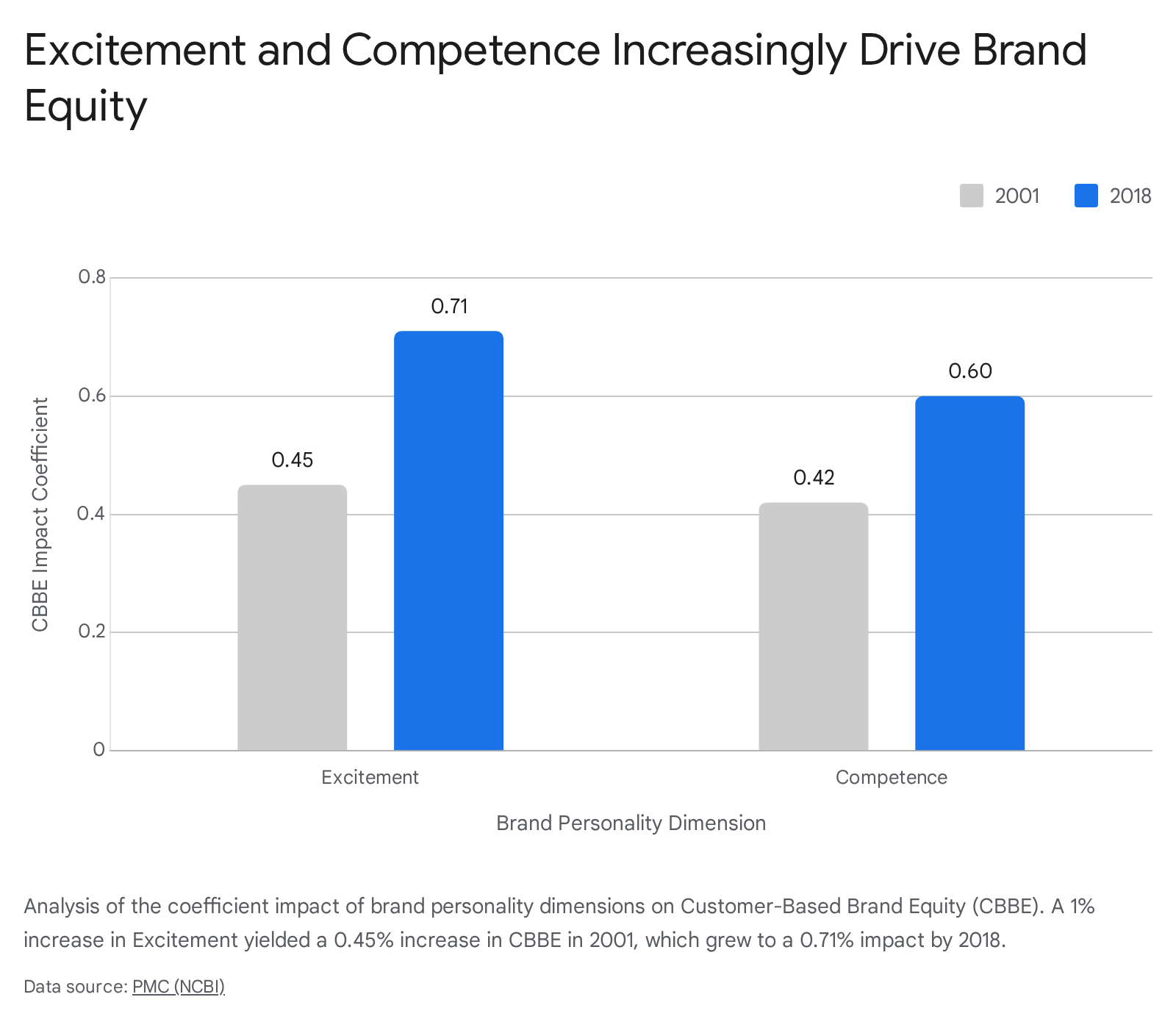
This trajectory suggests that in highly saturated, modernized markets, consumers increasingly prioritize brands that provide either highly engaging, innovative stimulation (Excitement) or fundamentally flawless, reliable execution (Competence).
Theoretical Critiques and Alternative Frameworks
Despite its widespread acceptance and utility, Aaker's multi-dimensional model has faced rigorous academic scrutiny over the subsequent decades. A primary critique centers on ethnocentrism; scholars argue that the framework is intrinsically biased toward American cultural contexts and individualistic psychology. Empirical attempts to replicate the five-dimensional structure in non-Western cultural settings have frequently failed to yield exact substantiations, suggesting that dimensions like "Ruggedness" lack universal cognitive relevance. Additionally, critics posit that Aaker's scale represents a crude measure because it transposes human personality traits onto inanimate entities rather than identifying traits that are uniquely intrinsic to brands themselves.
In response to these limitations, the academic literature has proposed several alternative theoretical frameworks for conceptualizing brand identity. One prominent alternative leverages the Stereotype Content Model (SCM), a social psychology framework suggesting that human cognition universally evaluates all social entities across two primary dimensions: warmth and competence. When applied to consumer behavior, this model posits that buyers instinctively assess a brand's intent (its sincerity or warmth) alongside its capability to execute that intent (its competence). Proponents of the SCM approach argue that these dimensions are truly generic and applicable across all cultural contexts.
Another pervasive alternative relies on Jungian psychology, which categorizes brand identities into twelve universal archetypes, such as The Hero, The Outlaw, The Magician, The Sage, and The Jester. While Aaker's dimensions describe the outward behavioral traits of a brand, the archetypal model defines the underlying motivational promise and the universal narrative role the brand plays within the consumer's psychological landscape. For instance, while a brand might exhibit the behavioral trait of "Excitement" under Aaker's model, the archetypal framework would clarify whether that excitement is driven by a desire for discovery (The Explorer) or a desire to disrupt the status quo (The Outlaw).
Psychological Mechanisms of Parasocial Relationships
When a corporate entity successfully projects a coherent, human-like personality using the aforementioned frameworks, it establishes the psychological foundation necessary for parasocial interactions. The concept of parasocial relationships (PSRs) was originally introduced in 1956 by sociologists Donald Horton and Richard Wohl to describe the illusion of face-to-face intimacy that early television audiences experienced with broadcast hosts and media figures. Horton and Wohl observed that viewers developed profound feelings of friendship, empathy, and connection with media performers, despite the performers being completely unaware of the individual viewers' existences.
In the contemporary digital marketing landscape, the application of PSR theory has expanded dramatically. Consumers no longer form these one-sided bonds exclusively with human celebrities or fictional characters; they form intense parasocial attachments with social media influencers ("human brands"), corporate mascots, and anthropomorphized corporate entities. The formation and endurance of these relationships rely on several specific psychological mechanisms, cognitive processing shortcuts, and intrinsic human social needs.
Anthropomorphism and Information Processing
The initiation of a consumer-brand parasocial relationship is heavily dependent on the psychological phenomenon of anthropomorphism - the attribution of human physical contours, behavioral traits, emotions, or subjective intentions to non-human entities. Within the context of brand marketing, anthropomorphism functions as an in-process situational output during consumer information processing. Because the human brain accesses schemas related to human socialization much more rapidly and completely than schemas related to inanimate objects, personifying a brand allows the consumer to bypass complex analytical evaluations. Instead, the consumer relies on deeply ingrained interpersonal heuristics to reason about the brand, instinctively viewing it as a capable relationship agent.
The extent to which perceived anthropomorphism translates into genuine brand attachment is moderated by specific motivational dispositions, best understood through the psychological SEEK model (Sociality and Effectance). The first moderator is the Need for Belonging (the sociality motive). Humans possess an evolutionary drive to maintain proximity to supportive social networks. When consumers experience a high need for belonging - often exacerbated by modern societal loneliness or social anxiety - human-like brand characteristics serve as vital social cues. These consumers utilize anthropomorphized brands to compensate for deficiencies in their actual interpersonal lives, obtaining emotional comfort and support that drastically strengthens their attachment to the brand. The second moderator is Parasocial Interaction (the effectance motive). Effectance refers to the intrinsic human desire to interact effectively with and exert control over one's environment. For consumers who are highly predisposed to parasocial interaction, utilizing anthropomorphic perceptions allows them to simulate predictable, efficient, and deeply rewarding engagements with brands. This imagined engagement provides a sense of relational control that is often absent in complex human relationships, thereby cementing the consumer's emotional bond with the corporate entity.
Attachment Theory and Social Comparison
The psychological depth of parasocial brand relationships is further explicated by attachment theory, originally formulated by psychoanalyst John Bowlby. Attachment theory posits that human attachment behaviors evolved as a survival mechanism, ensuring infants maintain proximity to caregivers. In adulthood, this behavioral system continues to govern how individuals seek out secure bases from which they can safely explore their environments and construct their identities. Within the parasocial economy, media figures, influencers, and highly personified brands function as these secure bases. When an influencer or brand consistently provides reliable content, demonstrates emotional accessibility, and projects a stable personality, it triggers the same neurochemical responses in the consumer's brain - such as the release of oxytocin and the activation of mirror neurons - that occur during genuine interpersonal bonding.
Simultaneously, Leon Festinger's social comparison theory plays a critical role in the maintenance of these bonds. Consumers continuously engage in social comparison with parasocial partners to evaluate their own self-concept, social standing, and lifestyle achievements. Consumers may engage in upward comparisons with highly sophisticated or successful brand personas to motivate self-improvement, or downward comparisons to find psychological comfort. Ultimately, the parasocial engagement enhances the consumer's perceived self-image. This self-image enhancement directly motivates consumers to engage in positive word-of-mouth and public brand advocacy, utilizing their affiliation with the brand to signal their own valued symbolic associations to their actual social peers.
The Absorption-Addiction Model
While many parasocial relationships remain casual and highly functional, the psychological drive to alleviate personal deficiencies can lead to escalating levels of involvement. The Absorption-Addiction Model provides a psychological explanation for how typical brand engagement transitions into obsessive fixation. According to this model, individuals form increasingly intense PSRs in response to deficits in their personal lives, such as identity disturbances, low self-esteem, or a lack of meaningful relationships. The parasocial bond provides a compensatory emotional outlet.
The literature generally categorizes the intensity of parasocial involvement into three distinct psychological tiers. The table below details these levels of involvement, illustrating how consumer behavior shifts as the parasocial bond deepens.
| Level of Parasocial Involvement | Psychological Focus and Consumer Motivation | Manifestation in Consumer Behavior |
|---|---|---|
| Entertainment-Social | The brand or persona is viewed primarily as a source of casual amusement, aesthetic enjoyment, and social currency. | The consumer enjoys consuming the content, sharing memes, and discussing the brand with actual friends for entertainment. |
| Intense-Personal | The consumer develops a profound, emotionally driven connection, viewing the brand or influencer as a trusted confidant or role model. | The consumer exhibits high empathy, celebrates the brand's successes as personal victories, and aligns their lifestyle/values with the brand. |
| Borderline-Pathological | The consumer crosses into obsessive preoccupation, delusional thinking, and over-identification with the media entity. | The consumer exhibits a dangerous sense of entitlement, stalks personnel, attempts inappropriate direct contact, and experiences distress if the brand changes. |
Stages of Parasocial Bond Formation
The transition from a consumer's initial awareness of a brand to the realization of a deep, intense-personal parasocial bond is not instantaneous. Rather, it is a dynamic, sequential process that unfolds over time. Recognizing the underlying similarities in how the human brain manages actual and imagined social encounters, communication scholars have successfully adapted Mark Knapp's model of interpersonal relationship development to map the trajectory of parasocial bonds.
Knapp's original model outlines the stages of "coming together" in romantic and platonic relationships. When applied to the media and marketing landscape, the framework demonstrates that positive parasocial relationships evolve through four distinct cognitive and emotional stages.
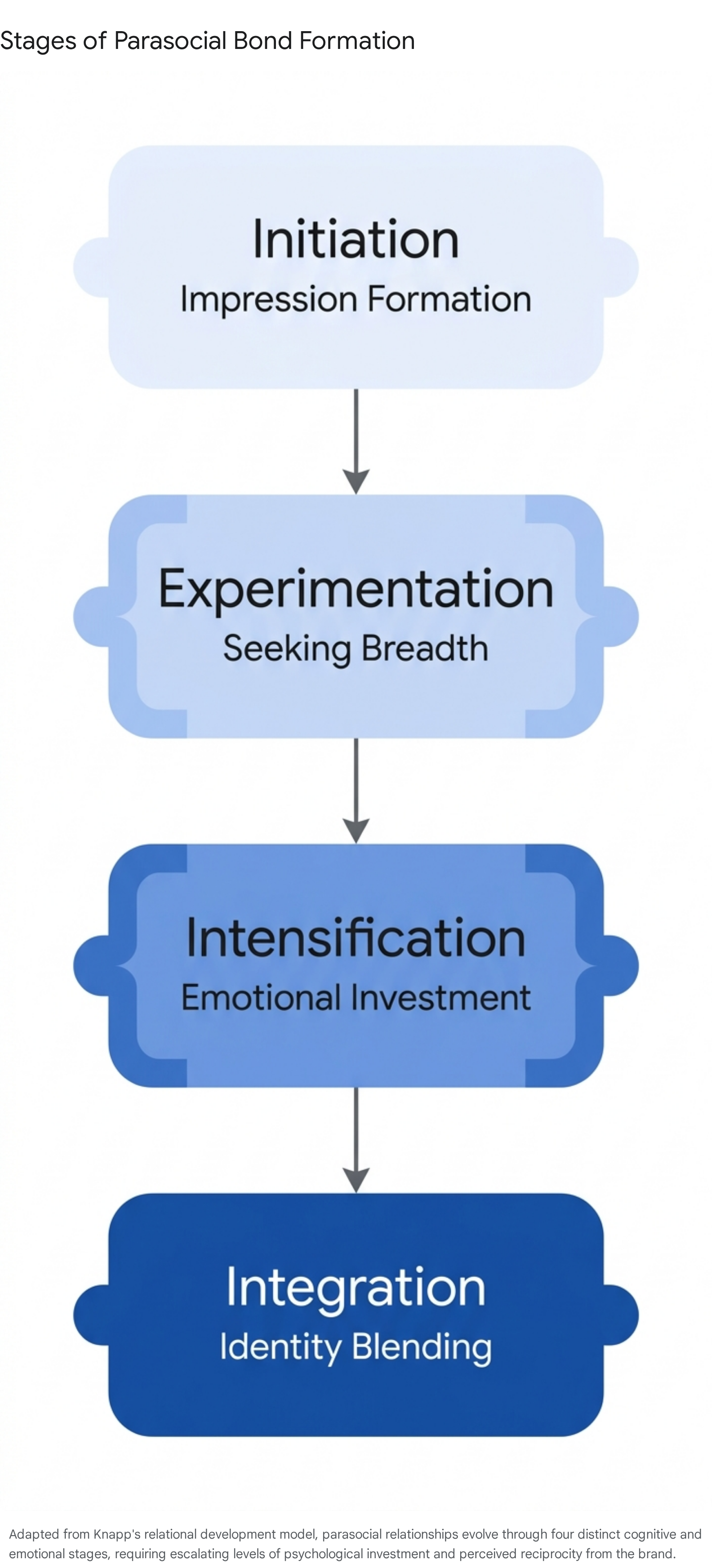
Progression through these stages requires escalating levels of psychological investment from the consumer and perceived reciprocity or self-disclosure from the brand.
Stage 1: Initiation
The initiation stage encompasses the consumer's very first exposure to the brand persona, influencer, or corporate mascot. This stage is characterized by high uncertainty and rapid impression formation. The consumer instinctively integrates available cues - such as visual aesthetics, tone of voice, perceived physical attractiveness of a spokesperson, and initial moral judgments - with their existing cognitive schemas. In digital marketing, this stage is heavily reliant on fleeting parasocial interactions (PSIs), such as a brand utilizing a first-person tone ("I" or "We") on social media, or a presenter making direct eye contact with the camera. If the initial cognitive appraisal is positive, the consumer's curiosity is piqued, and they move to reduce uncertainty.
Stage 2: Experimentation
In the experimentation stage, the primary psychological goal is uncertainty reduction. The consumer actively seeks out more information to learn about the brand figure. Crucially, behavior in this stage is characterized by a search for breadth rather than depth; the consumer may browse the brand's historical social media posts, watch multiple videos, or read varied reviews to verify the consistency of the projected personality. Predictors of advancing past the experimentation stage include perceived homophily - the consumer's realization that they share fundamental attitudes, demographics, or values with the brand - and the ease of accessibility to the brand's ongoing narrative.
Stage 3: Intensification
Intensification represents the critical threshold where casual consumption cements into a genuine parasocial relationship. The consumer's primary goal shifts to seeking emotional intimacy. The relationship begins to extend beyond the immediate moments of media exposure and permeates the consumer's daily life. This manifests as the consumer engaging in internal dialogues with the brand persona or anticipating the brand's reactions to current events. The progression of this stage is heavily accelerated by modern social media, which provides the illusion of mutual awareness. When a brand or influencer engages in self-disclosure - sharing behind-the-scenes struggles, unfiltered confessions, or vulnerabilities - it drastically strengthens perceived intimacy, transitioning the consumer's feelings from mere interest to friend-like affection.
Stage 4: Integration
The final stage of parasocial bond formation is integration, characterized by a deep sense of psychological "oneness." The brand persona becomes inextricably intertwined with the consumer's own personal identity. The relationship is often socially recognized by external parties, with the consumer publicly identifying as a devoted fan, advocate, or community member. At this stage, the consumer actively participates in brand defense, attends physical or virtual conventions, collects merchandise, and experiences significant emotional distress if the brand persona is threatened. The integration stage fulfills profound identity development needs, particularly for adolescents and marginalized groups seeking a secure sense of belonging.
Cross-Cultural Variations in Consumer Attachment
Brand personality perception and parasocial bond formation do not operate in a cultural vacuum. Extensive cross-cultural psychological research demonstrates that the foundational attachment styles governing human relationships - and by extension, consumer-brand relationships - differ significantly across global populations. These variations are primarily delineated by the cultural paradigms of individualism versus collectivism.
The developmental basis for these variations is found in early caregiving practices. Pioneering meta-analyses of attachment behaviors across different cultures, most notably the work of Van Ijzendoorn and Kroonenberg utilizing the Strange Situation procedure, reveal that while secure attachment is the universal baseline, the distribution of insecure attachment styles varies geographically.
In Western, individualistic cultures (such as the United States and Western Europe), socialization heavily emphasizes early autonomy, self-reliance, and personal space. Parenting practices that encourage rapid independence can lead to a higher prevalence of insecure-avoidant attachment styles in the general population, where individuals learn to distance themselves emotionally and prioritize self-sufficiency. In stark contrast, Eastern, collectivist cultures (such as Japan, China, and broader Southeast Asia) emphasize interdependence, social harmony, and deeply rooted community networks. Caregiving in these cultures often involves multiple extended family members and continuous physical proximity. This environment correlates with a higher prevalence of insecure-resistant (or anxious) attachment behaviors, wherein individuals remain highly attuned to the availability of social support and are profoundly sensitive to maintaining relational harmony.
These psychological foundations dictate how consumers evaluate brand personalities and form loyalties. The table below summarizes the intersection of cultural attachment styles and strategic brand reception.
| Cultural Context | Dominant Social Paradigm | Prevalent Insecure Attachment Style | Impact on Brand Personality Preferences and Consumer Behavior |
|---|---|---|---|
| Western Markets (e.g., US, UK) | Individualism, personal autonomy, and self-expression. | Insecure-Avoidant (valuing emotional distance and self-reliance). | Consumers favor brands that project bold, highly individualized personalities (e.g., Outlaw, Hero). Purchase logic is driven by personal preference; messaging is typically overt, direct, and benefit-led. |
| Eastern Markets (e.g., Japan, China) | Collectivism, interdependence, and social harmony. | Insecure-Resistant (valuing proximity, collective validation, and relationship maintenance). | Consumers favor brands that project Sincerity, Caregiver, and Sage archetypes. Purchase logic relies heavily on peer influence, family networks, and community validation. Messaging is often implicit and values-driven. |
The commercial implications of these cultural divergences are massive. When Western brands attempt to enter collectivist markets utilizing an individualism-based marketing playbook - relying on direct, disruptive messaging and highlighting individual benefits - they frequently underperform. Such strategies fail to respect the community-oriented decision-making process inherent to the culture. Conversely, Asian brands exporting to Western markets face the challenge of translating a native philosophy of collective harmony and meticulous service into narratives of innovation and personal expression that resonate with Western consumers' desire for autonomy. Linguistic analyses of corporate communications reveal these biases vividly; for instance, Chinese corporate websites exhibit a significantly higher usage of vocabulary associated with the "Sincerity" dimension - emphasizing family associations, high morals, and unquestionable trust - compared to American corporate sites, which skew heavily toward "Competence" and "Excitement."
Digital Personification and Chaotic Marketing Strategies
The theoretical understanding of brand personality has evolved dramatically to keep pace with the digital, algorithm-driven media environment. Traditional corporate marketing heavily relies on polished aesthetics, strict brand safety guidelines, and highly controlled, predictable messaging. However, younger demographics - specifically Generation Z and Generation Alpha - exhibit profound exhaustion with corporate fluff and high resistance to traditional sales pitches. These cohorts prioritize authenticity, spontaneity, and native internet fluency.
To bypass this resistance and rapidly initiate parasocial relationships, modern brands have increasingly adopted a strategy colloquially termed "unhinged marketing." This approach intentionally abandons professionalism, embracing absurdity, irreverence, self-deprecation, meme culture, and unpredictable chaos. By presenting a brand as flawed, sarcastic, or aggressively casual, the corporation bypasses the sterile "Competence" dimension and leans entirely into extreme, modernized versions of the "Excitement" dimension and the "Jester" or "Outlaw" archetypes.
The Mechanisms of Unhinged Branding
Unhinged marketing functions by accelerating the early stages of parasocial bonding. When a brand posts content that makes a consumer think, "How did legal approve this?", it shatters the corporate facade, creating an immediate illusion of human vulnerability and relatability. Early pioneers of this strategy included fast-food chains like Wendy's, which gained massive notoriety in 2017 for adopting a combative Twitter persona that "roasted" competitors and users alike.
The most prominent contemporary case study of this strategy is the language-learning platform Duolingo. Abandoning traditional paid advertising, Duolingo shifted its strategy entirely to organic, chaotic social media content centered around its green owl mascot, Duo. The marketing team transformed a corporate logo into a highly flawed, parasocial entity. Duo was given a distinct, unhinged personality characterized by ongoing narrative bits: a one-sided, thirsty crush on pop star Dua Lipa, a petty feud with Google Translate, and a running gag involving hostility toward the company's own legal department.
The strategic brilliance of the Duolingo approach lay in prioritizing pure entertainment over product selling. The content felt native to platforms like TikTok, utilizing trending audio and raw, unpolished video production (such as personnel in oversized mascot suits executing bizarre stunts). This orchestrated chaos successfully cultivated a massive parasocial community, rendering users feel as though they were in on a collective joke. The financial and metric outcomes were extraordinary. Duolingo grew its TikTok presence from 50,000 to over 17 million organic followers without significant ad spend, achieved near-zero customer acquisition costs, and dramatically increased its daily active user base, cementing a multi-billion dollar valuation.
Corporate Reversion and the Backlash Engine
However, deploying an unhinged, highly humanized brand personality is an exceptionally volatile strategy. Because the success of the strategy relies entirely on the consumer's genuine emotional investment in the parasocial illusion, any disruption to that illusion yields severe consequences. When a brand behaves like a corporate entity after convincing its audience it is a "friend," the consumer experiences acute psychological betrayal.
This volatility was starkly illustrated by Duolingo in early 2025. Following years of cultivating unprecedented brand love through its unhinged mascot, the company's executive leadership made decisions that fundamentally clashed with its carefully constructed persona. The CEO issued an internal memo outlining a strategic pivot to an "AI-first" operational model, signaling the replacement of human contractors with artificial intelligence. This corporate reality check, compounded by the highly publicized departure of key personnel including the Global Social Media Manager responsible for the unhinged persona, fractured the parasocial bond.
The consumer backlash was swift and severe, demonstrating the dark side of deep parasocial integration. Audiences viewed the corporate maneuvering not as a standard business optimization, but as a betrayal of the authentic personality they had emotionally bonded with. The hashtag #DeleteDuolingo trended globally, the brand suffered catastrophic reputational damage, and the company's stock valuation plummeted precipitously over a 100-day period. The crisis ultimately forced the CEO to publicly backtrack on the AI-first narrative. This case study underscores a vital law of modern brand personality: once a brand successfully positions itself as a parasocial entity, reverting to a sterile, profit-driven corporate posture constitutes a traumatic parasocial breakup for the consumer base.
The Rise of Virtual Influencers
In an attempt to harness the engagement power of parasocial relationships while mitigating the liabilities, unpredictability, and costs associated with human personnel, the industry has seen the rapid proliferation of Virtual Influencers (VIs). These AI-generated digital avatars are meticulously engineered to project perfect physical attractiveness, homophily, and anthropomorphism.
Based on the Computers Are Social Actors (CASA) paradigm, VIs rely on the premise that humans will apply standard social heuristics to computers if they exhibit sufficient human-like cues. However, academic research indicates that while VIs can effectively capture attention and trigger short-term engagement, they struggle to facilitate the deeper "Integration" stages of parasocial bonding. Consumers consistently rate VIs as possessing lower emotional expressiveness, true authenticity, and trustworthiness compared to human creators. Because the parasocial bond requires genuine vulnerability and the perception of a shared human reality, relationships with virtual entities often remain shallow, hindered by the audience's underlying awareness of the avatar's fabricated nature and primary commercial intent.
Negative Outcomes and Ethical Implications
While the successful cultivation of parasocial brand relationships yields immense commercial benefits, the underlying psychological mechanisms possess a severe "dark side." When the cognitive boundaries between strategic commercial marketing and genuine interpersonal connection are systematically dismantled, a host of negative behavioral phenomena and profound ethical dilemmas emerge.
Consumer Entitlement and Community Deviance
As consumers reach the deepest stages of parasocial integration, their personal identity becomes enmeshed with the brand. This profound loyalty frequently breeds an intense sense of psychological entitlement. Based on theories of social exchange and reciprocity, highly attached consumers subconsciously believe that their vast emotional and temporal investments warrant a reciprocal relationship from the brand.
When the brand inevitably fails to fulfill these asymmetrical expectations - perhaps by altering a beloved product, taking an unpopular sociopolitical stance, or shifting its content strategy - these highly invested consumers are prone to severe customer misbehavior. This entitlement frequently metastasizes within Online Brand Communities (OBCs). Traditionally conceptualized as homogenous networks that foster positive brand advocacy, OBCs frequently devolve into hubs of deviance. Consumers exhibiting borderline-pathological parasocial involvement often engage in toxic behaviors such as organized trolling, harassment of corporate employees, spreading misinformation, and active derision. This phenomenon of "brand hate" is not merely passive dissatisfaction; it is an active, aggressive emotional retaliation triggered precisely because the initial parasocial passion was so profound.
Moral Violations and Parasocial Breakups
The intensity of a parasocial relationship dramatically heightens the impact of perceived moral violations. In traditional marketing, a celebrity endorser caught in a scandal might cause temporary brand embarrassment. However, in the modern digital economy, human brands and influencers are fundamentally evaluated on their perceived authenticity and relatability. When an influencer or a highly personified brand commits an act deemed morally reprehensible by the audience, it does not merely terminate a commercial transaction; it shatters a perceived friendship, resulting in a traumatic "parasocial breakup."
Research demonstrates that the severity of the audience's reaction is directly correlated with the strength of the pre-existing parasocial bond. For highly attached consumers, the dissolution of the digital relationship triggers genuine psychological distress, grieving processes, and feelings of betrayal that mirror the loss of an actual romantic or platonic partner. This leads to prolonged grudge-holding, aggressive consumer boycotts, and organized campaigns to enact reputational ruin upon the offending entity.
The Ethics of Emotional Manipulation
The most profound concern regarding the industrialization of brand parasocial relationships lies in the ethics of deliberate emotional manipulation. Because human neurology evolved to process physical, face-to-face interactions, the brain does not fully distinguish between a digital persona demonstrating vulnerability and an actual friend in distress. When a creator or brand shares a moment of personal struggle - such as a mental health battle, financial hardship, or physical illness - mirror neurons fire, oxytocin is released, and genuine empathy is produced. During these moments of perceived authenticity, audiences are emotionally raw and maximally susceptible to influence.
Brands and marketing agencies frequently weaponize this neurochemical reality. Marketers actively deploy a "grief and loyalty engine" by manufacturing artificial scarcity or threatening the dissolution of the parasocial bond. Tactics such as limited-time collaborations, "final drops," or a creator threatening to leave a platform trigger preemptive parasocial grief, compelling audiences to make impulsive, emotionally driven purchases to preserve their connection to the persona.
Furthermore, because information delivered by a trusted parasocial "friend" bypasses standard cognitive scrutiny, the risk for public harm is immense. Vulnerable populations, particularly isolated adolescents who rely on these one-sided relationships to alleviate loneliness, are easily persuaded to adopt dangerous behaviors. This dynamic is evident in the spread of harmful health misinformation, such as the rise of "looksmaxxing" influencers on TikTok. Creators like 'Clavicular' leverage parasocial trust to promote dangerous, scientifically unfounded practices like "bone smashing" to their young, impressionable followers, prioritizing engagement and course sales over public safety. Similarly, systemic platform issues, such as Meta allegedly projecting billions in revenue from scam advertisements, highlight the catastrophic consequences of deploying highly engaging, algorithmically driven parasocial content without rigorous ethical guardrails or accountability.
Conclusion
Brand personality theory has evolved far beyond its origins as a mechanism for differentiating consumer packaged goods. In the contemporary era, it constitutes a complex psychological framework governing how humans interact with commercial entities in a digitally mediated world. By leveraging the cognitive mechanisms of anthropomorphism and aligning with deep-seated archetypal narratives, brands bypass rational analysis and initiate interactions that mirror human socialization. As these interactions deepen over time - moving from initial experimentation to profound identity integration - they forge powerful parasocial bonds that drive unparalleled customer equity, retention, and fierce community advocacy.
However, the efficacy of this psychological engineering is inextricably bound to cultural context and the perilous maintenance of perceived authenticity. The explosive success of "unhinged" marketing strategies underscores a generational demand for flawed, entertaining, and seemingly human interactions over sterile corporate communications. Yet, as evidenced by catastrophic consumer backlashes against AI-driven corporate reversions, the parasocial illusion is inherently fragile. Consumers who bond with brands as friends will relentlessly punish those same brands when they revert to behaving like corporations. Ultimately, as the boundary between commercial marketing and genuine social intimacy continues to blur, brands attempting to harvest the massive economic yields of psychological attachment must navigate the severe operational risks of consumer entitlement, and grapple with the profound ethical responsibilities inherent in monetizing human emotion.