
Mere exposure effect on brand familiarity and consumer preference
Introduction to the Mere Exposure Effect
The formation of consumer preference is frequently modeled as a rational, conscious process wherein individuals evaluate product attributes, weigh costs against benefits, and make deliberate purchasing decisions. However, contemporary consumer psychology and neuromarketing research consistently demonstrate that up to 95 percent of decision-making occurs below the threshold of conscious awareness 1. Central to this subconscious decision-making architecture is the mere exposure effect, a cognitive bias whereby individuals develop preferences for stimuli simply due to repeated exposure 234.
The concept of familiarity breeding preference possesses a long history in psychological research. Gustav Fechner conducted the earliest known empirical observations of the phenomenon in 1876, and Edward B. Titchener later documented the "glow of warmth" individuals feel in the presence of familiar objects 5. However, it was social psychologist Robert Zajonc who formally codified the mere exposure effect in a landmark 1968 monograph 235. Zajonc posited that repeated encounters with a neutral stimulus enhance an individual's attitude toward it, even in the absence of conscious recognition or specific information regarding its merits 245. Zajonc's foundational experiments, which utilized diverse stimuli ranging from nonsense syllables and Turkish words to Chinese ideograms and photographs of faces, demonstrated that familiarity reliably generates positive affect 2678. A famous sociological confirmation of this theory occurred in Charles Goetzinger's 1968 experiment, wherein a student attended class covered entirely in a black bag; initial hostility from peers gradually transformed into curiosity and eventual friendship, solely through repeated, non-threatening exposure 5.
Crucially, this effect is frequently more pronounced when the exposure occurs subliminally. Experiments utilizing tachistoscopes to flash stimuli for mere milliseconds (e.g., 5 milliseconds) reveal that cognitive awareness is not only unnecessary for the mere exposure effect to occur but may actually inhibit it by introducing critical cognitive evaluation and skepticism 91011.
In the realm of modern marketing and brand strategy, the mere exposure effect operates as a foundational mechanism for building long-term brand equity. From background product placements in cinematic media to micro-impressions generated by algorithmic social media feeds, repeated non-conscious encounters with brand identifiers lower perceived risk and foster an implicit sense of safety and trust 412. As the media landscape heavily fragments across connected television (CTV), short-form video, and dynamic digital environments in the mid-2020s, understanding the precise cognitive mechanisms, optimal frequency thresholds, and cross-cultural nuances of the mere exposure effect is critical for optimizing brand visibility and influencing consumer choice.
Theoretical Mechanisms of Preference Formation
The psychological literature presents two dominant, extensively debated models to explain how the mere exposure effect translates repeated ambient stimuli into consumer preference: the classical conditioning model and the perceptual fluency model 571213.
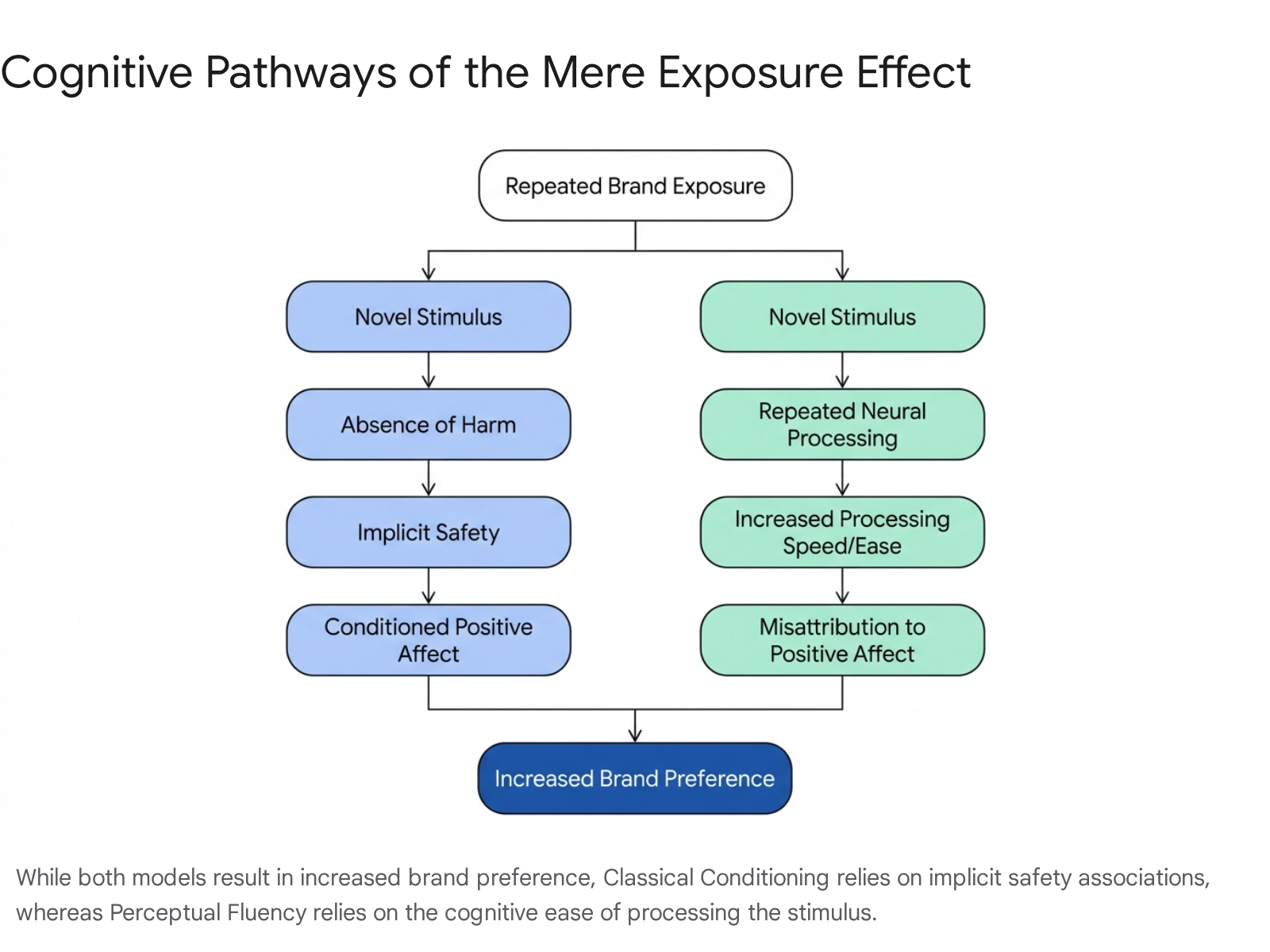
While these models are distinct in their neurological assumptions, they both conclude that conscious cognitive appraisal is secondary to affective response.
Classical Conditioning and Implicit Safety
Zajonc originally argued that the mere exposure effect operates via a subtle form of classical, or Pavlovian, conditioning 14. In a traditional classical conditioning paradigm, a neutral stimulus is repeatedly paired with an unconditioned stimulus that naturally elicits a physiological or affective response. Over time, the neutral stimulus alone begins to elicit that same conditioned response 614. In the specific context of mere exposure, the unconditioned stimulus is the absolute absence of negative consequences 14.
From an evolutionary biology perspective, when an organism encounters a novel stimulus, the initial biological response is an orienting reflex, often characterized by mild apprehension, fear, or avoidance, rooted in survival mechanisms 5. However, as the brand, product, or individual is encountered repeatedly without resulting in harm, the subconscious mind associates the stimulus with safety 414. Over successive exposures, this absence of harm conditions a positive approach tendency. The stimulus transitions from being novel and potentially threatening to familiar and safe, generating a primitive association in implicit memory that signals trust 14.
This conditioning mechanism carries several profound implications for contemporary advertisers. First, if a brand is repeatedly presented in a context that creates cognitive load, frustration, or competes with a goal-directed task - a phenomenon known as distractor devaluation - the mere exposure effect can be reversed 14. In such scenarios, liking for the distracting stimulus declines because it is implicitly associated with the "harm" of task interruption 14. Second, the positive affect generated by this form of conditioning is highly diffuse. Zajonc's later research in the late 1990s and early 2000s indicated that the positive mood induced by the subliminal repetition of a stimulus can spill over, improving the consumer's attitude toward entirely unrelated objects, shapes, or brands in the immediate environment 1114.
Perceptual Fluency and Misattribution
An alternative theoretical framework, which gained significant prominence through the research of Robert Bornstein and others in the 1990s, is the perceptual fluency/attributional model 51013. Perceptual fluency refers to the subjective ease, efficiency, and speed with which the brain processes incoming sensory information 513. When a consumer is repeatedly exposed to a brand logo, product silhouette, or advertising jingle, the neural pathways required to process that specific visual or auditory information become optimized and more efficient 13.
Because the brain expends significantly less cognitive energy to process a familiar stimulus, the neurological experience feels fluent and effortless. Human psychology inherently prefers cognitive ease to cognitive strain; therefore, the ease of processing is experienced internally as a positive affective state 513. The critical step in this model is misattribution: the consumer subconsciously misattributes the positive feeling of fluent processing to the inherent quality, aesthetic appeal, or trustworthiness of the brand itself 910.
Research into the perceptual fluency model indicates that this effect is maximized under conditions of incidental, low-involvement exposure 9. If a consumer consciously recognizes that they have seen an advertisement multiple times, they may correctly attribute their processing ease to the repetition rather than the product, effectively neutralizing the positive affect through conscious discounting 910. This underscores the immense value of low-attention advertising placements - such as programmatic display banners, algorithmic feed micro-impressions, or seamless product placements in entertainment - over highly intrusive, non-skippable formats that trigger critical cognitive evaluation 615.
Neurological Divergence of the Models
The debate between classical conditioning and perceptual fluency is further illuminated by neurological distinctions. Perceptual fluency, rooted in habituation, relies on short-term changes in brain function and immediate cognitive processing speeds 512. By contrast, classical conditioning depends on longer-term changes in synaptic physiology, such as the size of neurotransmitter vesicle pools and the density of postsynaptic receptors, which develop over hours and persist for weeks 12. Thus, the mere exposure effect likely relies on a combination of both mechanisms: immediate perceptual fluency driving short-term ad recall, and classical conditioning cementing long-term brand equity and brand safety associations 1012.
Neurological Evidence of Subconscious Processing
Advances in neuromarketing over the past decade, particularly the utilization of functional magnetic resonance imaging (fMRI), magnetoencephalography (MEG), and electroencephalography (EEG), have provided empirical validation for the subconscious nature of the mere exposure effect 121617. Traditional market research methods, such as surveys and focus groups, are inherently flawed when measuring familiarity biases because they rely on self-reported, conscious rationalizations of behavior 17. Neuromarketing bypasses this cognitive filter to measure the raw physiological and neural responses to marketing stimuli 1719.
Brain Activation and Implicit Memory
Neurological studies indicate that while explicit, deliberate decision-making relies heavily on the prefrontal cortex, the mere exposure effect is largely mediated by deeper brain structures associated with implicit memory and emotion 11217. Implicit memory functions independently of conscious recollection. Consequently, a consumer may genuinely prefer a specific brand of beverage, enterprise software, or fashion label without ever consciously remembering having seen its advertisements 414.
Research mapping neural pathways reveals that preference judgments related to mere exposure are associated with right lateral frontal activation, whereas conscious recognition judgments involve left frontopolar and parietal activation 11. In numerous studies, participants exhibited right lateral frontal activation indicating preference for previously exposed stimuli, yet their left frontopolar networks showed no indication of subjective, conscious familiarity 11. This biological bifurcation proves that humans process brand affinity and brand recognition on entirely separate neural tracks 11.
Cognitive Dissonance in Artificial Intelligence Stimuli
Recent neurological research highlights the brain's acute, subconscious sensitivity to stimulus authenticity, which has profound implications for the mere exposure effect in the modern era. A comprehensive study by NielsenIQ (NIQ), presented in late 2024 and early 2025, utilized EEG technology combined with implicit association tests to measure brain responses to artificial intelligence-generated advertising content across thousands of participants 1618.
The findings revealed that consumers subconsciously detect AI-generated imagery, even when it is visually convincing and rated as high quality by conscious observers 1618. The brain exhibits significantly decreased memory activation and heightened signs of cognitive dissonance when processing AI-generated ads compared to traditional, human-generated content 1618. This neurological mismatch severely impedes the perceptual fluency required for the mere exposure effect.
Furthermore, the NIQ study demonstrated that AI-generated ads create a "negative brand halo," with subjects implicitly associating the content with subconscious feelings of confusion, annoyance, and boredom 1618. By inducing negative affect, AI-generated stimuli violate the "absence of negative consequences" requisite for the classical conditioning model of mere exposure 141618. These findings suggest that while brands can build familiarity subconsciously, the stimuli themselves must align with established human cognitive processing patterns; synthetic media that triggers subconscious uncanny valley responses will actively degrade brand preference 1618.
Ad Wear-Out and Optimal Exposure Thresholds
While mere exposure is an incredibly powerful mechanism, it is subject to the economic principle of diminishing marginal returns, manifesting psychologically as "ad wear-out," "ad fatigue," or "issue fatigue" 192021. The trajectory of consumer preference is not infinitely linear.
The Inverted U-Curve of Consumer Preference
Zajonc's original hypothesis noted that the relationship between exposure and liking forms a positive, decelerating logarithmic curve: the first few exposures generate the most significant lift in positive affect and uncertainty reduction, with subsequent exposures contributing progressively less marginal value 25.
Modern psychological and marketing research extends this further, demonstrating an inverted U-curve relationship (e.g., Montoya et al., 2017) 458. Mere exposure typically reaches its maximum positive effect within 10 to 20 presentations of a stimulus 5. After this apex is reached, continuous forced exposure to the exact same stimulus generates boredom, irritation, and psychological reactance, causing brand preference to actively decline 458. This phenomenon is driven by "response competition," where an overexposed stimulus loses its fluent processing advantage and instead becomes a cognitive nuisance 6. Determining the optimal frequency threshold - the exact apex of the inverted U-curve - is a central challenge for media planners navigating fragmented media channels 2223.
Channel-Specific Frequency Dynamics
The threshold at which familiarity mutates into fatigue varies significantly depending on the media format, the level of active attention required by the platform, and the overarching campaign objective 2123.
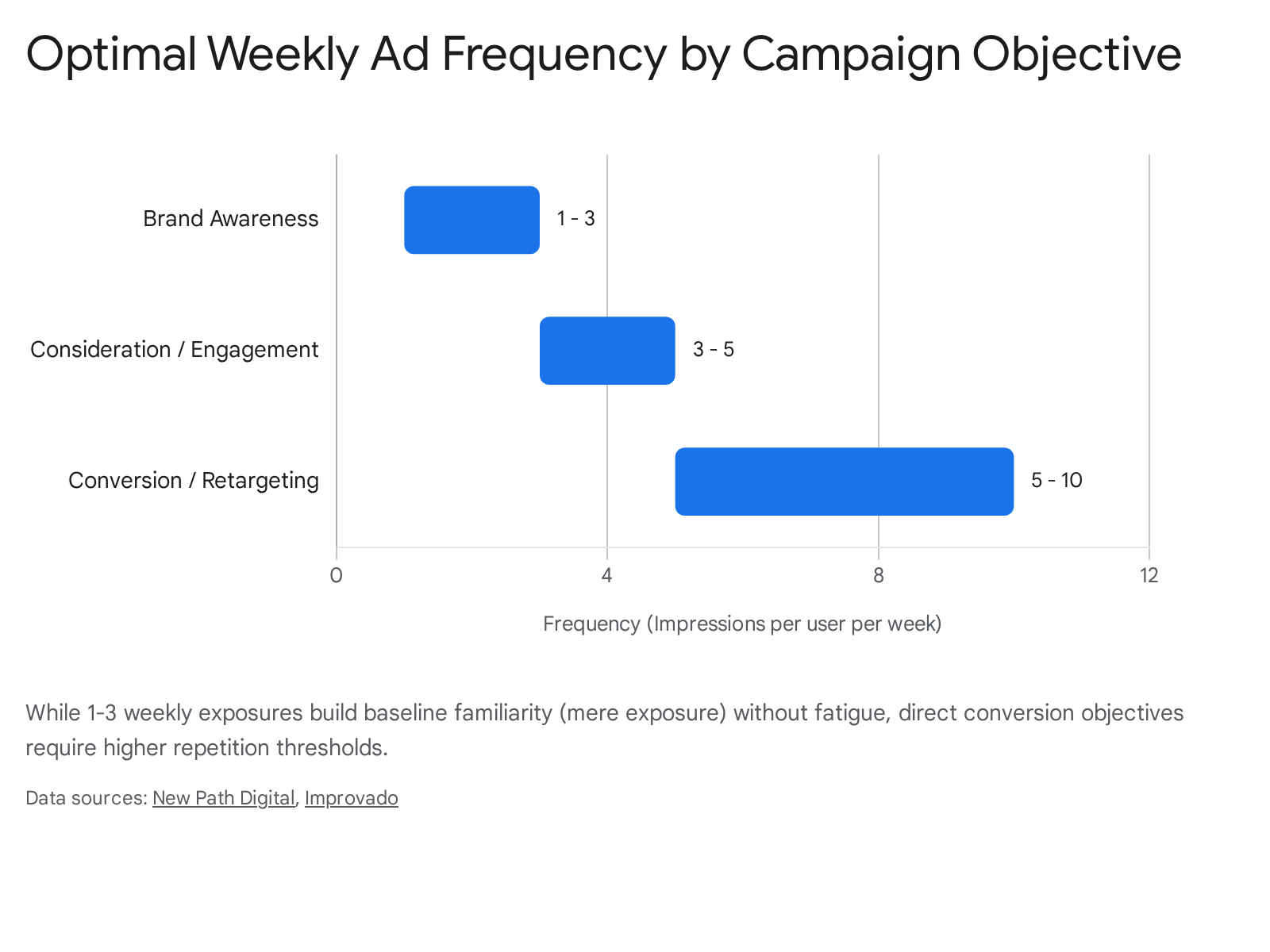
A nuanced approach to frequency capping is essential to protect brand equity.
| Media Format | Characteristics & Viewer Engagement | Optimal Frequency Threshold | Wear-Out Risk & Management Strategy |
|---|---|---|---|
| Static Display & Banner Ads | Low sensory engagement; highly peripheral processing 2126. | 1 to 3 impressions per week for awareness; 4 to 6 for retargeting 2123. | High risk of "banner blindness." Performance typically degrades within 7 days. Requires strict frequency caps to force algorithms to find new unique reach 212326. |
| Short-Form Video (Social) | High sensory engagement (motion, sound); scroll-based environment 2627. | 3 to 5 impressions per user per week 2123. | Moderate wear-out risk. Sustains performance for 2 to 4 weeks before creative fatigue. Requires regular creative refreshes rather than heavy single-asset repetition 2628. |
| Traditional & Connected TV | Immersive, often non-skippable; shared viewing environment 2924. | 5 to 10 impressions per week for conversion; lower for broad awareness 2223. | Lower immediate fatigue due to high production value, but high risk of annoyance if over-saturated. Best managed via household-level frequency capping 2223. |
| Audio & Podcasts | Passive, highly intimate consumption 25. | ~4 to 5 exposures per campaign flight 25. | High listener retention, but repetition of host-read ads can cause irritation. Decreasing frequency slightly often yields higher conversion rates 25. |
Measuring True Impact: Linear TV versus Streaming Analytics
Despite the rapid ascent of digital channels, linear television remains a massive driver of the mere exposure effect due to its sheer reach. In 2026, advertisers are projected to allocate approximately $139 billion to linear television, compared to roughly $33 billion for streaming and CTV ad formats 2627. However, the efficacy and attribution models of traditional TV are undergoing rigorous academic and industry reassessment.
Researchers from the University of Notre Dame, utilizing real-time LG smart TV tracking data cross-referenced with consumer delivery app usage, discovered that traditional measurement methodologies have historically overestimated the true sales lift of linear TV ads 2627. Previous models failed to account for pre-existing buyer habits and organic baseline familiarity, confusing the mere exposure effect generated by the ad with the demographic's baseline likelihood to purchase 2627.
By treating the randomized timing of ad slots across opt-in households as a natural experiment, researchers isolated the true causal effect of the TV exposure. When controlling for isolated ad exposure timing, the true sales impact of traditional TV ads was found to be nearly half of what was previously believed 2627. Nevertheless, CTV platforms, which allow for addressable, household-level frequency capping and deterministic attribution, are bridging this gap. By utilizing identity resolution and data collaboration, advertisers can precisely control exposure frequency, transforming television from an awareness-only broadcast channel into a full-funnel performance medium 2428.
Algorithmic In-Feed Placements and Micro-Impressions
As the digital landscape evolves, the mechanics of the mere exposure effect are shifting fundamentally from brand-controlled broadcasting to algorithm-mediated distribution. In 2025 and 2026, marketing science formally recognizes a paradigm shift known as "algorithmic branding" 29.
Traditionally, brand managers explicitly controlled the cadence, context, and frequency of brand exposure through purchased media. Today, proprietary algorithms on platforms like TikTok, Instagram, YouTube, and LinkedIn act as the primary gatekeepers of consumer attention 29. These systems utilize predictive machine learning to maximize user engagement, creating highly personalized, rapid-fire recommendation feeds 3031. Within these infinite-scroll environments, consumers are subjected to thousands of "micro-impressions" - brief, fleeting exposures to brand logos, product silhouettes, or influencer endorsements 293233.
The Concept of Algorithmic Fluency
To capitalize on the mere exposure effect within this ecosystem, brands must develop what industry analysts term "algorithmic fluency" 33. Algorithms lack consciousness, but they meticulously categorize content based on visual signals, repetitive language, metadata, and audience dwell time 3334. When a brand consistently publishes content around a specific thematic anchor using a highly recognizable visual identity, the algorithm builds confidence in categorizing and serving that content to lookalike audiences 34.
This dynamic creates a powerful compounding loop: the algorithm repeatedly serves the brand's content to a specific user cluster, generating continuous, rapid micro-impressions 34. Because these impressions occur within an in-feed environment where the user's primary focus is scrolling and entertainment consumption (a goal-directed task), the brand exposure is processed peripherally 614. This peripheral processing is the optimal condition for the perceptual fluency model of mere exposure, as it builds immense implicit brand familiarity without triggering conscious scrutiny, ad-blockers, or psychological resistance 133435.
The Danger of Trend Chasing and Echo Chambers
While algorithmic distribution scales mere exposure efficiently, it presents significant structural risks. Research on platform algorithms, such as studies conducted by the Bonn Collaborative Research Center, demonstrates a systemic tendency for recommendation engines to overexploit user similarities, effectively locking users into rigid "echo chambers" 36.
In response to algorithmic pressures, many brands engage in aggressive "trend-chasing" - constantly mutating their format, tone, and visual identity to match viral memes or trending audio 2934. However, this strategy actively sabotages the mere exposure effect. The human brain requires structural consistency to build the neural pathways that facilitate easy processing and perceptual fluency 1334. When a brand looks and sounds different in every algorithmic interaction, the cognitive effort required to recognize it increases, fracturing the implicit memory structures required for preference formation 34. Therefore, strict adherence to consistent positioning, recognizable brand codes, and thematic clarity is far more vital than viral trend-chasing in algorithmically mediated environments 2934.
As AI-driven recommendations saturate digital life, causing an "algorithmic flattening" where all content feels homogenous, consumer behavior is shifting toward "micro-authorship" - a desire for intentional, identity-driven choices 32. Brands that maintain consistent, authentic identities become reliable anchors in this flattened landscape, benefiting from long-term mere exposure rather than fleeting viral spikes 2932.
Cross-Cultural Moderation of Subconscious Branding
The efficacy, implementation, and optimal delivery mechanisms of the mere exposure effect are not universally uniform; they are deeply moderated by cultural frameworks. Anthropologist Edward T. Hall's seminal distinction between high-context and low-context cultures provides an indispensable lens for understanding these global variations in subconscious processing 373839.
Cultural Processing of Ambient Context
Different cultures process communication, visual stimuli, and implicit meaning differently based on their societal reliance on surrounding context:
- Low-Context Cultures (e.g., United States, Germany, Switzerland, Scandinavia): Communication is direct, explicit, and linear. Meaning is derived primarily from the exact words spoken or written, rather than the surrounding environmental, relational, or non-verbal cues. Clarity and efficiency are prioritized 374041.
- High-Context Cultures (e.g., Japan, China, Brazil, Saudi Arabia, Mexico): Communication is indirect, relational, and highly reliant on implicit cues. Meaning is deeply embedded in the situation, visual symbolism, non-verbal expressions, and historical context. The burden of interpretation often lies with the listener/viewer to "read between the lines" 37404142.
Strategic Implications for Advertising Design
Because individuals in high-context cultures are culturally conditioned from birth to constantly scan and interpret their periphery for non-verbal and environmental cues, their cognitive architecture is highly receptive to subtle, ambient forms of the mere exposure effect 373843. In these markets, brand preference can be heavily influenced by background product placements, ambient digital advertising, and atmospheric brand presence without ever requiring a direct sales pitch 943.
Conversely, in low-context cultures, consumers prioritize the central, explicit message and possess cognitive filters that more aggressively tune out peripheral ambient stimuli 384043. While the mere exposure effect still operates robustly in the West, generating the necessary perceptual fluency often requires the brand logo or core asset to be more centrally positioned or explicitly integrated into the primary content narrative 4043.
| Cultural Framework | Information Processing Style | Optimization for the Mere Exposure Effect | Advertising Strategy & Design Preferences |
|---|---|---|---|
| High-Context | Implicit, relational, holistic scanning, non-verbal reliant. | Highly effective through ambient, subtle placement. The brain is trained to process peripheral environmental cues continuously. | Visual symbolism, rich color palettes, metaphorical storytelling, and seamless product placement 4043. |
| Low-Context | Explicit, direct, focused attention, verbal/text reliant. | Requires more prominent placement. Peripheral processing is lower as cognitive focus is rigidly directed toward explicit text. | Clear calls to action (CTAs), structured formats (bullet points), clean layouts, direct and logical benefit claims 40. |
Empirical studies confirm these divergences. For example, a comparative analysis of global B2B websites found that platforms originating in low-context countries utilize more linear navigation, explicit textual information, and direct corporate data 44. High-context websites rely more heavily on aesthetics, animations, and relationship-building visual cues 44. Similarly, multinational advertising research indicates that brands utilizing rich imagery and sensory soundscapes achieve faster implicit familiarity in high-context Asian markets compared to text-heavy variants 43. Marketers attempting to enforce rigid global standardization of campaigns often fail because a minimalist, text-heavy low-context advertisement lacks the atmospheric cues necessary to build subconscious emotional resonance in a high-context market 404445.
Strategic Implications for Future Marketing
As the marketing industry navigates the latter half of the 2020s, the application of the mere exposure effect has evolved from a passive byproduct of mass broadcasting to a deliberately engineered, data-driven component of digital strategy.
The meteoric rise of Retail Media Networks (RMNs) exemplifies this shift. RMNs are projected to reach $100 billion in U.S. ad spend by 2028, representing a massive reallocation of enterprise marketing budgets 46. By placing programmatic advertisements directly within e-commerce environments (e.g., Amazon, Walmart Connect), brands leverage the mere exposure effect at the exact moment of consumer decision-making. Repeated exposure to a specific brand on the periphery of a digital storefront builds the necessary cognitive ease so that, when the consumer eventually executes a search query for that product category, the familiar brand instinctively feels like the safest and most reliable choice 446.
Furthermore, as the integration of artificial intelligence drives an unprecedented explosion in content volume, traditional metrics of reach and frequency are becoming commoditized. To differentiate, brands must utilize the mere exposure effect not merely to build cold recognition, but to cultivate "emotional ROI" 47. This is achieved by ensuring that every repeated exposure - whether a micro-impression on a social feed, an addressable CTV spot, or an experiential real-world activation - consistently reinforces a unified, emotionally intelligent brand identity 194748.
Conclusion
The mere exposure effect remains one of the most robust and highly replicated phenomena in consumer psychology, proving that familiarity alone is sufficient to generate brand preference without the prerequisite of conscious evaluation or rational analysis. Driven by the dual cognitive engines of perceptual fluency and classical conditioning, the subconscious brain instinctively equates processing ease and the historical absence of harm with positive affect, safety, and trust.
To leverage this psychological bias successfully in a highly fragmented, algorithm-driven media ecosystem, marketers must balance persistent visibility with strategic restraint. Implementing precise, channel-specific frequency caps across digital and connected TV environments is essential to avoid the inverted U-curve of ad wear-out and psychological reactance. Furthermore, brands must maintain absolute visual and thematic consistency to train algorithmic delivery systems and build the neural processing efficiency required for perceptual fluency. Finally, recognizing the distinct ways in which high-context and low-context cultures process ambient stimuli allows for the calibrated localization of international campaigns, ensuring that subconscious branding resonates effectively on a global scale.