
Impact of Advertisement Abstraction and Construal Fit on Persuasion
Foundational Principles of Construal Level Theory
Construal Level Theory postulates that human cognition and the resulting mental representations of objects, events, or concepts are fundamentally shaped by psychological distance 12. Psychological distance is defined as the subjective experience of how close or far an object is from the self in the present moment, encompassing four primary dimensions: temporal distance (time), spatial distance (physical space), social distance (interpersonal closeness or similarity), and hypotheticality (probability of occurrence) 234. When a consumer perceives an object or event as psychologically distant, they tend to represent it using high-level construals, which are abstract, schematic, and decontextualized representations focusing on core features and ultimate goals, often conceptualized as the "why" of an action 25. Conversely, when an object is perceived as psychologically proximal, it is represented through low-level construals, which are concrete, detailed, unstructured, and contextualized representations focusing on secondary features and practical execution, understood as the "how" 25.
Construal fit, frequently identified as the matching effect, occurs when the abstraction level of a persuasive message structurally aligns with the consumer's current mental construal or psychological distance 46.
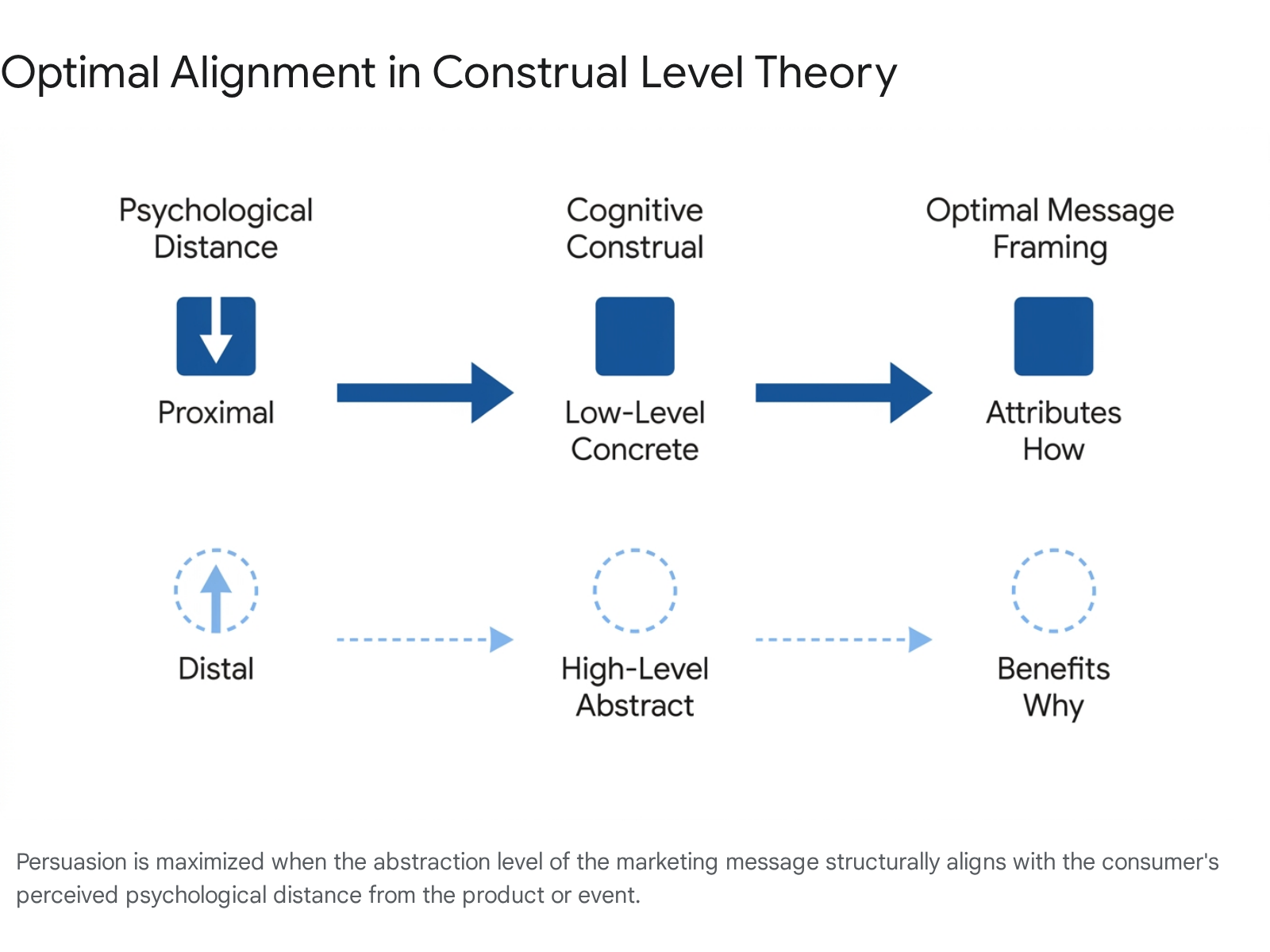
A substantial body of consumer psychology and marketing research demonstrates that persuasive appeals are significantly more effective when this cognitive congruence is achieved 466. When an advertising message matches a consumer's cognitive state, it facilitates processing fluency, which consumers subjectively experience as a "feeling right" sensation 57. This cognitive ease reduces skepticism, increases engagement, and ultimately enhances brand evaluation and purchase intent 789.
Mechanisms of Construal Fit in Consumer Processing
The efficacy of construal fit is driven by multiple underlying cognitive mechanisms, predominantly processing fluency and regulatory alignment. When individuals encounter information that corresponds to their current state of mental representation, the information requires less cognitive effort to encode and evaluate, subsequently influencing decision-making 7.
Processing Fluency and Confidence
Processing fluency directly influences the persuasiveness of an advertisement because individuals implicitly misattribute the ease of processing to the validity, truthfulness, or desirability of the message itself. Empirical findings demonstrate that concrete advertising messages are associated with low mental construals, whereas abstract messages are associated with high mental construals 7. When a consumer evaluates a psychologically proximal event using a low-level construal, highly detailed, contextualized information feels natural and easy to process. This fluency enhances the consumer's confidence in their evaluation, leading to robust attitude formation 57. Conversely, an incongruent message - such as providing highly abstract, value-driven rhetoric for an immediate, tangible purchase decision - creates cognitive friction, reducing the persuasiveness of the appeal and diminishing overall message acceptance 78.
Regulatory Focus and Goal Congruence
Construal fit also interacts dynamically with consumer goals, specifically within the framework of regulatory focus theory. Regulatory focus distinguishes between promotion-focused goals, which emphasize seeking positive outcomes, advancement, and achievement, and prevention-focused goals, which prioritize avoiding negative outcomes, risk reduction, and security 910. Research indicates that regulatory fit - the match between consumer goals and message concreteness - results in significant variations in persuasive impact 9.
Controlled experimental settings reveal that participants with a prevention focus report significantly more favorable brand attitudes when exposed to low-level, concrete construal messages ($M = 5.08$) compared to high-level, abstract messages ($M = 3.77$, $p < .001$) 9. Prevention inherently relies on vigilance and specific detail to avoid errors, aligning tightly with the mechanics of low-level construals. In a secondary experiment analyzing product evaluations (e.g., a flash drive), prevention-focused participants similarly favored concrete messages ($M = 5.31$) over abstract ones ($M = 4.63$, $p < .01$) 9. Conversely, promotion-focused consumers, who are driven by aspirational end-states, evaluated brands more favorably when described using high-level, abstract construals 910.
Dimensions of Psychological Distance in Advertising
The application of construal fit requires marketers to modulate message abstraction according to the specific dimensions of psychological distance relevant to the campaign, the medium, and the target audience.
Temporal Distance and Message Framing
Temporal distance - how far an event is located in the future or past - remains the most extensively investigated dimension within Construal Level Theory 111. Consumers planning purchases in the distant future exhibit a natural gravitation toward high-level construals. Evaluations made about distant future events rely heavily on primary, goal-relevant features and core benefits 25. In contrast, immediate or near-future purchase decisions trigger low-level construals, shifting cognitive focus to secondary, feasibility-related details and specific operational attributes 25.
This dynamic is clearly illustrated in the evaluation of service guarantees. Consumers planning to utilize a service in the distant future evaluate full-satisfaction, abstract guarantees more favorably, whereas consumers making immediate purchases prefer attribute-specific, concrete guarantees 4. Furthermore, the temporal framing of an advertisement can significantly alter consumer responses to cause-related marketing initiatives. Temporal frames that highlight extended durations or distant dates invoke higher-level construals, shifting the consumer's focus to the ultimate societal impact rather than the immediate personal costs of the donation 13.
Spatial and Visual Distance
Spatial distance influences both visual processing and linguistic encoding in advertising. Products or events physically distant from the consumer benefit from abstract messaging, whereas those nearby benefit from concrete messaging 1415. Image proximity operates on this same cognitive axis. Advertising images featuring extreme close-ups evoke low-level construals and synergize best with rational, detail-oriented textual appeals. By contrast, wide or long-shot images evoke high-level construals and enhance the effectiveness of emotional or hedonic appeals 1512. In experiments involving green advertising, close-up shots of environmentally friendly products successfully induced a low construal level, prompting consumers to process specific environmental information, such as carbon labels and packaging nuances 12.
Social Distance and Influencer Advertising
Social distance refers to the perceived interpersonal closeness, similarity, or familiarity between the consumer and the entity delivering the message. In digital marketing and influencer advertising, follower size acts as a powerful proxy for social distance. Influencers with massive followings (macro-influencers) are perceived as socially distant, invoking high-level construals 13. Consequently, macro-influencers are more persuasive when utilizing abstract brand promotions integrated seamlessly into their broader lifestyle content. Micro-influencers, possessing smaller followings, are perceived as socially proximal, akin to peers, thereby invoking low-level construals. As a result, micro-influencers achieve optimal persuasion when their posts utilize concrete, explicit brand tags and direct product demonstrations 13.
When multiple psychological distances compete within a single scenario, certain dimensions exhibit dominance. Experimental data testing competing construals found that social distance acts as the primary driver of consumer behavior in distant-future scenarios. When both dimensions were activated simultaneously, the interaction between social distance and advertising appeal significantly impacted consumers' willingness to pay ($\beta = 0.498, p = 0.042$) 1. However, in near-future contexts, the salience of temporal distance intensifies and can override the effects of social distance, demonstrating the fluidity of cognitive weighting 1.
Product Characteristics and Framing Congruence
The inherent functional nature of a product dictates a baseline construal level, requiring advertisements to match this inherent abstraction to achieve optimal persuasion.
Hedonic Versus Utilitarian Classifications
Products are generally categorized by the primary benefits they provide: hedonic, which are experiential, emotional, and pleasure-seeking, or utilitarian, which are functional, practical, and goal-oriented 1415. Hedonic products naturally activate an abstract, emotional processing model associated with high-level construals. Utilitarian products invite a detailed, cognitive thinking model associated with low-level construals 15.
Matching ad copy to these categories is critical for efficacy. For utilitarian products, advertisements containing detailed, contextual explanations and rational appeals are highly persuasive 15. For hedonic products, abstract, noncontextual information that evokes imagery and overarching benefits performs optimally. This principle extends to post-purchase interactions, such as how brands handle negative consumer comments online. To secure immediate sales recovery following negative feedback on a utilitarian product, management responses must offer detailed, concrete explanations of the remedy. In contrast, responding to complaints about hedonic products with overly detailed, concrete information can actually reduce desirable outcomes, as it breaks the high-level, experiential construal required for hedonic consumption 15.
Furthermore, product preference moderates the construal level applied to advertising. High product preference promotes low-level construals by increasing cognitive engagement with preference-congruent information, whereas low preference induces high-level construals, fostering an abstract focus on core attributes 16.
Product Durability and Media Formats
The physical durability of a product also influences psychological distance. Durable goods, such as furniture or tools, represent long-term investments and are conceptually distant, triggering high-level construals 4. Nondurable goods, such as food or daily consumables, represent immediate, short-term consumption, triggering low-level construals 4.
Simultaneously, the media format of the advertisement possesses inherent construal properties. Pictorial formats, such as highly vivid images, are contextualized and concrete, invoking low-level construals 414. Textual formats require symbolic decoding and are inherently more abstract and decontextualized, invoking high-level construals 414. Optimal persuasion occurs when the media format matches the product's durability.
Data from controlled experiments reveal a significant interaction effect between message type and product type concerning brand attitude and purchase intent ($F(2, 134) = 13.38, p < .001$) 4. Nondurable goods generate higher purchase intent when paired with concrete pictorial advertisements, whereas durable goods perform better with abstract textual advertisements 4.
| Product Category | Purchase Frequency | Optimal Ad Format | Purchase Intent (Matched) | Purchase Intent (Mismatched) |
|---|---|---|---|---|
| Nondurable (Fruit) | >16 times/year | Pictorial (Concrete) | $M = 3.72$ | $M = 2.61$ (Textual) |
| Durable (Furniture) | 0-5 times/year | Textual (Abstract) | $M = 3.07$ | $M = 2.18$ (Pictorial) |
| Durable (Tools) | 0-5 times/year | Textual (Abstract) | $M = 3.50$ | $M = 2.25$ (Pictorial) |
Promotional Tactics and Pricing Formats
Construal fit also dictates the optimal framing of price discounts. The two most ubiquitous discount formats - percentage-off (e.g., 20% off) and absolute dollar-off (e.g., $10 off) - are not cognitively equivalent, even when the economic savings are mathematically identical 17. A dollar-off discount is concrete, easily calculated, and cognitively immediate, activating a low-level construal. A percentage-off discount requires a secondary mental calculation against a base price, representing a more abstract, high-level construal 17.
Consumer responses to these discounts improve significantly when matched with the appropriate advertising appeal. Attribute-based appeals, which focus on concrete product features, synergize with dollar-off discounts. Benefit-based appeals, which focus on abstract end-goals or lifestyle enhancements, align optimally with percentage-off discounts 17.
Device-Specific Construal and Digital Environments
The physical medium through which consumers access digital environments profoundly alters their psychological distance and corresponding construal level. Modern digital advertising must meticulously account for the cognitive disparities between mobile and desktop users to optimize conversion rates.
Mobile Versus Desktop Cognitive Mindsets
Smartphones and mobile devices are highly intimate, touch-based interfaces carried constantly by the user. This physical and psychological intimacy collapses spatial distance, inducing a concrete, low-level construal mindset 18. Users on mobile devices are characterized by rapid browsing, divided attention, and a focus on immediate, context-specific tasks. Consequently, mobile users interact with digital content at higher rates but exhibit significantly lower overall conversion rates for complex or high-value purchases. For example, mobile popups achieve an average interaction rate of roughly 62.17%, but yield a conversion rate of only 34.15%, indicative of shallow, fast-paced "micro-moments" where users are easily distracted 23.
Desktop computers, conversely, establish a distinct physical boundary between the user and the screen, increasing spatial distance and inducing an abstract, high-level construal mindset 18. The desktop environment is conducive to deep focus, thorough evaluation, and high-stakes decision-making. Consumers purposefully shift to desktop devices for tasks carrying heavier psychological weight, such as comparing complex financial products, completing detailed workflows, or executing high-value e-commerce transactions 24. Consequently, while mobile devices drive the vast majority of global web traffic (upwards of 59% to 68%), desktop devices consistently outperform mobile in fundamental conversion metrics 242526. Desktop conversion rates average between 3.2% and 4.0%, representing a significant premium over mobile conversion rates, which typically hover between 1.8% and 2.8% 2527. Mobile users also abandon shopping carts 16% more frequently than desktop users, highlighting the fragility of low-level construal purchasing environments 2527.
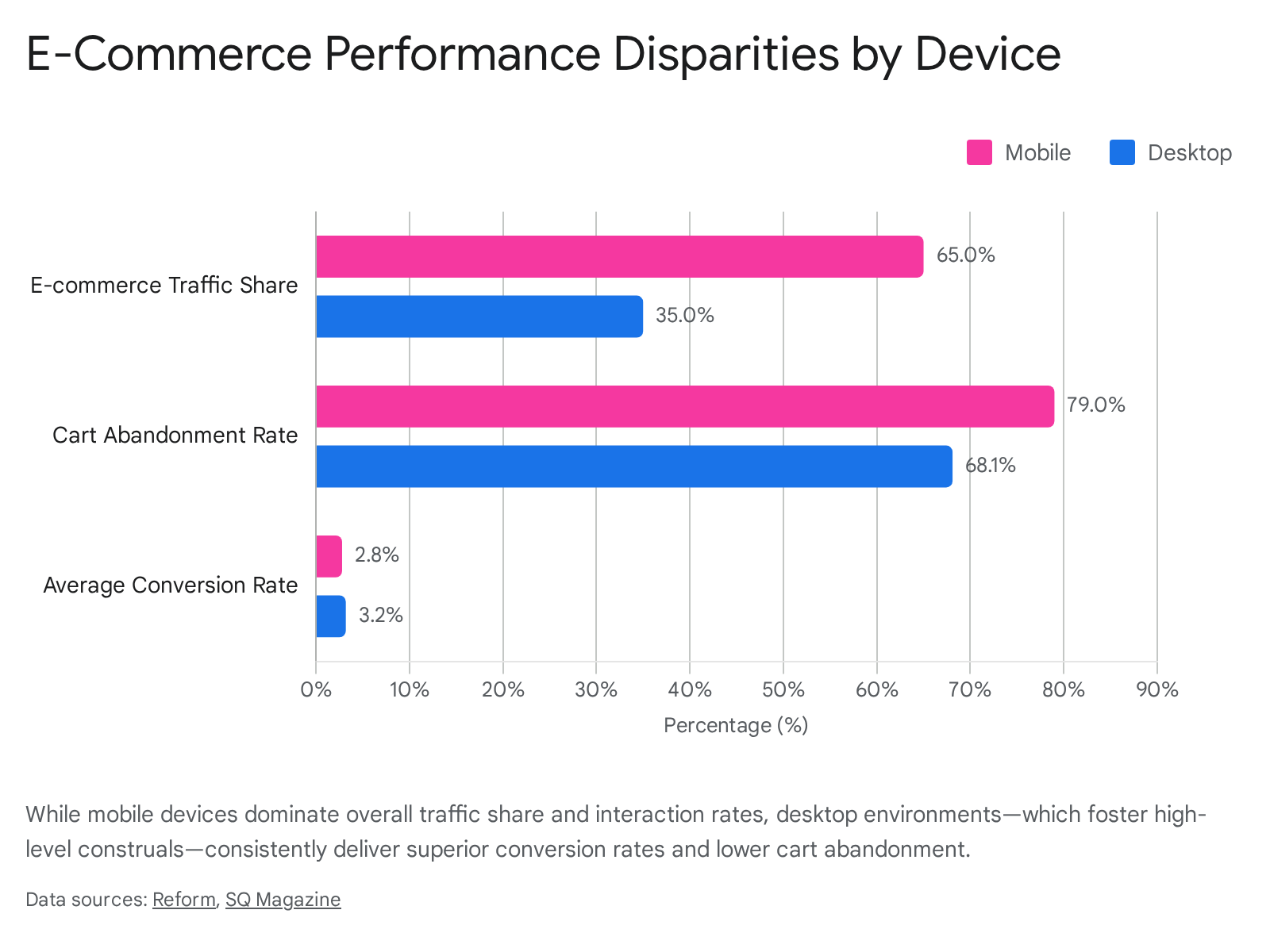
Marketers must align advertising construals with these device-specific mindsets to maximize return on ad spend. Mobile campaigns should strictly utilize low-level construals: highly concrete messaging, touch-optimized simplistic designs, location-based urgency, and clear, immediate calls to action. Conversely, desktop campaigns should deploy high-level construals: detailed product specifications, comprehensive comparisons, customer testimonials, and long-term benefit messaging designed to build confidence in intent-rich users 2425.
Algorithmic Personalization and Artificial Intelligence
The rapid proliferation of computational advertising and algorithmic personalization introduces a complex paradox into consumer psychology. Advanced algorithms possess the capability to match ad content to consumer profiles with unprecedented precision. However, these technological capabilities interact with human cognition in highly sensitive ways.
The Personalization-Privacy Paradox
When personalization becomes unexpected or hyper-specific, it frequently violates user privacy expectations, triggering a systemic shift in how the consumer processes the ad. This phenomenon, known as the "personalization-privacy paradox," forces consumers out of a fluent, intuitive processing state (often referred to as System 1 thinking) and into a slower, highly critical evaluation state (System 2 thinking). This cognitive shift increases psychological distance, diminishes institutional trust, and escalates advertising avoidance 1929. Furthermore, relying entirely on algorithmic personalization to curate information can inadvertently hinder consumer learning. Studies analyzing algorithmic tailoring reveal that users frequently develop a biased understanding of subjects, adopting an "illusion of competence" wherein their internal representation of categories becomes distorted due to a lack of exposure to diverse, non-prioritized features 2031.
Artificial Agents and Persuasion Dynamics
The source of the message - specifically whether it originates from a human or an artificial intelligence agent - also governs construal level. Consumers fundamentally perceive artificial agents, such as chatbots or algorithmically generated personas, differently than human agents 2133. Because AI lacks true autonomous intent, human empathy, and organic life experiences, consumers attribute a low-level construal profile to them. People view AI primarily as mechanical tools focused on execution (navigating "how" tasks) rather than sentient beings driven by intrinsic values or moral reasoning (navigating "why" tasks) 213334.
Consequently, persuasive messages delivered by AI agents are significantly more effective when framed using concrete, low-level construals. For instance, when an AI source focuses on the specific mechanics of how to perform a health-promoting behavior, persuasion increases. If an AI attempts to use abstract, high-level emotional or value-driven messaging - such as explaining why a behavior is morally important - it creates a stark construal mismatch, resulting in severe skepticism and diminished persuasive efficacy 213334. Virtual influencers face analogous hurdles; consumers perceive them as lacking inherent deservingness for their success, which generates lower engagement metrics compared to human counterparts. However, an important boundary condition exists: virtual influencers perform exceptionally well when matched with technology-oriented or futuristic products, where their artificial nature represents a high contextual fit, thereby increasing perceived credibility 13.
Cross-Cultural Cognitive Styles and Message Adaptation
Consumer mindsets are not solely shaped by momentary psychological distances or immediate technological contexts; they are deeply rooted in chronic, macro-level cultural orientations. The fundamental differences in cognitive processing between diverse cultures necessitate significant adaptations in global advertising strategies 1122.
Analytic Versus Holistic Thinking
Extensive cross-cultural psychology research indicates that Western cultures (e.g., North American, Western European) generally exhibit an analytic cognitive style, whereas Eastern cultures (e.g., East Asian) predominantly exhibit a holistic cognitive style 2223.
Analytic thinking involves deliberately detaching a focal object from its surrounding context, assigning it to specific categories, and using formal rules to predict behavior. Analytic thinkers tend to utilize high-level, abstract construals that focus on distinct, independent attributes 2223. As a result, Western consumers with analytic mindsets respond favorably to "attribute-oriented" advertising that isolates and highlights concrete product features and specific benefits 814. Furthermore, analytic thinkers utilize rigid differentiation strategies; when presented with contradictory information, they tend to polarize, evaluating one side as inherently more plausible than the other 24.
Holistic thinking, deeply influenced by interconnected philosophical traditions, involves a fundamental orientation toward the entire field or context. It emphasizes the complex relationships between objects rather than the objects in strict isolation 2223. Holistic thinkers process information at a broader, contextualized level. They rely heavily on background information, situational cues, and the overall narrative of an advertisement to evaluate products 8. Because holistic thinkers view the universe as composed of interconnected elements, they exhibit a high tolerance for contradictory information, often preferring a compromise or a "middle way" approach that reconciles opposing views 24. Evidence also indicates that cross-cultural construal differences extend to emotional processing; individuals from cultures fostering holistic thinking demonstrate higher comfort with marketing appeals that rely on mixed emotions, whereas analytic thinkers experience cognitive discomfort when presented with emotionally ambivalent ads .
When global brands expand across borders, aligning the advertising message with the prevailing cultural cognitive style is imperative for success. A Western consumer evaluating a brand extension utilizes analytic rules to determine categorical "fit" based on isolated features. Conversely, an Eastern consumer uses holistic thinking to identify broader, thematic relationships, leading to a higher baseline perception of fit and significantly more favorable evaluations of diverse, conceptually distant brand extensions 2541. Advertisements designed for holistic cultures should embed products in rich social contexts and emphasize relational harmony, whereas advertisements designed for analytic cultures should utilize clean, decontextualized layouts emphasizing specific, superior attributes .
Social Marketing and Purpose-Driven Advertising
The application of construal fit is equally potent outside traditional consumer goods, playing a vital role in social marketing, non-profit fundraising, and corporate brand activism. Purpose-driven advertising requires careful, strategic calibration of psychological distance to avoid appearing opportunistic or inauthentic to a skeptical public 42.
Cause-Related Marketing and Charitable Frames
In charitable advertising, the organization's messaging approach must strictly align with the psychological distance of the target audience. Competence-based appeals - which emphasize clear, immediate goals, organizational efficiency, and specific impact (e.g., "provide three meals daily per child") - operate at a low-level construal. These highly concrete messages maximize effectiveness when the psychological distance to the cause is low, such as with local community initiatives or demographically familiar beneficiaries 26.
Warmth-based appeals - which evoke empathy, moral identification, and abstract overarching ideals (e.g., "improve the quality of life for disadvantaged children") - operate at a high-level construal. These abstract messages are necessary to bridge large psychological distances, making them highly effective for international aid campaigns or conceptually distant societal issues where the donor lacks immediate physical proximity to the crisis 26.
The timing of corporate activism also influences public perception via construal mechanisms. Brands that publicly support sociopolitical causes (such as LGBT+ rights) early in their development signal a high degree of authenticity, sincerity, and principle. Delayed or reactive participation, however, generates a low-level construal evaluation from the public, focusing on the company's opportunistic execution rather than its overarching values, which frequently leads to consumer backlash 13.
Progressive Messaging and Femvertising
"Femvertising" - advertising that actively challenges traditional gender stereotypes and promotes female empowerment - relies heavily on construal fit to navigate consumer skepticism. In consumer categories historically reliant on functional utility, such as feminine hygiene, transitioning away from traditional informational (concrete, functional) advertising toward transformational (abstract, empowering) messaging has proven highly effective 66. Research spanning multiple experimental studies reveals that transformational femvertising messages boost purchase behavior significantly more than standard informational ones. However, this effect is entirely contingent upon the abstract empowerment narrative aligning tightly with the target audience's progressive mindset and the perceived authenticity of the brand's commitment to the cause 66.
Reevaluating the Efficacy of Concrete Messaging
A pervasive misconception within marketing literature and commercial industry practice is that concrete messaging is universally superior for driving immediate sales and engagement. Practitioners often operate under the assumption that distilling communication down to hyper-specific, tangible details minimizes cognitive load and forces immediate consumer action. A rigorous application of Construal Level Theory thoroughly debunks this reductive myth 2728.
Concrete messaging is not inherently or universally superior; its persuasive effectiveness is strictly contingent upon the presence of a low-level consumer construal 28. If a consumer approaches a decision with a high-level construal - whether due to temporal distance, spatial distance, holistic cultural framing, or the experiential, hedonic nature of the product - imposing a hyper-concrete, low-level message disrupts processing fluency and induces cognitive dissonance.
For example, in sustainability and fashion marketing, brand managers often mistakenly believe they must deploy highly detailed, concrete messaging regarding supply chain logistics and raw materials to prove authenticity and drive sales. However, qualitative and quantitative research demonstrates that when consumers lack extensive, specialized sustainability knowledge, or when they perceive the brand through a broader, lifestyle-oriented lens, these highly concrete messages fail to resonate 2829. Abstract messages that highlight the overarching values of environmental stewardship, aesthetic quality, and long-term durability are far more persuasive for these heterogeneous audiences 2829.
Similarly, utilizing highly concrete, functional descriptions for hedonic products actively harms the consumer experience by stripping away the necessary experiential, abstract imagery that drives hedonic consumption in the first place 1015. Even in digital environments highly optimized for direct response, abstract messaging retains immense power. While mobile platforms undoubtedly favor concrete calls-to-action due to user distraction, the desktop environment - where the vast majority of high-value conversions occur - richly rewards abstract, benefit-driven messaging that respects the user's high-level evaluation process 24.
Ultimately, persuasion is not a function of absolute message concreteness, but rather a strict function of structural alignment. The optimal advertising strategy requires a precise diagnosis of the consumer's psychological distance, cognitive style, and product context, followed by the deployment of a carefully calibrated message framed at the exact corresponding level of mental construal.