
Congruence Theory and Consumer Attitude Formation in Advertising
Consumer attitude formation is a multifaceted psychological process heavily influenced by the degree of alignment between a brand, its messaging, and the context in which the communication occurs. In marketing literature, this alignment is understood through the lens of congruence theory, which posits that consumers evaluate advertising stimuli based on preexisting cognitive schemas. When new information matches these internal frameworks, cognitive processing is fluent and automatic; when it deviates, it triggers varying degrees of cognitive elaboration, arousal, and affective response. Over the past several decades, the study of congruence has evolved from foundational cognitive psychology into a comprehensive domain encompassing cross-cultural communication, influencer marketing, native advertising, and algorithmic personalization.
Foundations of Schema Congruity in Advertising
Schema congruity theory, rooted in cognitive psychology and significantly advanced by George Mandler in 1982, forms the theoretical backbone for understanding how consumers process advertising messages. Schemas are organized structures of prior knowledge and expectations stored in memory, which individuals use to categorize, interpret, and evaluate incoming information 1234. In the context of consumer behavior, individuals possess well-developed schemas regarding product categories, brand identities, and typical advertising formats.
According to schema theory, when a consumer encounters a new instance of an advertisement, they automatically evaluate it against their activated category schema. Congruency refers to a state where the advertising stimulus fits neatly into these existing knowledge structures. Mandler theorized that the level of congruity between a product or message and a general schema dictates the nature of information processing and, consequently, the valence of the consumer's evaluation 125.
When information is highly congruent with a schema, it is perceived as familiar, acceptable, and logical. This familiarity allows for rapid, effortless cognitive processing, leading to a baseline of positive affect 16. However, because it matches expectations perfectly, strict congruence often fails to stimulate physiological arousal or deep cognitive engagement; it is easily overlooked in a highly saturated media environment 126. Conversely, schema incongruity occurs when incoming information does not easily fit existing knowledge structures. Incongruity acts as a cognitive disruption, triggering the autonomic nervous system, increasing arousal, and motivating the individual to resolve the discrepancy 278.
Dimensions of Schema Incongruity
Incongruency is not a unidimensional construct. Heckler and Childers (1992) refined the conceptualization of schema incongruity by demonstrating that it comprises two primary axes: expectancy and relevancy 169. Expectancy refers to the degree to which an item or piece of information falls into a predetermined pattern or structure evoked by the brand schema. Relevancy refers to the degree to which the information contributes to or detracts from the clear identification of the primary message 26.
These dimensions dictate how consumers process verbal and visual elements in advertisements. An advertisement that is unexpected but relevant generally stimulates deeper processing and better memory recall than one that is expected and relevant. In contrast, an advertisement that is both unexpected and irrelevant - often bordering on absurdity - risks causing confusion, diminishing evaluative responses, and impairing message comprehension 2910. For example, empirical studies on visual absurdity in print advertisements demonstrate that while an irrelevant visual anomaly might capture initial attention and increase brand name recall, it often causes consumers to misremember the actual brand slogan, as the cognitive load of processing the irrelevant stimulus overrides semantic memory storage 910.
Measurement of Advertising Memory
The impact of congruity on cognitive processing is frequently evaluated through memory metrics, specifically recall and recognition. While recognition tests measure whether a consumer can simply identify an advertisement they have seen before, recall tests measure how well they can retrieve the specific content of the advertisement from memory 1211. Industry methodologies, such as Starch scoring, further delineate these memory states by measuring the percentage of readers who noted the ad, associated it with the brand, and read the majority of the copy 11.
Memory retrieval is highly sensitive to the processing fluency established by ad congruency. However, marketers must also account for structural and financial variables that influence these metrics. Longitudinal analyses of digital advertising platforms indicate that while increased advertising spend is positively associated with message recall, excessive ad frequency can establish a negative relationship with recall due to ad fatigue and consumer annoyance 1215. Furthermore, researchers must control for telescoping errors, wherein consumers misremember the timing of their ad exposure, conflating long-term schema familiarity with recent campaign recall 11.
The Moderate Incongruity Effect
A central tenet of schema congruity theory is the non-monotonic, inverted-U relationship between the degree of incongruity and consumer preference, recognized broadly in marketing literature as the "moderate incongruity effect" 71314.
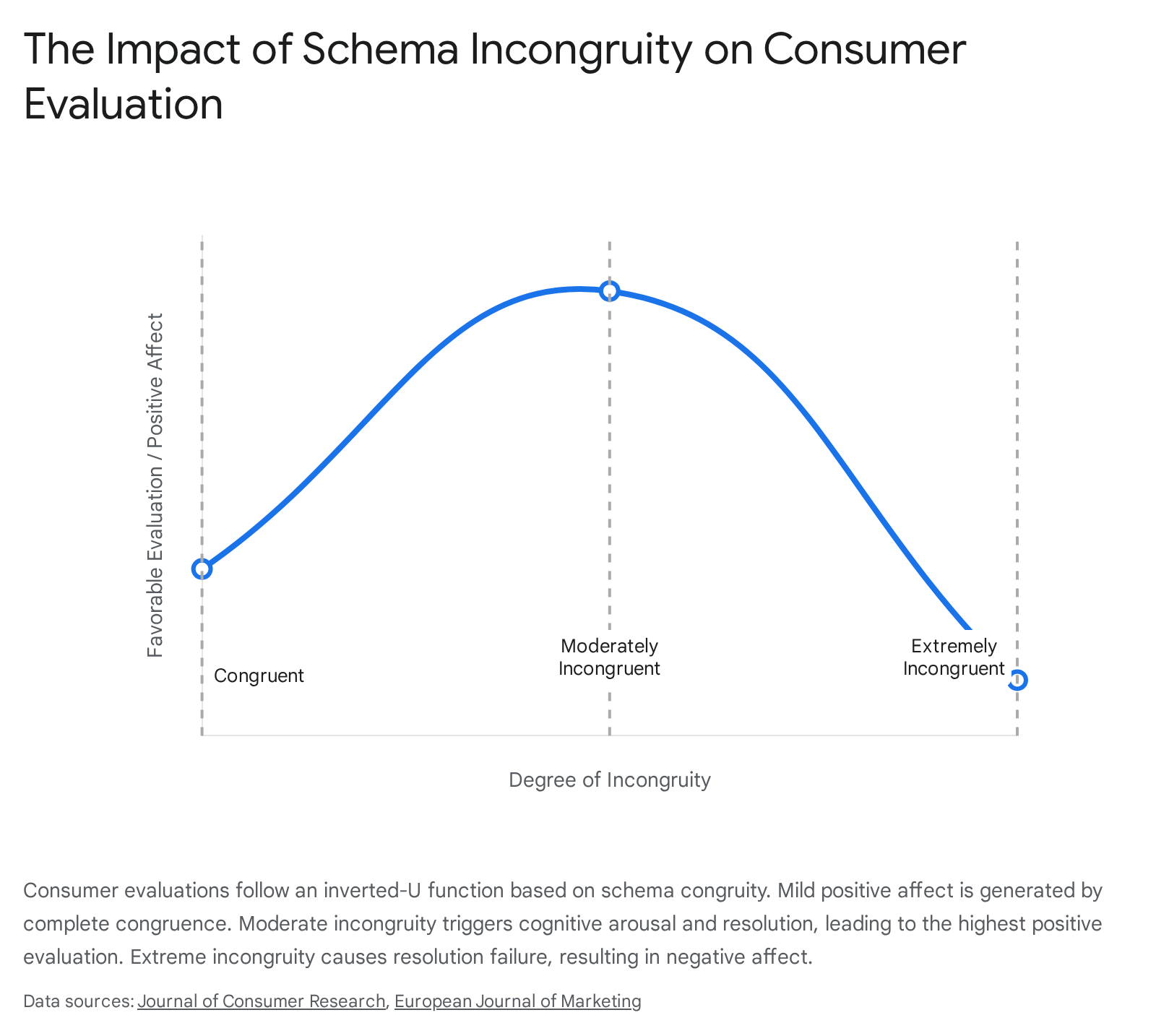
Meyers-Levy and Tybout (1989) provided foundational empirical evidence demonstrating that products or messages that are moderately incongruent with their associated schemas stimulate processing that leads to more favorable evaluations than stimuli that are either perfectly congruent or extremely incongruent 4515.
The psychological mechanism driving this effect is the cognitive resolution process. When consumers encounter a moderately incongruent advertisement, the slight mismatch activates the autonomic nervous system, generating physiological arousal, curiosity, and increased attention 7816. Because the incongruity is moderate, consumers can usually resolve the discrepancy using their existing cognitive structures through a process known as assimilation or subtyping 417. The successful resolution of this cognitive puzzle acts as an internal reward, yielding positive affect, enhanced memorability, and deeper elaboration of the brand message 131418.
To operationalize this progression, Yoon (2012) proposed a four-stage process model integrating schema incongruity theory with optimal stimulation level (OSL) theory 161819. The stages unfold as follows: 1) schema activation via initial exposure to the stimulus; 2) detection of incongruity, which captures attention; 3) motivated processing, wherein the arousal dictates whether the individual attempts to resolve the discrepancy via effortful, piecemeal processing or defaults to basic categorical rejection; and 4) evaluation, the final affective outcome contingent upon whether the incongruity was successfully resolved 1619.
Extreme incongruity, by contrast, presents unexpected and irrelevant information that fundamentally clashes with the consumer's established schemas 214. The cognitive effort required to accommodate such profound discrepancies is often too high, or resolution is entirely impossible without overhauling the core schema. This inability to resolve the incongruity generates cognitive dissonance, frustration, and negative affect, ultimately resulting in unfavorable brand evaluations and diminished persuasion 478.
Cognitive Fluency and Persuasion Knowledge
The relationship between brand-message fit and consumer attitude is heavily mediated by the dual, often competing mechanisms of cognitive fluency and persuasion knowledge (PK).
Cognitive fluency refers to the subjective ease with which individuals process information 202122. Thematic congruency between an advertisement and its medium or context generates high processing fluency. According to the Hedonic Marking of Fluency Account, this fluency is implicitly interpreted by the brain as a signal of familiarity, truth, and aesthetic pleasure, leading to positive, relatively automatic consumer evaluations 222324. For example, high visual consistency in ad design reduces cognitive load - a psychological relief that consumers frequently misattribute to the source's professional credibility or trustworthiness 24.
However, when an advertisement is incongruent with its context, processing fluency is disrupted. This disfluency forces the consumer out of automatic processing and into conscious, systematic elaboration 212223. While heightened attention benefits brand recall, it carries a significant risk: the activation of persuasion knowledge. Persuasion knowledge encompasses a consumer's awareness of marketers' persuasive intent and their tactical understanding of advertising 2325. Incongruency often triggers defensive cognitive mechanisms; as consumers expend energy analyzing an out-of-place stimulus, they become acutely aware of its manipulative intent 2326. Empirical studies demonstrate that while incongruence increases raw attention, it frequently generates negative PK thoughts, fostering skepticism and leading to unfavorable evaluations 2326. Therefore, the success of incongruent tactics relies on ensuring the cognitive puzzle remains engaging enough to resolve without triggering aggressive defensive skepticism.
Boundary Conditions and Moderating Variables
The moderate incongruity effect is not a universal law; its efficacy is constrained by numerous situational and individual difference variables. The literature identifies several critical moderators that determine whether a consumer will react positively or negatively to varying degrees of brand-message fit.
| Moderating Variable | Condition Favoring Absolute Congruence | Condition Favoring Moderate Incongruity | Source(s) |
|---|---|---|---|
| Perceived Risk | High financial, social, or functional risk (Preference for the norm) | Low perceived risk / routine decisions | 132728 |
| Regulatory Focus | Prevention focus (Motivated by avoiding errors or losses) | Promotion focus (Motivated by seeking novelty or gains) | 1428 |
| Baseline Arousal | High preexisting physiological arousal | Moderate or low physiological resting state | 78 |
| Environmental Emotion | State of awe derived from threatening or dangerous nature | State of awe derived from beautiful, harmonious nature | 29 |
| Decision Involvement | High personal issue involvement | Low to moderate involvement | 1330 |
| Prior Knowledge | High consumer expertise (reliant on established heuristics) | Low prior knowledge (sensitive to novel variations) | 143132 |
Perceived Risk and Decision Involvement
Perceived risk serves as a powerful boundary condition. Campbell and Goodstein (2001) demonstrated that the preference for moderate incongruity disappears when there is significant risk associated with the product selection 132728. Under conditions of high perceived financial or social risk, the moderate incongruity effect reverses, and consumers exhibit a strong "preference for the norm" 2728. In risky contexts, strict schema congruity provides psychological safety, whereas incongruity is perceived as an unnecessary gamble 27. Similarly, when consumers have exceptionally high involvement in a decision process, they often prefer clear, unambiguous, and congruent information, attenuating the benefits of moderately incongruent communication 1330.
Self-Regulatory Focus
The consumer's self-regulatory focus - whether they are motivated by promotion (seeking gains and advancement) or prevention (avoiding losses and ensuring safety) - significantly alters their tolerance for incongruity. Promotion-focused consumers demonstrate the classic inverted-U response, evaluating moderate incongruity more favorably than absolute congruity 1428. They view the cognitive challenge of resolving incongruity as an engaging opportunity. Conversely, prevention-focused consumers exhibit a monotonic decrease in product evaluation as incongruity increases 1428. For these individuals, any deviation from the expected schema is perceived as a potential error or threat.
Physiological Arousal and Discrete Emotions
Mandler's foundational theory rested on the premise that incongruity inherently alters arousal 7. Recent experimental work reveals that a consumer's state of arousal prior to viewing an advertisement dictates their response to incongruity. Low baseline arousal decreases preference for moderate incongruity while slightly increasing tolerance for extreme incongruity; however, a high state of baseline arousal diminishes evaluations for any form of incongruity, as the consumer lacks the cognitive bandwidth to process the discrepancy 8. Furthermore, discrete emotional states polarize these effects. For instance, feelings of awe derived from beautiful natural phenomena increase a consumer's choice of moderately incongruent products, whereas awe derived from threatening natural phenomena decreases it, as the latter heightens feelings of vulnerability and uncertainty 29.
Cross-Cultural Dimensions of Congruence
Because cognitive schemas are inherently shaped by cultural norms and values, the perception of brand-message congruity varies significantly globally. Cross-cultural advertising research utilizes Edward T. Hall's framework of high-context and low-context cultures, alongside Hofstede's dimensions of individualism and collectivism, to map these variations 33343536.
High-Context vs. Low-Context Communication
In low-context cultures (e.g., the United States, Germany, and Western European nations), communication is explicit, direct, and heavily reliant on verbal codes 333437. Consumers in these cultures expect advertisements to present clear, logical, and information-oriented arguments, often utilizing hard-sell approaches 3537. Congruence in low-context cultures is evaluated based on the functional and logical alignment between the brand's stated claims and the product's objective attributes.
Conversely, in high-context cultures (e.g., China, Japan, and various Middle Eastern nations), meaning is embedded in the physical context, social relationships, and non-verbal cues such as voice tone, gestures, and aesthetics 33343637. Communication is viewed as a relationship-building art form relying on metaphor, symbolism, and implicit understanding 333738. Advertisements tend to be emotional, symbolic, and rely on soft-sell approaches 35. Consequently, congruence is judged by the holistic, visual harmony of the advertisement and its alignment with social values, rather than strict verbal consistency 3638.
Individualism, Collectivism, and Self-Construal
Culturally congruent appeals dictate that individualistic societies respond favorably to messages emphasizing autonomy, personal achievement, and self-expression, while collectivistic societies favor messages emphasizing interdependence, group harmony, and shared tradition 33353839. Furthermore, an individual's self-construal - whether they view themselves as independent or interdependent - moderates the effect of visual harmony on attractiveness. Consumers with a highly interdependent self-construal demonstrate a more pronounced preference for visual harmony and holistic congruence in marketing artifacts 40. Thus, a standardized, moderately incongruent advertisement that relies on sharp visual contrast or blunt verbal shock may be perceived as a clever, stimulating puzzle in a Western market, but as aggressive, disjointed, and culturally dissonant in an Eastern market 3839.
Triadic Congruence in Influencer Marketing
The digital era has decentralized brand messaging, shifting significant persuasive power to social media influencers (SMIs). While traditional celebrity endorsement literature relies on the "match-up hypothesis" focusing solely on the fit between the celebrity and the product 414243, influencer marketing expands congruence theory into a complex triad involving the brand, the influencer, and the consumer 414445.
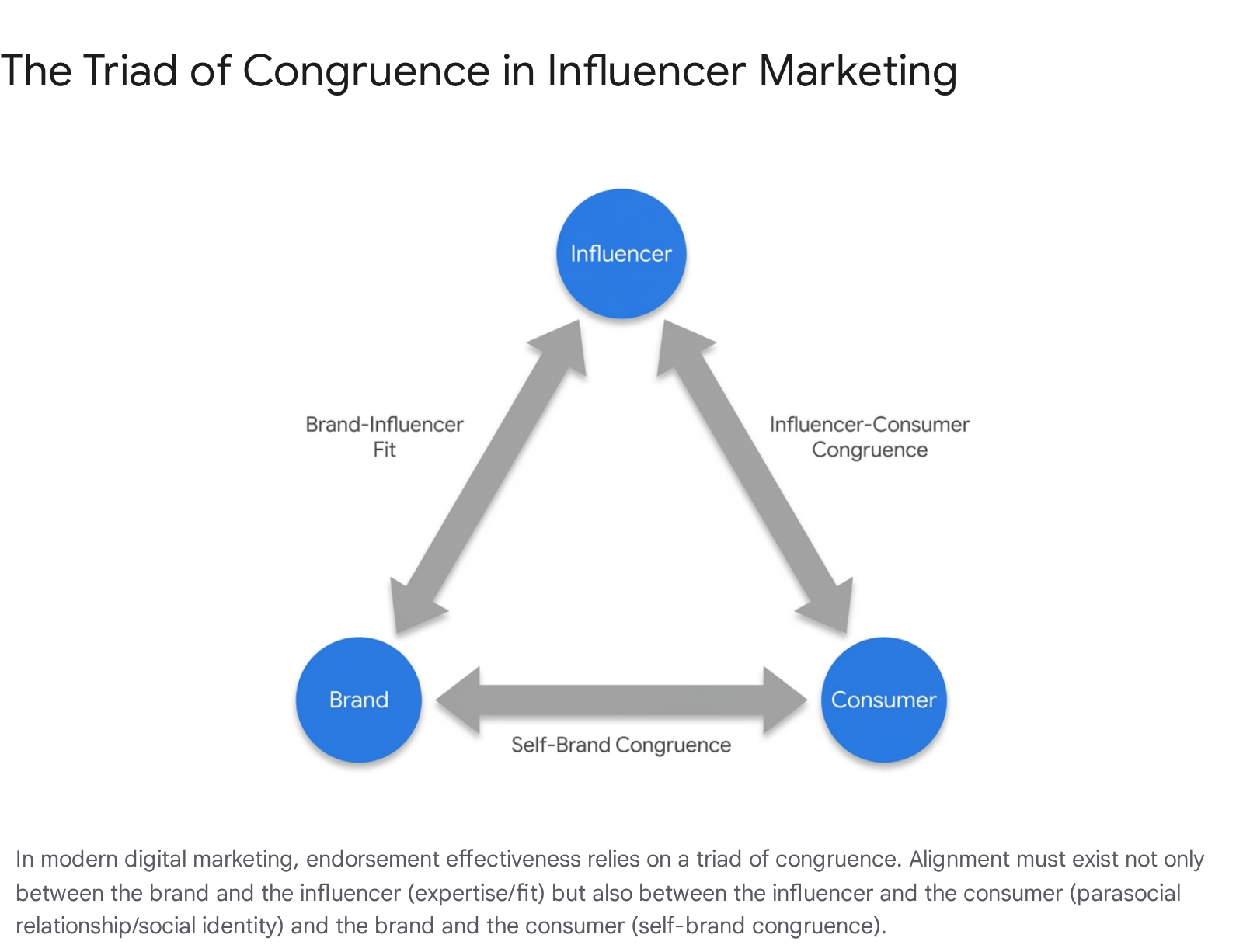
The first leg, brand-influencer congruence, refers to the degree of alignment between an influencer's personal brand - their values, lifestyle, aesthetic, and expertise - and the product being promoted 4446. High congruence here operates as the primary signal of source credibility and authenticity 4446. When a fitness influencer promotes a health supplement, the natural fit reduces the perception of forced commercial intent. Conversely, incongruence disrupts cognitive processing, leading consumers to view the endorsement as strictly financially motivated, severely damaging trust 4447.
The second leg, influencer-consumer congruence, leverages Social Identification Theory and parasocial relationships 46. Consumers follow influencers whose demographics, psychographics, or aspirational lifestyles mirror their own. High influencer-consumer congruence transforms the influencer into an trusted "in-group" member, dramatically amplifying receptivity and the likelihood of adopting the endorsed behaviors 444546.
The final leg is brand-consumer congruence, or self-brand congruity, which measures how well a brand matches the consumer's self-concept 47. Empirical research shows varying outcomes regarding which leg of the triad is most critical. Some studies suggest that the brand-consumer match primarily dictates purchase intent, whereas the endorser-consumer match primarily drives ad attitude and online engagement 41. Ultimately, congruence in influencer marketing operates as a bridge between corporate brand positioning and organic social dynamics, demanding alignment across all three vectors to avoid triggering consumer skepticism 46.
Native Advertising and Ad-Context Congruency
As digital advertising formats mature, the principles of congruence have been seamlessly integrated into editorial environments through native advertising. Native ads are specifically designed to blend into the visual format and thematic context of the publisher's platform, thereby maximizing ad-context congruency 4849.
Drawing upon the Limited Capacity Model and Spillover Theory, when an ad aligns with the emotional tone and format of the surrounding content, it benefits from the viewer's already engaged psychological state 50. Because the transition from organic content to promotional material requires minimal cognitive effort, processing fluency remains high. The ad is perceived as less intrusive and more welcome, leading to increased memorability and improved brand perception 305051.
However, the effectiveness of ad-context congruency is highly moderated by issue involvement. When consumers are highly involved in the surrounding content, congruent ads perform exceptionally well, as they are processed as an extension of the primary reading material. Interestingly, when consumers are less involved with the context, moderately incongruent ads perform better. In a low-involvement state, contextual priming fails, and an incongruent banner ad provides the necessary cognitive interference and visual disruption to capture wandering attention 30.
Algorithmic Targeting and the Personalization Paradox
Modern digital ecosystems utilize Artificial Intelligence (AI) and Machine Learning (ML) to process vast datasets, allowing for real-time, algorithmic targeting of advertising 4852. Algorithms match ad content to a user's behavioral, demographic, and psychographic profile, attempting to maximize relevance and self-referencing congruity at unprecedented scale 1548.
While highly congruent, personalized advertising initially enhances engagement and click-through rates, an over-reliance on this tactic has birthed the "Personalization Paradox" 15525354. The paradox dictates that as algorithmic targeting becomes hyper-accurate, its intrusiveness becomes overwhelmingly apparent to the consumer. Up to a certain point, relevance builds trust; beyond that threshold, extreme personalization - such as ads that appear to anticipate private conversations or leverage untraceable inference - triggers severe privacy concerns, psychological reactance, and "ad fatigue" 155253.
Ad fatigue manifests as emotional exhaustion, cognitive overload, and behavioral disengagement caused by excessive exposure to hyper-personalized, repetitive stimuli 1554. Consequently, consumers engage in digital self-defense mechanisms. Studies utilizing a Consumer-Dominant Logic (CDL) perspective show that the perception of algorithmic transparency and control is vital for maintaining the positive effects of message congruity 535455. When users feel they understand why an ad is targeted to them, the alignment strengthens engagement; when the targeting operates as an opaque "black box," the resulting anxiety destroys trust 155556.
Artificial Intelligence and Source Authenticity
The deployment of Generative AI to create actual advertising content - including text, imagery, and virtual influencers - introduces a novel dimension to congruence: the alignment between the message's emotional resonance and its perceived authorship 535758.
When consumers discover that emotionally framed content, designed to signal empathy, values, or human connection, was generated by an algorithm, it causes profound emotional dissonance 5362. This incongruence between a human-like emotional appeal and its synthetic machine origin triggers deep skepticism and highlights the persuasive, manipulative intent of the brand 255362. Research suggests that while consumers exhibit high trust in AI-generated content for rational, utilitarian, or informational tasks, they heavily discount AI-generated content for subjective, hedonic, or emotional messaging due to a perceived lack of authenticity 62. Transparency through disclosure of AI-generated content can positively influence perception if the task is analytical, but it risks reducing advertising credibility if consumers feel the brand is attempting to automate human empathy 57.
Extreme Incongruity and Shock Advertising
While moderate incongruity is generally the preferred strategy for maximizing cognitive engagement, certain advertising strategies rely explicitly on extreme incongruity to bypass standard cognitive filters. Shock advertising deliberately violates social norms, expectations, and moral schemas to capture attention, benefit memory, and prompt immediate reaction 5964.
Through the lens of congruence theory, shock advertising represents a severe schema mismatch. The resulting cognitive inability to easily assimilate the advertisement generates strong negative emotions, primarily anxiety and disgust 6460. According to the meaning maintenance model and fluid compensation theory, when faced with such an extreme drop in psychological equilibrium and meaning, consumers are motivated to quickly compensate by altering their evaluations of the stimulus 6061.
The success of shock advertising is highly dependent on the product category and the brand's established schema. Empirical evidence demonstrates that shock tactics are disastrous for highly familiar brands operating in socially acceptable product categories. The extreme incongruity between a safe, familiar brand and a shocking image leads to high levels of disgust and an immediate degradation of brand attitude 596460. Conversely, for brands operating in controversial or taboo product categories - such as sexual health products, edgy fashion, or urgent public service announcements - the schema is already primed for deviation. In these cases, the incongruity is less jarring, and the shock tactic can successfully cut through media clutter without generating fatal levels of brand antipathy 596062. However, even when successful at capturing short-term attention, shock advertising rarely produces long-term behavioral changes and routinely risks alienating broader consumer bases 6460.
Conclusion
Congruence theory remains a foundational psychological framework for understanding how consumers process, evaluate, and respond to advertising. While standard messaging benefits from the effortless cognitive fluency of strict schema congruity, an overwhelming body of evidence supports the moderate incongruity effect, wherein slight deviations from expectations stimulate arousal, prompt cognitive resolution, and ultimately yield superior affective evaluations.
The application of this theory is highly nuanced and far from absolute. Marketing communications must be meticulously calibrated against a myriad of moderating factors, including consumer involvement, perceived risk, self-regulatory focus, and cultural context. In the contemporary digital landscape, the theory extends far beyond simple brand-message fit. It encompasses the triadic relationships of influencer marketing, the contextual blending of native advertising, and the delicate balance of algorithmic personalization. Marketers utilizing programmatic targeting and AI-generated content must navigate the personalization paradox, ensuring that the drive for absolute congruity does not cross the threshold into intrusive surveillance or inauthentic emotional manipulation. Ultimately, effective advertising requires a strategic mastery of congruity: fitting the brand message closely enough to the consumer's schema to ensure relevance, while introducing just enough novelty to capture attention and reward cognitive engagement.