
Narrative Transportation and Brand Persuasion in Advertising
Storytelling has been a fundamental mechanism of human communication since antiquity, serving as a primary vehicle for cultural transmission, socialization, and persuasion. Within the contemporary marketing landscape, advertising has decisively evolved beyond the dissemination of functional product attributes, moving into the complex realm of immersive brand narratives. At the core of this evolution lies narrative transportation theory, a psychological framework that elucidates how and why stories exert profound persuasive effects on consumers. First articulated in the domain of cognitive psychology by Richard Gerrig and subsequently adapted for public persuasion and consumer psychology by Melanie Green and Timothy Brock, narrative transportation describes a convergent mental process wherein a consumer's cognitive and emotional faculties become entirely focused on the events occurring within a narrative.
When consumers are transported, they mentally enter the story world, leading to a temporary detachment from their immediate physical reality. The persuasive power of this phenomenon is immense; narrative transportation reliably increases brand affinity, mitigates counterarguing, enhances message recall, and drives purchase intentions, often yielding effects that persist or even magnify long after the initial exposure. As digital mediums advance rapidly, ushering in algorithmically driven short-form video ecosystems, immersive spatial computing through augmented and virtual realities, and artificial intelligence, the mechanisms of narrative transportation are undergoing a radical paradigm shift. The analysis presented herein synthesizes extant empirical literature, prioritizing findings from peer-reviewed marketing journals, to exhaustively map the psychological pathways of narrative transportation. Furthermore, this report differentiates transportation from adjacent cognitive states, analyzes cross-cultural dimensions, and investigates the structural conditions under which narratives fail, triggering backfire effects such as the activation of persuasion knowledge or the visual and motoric vampire effects.
Conceptual Distinctions: Transportation, Flow, and Cognitive Involvement
While narrative transportation shares superficial similarities with other experiential states of cognitive engagement, empirical research delineates critical psychological and functional differences between transportation, flow, trait absorption, and general cognitive involvement. Precision in these definitions is paramount for understanding how narrative advertisements function differently from non-narrative persuasive messages within the marketing discipline.
Absorption is broadly defined as an individual's general personality trait or dispositional tendency to become deeply immersed in life experiences, fantasies, or tasks. It is a stable, enduring psychological characteristic. Narrative transportation, conversely, is an acute, temporary experiential state triggered by a specific stimulus, namely the story. While individuals with high trait absorption, often termed "transportability," are inherently more susceptible to experiencing transportation upon exposure to an advertisement, the two constructs measure entirely different psychological domains. One represents a baseline personality trait, while the other represents a transient state of cognitive and emotional engagement.
The concept of "flow," pioneered by Mihaly Csikszentmihalyi, denotes a state of optimal experience characterized by complete absorption in an activity, typically resulting from a delicate balance between high challenge and high skill. Flow can occur during entirely non-narrative activities, such as playing a competitive sport, coding complex software, or assembling a puzzle. Narrative transportation fundamentally diverges from flow because transportation inherently requires empathetic engagement with specific characters and the active generation of mental imagery regarding a sequential plot. Flow is largely devoid of this empathetic requirement and does not necessitate the mental simulation of an alternate narrative reality.
Similarly, immersion is a term frequently utilized to describe an experiential response to aesthetic, spatial, or visual elements, particularly in modern digital environments. For instance, a consumer may feel visually immersed in a highly detailed, high-resolution photograph or an interactive 360-degree virtual tour of a luxury hotel resort. However, pure visual immersion lacks the sequential plot and character development that are essential to narrative transportation. A consumer can be spatially immersed in an environment without experiencing the narrative progression, suspense, and character identification that characterize true psychological transportation.
Finally, cognitive involvement refers to the degree of personal relevance and the subsequent mental effort a consumer purposefully dedicates to processing a persuasive message. High cognitive involvement typically leads to analytical processing, where the consumer critically evaluates the brand's arguments, scrutinizes the presented evidence, and actively generates counterarguments if the claims appear weak or unsubstantiated. Narrative transportation, while requiring high cognitive capacity to visualize the story and track the plot, actively suppresses the critical, evaluative nature of standard cognitive involvement. Transported consumers allocate their cognitive resources toward building and sustaining the narrative world rather than dissecting the brand's persuasive claims.
To consolidate these psychological distinctions, the following table outlines the comparative dimensions of these related but distinct constructs.
| Construct | Primary Domain | Core Mechanism | Empathy Required | Analytical Scrutiny |
|---|---|---|---|---|
| Narrative Transportation | Temporary State | Convergent focus on plot and imagery | Yes, high character empathy | Suppressed/Low |
| Trait Absorption | Stable Personality Trait | General propensity for deep focus | Variable | Variable |
| Flow | Temporary State | Balance of skill and challenge | No | Low |
| Visual Immersion | Temporary State | Sensory reaction to aesthetic stimuli | No | Low to Moderate |
| Cognitive Involvement | Temporary State | Effortful processing of relevance/claims | No | Very High |
Psychological Pathways of Narrative Persuasion
The persuasive efficacy of storytelling in advertising is not a monolithic event but a sequence of interconnected psychological pathways. The Extended Transportation-Imagery Model (ETIM), conceptualized by Van Laer and colleagues, provides a foundational architecture for understanding how specific antecedents translate into behavioral outcomes through the conduit of narrative transportation. The narrative transportation process functions sequentially: consumer and story antecedents trigger a highly concentrated cognitive and emotional state, which subsequently alters the consumer's psychological processing mechanics, culminating in enduring belief and attitude shifts.
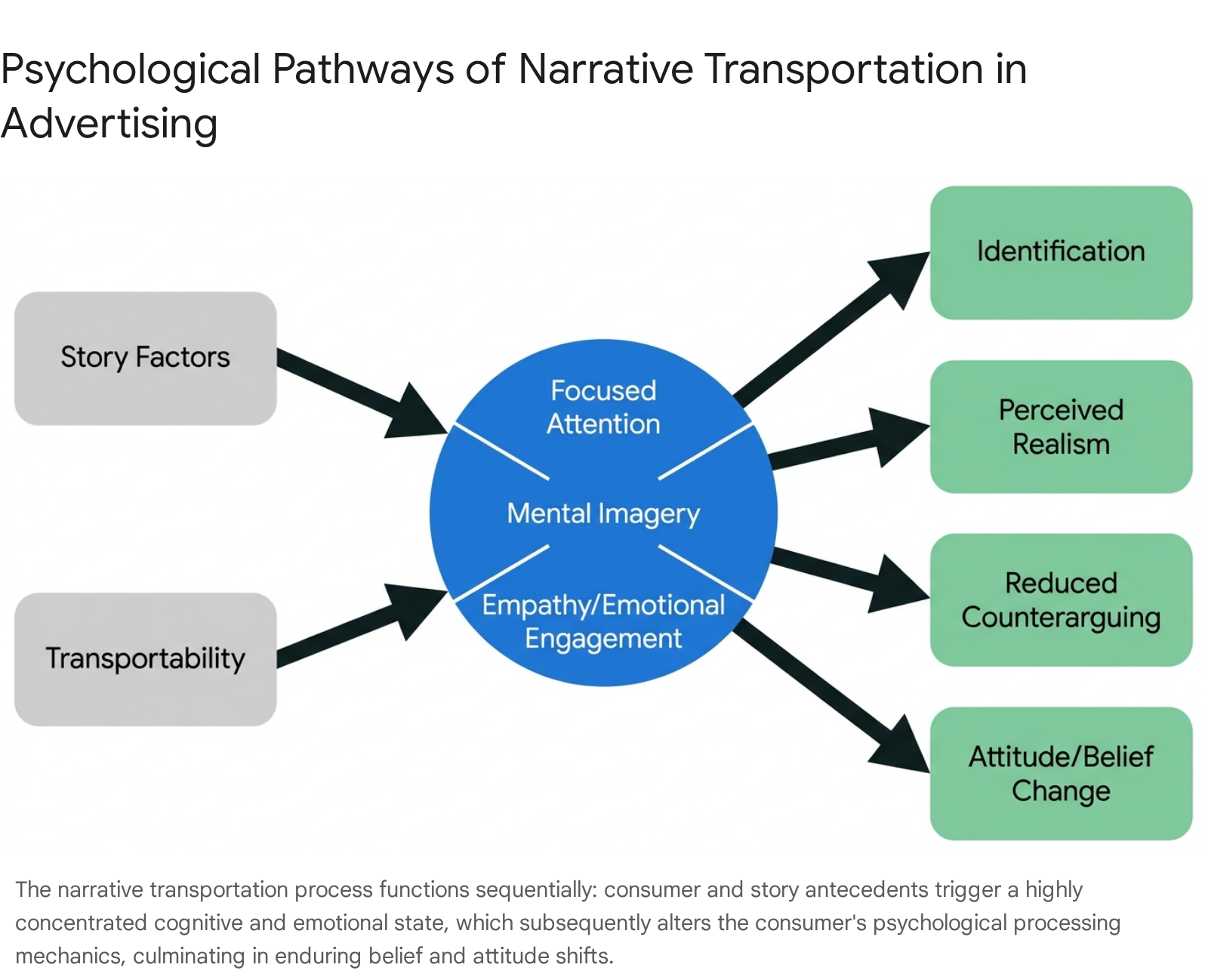
The transportation state itself represents a convergent mental process where all systems, including attention, emotion, and imagery, are singularly devoted to the unfolding story. The consumer filters out real-world stimuli and focuses entirely on the plot, leading to an intense concentration that severely limits the working memory available for external distractions. Simultaneously, consumers actively construct visual and spatial representations of the narrative world within their minds. High-quality narrative advertising utilizes vivid sensory language and visually rich cues to facilitate this mental simulation, making the story feel deeply experiential rather than merely observational. The affective dimension then requires the consumer to understand and share the feelings of the characters. Without this emotional engagement and empathy, a consumer may passively observe a story but will not be psychologically transported into it.
Once this tripartite transportation state is achieved, it alters how the consumer interacts with the brand message through several distinct catalytic pathways. The primary catalyst is character identification. Identification transcends mere emotional empathy; it occurs when a consumer temporarily adopts a character's specific goals, perspectives, and emotional state. When a consumer identifies with a protagonist in an advertisement who is utilizing a brand to solve a problem, the consumer internalizes that resolution, inextricably linking the brand to the consumer's temporary self-concept. Additionally, transported consumers evaluate the narrative based on its internal consistency and psychological realism, often referred to as verisimilitude. Even if an advertisement features fantastical elements or clear fictionalization, a coherent and emotionally true narrative exponentially increases the perceived believability of the underlying brand message.
The most critical pathway for advertising effectiveness within the ETIM framework is the suppression of analytical scrutiny. In standard persuasive communication, consumers automatically erect defensive cognitive barriers, generating counterarguments against marketing claims. Narrative transportation acts as a powerful cognitive distracter. Because the consumer's mental bandwidth is fully occupied with sustaining the narrative imagery and emotional tracking, the capacity for critical processing is severely diminished. Furthermore, because the persuasive message is seamlessly woven into the fabric of the story rather than presented as a direct mandate, consumers perceive a significantly lower intent to persuade, circumventing standard resistance mechanisms and paving the way for deep attitude and belief change.
Narrative versus Analytical Processing: Overriding the Elaboration Likelihood Model
The dichotomy between narrative transportation and traditional advertising processing is best understood by contrasting it with classical dual-processing theories, primarily the Elaboration Likelihood Model (ELM) developed by Petty and Cacioppo. Under the ELM framework, persuasion occurs via a central route, which involves deep analytical processing of facts and arguments, or a peripheral route, which involves reliance on superficial cues like source attractiveness, music, or basic heuristics 1. The central route requires both the motivation and the cognitive ability to process information. If a consumer is highly involved with a product category, they traditionally engage in analytical, central-route processing, rigorously scrutinizing the advertisement's functional claims 12.
Narrative transportation theory fundamentally disrupts this established paradigm. Empirical research demonstrates that when narrative transportation occurs, the motivation to process the message, which is the foundational antecedent of the ELM, no longer dictates the persuasive outcome 1. Transported consumers process the message deeply, expending remarkably high cognitive effort to build mental imagery and track plot lines, which mirrors the intense cognitive exertion of the central route. Yet, simultaneously, they exhibit the low counterarguing and high affective reliance typical of the peripheral route 1. Consequently, narrative advertising achieves a unique psychological synthesis: it demands high consumer engagement but entirely bypasses analytical skepticism 13.
An additional hallmark of narrative processing that separates it from standard analytical processing is the phenomenon known as the sleeper effect. While traditional analytical persuasion often degrades over time as the consumer forgets the specific arguments or the credibility of the source, the persuasive outcomes that result from narrative transportation are surprisingly long-lasting 1. In many instances, the persuasive effects of fictional narratives actually increase over time. As the specific details of the story fade, the emotional resonance and the internalized beliefs generated during the transportation state remain firmly embedded in the consumer's memory network, completely detached from the original advertising context 14.
However, the dominance of narrative processing is fragile under specific conditions. When perceived risk is exceptionally high, or if the consumer encounters overt manipulation warnings, the narrative spell breaks. The consumer abruptly shifts out of the story world and reverts to traditional analytical processing, evaluating the advertisement via the ELM's central route, which often leads to message rejection 1.
Moderating Variables: The Extended Transportation-Imagery Model
The likelihood and depth of narrative transportation are not uniform across all consumers or advertisements. A complex interplay of moderating variables dictates the ultimate success of a narrative campaign. The Extended Transportation-Imagery Model provides a systematic categorization of these variables, dividing them into storyteller antecedents, story-receiver antecedents, and medium characteristics.
Storyteller antecedents involve the architectural elements of the narrative itself. Factors such as literariness, denoting the stylistic and linguistic quality of the narrative, can enhance cognitive engagement and absorption 5. Furthermore, the trajectory of the plot is crucial. Narratives that feature dynamic emotional shifts, such as a protagonist moving from despair to joy, are generally more transporting than flat narratives, provided that the emotional shifts remain congruent with the audience's expectations and the brand's ultimate resolution 56. The presence of rich, context-based visual elements, as opposed to highly staged or posed corporate imagery, also significantly increases narrative transportation by enhancing perceived realism 3.
Story-receiver antecedents relate to the individual differences among consumers. Transportability acts as a primary individual moderator. Consumers with high transportability require fewer structural cues from the advertisement to lose themselves in the story. Similarly, a high baseline of trait empathy allows a consumer to connect with diverse protagonists more readily, facilitating the identification necessary for transportation 49. Prior knowledge and product involvement also moderate effects; empirical studies suggest narrative advertisements are particularly effective for consumers with lower prior experience in a product category, as the story provides a surrogate experiential framework that guides their understanding 1.
To systematically outline the components that influence narrative transportation, the following table presents the key antecedents categorized by their source within the communication dyad.
| Antecedent Category | Specific Variable | Mechanism of Action | Impact on Transportation |
|---|---|---|---|
| Storyteller (Brand) | Identifiable Characters | Allows the consumer to adopt the protagonist's goals and perspective. | High Positive |
| Storyteller (Brand) | Verisimilitude | Creates internal psychological realism and logical consistency. | High Positive |
| Storyteller (Brand) | Emotional Shifts | Dynamic plot arcs sustain focused attention and prevent habituation. | Moderate Positive |
| Story-Receiver (Consumer) | Transportability | An innate psychological trait enabling rapid narrative absorption. | High Positive |
| Story-Receiver (Consumer) | Trait Empathy | Facilitates rapid emotional connection with the advertisement's characters. | High Positive |
| Story-Receiver (Consumer) | Prior Knowledge | Lack of knowledge allows the narrative to serve as a primary educational heuristic. | Variable / Contextual |
The Modern Media Landscape (2023 - 2026): Formats and Frictions
As advertising mediums transition from traditional broadcast formats to algorithmically driven feeds and spatial computing ecosystems, the mechanics of narrative transportation are adapting to environments characterized by extreme brevity, interactivity, and technological mediation.
Short-Form Video: TikTok, Authenticity, and Algorithmic Flow
The proliferation of short-form video formats, spearheaded by TikTok, Instagram Reels, and YouTube Shorts, presents a unique challenge for marketers: achieving deep narrative transportation within highly compressed timeframes, often under 30 or even 15 seconds 5. In these rapid-fire environments, campaigns function less as bounded, linear arcs and more as adaptive or transmedia flows where consumers encounter fragmented story elements delivered sequentially by algorithms 5.
Recent empirical data from 2024 and 2025 indicates that polished, highly produced advertising narratives often fail dramatically in short-form environments due to sound-brand incongruity, over-editing, and a lack of perceived authenticity 1112. On platforms like TikTok, narrative transportation relies heavily on a "lo-fi" aesthetic and first-person point-of-view (POV) storytelling. Advertisements that intentionally strip away heavy overlays, overt brand logos, and aggressive promotional cues, relying instead on creator-driven, authentic tone and narrative pacing, vastly outperform traditional branded assets 1112. In short-form video, transportation is achieved through rapid cultural resonance and immediate character identification rather than extended, multi-act plot development.
The following table highlights specific performance metrics demonstrating the superiority of narrative, lo-fi aesthetics over traditional brand advertising on short-form video platforms in 2025.
| Metric / KPI | Finding for Lo-Fi / Narrative Content vs. Traditional | Implication for Transportation |
|---|---|---|
| Return on Investment (ROI) | +81% ROI for content omitting logos and heavy text overlays. | Overt branding breaks the narrative spell; subtlety sustains transportation. |
| Overall Channel Efficiency | Real ROI is measured at 10.7x higher than last-click attribution models suggest. | Narrative transportation causes delayed, enduring purchase intent beyond immediate clicks. |
| Brand Awareness | 2.6 median ROI for narrative-driven awareness campaigns. | POV storytelling successfully embeds the brand in the consumer's memory network. |
| Consideration & Conversion | 3.9 median ROI (Consideration); 3.1 median ROI (Conversion). | Deep engagement with authentic creator narratives directly influences mid-to-lower funnel actions. |
Augmented Reality (AR) vs. Virtual Reality (VR): The Telepresence Paradox
Immersive technologies like AR and VR physically surround the consumer, fundamentally altering the boundary between the viewer and the medium 131415. However, contemporary research reveals that AR and VR operate very differently regarding their capacity to facilitate narrative transportation.
Virtual reality offers extremely high immersion by completely replacing the physical environment, creating a profound sense of "telepresence," defined as the psychological feeling of actually "being there" in the virtual space 617. While VR can generate highly positive affective responses toward the overall technological experience, empirical findings from 2024 and 2025 reveal a critical paradox: enhanced telepresence can actually hinder narrative transportation and subsequent brand memory 617. In laboratory experiments comparing VR to low-immersion 360-degree video, the cognitive load required to navigate, orient, and process a fully immersive 360-degree virtual environment leaves significantly fewer cognitive resources available to follow the narrative voiceover and encode specific brand details 6. VR experiences can strengthen general, superficial attitudes toward a brand due to the sheer novelty of the experience, but they frequently fail to transport the user into a specific, persuasive story because the medium itself becomes a cognitive distraction 617.
Conversely, Augmented Reality overlays digital elements onto the physical world, demanding far less spatial navigational cognitive load than VR 1819. Research demonstrates that AR significantly enhances the vividness of the brand message without overwhelming the user's sensory processing, which in turn nurtures narrative transportation and a balanced sense of presence 1820. By allowing the consumer to remain physically grounded in their own reality while simultaneously interacting with the brand narrative, AR facilitates a highly effective synthesis of mental imagery and brand interaction. This seamless integration leads to improved social sharing, heightened brand recall, and increased purchase intentions compared to both static advertising and fully immersive VR 1920.
Cross-Cultural Variations in Narrative Advertising
Narrative transportation is deeply intertwined with cultural schemata. The specific manner in which a story is structured, decoded, and internalized depends heavily on the consumer's cultural background, specifically along the dimensions of high-context versus low-context communication and independent versus interdependent self-construal. Effective global marketing requires precise adaptation to these cultural paradigms 2122724.
High-Context versus Low-Context Storytelling
Anthropologist Edward T. Hall's framework of contexting remains a vital tool for cross-cultural narrative design 21228. In low-context cultures, such as the United States and Germany, communication is explicit, direct, and heavily reliant on the spoken or written word 212224. Narrative advertisements in these regions tend to feature clear, linear plots with overt brand resolutions. The storytelling is often highly individualistic, emphasizing a lone protagonist overcoming a specific challenge to achieve personal success, utilizing the functional product benefits to achieve this end 21910.
In contrast, high-context cultures, such as Japan, China, and various Middle Eastern nations, operate on the principle that meaning is deeply embedded in the situation, social hierarchies, non-verbal cues, and shared cultural understanding 21227. In these markets, explicit, hard-sell narratives that clearly spell out the brand's value proposition are often perceived as abrasive, insulting to the viewer's intelligence, or untrustworthy 2124. Effective narrative advertising in high-context cultures relies heavily on symbolism, metaphor, and visual aesthetics rather than direct dialogue 2111. The plot may be highly implicit, requiring the consumer to "read between the lines" to achieve narrative transportation, fostering a stronger emotional bond when the consumer successfully decodes the implicit message 21248.
Self-Construal and Character Identification
Cultural orientation also strictly dictates the mechanics of character identification. In highly individualistic societies, transportation is facilitated by an "independent self-construal," where the narrative appropriately focuses on internal attributes, personal agency, and self-actualization 91213. The consumer identifies with a hero standing apart from the crowd, making their own unique choices.
Conversely, in collectivistic societies, an "interdependent self-construal" prevails 12. Characters are defined almost entirely by their relationships to others and their harmonious integration into their surrounding environment 12. Transportation in these cultures is more effectively achieved through narratives emphasizing group harmony, social consensus, and complex relational dynamics 91314. A protagonist acting too independently or selfishly may actively alienate a collectivistic audience, completely preventing empathy and halting the transportation process 1114.
The following table summarizes the comparative cultural values and their impact on advertising appeals across three major global markets, highlighting the nuances required for effective narrative transportation.
| Cultural Dimension | United States | China | Japan | Impact on Narrative Transportation Design |
|---|---|---|---|---|
| Context Level (Hall) | Low-Context | High-Context | High-Context | US requires explicit linear plots; China/Japan require symbolic, implicit visual storytelling. |
| Self-Construal | Independent | Interdependent | Interdependent | US audiences identify with personal agency; China/Japan identify with social harmony and group success. |
| Uncertainty Avoidance | Low | Low to Moderate | Extremely High | Japanese narratives frequently require higher psychological realism and expert reassurance to alleviate risk anxiety. |
| Primary Advertising Appeal | Enjoyment, Individualism | Family, Tradition | Self-restraint, Status | Narratives must align with the primary cultural appeal to trigger empathy and bypass analytical scrutiny. |
Notably, recent longitudinal research tracking advertising appeals suggests a gradual, albeit slow, convergence toward Global Consumer Culture Positioning (GCCP) 13. Driven by the borderless nature of globalized digital platforms, modern campaigns frequently attempt to blend individualistic and collectivistic narrative elements, striving to transport diverse global audiences through universal emotional themes rather than strictly localized cultural archetypes 1315.
Backfire Effects: Persuasion Knowledge and the Vampire Effect
Despite its robust persuasive capabilities, narrative advertising is highly susceptible to severe backfire effects if the structural integrity of the story is compromised, if the ethical boundaries of disclosure are breached, or if the creative execution distracts from the brand.
The Persuasion Knowledge Model (PKM) and Disclosure Friction
The Persuasion Knowledge Model (PKM), pioneered by Friestad and Wright, posits that consumers develop complex cognitive schemas over time to identify and cope with marketing tactics 11617. When a consumer consciously recognizes that they are being manipulated by a brand, their persuasion knowledge is activated, instantly triggering skepticism, active counterarguing, and profound affective resistance 11617. Narrative transportation usually circumvents the PKM entirely by seamlessly hiding the persuasive intent within the engaging elements of the story 1. However, specific operational triggers can violently shatter narrative transportation and aggressively activate the PKM.
A primary trigger involves sponsorship disclosures. Regulatory requirements for native advertising and influencer marketing strictly mandate disclosures, such as "#Ad" or "Sponsored" 1635. Empirical studies reveal that explicit, highly prominent disclosures, or disclosures presented chronologically prior to the narrative content, act as powerful cognitive primers. They immediately activate persuasion knowledge before the consumer has any opportunity to become transported into the story, resulting in immediate critical processing, increased counterarguing, and lower overall brand attitudes 16363718. Conversely, disclosures that are placed after the story concludes or woven subtly into the content are far less disruptive to the psychological transportation process, allowing the persuasive effects to take hold before the consumer realizes the commercial intent 3618.
Another uniquely modern backfire effect occurs at the intersection of Artificial Intelligence and Cause-Related Marketing (CRM) 17. When an emotionally resonant CRM narrative discloses that it was generated by Artificial Intelligence rather than a human, it triggers a severe "value-instrumentality" conflict within the consumer 17. Consumers harboring high AI aversion perceive the use of automated machine generation for a moral or emotional cause as inherently deceptive and deeply manipulative. This specific disclosure violently activates the PKM, drastically increasing skepticism, destroying any narrative empathy established by the story, and severely depressing subsequent purchase intentions 17. Similarly, if the brand presence within the narrative is too heavy-handed or overt, the story feels less like an authentic narrative and more like a thinly veiled sales pitch. This perception of manipulative intent immediately terminates narrative transportation 1.
The Vampire Effect: Visual and Motoric Distractions
The "vampire effect" represents a critical failure in advertising execution. It occurs when a highly attention-grabbing element within an advertisement attracts so much cognitive focus that it literally "sucks the blood" out of the core brand message 1940204221. The consumer fondly remembers the highly entertaining element of the story but completely forgets the product or the brand that sponsored it 1940.
Traditionally, the visual vampire effect has been strongly associated with the use of celebrity endorsements and highly humorous narrative scenarios 19202122. Extensive eye-tracking studies demonstrate that when an unrelated celebrity is featured in an advertisement, viewers fixate almost entirely on the celebrity's face, significantly delaying and dramatically reducing visual attention to the product and the brand logo 4221. Similarly, highly humorous narratives can completely dominate cognitive processing. While the humor ensures the consumer pays attention to the advertisement, it creates a cognitive bottleneck, leading to high ad recall but abysmal product and brand recall, a phenomenon exacerbated when the consumer has low involvement with the product category 194023. To counteract the visual vampire effect, marketers must ensure high semantic congruence between the celebrity and the brand narrative 204222. Furthermore, eye-tracking research indicates that establishing direct physical contact between the endorser and the product within the visual frame naturally guides the consumer's gaze from the attention-grabbing face back to the brand, successfully mitigating the recall loss 21.
Recent empirical research from 2024 and 2026 has identified a novel manifestation of this phenomenon specific to mobile advertising: the motoric vampire effect 422425. Social media platforms inherently require physical interaction, such as swiping or tapping. Drawing on embodied cognition theory, researchers discovered that when consumers use "atypical swiping" gestures - movements that are unusual or less automated than standard vertical scrolling - to interact with an ad format, their visual attention to the advertisement actually increases 4225. However, contrary to standard attention-recall paradigms where more attention equates to better memory, this increased attention results in significantly decreased brand recall 4225. The atypical motor action requires conscious cognitive resources to execute safely and accurately. Consequently, the consumer's limited processing capacity is diverted away from encoding the narrative and the brand name, and redirected entirely toward managing the physical interaction with the smartphone 422548. To mitigate this motoric vampire effect, brands must design mobile narratives that align smoothly with typical, highly automated user interactions. If atypical gestures are utilized to grab attention, they must be semantically linked to the brand - such as prompting the user to physically trace the shape of the brand logo on the screen - to align the motor action directly with brand encoding mechanisms 49.
The Future of Narrative Transportation: An Integrated Agenda
The foundational theories of narrative transportation have historically treated the consumer, the storyteller (the brand), and the medium as distinct, separate entities within the communication process 1. However, the next iteration of narrative transportation research, as proposed by emerging conceptual models in 2024 and 2025, recognizes that modern technology is rapidly collapsing these traditional boundaries 1.
Future applications of narrative transportation will increasingly involve co-created stories, where the narrative structure is not rigidly determined by the marketer from the top down, but dynamically morphs based on continuous consumer interaction 16. In digital ecosystems like the metaverse or complex shared augmented reality environments, the consumer shifts from being a passive recipient of a story to an active character and a co-storyteller, actively influencing the plot's direction 16.
Furthermore, the medium itself is evolving into an extension of the consumer's physical body via wearable technology, virtual avatars, and advanced haptic feedback systems 150. This level of sensory embodiment will likely deepen the transportation state to unprecedented levels, but it also raises profound questions regarding the limits of persuasion. As the narrative world and the physical world continue to blur, future academic research must rigorously investigate how consumers manage their sense of autonomy within these integrated systems, how physical well-being is impacted by deep, prolonged transportive states, and the severe ethical implications of utilizing highly personalized, AI-driven narrative persuasion at scale 15.