
What Happens in Your Brain Throughout the Night
Far from powering down, your brain becomes fiercely active the moment you fall asleep, cycling through highly orchestrated stages of cellular repair, toxic waste clearance, and memory consolidation. Minute by minute, specialized neural circuits act as a biological washing machine while simultaneously running complex virtual reality simulations to test waking behaviors. Understanding this dynamic process reveals that the architecture of your sleep cycle - and how effectively your brain transitions between its phases - dictates your cognitive health far more than the total number of hours you spend in bed.
The Myth of the 90-Minute Sleep Cycle
For decades, popular health advice has dictated that human sleep is organized into neat, uninterrupted 90-minute blocks. This figure is frequently cited by sleep calculators and smart alarm companies, promising that if you time your wake-up to the exact end of a 90-minute cycle, you will bypass grogginess and wake up completely refreshed 123. However, modern neuroscientific data reveals that this rigid 90-minute rule is a statistical average, not a biological absolute.
When researchers measure electrical brain activity using an electroencephalogram (EEG), they observe a structured progression through two main types of sleep: non-rapid eye movement (NREM) sleep and rapid eye movement (REM) sleep 12. While the average duration of a full cycle across a massive population hovers around 90 minutes, individual cycles actually range anywhere from 70 to 120 minutes 123.
Furthermore, cycle lengths are highly variable within the exact same person on the exact same night 2. The first cycle of the night might last 70 to 100 minutes, heavily dominated by deep sleep, while subsequent cycles typically lengthen and become dominated by REM sleep 6.
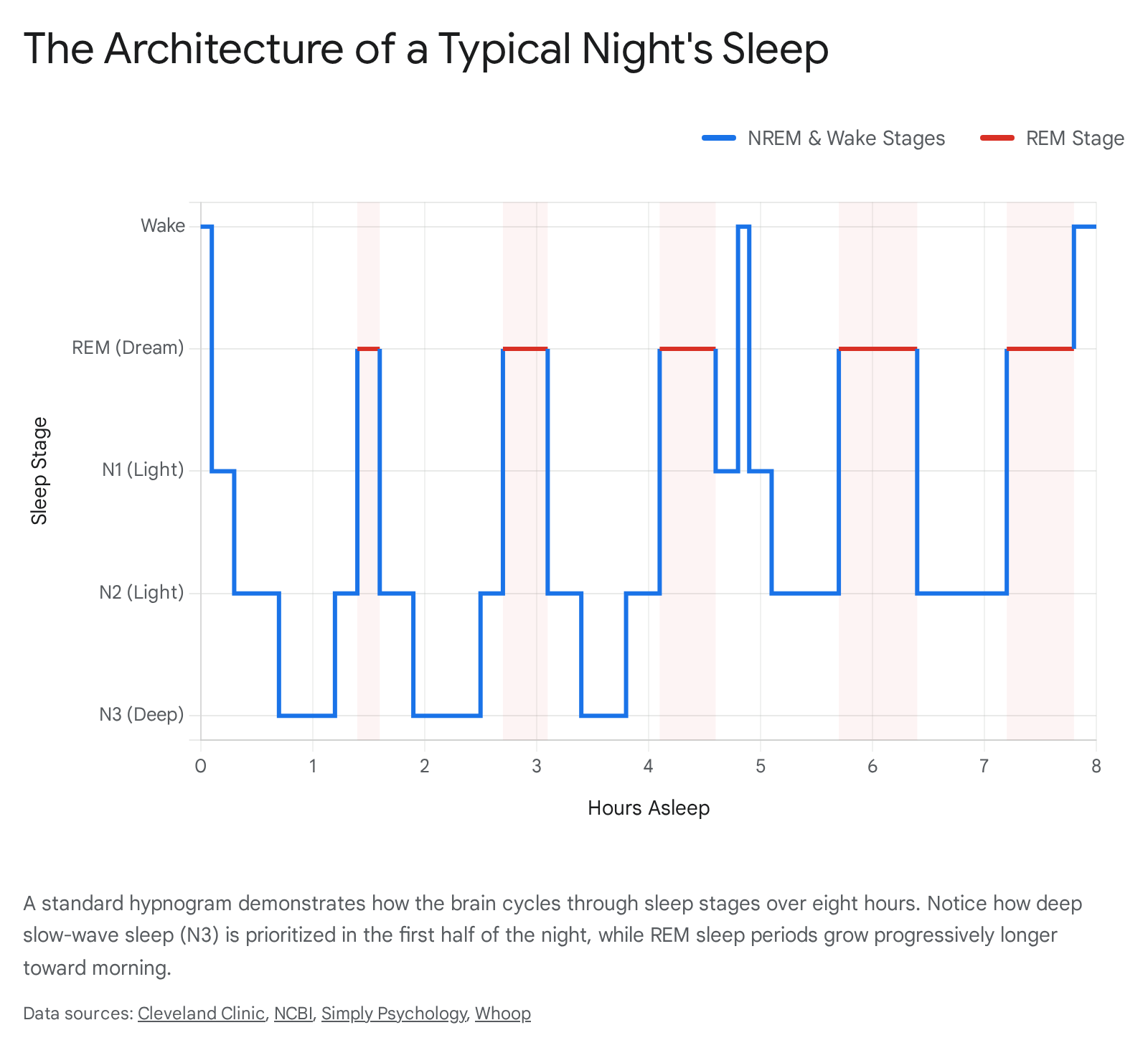
Age, recent sleep deprivation, temperature, and even alcohol consumption dynamically alter the length and composition of these loops 1. For instance, newborns experience much shorter sleep cycles ranging from 50 to 60 minutes, which gradually lengthen as the brain matures through childhood, stabilizing in the late teens 13.
Because of this immense nightly variability, consumer sleep tracking wearables (such as Oura, Whoop, and Apple Watch) frequently struggle to accurately map your exact sleep architecture. Clinical evaluations comparing top-tier consumer wearables against gold-standard laboratory polysomnography reveal that while devices are highly accurate at measuring total sleep time (usually within 15 to 30 minutes of clinical tools), their ability to accurately identify exact sleep stages is significantly compromised 8. The mean absolute error for tracking the percentage of the night spent in REM sleep ranges from 8 to 14 percentage points across major devices 8. Therefore, relying on an app to wake you up at the precise end of a "90-minute cycle" is largely based on flawed algorithmic assumptions rather than your real-time neurology 2.
To understand what actually occurs inside the brain as it navigates these complex oscillations, it is necessary to examine the process minute by minute, tracking the specific electrical signatures, neurochemical shifts, and physiological alterations that define each distinct stage of sleep.
Overview of Sleep Architecture
| Sleep Stage | Clinical Designation | % of Total Night | Dominant Brain Waves | Core Neurological Function |
|---|---|---|---|---|
| Stage 1 (Lightest) | NREM 1 (N1) | ~5% | Alpha & Theta (4 - 13 Hz) | Transitioning state; associated with sudden bursts of creative insight. |
| Stage 2 (Light) | NREM 2 (N2) | ~45-50% | Theta with Spindles (12 - 15 Hz) | Motor memory consolidation; filtering external sensory input. |
| Stage 3 (Deep) | NREM 3 (N3 / SWS) | ~20-25% | Delta (0.5 - 4 Hz) | Physical restoration; cellular waste clearance; synaptic resetting. |
| REM | Rapid Eye Movement | ~20-25% | Beta & Gamma (13 - 50 Hz) | Emotional processing; complex narrative dreaming; internal model testing. |
Data synthesized from clinical EEG sleep classifications 1451112.
Minute by Minute: Mapping Brain Activity During Sleep
Drifting Off: Stage N1 and the Creative Sweet Spot
When you first close your eyes and begin to relax, you enter N1 (Non-REM Stage 1). This is the lightest stage of sleep, serving as a transitional doorway between full wakefulness and true slumber. For a healthy adult, this initial descent typically lasts only one to ten minutes 1413.
During this brief window, your biological systems begin to power down. Your heartbeat and breathing rates slow, and your core body temperature begins to incrementally drop 213. Your muscles relax, which occasionally results in sudden, involuntary twitches known as hypnic jerks - a phenomenon where the brain misinterprets the sudden drop in muscle tone as a physical fall 14. On an EEG monitor, the high-frequency beta and gamma waves of an active, engaged brain begin to dissolve. They are gradually replaced first by highly synchronized alpha waves (8 - 13 Hz), which signal deep relaxation, and then by slower theta waves (4 - 7 Hz) 211.
Historically, sleep medicine viewed N1 merely as a mundane transitional phase with little clinical utility. However, a wave of recent neuroscientific research has revealed that this brief window - often referred to clinically as hypnagogia or the "twilight zone" - is a highly fertile breeding ground for problem-solving and creativity.
A landmark 2021 study by researchers at the Paris Brain Institute demonstrated that spending just 15 seconds in the N1 stage more than tripled a person's chances of solving a complex mathematical puzzle using a hidden rule, compared to individuals who simply rested while remaining completely awake 141516. The researchers noted an 83% success rate for subjects who hit this N1 "sweet spot," compared to a 30% success rate for the wakeful control group 1416. Strikingly, if participants drifted past N1 and into the deeper N2 stage, this creative spark entirely vanished 1516.
This phenomenon provides a neurological explanation for the famous habits of historical figures like inventor Thomas Edison and artist Salvador Dali. Edison famously napped while holding a metal ball; as he drifted past N1 and his muscles fully relaxed, the ball would drop to the floor, waking him up instantly so he could record the creative flashes that occurred in that twilight state 156.
Building on this in 2023, researchers at MIT and Harvard Medical School demonstrated that this creative boost can be actively directed. By prompting subjects to dream about a specific topic precisely during the N1 sleep-onset phase - a protocol the researchers termed "targeted dream incubation" - participants generated significantly more creative storytelling responses regarding that topic upon waking 6. During N1, the brain appears uniquely positioned to make wide-ranging, unconventional connections between disparate concepts, unshackled from the rigid logic of waking consciousness 6.
Disconnecting from the World: Stage N2
If you pass through the N1 twilight zone undisturbed, you seamlessly enter N2. This is the "workhorse" stage of sleep; an average healthy adult will spend approximately 45% to 50% of their entire night in N2 145. By the time you reach this stage, your eye movements have completely ceased, and your body temperature continues its downward trajectory 14.
While theta waves still dominate the background EEG in N2, the brain is far from quiet. The defining characteristics of this stage are sudden, powerful micro-events known as "sleep spindles" and "K-complexes" 218. Sleep spindles are rapid trains of high-frequency electrical waves (typically 12 - 15 Hz) that last for only one to two seconds 1118. A K-complex is a massive, biphasic wave that violently spikes out of the background rhythm 218.
These electrical phenomena serve two vital, distinct purposes. First, they act as a neurological shield. The thalamus, which acts as the brain's sensory relay station, uses these bursts of activity to actively block external sensory information from reaching the cortex 519. This sensory gating prevents you from waking up due to minor environmental shifts, such as a dog barking down the street or a partner shifting in bed.
Second, sleep spindles act as precision memory couriers. Research continuously highlights the fundamental role of sleep spindles in stabilizing and integrating new memories - particularly procedural and motor memories 207. Whether you spent the day practicing a new piano piece, learning a tennis swing, or navigating a new software interface, sleep spindles facilitate the offline processing of those skills.
A 2025 study published in The Journal of Neuroscience by researchers at Massachusetts General Hospital and Harvard Medical School provided fascinating new details on this process. They discovered that sleep spindles are not random, brain-wide events. Instead, they specifically target and concentrate in the exact cortical areas of the brain that were utilized during the day's learning task 22. Spindles occurring in execution-related motor areas help stabilize the physical memory trace, while spindles in the brain's planning areas refine and automate the skill 22. As you sleep, these targeted electrical bursts essentially "lock in" new skills, allowing for the refinement of movements without conscious practice.
The Deepest Dive: Stage N3 (Slow-Wave Sleep)
Roughly 20 to 30 minutes after falling asleep, you descend into N3, also known clinically as slow-wave sleep (SWS) or deep sleep 14. This stage constitutes about 20% to 25% of adult sleep and is heavily prioritized by the brain; the vast majority of your deep sleep occurs in the first third of the night, regardless of when you actually go to bed 1198.
Physiologically, your body reaches its lowest baseline of the 24-hour cycle. Heart rate, respiration, blood pressure, and overall metabolism drop to their absolute minimums 3910. The EEG trace looks drastically different here compared to lighter stages: the rapid, chaotic waves of wakefulness are replaced by massive, synchronized, high-amplitude "delta waves" (0.5 - 4 Hz) 411. During N3, millions of cortical neurons are firing in absolute synchronicity, creating vast electrical swells that roll across the brain 1011.
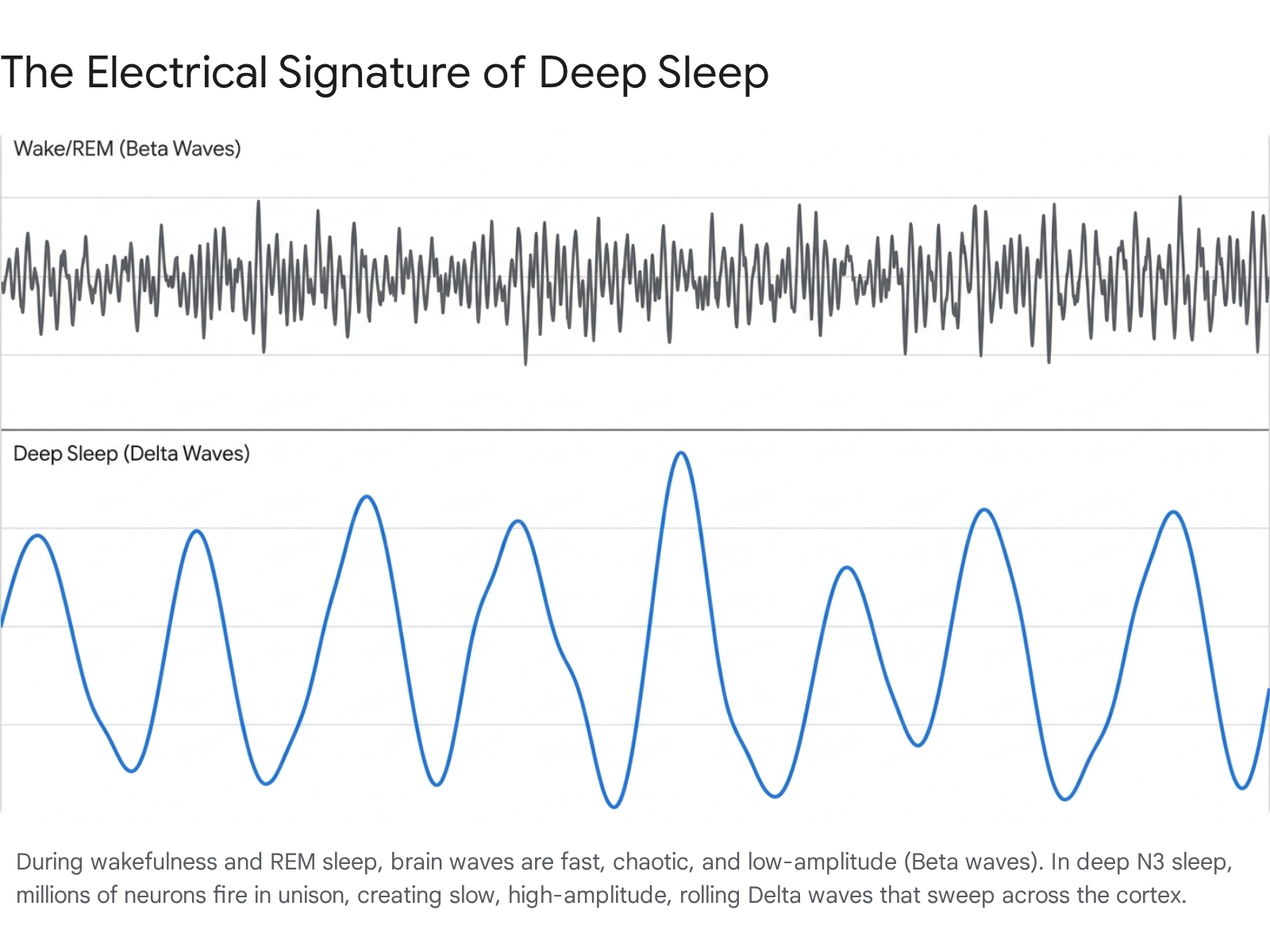
It is incredibly difficult to wake someone from an N3 state. If you are roused during this deep delta-wave rhythm, you will likely suffer from severe "sleep inertia" - a highly disorienting grogginess and cognitive impairment that can last anywhere from 15 to 60 minutes 127.
N3 is the ultimate physical and neurological restoration phase. The body secretes peak levels of human growth hormone to repair muscle tissue, heal injuries, and reinforce the immune system 1412. However, inside the skull, deeply complex biological events are occurring: the physical washing of brain tissue, and the resetting of trillions of synaptic connections.
The Biological Washing Machine: How the Brain Cleans Itself
The human brain is a remarkably energy-intensive organ. Despite making up only about 2% of total body weight, it consumes nearly 20% of the body's energy. This intense metabolic activity generates a significant amount of cellular waste, including amyloid-beta and tau - the very proteins whose abnormal accumulation is heavily associated with Alzheimer's disease and other forms of dementia 1229. The rest of the human body utilizes the lymphatic system to clear out waste, but the brain does not have conventional lymphatic vessels reaching deep into its tissue. How, then, does it avoid drowning in its own metabolic trash?
The Glymphatic System Hypothesis
More than a decade ago, researchers pioneered the concept of the "glymphatic system" 3013. According to this model, the brain possesses a highly specialized plumbing network consisting of perivascular spaces - fluid-filled channels that run alongside the brain's arteries and veins 12.
In a landmark 2024 study, researchers at Oregon Health & Science University (OHSU) provided the first definitive imaging of this system operating in living humans 12. By safely injecting a gadolinium-based inert contrast agent into the cerebrospinal fluid (CSF) of neurosurgery patients via a lumbar drain, the researchers utilized specialized T2/FLAIR MRI scans at 12, 24, and 48 hours to track the fluid's movement 1214. They observed the dye moving explicitly through these distinct perivascular channels, proving that fluid does not just randomly diffuse into the brain like a sponge, but rather follows a highly organized anatomical pathway to flush the parenchyma 1214.
Glymphatic theory dictates that this system is heavily dependent on sleep. The hypothesis posits that during deep N3 slow-wave sleep, glial cells in the brain shrink, widening the interstitial space between neurons by up to 60%. This physical expansion theoretically allows cerebrospinal fluid to rush in via convective flow, actively washing away the day's accumulation of amyloid-beta and other toxic metabolites, carrying them out toward the veins exiting the brain 12133315.
The Great Brain Clearance Controversy
While the glymphatic model has revolutionized the way we think about sleep and neurodegeneration, it has recently become the center of one of the fiercest controversies in modern neuroscience.
In early 2024, a major study published in Nature Neuroscience by a team from the UK Dementia Research Institute at Imperial College London directly challenged the core mechanics of the glymphatic hypothesis 1335. Using an advanced technique involving fluorescent dyes directly injected into mouse brain tissue, the researchers tracked how quickly molecules moved through the brain across different states of arousal 3536.
Their findings were highly unexpected: they reported that brain clearance actually slowed down during sleep and anesthesia compared to wakefulness 133536. The Imperial College team observed that clearance rates were roughly 30% lower in sleeping mice and 50% lower in anesthetized mice compared to when they were awake 13. Furthermore, they argued that waste movement is driven by passive diffusion - molecules naturally spreading from areas of high concentration to low concentration - rather than the active, sleep-driven "convective pumping" mechanism proposed by the glymphatic model 36.
This study ignited immediate pushback from leading proponents of the glymphatic system. Critics, including Dr. Maiken Nedergaard (who originally pioneered the glymphatic theory), argued that the Imperial College team's methodology was fundamentally flawed 1335. Specifically, injecting dyes directly into delicate brain tissue damages the local parenchyma, disrupts natural fluid dynamics, and artificially elevates intracranial pressure, completely altering how the brain behaves 133536.
While researchers intensely debate the precise fluid mechanics - convection versus diffusion, and exactly when the peak flow occurs - the overarching clinical consensus remains remarkably stable: chronic sleep deprivation undeniably impairs the brain's ability to clear toxic proteins over the long term, acting as a major risk factor for cognitive decline 293738.
Memory Consolidation and Synaptic Resetting
While cerebrospinal fluid manages the brain's physical waste, a parallel biological mechanism must manage the brain's informational capacity.
Throughout the waking day, learning and experiencing new things causes synapses (the connections between neurons) to grow stronger, a process known as long-term potentiation. However, the brain has a finite amount of space and energy. If synapses continually grew stronger without any regulatory mechanism, the brain would quickly become metabolically overloaded, running out of cellular resources and physical real estate to store new memories 391617.
Sleep solves this problem through two highly sophisticated mechanisms: synaptic scaling and targeted regional resetting.
Synaptic Homeostasis and Scaling
The "Synaptic Homeostasis Hypothesis" (SHY) proposes that sleep serves as a mechanism to proportionally scale down the strength of synaptic connections across the entire brain 1718.
Think of waking life as turning up the volume on hundreds of different audio frequencies. To prevent the speakers from blowing out, sleep acts as a master volume knob, turning the overall volume down while maintaining the relative differences between the frequencies 1719. The strong connections you formed that day (the important memories) remain relatively strong compared to the weak connections (irrelevant background details), which are scaled down so far that they vanish entirely 1719.
Recent 2024 computational and live-cell microscopy research reveals that this homeostatic scaling is primarily driven by changes in intracellular calcium concentrations and the regulation of specific AMPA and NMDA neurotransmitter receptors 1744. By globally down-scaling synaptic weights during N3 slow-wave sleep, the brain restores cellular homeostasis, frees up physical space, and primes the neural network to encode new information the next day 1844.
The Cornell Study: How CA2 Resets the System
We now know exactly which part of the brain acts as the architect of this daily reset. The hippocampus is the brain's primary memory processing center, responsible for transferring short-term daytime experiences into long-term storage in the cortex 1645. Anatomically, the hippocampus is divided into three distinct subregions: CA1, CA2, and CA3 1646.
For years, neuroscientists knew that CA1 and CA3 were the active players in encoding memories 39. During N3 sleep, neurons in CA1 and CA3 rapidly replay the exact firing patterns they experienced during the day - a process orchestrated by brief, high-frequency bursts called sharp-wave ripples (SWRs) - to consolidate memories 1646.
However, a groundbreaking August 2024 study from Cornell University, published in Science, finally uncovered the vital role of the enigmatic middle region: CA2 3920.
Using advanced electrode implants and optogenetics in mice, the Cornell researchers discovered that deep sleep features a secondary phenomenon entirely separate from memory replay. They identified a new type of brain event generated by CA2 called a "BARR" (barrage of action potentials) 46. When CA2 triggers a BARR event, it actively silences the highly active neurons in the CA1 and CA3 regions 3946.
This sudden, targeted neurological blackout forces the specific synapses that were heavily utilized during the day to reset to their baseline state 4620. Crucially, the researchers found that the neurons most active in learning were the exact ones targeted for silencing 46. This elegant "reset" mechanism provides the ultimate solution to memory overload, ensuring that the brain can safely recycle the same neuronal resources for new learning the very next morning without catastrophically overwriting vital data 391646.
Rapid Eye Movement: The Dream State
After spending considerable time in the profound depths of N3 deep sleep, the brain cycles back up through the lighter stages. Roughly 90 minutes after you first close your eyes, you enter Rapid Eye Movement (REM) sleep 199.
REM sleep presents a profound biological paradox. If a physician were to look solely at the EEG readout of a person in REM, they would assume the patient was wide awake 1510. The massive, slow delta waves of deep sleep entirely vanish, replaced by high-frequency, mixed-voltage beta and gamma waves that signify intense, active cognitive processing 3511.
Your physiological state drastically shifts: your breathing becomes rapid and irregular, and your heart rate and blood pressure elevate to near-waking levels 199. Most notably, your eyes dart aggressively side to side beneath your closed eyelids 199. Yet, despite this massive internal storm of brain activity, your physical body is entirely paralyzed 3419. The brainstem essentially cuts the connection to your spinal motor neurons, inducing a state of temporary muscular paralysis called atonia 3448. This evolutionary safety mechanism is critical; without it, you would physically act out the intense scenarios playing in your mind, risking severe injury 4198.
The Function of REM: Why Do We Dream?
While dreaming can occur during NREM sleep stages, those experiences are typically mundane, static, and fragmented 4950. REM sleep is the exclusive domain of highly immersive, narrative-driven, bizarre, and emotionally charged dreams 495051. Research analyzing dream reports immediately upon waking reveals that REM dreams are consistently longer, more vivid, and vastly more kinesthetically engaging than anything produced during lighter sleep 50.
The ultimate evolutionary purpose behind this intense nightly hallucination remains heavily debated. Why does the brain expend so much energy generating vivid virtual realities? Two dominant theories are currently driving research in the field:
-
Testing the Brain's "Internal Model" of the World: A fascinating 2026 study led by researchers at the Howard Hughes Medical Institute (HHMI) proposed that REM sleep is the brain's mechanism for safely testing its internal models 21. The brain constantly builds mental representations of how the physical world works to predict the consequences of our actions.
By examining the superior colliculus (the brain's motor center responsible for head movements), researchers discovered that during REM sleep, the brain actively issues real, directional motor commands 21. Even though the animal's physical muscles are paralyzed by atonia, the brain's "internal compass" neurons (ADn neurons) respond to these commands exactly as if the head had physically turned in the physical world 21. The dreaming brain is effectively generating a closed-loop virtual reality simulation, safely executing motor commands and observing the neurological feedback to fine-tune its internal models for waking survival 21.
-
Segregating and De-cluttering Memories: While NREM sleep primarily serves to strengthen new memory traces, REM sleep appears necessary to edit them. Computational biologists from the University of Michigan theorize that REM sleep prevents a phenomenon called "catastrophic forgetting" - a scenario where overlapping, similar memories overwrite each other 53.
This process is heavily regulated by acetylcholine, a critical neurotransmitter. During NREM deep sleep, acetylcholine levels drop, allowing broad networks of neurons to fire together and encode new memories 53. When the brain shifts into REM, acetylcholine levels spike dramatically 53. This neurochemical shift suppresses broad firing and forces the brain to isolate highly specific details, keeping intertwined memories distinct and segregated so you can recall similar events without them blurring into a single, confusing narrative 53.
As the night progresses, the time spent in N3 deep sleep gradually diminishes, and REM sleep periods become progressively longer. Your first REM cycle of the night may last only 10 minutes, but your final REM cycle before waking can stretch up to an entire hour 159.
The Flip-Flop Switch: How the Brain Transitions
You do not gradually slide back and forth between sleep and wakefulness; the transition is remarkably sharp. From a neurological standpoint, you are either awake, or you are asleep. Neuroscience explains this abrupt, binary transition through a mechanism known as the "flip-flop switch" 2255.
Deep within the brain's hypothalamus lies a cluster of neurons called the ventrolateral preoptic nucleus (VLPO). This is your brain's primary sleep-promoting center. When active, the VLPO releases potent inhibitory neurotransmitters, primarily GABA (gamma-aminobutyric acid) and galanin, to induce drowsiness 5556.
Opposing the VLPO are the brain's waking centers, primarily the monoaminergic nuclei, which pump out arousal chemicals like noradrenaline, serotonin, and histamine to keep you alert 2255.
The elegance of this system lies in mutual inhibition. When you are awake, the arousal centers actively bombard the VLPO to keep it shut off. However, as sleep pressure builds throughout the day, the VLPO gains strength until it eventually overpowers the arousal centers, flooding them with GABA and instantly shutting them down 2255. Because these two opposing systems actively inhibit one another, they operate exactly like an electronic flip-flop circuit: when one side turns on, it forces the other side to completely turn off 225556. This prevents the brain from getting stuck in dangerous, vulnerable transition states.
To keep this biological switch from violently flickering back and forth between wakefulness and sleep throughout the day, the brain relies on a stabilizing neurotransmitter called orexin (also known as hypocretin) 2255. Produced in the lateral hypothalamus, orexin acts like a heavy thumb on the scale, strongly reinforcing the wakefulness side of the switch during the day 225523.
When the neurons that produce orexin die off or malfunction, the flip-flop switch becomes wildly unstable. This instability results in the neurological disorder narcolepsy, where individuals can crash from full wakefulness directly into sleep, or experience sudden attacks of REM atonia (cataplexy) while wide awake, entirely bypassing the normal staging sequence 2223.
Re-evaluating the Eight-Hour Rule
A cornerstone of modern public health advice is the mandate to get a strict eight hours of sleep every night. However, an emerging body of anthropological and cross-cultural research strongly suggests that this metric may be more of a modern cultural construct than a universal biological imperative.
Lessons from Hunter-Gatherer Sleep
To understand human sleep in its most unadulterated state, sleep scientists have tracked the specific habits of three surviving pre-industrial hunter-gatherer societies: the Hadza of Tanzania, the San of Namibia, and the Tsimane of Bolivia 582460. Living entirely without electricity, artificial lighting, or digital screens, these populations exhibit sleep patterns that challenge modern industrialized assumptions.
Using actigraphy devices to measure precise sleep and wake times, researchers found that these pre-industrial populations do not sleep eight or nine hours. On average, members of these tribes sleep only 5.7 to 7.1 hours per night 586025.
Furthermore, they completely dispel the myth that ancient humans went to sleep as soon as the sun went down. Instead, they typically remain awake for roughly three and a half hours after sunset, socializing around fires 582425. Their sleep onset is heavily dictated by environmental temperature rather than ambient light; they reliably fall asleep as the ambient temperature drops and consistently wake up just before dawn when the temperature hits its absolute lowest point 246025. Despite sleeping durations that would be classified as "insufficient" by Western medical standards, these populations rarely take daytime naps and show almost nonexistent rates of insomnia (the languages of these groups do not even contain a word for the condition) 5860.
Cultural Differences in Optimal Sleep
This immense variability is not isolated to pre-industrial tribes. A massive 2025 study led by researchers at the University of British Columbia (UBC) analyzed sleep data and health outcomes from nearly 5,000 people across 20 different countries spanning North America, Europe, Asia, Africa, and South America 626364.
The UBC study revealed that average sleep durations vary drastically across the industrialized world. For example, the average sleep duration in Japan was just 6 hours and 18 minutes, while individuals in France averaged nearly 8 hours (7 hours and 52 minutes) 642627.
Crucially, the researchers found absolutely no evidence that countries with shorter average sleep durations suffered from worse population-level health outcomes 6263. Instead, optimal health followed a "cultural fit" model. The study demonstrated a quadratic relationship between sleep duration and health, but the "turning point" for optimal health shifted depending on the region 6226. Individuals whose total sleep duration closely matched the established norms of their specific culture reported the best overall health, regardless of whether that cultural norm was 6.5 hours or 8 hours 636426.
These findings suggest that human sleep requirements are highly flexible and heavily shaped by social and cultural contexts 6326. While chronic, extreme sleep deprivation is undeniably toxic to the brain - halting waste clearance, impairing memory consolidation, and driving neuroinflammation - stressing over hitting an arbitrary, universal 8-hour target may actually induce "sleep anxiety" 67. This hyper-fixation on perfect sleep duration, sometimes referred to clinically as orthosomnia, can elevate cortisol levels and paradoxically degrade the actual neurological quality of the rest you do get 3767.
Bottom line
Sleep is not a passive state of rest, but an aggressive, highly orchestrated biological maintenance routine. Minute by minute, your brain cycles through lighter stages that foster rapid creative connections, deep stages that scale down synapses and wash away toxic metabolites, and REM stages that rigorously test the mind's internal models. While the exact mechanics of fluid clearance and the ultimate origins of dreaming remain the subject of fierce scientific debate, one fact is absolute: the internal architecture of your sleep cycle is one of the most critical factors dictating your long-term cognitive health.